Best Social Listening Tools for Bluesky in 2026: 16 Tools Compared by Features & Pricing
A first-party documentation audit of 16 Bluesky social listening tools, ranked on verifiable integrations, pricing and collection schedules - with every unmeasured coverage claim flagged.


Quick answer: The best Bluesky social listening tools depend on your budget and monitoring needs. ForumScout is the lowest-priced option reviewed, Octolens is best suited to automated workflows, and BrandMentions is the best fit for reputation monitoring across Bluesky, all important social platforms, news and the web.
- Lowest-priced paid option reviewed: ForumScout, at $19/month with six-hour checks.
- Best for mentions wired into workflows: Octolens, at $159/month billed annually.
- Best for Bluesky brand monitoring: BrandMentions, from $99/month billed quarterly.
Credentials and methodology: We reviewed official documentation for 16 social listening tools with published Bluesky support, including vendor pricing pages, help centers, API references and release notes. We also consulted the AT Protocol and Bluesky API specifications. All sources were checked on November 4, 2026.
What Is Bluesky Social Listening?
Bluesky social listening is the automated capture of public Bluesky posts and replies containing a keyword (a brand, competitor, product or phrase) whether or not the author tagged your account, delivered as alerts or a searchable archive. That last clause is the whole purchase: native notifications already tell you who tagged you, so a listening tool only earns its price by finding the mention that never mentioned you. It is distinct from Bluesky analytics or scheduling tools, which report on your own account's posts rather than searching the network for strangers talking about you.
Which Social Listening Tools Actually Monitor Bluesky?
Sixteen products have first-party documentation or official announcements confirming Bluesky support, and they disclose wildly different amounts about how they get the data. The order reflects our editorial assessment of use-case fit based on published documentation.
| # | Tool | Best for | Documented method detail | Entry price | Trial |
|---|---|---|---|---|---|
| 1 | BrandMentions | Brand & reputation monitoring | Posts and conversations alongside social, web, news, forums | $99/mo billed quarterly | Trial |
| 2 | ForumScout | Budget monitoring | Scheduled keyword checks, schedule by tier (6h → hourly) | $19/mo | 7 days (Pro) |
| 3 | Octolens | Automated workflows | Posts and comments; per-minute in source guide, hourly refresh on Pro | $159/mo billed annually | 7 days |
| 4 | Mentionlytics | Reputation reporting | Public posts and reposts, no Bluesky authorisation | $49/mo annual offer | 14 days |
| 5 | Syften | Precise alerts | Live posts and replies, type:post/type:comment operators; no replyto: | $29.95/mo | 14 days (PRO) |
| 6 | Buska | Sales qualification | Scheduled scans, schedule by tier; firehose claimed on its Bluesky page | $49/mo | 7 days |
| 7 | Mentionkit | Flat-price small teams | Keyword and exact-phrase monitoring, auto-tagging; schedule not published | $49/mo | 14 days |
| 8 | Brandwatch | Consumer research | Firehose, posts + replies, with sentiment, emotion and engagement metadata | Pricing on request | Scoped evaluation |
| 9 | Sprinklr | Enterprise operations | Official API; posts, reposts, replies, mentions; 1 - 3 minute source latency | Pricing on request | Demo |
| 10 | Hootsuite/Talkwalker | Enterprise intelligence | Firehose via Lumen; posts, replies, shares, quote posts, no connection | Package pricing on request | Confirm package |
| 11 | Sprout Social | Existing Sprout teams | Topic collection, up to two levels of quoted posts | Listening add-on, on request | Confirm access |
| 12 | DigitalStakeout | Security monitoring | Firehose with risk classification applied at collection | $750/mo, 12-month term | Demo |
| 13 | YouScan | Consumer research | Query-based topic collection, no user-location data | $499/mo billed annually | Demo |
| 14 | Visibrain | Crisis monitoring | Keyword and channel monitoring with reply, quote and proximity filters | Pricing on request | Demo |
| 15 | Meltwater | Integrated comms | Listening source, no account connection; availability by subscription | Pricing on request | Guided demo |
| 16 | Onclusive | Integrated PR | Cross-channel listening; ingestion mechanics undisclosed | Pricing on request | Scoped evaluation |
Disclosure: BrandMentions publishes this article and is one of the tools reviewed. We assess our product using the same criteria as every other tool, assign it no numerical score, and identify where competitors offer stronger capabilities.
Which Are the Best Social Listening Tools for Bluesky in 2026?
The best social listening tool for Bluesky depends on what you need to track, how quickly you need updates, and your budget. Below, we compare tools for 2026 by their strengths, pricing, and limitations to help you find the right fit for your brand.
1. BrandMentions - Best for Brand Monitoring Across Bluesky, News and the Web ($99/mo billed quarterly)
Verdict: Best for overall brand monitoring and multi-source reputation work with Bluesky inside one view · 3 published plans with real-time from Expert · from $99/mo billed quarterly · Limitation: plans below Expert do not update in real time.
At a glance: Public posts and conversations · $99/mo billed quarterly (Nov 4, 2026) · Fastest documented update: real-time on Expert · Trial available.
Documented Bluesky method
Our help center lists public Bluesky posts and conversations as monitored sources, alongside web, news, blogs, forums and review platforms. We have not published the ingestion endpoint, which is the same disclosure gap we flag in every other profile here.
Alerts and integrations
Email, Slack and webhook delivery, exports, and entity-level sentiment that scores each brand named in a post rather than flattening the post into one label. If sentiment drives your reporting, read how sentiment scoring works before you trust any vendor's accuracy claim, ours included.
Pricing and trial
The facts page, updated October 30, 2026, lists Starter at $99/month billed quarterly, Pro at $299/month and Expert at $499/month, with real-time updates starting on Expert and Enterprise.
Where it falls short
BrandMentions offers hourly updates on Pro and real-time updates from Expert.
Ideal fit
Teams whose weekly question spans the open web, news and social rather than Bluesky alone, and who need duplicate-content collapsing and entity-level sentiment across several brands at once.
2. ForumScout - Cheapest Documented Bluesky Monitoring ($19/mo)
Verdict: Best for budget-conscious teams · 10 Starter keywords with unlimited seats and unlimited mentions · from $19/mo · Limitation: Starter checks every six hours, and the vendor's pages disagree on retention.
At a glance: Scheduled keyword checks · $19/mo (Nov 4, 2026) · Fastest documented update: hourly on Ultra · 7-day trial (Pro).
Documented Bluesky method
ForumScout's technical overview lists Bluesky posts and runs one keyword or phrase per scout. It does not separately define Bluesky reply coverage, which is the first thing to test.
Alerts and integrations
Email alerts, scheduled reports, Google Sheets synchronisation and webhooks are included on every plan, with no Slack destination listed. AI filtering accepts plain-language instructions instead of long Boolean strings.
Pricing and trial
The ForumScout plans and billing documentation lists Starter at $19/month, Pro at $49/month and Ultra at $129/month, each with unlimited mentions and unlimited seats, refreshing every six hours, three hours and hourly. The seven-day trial runs on Pro.
Where it falls short
One keyword per scout burns slots fast. More importantly, the billing documentation states 3, 6 and 12 months of retention by plan while the Bluesky FAQ states 30, 60 and 180 days; both are published, so get the retention figure confirmed in writing before you rely on it for a reputation lookback.
Ideal fit
Anyone validating whether Bluesky matters for their brand at all, and teams who need whole-company visibility without per-seat pricing.
3. Octolens - Best for Workflow Automation ($159/mo billed annually)
Verdict: Best for automation-focused marketing teams · 10 Pro keywords and 15,000 monthly mentions · from $159/mo billed annually · Limitation: the source guide's per-minute collection and the pricing page's hourly Pro refresh are two different promises.
At a glance: Posts and comments · $159/mo billed annually (Nov 4, 2026) · Fastest documented update: real-time on Scale · 7-day trial.
Documented Bluesky method
Octolens documents keyword matching across Bluesky posts and comments, with onboarding backfill governed by limits separate from ongoing collection. It does not name its ingestion endpoint.
Alerts and integrations
Slack, email, REST API, webhooks and an MCP server are included from the Pro plan, which is unusual at this tier. Assign an owner to each alert channel so incoming mentions receive a response.
Pricing and trial
The Octolens pricing page lists Pro at $159/month billed annually with 10 keywords and 15,000 mentions, and Scale at $499/month billed annually with 40 keywords and 50,000 mentions. Extra Pro mentions bill at $0.013 each, with a user-set spending cap. Trial runs seven days.
Where it falls short
The entry price is the highest of the self-serve group, and 10 keywords disappear fast once you add a competitor, a misspelling and a hashtag. The non-obvious part: that spending cap is a coverage setting, not only a billing setting, because extra mentions incur overage charges. Before setting a spending cap, confirm whether reaching it pauses collection, delivery or access to additional results.
Ideal fit
Product-led teams with someone who will actually consume the API or MCP, and brands whose volume justifies an overage model instead of a hard ceiling.
4. Mentionlytics - Best for Bluesky Reputation Reporting ($49/mo annual offer)
Verdict: Best for reputation reporting on a mid-market budget · 3 Basic keyword rules and 5,000 monthly mentions · from $49/mo on the annual offer · Limitation: Basic updates every 12 hours.
At a glance: Public posts and reposts · $49/mo annual offer (Nov 4, 2026) · Fastest documented update: continuous on higher tiers · 14-day trial.
Documented Bluesky method
Its help center lists Bluesky among supported sources and describes capture of public keyword-containing posts and reposts without any Bluesky authorisation. Reply depth is not separately specified.
Alerts and integrations
Bluesky data flows into sentiment, share of voice, topic clustering and a custom report builder. Feature availability is not accuracy, so treat the sentiment layer as untested until you label your own sample.
Pricing and trial
The Mentionlytics pricing page displays a $49/month annual Basic offer against a $69 reference price, with 3 keyword rules, 5,000 monthly mentions, 12-hour updates and a 14-day trial.
Where it falls short
The cheapest plan of a reporting product is a reporting purchase, not an alerting purchase, and a 12-hour refresh interval is poorly suited to time-sensitive crisis detection. Compare the continuous-update tier against competitors, not the promotional entry price.
Ideal fit
Communications teams and agencies that need stakeholder-ready Bluesky reporting with sentiment and share of voice, and that respond on a daily rather than hourly rhythm.
5. Syften - Best for Precise, Low-Noise Alerts ($29.95/mo)
Verdict: Best for precise community alerts · 6 delivery channels including RSS and Zapier · from $29.95/mo · Limitation: its own documentation warns that author exclusions and profile-URL filters can miss Bluesky results.
At a glance: Live posts and replies · $29.95/mo (Nov 4, 2026) · Fastest documented update: live monitoring · 14-day trial (PRO).
Documented Bluesky method
Syften monitors new public posts and replies, with type:post and type:comment operators separating original posts from thread activity. It states plainly that it does not track later edits and does not support replyto: filtering on Bluesky.
Alerts and integrations
Slack, email, RSS, Zapier, API and webhooks, with webhooks and MCP on PRO. Entry already includes account-match API access, while archive API search sits on PRO.
Pricing and trial
Entry is $29.95/month, Standard $49.95/month and PRO $119.95/month, with a 14-day trial that runs on PRO rather than Entry. X and YouTube coverage are paid add-ons.
Where it falls short
No sentiment scoring, no reporting layer, and daily result caps on lower tiers.
Ideal fit
Founders and small teams who want surgical alerts in Slack and will read documentation caveats before trusting a filter.
6. Buska - Best for B2B Lead Qualification ($49/mo)
Verdict: Best for B2B sales qualification · 5 Starter signals across 16+ sources · from $49/mo · Limitation: Starter scans daily, and even hourly scans run inside a published Paris-time window.
At a glance: Scheduled scans; firehose claimed on its Bluesky page · $49/mo (Nov 4, 2026) · Fastest documented update: hourly on Scale · 7-day trial.
Documented Bluesky method
Buska's Bluesky landing page claims firehose use, while its own plan documentation describes scheduled scans by tier. Firehose access describes the data source; the plan schedule describes how often results are processed or refreshed. Ask Buska which stage its published scan intervals refer to.
Alerts and integrations
Slack and Discord ship on Starter; Growth adds webhooks, CSV export and API access, and the product also documents MCP. Intent scoring and ideal-customer-profile matching sit in front of delivery, which is the point of the tool.
Pricing and trial
Starter is $49/month, Growth $99/month and Scale $249/month, with daily, three-hour and hourly Bluesky refresh respectively. The seven-day trial runs on daily scans.
Where it falls short
Historical reporting and share-of-voice analysis are not what this product does, so a PR team will find it thin. It also deduplicates across platforms, which keeps the lead list clean and makes raw mention totals non-comparable with other tools.
Ideal fit
Teams whose question is "who should an SDR reply to today," with working hours that overlap the documented scan window.
7. Mentionkit - Best Flat-Price Plan for Small Teams ($49/mo)
Verdict: Best for flat-price small teams · 10 keywords and unlimited mentions in 1 project · from $49/mo · Limitation: the plan includes only one project, limiting separate client workspaces.
At a glance: Keyword monitoring · $49/mo (Nov 4, 2026) · Fastest documented update: not published · 14-day trial.
Documented Bluesky method
Mentionkit explicitly supports Bluesky keyword and exact-phrase monitoring and auto-tags matches by category. It does not publish a Bluesky refresh interval or an ingestion method.
Alerts and integrations
The single published plan includes API, MCP, webhooks, Slack alerts and email alerts, which is a generous allocation at $49.
Pricing and trial
The Mentionkit pricing page shows Base at $49/month with 10 keywords, 10 trackers, one project and unlimited mentions, plus a 14-day trial.
Where it falls short
Unlimited mention capacity is a billing promise, not a coverage promise, and the undisclosed schedule makes arrival time unpredictable. Its own FAQ concedes that network restrictions, platform changes and deleted content can create misses, which is more candour than most pages offer and also a reason to run your own check.
Ideal fit
Founder-led teams who want one predictable invoice and an AI-assistant-readable mention feed, with no client separation requirement.
8. Brandwatch - Best for Consumer Research (pricing on request)
Verdict: Best for consumer-research teams · 2 documented Bluesky text types (posts and replies) · pricing on request · Limitation: firehose access does not demonstrate query-level recall.
At a glance: Vendor-documented firehose · Pricing on request (Nov 4, 2026) · Fastest documented update: not published · Scoped evaluation.
Documented Bluesky method
The Brandwatch sources for Listen mentions article documents firehose ingestion of Bluesky posts and comments, with Bluesky named in Listen since its May 2025 product updates.
Alerts and integrations
Bluesky metadata includes sentiment, emotion, engagement counts and author information, and feeds the same query language and dashboards as other sources.
Pricing and trial
Consumer Intelligence pricing requires a tailored quote; there is no published starting figure.
Where it falls short
The widely repeated figure of roughly eight million Bluesky mentions per day is vendor-reported ingest volume, not measured recall of your queries. Ask for exported matching records from a week you nominate.
Ideal fit
Global brands and research teams that need Bluesky cross-referenced against broader consumer datasets.
9. Sprinklr - Best for Enterprise Listening Operations (pricing on request)
Verdict: Best for enterprise listening operations · documented source latency of 1 to 3 minutes · pricing on request · Limitation: Bluesky must be explicitly enabled as a source.
At a glance: Official API; endpoint undisclosed · Pricing on request (Nov 4, 2026) · Fastest documented update: 1 to 3 minutes per docs · Demo.
Documented Bluesky method
Sprinklr's Bluesky listening source documentation records posts, reposts, replies and mentions, with historical data available from November 7, 2024.
Alerts and integrations
The same source table specifies one-to-three-minute latency and engagement metadata refresh, which is the most precise timing disclosure in this group.
Pricing and trial
Enterprise quotes and demos only; Sprinklr's self-serve products ended service on April 30, 2026.
Where it falls short
Documented source latency is a specification, not your inbox performance, and a licensed suite with the source switched off collects nothing. Confirm enablement before starting your benchmark.
Ideal fit
Large operations teams routing Bluesky into case management and unified customer care.
10. Hootsuite/Talkwalker - Best for Publishing Plus Listening (pricing on request)
Verdict: Best for enterprise social intelligence · Bluesky source history documented from January 1, 2025 · pricing on request · Limitation: your package's retrieval window can be narrower than the source history.
At a glance: Vendor-documented firehose via Lumen · Package pricing on request (Nov 4, 2026) · Fastest documented update: not published · Confirm package.
Documented Bluesky method
The Hootsuite data sources coverage article documents firehose access to Bluesky posts, replies, shares and quote posts, with no account connection required.
Alerts and integrations
Source data includes reply content, engagement and author metadata, feeding Lumen's listening workflows alongside Hootsuite publishing.
Pricing and trial
Hootsuite includes basic Bluesky listening in its paid plans. Advanced Lumen listening is available with Enterprise.
Where it falls short
Hootsuite publishes separate product limits for quick search, topic insights and exports, so source history and customer-accessible history are different numbers. Request both before comparing historical depth.
Ideal fit
Organisations that want publishing and enterprise listening under one vendor relationship.
11. Sprout Social - Best for Existing Sprout Teams (Listening add-on; pricing on request)
Verdict: Best for existing Sprout teams · backfill capped at 30 days or 100,000 messages · pricing on request · Limitation: Listening is purchased separately from core plans.
At a glance: Topic collection · Add-on, pricing on request (Nov 4, 2026) · Fastest documented update: near real-time per docs · Confirm access.
Documented Bluesky method
The Sprout Social Bluesky Listening FAQs document Bluesky collection and display of up to two levels of quoted posts, with support recorded in its API changelog on December 3, 2025.
Alerts and integrations
Engagement figures update from collected repost, quote-post and edit events, inside the same calendar and inbox your social team already uses.
Pricing and trial
Listening is an add-on rather than a core-plan feature, so request both the add-on quote and explicit evaluation access.
Where it falls short
The backfill is 30 days or 100,000 messages, whichever binds first, so a high-volume topic can exhaust its history long before the nominal window closes. Its October 20, 2026 API update also made Bluesky reposts an opt-in volume component, defaulting to false, which changes totals without changing collection.
Ideal fit
Teams already standardised on Sprout for publishing and engagement who want Bluesky in the same reporting surface.
12. DigitalStakeout - Best for Security and Executive Protection ($750/mo, 12-month term)
Verdict: Best for security-led monitoring · 5 to 15 primary terms per monitored entity · from $750/mo on a 12-month agreement · Limitation: its risk workflow answers a different question from marketing lead discovery.
At a glance: Vendor-documented firehose · $750/mo, 12-month term (Nov 4, 2026) · Demo.
Documented Bluesky method
Its June 28, 2025 product update documents Bluesky firehose ingestion with risk classification applied at collection.
Alerts and integrations
Monitoring and investigation products centre on classified risks, source evidence and analyst follow-up rather than marketing dashboards.
Pricing and trial
Customer-operated Scout starts at $750/month under a 12-month agreement, with entity scope covering keywords, aliases, handles, URLs and exclusions.
Where it falls short
No measured Bluesky recall accompanies the integration announcement, and the seat-and-entity model prices around investigations, not campaigns.
Ideal fit
Security, fraud and executive-protection teams who own the response to what they find.
13. YouScan - Best for Visual and Consumer Research ($499/mo billed annually)
Verdict: Best for visual and consumer research · 3 Starter topics and 15,000 monthly mentions · from $499/mo billed annually · Limitation: geographic filters can exclude Bluesky records with unknown location.
At a glance: Query-based collection · $499/mo billed annually (Nov 4, 2026) · Fastest documented update: not published · Demo.
Documented Bluesky method
The YouScan monitoring topic guide includes Bluesky in topic setup and warns that it does not supply user-location data.
Alerts and integrations
Starter includes one Slack, Microsoft Teams or WhatsApp integration, with image recognition as the platform's distinctive layer.
Pricing and trial
Starter is $499/month billed annually for three topics and up to 15,000 monthly mentions, evaluated through a demo.
Where it falls short
Two details matter more than any feature list: a country filter will quietly drop Bluesky results carrying no location, and the Unlimited tier explicitly describes sampled mentions. Keep "Unknown" geography switched on during any coverage evaluation.
Ideal fit
Consumer brands whose research depends on image and visual mention analysis as much as text.
14. Visibrain - Best for Crisis Monitoring (pricing on request)
Verdict: Best for crisis-monitoring teams · 5 documented alert destinations · pricing on request · Limitation: published coverage remains unbenchmarked.
At a glance: Keyword and channel monitoring · Pricing on request (Nov 4, 2026) · Fastest documented update: not published · Demo.
Documented Bluesky method
Its release notes document Bluesky reply-related filtering, quote retrieval and proximity filtering, which is more granular than a simple "Bluesky supported" badge.
Alerts and integrations
Bluesky alerts route to email, Slack, Teams, Telegram and SMS, which suits an on-call rotation.
Pricing and trial
Pricing is tailored and demo-led, with no published entry figure.
Where it falls short
The reviewed material quantifies capability, not recall or latency. Test whether reply and quote controls actually reveal the conversation driving an incident.
Ideal fit
Communications and public-affairs teams whose core job is catching a thread before it becomes a story.
15. Meltwater - Best for Integrated Communications (price on request)
Verdict: Best for integrated communications teams · 0 Bluesky account connections required for listening · pricing on request · Limitation: availability depends on your subscription scope.
At a glance: Listening source, no connection required · Pricing on request (Nov 4, 2026) · Fastest documented update: not published · Guided demo.
Documented Bluesky method
The Meltwater social connections guide lists Bluesky among listening sources that need no account connection, and explicitly qualifies availability by subscription.
Alerts and integrations
Searches connect to monitoring, alerts and reporting across news, broadcast and social in one workflow.
Pricing and trial
Pricing is bespoke and gated behind a guided demo, with no self-serve tier.
Where it falls short
The documentation does not establish Bluesky reply completeness, and subscription scope decides whether the source appears at all. Specify earned-conversation listening in the contract, not just Bluesky access.
Ideal fit
Corporate communications teams who need Bluesky folded into multi-market media intelligence.
16. Onclusive - Best for Integrated PR (price on request)
Verdict: Best for integrated PR teams · Bluesky support announced December 12, 2024 · pricing on request · Limitation: the announcement does not disclose ingestion mechanics.
At a glance: Cross-channel listening · Pricing on request (Nov 4, 2026) · Fastest documented update: not published · Scoped evaluation.
Documented Bluesky method
Onclusive added Bluesky to Onclusive Social in December 2024, covering conversations, trend and sentiment analysis.
Alerts and integrations
Bluesky feeds the platform's wider reputation and crisis-detection workflows alongside news and broadcast monitoring.
Pricing and trial
Request an evaluation scoped specifically to Onclusive Social rather than an unspecified monitoring bundle.
Where it falls short
The published material does not define reply depth, sampling or recovery after collection interruptions. Onclusive itself separates media monitoring from social listening, so write separate acceptance criteria for each.
Ideal fit
PR departments that need earned media and social conversation reported through one vendor.
How Brands Get Talked About on Bluesky: A BrandMentions Data Study
We analyzed 3,726 Bluesky posts mentioning 37 major brands, written by 2,662 accounts for 7 days, between October 28 and November 3, 2026, using BrandMentions data. Here are some of our findings:
- 97.1% of brand mentions tag no account at all. People write "Starbucks" or "Netflix", not the brand's handle, so the brand is never notified.
- 93.7% don't use the brand's hashtag. Only 18.5% of posts carry any hashtag, so hashtag tracking catches a small minority.
- Nearly 1 in 4 posts (22.6%) are not in English. Portuguese (7.4%) and Spanish (5.8%) lead.
- 13.8% of posts come from custom-domain handles such as a newsroom's own website address, which naive account filters can miss.
- Roughly 1 in 6 posts (16.5%) are deals, resale listings or affiliate promos, rising to 29.5% for retail brands. Noise filtering matters.
- Sentiment leans positive (44.2%) but not uniformly. News brands were the one category where negative posts outnumbered positive ones.
97% of sampled brand mentions on Bluesky contained no account tag
Only 108 of 3,726 posts (2.9%) contained an @-mention of any account, and almost none of those tagged the brand itself. A brand watching its Bluesky notifications would see a tiny fraction of what people actually say about it.
The untagged posts are where the useful signal lives: product opinions, complaints from employees and customers, reviews, sneaker drops, and news coverage. A post like "we don't have a Tesla" or a review of a new LEGO set reaches no one at the company unless a tool is listening for the brand name itself.
This is the core argument for a social listening tool on Bluesky: keyword monitoring, not handle monitoring.
What a Bluesky brand mention looks like
A typical brand mention on Bluesky is an untagged, hashtag-free post of about 185 characters, and a quarter of them are not in English. Each trait below is a test a listening tool has to pass.
| Trait | Share of posts | What it means for a listening tool |
|---|---|---|
| Tags no account (@) | 97.1% | Handle or notification monitoring misses nearly everything |
| No brand hashtag | 93.7% | Hashtag tracking alone is not enough |
| Uses any hashtag | 18.5% | Hashtags are a minority habit on Bluesky |
| Contains a link | 25.8% | Many posts share articles; link previews carry context |
| Not in English | 22.6% | Multilingual search matters (Portuguese 7.4%, Spanish 5.8%, German 2.3%) |
| Asks a question | 15.0% | Questions are chances to respond |
| Deal, resale or affiliate promo | 16.5% | Filters for noise are essential, especially in retail (29.5%) |
| Posted from a custom-domain handle | 13.8% | Tools must support custom-domain handles like a newsroom's own domain |
| Bridged from the Fediverse or web | 1.3% | Some posts arrive from Mastodon and RSS bridges |
Conversation is spread widely. The 3,726 posts came from 2,662 accounts, and the 10 most active accounts, many of them deal and resale accounts, wrote just 8.9% of them.
Among the included brand-days, 61.6% of retrieved posts were published between 12:00 and 23:59 UTC, with a peak at 18:00 UTC.
Overall, 44.2% of English posts scored positive, 29.4% negative and 26.4% neutral. The split varies a lot by industry.
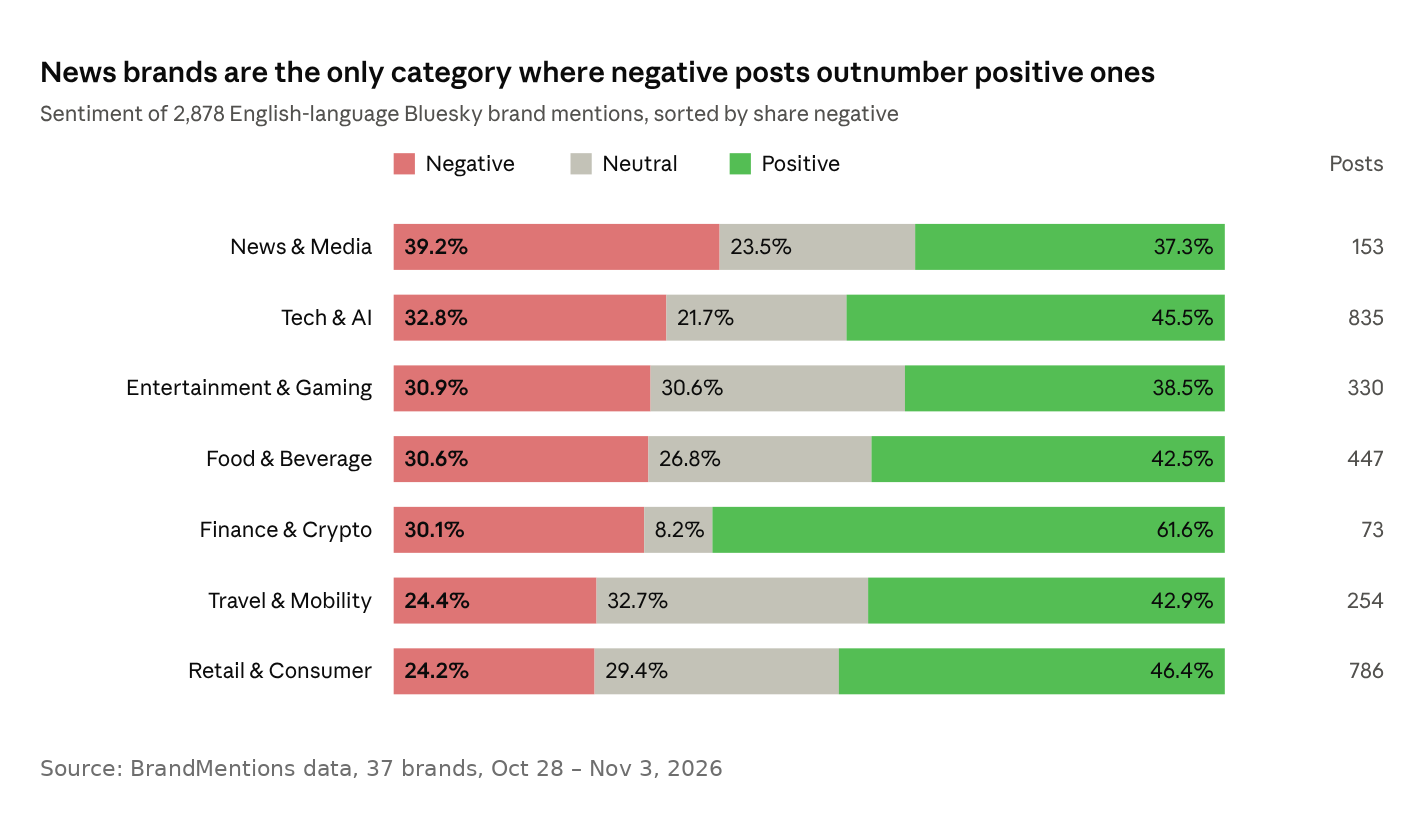
Automated sentiment struggles with Bluesky's sarcasm and in-jokes, so treat these as directional and spot-check any tool's sentiment before relying on it.
What this means when you choose a Bluesky listening tool
The data points to five things to test before you commit to a tool:
- Keyword search, not just handle tracking. With 97% of mentions untagged, monitoring your brand’s @handle alone would miss most of the keyword-matched posts in this sample.
- Boolean exclusions and noise filters. About one in six brand mentions is a deal, resale listing or affiliate post. You need to exclude terms and accounts without losing real customer posts.
- Multilingual coverage. Nearly a quarter of posts are not in English, so check that the tool searches and filters by language on Bluesky, not only on news.
- Full support for Bluesky's handle types. Custom-domain handles appeared on 13.8% of posts and bridged accounts on 1.3%. Both should show up and be filterable like any other author.
- Sentiment you can correct. Automated scores are a starting point. Pick a tool that lets you relabel posts, because sarcasm is common on Bluesky.
Methodology and limitations
Data came from the BrandMentions app, queried on November 4, 2026, for October 28 to November 3, 2026 (7 days, UTC). View the study’s supporting data.
- Brands. 37 consumer brands in 7 industries: Tech & AI, Entertainment & Gaming, Retail & Consumer, Food & Beverage, News & Media, Travel & Mobility and Finance & Crypto. Multi-word names were searched as exact phrases.
- Collection. One query per brand per day on the discussions source. Each query returned up to 100 posts. Queries returning exactly 100 results were potentially truncated unless completeness was established separately. Counts describe records retrieved from the BrandMentions index, not all posts published on each network.
- Bluesky sample. 3,726 unique Bluesky posts after removing duplicates that matched more than one brand.
- Measures. Tagging, hashtags, links and questions were detected from post text. Language was detected with langdetect. Sentiment used VADER on English posts only. Deal and promo posts were flagged with price and sale keywords, so that figure is an estimate.
- Reddit is excluded from the headline comparison. Reddit volume in the index swung sharply from week to week in October, so it would distort a platform comparison.
- Platform counts reflect what the index captures, not each network's full volume. X in particular limits data access, which lowers its counts in any third-party tool.
- One week is a snapshot. News events, such as product launches, can move a single brand's numbers. A study covering 30 or more days would help test whether these patterns persist.
Do Tools Catch Every Mention or Only Some?
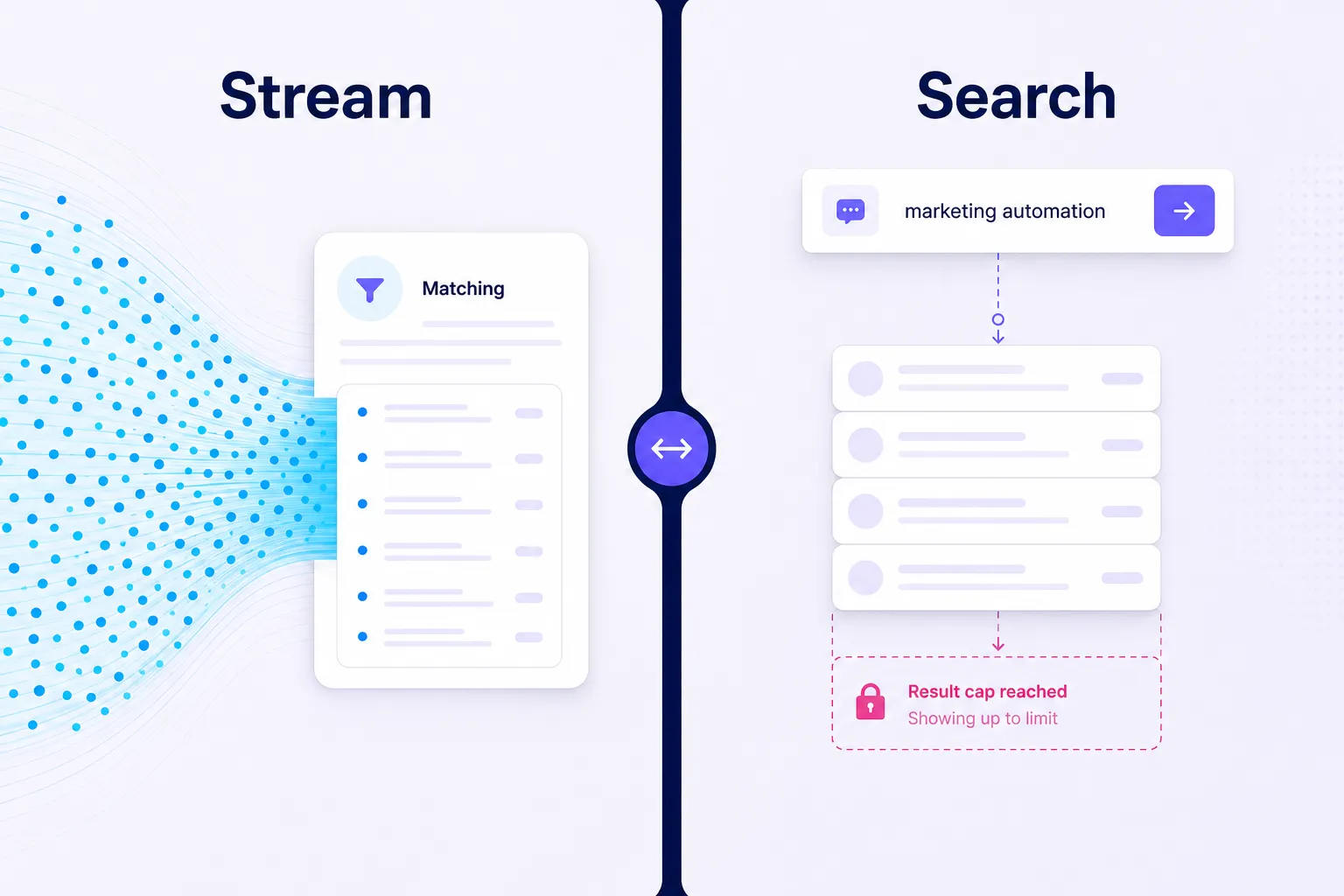
They catch different shares, and we did not find comparable published recall benchmarks in the sources reviewed. Vendor pages say "every mention," "complete coverage" and "real time" while showing no denominator; what their own documentation shows is a spread of delivery schedules from daily to roughly one minute, different disclosures about replies, and hard caps on history and pagination that decide what you actually see.
The mechanisms that would produce a gap are well documented. The AT Protocol synchronisation specification describes relays, replay cursors and synchronisation failures, and it makes a point that should worry any buyer: if an intermediary omits every event from one repository, downstream consumers may never detect the omission. An unbroken connection is evidence of uptime, not of network-complete coverage.
A source connection is not a coverage result. Ask the vendor for matching post IDs from a week you choose, not a slide that says "full network access."
Then separate three capabilities that get collapsed into one bullet point called "reply coverage." Did the tool collect a reply containing your keyword? Can it show you that reply's parent and the rest of the thread? Can it surface relevant replies that never repeat your keyword at all? A reply counter proves none of the three.
Conclusion: Count First, Then Compare
Bluesky’s public data and documented protocol make independent coverage checks possible, because the reference data is public and the protocol is documented. That should have ended the era of "every mention" marketing. It has not, because nobody in the category, including us, has published a recall number with a denominator attached.
So treat this review as what it is: a verified map of schedules, caps, filters and purchase conditions, ordered by our editorial assessment of use-case fit, based on published documentation, plus the protocol that would settle the rest. Pick two tools that match your job, start both trials on the same day, freeze eight queries, and keep your own reference log for a week. If results differ, compare matching post IDs, query rules, collection windows and exclusions before drawing conclusions. Your reference collection may also contain gaps.
When you are ready to see what Bluesky looks like next to your web, news and forum coverage in one feed, the BrandMentions facts page lists exactly what each plan collects and how often, including where real-time begins.
Frequently Asked Questions
What are the best social listening tools for Bluesky in 2026?
The documentation-based shortlist is BrandMentions from $99/month billed quarterly for brand monitoring across Bluesky, news and the web, ForumScout at $19/month for budget monitoring, Octolens at $159/month billed annually for automation, Buska at $49/month for lead qualification, Mentionlytics at $49/month on its annual offer for reporting, and Brandwatch, Hootsuite/Talkwalker or Sprinklr for enterprise evaluation.
Which Bluesky monitoring tool is cheapest?
ForumScout is the cheapest documented option at $19/month, which includes 10 keywords, unlimited seats, unlimited mentions and webhooks, with collection every six hours on that Starter plan. Syften Entry is next at $29.95/month, followed by Buska Starter and Mentionkit at $49/month each. Check the trial plan before you judge the price: ForumScout's seven-day trial runs on Pro (three-hour checks), not on the $19 Starter plan you would keep.
Can social listening tools catch Bluesky replies?
Several document that they collect them. Syften monitors new public posts and replies and separates them with type:post and type:comment operators, Brandwatch documents firehose ingestion of Bluesky posts and comments, Hootsuite documents posts, replies, shares and quote posts, and Sprinklr records posts, reposts, replies and mentions. Collecting a reply, showing you its parent thread, and surfacing relevant replies that never contain your keyword are three different capabilities, and no vendor publishes a measured figure for any of them.
Does Sprout Social cover Bluesky?
Yes. The Sprout Social Bluesky Listening FAQs document Bluesky collection and display of up to two levels of quoted posts, with support recorded in its API changelog on December 3, 2025. Two purchase conditions matter: Listening is an add-on rather than a core-plan feature, and backfill is capped at 30 days or 100,000 messages, whichever binds first.
Do Bluesky listening tools need an API key?
You generally do not need to connect a Bluesky account to use the hosted listening tools discussed here. If you build your own integration, authentication requirements depend on the endpoint and service.
BrandMentions, Mentionlytics, Meltwater and Hootsuite all document Bluesky listening with no account connection, because public records are readable without authentication, and Mentionlytics describes capturing public keyword-containing posts and reposts without any Bluesky authorisation. The API keys that appear in this category belong to the listening tool, not to Bluesky: Octolens, Mentionkit, Syften and Buska document REST API, webhook and MCP access so you can route mentions into your own systems.
Is there a free way to monitor Bluesky mentions?
Yes, with real limits. Bluesky's native search handles quoted phrases, hashtags, domains and date filters for manual checks, but it sends no alerts, and the searchPosts endpoint caps results at 100 per request without guaranteeing exhaustive pagination. Developers can build against the public streaming interfaces for free data access, though hosting, restart logic and deduplication become your operating cost.
Filed under: Social Listening