8 Tips For Dealing With Negative Reviews Online
Anegative review is rarely the thing that hurts you. The damage comes from what you do in the 24 hours after you see it. And the audience for your response is almost never the angry reviewer. It is…


Anegative review is rarely the thing that hurts you. The damage comes from what you do in the 24 hours after you see it. And the audience for your response is almost never the angry reviewer. It is the quiet prospect reading over their shoulder, deciding whether you are the kind of business that fixes things.
The goal, then, is not to eliminate every negative review or chase a perfect five-star rating. It is to respond quickly, resolve legitimate problems, report fake reviews with evidence, and build a steady stream of recent, genuine feedback that gives customers the full picture.
This guide shows you how to handle the bad ones so that quiet prospect stays.
What Are Negative Reviews Online?
Negative reviews are public customer evaluations that describe dissatisfaction with a product, service, staff interaction, billing, delivery, or post-purchase support. They matter because they now shape both human trust and the machine-generated summaries that appear across search, maps, marketplaces, and AI answer engines.
In short: a negative review is any public rating or written feedback, typically one to three stars, that flags a problem with a customer's experience. In 2026, its reach extends far beyond the page it sits on, because AI systems read, cluster, and quote these reviews when they answer buyer questions.
Summary
- 97% of consumers read reviews for local businesses in 2026, and 77% say negative reviews deter them from choosing a business (BrightLocal Local Consumer Review Survey 2026).
- Speed and quality both matter: 89% of consumers expect a business to respond to reviews, 81% expect a response within a week, and 50% say generic or templated replies make them less likely to choose a business (BrightLocal 2026).
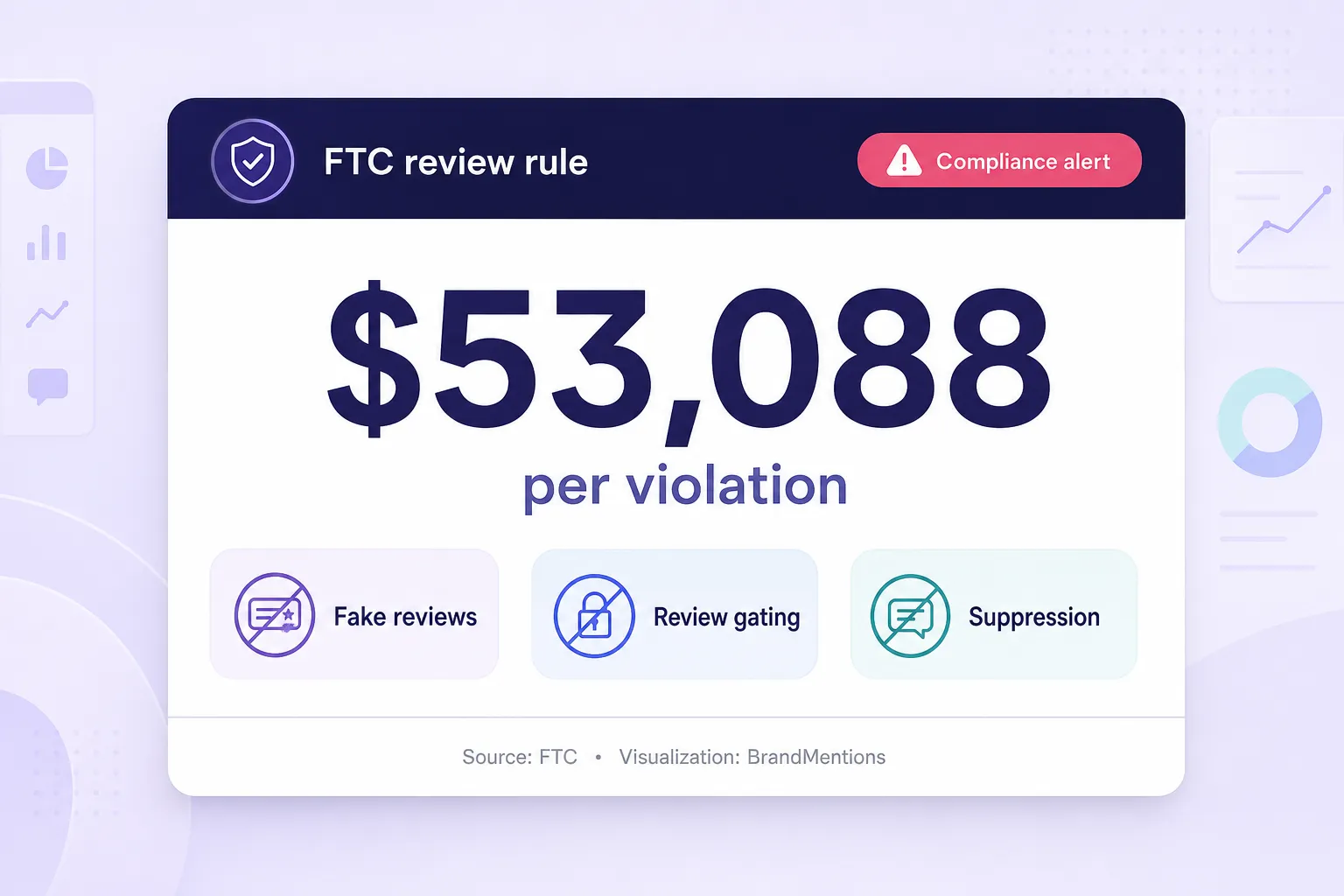
- Fake reviews, sentiment-conditioned incentives, and certain forms of review suppression can violate federal law. The FTC's Consumer Reviews and Testimonials Rule took effect on October 21, 2024, with a maximum civil penalty of $53,088 per violation, and the agency sent its first warning letters to 10 companies on December 22, 2025.
- Review management is now an AI visibility problem. Google review summaries are generated with AI, based on reviews from the past year, and updated as consistent themes emerge, and 45% of consumers now use AI tools for local recommendations, up from 6% in 2025 (BrightLocal 2026).
- Enforcement is real. Google blocked or removed over 292 million policy-violating reviews in 2025, and Yelp's automated systems filtered nearly 500,000 suspected AI-generated reviews the same year.
- Fragmentation is the new baseline. Consumers now consult an average of six review sites, and Google's share of review readership has slipped to 71% from 83% a year earlier.
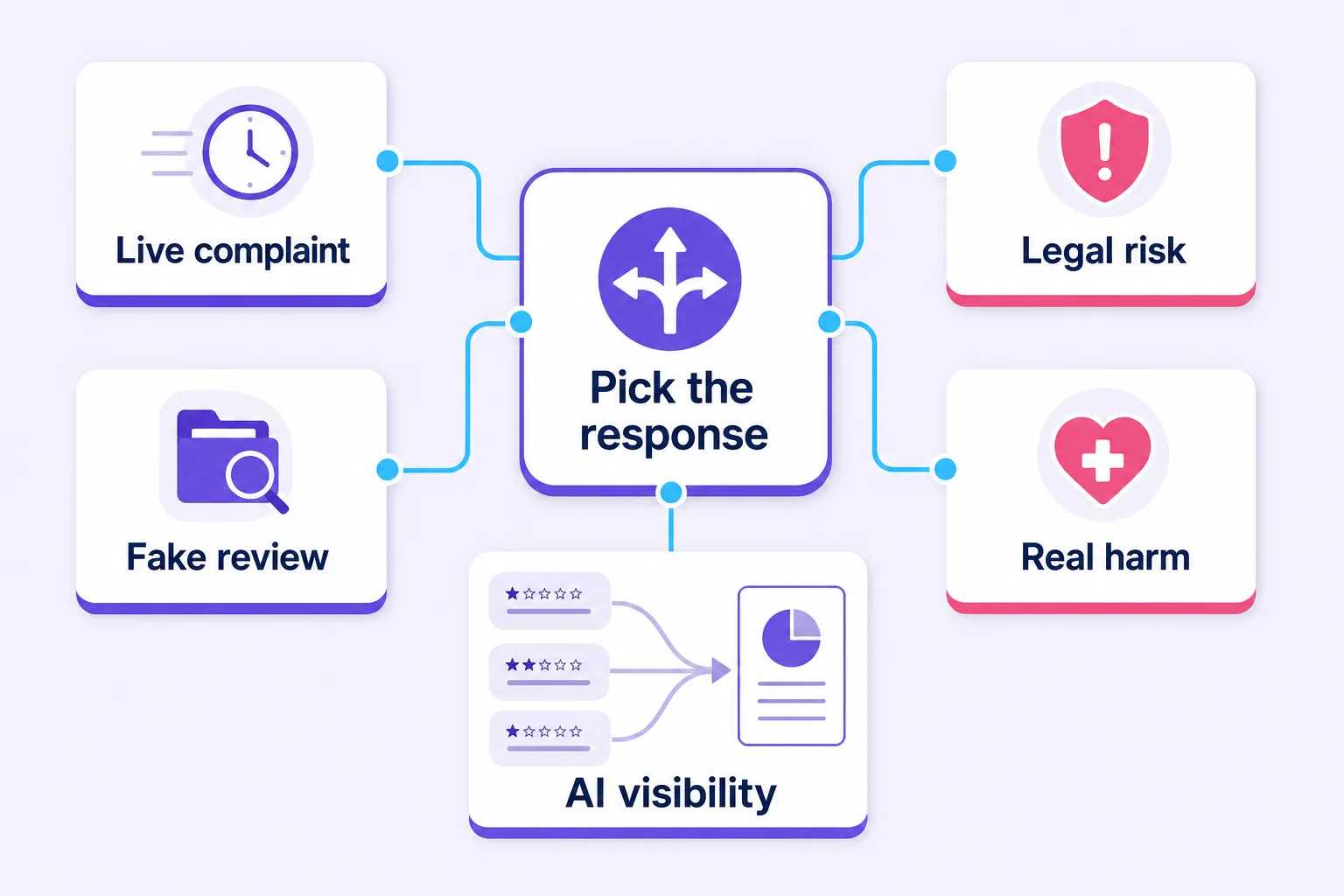
At a Glance: Which Tactic Fits Your Situation
- Best for a live complaint spreading right now: Respond within 24 hours, then take it offline. Public silence lets the story harden. A fast, calm reply plus a private channel starves the escalation.
- Best for protecting conversion: Respond to every review as content for future buyers. The reply is social proof aimed at the next hundred readers, not damage control for one person.
- Best for zero budget: Generate more genuine, recent reviews. Volume and recency dilute a single bad rating faster than any clever reply, and the ask costs nothing.
- Best for legal and platform compliance: Report fake or policy-violating reviews with evidence. Legitimate, documented flags get results. Retaliation and gating create liability.
- Best for high-stakes harm: Offer a proportionate remedy offline, with no strings attached to the review itself.
- Best for enterprise and multi-location brands: Monitor across platforms and route by severity. You cannot answer what you never see.
- Best for AI-era visibility: Audit the phrases customers repeat over the last 12 months. AI summaries quote patterns, not single reviews.
Do Negative Reviews Actually Hurt You, or Help?
Here is the part most guides skip. A wall of flawless five-star reviews reads as manufactured, and buyers know it.
BrightLocal's 2026 data makes this concrete. Only 10% of consumers will use a business exclusively with a perfect five-star rating, while 68% are satisfied with four stars or higher. Buyers are not looking for perfection. They are looking for evidence of how you behave when something goes wrong.
A negative review answers the question every buyer silently asks: what is the worst case, and can I live with it? Your job is not to erase the worst case. It is to make sure your response sits right next to it, calm and specific.
A perfect rating sells nothing. A believable rating with a thoughtful reply attached to the bad review is what moves the careful buyer off the fence.
The dangerous profile is not one bad review. It is a pattern of unresolved complaints, stale reviews, no owner responses, and vague copy-paste replies. That pattern is what future buyers, and the machines summarizing you, read as risk.
How Has the FTC Rule Changed What You Can Do?
This is the shift that turns a familiar topic into a compliance question, and older guides on this subject ignore it entirely.
In 2024, the Federal Trade Commission's Consumer Reviews and Testimonials Rule (16 CFR Part 465) took effect on October 21. It prohibits fake and AI-generated reviews, undisclosed insider reviews, buying reviews with a conditioned sentiment, groundless legal threats to force removal, and the deceptive suppression of negative reviews. The maximum civil penalty was inflation-adjusted to $53,088 per violation, effective January 17, 2025, and that figure remained current through 2026.
This is no longer theoretical. On December 22, 2025, the FTC issued its first warning letters, contacting 10 companies over potential violations. Three moves that used to appear in old reputation playbooks are now legal risks: buying positive reviews, burying negative ones, and offering a customer a reward in exchange for a review with a specific sentiment.
If a tactic depends on hiding or manufacturing sentiment, treat it as a liability, not a shortcut. The safe reputation strategy in 2026 is the honest one.
The practical line is narrow but firm. You can still ask for reviews. You can still resolve complaints and invite an honest update. You cannot condition a reward on the content of a review, and you cannot pressure a reviewer into silence.
How Is AI Changing the Way People Read Your Reviews?
Fewer people read your reviews one by one. A machine reads them first and hands over a verdict.
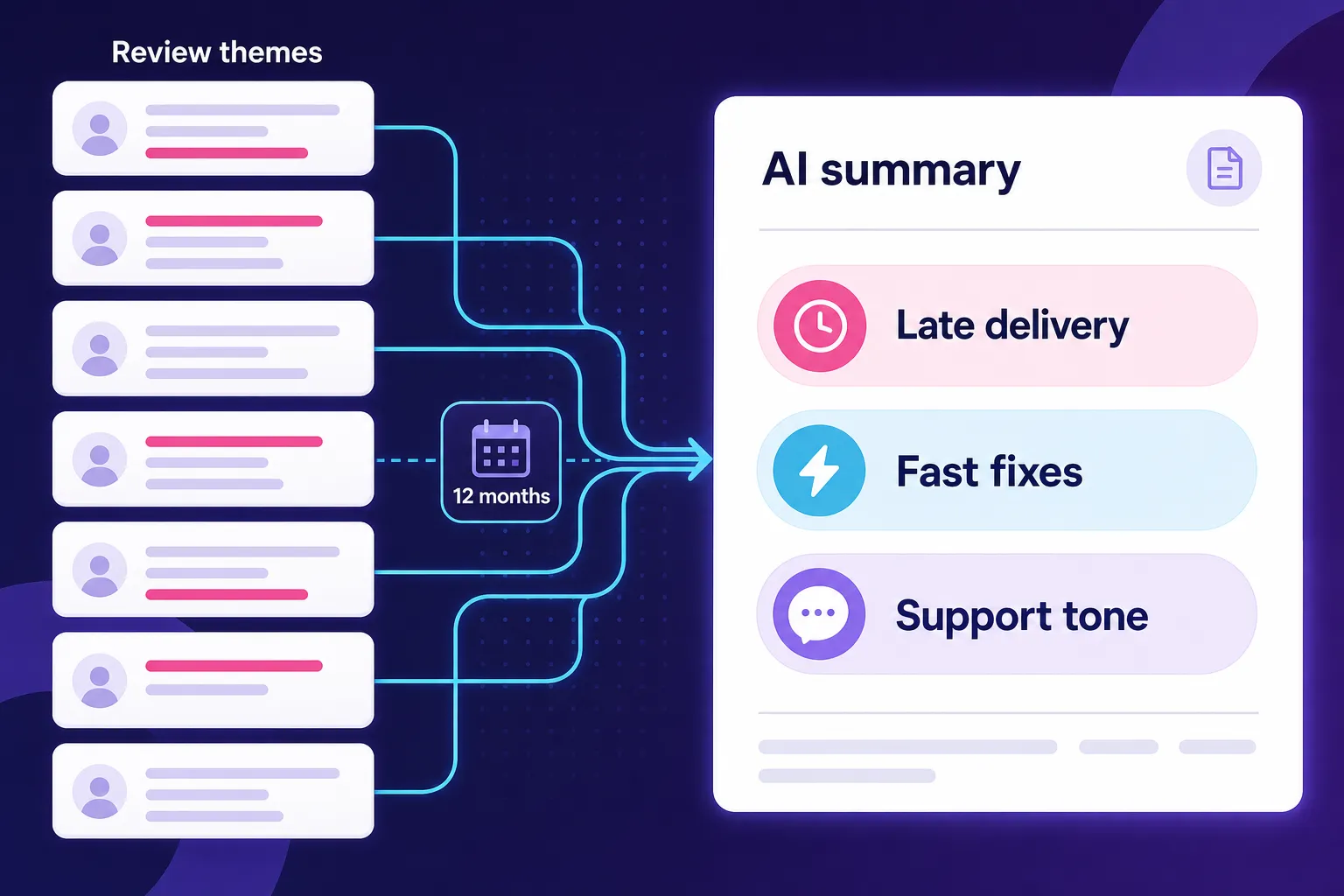
Google's Local Listings Help documentation is direct about this: review summaries are generated with AI, are based on reviews from the past year, and update regularly once there are enough consistent themes. That single detail rewrites old advice. Collecting a quarterly burst of generic five-star reviews does less than it used to, because the summary rewards recent, repeated, specific language.
The distribution has widened too. In July 2026, Axios reported that Yelp is licensing its reviews, photos, and business information to OpenAI for ChatGPT's local recommendations. When a buyer asks an assistant for a reliable plumber, the model synthesizes patterns across platforms rather than reading one page. A cluster of unresolved complaints on a site you never check can shape the answer a high-intent customer sees.
This is where reputation work meets AEO (Answer Engine Optimization). Your responses are now an input to a summary, not just a human impression. Ten unanswered complaints skew the machine's read of you. The same ten, each carrying a calm and specific reply, give prospective customers visible evidence that the business takes complaints seriously and fixes problems.
Now the eight tactics, each analyzed the same way so you can weigh them against each other.
1. Respond Within 24 Hours, Not "Quickly"
"Respond quickly" has been the standard advice for a decade, and it means nothing. Without a window, it becomes "respond when someone gets around to it," which in practice means never.
BrightLocal's 2026 survey gives you the threshold. 89% of consumers expect a business to respond to reviews, and 19% expect same-day responses on a complaint. Slow replies read as indifference, and indifference is what turns one annoyed customer into a warning to everyone else.
Treat a negative review like an inbound sales call. You would not let it ring for a week.
The 24-Hour Acknowledgment Rule: reply within one business day, but do not confuse speed with certainty. If you cannot resolve the issue in a day, still respond in a day. Acknowledge the complaint, say you are investigating, and give a specific date for follow-up. "We are looking into this and will update you by Thursday" beats silence every time.
Non-obvious insight: speed matters more than eloquence. A short, human acknowledgment posted in hours beats a lawyered paragraph posted in ten days. The reader is scoring your reflexes, not your prose. Build this into your workflow the same way you would any other part of a reputation management guide, with a named owner and a clock.
2. Take the Conversation Offline, Without Hiding
Public threads reward the loudest voice. Other customers pile on, the reviewer gets angrier, and someone screenshots the exchange for social media. Your goal is to limit how many people witness the back-and-forth.
Google's Business Profile review guidance advises keeping replies professional, short, personalized, and privacy-safe, and moving complex situations to phone or email. That mindset matches ISO 10002:2018, the international complaint-handling guideline, which frames complaints as a process of receiving, resolving, and improving. The public reply opens the door. The resolution happens in a controlled channel.
Move offline when the review involves order numbers, refunds, employee details, photos of private spaces, or anything that could become a legal or HR issue. But do not use "offline" as a hiding place. A reply that just says "call us" gives the customer another task and no confidence. Name a real person and a direct contact.
The Two-Reply Ceiling: never exchange more than two public replies with an upset reviewer. Reply once to acknowledge, once to confirm you have reached out privately, then stop. Beyond that, you are performing conflict for an audience.
Non-obvious insight: you should be the one who initiates the offline contact, and taking it private does more than de-escalate. A long, heated public thread becomes crawlable material an AI summary can quote later. A single professional reply followed by a private fix does not. Just remember the FTC line: reaching out to resolve is fine, pressuring someone into silence is the suppression the rule now targets. When a single review threatens to spiral into something larger, escalate it into your crisis management plan rather than improvising in the comments.
3. Respond to Every Review, and Never Template It
Treat your public reply as content written for future buyers. The evidence that this changes outcomes is strong and, unusually, operational. A study summarized by INFORMS found that when hotels began responding to reviews, they received 12% more reviews and their average rating rose by 0.12 stars. Visible management changes reviewer behavior and reader trust.
Templates undercut all of that. BrightLocal found that generic or copy-paste responses make 50% of consumers less likely to choose a business. A robotic reply signals you read the star rating, not the review.
A personalized response follows a structure you can learn but never paste:
- Name the specific issue in the first sentence. "You mentioned the technician arrived 40 minutes late without the replacement part." This proves you read it.
- Apologize for the experience, not for their feelings. "Sorry you feel that way" apologizes for the reaction, not the failure. Readers notice.
- Explain briefly, without excuses. One sentence.
- State the concrete fix. "We have changed dispatch so customers get a text if a technician is running more than 15 minutes behind."
- Invite offline follow-up with a real name.
Answer the Reader, Not the Reviewer. Write every response as if the upset customer will never read it and a thousand prospects will. That framing kills defensiveness and produces the calm, specific tone that rebuilds trust, and it supports the broader work of protecting online reputation.
Non-obvious insight: do not repeat the damaging keyword if you do not have to. If the review says "scam," your reply does not need the word "scam." Neutral, factual language keeps the phrase from compounding in search and summaries: "We take billing concerns seriously and would like to review the invoice with you."
4. Follow Up Once After You Fix It
Most teams treat the response as the end of the workflow. It is the midpoint. Follow-up is where good service converts into public proof.
After you resolve the issue, reach back out. Ask if the solution met their expectations. Thank them for the chance to fix it. Then, and only then, invite them to update their review if their view has changed. Trustpilot's Guidelines for Businesses allow fair, neutral invitations but prohibit incentives and pressure, and the same principle holds across platforms.
Here is the compliance nuance that trips people up. You may invite an honest update. You may not condition a refund, discount, or gift on the customer changing or deleting the review. That crosses into the sentiment-conditioned territory the FTC now polices.
Good language: "We corrected the issue you raised and appreciate the chance to address it. If your view of the experience has changed, you are welcome to update your review. No pressure either way."
Non-obvious insight: describe what you changed, not what you gave. "We retrained the front desk on that check-in issue" lands better than "here is 10% off." The first tells every future reader the flaw is fixed. The second reads like a payoff. Fixes scale to the audience. Discounts do not.
5. Generate a Steady Stream of Genuine, Recent Reviews
The math is your friend. One bad review out of eight is a crisis. One bad review out of two hundred is a rounding error. And most happy customers never think to post.
Recency matters as much as volume. BrightLocal found that 47% of consumers will not use a business with fewer than 20 reviews, 31% require 4.5 stars or higher, and 74% care most about reviews written in the last three months. A five-star review from three years ago is nearly invisible. A three-star review from last week outweighs it.
Where and how you ask matters, and the rules differ by platform. Google allows neutral reminders and a review link, but its user-generated content policy bans incentives, review gating (asking only happy customers), on-premises pressure, and requests to name specific staff. Yelp goes further. Its official Don't Ask for Reviews guidance tells businesses not to ask anyone, including customers, mailing lists, friends, or family, for Yelp reviews.
| Platform | Can you ask for reviews? | What to avoid |
|---|---|---|
| Yes, with neutral requests | Incentives, gating, staff-name requests, on-site kiosks or pressure | |
| Yelp | No, Yelp asks businesses not to solicit | Any direct request, incentives, asking friends or family |
| Trustpilot | Yes, if fair and neutral | Incentives, selective invitations, pre-screening |
| Users can recommend; owners can report violations | Turning recommendations off to hide criticism instead of fixing it |
The 4.5, 20, 90-day review health line: treat fewer than 20 reviews, a rating below 4.5, or no new reviews in the last 90 days as a reputation risk that needs attention before your next campaign.
Non-obvious insight: you do not need a flood. A suspicious burst looks manipulated to both humans and platform filters. A steady cadence looks real because it usually is. If your buyers live on social platforms, weigh how social media reviews factor into discovery before you point everyone at a single site.
6. Report Fake or Policy-Violating Reviews With Evidence
Not every attack is a customer. Competitors, former employees, and review brokers all plant fabricated reviews, and the FTC rule now makes all three illegal. But enforcement runs through the platforms, and platforms remove policy violations, not reviews you happen to dislike.
The Proof-Before-Removal Rule: do not report a review because it is painful. Report it because it violates a written policy, and capture evidence before you flag it.
Build a report packet: a screenshot, the review URL, the reviewer profile if visible, the date captured, the specific violation category, and a customer-record check showing no matching transaction. Then report through the closest policy label, whether that is conflict of interest, impersonation, off-topic content, or harassment. Moderation systems work from categories.
The systems do work, if slowly. Google's 2026 Maps report states its systems and analysts blocked or removed over 292 million policy-violating reviews in 2025 while publishing more than a billion helpful ones. Yelp's 2025 Trust & Safety Report says its automated systems filtered nearly 500,000 suspected AI-generated reviews and shut down over a million policy-violating accounts.
Non-obvious insight: removal is slow and uncertain, so run it in parallel, not as your only plan. While a flag sits in a queue, post one neutral public line: "We cannot match this review to a customer record, but we take feedback seriously. Please contact us so we can investigate." Do not apologize to a non-customer, and do not accuse the reviewer of fraud unless counsel approves it. Track patterns as part of how you handle negative brand mentions that spread beyond the review site itself.
7. Offer a Genuine Remedy When the Harm Is Real
Most negative reviewers do not want money. They want to be heard, and they want assurance the problem will not hit the next person. But when someone took a real financial or personal hit, an apology alone is thin.
Draw the line clearly, because the FTC Consumer Reviews Rule Q&A makes it a legal one. A refund because the product failed is customer service. A payment offered "if you take the review down" is suppression. Fix the harm because it is right, and let any review change happen on its own.
When compensation is appropriate: the failure was on your side, the customer incurred a concrete cost, and the remedy is proportional. A service credit for a technician arriving late fits. A full refund for one cold side dish usually does not, unless the customer asks.
When it is the wrong move: the review is vague or factually disputed, the customer is demanding money to remove the review (report that demand), or the review is fake. Paying a loud critic to disappear trains your market that complaining pays.
Non-obvious insight: remedy the experience, then stay silent about the review entirely. Customers made whole with no ask attached are more likely to update voluntarily, because they no longer feel transacted with. The absence of pressure is the persuasion.
8. Monitor Every Channel, Including AI Answer Engines
You cannot respond to what you never find. This is the quiet reason so few businesses keep pace: most are not ignoring reviews on purpose, they simply do not know the reviews exist.
Two shifts have outpaced most monitoring setups. First, fragmentation. Consumers now use an average of six review sites, and Google's share has dropped to 71% from 83%. Facebook, Yelp, Tripadvisor, the Better Business Bureau, Apple Maps, Trustpilot, and category sites like Healthgrades, G2, Capterra, and Angi all pull weight now. Second, distribution. Google's Local Listings documentation notes that listing data comes from web content, licensed third-party data, user contributions, and Google's own interactions with local places. Your reputation inputs are wider than your Business Profile.
Watch four layers: review platforms, social platforms (including Reddit, TikTok comments, and X), open-web mentions, and AI answers and summaries. This is where a tool earns its place, but only if you can name the decision its data will change.
BrandMentions fits a specific niche here: cross-channel reputation monitoring and AI brand mention tracking, useful when a complaint moves off the review sites into forums, social posts, and answer engines. Native dashboards still handle platform-specific replies. A broader monitoring layer catches the review-adjacent story before it becomes the dominant one. Pair it with analyzing review sentiment so repeated themes become operational signals, not just charts, and with a review tracking integration that preserves platform, urgency, ownership, and resolution status.
Non-obvious insight: monitor for phrase drift. When customers stop praising "fast delivery" and start mentioning "late delivery," your brand story has changed before your star average moves. That is your earliest warning. And monitor competitor reviews too. The complaints customers leave next door are a free product roadmap and a source of switch-ready prospects.
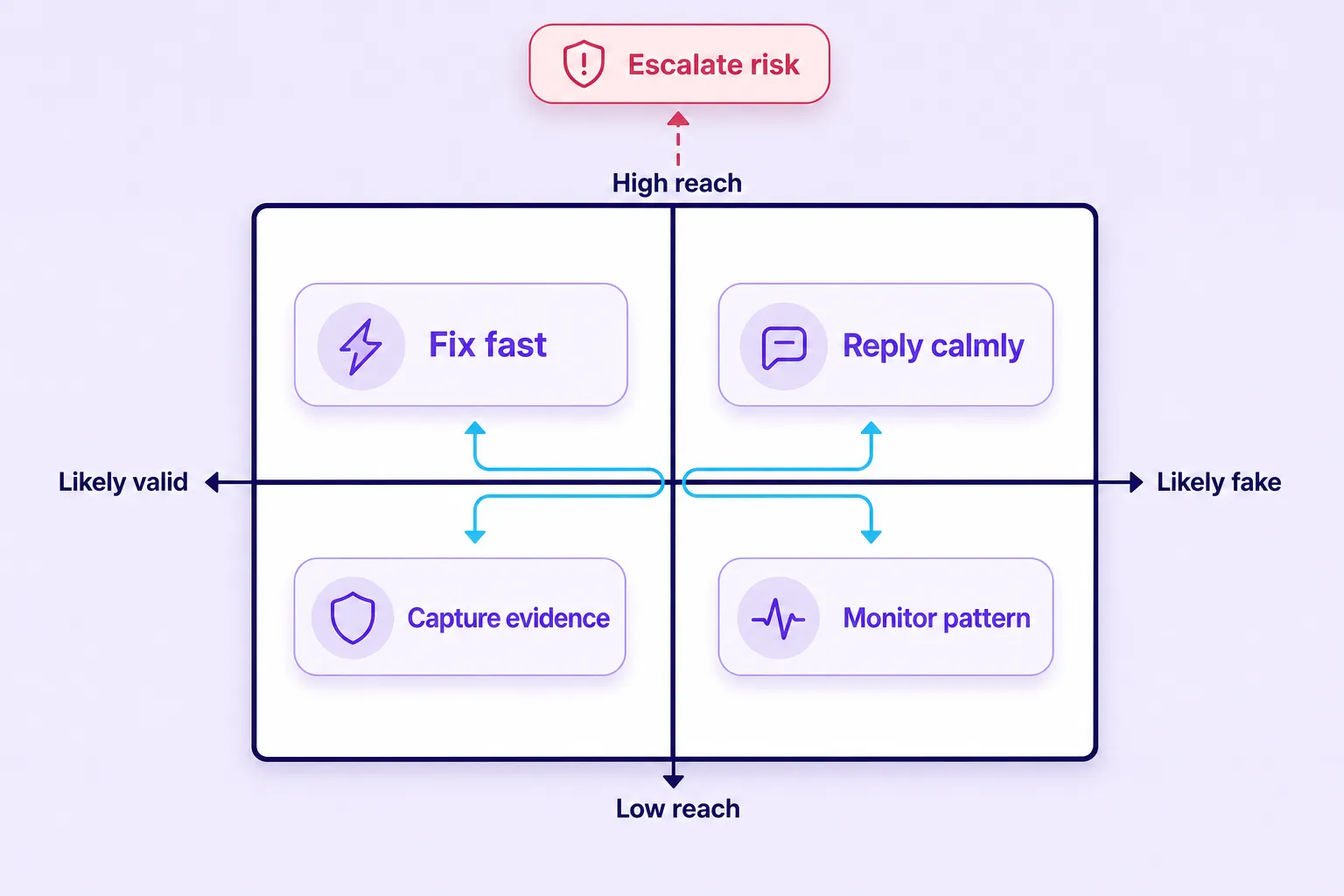
The Negative Review Triage Matrix
Not every negative review deserves the same energy, and treating them identically is how teams burn out or overreact. Use this to route each review in under a minute. Score legitimacy first, because a fake review changes the whole play. Then score reach.
| Review type | First action | Public response | Private action | Owner | Target window |
|---|---|---|---|---|---|
| Valid complaint, high visibility | Acknowledge, then take offline | Yes, short and specific | Fix, log root cause | Support or location manager | Same business day |
| Valid complaint, low visibility | Public reply, resolve privately | Yes | Fix, log root cause | Support | 1 to 2 days |
| Vague one-star, no text | Ask a clarifying question publicly | Yes | Try to identify the transaction | Support | 1 to 2 days |
| Safety, legal, health, discrimination, fraud, harassment | Escalate before any detailed reply | Holding response only | Legal, HR, or compliance review | Senior owner | Within hours |
| Fake, conflicted, or bot | Capture evidence, report | One neutral public note | Submit policy report, document status | Reputation lead | Report immediately |
| Review bomb or sudden spike | Freeze workflow, investigate pattern | One calm statement if needed | Incident log, platform reports | Crisis lead | Within hours |
| Repeated theme across reviews | Tag the theme, escalate internally | Acknowledge the improvement plan | Operational fix | Department owner | Weekly cycle |
The 12-Month Theme Rule: manage the phrases customers repeat, not just the star average. AI summaries quote patterns from the past year, so five reviews mentioning "long wait" matter more than any single one-star rating.
Notice that no row tells you to buy positive reviews, bury negatives, or trade money for a rating. Every action stays on the safe side of the FTC rule while still moving fast. That combination, speed inside legal guardrails, is the whole game in 2026.
Where Most Teams Break Down
Four failure points repeat across industries and business sizes.
No designated owner. Reviews become everyone's job and therefore nobody's. Fix: name one person, give them access to every platform, and make response time a KPI, not an aspiration.
Emotional replies. A manager responds while still angry, and the defensive reply lives online permanently. Fix: a mandatory 30-minute cooling-off period. Write it, wait, re-read, then post.
The apology without the fix. "We apologize and will use your feedback to improve" appears on fifty other profiles. Fix: name one concrete change in the reply.
Monitoring blind spots. The team watches Google and Yelp but never checks Trustpilot, Reddit, or what ChatGPT says about their category. Fix: at minimum, search your brand name on Google, Reddit, and one AI assistant weekly.
High-Risk Reviews That Need More Than a Reply
Some reviews are not marketing problems. In regulated industries, a public response can create a new liability. A healthcare business cannot confirm someone was a patient without risking a HIPAA breach, so a reply must stay generic and never acknowledge treatment. Financial services face similar privacy limits. Legal practices carry client confidentiality. Reviews involving minors, named employees, discrimination claims, or safety incidents belong with counsel or HR before anyone drafts a public word. For these, the public reply is a short holding line only. The real work happens in a documented private channel.
Escalate outside the normal workflow when you see review extortion ("pay me or the one-star stays"), coordinated review bombing, or defamation. Preserve evidence, involve counsel, and use the platform's partner or business-support escalation path. The FTC rule gives you standing against brokers and buyers of fake reviews, but the practical route usually runs through the platforms first.
A Governance Note on AI-Drafted Replies
If your team uses AI to draft responses, keep a human in the loop for every published reply. Redact private details before anything goes into a prompt, check for hallucinated facts (an AI will happily invent an apology for an event that never happened), and vary the phrasing so responses do not read as a repeating template. The same generic-response penalty that punishes copy-paste humans punishes copy-paste machines.
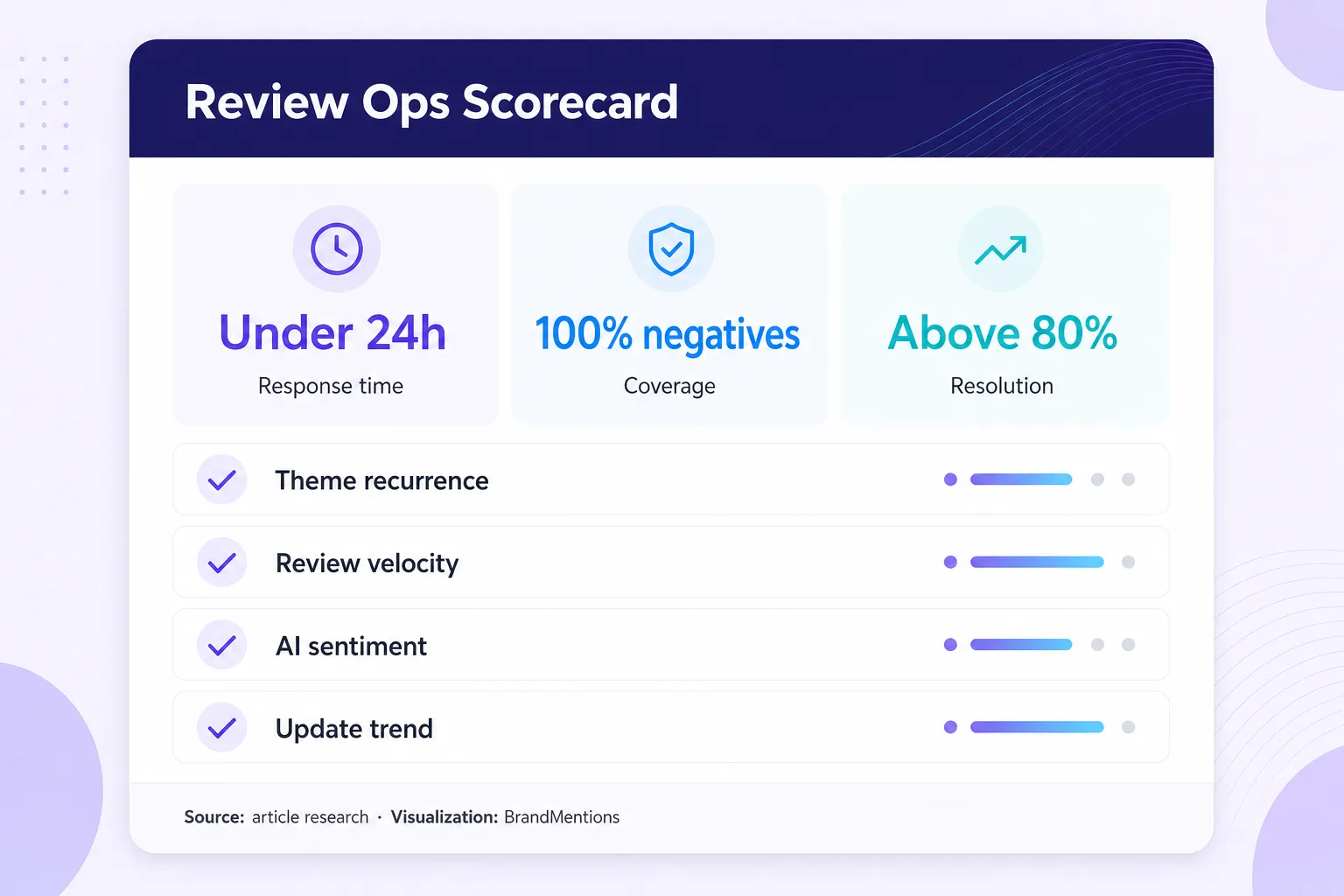
Your Review Operations Scorecard
Most teams measure star average and stop. That is a lagging number. Track these leading indicators monthly and you will see problems before the rating does.
| Metric | What it measures | Healthy target |
|---|---|---|
| Median response time | Speed from post to first reply | Under 24 business hours |
| Owner-response coverage | Percentage of reviews answered | 100% of negatives, majority of all |
| Resolution rate | Complaints resolved privately | Above 80% |
| Review-update rate | Reviewers who upgrade after a fix | Track the trend, not a fixed target |
| Theme recurrence rate | Same complaint appearing again | Falling quarter over quarter |
| Review velocity by platform | New reviews per platform per month | Steady, not spiky |
| AI-summary sentiment | Tone of the machine-written summary | Aligned with your true rating |
An AI-Answer Audit You Can Run Monthly
Because summaries now shape decisions, audit them like any other channel. Pick five to seven prompts a real buyer would use ("best [category] in [city]," "is [brand] reliable," "[brand] complaints"). Run them on ChatGPT, Perplexity, and Google AI Overviews on the first of each month. Log the exact answer, the sources cited, and any factual error. When an answer is wrong, correct the source data on the profiles you own, respond to the reviews feeding the mistaken theme, and re-run the prompt in two to four weeks to confirm the shift. Multi-location and multilingual brands should run this per market, and have native speakers review translated responses, because a clumsy machine translation reads as carelessness in the local language.
Tactic Comparison at a Glance
When you are deciding where to spend limited time, this is how the eight tactics stack up.
| Tactic | Execution complexity | Cost | Time to impact | Primary benefit |
|---|---|---|---|---|
| Respond within 24 hours | Low | None | Immediate | Signals attentiveness to readers |
| Take offline | Low | None | Hours | Stops public escalation |
| Respond to every review | Medium | Low | Weeks | Compounding social proof |
| Follow up after fixing | Medium | Low | Days | Converts detractors, upgraded ratings |
| Generate genuine reviews | Medium | None to low | 1 to 3 months | Dilutes negatives with recency |
| Report fake reviews | Medium | None | Days to weeks (unreliable) | Removes fakes and abuse |
| Offer a remedy | Low | Variable | Hours to days | Repairs high-harm situations |
| Monitor every channel | Medium | Tool cost | Ongoing | Makes every other tactic possible |
Respond fast vs. respond to everything: the core difference. Speed protects you in a live incident. Consistency protects you over the long run. If you can build only one habit this quarter, build speed on complaints. If you can build two, add consistency across all reviews.
Frequently Asked Questions
How quickly should a business respond to a negative review?
Aim for the same business day, and treat one business day as the outer limit. In 2026, 89% of consumers expect a response and 19% expect it the same day. If you cannot resolve the issue that fast, post a short acknowledgment with a specific follow-up date. A fast, honest holding reply beats a polished, late one.
How do you respond to a fake negative review?
Do not respond emotionally or accuse the reviewer of fraud. Capture evidence first, a screenshot, the review URL, the reviewer profile, the date, and a customer-record check showing no matching transaction, then report it to the platform under the specific policy it violates, such as conflict of interest, impersonation, or off-topic content. Because removal is slow and uncertain, post one calm, neutral public line noting you cannot match the review to a customer record and inviting contact, and run the flag in parallel rather than treating it as your only plan.
Can I offer a customer a refund in exchange for removing a negative review?
No. Offering compensation to remove or change a truthful negative review may violate Section 5 of the FTC Act because it can distort the overall picture consumers see. You can resolve the issue with a refund or remedy, and afterward invite the customer to update their review if their view has changed. The resolution and the request must stay separate.
Can a business delete or bury a negative review?
You cannot delete a genuine review just because you dislike it, and hiding lower-rated reviews to display only praise is now a form of illegal suppression. You can report reviews that violate platform policies, such as fake accounts, conflicts of interest, harassment, or off-topic content. For legitimate criticism, the only compliant path is a good public response and an internal fix.
Do AI assistants use my reviews when recommending businesses?
Yes, indirectly. AI answer engines synthesize sentiment from review platforms, directories, social media, and your own site rather than reading one page. Google review summaries are AI-generated from the past year of reviews, and Yelp now licenses its content to OpenAI for ChatGPT recommendations. If your reviews are recent, consistent, and answered, the machine has better evidence to work with.
Conclusion: Treat Every Bad Review as a Public Rehearsal
The brands that win at this stopped thinking of negative reviews as fires to put out. They treat each one as a scheduled, public rehearsal of how they behave under pressure, performed in front of the exact people deciding whether to buy.
That shift changes your priorities. You stop chasing a flawless rating and start building infrastructure instead: a named owner, monitoring that reaches every platform including the AI answer engines, a workflow that reliably hits the 24-hour window, and a review engine that keeps your profile recent and resilient. The follow-ups, the removal flags, and the remedies all hang off that foundation.
Your next step is small and concrete. Pick your highest-traffic review profile, set a one-business-day response SLA, assign one person to own it starting Monday, then audit the last 12 months of review themes and fix the pattern that shows up more than once. The gap between the businesses that respond and the 89% of customers who expect it is not your problem. For you, it is the opening.
Filed under: Growth