12 Engaging Social Media Marketing Ideas for Hotels and Resorts
Posting on Social Media might appear like a kid's play, but it requires more strategy to attract better results though. The rise of Facebook, Twitter, Instagram and other social media channels has …

Posting on Social Media might appear like a kid's play, but it requires more strategy to attract better results though. The rise of Facebook, Twitter, Instagram and other social media channels has made the market a more competitive place and the hospitality industry makes no exception from the rule. Getting some social media marketing ideas for hotels and resorts will help you promote your business.
TL;DR: Hotel social media no longer rewards follower counts or pretty pool photos - it rewards original short-form video, answer-first content, and a booking path short enough to convert attention before it fades. This guide breaks down 12 execution-ready tactics that turn social discovery into direct bookings in 2026, plus the platform mechanics that make them work and the mistakes that quietly kill reach.
Summary
- Social media as a planning layer: Social media is now a primary travel planning layer, not only a branding channel. Expedia Group's 2025 Traveler Value Index found that 61% of travelers find trip ideas on social platforms, up from 35% in 2022, and 73% say influencer recommendations have influenced a booking decision.
- A long, multi-touch path to purchase: Travelers do not go from "nice post" to "book now" in one step. Expedia Group's Path to Purchase research found travelers view 141 pages of travel content on average in the 45 days before booking, and U.S. travelers view as many as 277.
- Short-form video as a booking surface: Short-form video is the delivery system for almost everything else, and it now doubles as a booking surface. TikTok launched TikTok GO in May 2026, letting U.S. users 18 and older discover and book hotels, attractions, and experiences in-app through partners including Booking.com, Expedia, Viator, GetYourGuide, Tiqets, and Trip.com.
- Originality as an eligibility rule: Originality is now an eligibility rule. Meta's originality guidance excludes accounts from recommendations when they repeatedly post unoriginal, watermarked, or lightly recycled content, so reposting other people's clips costs you non-follower reach.
- Reviews inside the social calendar: Reviews belong inside the social calendar, not beside it. Tripadvisor research found 76% of travelers prefer long-form reviews when choosing accommodations, because detail helps them picture the stay and judge value.
- An event-sensitive 2026 for U.S. hotels: For U.S. hotels, 2026 is an event-sensitive year. The American Hotel and Lodging Association projects hotel guest spending near $805 billion, with the FIFA World Cup and America250 flagged as demand opportunities that social teams should turn into local guides, packages, and timely updates.
At a Glance: Core Tactics by Goal
- Best for fast reach with zero ad budget: Original short-form video. Reels, TikToks, and Shorts get recommended to non-followers on merit, so a small account can outrun a large one on a single strong clip.
- Best for booking confidence: Room-first vertical video. Show the actual room, view, bathroom, balcony, and walk to breakfast so travelers can picture the stay before they commit.
- Best for low-budget consistency: Recurring content pillars built from real guest questions, not cute weekday labels.
- Best for trust and conversion at the decision moment: Systematized user-generated content and honest review response. Real guest footage lowers perceived risk better than any brand edit.
- Best for credible reach at low cost: Micro and local creator partnerships, chosen by destination fit, not follower count.
- Best for local discovery: Answer-first captions, geotags, and map-aware content. Treat metadata as classification, not a reach hack.
- Best for direct-booking revenue: A three-tap bookable funnel plus value-add offers over blunt discounts.
- Best for defensive brand health: Social listening and reputation monitoring across social, review sites, and AI answers.
What Is Social Media Marketing for Hotels?
Social media marketing for hotels is the planned use of social platforms, creator content, guest content, reviews, direct messages, and local discovery surfaces to influence travel inspiration, trip planning, booking confidence, and post-stay advocacy.
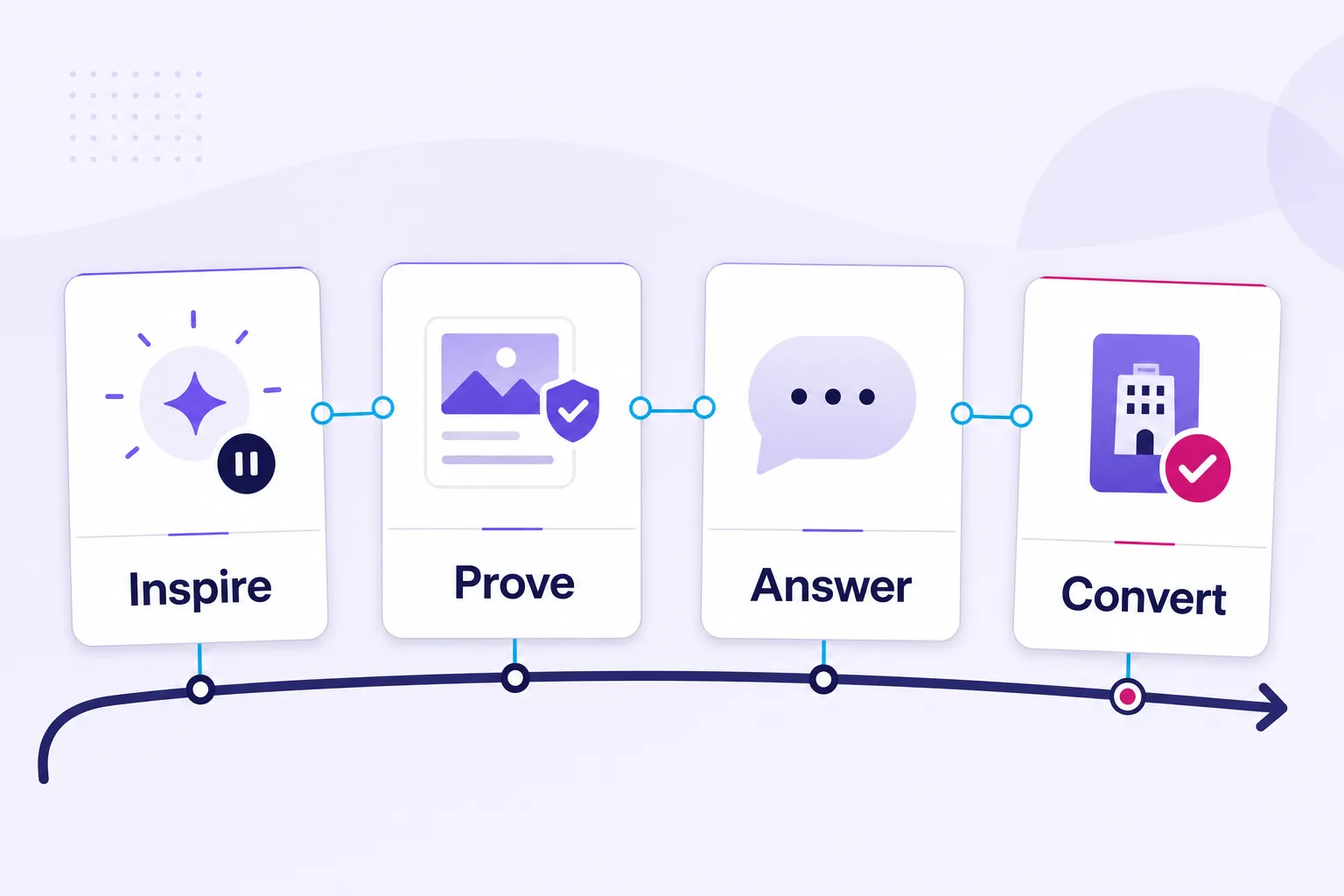
That definition matters because it stops your team from treating social as a gallery. A hotel calendar has four jobs: inspire, prove, answer, convert. Inspiration earns the pause. Proof makes the experience believable. Answers remove friction. Conversion gives a next step.
Weak accounts over-index on inspiration. Sunsets, lobby shots, champagne trays, repeat. The strong ones build evidence. They show the route from elevator to spa, compare room types, explain parking, and name the best family hike twenty minutes away.
If a post cannot reduce a traveler's uncertainty, it is not content. It is wallpaper.
How Is Hotel Social Media Different From Five Years Ago?
The short answer: reach used to follow your follower count, and now it follows each individual post's usefulness. The old model was a broadcast. You built a follower base and reach roughly tracked follower count. That model is gone.
Reach is now earned per post, by strangers. Meta says its Instagram and Facebook systems weigh thousands of signals, including watch behavior, shares, saves, and prior interaction, per its published Instagram and Facebook system cards. A property with 800 followers and a genuinely useful clip can reach 200,000 people. A property with 80,000 followers and recycled stock footage can reach almost none.
The second shift is intent. Social stopped being inspiration-only and became a search surface. Your feed is not a portfolio. It is a results page for "hotels near me" that you actually control.
Which Social Platforms Should Hotels Prioritize?
Start with the traveler's decision, not the platform. Match each platform to the job it does best, then pick the two or three that fit your guests and your capacity.
Instagram and TikTok win inspiration, vibe, creators, and local discovery. YouTube wins when people want a fuller explanation ("room tour with ocean view," "best resort in Sedona for couples"). Pinterest works for early planning, weddings, and spa retreats, because people search and save before they book. Google Business Profile matters when travelers are already comparing on Search and Maps. Facebook still earns its place for local events, community groups, weddings, reunions, and older demographics.
The audience is there. DataReportal's Digital 2026 Mid-Year Global Update reported 5.79 billion social media user identities worldwide by April 2026, with 254 million in the United States as of October 2025.
| Platform | Best use for hotels | Content that fits | Main constraint |
|---|---|---|---|
| Visual discovery, Reels, Stories, creator proof, location tags | Room tours, pools, dining, guest moments, local reels | Pretty posts without useful detail fade fast | |
| TikTok | Personality, discovery, local tips, candid video, in-app booking via TikTok GO | "Things guests ask us," staff picks, honest room POVs | Weak hooks die in three seconds |
| YouTube | Search-led planning, longer consideration | Room comparisons, destination guides, venue tours | Requires clearer structure and retention |
| Early planning, weddings, mood boards | Wedding boards, spa weekends, seasonal itineraries | Needs search-friendly titles and visuals | |
| Local events, groups, older travelers | Brunch, live music, family packages, wedding showcases | Organic reach depends on local relevance | |
| Google Business Profile | Search and Maps decision support | Updates, offers, events, photos, videos | Posts must stay accurate and current |
If you have one marketer, pick two primary platforms and one support surface. For most hotels that means Instagram plus Google Business Profile, adding TikTok or Pinterest when the property has enough visual material and staff capacity. Sort out best posting times only after you know what content deserves to be posted.
Can a Small Independent Hotel Compete With the Chains?
Yes, and for once the mechanics favor you. Because distribution follows engagement rather than budget, a boutique property with a point of view can beat a chain template that three committees approved.
The catch is consistency, not volume. I have watched properties post seven times a day to almost no one, then watched a boutique hotel posting three thoughtful Reels a week pull far ahead. You do not need a media team. You need a repeatable weekly habit and a voice that sounds like a real place run by real people.
How Do You Turn Social Content Into Bookings When They Happen Later?
Measure each post by the job it was doing, not by last-click revenue. Attribution in travel is messy because discovery and booking rarely happen in the same session. Someone finds you on TikTok, checks Maps, reads reviews, and books direct three days later. Social sits at the top and middle of that path, not always the click before checkout.
So stop forcing every post into a last-click report. Measure by the job the content was doing.
| Content job | Good metrics | Weak primary metric |
|---|---|---|
| Inspiration | Reach, saves, shares, profile visits, follows from non-followers | Likes alone |
| Proof | Saves, carousel completion, room-page clicks, specific-question comments | Impressions alone |
| Service | Response time, resolved DMs, review sentiment, repeat-issue reduction | Reply count alone |
| Conversion | Booking-link clicks, promo-code use, event inquiries, assisted revenue | Engagement rate alone |
| Retention | Repeat-guest comments, loyalty sign-ups, UGC volume, post-stay reviews | Follower growth alone |
Build the plumbing so the numbers are real. Tag every social booking link with a consistent UTM structure, fire a booking-engine event you can read in your analytics, and use a distinct promo code or landing page per campaign so you are not double-counting OTA revenue as direct. If your booking engine cannot pass a source parameter through to confirmation, add call tracking and a code-based fallback. Attribution you cannot trust is worse than no attribution.
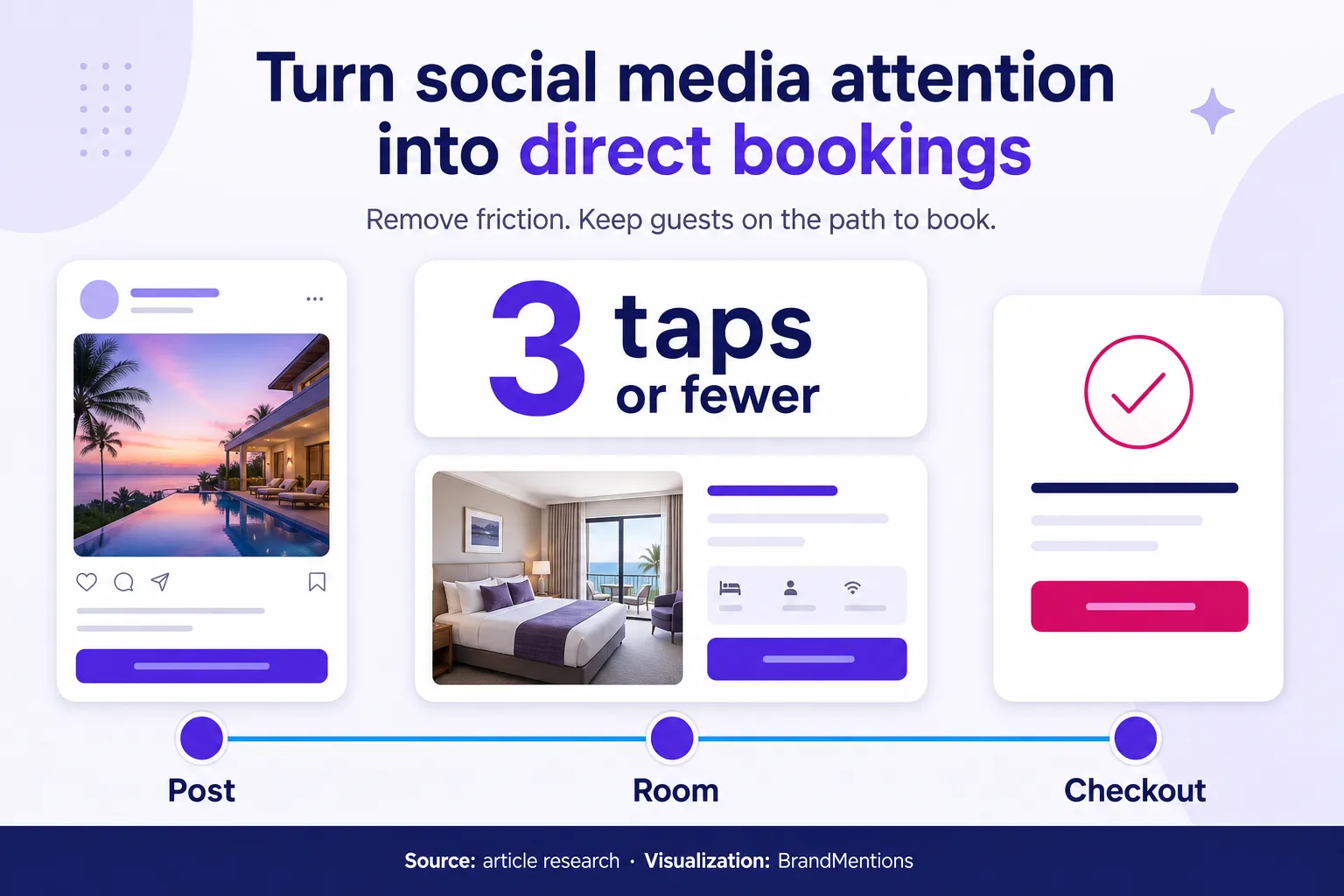
The Book-in-Three-Taps rule: the path from any post to a confirmed booking should be three taps or fewer. Content to link-in-bio, link-in-bio to the room, room to checkout. Every extra tap is a leak.
Open your own profile, tap your bio link, and count the taps to book a room. If it is more than three, that is your first project, before you touch content.
The Hotel Social Priority Matrix
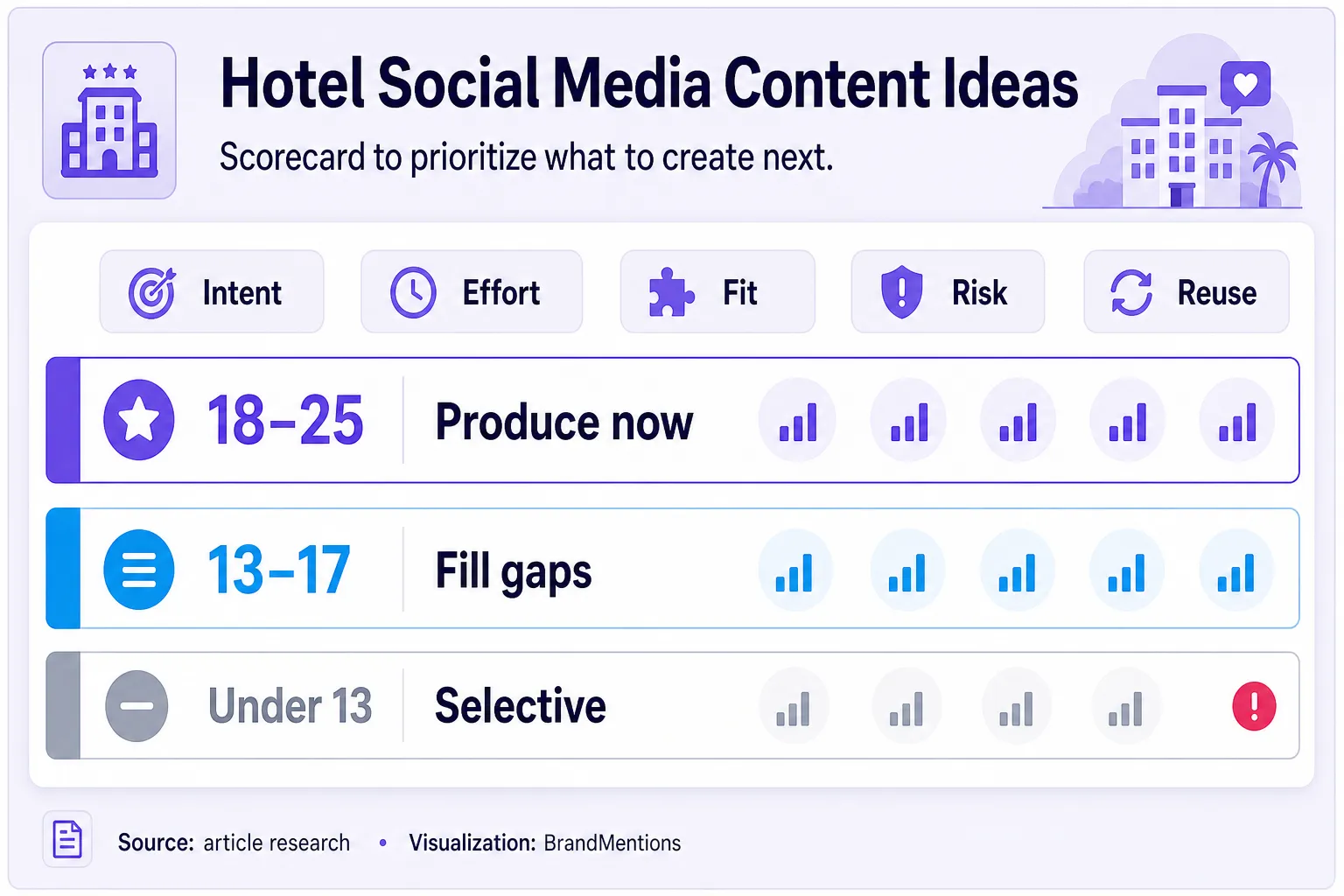
Most hotels have more ideas than time. Before you build next month's calendar, score each idea from 1 to 5 across five factors, then add them up.
| Content idea | Booking intent | Content effort (low = 5) | Platform fit | Service risk (low = 5) | Reuse potential | Total |
|---|---|---|---|---|---|---|
| Ocean-view room tour | 5 | 3 | 5 | 4 | 5 | 22 |
| Wedding venue walkthrough | 5 | 2 | 4 | 4 | 5 | 20 |
| Local creator weekend guide | 4 | 2 | 5 | 3 | 4 | 18 |
| Guest review carousel | 4 | 4 | 4 | 3 | 4 | 19 |
| Rainy-day itinerary | 4 | 4 | 4 | 5 | 4 | 21 |
| Flash discount post | 3 | 5 | 3 | 3 | 2 | 16 |
| Generic pool photo | 2 | 5 | 3 | 5 | 2 | 17 |
| Staff birthday post | 1 | 5 | 2 | 5 | 1 | 14 |
Read it like this:
- 18 to 25: produce now, and consider paid amplification if early signals are strong.
- 13 to 17: use to fill a gap or support a seasonal push.
- Under 13: post only when it serves culture, hiring, or community goodwill.
The point is not the exact math. It is that a beautiful pool photo and an honest room tour are not equal, and your calendar should stop pretending they are.
Pair this with a simple maturity ladder so you do not buy advanced reach before your funnel can convert it. Rung 1, Present: branded profiles with correct location, hours, and a three-tap booking link. Rung 2, Consistent: three to five original short-form videos a week without watermarks. Rung 3, Discoverable: captions and geotags that answer real search queries. Rung 4, Trusted: a UGC pipeline and a reply on every review. Rung 5, Listening: you catch a complaint before it spreads and amplify praise before it fades. Climb in order.
12 Social Media Marketing Ideas for Hotels
1. Build a Measured Posting Cadence, Not a Random Schedule
Cadence only works when the content earns response. Meta's system cards show ranking depends on engagement and watch behavior, so posting daily filler actively teaches the algorithm your content is not worth showing.
For most hotels: three to five Instagram feed posts or Reels a week, daily Stories only when there is real on-property activity, two to four native TikToks a week if you can film candidly, and weekly Google Business Profile updates for events and offers. Add a daily TikTok only if you can sustain quality, not as a rule.
The schedule should follow demand moments. A ski resort does not post the same in July as December. On Monday, pull the last 30 days of native analytics, sort by saves, shares, and profile visits, and build next week around the theme that created the strongest intent signal. Keep one slot open for weather or a guest question.
Non-obvious insight: your posting time matters less than your guest's planning time. A Sunday-night post about "three quiet midweek spa dates still open this month" can beat a perfect Tuesday-morning post, because that is when people plan escapes.
2. Create Recurring Content Pillars From Real Traveler Questions
Expedia Group's Path to Purchase research shows planning spans inspiration, research, planning, and booking, so your pillars need to serve different jobs, not just fill weekday slots.
Strong pillars: Stay here (room types, views, accessibility, pets, parking), Eat here (breakfast, chef specials, bar), Do this nearby (trails, museums, shows, kids' activities), Plan better (packing, weather, transport, best months), Trust us (reviews, guest stories, renovation updates), Book smarter (value dates, loyalty perks, direct-booking benefits).
The old "Monday quote, Tuesday review, Wednesday hotel photo" calendar fills slots but does not match intent. Build the week around questions your front desk actually hears.
Non-obvious insight: repetition is not the enemy. Repetition without progression is. A traveler may need to see five different pieces of proof before they believe one claim.
3. Make Rooms and Resort Spaces Bookable With Vertical Video
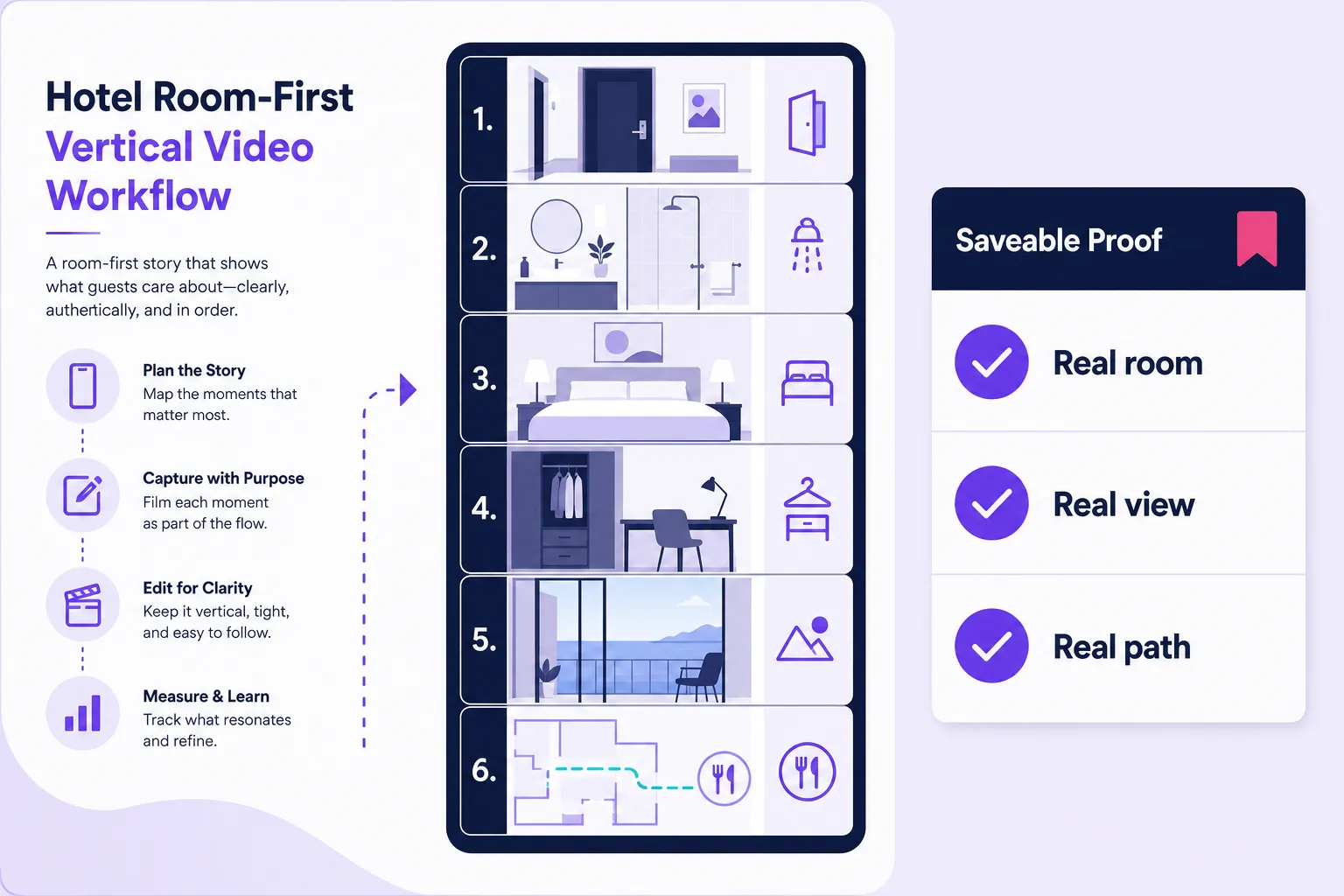
Hotel video often needs more than fifteen seconds, and the format finally allows it. YouTube classifies eligible uploads after October 15, 2024 as Shorts up to 3 minutes when they meet the length and aspect rules. A room tour, venue walkthrough, or spa circuit can breathe.
Film in traveler order. Door, entry, bathroom, bed, storage, work area, balcony or view, amenities, route to elevator, route to pool or restaurant. Do not open with the logo. Open with the question. Answer the physical things people worry about: real size, real view, street noise, stroller fit, distance to breakfast.
Caption for search, and add readable on-screen text plus real captions so the video works with the sound off and for travelers using screen readers. Accessibility is not a nice-to-have here. A large share of viewers watch muted, and clear text overlays lift both comprehension and reach.
The Saveable Room Rule: if a room, suite, cabana, spa, restaurant, or venue post does not earn saves, it probably did not help someone plan. Saves signal future intent, which is exactly what you want a room video to produce.
Non-obvious insight: "cinematic" hotel video often hides the details that make people book. The best-performing room clip looks less like a brand film and more like a confident friend showing you exactly what you get.
4. Build a Recognizable Visual Memory System
A color palette still helps, but travelers remember repeatable cues more than brand hex codes. Pinterest's Predicts 2026 report, built from search behavior across more than 600 million monthly users, shows how fast travel aesthetics shift, so anchor your identity in scenes you can repeat, not a trend you will chase.
Pick two or three signature angles, a consistent way to show the view, food and drink standards, and one clear rule for text overlays. A desert resort might repeat morning light, stone textures, spa water, and sunset fire pits. A city hotel might repeat lobby art, street-corner arrivals, and skyline windows.
Visual identity vs aesthetic grid, the core difference: a grid makes the profile page look consistent. A visual identity makes the property recognizable when one post appears alone in a stranger's feed, which is how most people will meet you.
Non-obvious insight: most travelers never see your grid. They see one Reel, one Story, one shared screenshot. Design every asset to work solo, and never let a curated grid of static photos override the format the feed rewards, which is video.
5. Communicate Property Updates and Behind-the-Scenes Changes
A renovation, new chef, changed pool hours, EV charger, or pet-policy update should not live only in an email. Publish the operational truth on your site, then update your Google Business Profile, where posts appear on Search and Maps and are archived after 6 months unless you set a date range.
Sequence a renovation instead of dumping the finished suite in one shot. Post the demolition, then the mood board, then the reveal. Three posts, a narrative, and a reason to come back, out of one project.
Non-obvious insight: updates are objection-removal content, not announcements. A guest who saw construction in a review needs to know it is finished, what changed, and whether their stay is affected.
6. Promote Events and Private Parties With a Clear Booking Path
The AHLA 2026 State of the Industry report flags the FIFA World Cup and America250 as demand opportunities, while warning that demand varies by market. Event content should not assume the crowd arrives by itself.
Build social packages around weddings, corporate retreats, holiday parties, alumni weekends, sports and concert travel, and local festivals. Each post needs four elements: who it is for, what is included, a date or capacity constraint, and the next action.
Weak: "Host your next event with us." Better: "Planning a 40 to 80 person rehearsal dinner in October? Our courtyard package includes passed appetizers, a private bar, a rain backup, and discounted room blocks. DM 'courtyard' for open Fridays."
Non-obvious insight: event content should sell the planner's reduced workload, not just the venue. Show floor plans, rain plans, parking, load-in, kids' menus, and how long setup takes. That is what a stressed planner is actually buying.
7. Promote Loyalty and Value Over Blunt Discounts
Expedia Group's 2025 Traveler Value Index found 83% of travelers consider travel their top category for redeeming loyalty points. Guests care about value, flexibility, and rewards, which is not the same as the lowest rate.
Explain offers in human terms. "Stay Sunday, get late checkout Monday." "Book direct and receive daily breakfast for two." "Add parking and breakfast for less than booking separately." Match the offer to the need period so you do not train guests to wait for 30% off.
If you run a contest or a tag-to-win promotion, put the rules where people can read them, follow each platform's promotion guidelines, and check local sweepstakes law before you launch. A giveaway that breaks platform rules can cost you the account you built it on.
Non-obvious insight: social is better at explaining value than announcing price. A family may ignore "15% off" but save "free parking plus breakfast, two fewer decisions before 9 a.m."
8. Use Geotags and Hashtags as Classification, Not Reach Hacks
Instagram's 2025 Map update made location-tagged Reels, posts, and Stories discoverable through map-based content, with Stories surfacing for 24 hours. Geotags are no longer decorative. They connect content to a place travelers can search.
Use a tight mix: one or two branded tags, two to four destination tags, two to four intent tags, and one or two seasonal tags. Skip the pile of 30. Your hashtag marketing tactics should support discovery, but captions, visuals, and geotags carry more of the trust work.
Hashtags vs geotags, the core difference: hashtags tell the platform what the content is about. Geotags tell the traveler where the experience happens.
Non-obvious insight: track which geotags create profile visits, not just which hashtags create impressions. For hotels, location intent sits much closer to booking intent than broad travel reach.
9. Turn Guest Content and Reviews Into Proof, With Permission
Tripadvisor research found 76% of travelers prefer long-form reviews for accommodations, because detail helps them picture the stay and judge value. Guest content works for the same reason: it reads closer to the traveler's point of view than your campaign assets.
Do it properly. Never screenshot a guest post and reuse it silently. Ask for rights in one line, store the approval, and credit the creator. Be careful with anyone recognizable in the frame, especially children, and get consent for staff who appear on camera. If you film in public property areas, post clear signage that filming may occur, and follow GDPR and CCPA rules when you collect and reuse guest images.
Diversify beyond the predictable pool shot. Reviews, anniversary photos, pet stays, family breakfasts, and rainy-day lobby moments all prove different claims. Pull from these user-generated content ideas to match content to the specific promise you make.
Non-obvious insight: the best UGC is rarely the prettiest image. It is the image that proves a claim your brand makes, like "walkable," "quiet," "kid-friendly," or "worth the splurge."
10. Work With Local Creators, and Control Disclosures and Rights
A hosted stay counts as a material connection. The FTC's Disclosures 101 for influencers says a free stay, comped meal, upgrade, or affiliate commission must be disclosed clearly, not buried in a tag.
Pick creators by fit, not follower count. A regional food creator with 12,000 engaged local followers drives more qualified bookings than a travel account with a passive million. A good brief covers the goal, audience, exact experience provided, deliverables, disclosure, usage rights, approval, posting window, safety rules, tracking links, and payment terms. Use finding Instagram influencers as a starting point, then check comment quality and prior hotel work.
The Creator Stay Test: would you pay this creator to answer guest objections, not just make pretty content?
Non-obvious insight: the most valuable deliverable is often not the post on the creator's account. It is the licensed asset you can reuse in ads, email, and retargeting for the next 6 to 12 months.
11. Post Original, Platform-Native Content and Answer, Not Advertise
Two things quietly decide whether your account is even eligible for reach. First, originality. Meta's originality guidance limits recommendations for accounts that repeatedly repost unoriginal or watermarked content, so exporting a TikTok with the watermark on and dropping it straight onto Reels costs you non-follower distribution.
The Repost Tax: every watermarked or lightly recycled clip quietly costs you the reach the algorithm would otherwise give you for free. Reshoot for each platform's native feel, and add a real edit or voiceover when you remix a trend.
Second, service. Every comment, DM, and review is a public audition. Set response tiers so nothing slips.
| Message type | Response goal | Owner |
|---|---|---|
| Booking question | Same business day, faster during campaigns | Social or reservations |
| On-property complaint | Within 1 hour during staffed hours | Front office or guest relations |
| Safety issue | Immediate escalation | Manager on duty |
| Event inquiry | Same business day | Sales team |
| Generic comment | Within 24 hours | Social team |
| Review complaint | Public acknowledgment, private resolution | Guest relations |
If complaints cluster on one topic, content is not the fix. Operations is. Social should document the pattern and hand it to leadership, which is where handling negative reviews becomes a workflow, not a panic.
A hotel does not lose trust because one guest complains in public. It loses trust when the reply reads like nobody owns the guest experience.
Non-obvious insight: unanswered praise is also lost revenue. When someone says "I need to stay here," reply with the next step. When they tag a partner, add concierge-level context.
12. Publish Live Utility, and Keep a Crisis Protocol Behind It
The content teams overlook because it feels too practical is the content that earns saves. The U.S. National Weather Service API gives forecasts, alerts, and 12-hour forecast periods for specific grid locations, which you can turn into weekend packing tips, beach or ski conditions, and rainy-day plans.
For destination resorts, keep a permanent "Things to Do" highlight. City hotels should keep "Walkable," "Food," "Events," and "Rain Plan" highlights. When you promote hidden gems, promote them responsibly. Sending thousands of travelers to a fragile trail or a small community can do harm, so point people toward capacity, off-peak timing, and local etiquette instead of just a pin.
The same utility muscle handles a crisis. Before storm season, agree who posts during a wildfire, road closure, or public-safety incident, what the front desk says versus social, and how fast you update. Lock down account governance now, not during the emergency: Business Manager ownership, two-factor authentication on every admin, documented agency access, and a plan for staff turnover so a departing employee cannot lock you out.
Non-obvious insight: utility content creates gratitude before the stay. A traveler who used your rainy-day plan before booking already feels helped by your brand, and that feeling books rooms.
How Should Hotels Serve International Guests on Social Media?
If your guests come from more than one language market, do not run everything in English and hope. Translate captions for your top two or three source markets, and where a market lives on a different platform, meet it there. The old bilingual-caption trick still works, and it signals that the property will not be confusing to navigate on arrival. A short, accurate translation beats a long one machine-translated badly.
Tactic Comparison: Effort, Cost, and Time to Impact
| Tactic | Effort | Cost | Time to impact | Best for |
|---|---|---|---|---|
| Measured posting cadence | Medium | Low | 2 to 6 weeks | Learning what works |
| Content pillars from questions | Medium | Low | 4 to 8 weeks | Consistency |
| Room-first vertical video | High | Low | 2 to 6 weeks | Booking confidence |
| Visual memory system | Medium | Low | 8 to 12 weeks | Recognition |
| Property updates | Low | Very low | 2 to 6 weeks | Objection removal |
| Events and packages | Medium | Medium | 1 to 6 weeks | Group revenue |
| Loyalty and value offers | Low | Low | 2 to 8 weeks | Direct bookings |
| Geotags and hashtags | Low | None | 4 to 8 weeks | Local discovery |
| Guest content and reviews | Medium | Very low | 4 to 12 weeks | Conversion and trust |
| Local creators | Medium | Medium | 1 to 4 weeks | Credible reach |
| Original content and social care | Medium | Low | Ongoing | Eligibility and confidence |
| Live utility and crisis readiness | Low | Low | Immediate | Saves and safety |
Room tour vs offer ad, the core difference in execution. A room tour reduces uncertainty. An offer ad creates urgency. If the room tour is weak, the offer ad has to work too hard. Build the proof first, then buy distribution behind the content that already earned saves, shares, and DMs. On Facebook specifically, a Facebook content strategy built on local events and community packages usually outperforms pure aesthetic posting.
Where a Listening Layer Fits
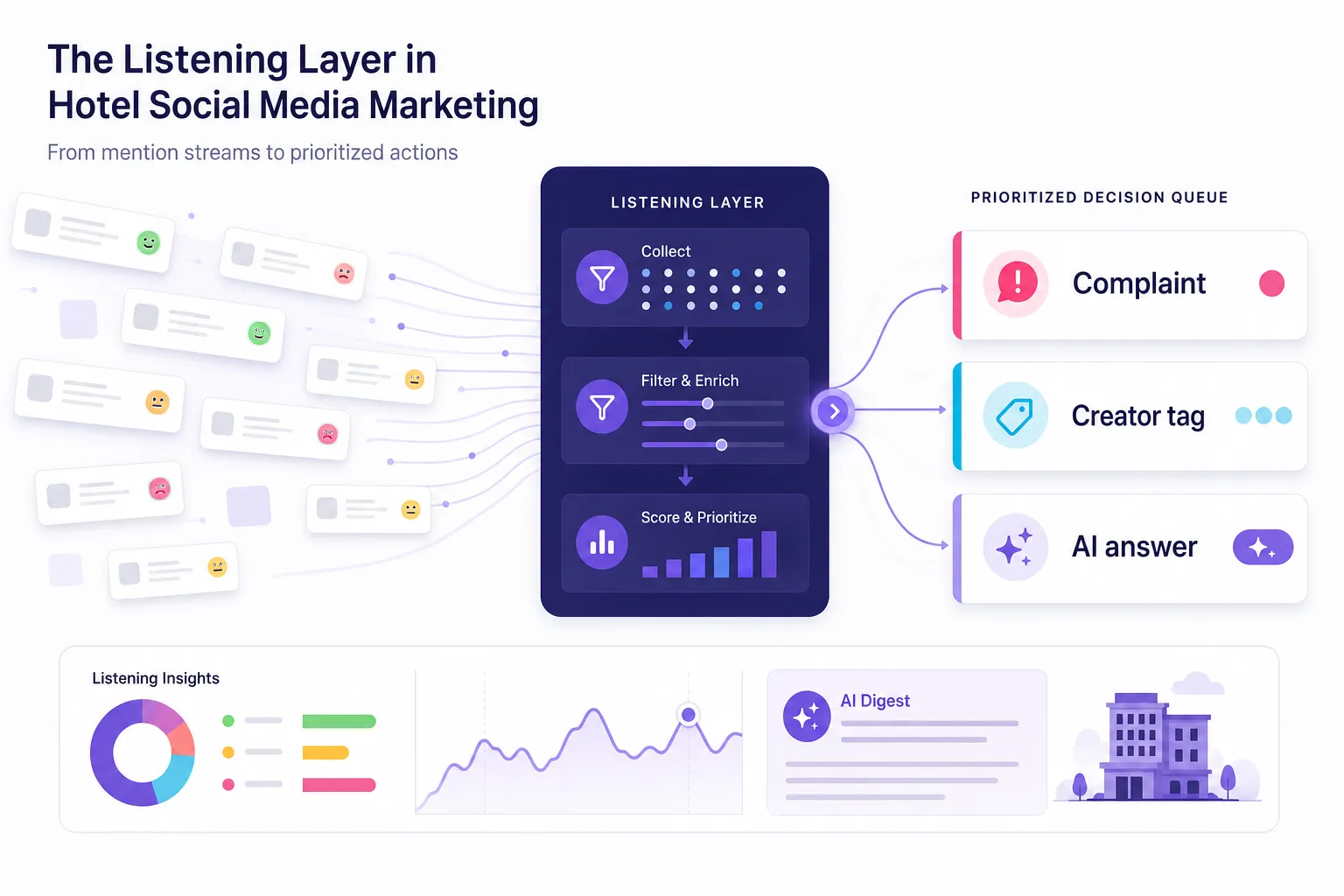
Once content is flowing and guests are talking back, the constraint stops being output and becomes attention. You cannot manually watch every platform, and the mentions that matter are a tiny fraction of the noise.
Brand monitoring is not about watching every mention. It is about catching the few that signal a shift: a complaint about to spread, a creator who just tagged you organically, a journalist forming an opinion. For that filtering job, BrandMentions is useful as cross-channel hospitality reputation monitoring when you need tagged and untagged social mentions, web mentions, sentiment patterns, and AI brand mention tracking in one workflow. Native inboxes are better for replying inside each platform, and large publishing suites are often stronger for approval workflows across big teams, so match the tool to the decision it will change. Wire whatever you choose into structured tourism reputation monitoring so scattered chatter becomes a short decision queue.
The newer job is AI visibility. When a traveler asks an assistant "best boutique hotel in Santa Fe with a rooftop," you want to know whether your property is named. Build a simple test: write down 10 to 15 prompts real guests would ask, run them across the major AI assistants once a month, log whether you appear and what the answer says about you, then treat gaps as content and reputation work. BrandMentions extends monitoring into that answer-engine layer, so you are not blind on the surface quietly replacing the search box. Keep that test separate from your day-to-day social listening, because one measures conversation and the other measures how machines describe you.
Frequently Asked Questions
How often should a hotel post on social media in 2026?
Aim for three to five short-form videos or feed posts per week, weighted toward original Reels, TikToks, and Shorts, with daily Stories only when there is real on-property activity and weekly Google Business Profile updates for events and offers. Consistency and intent signals like saves and shares matter more than daily volume, and posting recycled or watermarked content can pull your account out of recommendations entirely.
Is TikTok or Instagram better for hotels?
Use both for different jobs. TikTok is now a discovery and booking layer, especially since TikTok GO lets U.S. users find and reserve stays in-app through partners like Booking.com and Expedia. Instagram remains stronger for a recognizable visual identity and for nurturing an audience toward a direct booking. If your guests skew under 30, prioritize TikTok discovery. If they skew older, Instagram plus a clean direct funnel does more work.
What should hotels post besides room photos?
Post room comparisons, guest reviews, creator stays, local day-trip itineraries, dining content, event setups, weather and packing tips, transport guidance, behind-the-scenes updates, loyalty perks, and direct answers to the booking questions your front desk hears every day. The goal is proof and usefulness, not another pretty pool shot.
Do hashtags still matter for hotel marketing?
Yes, but as classification, not a reach hack. Use a focused mix of branded, destination, intent, and seasonal tags, then pair them with accurate geotags, search-friendly captions, and content that earns saves, shares, DMs, and profile visits. For hotels, a precise geotag often carries more booking intent than any hashtag.
Can a small independent hotel really outrank a big chain on social media?
Yes. Because reach is now earned per post through engagement rather than follower count or ad budget, a boutique property posting three to five thoughtful, original short-form videos a week can outperform a chain running a committee-approved template. The advantage comes from a repeatable weekly habit, a genuine voice, and content that answers real guest questions.
How do hotels measure ROI from social media when bookings happen later?
Measure each post by the job it was doing rather than last-click revenue, since travelers view an average of 141 pages of travel content in the 45 days before booking. Track inspiration with reach, saves, and profile visits; proof with saves and room-page clicks; and conversion with booking-link clicks and promo-code use. Tag every social booking link with a consistent UTM structure and use a distinct promo code or landing page per campaign so direct revenue is not double-counted as OTA revenue.
Conclusion: Build the Engine, Then Feed It
These twelve ideas are not twelve campaigns. They are one system. Original short-form video earns the reach. Answer-first captions and geotags make you findable. Guest content and honest review response convert interest into a booking, and a three-tap funnel keeps that booking direct instead of handing margin to an OTA.
The properties that win the next two years will not be the ones with the biggest photography budget. They will be the ones that understood the feed stopped rewarding follower counts and started rewarding usefulness, originality, and speed of response. That shift favors the independent operator with a point of view over the chain with a template.
So do one thing this week before anything else. Pick four questions your reservations team hears constantly, build one honest, saveable piece of content for each, and measure saves, shares, DMs, and booking-path clicks. Fix the funnel, then feed it with content only your property could have made.
Filed under: Growth