Increase Social Media Followers: 10 Proven 2026 Tactics
H ow do you increase social media followers in 2026? The answer isn't posting more often or chasing every viral trend. Sustainable growth comes from publishing content that solves real problems, op…

H ow do you increase social media followers in 2026? The answer isn't posting more often or chasing every viral trend. Sustainable growth comes from publishing content that solves real problems, optimizing it for both social search and AI-powered discovery, engaging in the right conversations, and giving people a compelling reason to follow. In this guide, you'll discover 10 proven strategies that work across today's major social platforms, helping you attract more relevant followers, increase organic reach, and build an audience that actually drives long-term business results.
How Do You Increase Social Media Followers in 2026? (Quick Answer)
To increase social media followers in 2026, earn distribution to non-followers first, then give a specific slice of them a clear reason to opt in. Publish original, native content with search-optimized titles and captions, prove value in the first few seconds so real people watch to the end and share privately, and post through visible human voices rather than a faceless brand page. Follower growth is now the byproduct of winning recommendation-driven reach - not the cause of it.
Let me start with the uncomfortable part. In 2026, the follow button is no longer the funnel. You do not grow followers to earn reach. You earn reach to grow followers, and the order of those two things reverses almost everything the old playbooks told you.
I have run enough content and monitoring programs to know where this breaks in practice. Teams still chase a follower number as if it were a bank balance, when the platforms decoupled reach from follower count years ago. Your next thousand followers will come from strangers who watched something to the end and sent it to one friend, not from people who saw a "follow us for more" caption.
So this guide treats follower growth as the byproduct of two things: earning distribution to people who do not follow you yet, then giving a specific slice of them a clear reason to opt in. Every strategy below is built backward from how the recommendation systems actually work right now.
Key Takeaways: How Follower Growth Works Now
- Social media reached 5.79 billion user identities worldwide as of April 2026, per DataReportal, yet the typical user's weekly time on social and video feeds has been roughly flat for three years. Growth now means winning attention, not waiting for new users to arrive.
- Followers are a probability asset, not a distribution guarantee. YouTube's recommendation system learns from more than 80 billion signals, including watch history, search history, and satisfaction surveys, so your content re-earns distribution every time you post.
- Original, native content is now a distribution requirement. Instagram's creator distribution update states that accounts posting unoriginal content 10 or more times in 30 days may lose recommendation eligibility.
- Trend-chasing has a short shelf life. Sprout Social's Index found 93% of consumers expect brands to keep up with online culture, but about one-third find it embarrassing when brands jump on trends, and 27% say trend participation only works within 24 to 48 hours.
- Relevant followers beat raw volume. Bought, irrelevant, or trend-only followers depress engagement quality and confuse recommendation systems, which read a dead test audience as a reason to throttle your reach.
- Real people outgrow logos. LinkedIn reported that more than 100 million members had added at least one profile verification by 2026, part of a broader platform push toward authentic human voices over faceless brand pages.
What is social media follower growth? It is the process of attracting more relevant people to follow, subscribe to, or regularly receive your content across platforms like Instagram, TikTok, YouTube, LinkedIn, Reddit, Pinterest, Facebook, Threads, and X. The goal is not the biggest number. It is a reachable audience that engages, remembers, trusts, and eventually buys.
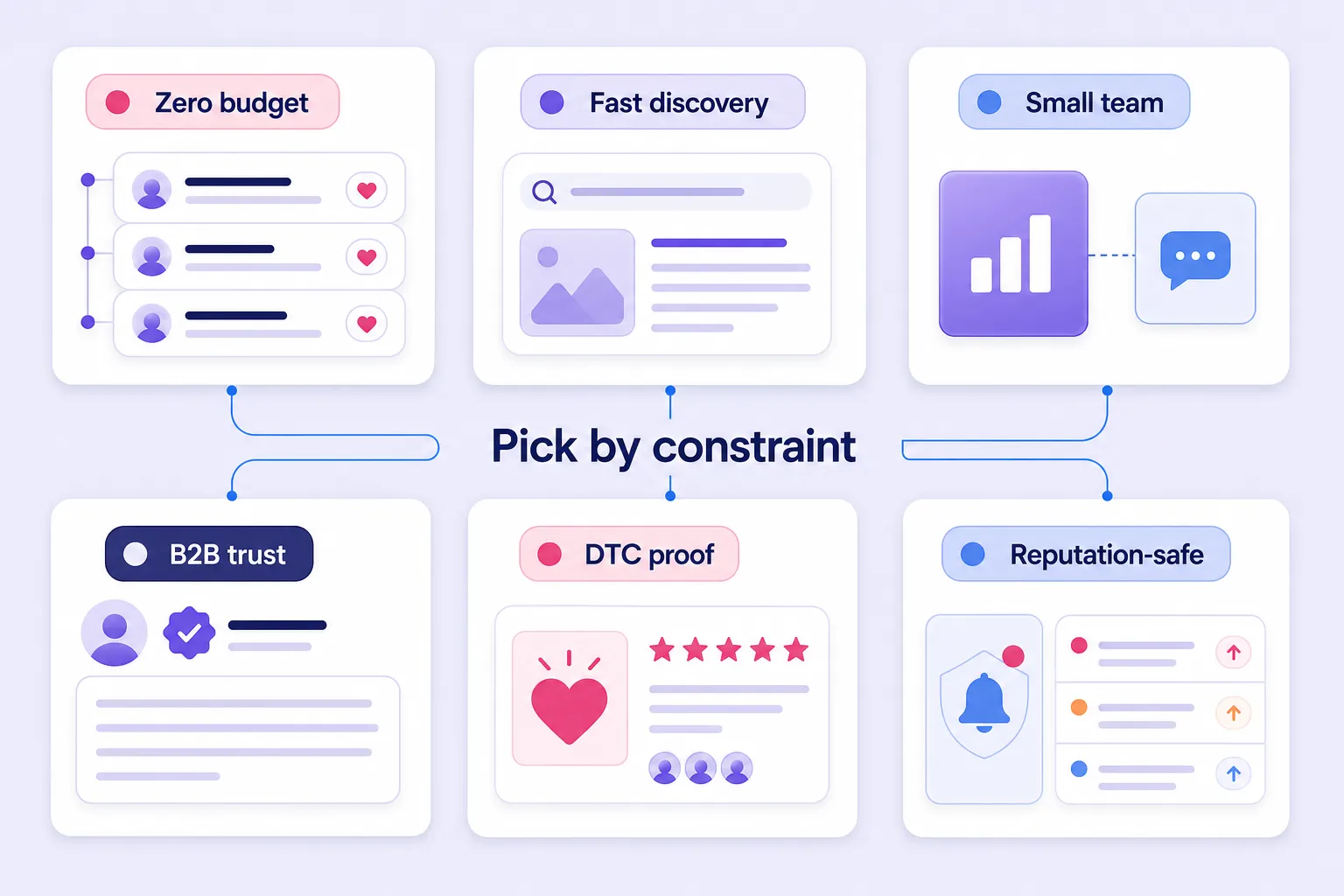
Best Follower-Growth Tactic by Goal (At a Glance)
Pick the strategy that matches your constraint, not the one that sounds most impressive.
- Best for zero budget: Niche conversation engagement. Useful public answers create profile visits and relevant follows before you spend a dollar.
- Best for fast discovery: Search-optimized short-form video. Reels, TikToks, and Shorts reach non-followers when the opening seconds and caption keywords line up with intent.
- Best for small teams: One primary platform plus one support platform. Master one surface before adding another, or you become average on all of them.
- Best for B2B and considered purchases: Founder and employee visibility. Credible human voices earn the conversation-and-dwell signals professional feeds reward.
- Best for e-commerce and DTC: Customer-created content (UGC). It is the highest-trust, lowest-cost content you will ever run.
- Best for reputation-sensitive brands: Listen before you publish. One ignored complaint can outrank ten polished posts.
- Best for long-term compounding: Entity consistency across profiles. Clean, matching bios and links make your brand easy for people, search, and AI systems to identify.
How Is Social Media Follower Growth Different in 2026?
Five years ago, the follow button was the whole distribution chain. You reached your followers, some of their friends saw your posts through likes and shares, and growth was roughly proportional to the audience you already had. That model is gone.
Every major feed now runs on an interest graph layered over the social graph. Reels, For You, Shorts, Explore, LinkedIn recommendations, YouTube Home, and Reddit and Pinterest discovery all expose people to accounts they do not follow. A follower is no longer your whole audience. It is a signal of repeated interest.
The practical reversal most teams have not internalized: a non-follower view is the platform testing whether your content deserves a larger audience. Your followers are the seed group that decides whether that test passes.
Stop optimizing for the follow button. Optimize for the moment a stranger decides to watch to the end or send your post to one specific person, because that decision is what the system is actually counting.
This is also why bought followers are worse than useless now. A bloated count with dead engagement tells the recommendation system your content is not worth distributing, because your seed audience never responds during the critical early test.
Can You Still Grow Followers Organically Without Paying for Ads?
Yes, and 2026 is arguably better for it than the previous three years. The systems now reward signals money cannot easily manufacture: retention, completion, saves, and private shares.
The catch is discipline. You are not buying impressions, you are earning them one retention curve at a time. Teams that treat organic as a 90-day compounding project win. Teams expecting one viral hit usually quit before the system has learned who their content is for.
Paid amplification still has a job, but a narrow one. Use ads to pour fuel on a post that already performed organically, never to rescue a mediocre one. Boosting weak content buys followers who churn within a month and leaves you with worse audience data than you started with. If you are going to spend, spend behind a proven post or on creator whitelisting where the creative already earns trust.
How Do You Choose Which Social Media Platform to Grow First?
Follow the attention, then follow the buyer. Time spent is the pool your content competes in, but where your audience makes decisions is a different question.
A B2B software brand growing on TikTok because "that is where the time is" collects followers who never buy. A local restaurant ignoring Reels because "our customers are older" leaves the cheapest reach on the table. The Pew Research Center Social Media Fact Sheet shows how sharply platform use splits by age, which is why platform choice should follow your audience, not your team's personal habits.
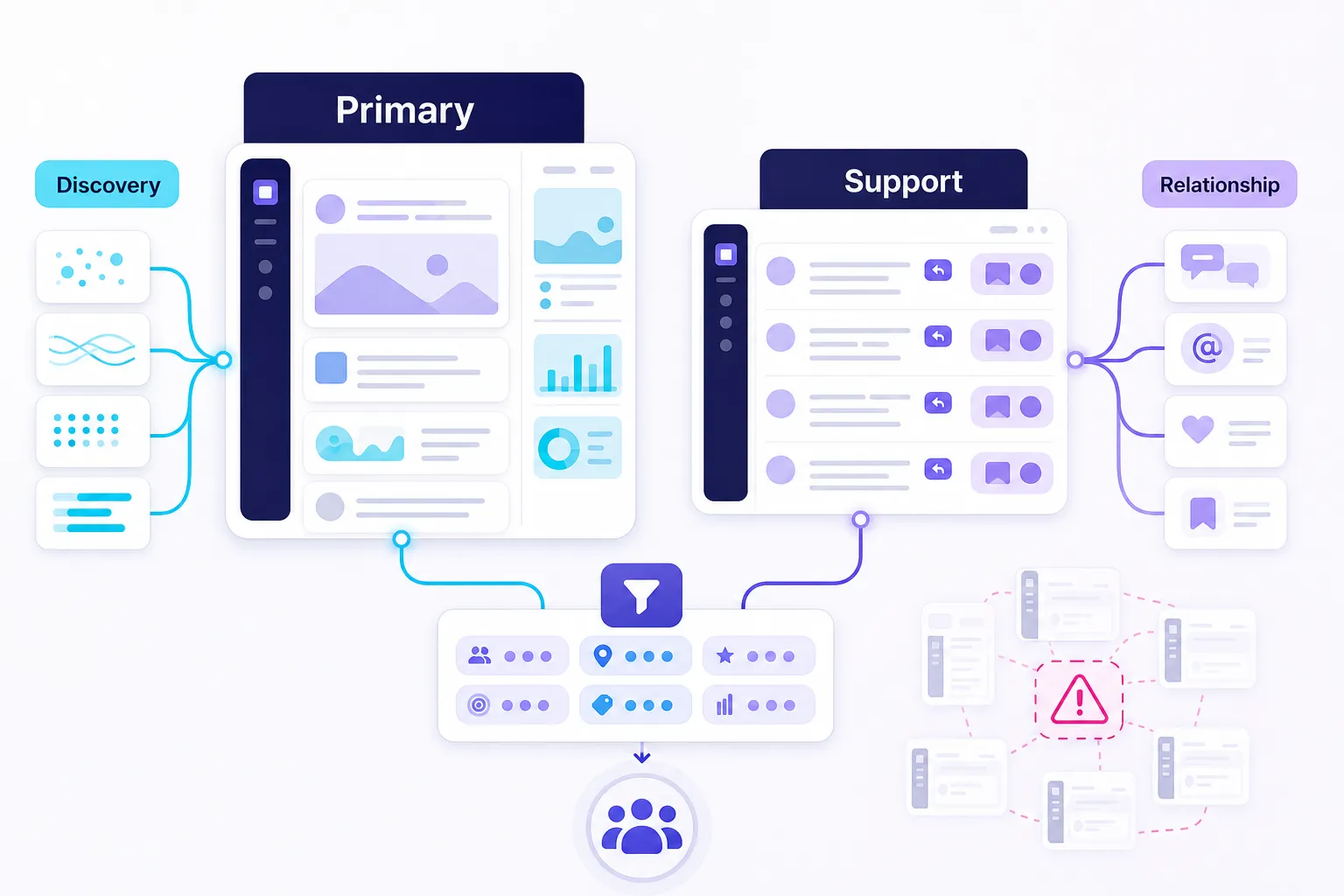
The one primary, one support rule: pick one discovery platform and one relationship platform, and add a third only after both run on repeatable workflows.
DataReportal's Digital 2026 analysis reports that online adults use an average of 6.75 social platforms each month. Your audience is multi-platform. Your team should not try to be excellent everywhere at once. If you run a lean operation, keep the scope realistic with a plan built for small business social growth rather than a ten-channel calendar you cannot sustain.
Social Media Platform Selection Matrix
| Platform | Strongest for | Content format fit | Purchase-intent signal | Team lift |
|---|---|---|---|---|
| TikTok | Fast discovery, zero-follower reach | Native short video, search captions | Medium, rising via Shop | High |
| Visual proof, DTC, creators | Reels, carousels, Stories | Medium to high | Medium | |
| YouTube | Depth, long-term search | Long video plus Shorts | High for considered buys | High |
| B2B authority, hiring | Text, carousels, video | High per follower | Medium | |
| Technical trust, niche depth | Discussion, AMAs | High intent, low tolerance for pitching | Medium | |
| Search-led planning | Static and video pins | High for retail and DIY | Low | |
| Groups, local, older demos | Groups, events, video | Medium | Low |
One note that matters more than most guides admit: a brand account and a personal creator account grow differently. Creator accounts convert faster on individual trust and can take creative risks. Brand accounts carry approval overhead and reputation exposure. Decide which you are running before you copy tactics built for the other.
1. Define Your Ideal Follower Before You Try to Grow
Start here because algorithm expansion only works when the seed audience is tight. If a hobbyist and an enterprise buyer both follow you, the recommendation engine builds a fuzzy similarity map and pushes your content toward a compromised middle. You collect followers who never engage, and that dead weight dilutes your next round of distribution.
Define your follower in one sentence: "We want [specific audience] to follow us because we help them [specific outcome] with [specific format or perspective]." Then audit your profile against it. Can a stranger understand the promise in five seconds? Does your pinned content prove it?
The non-obvious insight: follower growth often starts with unfollow prevention. A viral post sends people to a profile that does not clearly state the next benefit, and they leave without converting. Fix the profile before you chase the reach. If your base needs strengthening first, use your owned content to boost social presence in a way that matches the exact audience you want.
The follower fit rule: if a post attracts followers who will not care about your next ten posts, the growth is cosmetic.
2. Post Informer Value, Not Meformer Content
The old split still holds. Meformers post about themselves. Informers post to help, teach, alert, or amuse. In 2026 the platforms enforce that split mechanically.
Instagram's creator distribution update says original content can be shown first to a small interested audience and then expanded if it performs, while reposted content may be replaced in recommendations by the original creator's version. Accounts that post unoriginal content 10 or more times in 30 days may lose recommendation eligibility entirely. Curation still works, but only when your point of view adds something.
Use a simple litmus test on your last 20 posts. If more than roughly a third are brand-centric, pause self-promotion until you have published ten pure informer assets. And run the logo test: if you removed your logo, would your audience still recognize the post as yours? If not, the format is too generic to travel.
The non-obvious insight: value is judged fast. Posts that read as low-value in their first half hour get progressively narrower distribution, and you cannot fake it, because real people vote with the back button faster than any signal can rescue.
3. Engage in Niche Conversations Before You Publish More
Growth is not only what you publish. It is where you show up in other people's threads. A sharp, specific answer in a live discussion puts you in front of an already-warm audience, and people often follow from the comment section before they ever reach your feed.
The order of operations matters: listen first, then engage. You need to know which conversations are moving, who drives them, and what your audience is frustrated by before you can add anything useful. Reddit Pro Trends lets brands monitor keywords, conversation volume, and related terms across communities, which is a clean way to find the threads worth entering rather than guessing.
This is also where a monitoring workflow earns its place. BrandMentions is best for deep historical tracking of brand and topic mentions across social, news, blogs, forums, and video, which helps you catch the few conversations that signal a shift instead of drowning in every mention. Increasingly that also means watching how your brand surfaces inside AI answer engines, since more discovery now runs through AEO (Answer Engine Optimization) and assistants that summarize who to trust. The skill is filtering, not collecting.
The non-obvious insight: reply velocity matters most while a conversation is forming, not after it peaks. The first substantive answer in a technical thread captures the curiosity clicks. To find those threads before they crest, our guide to spotting trending hashtags shows how to read momentum early.
If you want better followers, stop broadcasting into silence. Go where your audience is already asking the question, and answer it 90 seconds before anyone else does.
4. Write a Search-Optimized Title Before You Film
The feeds now behave like search engines, and that changes how you write. A person opens an app, types "budget home office lighting," and follows the creator whose Reel answered it. That journey starts in a search bar, not a scroll.
TikTok's Creator Search Insights surfaces the real queries people type and ties video ranking to caption-keyword relevance. The platform's language model scans your caption text, tags entities, and matches them to searches. Hashtags are secondary. Keyword-dense, human-readable text is primary.
So invert your process. Write the title first, and make it a search title, not a clever one: "How to replace a zipper slider without sewing," not "You won't believe this hack." Then film the content to prove the title. This is the Google-doc-first, camera-second habit, and it stops you making beautiful videos nobody searches for.
The non-obvious insight, and an accessibility win at the same time: put the answer in the caption text, not only in the voiceover. Answer engines and search crawlers read caption text far more reliably than speech. Subtitles, readable on-screen text, alt text on images, and transcripts also widen your reachable audience and lift watch completion, which feeds distribution. Machine-readable and human-accessible are the same investment.
5. Use Social Media Trends Only When They Fit Your Audience
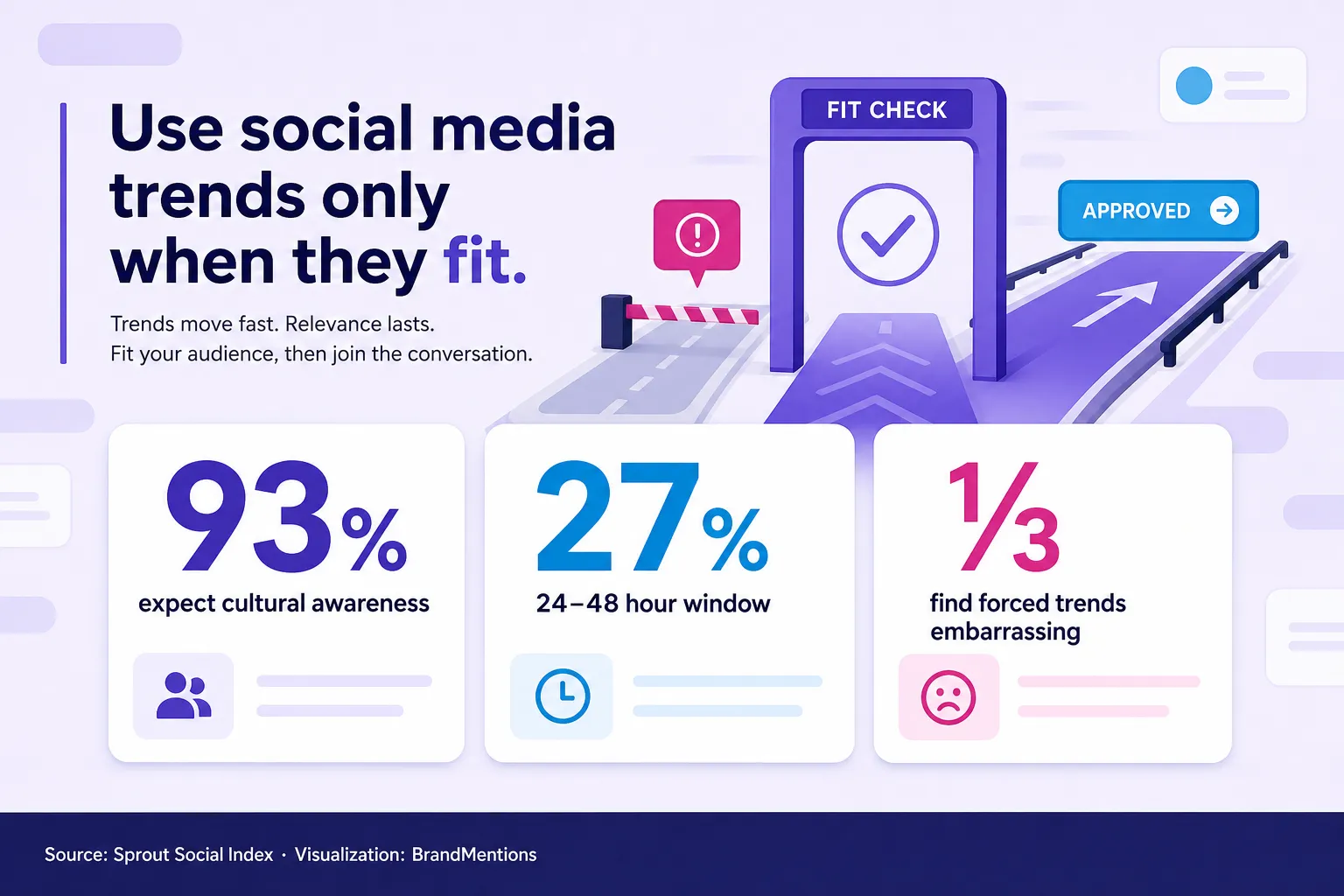
Trends are a calendar shortcut that backfires more often than teams admit. The Sprout Social Index found that 93% of consumers expect brands to keep up with culture, but about a third find it embarrassing when brands force a trend, and 27% say participation only works within a 24-to-48-hour window.
That last number should reshape your approval process. A five-day signoff kills nearly every trend opportunity, so build a fast lane for time-sensitive content with a clear owner and a brand-safety check that takes minutes, not days. Before you jump on anything, ask: does my audience already get this reference, can I attach it to a real customer problem, can I post inside the window, and would it still make sense if it never went viral? Fail two and skip it.
The non-obvious insight: format trends are safer than joke trends. A format (a teardown structure, a "day in the life," a specific transition) can carry your expertise. A joke usually forces your brand into someone else's personality and ages badly the moment the sound stops trending.
Trend participation vs. trend dependence: participation borrows attention for a message you already own; dependence replaces your strategy with whatever the feed is doing this week.
6. Collaborate With Niche Creators, Not Celebrities
The economics have inverted the old celebrity model. Niche creators with roughly 4,000 to 50,000 followers convert better because audience overlap is sharper and their recommendation reads as peer advice, not paid endorsement. When you appear as a genuine guest on their content, the platform reads the audience overlap and boosts your profile to their followers.
Vet with three checks. Their average view count should stay within about 15% of their follower total (real attention, not a ghost town). Their comments should show people tagging friends, not emoji strings. And they should already reference your category without an active brand deal. If they have mentioned your problem space before, the pitch shifts from "let me explain who we are" to "here is a joint idea for your people," and that warm path closes far faster.
Disclosure is not a footnote. The FTC's Disclosures 101 for Social Media Influencers requires clear disclosure of material relationships, and notes that platform tools alone may not be enough. If the audience feels tricked, the collaboration can earn reach and still cost you trust. Some of that content will also be user-generated content you can reshare, which compounds the value of every partnership.
One macro post is a bet. Twenty aligned niche creators is a system. Build the system, and start with the creators who already talk about you unprompted.
The collaboration safety line: if you have to script every word for the creator, you probably chose the wrong creator.
7. Build for Recommendation Eligibility, Not Just Engagement
Here is a distinction most marketers miss: content can be allowed on a platform and still be ineligible for broad recommendation. TikTok's For You feed eligibility standards list unoriginal content, fake engagement, undisclosed paid content, low-quality clips, and several sensitive categories as ineligible for the For You feed, even when the content is not removed. TikTok also states that content from account holders under 16 is not eligible for the For You feed at all.
Recommendation eligibility is the hidden floor under follower growth. If a post cannot travel, it cannot create new followers, no matter how good it is. Run a pre-publish checklist: no watermark from another app, meaningful edits or commentary on any reused material, a caption that promises what the content delivers, clear disclosure on anything sponsored, and no clickbait the video does not pay off.
This is also where account-health hygiene lives. Recycled or watermarked content, engagement-bait captions, and repeated reposts are the real cause of most "my reach suddenly dropped" panics, not a mythical shadowban. Audit your last 30 days before you blame the algorithm, and if a post genuinely got a strike or an originality flag, use the platform's appeal flow rather than posting through it.
The non-obvious insight: originality now reads as a distribution feature, not a creative luxury. Slightly raw and real often outperforms studio-grade, because the systems down-rank content that looks recycled or over-produced. If you want to see which formats earn saves and comments instead of passive scrolls, our notes on how to boost engagement go deeper.
8. Give Viewers a Clear Reason to Follow
A follow CTA works best after the content proves value, not before. YouTube's recommendation system leans on watch history, search history, feedback, and satisfaction surveys, so asking someone to subscribe before you have earned a useful moment feels needy and converts poorly.
Replace vague asks. "Follow for more" tells nobody what "more" is. Give a future reason instead: "Follow for one practical example every week," "Save this and follow for the next checklist," "Follow if you work on this problem and want the field notes." Specificity is the whole trick.
The non-obvious insight: a strong content path beats a stronger single post. If someone likes one video and your profile shows no clear next step, you lose the follow. Pin your best explanation of what you do, turn a high-performing topic into a series, and use playlists, guides, and highlights so a first-time visitor sees exactly what following you gets them.
The two-surface test: before publishing, decide whether the post is for current followers, non-followers, or both. Follower-only content deepens relationships; non-follower content creates discovery. A healthy calendar runs both on purpose.
9. Cross-Promote as Translation, Not Copy-Paste
Posting the same file to five platforms is a guaranteed underperformer. Each engine detects mismatched aspect ratios and foreign watermarks and throttles reach accordingly. Cross-posting is not copying. It is translation.
Take one core idea and rebuild it natively: a thread for text platforms, a carousel for Instagram and LinkedIn, a keyword-titled short for YouTube, a discussion post for Reddit. The extra 20 minutes per platform routinely earns more than the duplicate ever would. Give each platform a different promise too. Instagram shows process, LinkedIn shows lessons, YouTube teaches depth, Reddit answers the hard questions. Same brand, different reason to follow.
There is a quieter payoff. Google Business Profile lets you manage social links, and your profiles increasingly act as entity signals across search, maps, and AI answers. Inconsistent handles, abandoned accounts, and broken links make your brand harder to identify and trust. Fix your website footer, YouTube About tab, bios, and business profile so they point to the same, current destinations. And instead of guessing at timing, use platform analytics and general best posting times as a starting hypothesis, then test against your own account data.
The non-obvious insight: entity consistency now feeds AI visibility. When your name, description, and core facts match across every profile, answer engines are likelier to treat you as a verified source worth citing. A single contradiction, like two different founding years, adds enough noise to hurt that.
10. Grow Through Real People, Not Only Brand Pages
People follow people faster than they follow logos. A founder, an executive, or a handful of visible employees will almost always outgrow the brand account, and their reach flows back to it. LinkedIn's 2026 feed update points the same way, using generative recommenders and LLMs to better understand posts while reducing recycled content, engagement bait, automated comments, and coordinated engagement.
You do not need every employee to become a creator. Forced advocacy produces awkward reshares. Build a small bench instead: a founder for category perspective, a product expert for practical depth, a customer-facing employee for the recurring questions, and the brand page for launches, hiring, and official updates. The strongest employee content is never "please share our post." It is "here is what I learned building this" or "here is a mistake we fixed."
A personal brand carries real reputation risk (the Elon Musk and Tesla dynamic cuts both ways), so it needs guardrails, not just enthusiasm. This is where monitoring earns its keep: BrandMentions can track how a founder or executive is discussed across social, news, and AI answer engines, giving you early warning when sentiment shifts before it spreads. That early signal is the difference between a correction and a crisis.
The non-obvious insight: your best ambassador is rarely the executive with the largest network. It is the practitioner who explains the work clearly and replies generously. For early-stage teams, our guide to social marketing startups shows how to run this without a big headcount.
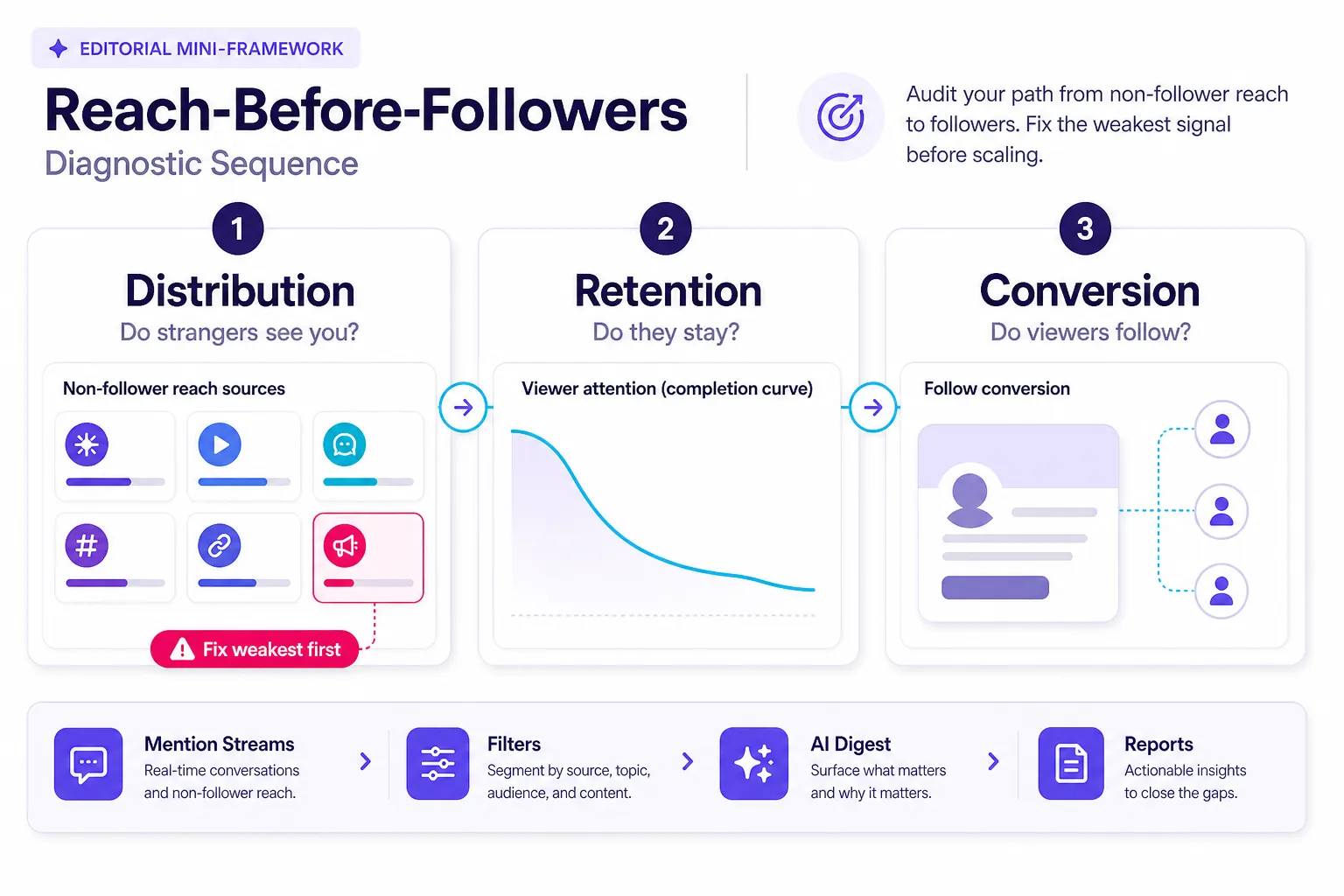
The Reach-Before-Followers Sequence: A Diagnostic Framework
Most follower guides hand you a list and wish you luck. Here is the sequencing model I use to decide what to fix first, based on where an account is actually stuck. Score your account on the three signals below, then work only on the weakest one. Fixing your weakest signal beats polishing your strongest.
Signal 1, Distribution: do strangers see you? Check the share of reach coming from non-followers. If it is low, your problem is distribution, not conversion. Prioritize strategies 2, 4, and 7. Nothing else matters until strangers see your content.
Signal 2, Retention: do they stay? Check average watch time and completion. If completion is weak on video, your openings are the bottleneck. Fix hooks and titles for four weeks before touching anything else. More posting only amplifies a weak signal.
Signal 3, Conversion: do viewers follow? Check follows-per-reach and profile visits. If reach is healthy but follows are flat, your problem is reason-to-follow. Prioritize strategies 1, 8, and 10, plus a benefit-led bio and a consistent theme.
The diagnostic that ties it together: if you cannot name the one thing a stranger gets by following you, no tactic will fix your growth. Run this audit monthly, because your weakest signal moves over time and your effort should move with it.
Follower-Growth Strategy Comparison (Effort, Cost, and Time to Results)
| Strategy | Effort | Cost | Time to first signal | Main risk |
|---|---|---|---|---|
| Define your follower | Low | Free | 1 to 7 days | Persona too broad to act on |
| Informer voice | Medium | Free | 2 to 6 weeks | Producing generic formats |
| Niche engagement | Low | Free | 1 to 4 weeks | Sounding promotional |
| Search-titled content | Medium | Free | 3 days to 2 weeks | Chasing zero-volume queries |
| Fit-checked trends | Medium | Free | 1 to 14 days | Posting outside the window |
| Niche collaborations | Medium | Medium | 2 to 12 weeks | Poor audience fit, weak disclosure |
| Recommendation eligibility | Medium | Free | 2 to 8 weeks | Content that publishes but cannot travel |
| Clear follow CTAs | Low | Free | 1 to 4 weeks | Asking before earning interest |
| Native cross-promotion | Medium | Free | 4 to 12 weeks | Copy-paste fatigue |
| Real-people advocacy | High | Free to low | 2 to 6 months | Forced or off-brand posting |
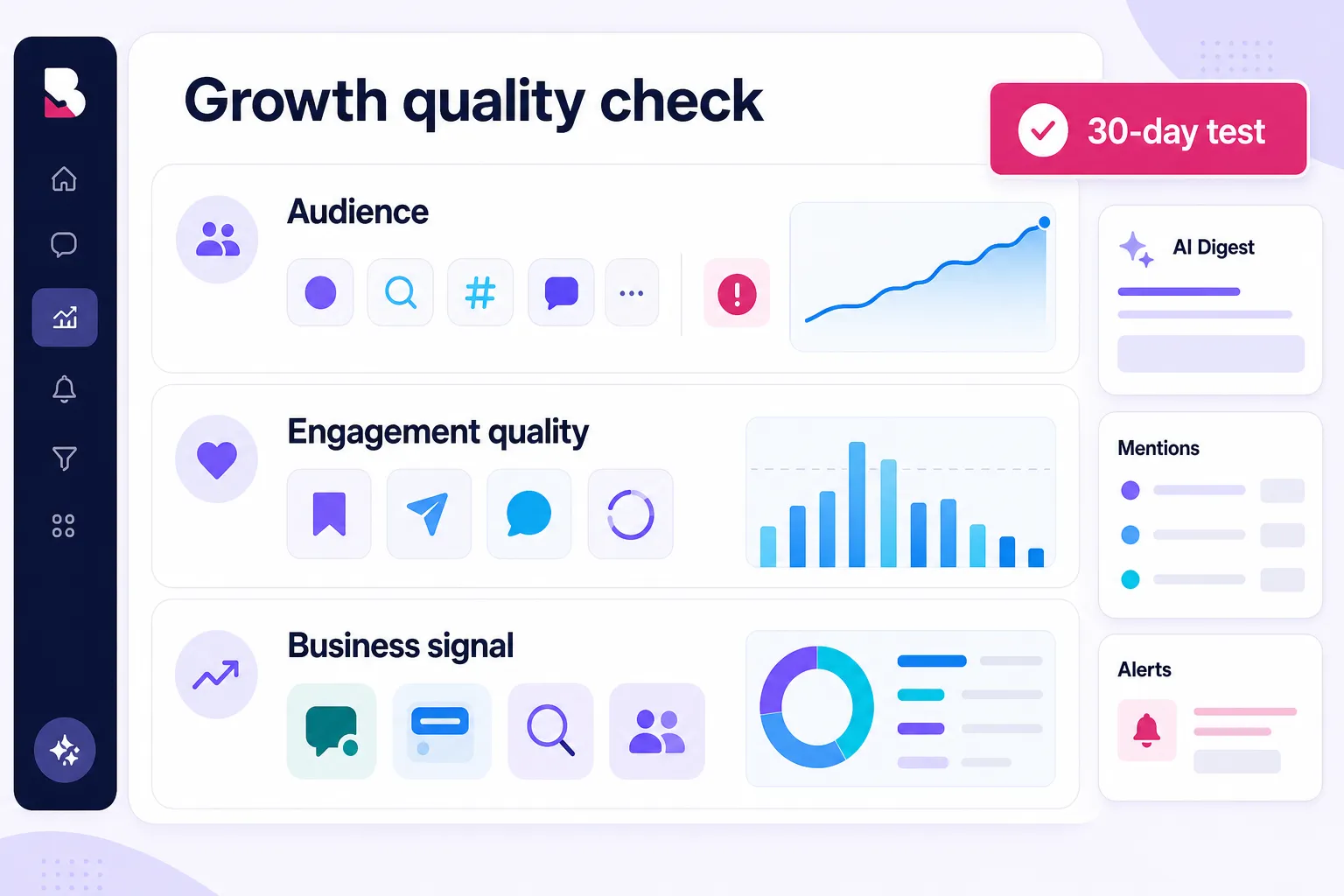
How to Measure Social Media Follower Growth Without Fooling Yourself
Track growth in three layers so a good top-line number cannot hide a bad campaign. Audience: net new followers, follower source, and unfollow rate. Engagement quality: save rate, send rate, comment rate, and watch completion. Business signal: qualified DMs, signups, branded search, and referral traffic.
The formulas worth watching weekly are follows per reach (new follows divided by accounts reached), profile-visit-to-follow rate, non-follower reach share, and unfollow rate after a spike. A viral post that spikes followers and then bleeds them within two weeks attracted a moment, not an audience.
The 30-day quality test: if follower count rises but saves, comments, profile visits, branded searches, or qualified DMs do not rise within 30 days, you bought attention, not durable interest.
One more discipline that protects everyone: keep the legal and ethical guardrails visible. Disclose paid partnerships, respect platform terms and community rules when you engage, avoid scraping data your tools are not permitted to collect, follow contest and giveaway rules, and be careful with minors and regulated claims in health or finance. Social listening is a monitoring practice, not a surveillance one. Watch public conversations, respect privacy, and act on the few mentions that signal a real shift.
Frequently Asked Questions
How many followers do you need to make money on social media in 2026?
Fewer than you think, because engagement matters more than size. Nano and micro creators with tightly engaged audiences are the most sought-after partners precisely because they convert. A focused audience of a few thousand in a clear niche is often more monetizable than a passive hundred thousand.
Is it better to post more often or focus on quality?
Quality and consistency first, volume last. For most teams, three to five strong posts a week on a primary platform beats daily filler. If you cannot respond to comments and DMs, reduce posting before you increase it. There is no universal frequency; pick a cadence you can hold for a year.
Do hashtags still help grow followers?
They help as classification signals, not as a growth strategy on their own. A small set of specific, audience-relevant hashtags supports discovery, but keywords in your captions, on-screen text, and bio now do at least as much work, because the feeds behave more like search engines. Treat hashtags as one input.
Why did my social media reach suddenly drop this year?
Usually it is the shift toward original content, retention, and authentic engagement, combined with down-ranking of recycled or watermarked posts. Audit your last 30 days for reposts, foreign watermarks, engagement-bait captions, and off-topic content before assuming a penalty. Most reach drops are a content problem, not a shadowban.
How long does it take to grow social media followers organically?
Treat organic growth as a 90-day compounding project, not a one-post event. Low-effort moves like defining your follower or tightening your bio can shift metrics in 1 to 7 days, while native cross-promotion and real-people advocacy typically take 4 weeks to 6 months to show durable follower gains. The system needs repeated posts to learn who your content is for before it expands your reach.
Conclusion: Grow the Reach, and the Followers Follow
The teams still chasing a follower number in 2026 are optimizing the scoreboard instead of the game. The game is distribution to the right non-followers, and it is won by three things no budget can fake: content that earns the first few seconds, content worth saving or sending to one specific person, and a profile that gives a stranger an obvious reason to stay.
Everything here serves those three. Search-titled content and recommendation eligibility get you seen. Niche engagement, collaborations, and UGC get you shared. Clear CTAs, real people, and entity consistency give discovery a reason to convert into a follow.
Here is your Monday-morning plan. This week, run the Reach-Before-Followers audit and name your single weakest signal. In the next 30 days, fix only that: if distribution is weak, rebuild your titles and originality; if conversion is weak, rewrite your bio, pin your best asset, and add a specific follow reason to your top format. By day 90, add a second surface, one recurring collaboration, and the 30-day quality test as a standing checkpoint with a named owner.
Growth compounds when you stop spreading effort evenly and start applying it where the system is actually holding you back. The next follower is not the goal. The next relevant follower is.
Filed under: Growth




1 comment