How Long Does It Take for AI Search to Cite a New Brand Mention?
A data-backed benchmark of how fast ChatGPT, Perplexity, Gemini, Google AI Mode, Copilot and Claude cite new brand mentions in 2026.


Quick answer: Some pages appear within a day; others remain uncited throughout a month of tracking. The timing depends on the search platform, the source, and the questions being tested. In Semrush’s experiment with 81 new pages, Google AI Mode cited 29 pages the day after publication, compared with eight in ChatGPT Search. By day 30, the number of pages being cited was 21 in AI Mode and 34 in ChatGPT. These results describe one established publisher’s website, not a guaranteed timeline for every brand.
The essential distinction is between a first citation and recurring visibility. This guide compares published timing studies, explains their limitations, and shows how to measure when a specific page first appears, and whether it continues appearing, in AI answers.
Key figures at a glance
- Owned page, first citation: 13 days (reported median, all engines)
- Earned mention, first citation: 22 days (reported median, all engines)
- Recurring citation, owned (5 cited days out of 7): 41 days (reported median)
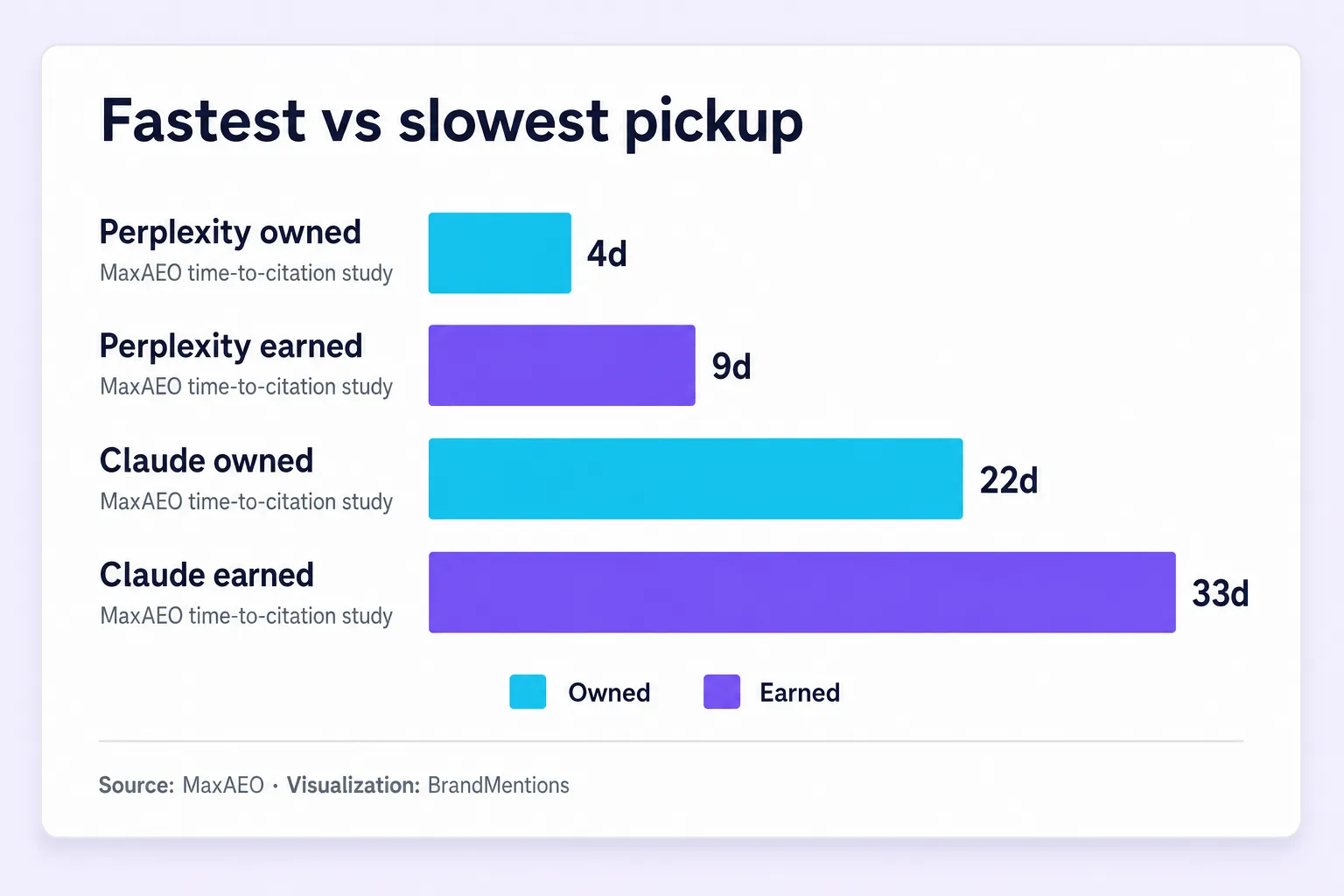
- Fastest engine: Perplexity, 4 days owned / 9 days earned
- Slowest engine: Claude (web access), 22 days owned / 33 days earned
- Timing evidence base: 1,240 sources (740 owned, 500 earned), 132 brands, 7 engines, February through May 2026
- Durability context: weekly domain-level churn-in of 56% on Google AI Mode (54% in the US) and 74% on ChatGPT Search (German market) in SISTRIX’s December 2025–April 2026 data, with a stable core of one to five domains in 86% of AI Mode prompts
Key definitions: what is time to first AI citation versus recurring citation?
- Time to first AI citation is the elapsed time between a verified start event - publication of an owned page, or insertion of a new brand passage into a third-party page - and the first saved AI answer that presents that source as supporting evidence.
- Time to recurring citation measures the same start event against a complete seven-day window in which the source is cited on five of seven days.
- Sustained visibility measures the same start event against four consecutive weeks that each meet the recurrence rule. This tier is an editorial addition, not a reported research finding.
- In the SISTRIX results cited here, churn-in is the percentage of domains cited in the current weekly observation that were absent from the previous one. It is distinct from retention and individual citation lifespan.
- Stable core describes the small set of domains - one to five in 86% of Google AI Mode prompts in the drift research below - cited reliably week after week while the surrounding sources rotate.
The two benchmark sections below report what published research says about each clock, engine by engine.
How long does each AI engine take to cite owned pages and earned mentions?
A new owned page reaches its first AI citation in a reported median of 13 days and an earned third-party mention in 22 days; per-engine medians run from 4 days owned and 9 earned on Perplexity to 22 and 33 on Claude.
One verified source link in a saved answer establishes a first citation; a brand name appearing in generated text without a source link does not.
The table below aggregates data coming from MaxAEO's panel of 1,240 sources (740 owned pages and 500 earned mentions) across 132 brands and seven surfaces, observed daily against approximately 50 prompts per brand from February through May 2026, published July 2, 2026.
| AI engine or surface | Owned page (median days) | Earned mention (median days) | Difference in reported medians | Diagnostic emphasis |
|---|---|---|---|---|
| Perplexity | 4 | 9 | +5 days (+125%) | Capture early appearances without assuming they persist |
| Google AI Mode | 6 | 14 | +8 days (+133%) | Separate fast pickup from subsequent source rotation |
| ChatGPT (web search) | 11 | 19 | +8 days (+73%) | Record whether the tested session actually performed a search |
| Microsoft Copilot | 13 | 22 | +9 days (+69%) | Identify the exact consumer or enterprise surface tested |
| Gemini | 16 | 27 | +11 days (+69%) | Distinguish supporting citations from related-content links |
| Google AI Overviews | 18 | 26 | +8 days (+44%) | Slowest Google surface for new sources, most stable once in |
| Claude (web access) | 22 | 33 | +11 days (+50%) | Keep web-enabled and non-web observations in separate cohorts |
| All engines (median) | 13 | 22 | +9 days | Use the engine row, not the aggregate, for planning |
Table source and definitions
- Source: MaxAEO's time-to-citation study, published July 2, 2026.
- Cohort: 1,240 sources (740 owned pages and 500 earned mentions) across 132 brands and seven engines or surfaces.
- Observation window: February through May 2026, checked daily against approximately 50 prompts per brand.
- Start event (owned): publication of the page on the brand's own domain. Start event (earned): insertion of the new brand passage into a third-party page.
- Endpoint: the first saved AI answer that presents that source as supporting evidence.
- Unit: reported median days to first citation. Vendor-reported observations from one panel, not a pooled industry average.
Two reads matter. First, the reported earned-mention medians were higher on all seven platforms in this panel, which is usually an ignored fact in PR reporting, but the size of that penalty is not universal: it ranges from 5 days on Perplexity to 11 on Gemini and Claude, and from 44% slower on AI Overviews to 133% slower on AI Mode.
Second, treat this table as a planning reference rather than a countdown. The published report does not expose source-level records, per-engine denominators, or its handling of sources that were never cited, so the medians cannot be independently reproduced.
Plan against the tail, not the midpoint. Josh Blyskal's AI citation research index reports a first-citation median of 6.81 days with a 75th percentile of 18.68 days and a 90th percentile of 37.10 days. The observation window and the treatment of never-cited pages are not published there, so use the shape of that distribution rather than its absolute values: these percentiles describe the reported sample; they should not be treated as delivery commitments.
How fast did new pages get cited on one established blog? The 30-day longitudinal cross-check
Semrush's citation-speed experiment followed 81 FAQ-style pages published on its established blog in September 2025, checking ChatGPT search and Google AI Mode daily for 30 days.
| Observation point | Google AI Mode | ChatGPT search |
|---|---|---|
| Day 1 | 29 pages (36%) | 8 pages (approximately 10%) |
| Day 7 | 45 pages (56%) | 14 pages (17%) |
| Day 14 | 39 pages (48%) | 28 pages (35%) |
| Day 30 | 21 pages (26%) | 34 pages (42%) |
Two corrections are worth carrying into any deck that reuses this data. The report's summary labels the day-one ChatGPT result as 8%, but eight of 81 is approximately 9.9%, which its detailed section rounds to 10%. And these are daily observed page counts, not cumulative ever-cited totals, so AI Mode's peak of 48 pages on day six cannot be read as "59% of pages were eventually cited."
The two engines behaved like different species in that test. AI Mode rose fast and then contracted. ChatGPT accumulated slowly and held. For planning, that means AI Mode rewards vigilance and ChatGPT rewards patience, with the firm caveat that one established publisher's FAQ pages are not a proxy for a new company's product pages or a campaign's independent press coverage.
One more boundary: several agency write-ups circulate the 42% day-30 figure and the approximately 500-day median page age as if they were separate studies. They originate in Semrush and Ahrefs research respectively. A repeated statistic is not a replicated finding.
How Long Until AI Cites a Brand Mention? Results From a Live Experiment
This section reports our own live observational study, separate from the external benchmarks above. We tracked 12 third-party articles across Google AI Mode, Perplexity, and ChatGPT Search to measure two outcomes: time to the first observed citation of each article, and how often answers mentioned the brand without citing the tracked article.
Each article had up to 14 inclusive observation days, with tracking ending on September 18, 2026. Ten of the 12 articles received at least one observed citation across the three platforms during their respective tracking windows.
This is a small study of one brand and two prompts. Its results describe the articles and answers we monitored; they do not establish typical citation timelines for other brands or prove that publication caused subsequent brand mentions.
Study setup
Our cohort tracks 12 third-party articles featuring a brand in the operations software space: four news articles, four specialist-publication pieces, and four forum discussions. Publication dates range from September 1 to September 12, 2026.
Throughout the tracking period, we issued two fixed, unbranded prompts:
- "Best operations platforms in 2026"
- "How to reduce manual work in operations"
For each eligible article, we ran each of the two prompts twice daily across Google AI Mode, Perplexity, and ChatGPT Search, producing 12 scheduled answer runs per article-day. Each source article is eligible for up to 14 inclusive observation days, with all logging terminating at a global cutoff on September 18, 2026 . For example, an article published on September 12 yields a seven-day window (September 12–18). Publication is elapsed day 0 and observation day 1. Fourteen inclusive daily observations therefore cover elapsed days 0–13. Citation latency is reported in elapsed calendar days.
The resulting dataset contains 1,716 source–answer checks across 143 total source-days. Seven articles have a full 14-day follow-up; five have shorter follow-up due to the global cutoff date.
Time to first observed target-URL citation
For every source–engine pair, the first-citation date is the earliest completed observation in which the exact tracked target URL appears in the citation list. The time to citation is the difference in calendar days between that observed date and publication. An unobserved citation is not assigned a zero or an infinite latency.
| Engine | Sources Cited (out of 12) | Median Days (Cited Sources Only) | Sources Uncited at Cutoff |
|---|---|---|---|
| Google AI Mode | 8 | 8 | 4 |
| Perplexity | 9 | 9 | 3 |
| ChatGPT Search | 4 | 10 | 8 |
| At least one of the three | 10 | 6 | 2 |
Note: The medians in this table are conditional on a citation having appeared during the observed period. They are not estimated medians for all 12 articles, particularly for ChatGPT Search, where only four sources receive a citation.
Of the five sources with less than 14 days of follow-up, three receive a citation before cutoff and two do not. Therefore, five sources have shortened follow-up, but only two have no observed first-citation event across the three engines. Calling all five "censored articles" without distinguishing whether the event already occurred hides this difference. For a time-to-first-citation analysis, an article with an observed first citation is an event, not a right-censored non-event.
Why the citation-rate denominator matters
Evaluating day-N citation performance requires strictly defined populations. Restricting analysis to articles observed for at least N days yields transparent arithmetic, but it shifts the underlying sample with every step:
| Observation day | Articles observed for at least N days | Articles cited by observation day N | Share of eligible articles |
|---|---|---|---|
| 7 days | 12 | 5 | 41.7% |
| 10 days | 9 | 6 | 66.7% |
| 13 days | 7 | 6 | 85.7% |
| 14 days | 7 | 7 | 100.0% |
Because these percentages apply to shifting eligibility subsets, they cannot be plotted as a single, continuous cumulative survival rate. For instance, "100% by Day 14" indicates only that all seven sources tracked for a full 14 days received a citation, it does not imply that all 12 articles were cited, nor does it project the post-September 18 trajectory of uncited sources.
The target-URL non-attribution gap
Our second metric restricts its denominator exclusively to checks where the brand name appears in the generated answer text. It evaluates whether the engine cited the specific, newly published target article alongside that brand mention.
(Note: This metric does not evaluate whether an engine provided general citations, nor does it establish that the target article caused the brand mention).
| Engine | Checks Mentioning Brand | Brand-mentioned checks without the tracked article URL | Non-Attribution Rate |
|---|---|---|---|
| Google AI Mode | 281 | 188 | 66.9% |
| Perplexity | 288 | 197 | 68.4% |
| ChatGPT Search | 323 | 298 | 92.3% |
| All three | 892 | 683 | 76.6% |
The unit is a source–answer check. An answer may mention the brand and cite another tracked article while still counting as non-attributed to the particular article being evaluated. This metric does not measure the share of brand mentions lacking any supporting citation.
Categorizing Non-Attributed Answers
Of the 683 brand-mentioned checks that omitted the target URL:
- 409 checks (59.9%) included at least one citation to another URL.
- 274 checks (40.1%) provided no URL citations whatsoever.
These two scenarios must remain distinct: A brand mention accompanied by another URL shows that the answer cited a different source. A mention without citations shows that no source link was displayed. Neither observation alone establishes why the target URL was omitted. Furthermore, citing a third-party URL does not inherently prove that the LLM derived its answer from that passage, comparing the answer with the cited passage can establish whether the source supports the claim. It cannot, by itself, prove how the model generated the answer.
Key Takeaways
The core value of this study is not proving whether an engine requires 8, 9, or 10 days to cite a source. Rather, it offers a reproducible blueprint for measurement:
- Distinguish brand mentions from target URL citations. Naming a company is not equivalent to linking to new coverage.
- Preserve exact observation windows. Clearly differentiate right-censored non-events from completed events.
- Report conditional metrics transparently. Always qualify median latency figures as "cited-only" when truncated.
- Standardize denominators. Ensure all cumulative and comparative rates maintain mathematically consistent sample sizes.
How long does a recurring AI citation take, and how does it differ from a first citation?
Recurring citation - five cited days inside a complete seven-day window - takes a reported median of 41 days for owned content, roughly three times the 13-day first-citation median.
Five positive daily observations inside a complete seven-day window qualify as recurring visibility; fewer than five cited days does not meet this article’s recurring-visibility threshold.
Both clocks start from the same verified event. They stop at different milestones, and conflating them is where most AI-visibility reporting quietly breaks.
| Clock | Start event | Stop event | What it establishes |
|---|---|---|---|
| First citation | Source publication, or insertion of the new brand passage | First saved answer presenting the source | Discovery and initial selection |
| Recurring citation | Same start event | A complete window reaching 5 cited days out of 7 | Repeatability inside that window |
| Sustained visibility | Same start event | 4 consecutive weeks each meeting the recurrence rule | Continued sampled presence |
The five-of-seven definition comes from the published stability criterion. The four-week sustained tier is an editorial addition, because one good week is too thin a basis for a maintenance decision.
"Stable" never means permanent. It means a source met a stated observation rule during a stated period.
What access requirements affect citation eligibility?
Access and eligibility requirements differ by platform. Google requires supporting pages to be indexed and eligible for a Search snippet. For other platforms, review their documented crawler controls and retrieval requirements separately. Meeting access requirements does not guarantee citation.
Permission to crawl is not proof of eligibility everywhere, and eligibility is not proof that an engine will select the page. Separate those three layers before you attribute absence to content quality.
Google AI Mode and AI Overviews. Google Search Central's AI features documentation states that supporting pages must be indexed and eligible to appear in Search with a snippet, and specifies no additional technical requirements, no special schema, and no machine-readable file. The practical audit is therefore narrow: confirm indexation, confirm snippet eligibility, and review nosnippet and data-nosnippet on templates where someone added them years ago for a different reason. Do not treat any vendor's authority score as an admission threshold, because it is a research descriptor, not a published requirement.
ChatGPT. OpenAI's crawler documentation distinguishes OAI-SearchBot, used to surface sites in search results, from GPTBot, used for potential training collection, and the robots.txt controls are independent. You can allow search access while declining training access. Note that the roughly 24 hours OpenAI cites for a robots.txt change to take effect concerns processing that control change, not a promise to index or cite a page within 24 hours.
Perplexity and Claude. Perplexity's crawler guidance identifies PerplexityBot as the search crawler, documents user-requested fetching separately, and recommends matching both user agent and published IP ranges in firewall rules. Anthropic's web crawler documentation describes ClaudeBot, Claude-SearchBot and Claude-User as distinct agents, so blocking the search or user-request paths affects retrieval independently of any training decision.
How long do AI citations last? Citation churn and durability decay
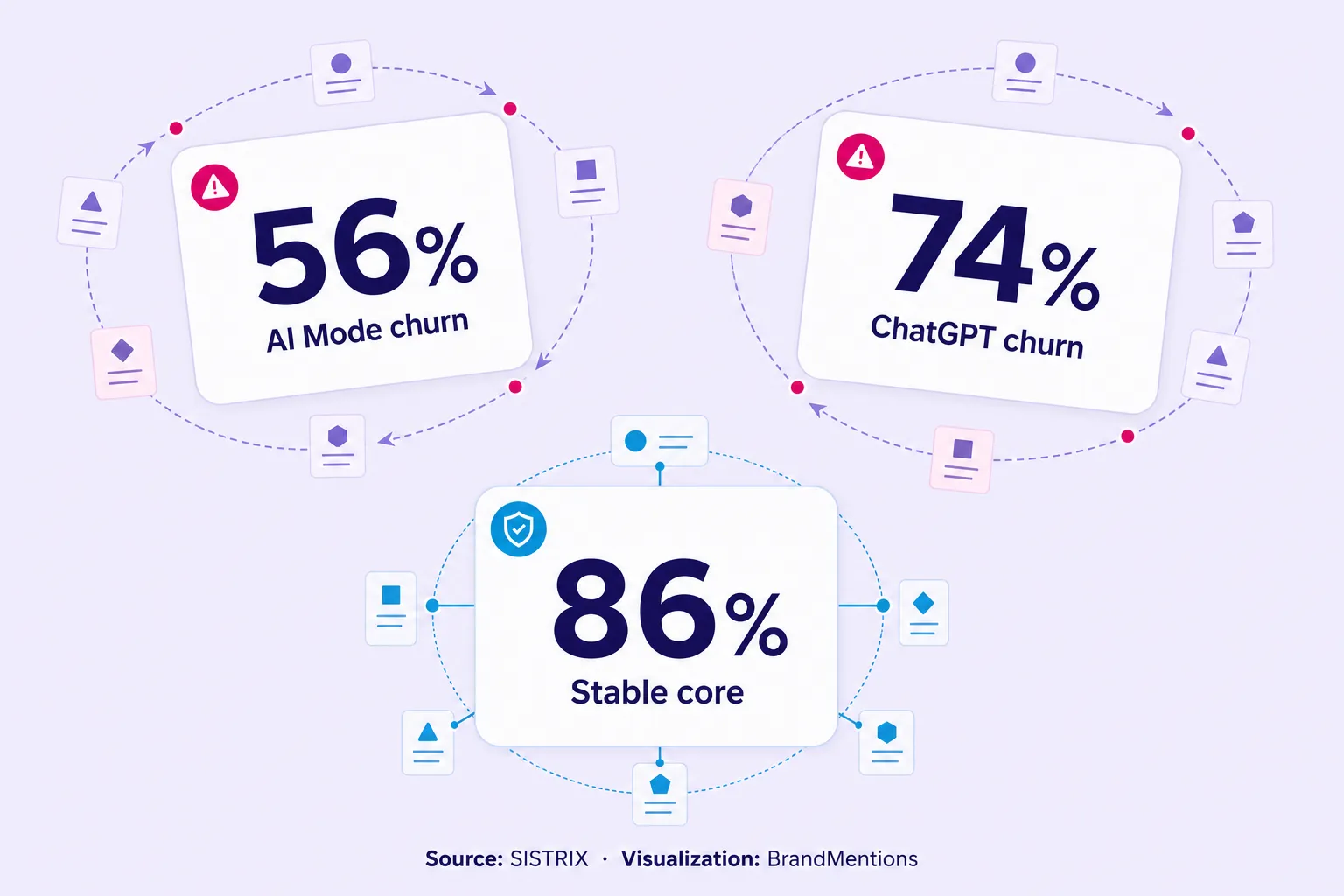
The cited studies report changes in source sets between observation windows. These turnover measures do not directly establish how long an individual citation remains visible.
SISTRIX's AI citation drift research is a large public study: 82,619 qualified prompts and 1,548,213 snapshots across six countries and three surfaces, resampled across 17 weekly reference dates from December 17, 2025 to April 8, 2026.
| Surface | Weekly source churn (domain level) | Qualifier |
|---|---|---|
| Google AI Mode | 56% headline; 54% for the US | Narrow 54% to 59% band across six countries |
| ChatGPT Search | 74% headline, identified in the country breakdown as the German figure | Varies far more by market than AI Mode |
| Google AI Overviews | Approximately 5% weekly churn-in | Bimodal, not uniform |
Three corrections keep this honest. The 74% figure appears in the country breakdown as Germany's, so geography belongs beside the headline. At URL level, drift runs higher than at domain level (85% against 74%, an 11-percentage-point difference, roughly 15% in relative terms), because the specific page frequently changes even when the domain stays cited. And these studies measure incoming source domains, not the replacement of brand recommendations, so "half the brands cited Monday are gone by Sunday" is not what the data says.
AI Overviews stability is the finding most people average away. In 53% of prompts not a single source changed across 17 weeks, in 28% there were isolated changes, and in 19% sources drifted roughly as much as in AI Mode. You cannot forecast against the blend. Classify each priority prompt as frozen or rotating and manage the two groups differently.
Separate durability measures, and keep them separate
Yotpo's citation duration study from May 2026 tracked consumer purchase-journey prompts for more than 14 weeks and reports weekly citation-set turnover of approximately 70% for ChatGPT, 76% for Gemini and 81% for AI Mode. That is a URL-set overlap measure on commerce prompts, not the same quantity as SISTRIX's domain-level churn.
Scrunch's half-life analysis of 3.5 million citation events across more than 120,000 domains (September 2025 to March 2026) adds a cohort-level durability measure: roughly 3.4 weeks for ChatGPT at one end and approximately 5.8 weeks for Perplexity at the other, with the Google surfaces in between. Half-life is a cohort statistic. It does not predict whether your specific citation survives next Tuesday.
Profound's AI search volatility research compared June 11 to 13 with July 11 to 13, 2025, measuring domains present in July but absent in June, and reports monthly drift of 40.5% for Perplexity, 53.4% for Copilot, 54.1% for ChatGPT and 59.3% for AI Overviews. Resist the temptation to reconcile that with weekly figures. Different cohorts, periods and definitions produce different numbers, and stacking them into one "AI citation lifespan" is how benchmark articles go wrong.
The stable core is the actual target
The most actionable finding in the drift data is not the churn rate. In 86% of AI Mode prompts there is a stable core of one to five domains cited reliably week after week while the surrounding sources rotate at roughly 89% per week, and the core itself shows a churn-in rate close to zero.
Model updates stack a second decay mechanism on top of baseline churn. After Google made Gemini 3 the default for AI Overviews on January 27, 2026, SE Ranking's analysis of the Gemini 3 transition across 100,000 US keywords in 20 niches found that roughly 42% of previously cited domains no longer appeared, concentrated in the long tail, while the average number of sources per overview rose 31.8% (from 11.55 to 15.22). The same report notes a concurrent citation-display issue, so treat the magnitude as directional. The operating lesson holds regardless: tie a re-baseline trigger to platform announcements, not only to campaign dates.
How do you measure your brand's time to AI citation?
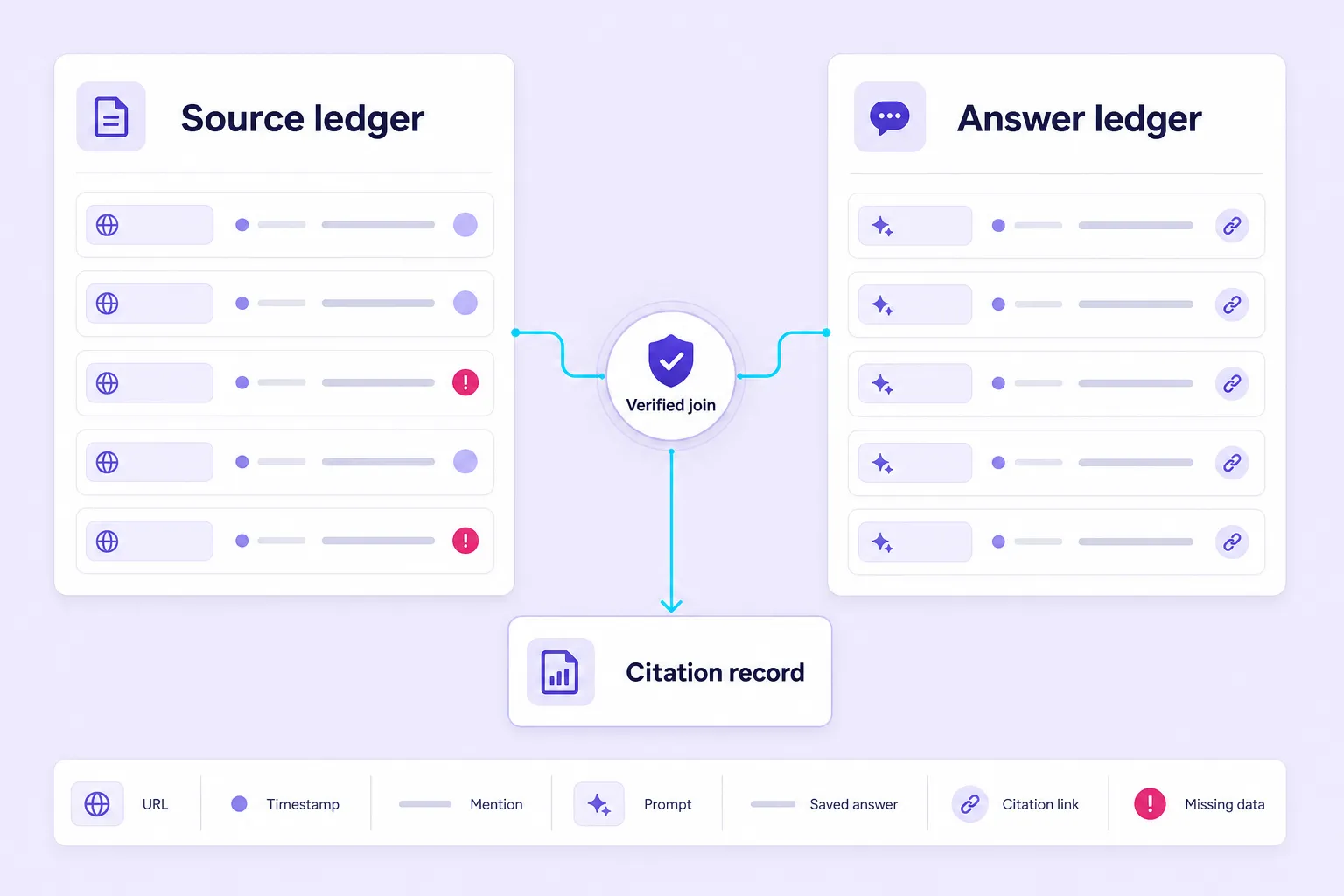
Run two synchronized ledgers - a source ledger of what became publicly available and an answer ledger of what appeared in sampled AI answers - and join them on a verified start event, a saved answer and a resolved canonical URL.
A timing record is auditable only when it joins a verified start event, a saved AI answer, and a resolved canonical source URL; two of the three is an anecdote.
Run the seven steps below in order.
- Define the cohort and the start events. Decide which sources you are measuring and keep new URLs, substantive updates to existing pages, and new mentions inserted into old pages in separate publication cohorts, because they are three different start events. For each source, store source publication, brand-mention insertion and monitoring discovery as three separate timestamps, and report an interval or an unknown start date when insertion time cannot be verified.
- Freeze the prompt panel and engine settings. Build a neutral discovery panel of buyer questions that never names your URL, and keep the diagnostic panel (explicit fetch requests and source-specific prompts) separate so induced retrieval never contaminates the benchmark. Fix the engines, product surfaces, markets, languages, account configuration and run cadence before the first observation, and record which surface you actually tested.
- Establish the source ledger. Create one row per source carrying - resolved canonical URL, owned/earned/paid/syndicated classification, publisher group and content-family identifier, the exact brand passage, prompt-panel assignment - and define the entity-resolution policy before anything enters the denominator.
- Capture daily answers. For every scheduled observation, preserve the engine and surface, model identifier, timestamp, market, language, configuration, exact prompt, conversation state, search availability and observed search activity, the complete answer text and every presented link. Log errors, refusals, timeouts and truncated responses as missing data, never as citation absences.
- Validate brand-supporting citations. Confirm that the cited URL resolves to your source and that the brand passage is what the answer relied on, then label brand mention, recommendation, accuracy and sentiment. Double-code a 10% random sample weekly with two independent reviewers and publish the agreement rate alongside the benchmark.
- Calculate first and recurring citation times. Measure first citation from the verified start event to the first saved answer presenting the source; measure recurring citation against a complete seven-day window reaching five cited days out of seven, and the sustained tier against four consecutive qualifying weeks. State your observation precision: daily checks locate a first citation within the sampling interval, not the moment an engine first became capable of citing the page.
- Report uncited sources and configuration changes. Retain never-cited sources in the cohort and label any median built only from cited sources as "median among cited sources." Record every panel, cadence, market or surface change as a documented series break, keep the original series intact.
What are the limits of this evidence?
A benchmark is directly comparable only when the source cohort, start event, engine surface, market, prompt design and observation cadence are aligned; change any one and you have a new study.
This article combines published research, official platform documentation, and our own live experiment tracking 12 third-party articles across three AI search platforms. The external benchmarks and our experimental results are reported separately.
| Evidence family | Sample and window | Appropriate use | Boundary |
|---|---|---|---|
| MaxAEO timing panel | 1,240 sources (740 owned, 500 earned), 132 brands, 7 engines, Feb to May 2026 | Per-engine planning references by source type | Vendor-reported medians; source-level records and denominators not public |
| Semrush longitudinal test | 81 FAQ pages, one established blog, 30 days from Sept 2025 | Daily pickup and persistence curves | Two engines only; no earned-mention comparison; one publisher's authority profile |
| SISTRIX drift research | 82,619 prompts, 1,548,213 snapshots, 6 countries, 17 weeks | Domain-level rotation and geographic variance | Measures incoming source domains, not brand recommendation replacement |
| Yotpo duration study | Consumer purchase-journey prompts, 14+ weeks, May 2026 | Commerce-prompt citation-set turnover | URL-set overlap; prompt count not disclosed; not interchangeable with domain churn |
| Yotpo review-backed analysis | 96 vs 5,686 articles, 15 brands, Feb to Sept 2026 | Page-archetype hypotheses | Observational; topic targeting differed between groups |
| Scrunch half-life study | 3.5M citation events, 120,000+ domains, Sept 2025 to Mar 2026 | Cohort-level durability by platform | Cohort statistic, not an individual citation's survival probability |
| Profound volatility study | ~80,000 prompts, June vs July 2025 snapshots | Monthly domain drift | Two three-day snapshots; not comparable with weekly series |
| Ahrefs cited-page analysis | 1.4M prompts, April 2026 | Source-selection and age context | Page age is not first-citation waiting time |
| SE Ranking Gemini 3 analysis | 100,000 US keywords, 20 niches, Jan 2026 | Model-update shock magnitude | Concurrent citation-display issue; treat magnitude as directional |
| Official platform documentation | Current as of October 2026 | Access controls, eligibility, reporting definitions | Describes requirements and controls, never citation schedules |
Rules for reporting your own numbers
Retain uncited sources. If 12 of 40 sources receive citations, a median built from those 12 must be labelled "median among cited sources." It does not describe the cohort.
Do not force a cohort median. When fewer than half the cohort has been cited by the cutoff, the full-cohort median has not been reached. Say so.
Report observation precision. Daily checks locate a first citation within the sampling interval, not the moment an engine first became capable of citing the page.
Separate publication cohorts. New URLs, substantive updates to existing pages, and new mentions inserted into old pages are three different start events.
Avoid causal shortcuts. A citation following a placement establishes sequence. Attribution requires stable comparison prompts and a record of what else changed in the same window.
Frequently Asked Questions
How Long Does It Take for AI Search to Cite a New Brand Mention?
MaxAEO reports a median of 22 days for third-party mentions and 13 days for owned pages in its panel. These figures describe that study’s sample, not a guaranteed waiting period. The separately reported 41-day recurring-citation figure applies to owned pages.
How long does a recurring AI citation take, not just a first one?
Reaching recurring citation takes a reported median of 41 days for owned content - roughly three times the 13-day owned first-citation median. Recurring means the source was cited on five of seven days inside one complete weekly window.
Does Perplexity actually cite fastest?
Perplexity had the lowest reported median first-citation time in MaxAEO’s seven-platform panel: 4 days for an owned page and 9 days for an earned mention are the fastest figures recorded. In a separate study with a different cohort (Scrunch, Sept 2025–Mar 2026), Perplexity also showed the longest cohort citation half-life, about 5.8 weeks. The two results come from different samples and should not be combined into a single lifespan estimate.
Do AI citations last once you get them?
A first citation does not establish lasting visibility. Persistence varies by platform and question: some source sets remain stable, while others change substantially between observations. Track repeat appearances separately from the first citation.
How much do cited sources change between weekly observations?
Weekly sampling reveals differences between the observed source sets. It does not establish an engine’s internal refresh schedule. Domain-level turnover runs at 56% weekly on Google AI Mode and 74% on ChatGPT Search, while AI Overviews shows approximately 5% weekly churn-in.
Does Google AI Mode or ChatGPT pick up new content faster?
In Semrush’s experiment, AI Mode cited more pages initially, while ChatGPT’s daily cited-page count increased over the tracking period. In a 30-day test, AI Mode's observed page count peaked in the first week and fell by day 30, while ChatGPT's rose steadily to its highest point on day 30.
Do older pages get cited more often than new ones?
Not in a way that tells you how long to wait. Page age at observation time and first-citation waiting time are two different measurements.
Which page types get cited fastest?
In Yotpo’s observational analysis (96 review-backed vs 5,686 brand-written articles, 15 brands, Feb–Sept 2026), review-backed pages had a two-day median first citation versus 14 days. Topic targeting differed between the groups, so treat this as a hypothesis.
Can you speed up time to first AI citation?
You can remove the blockers and improve the comparison, but no engine publishes a citation schedule you can buy into. The levers are verified search-class crawler access, indexation and snippet eligibility, and whether the page directly answers the monitored question with verifiable evidence.
How many prompts and engines do you need to measure time to citation?
Fix the panel before the first observation, and size it against the QA hours you actually have. A panel of 20 fixed prompts per market checked daily across six engines generates 3,600 scheduled observations in 30 days before retries.
What counts as an AI citation, and what does not?
One verified source link in a saved answer establishes a first citation; a brand name appearing in generated text without a source link does not. A URL citation also only counts toward a new brand mention once you have verified that the brand passage, not an unrelated statistic on the same page, is what the answer relied on.
Why was my page indexed but never cited?
Because indexing and retrieval are separate systems, and a page can clear every eligibility requirement while still losing source selection. Work the layers in order rather than publishing more pages against the same gap.
How long should I wait before declaring a page uncited?
Thirty fully observed days with verified access is a decision checkpoint, not a death certificate. At that point keep the source in the cohort.
Conclusion
AI citation timing is an observation, not a publishing deadline. A page may appear quickly, take weeks to surface, or remain uncited for the questions you monitor. Published benchmarks are useful only when their platforms, source types, prompts, and observation windows are clear.
Measure first citations and recurring visibility separately. Keep a fixed set of questions, save the answers and cited URLs, and include pages that receive no citations in your reporting. Treat brand mentions as a separate outcome from links to your content.
If a page remains uncited, check access and indexing first, then assess whether it answers the target question with clear, verifiable evidence. The goal is to become a useful source that search engines and AI systems can repeatedly select.
Filed under: AI Visibility & SEO