8 Hashtag Monitoring Tactics Every Marketer Should Use
H ere is the uncomfortable truth I lead with when I train a marketing team on this: the reason most people stopped caring about hashtags is the exact reason smart marketers should start monitoring …

Here is the uncomfortable truth I lead with when I train a marketing team on this: the reason most people stopped caring about hashtags is the exact reason smart marketers should start monitoring them again. The hashtag lost its old job as a reach lever. It quietly picked up a better one. It became a clean, self-selected signal you can read.
What Is Hashtag Monitoring?
Hashtag monitoring is the practice of tracking specific tags across social platforms, news, and the open web to analyze how, where, and by whom a topic, brand, or campaign is being discussed. It converts self-selected hashtag signals into measurable insight about audience intent, campaign performance, competitor activity, and brand reputation, including how your brand now surfaces inside AI-generated answers.
Summary
- Hashtags no longer buy you reach on the major networks. Instagram's leadership has repeatedly said hashtags do not drive reach, and X removed hashtags from promoted posts in mid-2025. They now work as classification and search signals, not distribution hacks.
- The winning number of tags is small. Current best practice has converged on roughly three to five relevant hashtags per post, and YouTube ignores every hashtag on a video or playlist the moment it carries more than 60.
- The audience is still growing and still searching inside social. DataReportal's 2026 update counts 5.79 billion active social media user identities, 69.9% of the world's population, with more than 800,000 new identities added per day over the prior year.
- Monitoring became standard practice, not a specialist luxury. Mordor Intelligence values the social media listening market at USD 9.36 billion in 2025, rising to USD 10.91 billion in 2026 and a projected USD 20.51 billion by 2031, an 11.19% compound annual growth rate.
- A tag with fewer posts but more buyer questions beats a viral tag with no commercial intent. Volume tells you people typed the symbol. Sentiment, velocity, and business action tell you whether it mattered.
- Hashtag campaigns now need compliance built in from day one, including FTC influencer disclosure and platform-specific contest rules, not bolted on after entries arrive.
Before you add another hashtag to a calendar or a dashboard, answer one question. What decision will monitoring it change? If the honest answer is "we will know whether people are talking," that is too vague. If the answer is "we will detect campaign lift, find creators already shaping the conversation, route complaints before they spread, and harvest the language people use to search," now you have a system worth building.
At a Glance: Which Tactic Fits Your Scenario
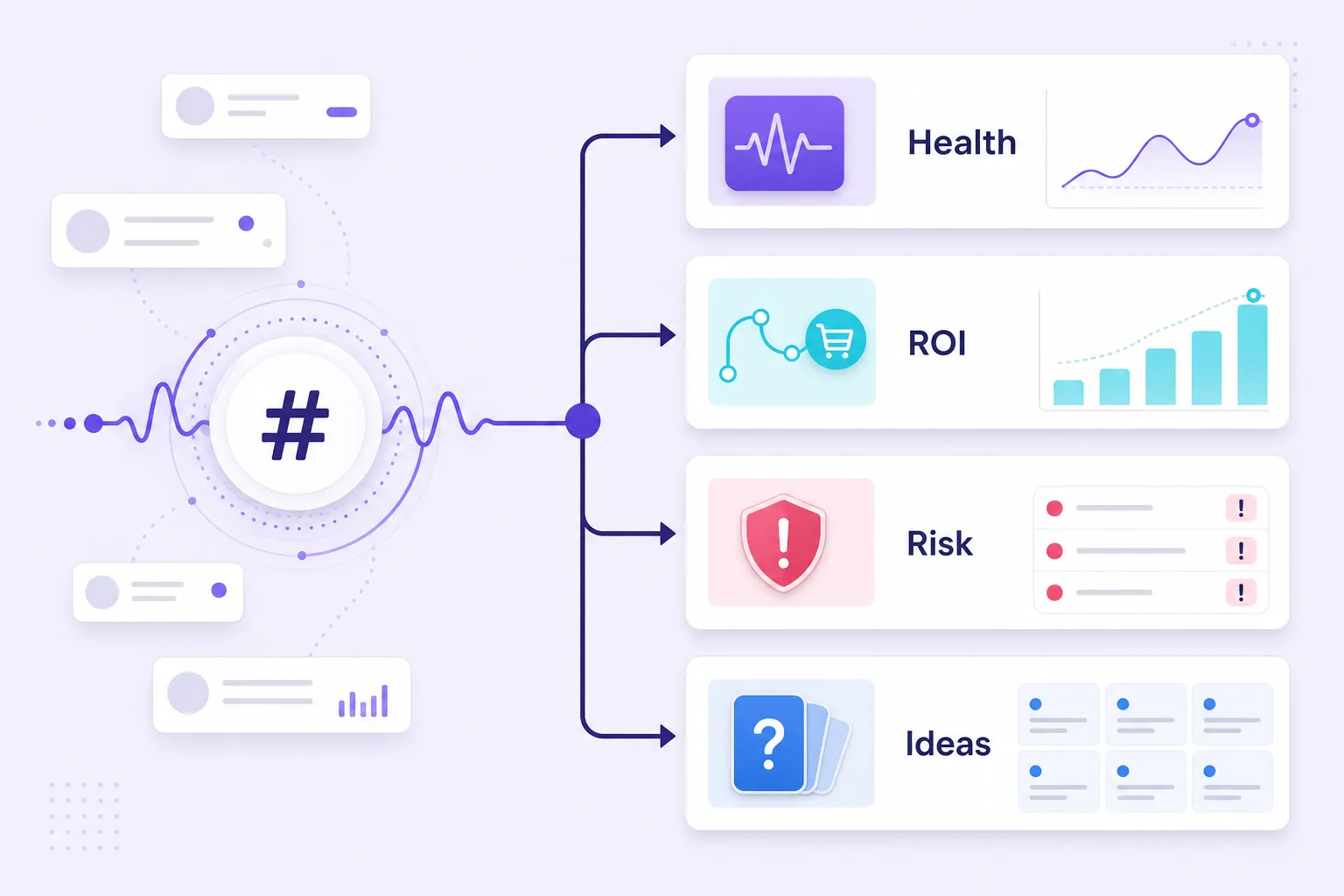
- Best for brand health, always on: Track branded and content hashtags. They show who voluntarily attaches your name to a topic, product, or emotion, which is a cleaner unaided-awareness read than any follower count.
- Best for zero-budget competitive intelligence: Monitor competitor and category tags. Watching the conversations you do not own is free, unfiltered, and where the unmet needs surface.
- Best for reputation and crisis defense: Turn hashtag streams into real-time social listening. The mention that matters is usually the early angry one, not the loudest late one.
- Best for provable campaign ROI: Measure performance with one owned tag. A single clean tracking hashtag gives you a before-and-after read on what actually worked.
- Best for authentic influencer growth: Discover and vet creators through the tags they already use for free. Repeated organic use beats a cold database list.
- Best for a starved content pipeline: Mine trending and community tags for ideas. Live feeds are the cheapest focus group you will ever run.
- Best for engagement plus conversion: Run and audit hashtag contests and UGC. A required tag gives you promotion, a searchable entry list, and a fraud-checkable participation rate at once.
- Best for future-proof visibility: Extend monitoring into cross-channel and AI-answer tracking. The mention that shapes a purchase in 2026 is as likely to sit in an AI answer as in a feed.
Do Hashtags Still Matter When Feeds Are Algorithmic?
Yes, but not the way they did in 2019.
Hashtags still help platforms and people file and retrieve content. They no longer rescue weak creative, unclear positioning, or a campaign nobody wants to join. Instagram's search ranks results on the text you enter plus account, hashtag, and place signals. X says Trends favor what is popular now and personalize by interest and location, so post count is only one factor. YouTube uses hashtags to connect related videos and playlists, then ignores all of them past 60.
The Filing-Cabinet Shift.
Once a tag stops being a reach hack, it becomes something more useful to a marketer: a clean label people chose on purpose. Someone who types a hashtag is telling you their intent. That is a purer signal than an impression count ever was. The megaphone broke. The filing cabinet got better.
If a post only works because of the hashtag, the post probably does not work. Use tags to make strong content findable, never to make weak content travel.
Hashtag Monitoring vs Keyword Listening: Which Should You Prioritize?
This is the question I get most from teams building a workflow, and the honest answer is that they solve different problems.
Hashtag monitoring captures deliberate, structured conversation. Someone chose the #. That intentionality makes it clean but narrow. You only catch people who tagged. Keyword listening captures everything: the untagged mention, the misspelling, the sarcasm, the complaint that never used your handle. Broader, noisier, and closer to reality.
The practical rule I use: track the branded and campaign tags you control with tight, alert-driven monitoring, and track your brand name plus category terms as keywords for the messy truth. If a tag returns fewer than a handful of real posts a week, stop babysitting it and monitor the underlying keyword instead. The tag is no longer carrying enough signal to justify the attention.
Which Platforms Should You Monitor Differently in 2026?
Hashtag monitoring fails when a team applies one rule to every network. The same tag behaves differently everywhere, and the data you can actually pull differs even more. This table is the reality check most guides skip.
| Platform | Native tag / search behavior | Data access for monitoring | Historical data | Main execution constraint |
|---|---|---|---|---|
| Search and Explore, campaign grouping, UGC review | Graph API is limited to Business/Creator accounts; hashtag search historically capped at 30 unique tags in a rolling 7-day window | Shallow via API | Ranking depends on text, activity, and result popularity, not tag volume | |
| TikTok | Trend discovery, creator formats, search-led ideas | Creative Center is free for trends; broad commercial API access is restricted | Trendlines, not full archive | Watch time and completion outrank caption tags |
| YouTube | Topic grouping for videos, Shorts, playlists, hashtag pages | Free Data API with strict daily quotas | Limited | More than 60 hashtags voids all of them on that content |
| X | Real-time events, breaking topics, public reaction | Manual via Advanced Search; broad real-time needs paid developer tiers | Full archive behind paid access | Trends are personalized, not ranked only by post count |
| Topic discovery for B2B, still followable by members | No open third-party hashtag search API | Minimal | Signal is real but small; three to five specific tags | |
| Category research in plain language | Data API with paid volume tiers; Reddit Pro Trends | Community-dependent | The useful signal is usually a phrase, not a # | |
| Threads | One topic tag per post | Threads API, limited tag/keyword search | Emerging | Single-tag model, no stacking |
| Bluesky | Hashtags plus an open firehose | Free public firehose via the AT Protocol | Fully accessible | Smaller audience, but the least gated data of any platform |
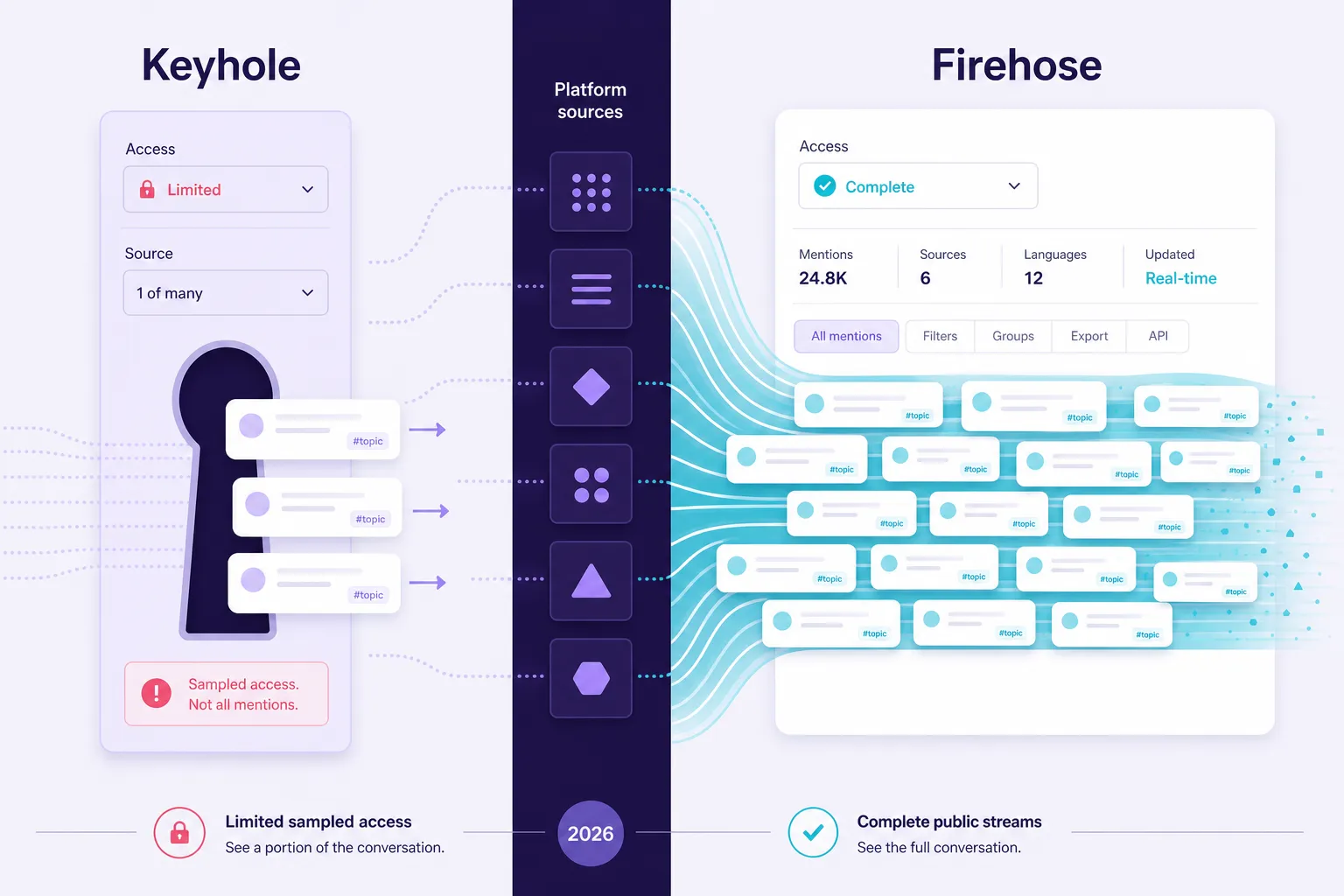
The lesson is not "monitor everything." It is that your coverage is only as good as the platform lets it be. Bluesky hands you an open firehose. Instagram and TikTok hand you a keyhole. Any tool promising complete, instant, free monitoring of the closed platforms is quietly relying on delayed caches or sampled data.
The API Cost Floor. If a vendor claims complete real-time monitoring of X or full historical hashtag archives at no cost, distrust the completeness. Broad real-time and historical access on the closed platforms sits behind paid enterprise tiers, and that is a constraint to design around, not wish away.
How Does AI Search Change What You Monitor?
Search behavior moved onto social and into answer engines. Sprout Social's 2025 research found that 41% of Gen Z now treat social apps as their primary search engine, ahead of traditional search. When people ask an AI assistant about your brand or category, it summarizes the same public conversation your hashtag streams already touch.
So monitoring a tag is step one. Step two is following where that conversation resurfaces: quoted in articles, screenshotted into other feeds, and folded into machine-generated answers. Compressed hashtag language and the fuller questions in the comments are exactly the phrasing that later shows up in AI answers, social search, and support tickets. Harvest it.
One Tag, Three Mirrors. Check every monitored tag against platform conversation, search demand, and community language. If all three move together, you are seeing a real market signal. If only one moves, you are probably seeing a platform-only spike.
The Hashtag Signal Scorecard
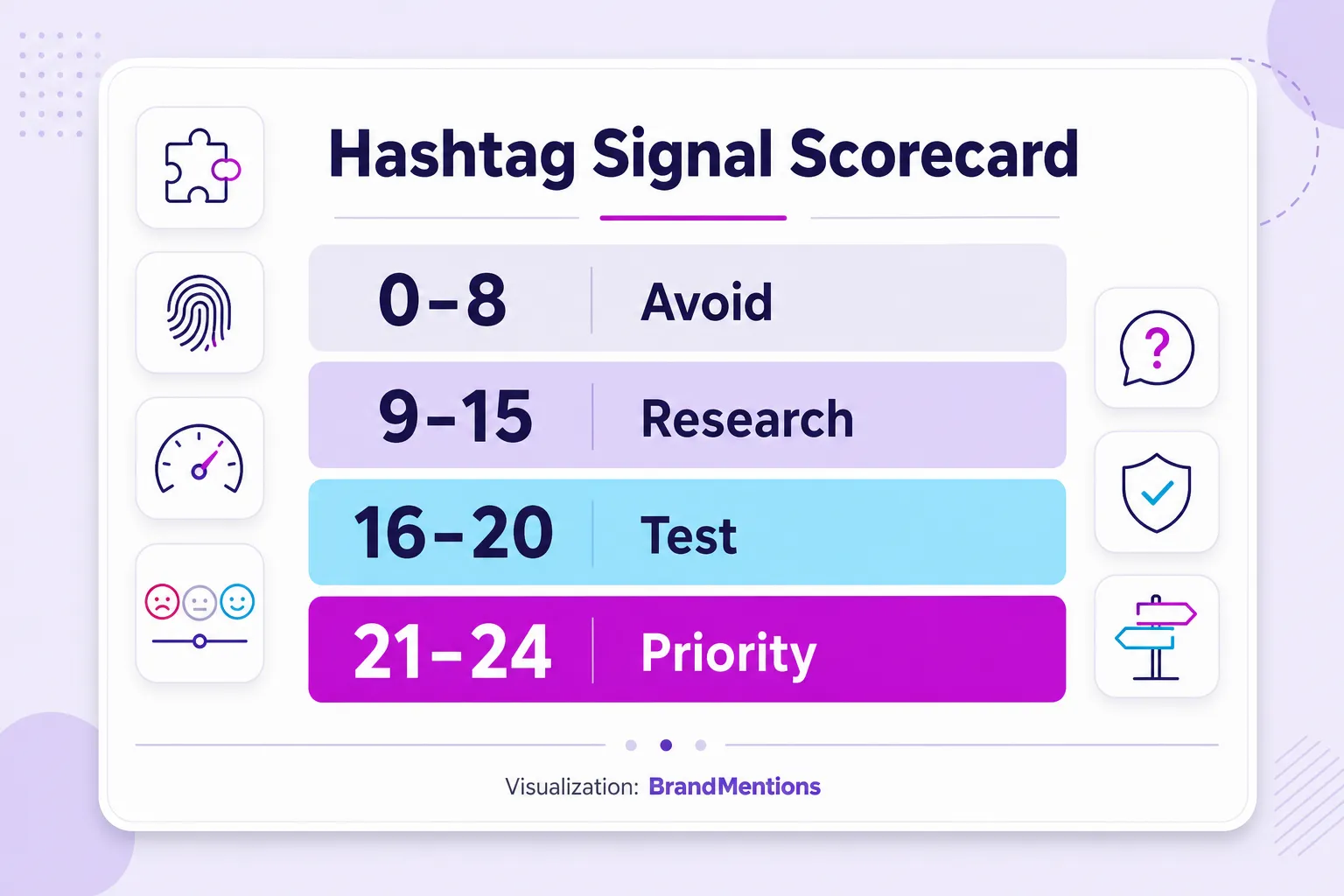
Not every tag deserves the same effort, and treating them equally is how teams drown in noise and still miss the post that mattered. Score each hashtag you are considering from 0 to 2 (0 = weak or risky, 1 = present but unproven, 2 = strong enough to act on).
| Signal | What to check |
|---|---|
| Brand fit | The tag connects clearly to your brand, category, audience, or offer |
| Uniqueness | Not dominated by another brand, fandom, place, or unrelated meaning |
| Spelling resilience | People can type it correctly without instructions |
| Platform fit | It works natively where your audience actually participates |
| Volume | Enough conversation to review without leaning on one or two posts |
| Velocity | It is growing, not sitting in old posts |
| Creator concentration | Relevant creators already use it or an adjacent term |
| Sentiment | Neutral to positive, or the negative angle is clear and actionable |
| Question density | People ask questions your brand can answer |
| UGC quality | Posts are useful enough to learn from, request rights to, or feature |
| Compliance risk | It does not invite misleading claims, undisclosed ads, or unsafe behavior |
| Business path | You can connect it to a page, offer, product, support action, or content plan |
| Total | Decision |
|---|---|
| 0 to 8 | Do not build a campaign around it. Monitor only if reputation risk exists. |
| 9 to 15 | Use as a research tag. Collect language, creators, questions, competitor moves. |
| 16 to 20 | Test it in content, a creator brief, or a limited campaign. |
| 21 to 24 | Treat it as a priority tag. Build reporting, response rules, and a conversion path. |
Monitor the collision, not the count. A tag becomes worth your best attention when several signals collide at once: rising use, relevant people, clear sentiment, repeated questions, and a next action your team can actually take.
Now the tactics. Each one includes what to do, the current constraint you work inside, and one thing most guides leave out.
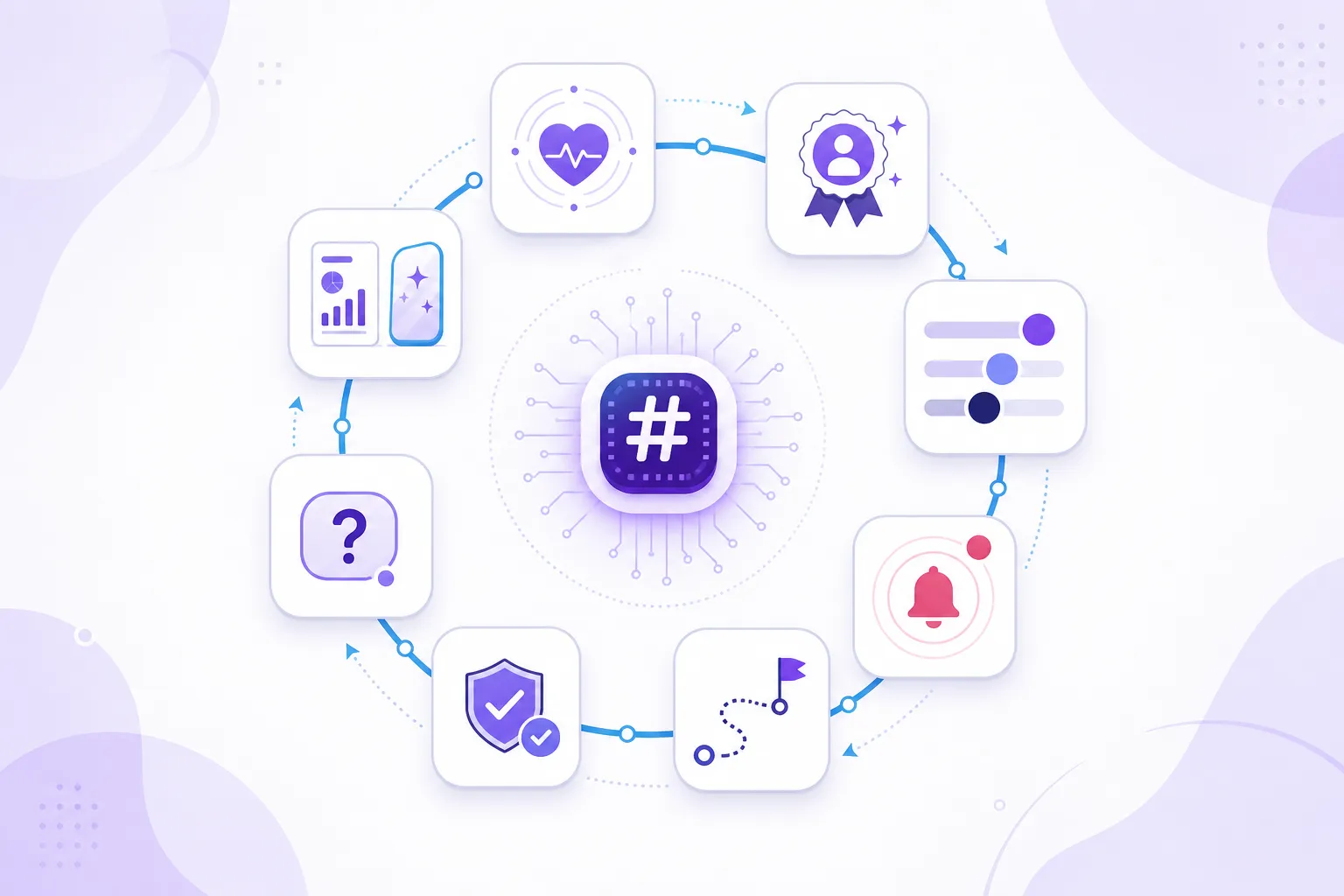
The 8 Hashtag Monitoring Tactics
1. Track Branded and Content Hashtags to Read Real Brand Awareness
Start here because it is the cleanest signal you own. When someone posts with your branded tag, they chose to associate publicly with you, and that gives you a live read on unaided awareness a survey cannot match. Even on B2B, the signal holds: the Metricool 2026 LinkedIn study of 673,658 posts across 63,108 accounts found that posts with at least one hashtag earned 85% more impressions than the platform average. Connect this to how you measure brand awareness across channels rather than guessing from follower counts.
Track three tag types: brand tags (your name, slogan, campaign), content tags (the category terms you want to own, like #sociallistening or #brandmonitoring), and event tags. Then sort the mentions into four buckets: owned (your accounts), earned (customers, creators, press), misaligned (unrelated posts on the same tag), and risk (complaints, scams, impersonation).
Non-obvious insight: the number to watch is not total tag volume. It is the share of branded-tag posts you did not pay for or prompt. A tag stuffed only by your own team and paid creators is a vanity metric. Organic-to-prompted ratio is your real awareness gauge.
Decision threshold: if fewer than a quarter of your branded-tag posts are genuinely organic, you are measuring your own marketing, not your market.
2. Discover and Vet Influencers Through the Tags They Already Use
The best creator for your brand is often already using your hashtag for nothing. TikTok's creator discovery guidance tells advertisers to review follower growth, view trends, engagement over time, and audience demographics before partnering. Apply that same logic to whoever shows up under your category tags, on any platform. Searching those tags is a faster, more honest way to find Instagram influencers who fit your voice, because you see unpaid enthusiasm before any contract exists.
Do not start with "who has the biggest audience." Start with "who already makes this tag make sense." Build a shortlist by relevant posts, comment quality (not count), audience fit by region and buyer stage, and brand-safety notes. The strongest candidates often sit mid-curve, with audiences that ask practical questions and come back.
Non-obvious insight: consistent tagging across two platforms is a stronger professionalism signal than one viral post. One viral hit can be luck. Repeated, specific use shows topic ownership. Copy-pasted tag blocks are a quiet red flag about how a creator will treat your brief.
3. Monitor Category and Competitor Tags to Discover New Audiences
The tags you do not own are often more valuable than the ones you do. Reddit Pro Trends is useful here because it tracks keywords and phrases, not just hashtags, and shows where conversations are forming across communities, which matters when your market uses your category language in places where hashtags are not native behavior.
This tactic is about audience drift. A project-management brand may see wedding planners bending its tag to their workflow. A skincare brand watching #barrierrepair may find swimmers, nurses, and outdoor workers in the same stream. Do not dismiss those as noise. Pull the co-occurring hashtags those unexpected users pair with yours, monitor them for a week, and you have a low-competition entry point into a new segment.
Monitor the tags you do not own.
Non-obvious insight: watch the complaint clusters under a rival's launch tag, not the praise. Praise tells you what they did well and cannot be copied cheaply. Complaints tell you the unmet need you can move on this quarter, and they hand your sales team an acquisition angle.
4. Turn Hashtag Streams Into Real-Time Social Listening
Awareness and competitor data are retrospective. Listening is where hashtag monitoring earns its keep in the moment. When a spike starts, X Advanced Search lets you filter by hashtag, account, replies, mentions, location, and date range for manual investigation. That is fine for one platform in one moment. It does not scale across channels.
For cross-channel work, BrandMentions fits this tactic well because it pulls a tag's activity from social, news, and the open web into one sentiment-scored alert stream, which makes it useful for teams that need same-day visibility on where a tag is spreading and in what tone. Pair it with sentiment analysis so you triage by mood, not just volume, and route each mention by severity: watch, engage, resolve, or escalate. Give every level an owner. Complaints go to support, safety and legal claims go to compliance, content angles go to strategy.
The most expensive hashtag mention is not the negative one. It is the negative one that sat in the wrong inbox until other people repeated it.
Non-obvious insight: speed of indexation beats volume for crisis work. Catching five influential complaints in the first hour prevents a fire better than counting five thousand two days later. And set alerts on the tag stub plus common misspellings. The angriest customers rarely spell your campaign tag correctly.
5. Measure Campaign Performance With a Single Owned Hashtag
If you launch without one dedicated tracking tag, you are choosing to report blind. A single owned tag creates a clean containment boundary: every post inside it belongs to the campaign. Make it specific. #SummerSale is useless because it fills with unrelated noise. #AcmeVaultSummer2026 is attributable. Then push the data past social by using Google Analytics campaign parameters (utm_source, utm_medium, utm_campaign, utm_id) so participation connects to clicks and conversions.
Report in four layers, never one. Visibility (mentions, reach, participation), engagement (comments, saves, shares, completions), intent (clicks, landing-page visits, branded search), and outcome (signups, purchases, registrations). Build this sheet before launch, with approved variants, banned variants, creator handles, and campaign dates. Teams that write the measurement plan after launch spend the recap meeting explaining gaps.
Non-obvious insight: measure the decay curve, not just the peak. A tag that keeps collecting posts for three weeks after your spend stops is doing something structurally different from one that flatlines the day the ads end. The tail tells you whether you built a moment or a movement. Watch, too, for the "borrowed tag" effect: unrelated accounts hijacking your campaign hashtag for their own agenda, which you need to catch before it distorts both your data and your message.
6. Monitor Your Influencers for Delivery and Disclosure
Discovery is half the job. Accountability is the other half. The FTC's Endorsement Guides require clear and conspicuous disclosure whenever a material connection exists, and the FTC has warned that a platform's built-in tool may not be enough on its own. That makes monitoring sponsored posts a compliance job, not only a performance one.
Assign a unique tag or code per creator only when it genuinely aids measurement, then verify each post: published on time, used the required tag, disclosed early enough to be seen, made approved claims, tagged the right product, and stayed live through the required window. For a large ambassador program, manual checking does not scale, so build automated alerts on contracted creators.
Non-obvious insight: automated compliance checks often fail on video because a creator can hide the required disclosure behind interface elements or a "more" fold. Check the visual placement, not just the caption text. And read the comment section, because the objection, the correction, and the reputation risk usually appear after the post, not inside it.
7. Mine Trending and Community Tags for Content Ideas
Live feeds are the cheapest focus group you will run. The TikTok Creative Center lets you inspect trending hashtags by industry with trendlines, related videos, audience insights, and regional popularity. Layer Google Trends on top for the search side, remembering that its data is normalized from 0 to 100, so it shows relative interest, not absolute demand. When you spot a tag climbing fast, you can find trending hashtags worth building around while competition is still low.
Do not copy a trend because it is trending. Extract the pattern. Classify each tag by intent: entertainment (join only with a natural voice), education (turn into how-tos and FAQs), purchase research ("best," "dupe," "worth it," feed proof-led content), community identity (build audience-specific messaging), and complaint (feed product and support). Tie this into your broader hashtag marketing strategies only after you understand what people mean, not what looks popular.
Non-obvious insight: the richest source is not the top trending tag. It is the mid-tier community tag with steady, unglamorous volume, the #SaaSOnboarding or #EmailDeliverability kind. Trending tags tell you what everyone is about to do. Community tags tell you what your specific audience never stops caring about, which is where durable content lives. A tag that generates repeated questions beats one that generates repeated reactions, because questions become evergreen content and reactions decay.
8. Run, Audit, and Extend Hashtag Contests Into Cross-Channel Visibility
A contest hashtag is both a growth engine and an accountability check. Instagram's promotion guidelines require official rules, eligibility terms, a full release of Instagram, an acknowledgment that Instagram does not sponsor the promotion, and no encouragement to tag content inaccurately. Design for that from the start, and design the tag for verification before virality: unique enough to isolate entries, short enough to avoid typos, and paired with a rights process if you plan to reuse UGC.
The verification workflow that protects you: collect all posts on the tag, deduplicate by account rather than by post, filter accounts under 30 days old or with suspicious follower ratios, manually review the remaining pool for rule compliance, then draw the winner. When you announce, publish the numbers ("1,200 entries submitted, 890 eligible"). Transparency discourages the next cheater. Volvo's 2015 #VolvoContest remains the model, not because of the Super Bowl stunt, but because the tag had a real job: it captured entries at the exact moment attention moved from TV to public conversation, and it earned a Cannes Lions Grand Prix for the campaign.
The extension almost no legacy guide covers is what happens after the contest ends. That conversation does not stay on one platform. It gets quoted, screenshotted, and summarized by AI answer engines when people research your brand. This is the second place BrandMentions genuinely fits, because it tracks brand mentions across the open web, news, and social alongside how your brand is described in AI answers, which matters for teams whose reputation now forms inside machine-generated summaries as much as human feeds. As you connect that data to revenue, listening for sales turns scattered mentions into a pipeline signal rather than a vanity report.
Track the tag, then track where its conversation travels. In 2026, the mention that shapes a buying decision is as likely to appear in an AI answer as in a feed.
Non-obvious insight: the quiet failure mode is a contest tag too generic to own. Monitor your proposed tag for a full week before launch. If it already carries unrelated volume, you have chosen a tag you cannot cleanly measure, moderate, or defend in a winner dispute.
Hashtag Monitoring Tactics Compared
| Tactic | Primary goal | Execution complexity | Time to signal | Core metric |
|---|---|---|---|---|
| Branded and content tracking | Awareness measurement | Low | 1 to 2 weeks | Organic-to-prompted ratio, sentiment |
| Influencer discovery and vetting | Advocate growth | Medium | 2 to 4 weeks | Repeat usage, audience fit |
| Category and competitor monitoring | Competitive intelligence | Low | Immediate | Complaint themes, share of voice |
| Real-time social listening | Reputation and crisis | Medium | Same day | Negative velocity, response time |
| Campaign performance tracking | Provable ROI | Medium | Full campaign cycle | Qualified participation, conversions |
| Influencer monitoring | Partnership governance | Medium | Per post window | Delivery, disclosure, comment sentiment |
| Trend and idea mining | Content pipeline | Low | Daily to weekly | Question density, rising related tags |
| Contests and cross-channel UGC | Engagement and visibility | High | Full campaign cycle | Valid entries, fraud flags, rights status |
Governance: The Part Most Guides Skip
Monitoring public conversation carries obligations, and 2026 regulators are less forgiving than 2019 ones.
Respect platform Terms of Service and consent. Scraping around API limits can breach both platform terms and data law. Under GDPR, the EU Digital Services Act, and CCPA, social posts can contain personal data, so keep retention short, purpose-limited, and documented. When you find UGC worth featuring, request rights in writing and track the status before you reuse anyone's content. A screenshot in a deck is a permission problem waiting to surface.
Watch tag hygiene too. Banned, suppressed, or hijacked hashtags are a governance risk, not a spam footnote: a tag that gets co-opted by a movement, a scam, or an unsafe trend can attach your brand to a story you never chose. And for global brands, monitor localized spellings, transliterations, regional slang, and emoji-based equivalents, because a campaign that trends in one language can be invisible in your dashboard if you only track the English form. One practical touch that pays off in both accessibility and search: write multi-word tags in camel case (#BrandMonitoring, not #brandmonitoring) so screen readers parse them and platforms index the words cleanly.
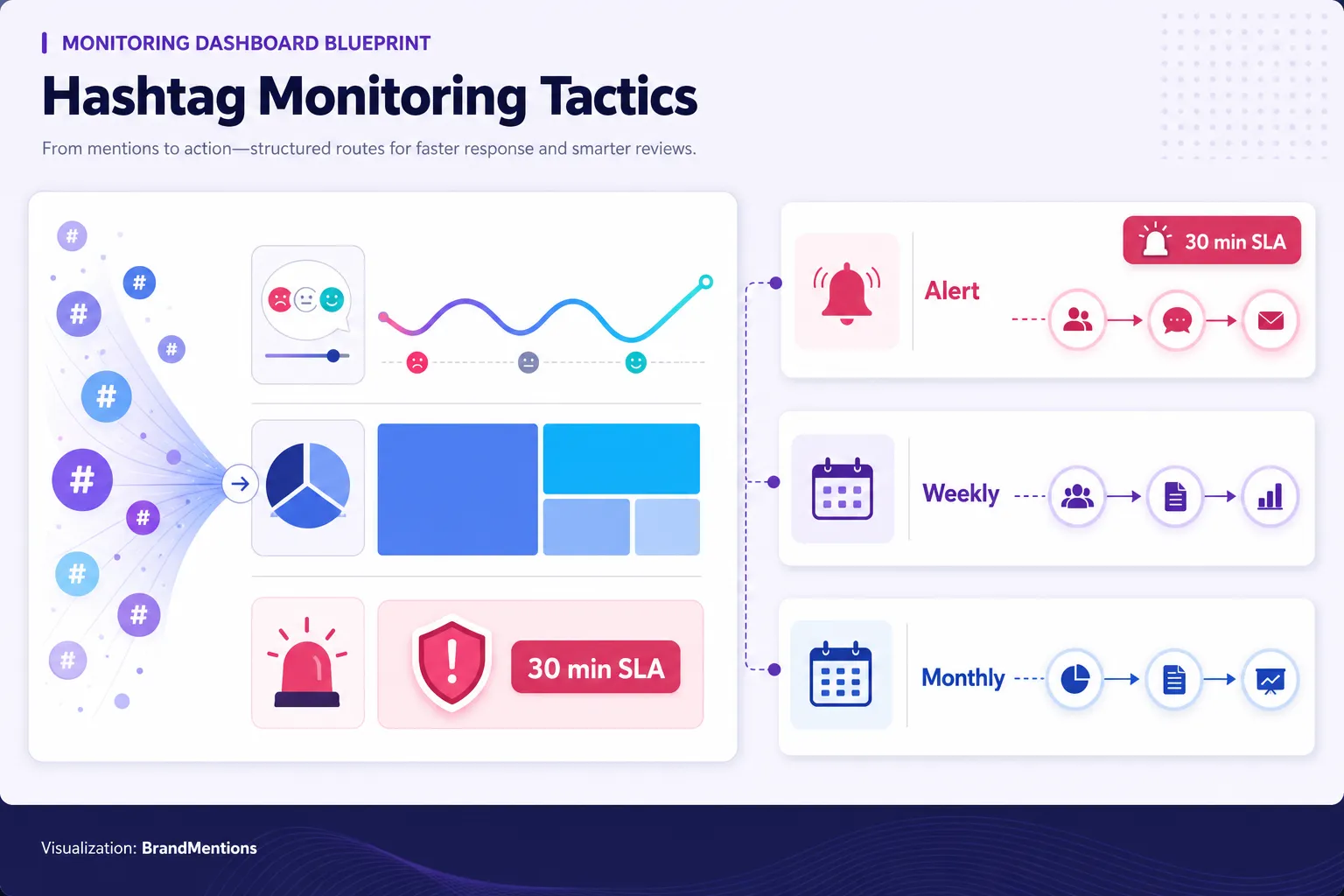
The Monitoring Dashboard Blueprint
A framework only helps if it lands in a real dashboard. Build one view per tag with these fields, owners, and cadences, and stop reporting volume alone.
| Field | Definition / formula | Owner | Cadence |
|---|---|---|---|
| Share of voice | Your tag mentions ÷ total category mentions | Analyst | Weekly |
| Velocity | New posts per hour (Δ posts ÷ Δ time) | Community lead | Real-time on branded tags |
| Sentiment shift | (Positive − negative) this period vs last | Analyst | Weekly |
| Qualified participation | Valid on-brand posts ÷ total tagged posts | Campaign manager | Per campaign |
| Escalation rate | Mentions escalated ÷ mentions flagged | Support lead | Weekly |
| Response SLA | Time from alert to first public reply | Community lead | Real-time (target under 30 min on crisis tags) |
While many hashtag monitoring tools can automate this reporting and populate these fields for you, the discipline still comes from deciding which tags earn a place on the dashboard in the first place.
The Attention Budget Rule. A strong program is not about monitoring more tags. It is about spending your best attention only on the tags that can change a decision this week. Route high-ownership, high-velocity tags (branded and crisis) to real-time alerts with a named owner. Send low-ownership, high-intent tags (competitor and category) to a weekly review. Automate low-velocity trend scans monthly. Everything else gets a lighter touch, and your team stays sane. Use the social analytics tools that already report these fields rather than buying a second dashboard that duplicates the first.
Frequently Asked Questions
Do hashtags still work in 2026?
They work for categorization, search, and monitoring, not for reach. On Instagram, X, and Facebook they carry little to no distribution weight, while on TikTok, LinkedIn, and YouTube a small set of relevant tags still aids search and topic sorting. Use roughly three to five relevant tags on most platforms, and remember YouTube ignores all hashtags on any video or playlist that exceeds 60.
What is the difference between hashtag monitoring and social listening?
Hashtag monitoring tracks a specific, deliberate tag that people chose to use, which makes it clean but narrow. Social listening is broader, capturing every mention of your brand, product, or category including untagged posts, misspellings, and complaints. In practice, hashtag monitoring works best as one structured, campaign-level input inside a wider listening program.
How many hashtags should I monitor per campaign?
Track one official campaign tag, two to five approved variants, your brand name without the hash, key creator handles, and one or two category phrases. Coverage of how people actually talk matters more than the raw count. If a tracked tag returns only a trickle of real posts each week, drop it and monitor the underlying keyword instead.
Which platform is best for hashtag monitoring right now?
TikTok, because users actively browse hashtags and the Creative Center exposes trendlines, related videos, and regional data. LinkedIn is second for B2B, where a few relevant tags measurably lift impressions. Instagram and X remain worth monitoring for conversation and reputation, though not for tag-driven distribution, and Bluesky is the easiest for raw data access because its firehose is open.
Conclusion: Read the Tag, Do Not Chase It
For a decade, marketers treated hashtags as a way to be found. That job is mostly gone, and pretending otherwise is why so many campaigns still stuff tags that do nothing.
The tag's second act is quieter and more valuable. It is a self-selected, structured signal that tells you what your audience means, where your campaign is landing, what your competitors are getting wrong, and where your brand is being talked about long after the post scrolls away, including inside the AI answers people now trust. Monitoring that signal, and routing your best attention to the few tags that can change a decision this week, is a real edge while everyone else argues about whether hashtags are dead.
So do this next week. Pick one branded tag, one category tag, and one competitor tag. Set a real-time alert on the first, a weekly review on the second, and a monthly scan on the third. Run each through the scorecard, give each a routing level and an owner, and record one decision the data actually changes. You will learn more about your market in a month of disciplined listening than in a quarter of chasing reach that hashtags no longer provide.
Filed under: Growth




2 comments