How to Creatively Use Social Media Marketing for Fashion Brands
Fashion brands have always been aggressive when it comes to their marketing strategies. And if you want to make a business in fashion, you need a killer social media marketing strategy. What is soc…

Fashion brands have always been aggressive when it comes to their marketing strategies. And if you want to make a business in fashion, you need a killer social media marketing strategy.
What is social media marketing for fashion brands? It is the use of platforms like Instagram, TikTok, Pinterest, and YouTube to create demand, prove product value, distribute styling ideas, drive in-app commerce, and protect reputation for apparel, accessories, footwear, and jewelry. In 2026, it is measured less by likes and more by watch time, saves, shares, and attributed, return-adjusted revenue.
Summary
- Meta reported 3.60 billion daily active people across its apps in June 2026, and Instagram reached 2 billion daily actives. Scale is not the problem for fashion. Translation is.
- TikTok's own For You documentation states that follower count and a creator's past high-performing videos are not direct ranking factors. Interactions, video information, and watch completion drive distribution instead.
- TikTok Shop's global GMV reached $50.3 billion in the first half of 2026, up 92% year over year, with $11.8 billion of that in the United States.
- Instagram now excludes accounts that repeatedly repost content they did not create from being recommended across the app. Originality became an eligibility gate, not a bonus.
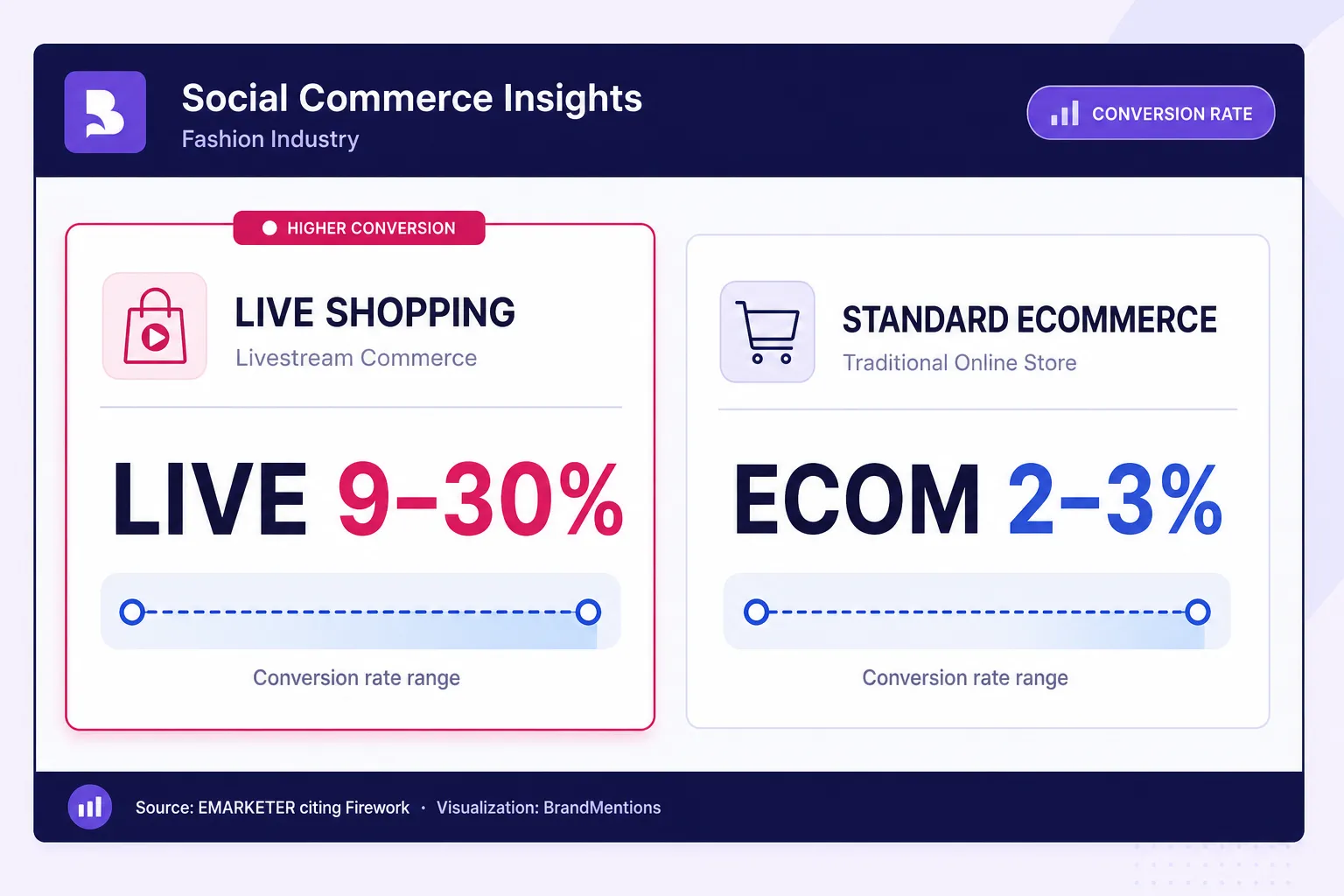
- Live shopping converts at roughly 9% to 30%, compared with 2% to 3% for standard ecommerce, which makes it the closest digital equivalent to a fitting room fashion has.
- Pinterest reached 640 million monthly active users in Q2 2026, and luxury house TOD'S reported 2x ROAS using Pinterest Performance+ and shopping ads, which is why planning-intent platforms deserve their own role in a fashion plan.
What is social media marketing for fashion brands? It is the use of platforms like Instagram, TikTok, Pinterest, and YouTube to create demand, prove product value, distribute styling ideas, drive in-app commerce, and protect reputation for apparel, accessories, footwear, and jewelry. In 2026, it is measured less by likes and more by watch time, saves, shares, and attributed, return-adjusted revenue.
At a Glance: Core Tactics by Goal
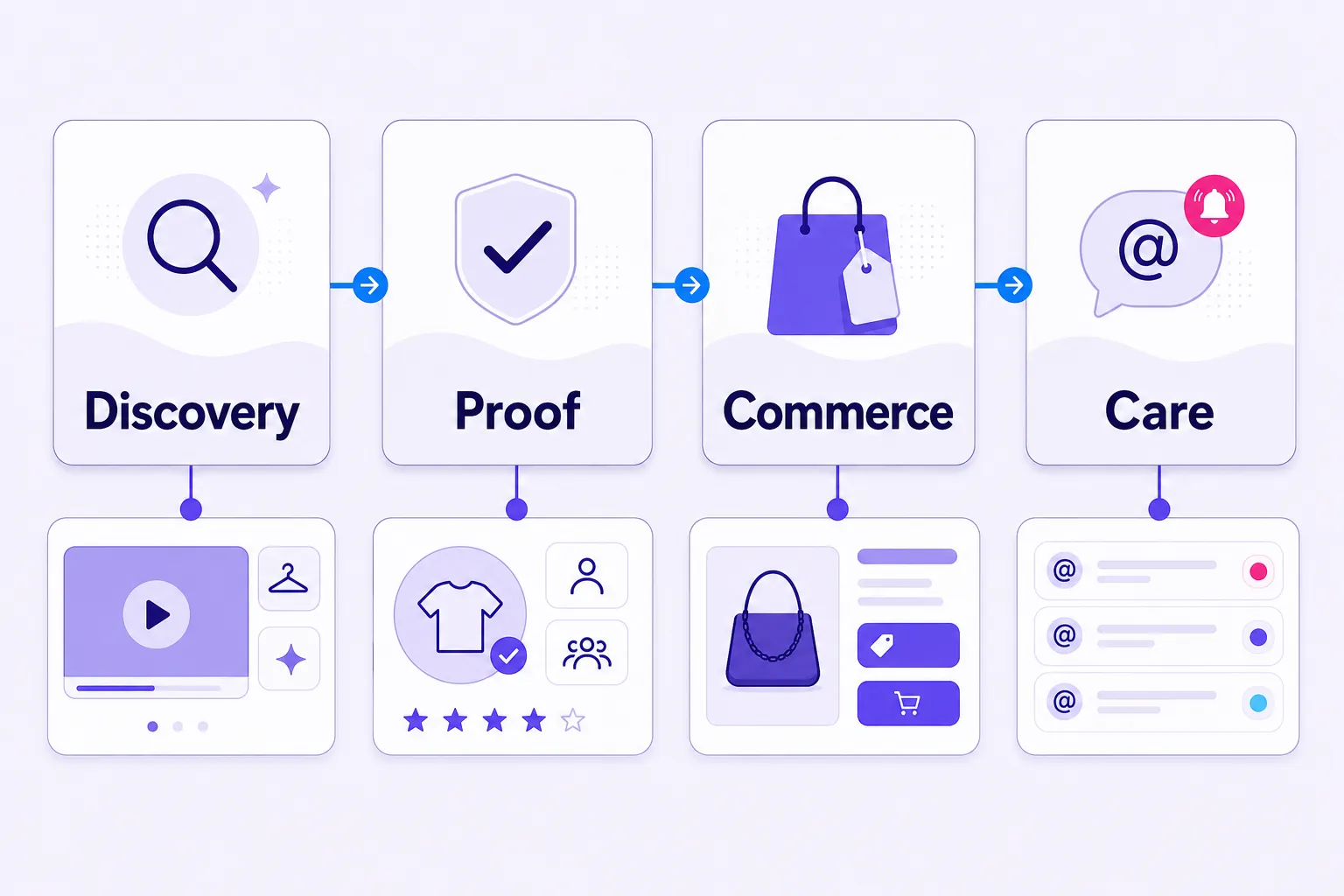
- Best for zero-budget credibility: Customer styling and fit-proof content. Real buyers on real bodies answer objections that a polished campaign shot cannot, and they cost nothing to source.
- Best for pure discovery and reach: Original, made-for-platform short-form video. Platforms now hand reach to content they recognize as original, and demote recycled clips before anyone watches.
- Best for high-intent conversion: Native social commerce and TikTok Shop. Product tags, in-app checkout, and creator affiliate links collapse the distance between seeing a garment and owning it.
- Best for considered and higher-price purchases: Pinterest and YouTube. They catch the shopper who is planning a wedding look, a season, or a considered footwear purchase weeks before they know the product name.
- Best for trust and audience extension: A nano and micro creator roster chosen for fit and objection coverage, not follower count.
- Best for reputation and return protection: Social listening plus a public service workflow. You cannot fix a sizing complaint, or correct how the market describes you, if you never see it.
How Is Fashion Social Media Different in 2026 Than in the Feed Era?
In 2026, fashion social media has shifted from follower-based broadcasting to algorithmic recommendation engines that prioritize original, high-retention content and in-app commerce.
The old model rewarded a follower graph. You built an audience, posted often, looked aspirational, and broadcast to the people who already followed you. That model is gone. Instagram, TikTok, and YouTube now run as recommendation engines that evaluate each post on its own merits.
TikTok's own explanation of For You recommendations is blunt about this. Follower count and whether you have had a previous high-performing video are not direct ranking factors. What matters is user interactions, video information such as captions and sounds, and how much of the video people actually watch. A 12,000-follower label with a genuinely shareable clip can now out-reach a two-million-follower brand that reposts a watermarked video.
The second shift is originality as an eligibility gate. In April 2026, Instagram confirmed that accounts which regularly repost content they did not create, or primarily share other people's photos and carousels, would no longer be eligible for recommendations across the app, as TechCrunch reported. Reposting is no longer free reach with a small cost. It is a distribution risk you take on before a single viewer arrives.
The third shift is commerce moving inside the feed. The window between seeing a garment and buying it collapsed to a tap, and the platforms built the checkout to match.
The Originality Tax: every time you drop a watermarked clip or a found video into your feed, you pay a reach penalty before anyone hits play. Export clean masters per platform, always.
Does Follower Count Still Decide Reach for a Fashion Brand?
Less than you think, and that is good news if you are not a heritage house sitting on a million followers. Reach in 2026 is earned per post, not banked in your follower number.
That reframes the strategic question. It is no longer "how do I get more followers." It is "what would make one person send this look to a friend." Design for the forward, and the growth follows. If you want the mechanics behind compounding an audience, our guide on how to grow your followers breaks down the loop.
The practical consequence is that a small, specific brand can beat a large, generic one on any given day. That is the quiet gift of the recommendation era. The playing field tilted toward taste, consistency, and usefulness, and away from raw spend.
Should You Chase Trends or Build Recognizable Content Codes?
Do not build a strategy on trends. Build it on recognizable content codes, then borrow a trend only when it helps the code travel.
A trend is the wrapper. A content code is the repeatable thing shoppers recognize from you in three seconds: the same mirror angle for every true-fit try-on, the same three-person denim fit test, the same "office, dinner, weekend" styling format, the same founder voice explaining fabric decisions. Fashion teams often confuse consistency with repetition. Consistency means a shopper can identify your point of view instantly. Repetition means the same product shot with a new caption.
The Recognizable Variation Rule: repeat the promise, vary the expression.
The non-obvious move is to make trends solve an inventory problem. If a trouser is getting attention but low conversion, do not chase random trending audio. Build five pieces of proof around the friction: waistband stretch, inseam options, real-light color, shoe pairings, and a return-reason answer.
Can Social Still Sell When Shoppers Are Skeptical and AI Is Answering Their Questions?
Yes, but social now sells in a more distributed way. A shopper sees the first look on Instagram, searches TikTok for reviews, saves a Pinterest outfit, watches a YouTube Short about fit, texts a friend, then buys after a retargeting ad. If you measure only the last click, social looks weak. If you measure only engagement, social looks stronger than it is.
The State of Fashion 2026 report from McKinsey and The Business of Fashion describes a tougher market, with 46% of fashion leaders expecting conditions to worsen in 2026, and argues that brands need stronger product quality, standout experiences, storytelling, and more machine-readable content as AI reshapes discovery. That is the real change. Your social content no longer influences only humans. It becomes public evidence that search systems, AI assistants, creators, journalists, and marketplaces can interpret.
One correction worth making here, because a lot of noise surrounds it. Google's own documentation on AI features states that AI Overviews and AI Mode use standard Search eligibility, supporting web content, and normal SEO best practices. There is no secret "social consensus" ranking factor or special citation layer for TikTok comments. So the honest framing is this: strong, specific, well-described social content improves your legibility across the web, which is where AI systems read. It is not a magic button.
The Fashion Social Operating Scorecard
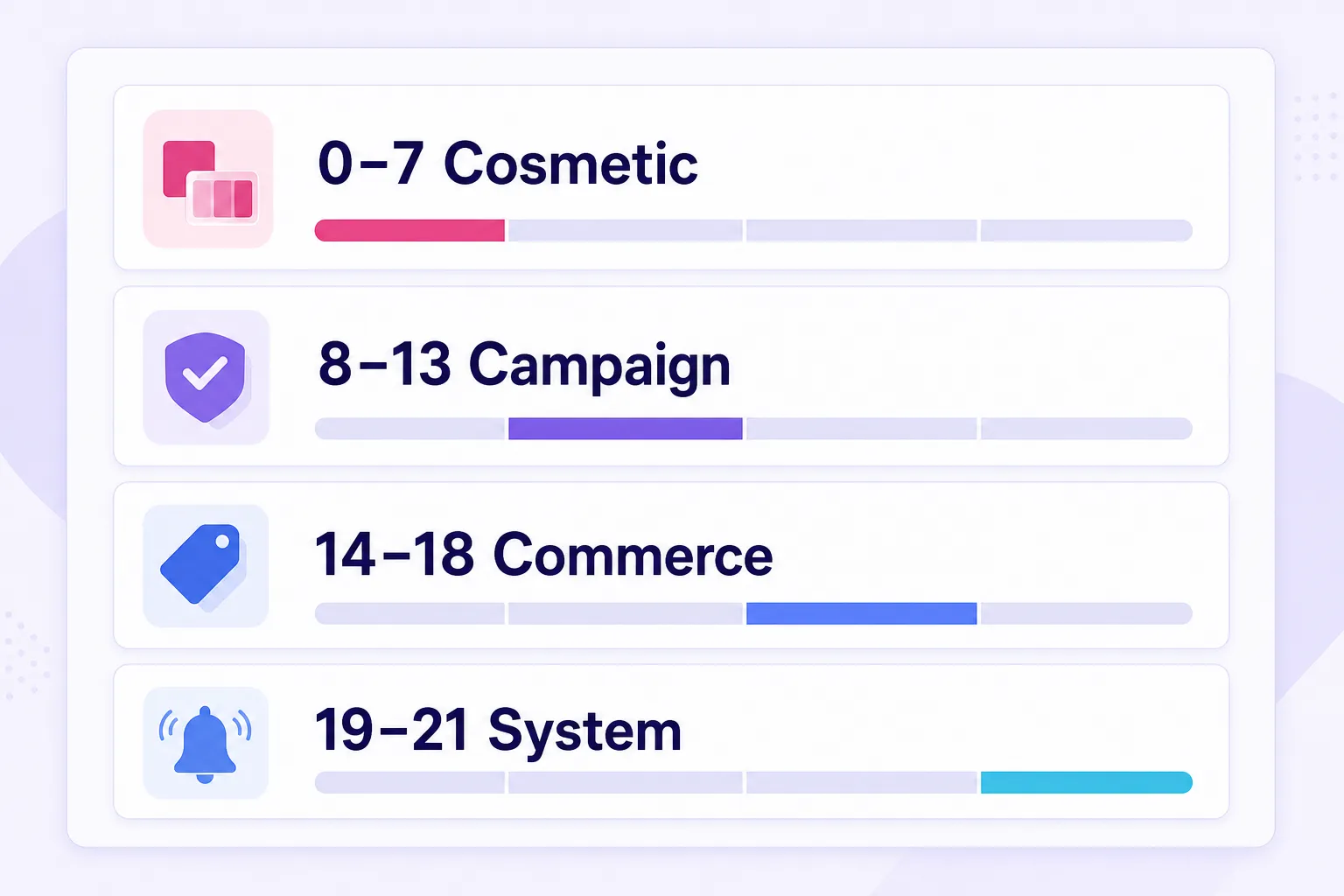
Most guides hand you tactics with no sense of sequence, and that is how teams end up launching a live show before they own a single piece of shareable video. Before you add a channel or a tool, score the system you already have. Most underperformance comes from gaps between creative, commerce, and service, not from one weak post.
Score each capability from 0 to 3.
| Capability | 0 means | 1 means | 2 means | 3 means |
|---|---|---|---|---|
| Visual identity | The brand looks different every week | Some recurring colors or shoot styles | Recognizable across most surfaces | Identifiable without seeing the logo |
| Product proof | Posts show product but do not reduce buying risk | Some fit or styling detail appears | Most posts answer a shopper objection | Every hero product has fit, styling, quality, care, and social proof |
| Platform fit | The same file is reposted everywhere | Minor caption changes by platform | Creative adapted by surface and intent | Each platform has a clear job in the funnel |
| Creator system | Chosen by follower count | Matches the general audience | Maps to product use cases | Covers body types, occasions, objections, and content rights |
| Commerce readiness | Tags, catalogs, checkout inconsistent | Catalog exists but unoptimized | Feeds, tags, analytics reliable | Commerce data feeds paid, organic, creator, and retention decisions |
| Community and care | Ad hoc replies | The team answers direct tags | Public and private replies follow a workflow | Mention themes and sentiment shape content and product decisions |
| Measurement | Reports likes and follower growth | Adds reach and clicks | Connects content to product actions | Connects content, creators, returns, and repeat purchase |
Add it up. 0 to 7 is cosmetic presence, so stop adding channels and fix product proof first. 8 to 13 is campaign-led, so build repeatable content codes and a creator brief system. 14 to 18 is commerce-aware, so improve attribution, catalog quality, and your social care loop. 19 to 21 is a working operating system, where you scale paid amplification, creator licensing, and visibility monitoring.
The scorecard protects you from the most common mistake I see: treating every weak result as a creative problem. Sometimes the creative is good and the catalog is broken. Sometimes the post earns comments and nobody owns the replies.
The Six Tactics That Actually Move Fashion in 2026
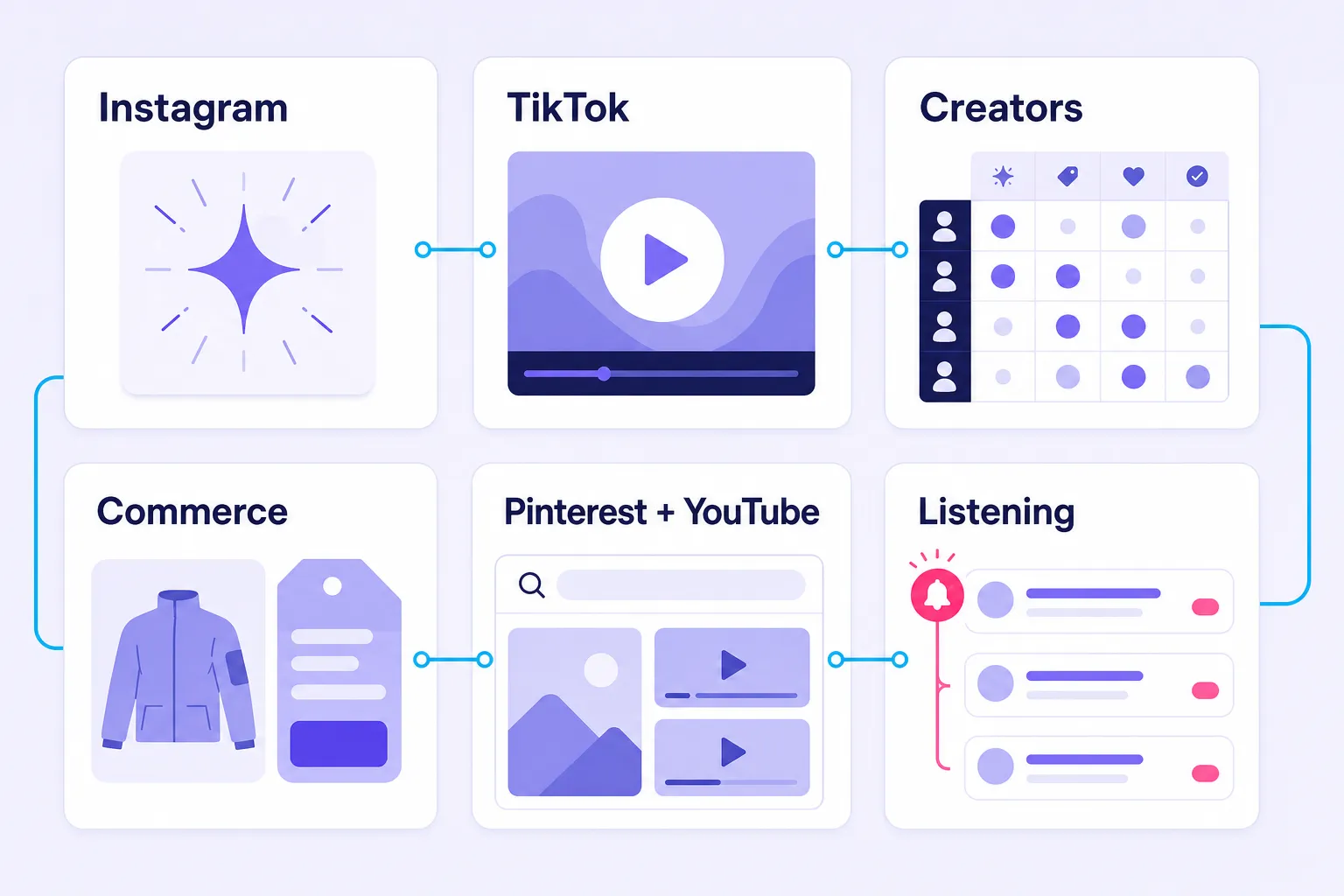
Here is how the core tactics compare before we break each one down.
| Tactic | Best use case | Execution complexity | Time to useful signal | Primary resource |
|---|---|---|---|---|
| Instagram original-content testing | New drops, styling angles, product proof | Medium | 24 to 72 hours | Social lead plus in-house content |
| TikTok proof-led video and search | Fit questions, discovery, younger shoppers | Medium | 3 to 14 days | Creator-style production, comment mining |
| Creator fit-proof system | Trust and audience expansion | Medium to high | 2 to 6 weeks | Creator manager, usage rights, disclosure |
| Social commerce catalog system | Revenue attribution, friction reduction | High | 2 to 8 weeks | Ecommerce, paid media, feed ownership |
| Pinterest and YouTube discovery | Considered purchases, occasion dressing | Medium | 4 to 12 weeks | Search-led, evergreen planning |
| Social listening and care | Reputation, retention, return reduction | Medium | Same day to 30 days | Community manager, workflow, monitoring |
1. Build Instagram as an Original-Content Testing Lab
Start with Meta's Instagram Feed Ranking System Card, not with someone's favorite posting hack. Meta's own explanation says the feed predicts likely actions such as comment, like, save, profile tap, and video viewing, then combines those predictions into a score. So every asset should be designed around an action you want a specific shopper to take.
Instagram still carries the cultural weight fashion needs. Meta said the wider family reached 3.60 billion daily active people in June 2026, and Instagram reached 2 billion daily actives, according to Meta's Q2 2026 investor materials. But it is a multi-surface system now, and each surface has a job. Use Reels for discovery, carousels for decision support, Stories for urgency and conversation, DMs for assisted selling, and creator collabs for borrowed trust.
Build every hero product around five proof types: fit proof (height, size, stretch, drape, opacity, inseam), styling proof (one product across occasions), quality proof (fabric, stitching, wash tests, repairability), social proof (customer and creator outfits), and drop proof (launch details, restocks, comparisons).
The Product Proof Loop: every fashion post should create at least one of four things, fit confidence, styling confidence, quality confidence, or purchase confidence. If it creates none, it is decoration.
Hashtags changed jobs. They still help categorize a post, so use three to five specific, relevant tags as filing, not as a reach lottery. To keep them aligned with what is surfacing in your category, monitor trending hashtags rather than recycling the same evergreen set.
Meta's Trial Reels feature is a genuinely useful test bed most brands ignore. Trial Reels are shown to non-followers first, surface key engagement metrics after roughly 24 hours, and can be auto-shared to your followers if Instagram judges them to perform well based on views in the first 72 hours. Use them for a silhouette that may split opinion, a founder-led explanation instead of a model-led look, or a creator edit before you pay to amplify it.
Non-obvious insight: your best Instagram content is often not the prettiest asset. It is the one that removes the most purchase anxiety. A coat post showing lining, movement, pocket depth, and three temperatures of styling can beat a perfect campaign image because it gives the feed system more actions to predict.
If you treat Instagram as a gallery, you will post pretty work and wonder why it stalls. Treat it as a testing room for shopper objections, and the content sharpens fast.
2. Use TikTok as a Proof Engine, Not a Trend Machine
The mistake I see most is a team translating "TikTok" into "be funny" or "chase the sound." Sometimes that works. Often it buys empty reach. TikTok's own Next 2026 trend research points to an evidence economy, where audiences treat TikTok as a verification hub and lean on comment sections and candid creator reviews before they buy. For fashion, that means the platform works best as a public fitting room.
Build content from the questions people already type: what to wear to a September wedding, whether a dress is see-through, how a piece fits between sizes, whether a fabric wrinkles after sitting, whether it is worth the price. Present two styling routes, let the comments decide, then turn the winning answer into a product-tagged follow-up. That is a weekly format, not a one-off.
TikTok Search has also become a paid surface. TikTok's August 2026 Search Ads setup guidance says these campaigns manage keyword targeting at the ad group level, are limited to search-result placement, and recommend a budget roughly 20 times higher than the bid to support delivery. Use it to catch high-intent terms like "wedding guest dress," "wide calf boots," or "petite blazer." Use organic to create demand, and search ads to catch it.
To build a bench, sort your TikTok creators by use case rather than vanity category. You want the petite denim explainer, the midsize workwear stylist, the modest fashion editor, the travel capsule packer, and the repair-minded sustainability voice.
Non-obvious insight: mine comments before you write scripts. TikTok comments are objection data. If five people ask whether a skirt rides up, that is next week's video. If shoppers debate a color, film it in daylight, shade, and warm indoor light.
One caution for 2026 planning. US regulatory and ownership uncertainty around TikTok has not fully settled, so do not build your entire fashion engine on a single platform you do not control. Treat TikTok as a powerful channel, not a foundation.
3. Turn Creator Collaborations Into a Fit-Proof System
Clothes change meaning on a body. A product page can tell you a dress is satin. A creator can show whether it clings, moves, wrinkles, photographs well, and survives dinner. That is why creators anchor fashion social, but you have to pick them for the objection they solve, not the audience they command.
The strongest programs use four creator roles. The body double proves fit on a specific height and proportion, which suits denim, tailoring, and swimwear. The stylist proves versatility, which suits capsules, accessories, and footwear. The reviewer proves quality and price justification, which suits premium basics and outerwear. The cultural translator proves how a piece fits a community or moment, which suits streetwear, modest fashion, resale, and bridal.
The Fit Before Fame Rule: a creator who answers the right fit question is often worth more than a bigger creator who only makes the outfit look desirable.
There is a compliance layer you cannot skip. The FTC's endorsement guidance requires clear disclosure of material connections between a brand and a creator, and both parties carry responsibility. Build disclosure, usage rights, and content licensing into the brief from the start. A creator video you can run as a paid ad with clear rights extends the asset far beyond a 48-hour post. A video you cannot reuse dies in the feed.
Two more legal notes fashion teams routinely miss. Music licensing on commercial and boosted content is not the same as organic use, so a trending sound you can post organically may not be cleared for a paid ad. And any customer or creator likeness you repurpose needs an explicit content release, not just a comment saying "sure." Store those permissions where your team can find them.
Use finding Instagram influencers as a research workflow, and keep the structure current by watching influencer marketing trends. But judge every creator through the product problem they solve.
The Nano Overlap Rule: before you pay a creator, check how much of their audience already follows you. High overlap means you are buying reach you already own. Weight your roster toward audiences you cannot otherwise touch.
Non-obvious insight: pay creators for useful doubt. A creator who says "size up if you want a relaxed fit" drives better customers than one who says everything is perfect, because honest fit guidance cuts bad-fit purchases. In a category where returns routinely run 30% or higher, that honesty protects margin as much as image.
Manage creators like a portfolio, not a campaign. Twenty small, well-matched partnerships you nurture for a year will out-earn one celebrity post you rent for a week.
4. Build Social Commerce Around Catalog Accuracy, Not Just Shop Buttons
The scale here is no longer speculative. Global TikTok Shop GMV reached $50.3 billion in the first half of 2026, up 92% year over year, with $11.8 billion of that in the US, according to Momentum Works. Apparel is the largest combined category, and also the most competitive for new sellers, so do not launch a shop and expect the algorithm to find you. It needs creator content pointing into it.
The bigger point is that the social team can no longer treat product data as website admin. TikTok Shop's seller guidance recommends at least five clear, high-resolution images and detailed, category-specific product information, states there is no setup fee, and lists a 6% commission per sale for US sellers. A weak title hurts discovery, a missing size chart kills conversion, and a vague description drives returns.
Meta commerce shifted too. Shopify's Selling on Meta documentation says eligible US stores can use a Shopify-powered direct checkout on Meta surfaces, that it is active by default for eligible stores, and that there are no fees beyond standard payment processing. It also notes that subscriptions, product bundles, customizable products, and custom pixels are not supported.
Non-obvious insight: a lower-friction checkout can create a measurement blind spot. If your usual client-side analytics or custom pixels do not fire in Meta direct checkout, you lose visibility into part of the journey. For simple apparel with clean variants, that friction reduction is worth it. For customizable pieces, bundles, or products that need rich fit education, sending shoppers to your own site may serve both the customer and your data better.
| Commerce setup | Use it when | Watch for |
|---|---|---|
| TikTok Shop | Category benefits from creator demos, LIVE, or affiliate selling | Commission, fulfillment readiness, Shop Tab optimization |
| Meta direct checkout via Shopify | Simple US products, want lower in-app friction | Unsupported custom pixels, bundles, subscriptions |
| Website checkout from social | Need richer education, advanced analytics, complex promotions | More friction, possible drop-off |
| Product tagging, no in-app checkout | Want discovery and context but prefer site conversion | Attribution gaps across paths |
On attribution, do not judge social on last click alone. Wire up server-side events (CAPI), use creator codes and post-purchase surveys as directional cross-checks, and hold out a portion of spend for incrementality tests when budgets allow. Track return-adjusted ROAS and contribution margin, not just top-line ROAS, because a category with heavy returns can look profitable on paper and lose money in the warehouse.
Live selling deserves its own mention inside commerce. EMARKETER reports livestream shopping conversion rates between 9% and 30%, citing Firework, compared with 2% to 3% for standard ecommerce. Live works for fashion because a host walking through fit, texture, and styling answers the questions that drive returns before checkout. Only commit if you can sustain a weekly cadence. The audience learns when to show up, and the algorithm learns you are a reliable live surface. And treat viewer questions as inventory research. The SKUs that generate the most fit and color questions are the ones to reorder, and the questions you cannot answer expose your product data gaps.
5. Use Pinterest and YouTube for Considered Fashion Discovery
Not every purchase is an impulse. Pinterest and YouTube catch the shopper who is planning. Pinterest reached 640 million monthly active users in Q2 2026, and it behaves like a search and planning engine, where people decide what their wedding guest look, autumn wardrobe, or capsule closet should become before they know a product name.
Pinterest has stronger performance tooling than many fashion teams assume. In a Pinterest case study, TOD'S used Pinterest Performance+ and shopping ads and reported 2x ROAS against 1.48x on another social platform, a 28% lower CPC, and a 19% lower CPA. Its Performance+ guidance recommends more than 50 weekly conversions for Lead or Sales campaigns and a daily budget at least five times your cost-per-action goal, so plan volume before you switch it on.
The Planning Beats Posting Rule: if a shopper buys for a future occasion, publish before the occasion enters panic mode. Fall capsules in August, holiday blazers in November.
YouTube supports deeper trust. It classifies square or vertical videos up to three minutes as Shorts for uploads after October 15, 2024, and YouTube's Shorts documentation confirms you can add shopping product stickers to Shorts. Use Shorts for compressed education ("three signs a blazer fits correctly," "one trench coat, four climates") and longer videos when the purchase needs depth, like handbags, occasionwear, footwear, or bridal.
If assets are tight, start from user-generated content ideas that can become a Pin, a Short, a product-page review, and a Story highlight from a single customer outfit.
Non-obvious insight: Pinterest and YouTube are your evergreen insurance against platform risk. A searchable pin or Short keeps working for months, which matters when a feed-based channel changes its rules overnight.
6. Treat Social Listening and Customer Service as Public Merchandising
This tactic protects everything the other five build. Fashion has predictable service flashpoints: where is my order, will this restock, which size, why does the color look different, how do I return it, the zipper broke, the fabric pilled, the creator code failed. Every public reply teaches silent shoppers something, so a clear size answer under a Reel prevents ten DMs, and a fast reply on a shipping delay protects trust.
Customer expectations have hardened. Zendesk's 2026 CX Trends research, based on more than 11,000 respondents across 22 countries, found that 81% want agents to continue a conversation without backtracking and 74% get frustrated when they have to repeat information. Set response targets accordingly. Aim for public comments under one hour during business hours, and DMs under four.
The harder job is catching what you were never tagged in. Most fashion complaints do not include your handle. They mention a product name, a misspelled store name, or a generic phrase in a forum thread. This is where a monitoring layer earns its place. In client programs, I use BrandMentions, which is best for web-wide untagged mention discovery and sentiment tracking, to surface the posts where a customer raves about a dress or flags a sizing problem without ever using your handle or a link. Those are exactly the posts you would otherwise miss, and they are the raw material for both your reputation defense and your content pipeline.
A complaint that never tags your brand still ranks against you. The skill is filtering for the few mentions that signal a shift, not collecting every one.
The same data feeds merchandising. Track which products draw repeated complaints, which fit words appear with negative sentiment, which colorways get praised. That is voice-of-customer data you would otherwise pay a research firm for. Layering sentiment analysis on top tells you which conversations need a human now and which are noise, and grouping mention themes stops your team treating every comment as a one-off.
There is a newer frontier worth watching honestly. Shoppers increasingly ask AI assistants for recommendations like "best sustainable denim brands," and those answers assemble from how your brand is described across the open web. You cannot control that directly, and no platform gives you a switch for it. What you can do is watch how the market and those systems describe you, and BrandMentions is useful for that web-wide visibility check so you spot a shifting narrative early. The value is not watching everything. It is seeing the pattern before a single thread becomes the brand story.
Build a real crisis workflow before you need one. Define severity levels (minor complaint, viral thread, product-safety or recall trigger, creator controversy), assign an escalation owner, prepare a holding statement, and set a rule for when to pause scheduled content so you are not posting a launch during a service fire.
Non-obvious insight: a complaint trend is a content brief before it becomes a product crisis. If buyers keep asking whether a white dress is lined, do not wait for returns. Publish a lining close-up, a daylight try-on, and a size note this week.
Versus Comparisons That Matter
Instagram Reels vs. TikTok video: use Instagram to make the brand feel coherent and product-tagged, and TikTok to make the product feel verified through comments and candid proof.
Creator content vs. customer content: use creators to launch a proof angle with controlled reach and rights, and use customers to prove it keeps working after purchase.
Pinterest vs. Instagram: Pinterest captures planned intent months out, Instagram creates active desire now. Occasionwear often sparks on Instagram and gets planned on Pinterest.
Social checkout vs. website checkout: use social checkout for simple, high-confidence products, and your own site when the purchase needs education, customization, or richer analytics.
Getting the Product Page and the Brand Ready to Convert
Fashion social performance lives or dies on details that sit outside social. Before you scale reach, make sure every hero product page carries a real size chart, model measurements and the model's own size, fabric composition, care instructions, honest shipping times, a clear returns policy, reviews, and accurate variant stock. A great Reel that lands on a page missing a size chart just funds a return.
Two things fashion brands underweight in 2026. First, accessibility and inclusive execution are not optional extras. Caption your videos, write alt text, keep on-screen text high contrast, and show fit on a genuine range of bodies, sizes, and skin tones. That is both the right call and better proof, because more shoppers see themselves and buy with confidence. Second, watch your sustainability claims. If you market recycled materials, ethical production, durability, or resale, keep the evidence specific and documented. Vague green claims invite both regulatory scrutiny and public backlash, and fashion audiences are quick to test them.
If you sell across regions, do not assume one channel map fits everyone. A brand active in China or the wider region may need Douyin, WeChat, and RED (Xiaohongshu) rather than the Western stack, and markets like Japan lean on LINE. Localize the platform mix, the sizing language, and the styling references, not just the captions.
The Two-Platform Rule: pick two primary platforms and run them deeply before adding a third. Depth beats spread for a small fashion team, and it hedges you against any single platform's rule changes.
A 30-Day Creative Execution Plan
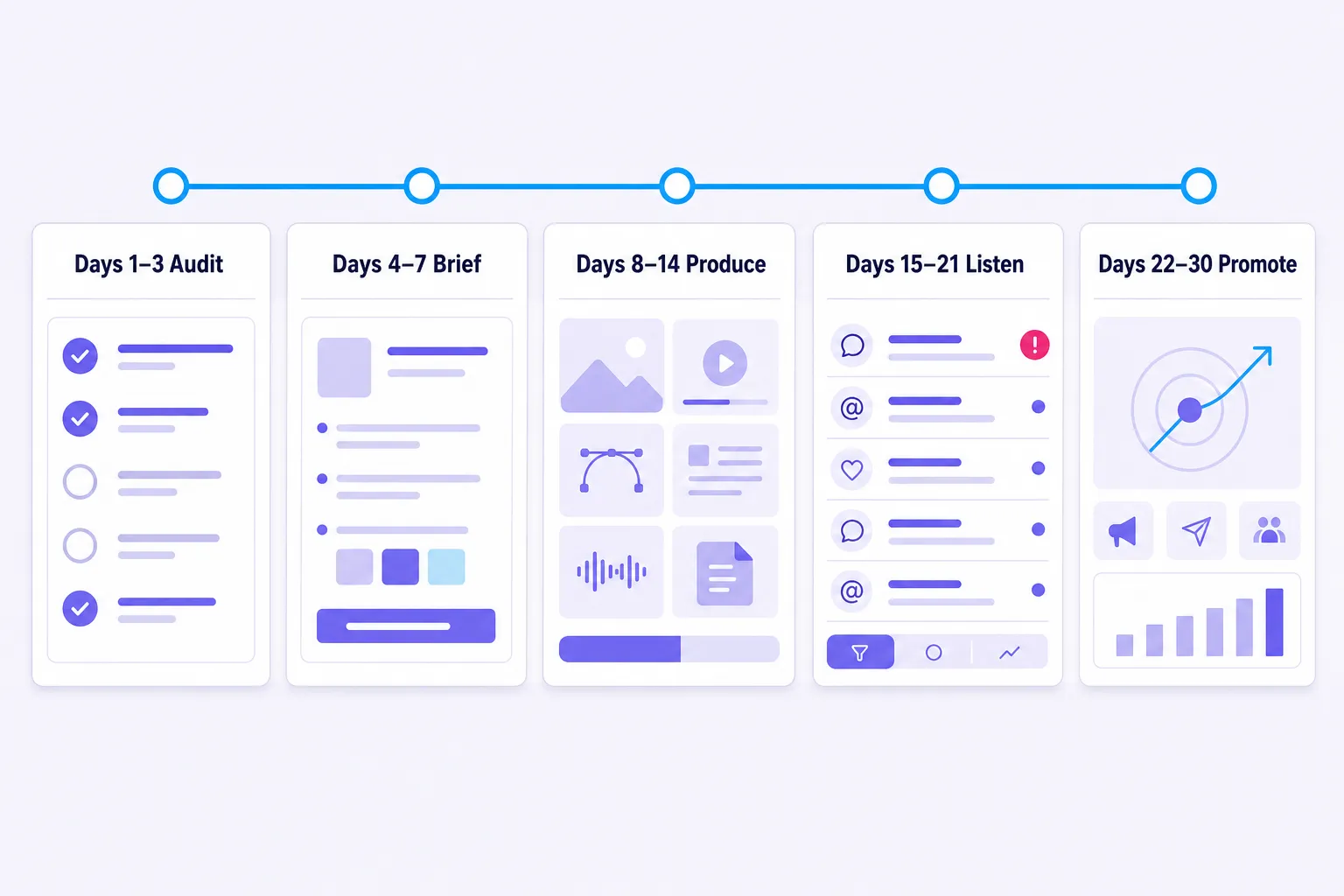
Days 1 to 3, audit the proof gap. Pick your top 10 revenue products. For each, name what the shopper must believe before buying, what questions appear in comments, DMs, reviews, and returns, and which products sell but lack social proof. Score each across fit, styling, quality, social, and commerce readiness.
Days 4 to 7, build product proof briefs. For each hero product, write a one-page brief: the main objection, the best platform for it, the best creator or customer type, the required shots, the disclosure needed if paid or gifted, the checkout path, and the metric that defines success. This is also the moment to check best posting times for your own audience, but do not let timing distract from the content. A weak asset posted perfectly is still weak.
Days 8 to 14, produce platform-native assets. For each product, create one Reel for discovery, one carousel for decision support, one TikTok built on a real question, one Pinterest pin set for planning intent, one YouTube Short if it needs education, and one Story sequence with a poll or product link. Show the garment moving, the fabric close, the product with real shoes, bags, and bodies.
Days 15 to 21, publish, listen, and reply. For the first 48 hours after each post, pin the most useful comment, answer fit questions with specifics, save objections into your next creative list, and turn high-friction questions into follow-ups. Check untagged mentions if a drop gains traction.
Days 22 to 30, promote only what proved useful. Boost the Reels that drove profile taps and saves, the TikToks that generated purchase-intent comments, and the Pinterest assets tied to seasonal search. Do not promote a post because the team likes the shoot. Promote it because shoppers showed it helped.
The Quote Test: if a social post cannot be quoted by a customer or an answer engine in one clean sentence, it has not earned its production cost. Rewrite it until it can.
Frequently Asked Questions
Which social media platform is best for a fashion brand in 2026?
It depends on your goal, not on a single winner. Instagram remains the strongest general platform for visibility, creator tools, and commerce, given its 2 billion daily actives. TikTok is stronger for proof-led discovery and impulse commerce, Pinterest for planning intent, and YouTube for deeper product education. Pick one primary platform where your audience already shops, go deep, then add a second.
How often should a fashion brand post on social media?
Post only as often as you can publish useful, platform-native content. A practical baseline is three to five higher-effort Reels or TikToks per week, daily Stories during active launches, and a weekly live session if you can staff it. Do not post four times a day if each post repeats the same campaign image.
Do hashtags still work for fashion brands?
They now serve categorization more than reach. Use specific category, occasion, community, and product hashtags rather than dumping broad tags like fashion or style. The heavier discovery work is done by your spoken words, on-screen text, and the first line of your caption, which platforms transcribe and index.
How do small fashion brands compete with luxury social budgets?
By being more specific. Real fit content, founder decisions, customer outfits, and honest styling advice answer objections that a bigger budget cannot fake. The cheapest levers, original video and customer content, are the ones the algorithm and the shopper reward most, and searchable content compounds long after a paid impression disappears.
How is social media marketing for fashion brands measured in 2026?
Less by likes and more by watch time, saves, shares, and attributed, return-adjusted revenue. Because a fashion category with heavy returns can look profitable on top-line ROAS and still lose money in the warehouse, track return-adjusted ROAS and contribution margin, wire up server-side events, and use creator codes and post-purchase surveys as directional cross-checks.
Does social commerce or website checkout convert better for fashion?
Neither wins outright; it depends on the product. Use social checkout for simple, high-confidence products with clean variants where lower in-app friction helps, and your own site when the purchase needs fit education, customization, or richer analytics. Live shopping sits at the high-conversion end, with livestream conversion rates reported between 9% and 30% versus 2% to 3% for standard ecommerce.
Conclusion: Build the System, Not the Post
The temptation in fashion is to chase the next viral post. Resist it. Virality is an output of a system, not a strategy. The brands that last built the machine underneath: original video that earns discovery, catalog-accurate commerce that converts it, creators and customers who supply trust at scale, live selling that closes at fitting-room rates, and monitoring that tells them what is working and what is about to break.
Notice how little of that depends on spend. The most expensive tactic here, live selling, is optional. The cheapest, original video and customer content, are the ones that perform best. That is the quiet gift of 2026.
So here is your Monday-morning move. Score your system on the operating scorecard, honestly, and fix the single thing blocking the next level. If reach is flat, audit for watermarks and reposts this week. If reach is strong but sales are not, make your best video shoppable and fix the product page before you spend another dollar on ads. One fix, in order, repeated. That is how fashion brands compound on social, and it outlasts any post that happens to pop.