WhatsApp Ads: How They Work, What They Cost, and How to Use Them
Advertising on WhatsApp is becoming an increasingly popular option for marketers looking to directly engage their audiences. With over 3 billion users globally, WhatsApp offers brands a unique oppo…


Advertising on WhatsApp is becoming an increasingly popular option for marketers looking to directly engage their audiences. With over 3 billion users globally, WhatsApp offers brands a unique opportunity: real-time, personal communication right where their audience already is.
What Are WhatsApp Ads?
WhatsApp ads are Meta ads that either open a chat with your business on WhatsApp (click-to-WhatsApp, or CTWA, ads on Facebook and Instagram) or appear inside WhatsApp's Updates tab (ads in Status, with promoted Channels coming). You pay for the ad through Meta’s advertising system. If the conversation is handled through the WhatsApp Business Platform, additional per-message charges may also apply depending on message category, market, and applicable free-entry-point benefits.
More precisely: a WhatsApp ad is either a paid placement whose destination is a WhatsApp business conversation or a paid placement shown inside WhatsApp's own advertising-supported discovery surfaces. Both are sold through Meta's advertising systems, both are targeted using limited account and interaction signals rather than message content, and the conversations they generate are billed separately from the ad itself under WhatsApp Business Platform per-message pricing. Nothing about that definition makes an ordinary business message an advertising placement.
There are three formats:
- Click-to-WhatsApp (CTWA) ads - Facebook and Instagram ads whose call to action opens a chat with a business on WhatsApp.
- Ads in Status (WhatsApp Status ads) - sponsored placements shown between organic Status content in WhatsApp's Updates tab, currently supporting chat and website destinations.
- Promoted Channels - paid visibility for a WhatsApp Channel in the Channels directory, labeled by WhatsApp as forthcoming rather than generally available.
Personal chats, calls, and group membership are excluded from WhatsApp's advertising signal set. Promotional business messages, organic Status updates, and Channel broadcasts are adjacent products, not advertising placements.
Key takeaways
- Two ad types, not one. Advertising that leads into WhatsApp (click-to-WhatsApp on Facebook and Instagram) and advertising displayed inside WhatsApp (ads in Status, with promoted Channels announced as forthcoming).
- Potentially two cost layers. Advertisers pay for ad delivery, while businesses using the WhatsApp Business Platform may also incur per-delivered-message charges. The exact cost structure depends on the campaign destination and messaging setup.
- Two windows that are constantly confused. The 24-hour customer service window is a permission rule; the 72-hour free entry point benefit is a pricing rule.
- October 1, 2026 changes the bill. From that date, service messages become chargeable beyond a monthly allowance of 1,000 per business phone number and in-window utility templates become chargeable, while the qualifying 72-hour free-entry-point exemption is retained.
- Targeting inside WhatsApp runs on a thin signal set. Country and city, language, followed Channels, ad interactions, and - only where a person has linked accounts in Meta's Accounts Center - cross-app ad preferences.
- No Facebook account is strictly required. Since June 27, 2023, businesses can create, purchase, and publish click-to-WhatsApp ads from inside the WhatsApp Business app using an email address and a payment method.
- A conversation is not a conversion. Closing the loop requires capturing the
ctwa_clidclick identifier from the inbound message and returning the outcome through the Conversions API - see the measurement section for how the loop is built and where it breaks. - Europe is a capped-reach market. Meta described a paid ad-free option for Status and Channels in Europe, which bifurcates the addressable Status audience in a way no other region has.
- The old one-line definition is obsolete. Meta no longer sells only the click; it sells the click plus the metered conversation that follows, which is why "a Facebook ad with a WhatsApp button" is no longer a complete description of this channel.
Why the Old Definition of WhatsApp Ads Stopped Working
Most explanations of WhatsApp ads describe a single mechanism: a Facebook or Instagram ad with a button that opens a chat. That was a complete description for about seven years, and it is not one anymore. Since June 2025, WhatsApp has been building paid inventory inside its own Updates tab, which means "WhatsApp ads" now covers two structurally different things: advertising that leads into WhatsApp, and advertising displayed inside WhatsApp. They share a brand name and almost nothing else - different placements, different targeting signals, different destinations, different measurement obligations.
The second shift is quieter and costs more money. Meta no longer sells only the click. It sells the click and then meters the conversation that follows, category by category, with a scheduled change taking effect eight days from this verification date. Teams that budget the ad and forget the conversation discover the gap when the invoice arrives, not when the campaign launches.
Having spent years close to content programs and brand monitoring workflows at BrandMentions, the failure I (Cornelia Cozmiuc) see most often is not a targeting mistake. It is a definition mistake: a team counts conversations, calls them leads, and never agrees on what a lead actually is. This brief fixes the mental model and gives you the setup routes - what WhatsApp ads are in September 2026, how to create one, how the rules changed, how delivery works around an encrypted messenger, what the conversation costs after the click, how attribution genuinely functions, and where the whole system breaks in practice.
How to Create a Click-to-WhatsApp (CTWA) Ad: Step by Step (Ads Manager and WhatsApp Business App)
There are two supported creation routes, and they have different requirements. Use Ads Manager when you need full targeting, placements, and conversion optimization; use the WhatsApp Business app when a small team wants ads without a Facebook account. Costs are detailed in ad spend vs messaging charges, and tracking is covered in conversations vs conversions.
What you need before you start
- A WhatsApp Business account and phone number that will receive the chats (the ad's destination).
- A Facebook Page if you are using the Ads Manager route.
- One Meta Business Portfolio holding the WhatsApp Business account, the Page, the ad account, and the catalog.
- An email address and a payment method if you are using the WhatsApp Business app route (no Facebook account required since June 27, 2023).
- Someone - or something - to reply within 24 hours, because the reply is what opens the 72-hour billing exemption.
Route 1: Meta Ads Manager (full control)
- Align the Business Portfolio first. Put the WhatsApp Business account, the Page, the ad account, and the catalog in the same Meta Business Portfolio. Misconfigured or disconnected business assets can prevent conversation and outcome data from being connected correctly
- Choose a fulfillable campaign objective. WhatsApp's own down-funnel guidance separates lead optimization from purchase optimization; the optimization event defines what the delivery system learns, so pick the outcome you can actually report back.
- Set WhatsApp as destination. Select WhatsApp as the messaging destination and choose the business phone number that will receive the chats.
- Choose audience and placements. Facebook and Instagram inventory draws on the full Meta signal stack; the WhatsApp Status placement is available depending on your account, market, and destination type, so confirm it in the account rather than from a press release.
- Upload creative in Meta formats. Use the standard Meta formats (single image, video, carousel, collection), and supply vertical assets if you are extending into Status.
- Write greeting and prompt questions. Build them around the specific decision you want the customer's first message to contain - availability, size, location, quantity - not "I'm interested."
- Publish, then confirm who answers. A reply inside 24 hours is what opens the 72-hour billing exemption, so staff the first response or automate it before the ad goes live.
Route 2: The WhatsApp Business App (no Facebook account required)
- Complete the business profile. Name, category, description, and catalog - so the destination lives up to the ad's promise.
- Open the in-app advertising option. Inside the WhatsApp Business app, choose to create a Facebook and Instagram ad that clicks to WhatsApp.
- Pick the creative. Either an existing image or video from your business content, or a new asset.
- Set audience, budget, and duration. Use the app's simplified controls.
- Confirm the chat destination. The destination is a chat with your own WhatsApp Business number.
- Add email and payment method. Since June 27, 2023, this route does not require a Facebook account.
- Publish, then record outcomes. Use labels and quick replies, which give a limited but real result set without order values.
The Four Layers of a WhatsApp Ad Campaign
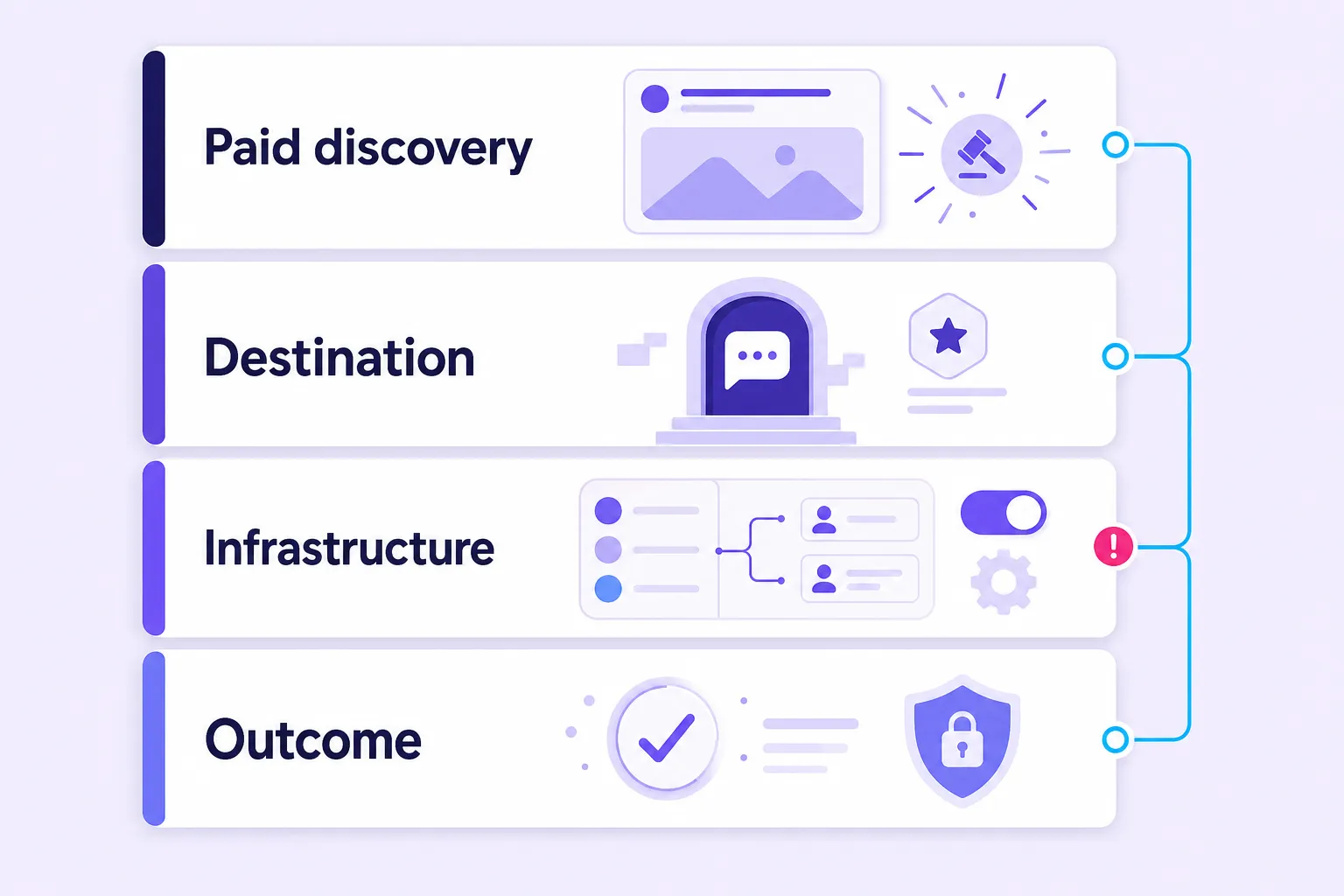
WhatsApp advertising is not one product with one price. It is an ecosystem with four structural layers, each governed by a different rule set and each capable of failing independently of the others.
1. The paid discovery surface: The environment where the promotion is encountered and the auction that decides whether it is shown. For click-to-WhatsApp (CTWA) ads this is Facebook and Instagram inventory, bought in Meta Ads Manager or (for smaller advertisers) from inside the WhatsApp Business app. For ads in Status, the surface is WhatsApp's Updates tab itself, sold as an extension of Meta campaigns rather than as a separate buy.
2. The destination and business identity: Where the tap lands and who receives it. A click-to-WhatsApp ad is defined by its destination, a conversation with a specific WhatsApp Business phone number. A Status ad is defined by its placement, and its supported destinations currently include a WhatsApp chat or a website. Business name, category, verified details, and the offer stated in the creative form the identity that the conversation has to live up to.
3. The conversation infrastructure: The people, software, and processes that handle the inquiry. This is either the free WhatsApp Business app or the WhatsApp Business Platform (the Cloud API), optionally combined, plus whatever automation, CRM, or AI agent sits behind them. This layer determines what the conversation costs, how fast it is answered, and whether the outcome is ever recorded.
4. The outcome and permission layer: The records that distinguish an ad being seen, a chat starting, a qualified opportunity emerging, and a transaction completing, together with the consent that governs any later outreach. This is where campaign claims are either substantiated or quietly inflated.
Separating these four layers is the single most useful thing a strategist can do before spending. A team can be excellent at buying attention and poor at handling it, and an averaged engagement number will hide exactly that. It is also why the classification discipline behind paid media explained against owned and earned activity matters here more than on any other Meta surface: the ad is paid, the conversation is owned, and the reputation that follows it is earned.
Illustrative: the WhatsApp Business catalog view a customer can reach inside a business conversation. Interface details change frequently, and Meta has not published a current public screenshot set for Status ad inventory, so no Status mockup is presented here as documentation.
How the Rules Changed: A WhatsApp Advertising Timeline (2014 - 2026)
Each phase of this channel redefined either what an ad on WhatsApp could be or what the resulting conversation cost. Reading the sequence explains why the current system looks the way it does.
WhatsApp advertising timeline at a glance
| Year | Change | Consequence for advertisers |
|---|---|---|
| 2014 - 2017 | Facebook acquires WhatsApp; no business tools, no advertising, no official brand presence | Companies improvise with personal accounts and broadcast lists |
| 2017 - 2018 | Business app announced Sept 2017 and released Jan 2018; Growing Our Tools for Business published Aug 1, 2018; click-to-WhatsApp ads begin rolling out | The original definition is set: the ad lives elsewhere, the destination lives in WhatsApp |
| 2019 - 2020 | Ads in Status discussed, then shelved in early 2020 | Monetization targets the business conversation, not attention inside the chat list, for five years |
| 2022 | Feb: per-conversation billing with 24-hour windows; May: Meta-hosted Cloud API opens worldwide | The conversation becomes the metered unit, and the infrastructure barrier to receiving chats falls |
| 2023 | June 27: ads can be created, purchased, and published inside the WhatsApp Business app without a Facebook account | "A Facebook Page is always required" stops being true |
| 2024 - 2025 | Nov 1, 2024: free-form in-window messages free of delivery charges; July 1, 2025: per-delivered-message pricing replaces conversation billing; Apr 2025: paid broadcasts, per-recipient marketing limits, US marketing-template pause | Price is unbundled by message category, and "the app is free" stops being categorically true |
| 2025 - 2026 | June 16, 2025: ads in Status, promoted Channels, and Channel subscriptions announced; phased rollout continues, with chat and website destinations supported | WhatsApp becomes a placement, not only a destination |
| 2026 | Business Agent expansion with token-based charging described for Aug 1, 2026; from Oct 1, 2026 service messages and in-window utility templates become chargeable | Nearly every message category is metered, and response speed becomes a cost variable |
Phase 1: The ad-free posture (2014 to 2017)
Facebook acquired WhatsApp in 2014. There were no business tools, no advertising, and no official way for a brand to be present. Companies improvised with personal accounts and broadcast lists.
Phase 2: The business layer (2017 to 2018)
In September 2017 WhatsApp announced it was testing a free app for small businesses and a solution for larger enterprises, framing the problem as business identity, responsiveness, and useful notifications. The WhatsApp Business app arrived in January 2018. On August 1, 2018, WhatsApp published Growing Our Tools for Business, expanding enterprise tooling and stating plainly that businesses would pay for certain messages. Click-to-WhatsApp ads began rolling out the same year. The original definition was set: the ad lives elsewhere, the destination lives in WhatsApp.
Phase 3: The in-chat advertising retreat (2019 to 2020)
Facebook discussed placing ads in Status, then shelved the effort in early 2020. The strategic choice was explicit: monetize the business conversation rather than the consumer's attention inside the chat list. That decision held for five years.
Phase 4: Pricing the conversation (2022)
In February 2022 the Platform moved from per-notification to per-conversation billing with 24-hour windows. In May 2022 Meta opened a Meta-hosted Cloud API to businesses worldwide, lowering the infrastructure barrier to actually receiving the chats an ad produced.
Phase 5: Lowering the entry barrier (2023)
On June 27, 2023, WhatsApp announced that businesses could create, purchase, and publish Facebook and Instagram click-to-WhatsApp ads directly from the WhatsApp Business app without a Facebook account, using only an email address and a payment method. This is the detail that invalidates the widely repeated claim that a Facebook Page is universally required.
Phase 6: Unbundling the price (2024 to 2025)
From November 1, 2024, free-form messages inside an open service window became free of delivery charges. From July 1, 2025, Meta replaced conversation-based billing with per-delivered-message pricing across marketing, utility, authentication, and service categories. In April 2025, Meta also introduced paid broadcasts and per-recipient marketing message limits in the Business app, and paused marketing-template delivery to US phone numbers.
Phase 7: Native inventory (2025 to 2026)
On June 16, 2025, Meta announced ads in Status, promoted Channels, and Channel subscriptions in the Updates tab. The rollout has been phased rather than instantaneous, and Meta's second-quarter 2026 disclosures still described progress toward a global Status rollout. WhatsApp's own Status advertising product page currently lists chat and website destinations as supported, with app destinations and promoted Channels labeled as coming.
Phase 8: Agents and metering (2026)
Meta expanded Business Agent availability on WhatsApp during 2026 and described token-based charging for agent processing and delivery beginning August 1, 2026 on its second-quarter follow-up call. From October 1, 2026, service messages and in-window utility templates become chargeable under the terms described later in this brief.
Every phase of this channel moved the point of monetization closer to the conversation. Meta is no longer selling a click to a chat, it is selling a click plus a metered relationship, and any budget model that prices only the first half is structurally wrong.
What Counts as a WhatsApp Ad in September 2026?
Three formats meet the definition above, and their availability differs. This is the status of each as of September 23, 2026.
| Format | Where it appears | What the user does | Status as of Sept 23, 2026 |
|---|---|---|---|
| Click-to-WhatsApp (CTWA) ads | Facebook and Instagram inventory | Opens a chat with the business | Generally available; buildable in Ads Manager or the WhatsApp Business app |
| Ads in Status (WhatsApp Status ads) | WhatsApp Updates tab, between organic Status content, labeled sponsored | Taps through to a chat or a website | Phased rollout; availability varies by market, account, and destination type |
| Promoted Channels | WhatsApp Channels directory | Follows a Channel (reach, not conversation) | Labeled forthcoming on WhatsApp's product page; availability still limited |
Click-to-WhatsApp (CTWA) ads. Meta's click-to-WhatsApp product documentation describes Facebook and Instagram advertisements that open a chat with a business on WhatsApp. The creative formats are the standard Meta set (single image, video, carousel, collection), the auction is the standard Meta auction, and the only structural difference from a website campaign is the destination. Advertisers can define a greeting and a small set of tappable prompt questions that shape the customer's first message.
Ads in Status (WhatsApp Status ads). These appear between organic Status content in the Updates tab, are labeled as sponsored, and extend existing Meta campaigns into a WhatsApp placement rather than forming a separate buy. Their defining property is placement, not destination, which is why a Status ad can send someone to a website instead of a chat.
Promoted Channels. Paid visibility for a WhatsApp Channel inside the Channels directory. The action is a follow, not a conversation, which makes this a reach and audience-building product rather than a direct-response one. Availability is still limited, and WhatsApp's product page treats it as forthcoming rather than generally available.
Two distinctions prevent the most common reporting errors. A campaign appearing inside WhatsApp does not necessarily end in a WhatsApp conversation. A campaign ending in a WhatsApp conversation does not necessarily appear inside WhatsApp. Destination and placement are independent variables and should be reported as such.
What WhatsApp ads are not, despite persistent vendor claims: they are not banner units inside the chat list, not sponsored messages injected into an inbox, and not paid access to phone numbers. Unsolicited promotional messaging to cold numbers is not advertising; it is a policy violation under the WhatsApp Business Messaging Policy, and it carries quality-rating and messaging-limit consequences.
A note on availability, because the internet is full of confident claims here. Rollout announcements, consumer exposure, and universal advertiser access are three different things. As of this verification date, Status advertising availability varies by market, account, and destination type. If a plan depends on a specific Status destination or on promoted Channels in a specific country, that has to be confirmed inside the ad account rather than inferred from a press release.
How Does Meta Target and Deliver Ads Around an Encrypted Messenger?
Meta targets and delivers these ads using its general advertising systems operating on limited account and interaction signals, because message content is not part of the advertising signal set at all.
WhatsApp's stated approach, published with the June 2025 Updates tab announcement, lists the information used to determine which ads a person sees: country and city, language, the Channels a person follows, and how they interact with the ads they see. If someone has added WhatsApp to Meta's Accounts Center, ad preferences and information from Facebook and Instagram can also be used. Personal messages, calls, and group membership are excluded, and personal Status content remains end-to-end encrypted.
WhatsApp does not use personal messages, calls, or group membership to determine advertising. Targeting on the Status placement rests on location, language, followed Channels, ad interactions, and, only where a person has linked accounts, cross-app ad preferences.
Two targeting regimes inside one campaign
On Facebook and Instagram placements, a click-to-WhatsApp ad draws on the full Meta stack: custom audiences from customer lists and site events, lookalikes, interest and behavior signals, and automated audience expansion. On the Status placement, the same ad is delivered against a thinner signal set unless the viewer has linked accounts. Delivery reports will therefore look broader on Status than on Feed. That is a property of the signal ceiling, not a defect in the campaign.
What is documented about delivery mechanics
On the delivery mechanics, precision matters more than drama. Meta's engineering write-up on Andromeda describes retrieval as an early stage that narrows tens of millions of candidate ads to a small set, after which ranking models estimate value. Meta's published auction description has remained consistent for years: total value combines the bid, estimated action rates, and ad quality. There is no published WhatsApp-only ranking formula, and named "conversational bidding systems" circulating in marketing blogs have no documentation behind them. Treat any claim of a secret WhatsApp scoring model as unverified until someone produces the source.
Why the optimization event decides what the system learns
What is documented and operationally relevant is that the optimization event defines what the system learns. Asking "who is likely to start a conversation" and asking "who is likely to complete a purchase" are different prediction problems even when the creative, audience, and destination are identical. WhatsApp's own down-funnel optimization guidance separates lead optimization from purchase optimization and reports a bounded platform-run comparison in which purchase-optimized click-to-WhatsApp campaigns produced a lower average cost per purchase than conversation-optimized ones. That supports choosing the objective deliberately. It does not constitute a universal performance promise, and it only applies at all if purchase events are actually reported back.
Creative alignment follows from the same logic. An ad that says "message us for more info" and an ad that says "check availability for this model in your size" produce measurably different first messages, and the first message is what a human or an agent uses to qualify. A coherent Facebook content strategy for this channel starts from the outcome the business can fulfill and works backward to the promise in the creative, never the other way around.
Illustrative: the in-app route for creating a click-to-WhatsApp ad, available since June 2023 without a Facebook account. Screens are simplified over time, so treat the flow, not the pixels, as the reference.
Infrastructure: WhatsApp Business App vs WhatsApp Business Platform
The choice of conversation infrastructure is a media decision, not an IT decision made after launch, because it determines response speed, automation capability, and per-message cost.
The WhatsApp Business app is free, supports multiple linked devices (currently up to four), and can be managed through a shared inbox in Meta Business Suite. It supports catalogs, quick replies, labels, and ad creation from inside the app. It is a fully legitimate destination for advertising traffic, and the 2023 app-based ad creation route means a small business can run click-to-WhatsApp ads without ever opening Ads Manager.
The WhatsApp Business Platform (the Cloud API) is Meta-hosted infrastructure for programmatic sending and receiving, routing, integrations, and automation. The older On-Premises architecture has been retired, so current Platform work means Cloud API work. Per-message delivery pricing applies here.
The important correction to the usual framing: this is not a binary migration. WhatsApp documents adding Platform capability while keeping the same business, number, and chat history, which means "app or API" is often the wrong question. The real question is whether the organization needs routing, permissions, customer records, and system integration. If two people answer thirty inquiries a day and record outcomes reliably, the app is sufficient. If inquiries have to be assigned, escalated, audited, and reconciled with an order system, the Platform is the price of that structure.
Neither architecture proves commercial maturity. A sophisticated integration can record low-quality conversations with great efficiency. A simple inbox can close valuable transactions if the offer, staffing, and records are coherent. This is especially relevant to small business marketing, where every new channel is also a new service commitment that someone has to staff.
Two further infrastructure realities belong in any current analysis.
Automation and AI assistance. Meta expanded Business Agent availability on WhatsApp during 2026, including catalog-aware assistance and human handoff. Agents change the economics of response time, because a reply arrives in seconds rather than hours. They do not change authority. A system can explain a returns policy without being permitted to approve an exception, describe a product without reliable access to live stock, or collect a request without being able to confirm an appointment. Draw those boundaries before connecting an agent to a live ad campaign, not after the first mishandled complaint.
Who may build what. WhatsApp's Business Solution Terms restrict distributing general-purpose AI assistants over the Business Platform, while purpose-built business automation (support, booking, order status, lead qualification) remains permitted. The restriction is not uniform worldwide: the current terms carve out exceptions for users with European Economic Area or Brazil country codes. If your product roadmap includes an open-ended assistant on WhatsApp, read the terms for your specific recipient geographies rather than assuming a single global rule.
If you cannot guarantee a useful reply within hours, fix the inbox before you touch the budget. A WhatsApp campaign is only as good as the slowest reply it generates, and every unanswered chat trains the delivery system on people who never heard back.
How Much Do WhatsApp Ads Cost? Ad Spend vs Messaging Charges
WhatsApp ads cost = Meta auction price per click or result + per-delivered-message charges by category and market, with a 72-hour free entry point when you reply within 24 hours.
A click-to-WhatsApp campaign therefore has two cost layers: the auction price of the ad, paid through Ads Manager, and the message delivery charges that follow, governed by WhatsApp Business Platform pricing. Most budgeting errors live in the second layer.
The WhatsApp Business Platform pricing documentation describes per-delivered-message charging that varies by recipient market and message category, plus free-entry-point benefits attached to qualifying click-to-WhatsApp interactions. Marketing templates are the most expensive category, authentication the cheapest, with volume tiers applying to utility and authentication sends. Per-country rates circulate widely in marketing content and change more often than those articles do, so read them off the current rate card for your recipient markets rather than trusting a figure in a blog post, including this one.
Are WhatsApp messages free after a click-to-WhatsApp ad?
Yes for now, within limits, and that changes next week. Qualifying ad-originated conversations carry a 72-hour delivery-charge exemption when the business replies within 24 hours, and as of September 23, 2026 in-window service replies and in-window utility templates carry no Meta delivery charge - but from October 1, 2026 those last two become chargeable.
WhatsApp messaging costs at a glance: before and after October 1, 2026.
| Cost item | Before Oct 1, 2026 (in force as of Sept 23, 2026) | From Oct 1, 2026 |
|---|---|---|
| Service message (free-form reply inside the 24-hour customer service window) | No Meta delivery charge | Chargeable beyond a monthly allowance of 1,000 service messages per business phone number |
| Utility template (in-window) | Retains its current exemption through September 30, 2026 | Chargeable |
| Marketing template | Chargeable per delivered message; most expensive category; per-recipient limits apply; delivery to US numbers paused since April 1, 2025 | No change announced; per-delivered-message pricing continues |
| Authentication | Chargeable per delivered message; cheapest category; volume tiers apply to utility and authentication sends | No change announced; per-delivered-message pricing continues |
| Ad-originated 72-hour entry point | Delivery charges waived for 72 hours when the conversation starts from a qualifying click-to-WhatsApp entry point and the business replies within 24 hours | Exemption retained for qualifying free-entry-point messaging |
| Business Agent usage | Token-based charging for agent processing and delivery, announced for August 1, 2026 | No change announced; verify the current agent billing schedule before assuming automation is a pure saving |
Rates themselves vary by recipient market and change frequently; the table above describes which categories carry charges, not the per-message prices.
Why are the 24-hour and 72-hour windows not the same thing?
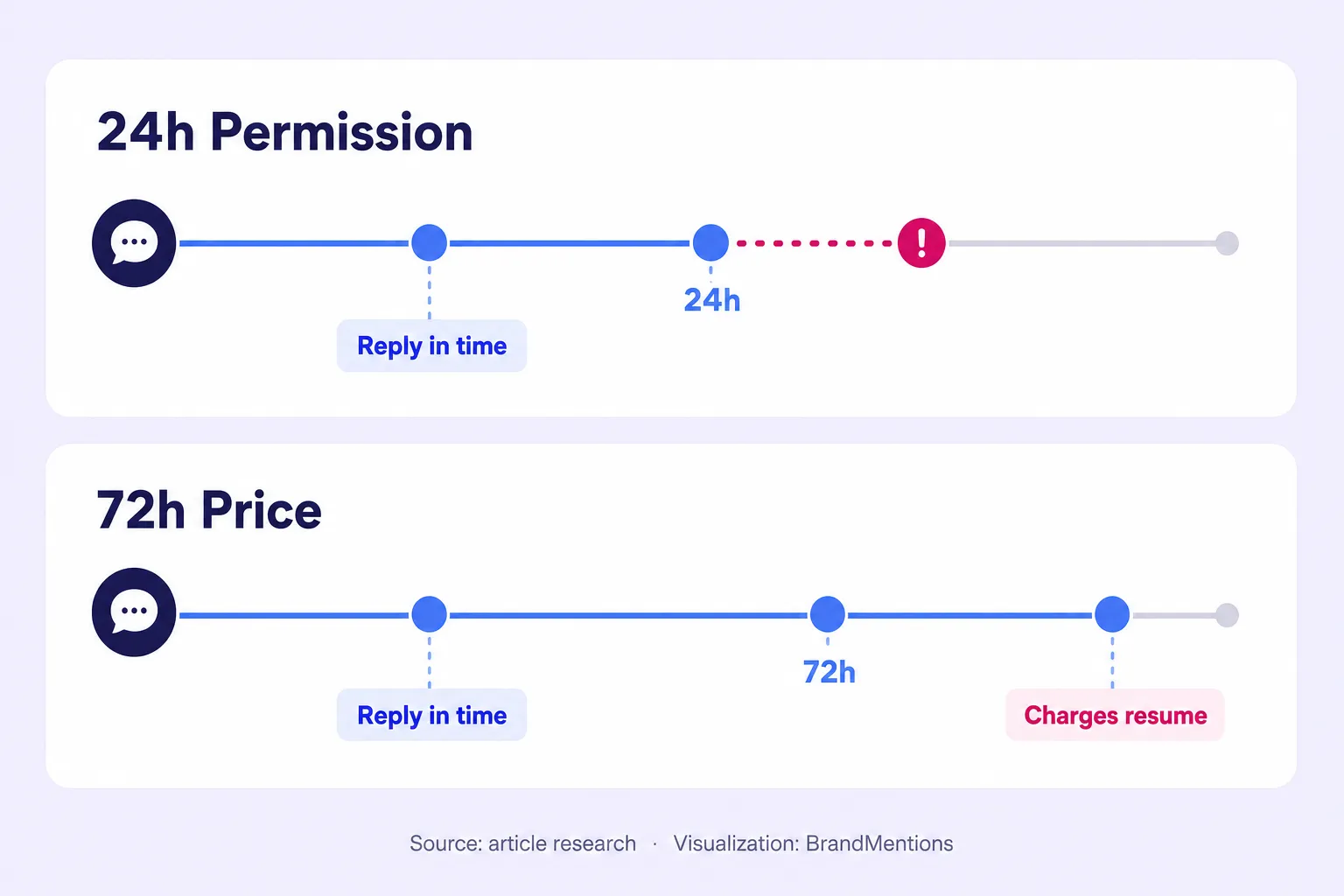
The two windows are not the same thing. This is the most common confusion in the category, and it costs real money.
The 24-hour customer service window is a permission rule. After a customer messages a business, the business may reply with free-form, non-template messages for 24 hours. When that window closes, contacting the person again requires an approved template.
The 72-hour free entry point benefit is a pricing rule. When a conversation begins from a qualifying click-to-WhatsApp entry point and the business replies within 24 hours, message delivery charges are waived for 72 hours. It is a billing exemption, not a licence to send anything in any format. Permission and price are separate dimensions: a message can be permitted and chargeable, or exempt from delivery charges while still bound by template and policy requirements.
Reply at hour 25 forfeits the 72-hour billing exemption
In plain text: the 24-hour permission window and the 72-hour pricing benefit are separate rules with separate consequences. A reply at hour 23 keeps both open - free-form replies are allowed and delivery charges are waived. A reply at hour 25 closes the permission window, so an approved template is required, and forfeits the 72-hour billing exemption. After 72 hours, per-message pricing resumes either way. Status as of September 23, 2026.
THE TWO WINDOWS - PERMISSION VS PRICE   (status as of September 23, 2026)

Customer taps a click-to-WhatsApp ad and sends the first message
|
|---- PERMISSION: 24-hour customer service window ----|
|  free-form, non-template replies allowed            |  after 24h: approved template required
|
|---- PRICE: 72-hour free entry point benefit --------------------------------|
|  delivery charges waived, IF the business replied within 24 hours           |  after 72h: per-message pricing resumes
|
Reply at hour 23  ->  both windows open
Reply at hour 25  ->  permission window closed (template needed)
                      AND the 72-hour billing exemption forfeited
The operational consequence is unusual and worth internalizing. Response speed is a cost variable, not only a service metric. A reply at hour 23 and a reply at hour 25 differ by the entire messaging cost of that lead's first three days. That is the strongest economic argument for automating the first response, and the strongest argument against launching a campaign on a Friday afternoon with no weekend cover.
What changes on October 1, 2026?
The September 23, 2026 pricing boundary. Timing matters this month because a scheduled change is eight days away. As of today, ordinary Platform service replies inside the customer service window carry no Meta delivery charge, and utility templates sent inside that window retain their current exemption through September 30. From October 1, 2026, per Meta's pricing documentation as implemented across messaging providers, service messages become chargeable beyond a monthly allowance of 1,000 service messages per business phone number, in-window utility templates become chargeable, and qualifying 72-hour free-entry-point messaging keeps its exemption. Those are October rules. A forecast that blends September and October behavior will misstate the cost of an identical conversation pattern.
What else sits in the WhatsApp ads bill?
What else sits in the bill. Three cost items are routinely omitted from WhatsApp plans. Paid broadcasts in the Business app, introduced in April 2025, mean "the app is free" is no longer categorically true. Business Agent usage is moving to token-based charging covering processing and delivery, announced for August 1, 2026, so verify the current agent billing schedule before assuming automation is a pure saving. And staff time is the largest hidden line in most small programs.
A workable planning equation looks like this: advertising spend, plus message delivery charges, plus software and provider fees, plus automation or agent usage, plus staff time, plus attributable transaction costs. It is an accounting framework, not Meta's billing formula, and it is the version that survives contact with a finance team. Consider a product with a 40 dollar contribution margin before acquisition and service. If advertising costs 12 dollars per customer and messaging, software, and agent handling add 18, then 10 dollars remain. A 12 dollar acquisition cost was never the whole story. This is the arithmetic that most often surprises teams doing marketing for startups, where founder time is free in the model and scarce in reality.
Why Are WhatsApp Conversations Not the Same as Conversions?
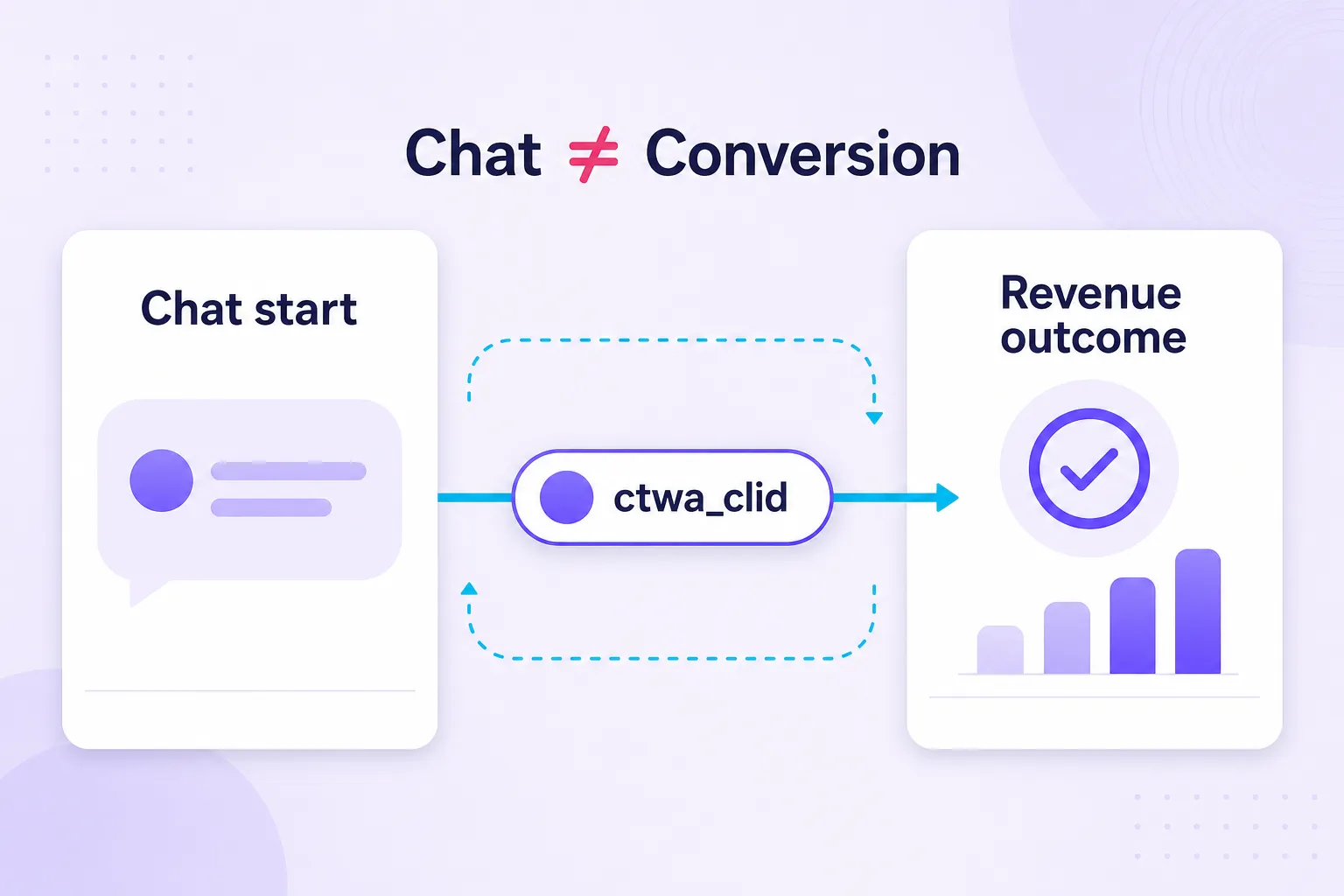
A conversation records communication while a conversion records a defined outcome, and the distance between them is filled by qualification, service quality, transaction completion, and measurement integrity.
Meta can report impressions, clicks, cost per click, and conversations started. It cannot see inside the private conversation, so by default it cannot tell you whether the chat produced a qualified lead, a booking, or a sale. If the reporting stops there, the optimization system does exactly what you asked: it finds more people who like to start conversations.
The identifier that closes the loop. Ad-originated conversations carry a click identifier, ctwa_clid, which arrives in the referral object attached to the customer's incoming message. Meta's own Conversions API sample collection shows it passed in user_data alongside an action source of business messaging and a messaging channel of WhatsApp. Stored with the customer record and returned later with a purchase, lead, or booking event, it is what lets delivery optimization learn from revenue instead of from chat starts. Two corrections to the hype around it: this architecture is not a 2026 invention, and the identifier is not irretrievably destroyed the instant a chat opens. It has to be captured from the inbound message payload and carried through whatever CRM or sales process handles the lead, which is exactly where most implementations lose it.
Smaller businesses have a lighter path. Outcome labels in the WhatsApp Business app can report a limited set of results without any order values, which is enough to move an account past "conversations started" and nowhere near enough for revenue-level optimization.
Attribution is not incrementality. Attribution asks which interaction gets credit for an outcome. Incrementality asks how much additional business the advertising actually created. The distinction is supported by original research: in Close Enough? A Large-Scale Exploration of Non-Experimental Approaches to Advertising Measurement, researchers analyzed 663 Facebook advertising experiments to test whether observational methods recover experimental results. Rich platform data does not settle the causal question by itself. Attribution remains useful for explaining journeys and managing campaigns. Claims about additional revenue created need experimental evidence.
The economics, transparently. Take two hypothetical campaigns, each spending 1,000 dollars. Campaign A generates 1,000 conversations, 50 qualified opportunities, and 10 customers. Campaign B generates 400 conversations, 100 qualified opportunities, and 20 customers. Campaign A costs 1 dollar per conversation, Campaign B costs 2.50 dollars. Advertising cost per customer is 100 dollars for A and 50 dollars for B. The campaign that looks twice as expensive at the conversation level acquires customers at half the media cost. These are illustrative numbers chosen to isolate one analytical error, not benchmarks.
Cost per conversation is a diagnostic, never a success metric. If your reporting stops at "chat started," your optimization is blind and your budget will drift toward people who enjoy messaging and never buy.
The failure modes nobody documents. Closed-loop attribution on WhatsApp breaks in specific, predictable ways, and a serious program plans for them rather than discovering them during a quarterly review.
Duplicate and repeated events. The same customer can click several ads over weeks and message twice. Without deduplication keys and a rule for which interaction is retained, one sale can be reported more than once or credited to the wrong campaign.
Timestamp confusion. Event time and reporting time are different fields. A sale that occurred on Monday and was uploaded on Friday can fall outside the attribution window or be assigned to the wrong reporting period.
Reversals. Refunds, cancelled bookings, no-shows, and failed payments rarely flow back as negative events. Programs that report only positive outcomes systematically overstate performance in categories with high cancellation rates.
Rejected or malformed payloads. Conversion events with missing identifiers, invalid hashing, or schema errors are silently dropped. If nobody monitors delivery acceptance rates, the optimization system is learning from a fraction of the data the team believes it sent.
A stable outcome definition is the precondition for all of it. If one team marks a lead qualified after a greeting and another waits for confirmed purchasing intent, their numbers describe different populations and should never be compared. Deciding in advance which digital marketing KPIs this channel is accountable for is what separates a reporting system from a reassurance system.
How a WhatsApp Ad Conversion Journey Works, Step by Step
This is an analytical model of the journey and the signals it produces. It is not a diagram of Meta's proprietary implementation.
The journey breaks most often between the first message and the business reply
In plain text, the chain runs: business offer and creative promise reach an eligible audience → ad exposure on Facebook, Instagram, or WhatsApp Status → destination opened (not yet a conversation) → customer sends the first message, shaped by prompt design → business replies within 24 hours, which opens the 72-hour pricing benefit → a meaningful response advances the customer's task → qualified commercial intent, defined by the business rather than the platform → order, booking, or other defined outcome → outcome returned with ctwa_clid through the Conversions API, so delivery optimization learns from revenue instead of chat starts. Three parallel branches run alongside it: captured opt-in enables template messaging under per-message pricing, conversation themes inform public content and creative decisions, and public brand discussion stays a separate observation stream that never uses private chat data.
Business offer + creative promise + eligible audience
        |
        v
Ad exposure (Facebook, Instagram, or WhatsApp Status)
        |
        v
Destination opened  ......... not yet a conversation
        |
        v
Customer sends first message  ......... shaped by prompt design
        |
        v
Business replies within 24 hours  ......... opens 72-hour pricing benefit
        |
        v
Meaningful response  ......... advances the customer's task
        |
        v
Qualified commercial intent  ......... business-defined, not platform-defined
        |
        v
Order, booking, or defined outcome
        |
        v
Outcome returned with ctwa_clid via Conversions API
        |
        v
Delivery optimization learns from revenue, not chat starts

Parallel branches:
  Opt-in captured  ->  template messaging (per-message pricing, retention)
  Conversation themes  ->  public content and creative decisions
  Public brand discussion  ->  separate observation stream, never private chat data
Every arrow is a breakable dependency, and each boundary between stages deserves its own measurement.
The intent boundary. Opening a destination and sending a message are different events. Collapsing them hides whether the creative communicated a reason to make contact.
The service boundary. A reply is not proof of a useful answer. An automatic acknowledgment can confirm receipt without resolving a stock question. Evaluate speed and usefulness separately instead of assuming one implies the other.
The qualification boundary. Qualification is a business definition. For a repair service it might mean a supported appliance in a serviceable area; for a wholesaler, a viable order quantity and purchasing authority. The criteria differ, the purpose does not.
The outcome boundary. A defensible model ends in reconciled revenue, preserving the possibility that a conversation led to a sale later, through another channel, or not at all.
The most common break in practice is between "customer sends first message" and "business replies within 24 hours." That is precisely why AI agents matter more to this channel's economics in 2026 than any creative trend of the year.
Consent, Privacy, and the Data Chain
A person choosing to contact a business does not grant that business unlimited permission for future promotional messaging.
Does contacting a business count as opt-in for promotions?
No. The Business Messaging Policy requires appropriate opt-in for subsequent contact, respect for opt-outs, approved templates outside the customer service window, and clear escalation paths when automation is used. It also restricts certain business categories and regulated activities. Eligibility to advertise an offer and eligibility to message people about it are separate checks.
Per-recipient limits and quality ratings
Two platform controls are frequently misread. Marketing templates are subject to per-recipient limits that Meta enforces across all businesses, so a clean opt-in list does not guarantee delivery to a saturated recipient. And business phone numbers carry dynamic quality ratings (high, medium, low) that affect messaging limits when users block or report. Documented consequences include warnings and restricted messaging limits; claims that Meta automatically pauses ad campaigns at a specific undisclosed block-rate threshold are not documented and should not be repeated as fact.
The United States exception
Salesforce's WhatsApp messaging documentation records Meta's pause, effective April 1, 2025, on marketing-template delivery to recipients whose numbers combine a +1 country code with a US area code. Customer-initiated conversations and service replies are unaffected. This matters for planning: an acquisition campaign and its intended promotional follow-up do not have identical availability in every market, and a line on a regional price card is not proof that a message category is currently deliverable.
Platform policy is not local law
The UK Information Commissioner's Office, in its guidance on direct marketing using electronic mail, treats private social media messages as electronic mail and distinguishes purely administrative service communication from messages containing promotional material. That is one jurisdiction's position, not a worldwide rule, and it illustrates why message purpose, recipient type, and permission need separate legal consideration. A template category is a platform classification, not a legal determination.
The data chain almost nobody maps
Privacy discussion around WhatsApp ads usually stops at encryption, which is the least interesting part of the question. Personal message content is not used for advertising, and a business genuinely needs to read the inquiry a customer sent it. The real governance work is downstream.
An ad-originated conversation typically passes through several processors: WhatsApp itself, a Business Solution Provider or self-hosted Cloud API integration, a CRM or helpdesk where the record lands, possibly an AI vendor that drafts or summarizes replies, and finally Meta again when outcome data is returned for optimization. Each hop raises the same four questions. Who can access the conversation content. How long it is retained. How deletion requests propagate across every system that stored a copy. And on what basis outcome data, including identifiers derived from a customer interaction, is sent back to an advertising platform.
Personal messages, calls, and group membership are outside WhatsApp's advertising signal set, but everything a customer sends your business is data your business now controls and must govern. Encryption protects the pipe, not your retention policy.
If your team cannot answer those four questions for each system in the chain, the compliance risk in this channel is not the ad, it is the archive.
Can You Run WhatsApp Ads in Europe? Regional Variance and Availability Ceilings
Yes, but not on the same terms as elsewhere. WhatsApp advertising is not delivered identically everywhere, and the European Region is the clearest structural exception.
Alongside the Updates tab advertising announcement, Meta described a paid option for people in Europe to use Status and Channels without ads, with eligibility conditions including a minimum age and an Accounts Center connection. Price figures circulating in trade coverage (roughly three euros monthly on the web and four euros through mobile app stores) mirror the purchase-channel structure Meta uses for its Facebook and Instagram subscriptions in the EU, but they come from secondary reporting rather than a first-party price page, so treat them as indicative rather than verified.
I would also be careful with the causal story. It is widely asserted that the European model is a direct product of specific regulatory requirements, and the shape of the offer is consistent with the pay-or-consent approach Meta adopted for its other apps in the EU. There is no current first-party regulatory document that neatly validates the popular explanation, so the honest position is that the European mechanism exists, its motive is plausibly regulatory, and the precise legal basis should not be stated as settled fact in a strategy deck.
For advertisers, the practical consequences are concrete regardless of motive. European Status inventory is bifurcated between people who see ads and people who have paid not to, which creates a reach ceiling that does not exist elsewhere. Subscribers' ad interactions are not used for cross-Meta targeting. And the people who do see Status ads in Europe are, by definition, those who declined to pay to remove them, a selection effect no platform has published conversion data on. Plan European Status reach as a subset of the audience, never the whole of it.
Availability varies in other ways worth checking before committing budget: special ad categories (housing, employment, credit, social issues, elections, politics) carry additional restrictions in specific markets, and Status destinations and promoted Channels are still rolling out by region.
Public Brand Monitoring and the AI Search Boundary
WhatsApp advertising, public brand conversation, and AI search visibility can influence the same customer journey without sharing any underlying data, and keeping them separate produces better decisions than merging them into one visibility score.
Three questions should stay distinct. Did paid distribution generate the intended outcome. What are people saying publicly about the offer and the experience. And does the business appear in AI-generated answers, supported by which accessible sources.
Public conversation analysis vs. private inbox analytics. A private channel makes teams complacent about the public afterlife of a campaign. Response delays, a promotion that did not apply at checkout, an agent that gave a wrong answer: those complaints surface in reviews, forums, and social posts long before they surface in an internal report. This is where BrandMentions, a brand monitoring and media-tracking tool, has a specific, defensible role: AI-assisted analysis of collected public mentions, with mention summaries, sentiment and emotion scoring, and topic-level insight into what people are actually asking about a campaign. The same web and social listening setup that tracks a brand's mentions across the web, news, and social platforms is what turns campaign-period complaints into something a team can act on. That is a different job from buying inventory or reading a chat, and it cannot see inside WhatsApp conversations, because nothing outside the conversation can.
Neighbouring tools solve adjacent problems honestly. Meta Business Suite reports on owned Meta surfaces only. Provider inboxes and CRM dashboards report conversation-level data for your own numbers. Enterprise media intelligence platforms cover broader media mixes with correspondingly heavier configuration and cost. The selection question is the same one I would ask before adding anything to a stack: what decision will this data change. Evaluating social media analytics tools against the decisions they support, rather than the number of metrics they can display, is the difference between insight and another dashboard.
Does WhatsApp advertising affect AI search visibility? Not directly, and the documentation is clear about why. Google's guidance for AI features in Search ties eligibility to Search indexing, snippet eligibility, and the standard inclusion controls, all of which concern public, crawlable content. OpenAI's publisher guidance similarly addresses public websites and crawler access for inclusion in summaries. Private conversation volume is not a documented ranking input anywhere.
The defensible connection runs through content, not spend. Recurring customer questions inside a conversational channel are the cheapest information-gap research a brand has access to. If forty people a week ask whether a product works with a particular accessory, that is a compatibility page waiting to be written, reviewed, and published where crawlers and answer engines can actually read it. The conversation reveals the information need, the public documentation addresses it, and any discovery benefit comes from the quality of that public material. No invented mechanism required.
This is also the honest version of the relationship between conversational campaigns and efforts to increase social presence: private conversations and public reputation are two halves of one asset, measured by two completely different instruments.
Illustrative: promoting a business through click-to-WhatsApp conversations, where the catalog and the reply carry the outcome the ad promised.
Where WhatsApp Ad Programs Break in Practice
The failure patterns in this channel are consistent enough to describe structurally rather than as individual mistakes.
Budget without inbox capacity. A campaign that generates conversations faster than the team can answer them can waste demand and, where the required response window is missed, may also lose applicable free-entry-point pricing benefits. If reply capacity is not guaranteed, automate the first response or delay the launch.
Feed creative in a vertical placement. Status is a full-screen vertical environment. Square feed assets cropped into it perform the way square assets performed in Instagram Stories in 2018: badly, and expensively.
Vague prompts producing vague leads. Prompt questions and greeting messages are not decoration. "Hi, I'm interested" costs three exchanges to qualify. "I want to check availability for size 42 in Lisbon" costs none.
Conversations that dead-end. A chat ending with "we will get back to you" wastes the premise of the channel. Chats should end in a next step the platform can carry: a catalog item, a booking confirmation, a payment step where available, or an explicit opt-in for updates. Treating the first conversation as an opening rather than a closing is what actually helps boost brand engagement across the lifecycle.
Templates used as a substitute for ads. When per-message costs look cheaper than clicks, budget drifts from acquisition to promotional templates. Per-recipient marketing limits, the US delivery pause, and simple fatigue all push back. Templates are a retention instrument. Ads are the acquisition instrument. They are not interchangeable.
Portfolio misconfiguration disguised as a measurement problem. If the WhatsApp Business account, the Page, the ad account, and the catalog are not in the same Meta Business Portfolio, conversation and outcome events land in different places and never join. Check this first when someone reports that WhatsApp "does not convert."
How WhatsApp Ads Compare to Adjacent Channels
| Comparison | Key difference | When to choose which |
|---|---|---|
| Click-to-WhatsApp vs click-to-Messenger | Phone-number identity and per-message pricing vs stronger US penetration | Messenger for primarily American audiences, especially where promotional follow-up matters |
| Ads in Status vs Instagram Stories ads | Same vertical format, thinner signals on Status, European reach ceiling | Status as incremental reach for vertical creative |
| WhatsApp ads vs SMS marketing | Inbound-first with a discovery layer vs outbound-first universality | WhatsApp for media and context, SMS for universality and some authentication cases |
| Click-to-WhatsApp vs promoted Channels | One-to-one conversation vs one-to-many follow | Conversations for considered purchases, Channels for regular publishing |
Click-to-WhatsApp vs. click-to-Messenger. Both are Meta messaging destinations with near-identical campaign setup. WhatsApp carries phone-number identity, dominant daily usage across most of the world, and per-message pricing after the free window. Messenger remains the stronger destination in the United States, where WhatsApp penetration is lower and where marketing-template delivery to US numbers is paused. If your audience is primarily American and your model depends on promotional follow-up, that constraint should decide the destination.
Status ads vs. Instagram Stories ads. The format is nearly the same and the creative requirements are identical, but three things differ: signal depth (Stories has richer targeting), regional ceilings (the European ad-free option applies to Status), and destination bias (Status is being built around conversation and website outcomes). Treat Status as incremental reach for vertical creative, and judge it on frequency and assisted conversations rather than last click.
WhatsApp ads vs. SMS marketing. SMS is outbound-first with no discovery layer and thin media support. WhatsApp advertising is inbound-first, with discovery on Meta surfaces and a rich two-way thread the customer opened. SMS still wins on universality and some regulated authentication cases. WhatsApp wins on media, context, and the fact that the customer initiated contact.
Click-to-WhatsApp vs. promoted Channels. One buys a one-to-one conversation, the other buys a one-to-many follow. A brand publishing regularly gets compounding value from Channel growth. A brand selling a considered purchase gets faster value from conversations. The decision should rest on which relationship the team can sustain for a year, not on which format is newer.
Why Did Meta Wait Years to Put Ads Inside WhatsApp?
Meta waited because the only surfaces inside WhatsApp where advertising is compatible with its privacy architecture are discovery surfaces, and those surfaces needed years of habitual use before they could carry inventory.
Encrypted chats were never a viable placement
An ad relevance model cannot be built on content the platform cannot read. Chats were therefore never a viable placement, which is exactly why the 2020 in-chat ads effort was abandoned rather than refined. Status and Channels are broadcast environments where interaction signals (which Channels someone follows, which ads they skip) legitimately exist. The inventory and the signals coincide there and nowhere else in the app.
Status and Channels had to reach habitual scale
Scale did the rest. The Updates tab is used by more than 1.5 billion people daily, a figure WhatsApp published with the June 2025 announcement, which makes it larger than most standalone social networks. Meta's historical pattern is to monetize a surface once usage becomes habitual, as it did with Feed, Instagram, Stories, and Reels. Status follows the same sequence, several years later, under tighter privacy and regulatory constraints.
What Meta's disclosures actually show
The commercial case is visible in the disclosures. Meta's second-quarter 2026 results reported total revenue of 60.8 billion dollars and Family of Apps other revenue of approximately 1.007 billion dollars, with the company attributing that line's growth primarily to WhatsApp paid messaging and subscriptions. Read that figure carefully: it is a Family of Apps line item, not WhatsApp revenue in isolation, and it remains small against Meta's advertising business. Its growth rate, and the appointment of Kunal Shah (founder of the Indian payments company CRED) to lead WhatsApp, say more about intent than the absolute number does. For scale context, WhatsApp passed 3 billion monthly active users according to Meta's 2025 disclosures, the last official business count remains 200 million monthly active businesses stated in June 2023, and messaging peaked at 30 million messages per second during the 2026 World Cup final.
What this means for brand teams
For brand teams the reading is simple. The audience is present and already messaging businesses. The constraint is operational: capacity to answer, authority to resolve, and discipline to measure. That is a different problem from the one most social media marketing trends coverage prepares teams for, because it is not a format problem at all.
Frequently Asked Questions
What is a click-to-WhatsApp (CTWA) ad?
A click-to-WhatsApp (CTWA) ad is a paid Meta ad shown on Facebook or Instagram whose call to action opens a WhatsApp conversation with the advertising business instead of loading a website. The business can pre-set a greeting and tappable prompt questions, and qualifying ad-originated conversations receive a 72-hour exemption from message delivery charges when the business replies within 24 hours.
How do you create a click-to-WhatsApp ad?
Two routes are supported: in Meta Ads Manager, align the Business Portfolio, choose a fulfillable objective, set WhatsApp as the messaging destination, pick the business phone number, add creative, greeting, and prompt questions, then publish with a reply plan; or create the ad inside the WhatsApp Business app with only an email address and a payment method. Full step lists for both routes are in the setup section above.
How much do WhatsApp ads cost?
WhatsApp ads cost the Meta auction price per click or result, paid through Ads Manager, plus per-delivered-message charges under WhatsApp Business Platform pricing that vary by recipient market and message category: marketing templates are the most expensive category, authentication the cheapest, with volume tiers applying to utility and authentication sends. Read current per-country rates from the rate card, and budget software fees, Business Agent usage, staff time, and transaction costs.
Where do ads appear inside WhatsApp?
Inside the app, advertising appears in the Updates tab: WhatsApp Status ads, shown between organic Status content and labeled as sponsored, with promoted Channels in the Channels directory announced as forthcoming. Click-to-WhatsApp (CTWA) ads are not inside WhatsApp at all; they run on Facebook and Instagram inventory, and only the destination is a WhatsApp chat.
What are WhatsApp Status ads?
WhatsApp Status ads are sponsored placements shown between organic Status content in WhatsApp's Updates tab, labeled as sponsored, and sold as an extension of existing Meta campaigns rather than as a separate buy. They are defined by placement rather than destination, currently support chat and website destinations, and remain phased by market, account, and destination type.
Are WhatsApp ads shown inside personal chats?
No. WhatsApp advertising appears in the Updates tab - in Status, with promoted Channels announced as forthcoming - and on Meta's other surfaces, never inside personal chat threads, calls, or groups. Meta states that personal messages, calls, and group membership are not used to determine which ads a person sees, and personal Status content remains end-to-end encrypted.
Are WhatsApp conversations free for businesses?
Not universally, and the answer changes on October 1, 2026. As of September 23, 2026, free-form service replies and utility templates sent inside the 24-hour customer service window carry no Meta delivery charge, but from October 1 service messages become chargeable beyond a monthly allowance of 1,000 per business phone number and in-window utility templates become chargeable. The qualifying 72-hour free-entry-point exemption is retained.
What is the difference between the 24-hour window and the 72-hour free entry point?
The 24-hour customer service window is a permission rule: a business may send free-form, non-template replies for 24 hours after a customer messages it, and afterwards an approved template is required. The 72-hour free entry point benefit is a pricing rule: delivery charges are waived for 72 hours when a conversation starts from a qualifying click-to-WhatsApp entry point and the business replies within 24 hours. Permission and price are separate dimensions.
How do you track conversions from WhatsApp ads?
Capture the ctwa_clid click identifier from the referral object on the customer's incoming message, store it with the customer record, and return it later with the purchase, lead, or booking event through the Conversions API, passed in user_data with an action source of business messaging and a messaging channel of WhatsApp. Meta on its own reports only clicks and conversations started, never what happened inside the chat.
What is ctwa_clid?
ctwa_clid is the click identifier attached to an ad-originated WhatsApp conversation, delivered in the referral object on the customer's first inbound message. Stored with the customer record and returned with a conversion event, it lets delivery optimization learn from revenue instead of from chat starts. It must be captured from the inbound message payload and carried through the CRM or sales process, which is where most implementations lose it.
Can you run WhatsApp ads in Europe?
Yes. Meta described a paid option for people in Europe to use Status and Channels without ads, with eligibility conditions including a minimum age and an Accounts Center connection, which splits European Status inventory between people who see ads and people who have paid not to. That creates a reach ceiling no other region has, and subscribers' ad interactions are not used for cross-Meta targeting.
Do you need a Facebook Page to run WhatsApp ads?
Not always. Ads built in Meta Ads Manager are structured around a business portfolio and a Page, but since June 2023 businesses have been able to create, purchase, and publish click-to-WhatsApp ads directly from the WhatsApp Business app without a Facebook account, using an email address and a payment method. Requirements depend on the creation route and on regional availability.
What Comes Next for WhatsApp Ads
The next phase of this channel will be decided by the quality of the handoff, not by where the ad appears. Meta has now placed inventory on the last unmonetized surface of the app and has started metering nearly every message category that follows. The remaining variable is what happens in the ninety seconds after someone taps.
That makes the interesting 2027 question an optimization question. If Meta begins to train delivery on agent-derived outcome signals (which conversations resolved, which ended in a purchase, which were abandoned), WhatsApp becomes the first major advertising channel whose conversion model is shaped by the content of a business's own customer service. Creative testing would start to look like conversation design, and the competitive advantage would shift from targeting skill to operational honesty about what the business can actually fulfill.
AI search changes the entry conditions in parallel. Customers will increasingly arrive already briefed by a generated answer, which means the conversation has to add what the public explanation could not: confirm availability, resolve an exception, complete a transaction. Businesses whose WhatsApp presence just repeats their website will find the channel decreasingly useful, while those whose conversations carry authority will find it decreasingly replaceable. Expect the private conversation and the public record to keep converging as the same reputational asset, measured with two different instruments.
Two constraints will persist. Europe will stay a thinner-signal, capped-reach market where creative quality has to compensate for what targeting cannot do. And per-message metering will keep drifting toward full coverage, which rewards utility-led communication and punishes volume-led promotion.
The decision I would put to any team before they open an ad account has not changed, only sharpened. Can you answer usefully within hours, every time. Can you say what a qualified lead means and defend that definition next quarter. Can you return the outcome, with its identifier intact, to the system that decides who sees you next. If the answer to all three is yes, click-to-WhatsApp can become a strong acquisition channel worth testing against the business’s other Meta campaigns. If any answer is no, fix that first, because no amount of targeting rescues a conversation nobody is ready to have.
Filed under: Growth