
S even-day discount codes fail to measure TikTok gifting ROI because they close before influencer-driven conversions peak (three to seven days after a post) and miss the two-to-four-week long tail entirely, while their last-click model hands gifting's credit to branded search and retargeting. Measure branded search lift, share of voice, and mention volume across a 30-day window with a geo holdout instead - because gifting is a demand-creation instrument, not an affiliate program.
Key Takeaways
- TikTok gifting is a demand-creation instrument, not an affiliate program. Its payoff is awareness, branded search, and share of voice - not last-click revenue.
- A seven-day code window is structurally blind. Influencer-driven conversions typically peak three to seven days after a post and taper over the following two to four weeks, so the tail lands entirely outside a seven-day read.
- Discount codes are biased twice, once by window and once by last-click model, and both biases point down.
- A low post rate (often 20 - 30%) is the expected tolerance of a no-obligation model, not a sign of failure.
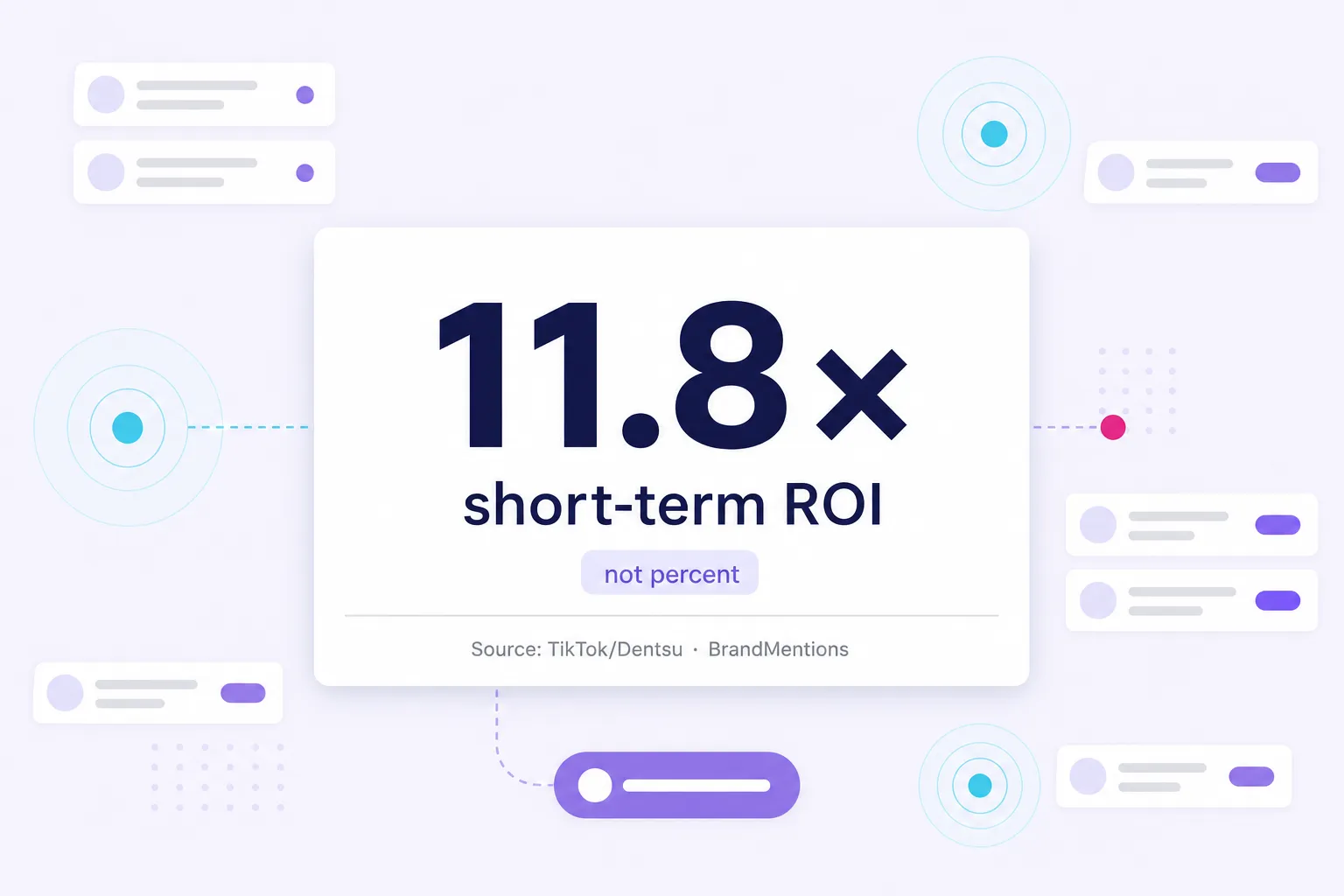
- TikTok posted an average short-term ROI of 11.8 (11.8× the investment) in the TikTok/Dentsu study, with effects persisting three to four weeks after exposure - well beyond a seven-day window.
- Storytelling content beat promo-heavy content on sales impact, which is exactly the content a code scorecard cannot track.
- Measure three layers instead of one revenue column: exposure supply, market response, and transaction capture.
- Branded search lift is the defensible behavioral proxy for gifting-driven demand - track it across a 30-day window, with a geo holdout to isolate causation.
What is TikTok Gifting?
TikTok gifting is the practice of sending free product to creators in exchange for the possibility of organic content, with no guaranteed post, no paid media placement, and no conversion-tracked ad interaction attached to the exchange.
That definition matters, because the industry keeps confusing it with something it is not.
The industry measures gifting as if it were an affiliate program. That is the category error. Gifting is a demand-creation instrument that lives at the top of the funnel, and its output is awareness, branded search, and share of voice, not last-click revenue. When you attach a unique code and read redemptions at day seven, you are auditing the smallest, latest-firing, most easily bypassed slice of the channel's effect and calling that slice the whole. The mechanical reality is less convenient and more expensive to admit: TikTok gifting creates demand before it captures demand, and the payoff shows up as people searching for you, talking about you, and remembering you. None of those live in a coupon dashboard.
Why the Seven-Day Code Window Is Structurally Blind
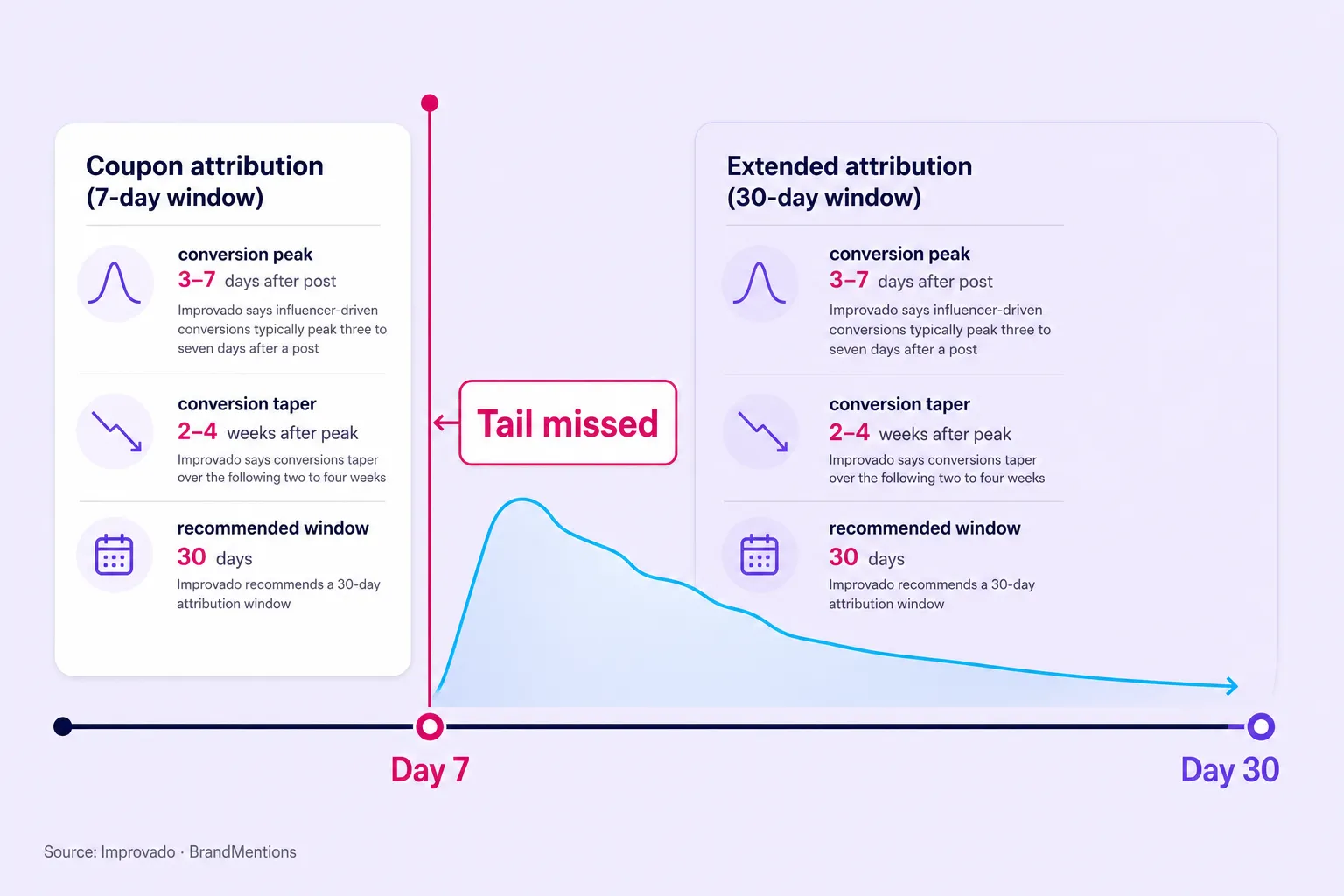
A seven-day attribution window closes before most gifting-driven conversions begin to fire. This is a timing fact, not a funnel opinion. Awareness signals like reach and engagement appear within a day or two of a post going live. Conversions behave differently. According to Improvado's influencer measurement guide, influencer-driven conversions typically peak three to seven days after a post, then taper over the following two to four weeks, which is why the guide recommends a 30-day attribution window as the default and warns that a seven-day read undercounts long-tail impact. Read that carefully. The peak sits at the very edge of a seven-day window, and the taper, the long soft tail where a meaningful share of conversions actually lands, happens entirely outside it.
The Consensus: seven days is a conservative, clean measurement window. The Attribution Reality: it amputates the tail and reports the amputation as underperformance.
TikTok's own paid infrastructure confirms that the window is a reporting choice, not a law of buyer behavior. TikTok's flexible attribution documentation shows the platform defaults Pixel and Web Events API advertisers to a seven-day click and one-day view window, while letting advertisers set click-through attribution up to 28 days and view-through up to seven. Even the ad product treats seven days as configurable. The people applying it to organic gifting have quietly downgraded their own visibility and forgotten they did it.
Now stack the second failure on the first: the model, not just the window. Discount codes are last-click by construction. The code fires only at the final action, so credit for the purchase flows to whatever channel stood closest to the register, usually branded search or retargeting. A code report on gifting is therefore biased twice, once by window and once by model, and both biases point the same direction. Down.
The magnitude here is not a rounding error. A Marketing Science Institute summary of large Facebook field experiments found that observational attribution methods routinely diverged from randomized controlled results, and that in half the studies the estimated lift in purchase outcomes was off by a factor of three depending on the method used. If sophisticated ad measurement can miss by that much, a creator-code spreadsheet is not a source of truth. It is a partial log that finance is mistaking for a ledger.
If your gifting scorecard reads code sales at day seven, you are not measuring the channel. You are measuring the one behavior least likely to occur inside a channel built for discovery.
There is a final irony in the defaults themselves. Teams treat seven days as the responsible standard, yet Google Analytics 4 uses a 30-day lookback for acquisition conversion events and a 90-day window for other conversion events. Seven days is not the platform recommendation. It is a manual choice someone made because a shorter window makes attribution feel cleaner. Cleaner is not the same as correct. If you want to understand why so many upper-funnel programs die on the scorecard, audit your marketing KPIs for exactly this kind of self-inflicted blindness before you touch the creator list.
Why Post Rate Is a Vanity Metric
Post rate is a fulfillment metric, not a business outcome, because the mechanism that makes gifting valuable is precisely the mechanism that makes a low post rate mathematically expected. Post rate tells you whether a box became a post. It tells you nothing about whether the post entered the right interest graph, whether the audience understood the category, or whether the market moved.
Here is the part nobody wants to say in the quarterly review: gifting is a probability play, and you priced it that way on purpose. Industry programs commonly see posting rates well below half, often somewhere in the range of 20 to 30 percent, and that is not a defect. It is the design tolerance of an instrument you paid for at product cost precisely because you were buying optionality, not guaranteed output. When a strategist reports "only 24 percent of our gifted creators posted" as a failure signal, they are describing the median outcome of a functioning program as if it were a malfunction.
What Marketers Think: a low post rate means the program flopped. What the Mechanic Says: a low post rate is the expected outcome of a no-obligation model, and a low post rate can still shift category conversation if one creator lands the product in the right cultural pocket.
Post rate becomes actively dangerous when it gets promoted to the pivot metric, because it pushes teams to abandon gifting for paid deals that guarantee a post. Sometimes that is right. Often it is not, and the reason is quantified below in the Dentsu data. A guaranteed post buys you a scripted, promotional, lower-trust piece of content. That trade is not free.
The operating rule I give teams is blunt. Gift when you are buying discovery and authentic reaction. Pay when you are buying guaranteed placement and trackable revenue. Do not judge the first with the scorecard built for the second. And if the post rate itself is genuinely low, treat it as what it is: a logistics, outreach, product-fit, or creator-selection problem to fix upstream, not evidence that the channel cannot create demand. The broader structural shifts here move faster than most dashboards adapt, which is why watching influencer marketing trends is part of the measurement job, not separate from it.
How the TikTok Discovery Algorithm Impacts Gifting
TikTok gifting enters the platform as content inside a recommendation system, not as a clean paid-click path, and that system distributes by behavioral and content signals rather than by your attribution preference. TikTok's own published account of its For You recommendations describes ranking driven by user interactions, video information such as sounds and hashtags, and device and account settings, and it states that follower count is not a direct ranking factor. That last point is why a gifted creator with a small following can outproduce a macro name on reach, and why judging gifting by audience size is its own mistake.
So the first job of a gifted post is not to push a code. The first job is to survive distribution. Did the video hold attention? Did it earn enough relevance for the system to test it with adjacent audiences? Did the comments build new context around the product? Did viewers search the brand afterward? Post rate answers none of that.
The procurement view: more posts mean more value. The algorithmic view: more qualified watch time, saves, searches, comments, and derivative mentions mean more value.
The hard data on what TikTok actually does is on the record. In the TikTok and Dentsu marketing mix modeling study, the channel posted an average short-term ROI of 11.8. Read that as 11.8 times the investment, not 11.8 percent. That distinction matters, because the figure gets misquoted in both directions and neither misquote helps you. The number that matters for gifting is not the headline, though. It is the shape of the effect. Dentsu measured short-term sales effects over one to six weeks and long-term brand-driven impact over one to ten months. Your seven-day code window sees roughly the first sixth of the short-term effect and none of the long-term one. As Search Engine Journal reported on the study, the effect persisted for three to four weeks after exposure, and 75 percent of the analyzed advertisers achieved their highest ROI on TikTok relative to other channels.
Then there is the content-type finding, which should end the "just switch gifting to paid affiliate" argument. In the same body of work, storytelling content without explicit promotional messaging outperformed tactical, promo-heavy content on sales impact by a wide margin. The scripted, code-attached content a paid deal guarantees is the tactical category. The authentic, unscripted reaction that gifting produces when a creator genuinely likes the product is the storytelling category. When you force gifting into paid to lift the post rate, you are trading the higher-performing asset for the lower-performing one and calling it better measurement.
The content that converts best is the content your code scorecard is least able to track, because storytelling almost never carries a hard promo call to action. Your measurement is quietly optimizing against your own best-performing asset.
There is a corroborating efficiency signal in the same research: TikTok represented a small share of media spend while delivering a disproportionately larger share of measured sales effects. A channel that punches above its spend weight does not get cut because it failed. It gets cut because the instrument pointed at it could not read it. And when a team responds to a thin code column by asking creators to sell harder, the content gets worse, the engagement signals weaken, the algorithm distributes it to fewer people, and performance genuinely declines. The channel was not weak. The measurement system trained it to become weak.
The Hidden Cost of the Code-Only Verdict
Every quarter a brand judges gifting on a seven-day code scorecard, it does not simply record a wrong number. It compounds a series of losses that feed each other. Here is the sequence laid out as the blind spot, what the scorecard shows, what actually happened, and the loss it locks in.
| The blind spot | What the scorecard shows | What actually happened | The compounding loss |
|---|---|---|---|
| Window closes at day 7 | Near-zero attributed sales | Conversions peak day 3 to 7, then taper over 2 to 4 more weeks, all uncounted | The tail is invisible, so ROI reads a fraction of reality |
| Last-click model | Code redemptions only | Buyers searched, compared, bought elsewhere, or forgot the code entirely | Gifting's assist credit is handed to the channels it fed |
| Post rate as pivot metric | "Only 24 percent posted, program failing" | A sub-half post rate is the normal tolerance of a no-obligation model | Team switches to paid, trading storytelling content for lower-trust tactical content |
| Wrong-platform yardstick | TikTok underperforms on CPA | TikTok is a discovery engine, Instagram owns the trackable path | Budget migrates off the highest-awareness channel |
| No awareness baseline | "No measurable lift" | Branded search and mention volume rose but were never tracked | The real payoff is never entered into evidence, so it never happened on paper |
Read the last row twice. It is the quiet killer. The loss is not that awareness went unrewarded. The loss is that the awareness lift was never measured, so in the record of the business it does not exist, and you cannot defend a number you never collected. This is why arguing harder for gifting in the meeting never works. You have to change what you instrument before the wave ships.
Why Branded Search Is the Best Proxy for Gifting Demand
Branded search lift is a defensible behavioral proxy for gifting-driven demand because it records the moment a viewer left passive discovery and actively sought your brand by name. That is the exact behavior a code dashboard misses. TikTok introduces. Search verifies. The viewer sees the product in a routine, a haul, a review, or a shelf, then opens a browser and searches the brand, because typing a name feels safer than hunting for a three-day-old bio link.
Branded search is not attribution. It is evidence that awareness escaped the feed. That distinction keeps you honest, because branded search is also imperfect as a data source. Google Search Console's performance data documentation states that some queries are anonymized to protect user privacy and that the tool stores and displays only the most significant rows of data. So branded search lift is a strong market signal, not a clean causal ledger. Good. Nothing in this category is clean. It is still closer to demand creation than a coupon field that only fires at checkout.
The research direction supports treating it as a first-class metric. A recent Journal of Marketing Analytics study on digital media and organic branded search argues that click-based attribution misses branding goals and top-of-funnel activity, and positions organic branded search as a way to observe how media investment shapes awareness. Use it as the leading indicator it is.
One practical warning that most measurement plans skip: branded search does not happen in one place. It happens on Google, inside TikTok's own search, on Amazon, and on retailer sites, and increasingly inside AI answer engines. Google has rolled out generative AI performance reporting in Search Console so brands can see visibility inside AI features on Search, and public web visibility now shapes whether a brand is surfaced and compared in those answers at all. If you only watch Google web queries, you will undercount TikTok search and marketplace search, and you will miss the answer-engine surface entirely. Measure the branded query wherever the buyer might type it.
How to Measure TikTok Gifting ROI Correctly
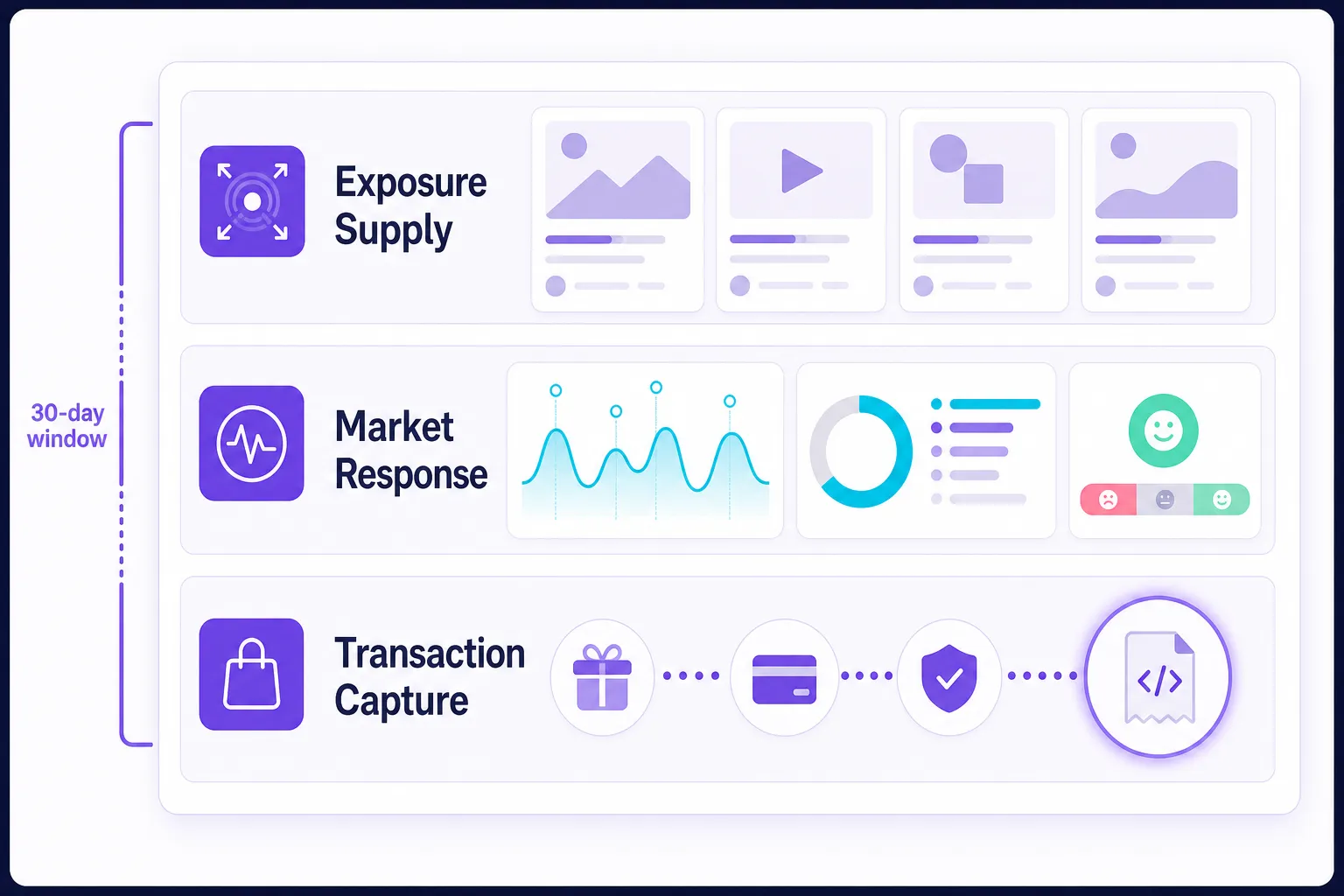
A credible gifting scorecard separates three layers instead of forcing every signal into one revenue column: exposure supply, market response, and transaction capture. Collapsing them into a single number is a management convenience, not a measurement standard.
Step 1: Exposure Supply - the Operational Layer
Units shipped, creators activated, posts published, raw reach, view quality, saves, comment depth, and content you can reuse in paid rotation. It answers whether you got into the feed.
Step 2: Market Response - the Awareness Layer
This is the layer code dashboards cannot produce. Branded search lift, TikTok search movement where accessible, mention velocity, share of voice against competitors, sentiment, and category association. Establish a baseline in the two weeks before the wave, then read the delta across the 30 days after. This is where a monitoring layer earns its place. Set up tracking TikTok mentions around the wave, separate creator posts from audience response, and compare brand mention volume against competitors rather than only against your own prior week. This is intelligence infrastructure that verifies whether the market actually moved, and it sits beside your sales analytics, never underneath them.
Step 3: Transaction Capture - the Revenue Layer
Keep the codes, keep the UTMs, add post-purchase surveys and assisted-conversion reporting, watch TikTok Shop and retail sell-through where you have it. The code tells you about the last step. The other layers tell you whether the market shifted.
Assign each metric its job, and let your marketing KPIs reflect the job of the channel rather than the anxiety of the reporting meeting.
Instrument the awareness signals before the wave ships, not after finance asks for the number. You cannot retroactively baseline a metric you never started collecting.
Sentiment sits inside the market-response layer for a reason. Volume without valence is a trap. A thousand mentions during a complaint storm is not the same as a thousand mentions during a positive launch, and a gifting wave can lift both at once. Tracking sentiment lift alongside volume is what separates "we created demand" from "we created a controversy." Which brings up a decision rule most plans never write down: if share of voice climbs while sentiment or purchase intent falls, do not celebrate the reach. Pause the wave, diagnose the cause, and fix the product or messaging problem before you scale, because negative virality is still virality and it will scale a liability just as efficiently as an asset.
Two more honesty checks belong in this layer. First, understand what your tools cannot see. Private accounts, deleted videos, regional personalization, sampled feeds, and hard API quotas all limit visibility. TikTok's Research API, for example, is not available to commercial users and caps eligible researchers at roughly a thousand requests and a hundred thousand records per day, which is worth remembering any time a vendor promises complete, real-time, platform-wide coverage. No tool has total coverage. Choose your TikTok listening tools on the basis of what they can access and how they handle the gaps, not on coverage claims. Second, remember that much of TikTok's brand presence is not clean text. It is logos on a shelf, packaging in frame, an audio mention, a stitch, a duet, or a product referenced only in the comments. A measurement setup that reads hashtags and text overlays alone will systematically undercount the visual and audio footprint that gifting is specifically good at producing.
Run all of this on a 30-day window, not seven. For high-consideration, replenishment, regulated, or gift-cycle categories, run it longer. Give finance interim reads if they need them. Do not call an interim read the final truth.
The Confounders Nobody Puts on the Slide
Branded search lift is only evidence if you can rule out the other things that move it, which means a gifting scorecard without a causal design is a story, not a measurement. This is where most awareness cases fall apart under real scrutiny, so build the controls in from the start.
A gifting wave rarely runs in isolation. Seasonality, a PR hit, a paid-search budget change, a retail promotion, an email push, or creator overlap with your paid roster can all move branded search at the same time your gifted content lands. If you attribute the whole lift to gifting, you have made the exact mistake you are accusing the code dashboard of making, just in the other direction. For programs of any size, use a holdout: run the wave in matched geographies and hold others back, or use lift testing and marketing mix modeling for larger spends. A clean geo comparison is worth more to a skeptical CFO than any dashboard number, because it isolates the variable everyone actually cares about.
Two commercial realities also belong on the slide and almost never make it. First, the economics of the product itself. Awareness lift is only worth creating if your supply can serve it. If a gifting wave spikes branded search into a stockout, or the margin after COGS, shipping, and damaged inventory does not survive the discount you attached to the code, you did not run a demand program. You ran an expensive out-of-stock notification. Model the fulfillment and margin math before the wave, not after. Second, the legal reality. Gifted product creates a material connection between brand and creator, and the FTC's Endorsement Guides require clear disclosure of that relationship even when there was no payment and no obligation to post. Disclosure is not optional, it shapes creator behavior, and it belongs in your brief. Treat it as a compliance requirement, not a nice-to-have.
Finally, separate the mechanics you are actually running, because "gifting" gets used as a catch-all. Organic product seeding, paid creator sponsorships, Spark Ads that amplify a creator post as media, TikTok Shop affiliate activity, and TikTok's own creator monetization gifts are five different things with five different data trails and obligations. Only the first is the no-obligation awareness buy this piece defends. Do not import affiliate benchmarks into a seeding report, and do not confuse a creator's Live gift income with your product-seeding outcomes. They are unrelated. One more strategic note for a US audience in 2026: TikTok carries real platform-availability and regulatory risk, so treat the branded-search demand you build as portable. Capture it into owned search, email, and retail relationships so that a demand asset does not evaporate if the distribution channel does.
The Skeptic's Corner
"But finance needs a hard CPA, and awareness metrics are not revenue."
Correct. Awareness metrics are the leading indicator of revenue, not revenue itself. But the choice is not between a hard CPA and soft awareness. It is between a CPA that is precise and wrong and a stack that is directionally correct. A seven-day last-click code CPA misattributes a large share of the conversions gifting drove and hands the credit to search and retargeting. A code sale is also not automatically incremental. If the buyer would have purchased anyway, the code captured margin loss, not creator value. The defensible finance answer is a 30-day read with assisted conversions and a branded-search lift chart beside it, backed by a geo holdout for anything you plan to scale. Precision on the wrong quantity is not rigor. It is confident error.
"But TikTok's own study shows an 11.8 short-term ROI, so it is clearly a performance channel we can measure on code."
The 11.8 is real, and it is 11.8 times the investment, not 11.8 percent. Read what produced it. Dentsu used marketing mix modeling across a one to six week short-term horizon and a one to ten month long-term horizon. Marketing mix modeling is a top-down statistical method that isolates a channel's contribution without needing a click path. Your discount code is the opposite: bottom-up, last-click, seven days. Citing that figure to defend a code CPA is quoting a number produced by the exact methodology that proves code CPA is inadequate. The study is evidence for the awareness stack, not against it.
"But TikTok lets us set longer attribution windows, so the problem is solved."
Only for paid. Extending click-through attribution past the seven-day default fixes an ad-reporting problem inside TikTok Ads Manager. It does nothing for organic gifting, where there is usually no ad impression tied to the viewer, no click, no pixel event, and no deterministic path into the sale. A longer paid window does not make a gifted creator post behave like a trackable ad click. The organic problem is not window length. It is that the decisive commercial event happened somewhere the pixel was never watching.
The Final Verdict
Brands that keep judging TikTok gifting by seven-day code redemptions are not going to lose because gifting is weak. They are going to lose because they will decommission a demand-creation engine on the word of an instrument that was never wired to detect demand creation, and their competitors will quietly buy the awareness they abandoned at a discount.
So here is the ultimatum, stated plainly. If you cannot see branded-search lift, share of voice, and mention volume moving around your gifting waves, you do not have a debate to win in the next review. You have a data-collection problem you had to solve before the wave shipped. Instrument the awareness signals, run a holdout so the causal claim survives scrutiny, push the window to 30 days, keep the code as one input rather than the verdict, and stop letting a coupon column decide the fate of the one part of your mix that builds the future demand everything else converts. The market does not record who had the cleanest attribution model. It records who became visible, who owned the conversation, and who showed up when the customer finally decided to search.
Frequently Asked Questions
What is TikTok gifting?
TikTok gifting is the practice of sending free product to creators in exchange for the possibility of organic content, with no guaranteed post, no paid media placement, and no conversion-tracked ad interaction attached to the exchange. It is a demand-creation instrument at the top of the funnel, and its output is awareness, branded search, and share of voice, not last-click revenue.
Why does a seven-day code window undercount TikTok gifting ROI?
Because the window closes before most conversions fire. Influencer-driven conversions typically peak three to seven days after a post, then taper over the following two to four weeks - a tail that lands entirely outside a seven-day read. Discount codes are also last-click by construction, so credit for the purchase flows to whatever channel stood closest to the register. The report is biased twice, once by window and once by model, and both biases point down.
Is a low post rate a sign that a gifting program failed?
No. A low post rate is the expected tolerance of a no-obligation model. Industry programs commonly see posting rates well below half, often in the range of 20 to 30 percent, because you paid product cost to buy optionality, not guaranteed output. Treat a genuinely low post rate as a logistics, outreach, product-fit, or creator-selection problem to fix upstream - not as evidence the channel cannot create demand.
What should you measure instead of code redemptions?
Separate three layers: exposure supply (units shipped, creators activated, reach, saves, comment depth), market response (branded search lift, mention velocity, share of voice, sentiment, category association), and transaction capture (codes, UTMs, post-purchase surveys, assisted conversions, TikTok Shop and retail sell-through). Run it on a 30-day window and baseline the awareness signals before the wave ships.
How reliable is branded search as a measure of gifting demand?
Branded search lift is a strong behavioral proxy, not a clean causal ledger - it records the moment a viewer actively sought your brand by name. It is imperfect as a data source (some queries are anonymized and only the most significant rows are stored), and it can be moved by seasonality, PR, paid search, and promotions. Use a geo holdout to isolate the gifting effect before you attribute the whole lift to the channel.