What Are Brand Mentions? The Complete 2026 Guide (Definition, Types, and Why They Matter for SEO and AI Search)
A definitive guide to brand mentions: what they are, the types (linked/unlinked, earned/owned/paid), where they happen, and how they affect classic SEO versus AI search visibility.


Amention is not a trick, and it is not trivia. It is a unit of reputation, and the systems that now sit between your brand and your buyers (search engines, and increasingly answer engines) read those units to decide whether you exist, whether you are credible, and whether you deserve to be named.
"Do mentions actually help us, or are we chasing a myth?" It defines the concept precisely, sorts the types, maps where mentions live, and separates what a mention does in classic search from what it does inside an AI answer. That separation is the whole game in 2026, and almost every thin definition on the web skips it.
What Is a Brand Mention? (Definitive Answer)
A brand mention is any public reference to a company, product, person, or branded asset, with or without a hyperlink, across web pages, social platforms, forums, reviews, news, podcasts, video, or AI-generated answers.
Beyond that one-line definition, a brand mention functions as a machine-readable signal of a brand's presence, credibility, and topical relevance, and it is measured through volume, reach, sentiment, and share of voice. Unlike a backlink, a mention does not require a clickable connection to carry meaning, which is why it has become the signal that large language models rely on most heavily when deciding which brands to name.
Key Takeaways
- A brand mention is any public reference to a brand, linked or unlinked, appearing across web pages, social, forums, reviews, news, podcasts, video, and AI answers. It is broader than a backlink and broader than a citation.
- Unlinked mentions are not a confirmed classic-SEO ranking factor. Google's John Mueller stated in 2021 that plain brand mentions are too subjective and noisy to use like links for PageRank; their classic-search value is indirect (branded search, link reclamation, entity reinforcement).
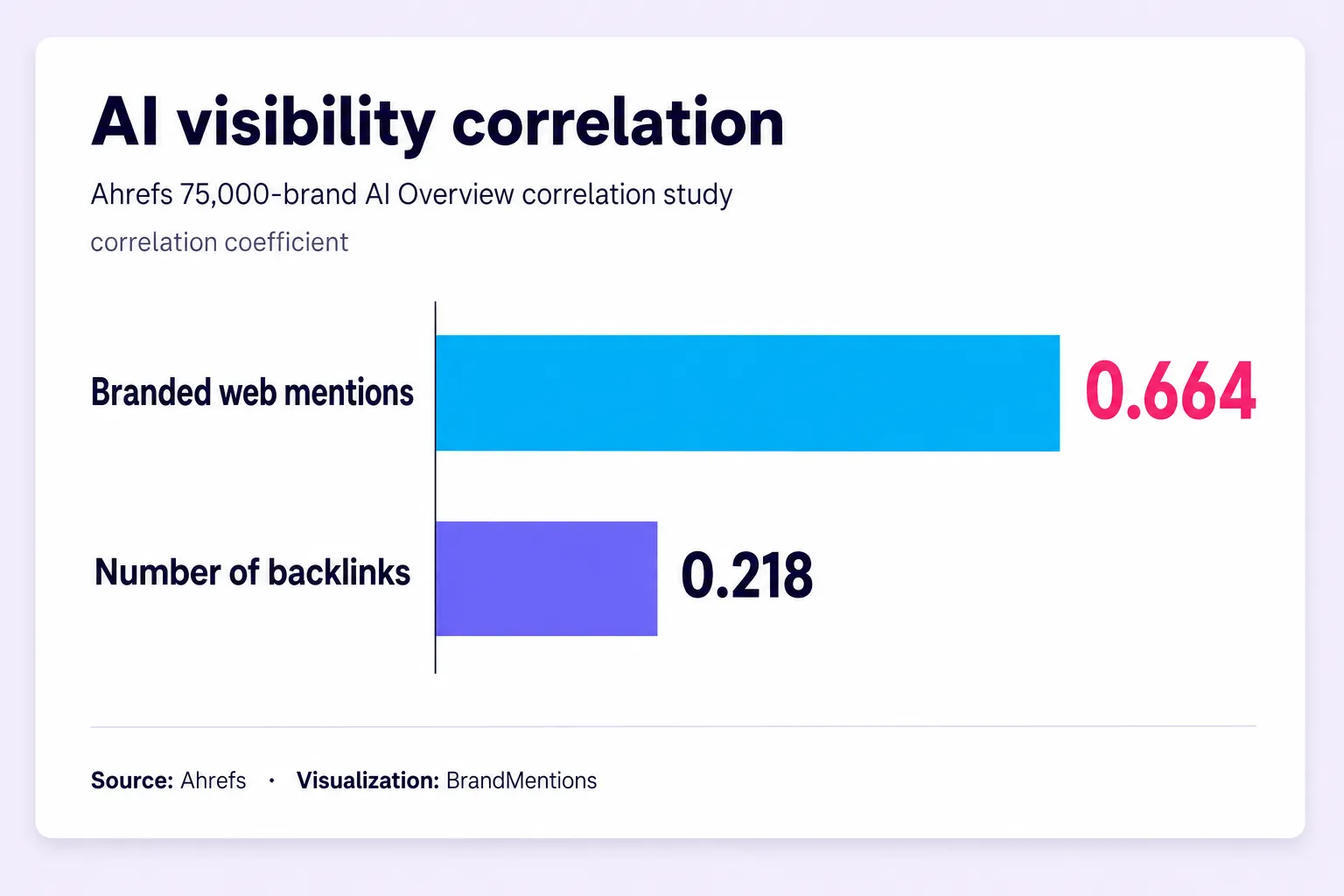
- Mentions now outweigh links for AI search visibility. Ahrefs' 75,000-brand study found branded web mentions correlated most strongly with AI Overview visibility (0.664) versus backlinks (0.218), and Muck Rack found earned media drives roughly 82 - 89% of AI citations.
- Measure mentions honestly, not just loudly. Track volume, reach, sentiment, and share of voice - but weight for source authority, treat sentiment (82 - 88% accurate) as a trend instrument, and monitor AI presence with a repeated prompt library, since AI answers have no permanent URL.
Core Definitions: Brand Mention vs. Backlink vs. Citation vs. Implied Link
Before sorting types and impact, it helps to fix the vocabulary. These are not tactics. They are the structural parts of one ecosystem, and confusing them is the single most common reason teams misjudge what a mention is worth. The table below sets each term against its definition and its primary function so the distinctions are extractable at a glance.
| Term | Definition | Primary Function |
|---|---|---|
| Brand mention | The reference itself: your company name, product, founder, or distinctive asset appearing in text, audio, or generated content that you did not necessarily place. It is the atom of the system. | Signals brand presence, credibility, and topical relevance - linked or unlinked. |
| Backlink | A clickable hyperlink pointing to your domain. Every linked mention contains a backlink, but the majority of mentions contain no link at all. | Passes referral traffic and, in classic search, participates in the link graph. |
| Citation | A narrower case where a system surfaces and attributes a reference as a source. In local search, a structured business listing (name, address, phone); in an AI answer, the source link the engine attaches to a claim. A citation is a mention promoted to evidence. | Confirms a business exists (local) or supports a specific claim as evidence (AI). |
| Implied link | A term from a 2012 Google patent describing a reference to a resource that is not an express hyperlink. It is the concept most often cited, and most often misread, in arguments about whether unlinked mentions carry ranking weight. The nuance is resolved in full below. | Describes an unlinked reference in patent language - not a confirmed live ranking mechanism. |
What Are the Types of Brand Mentions?
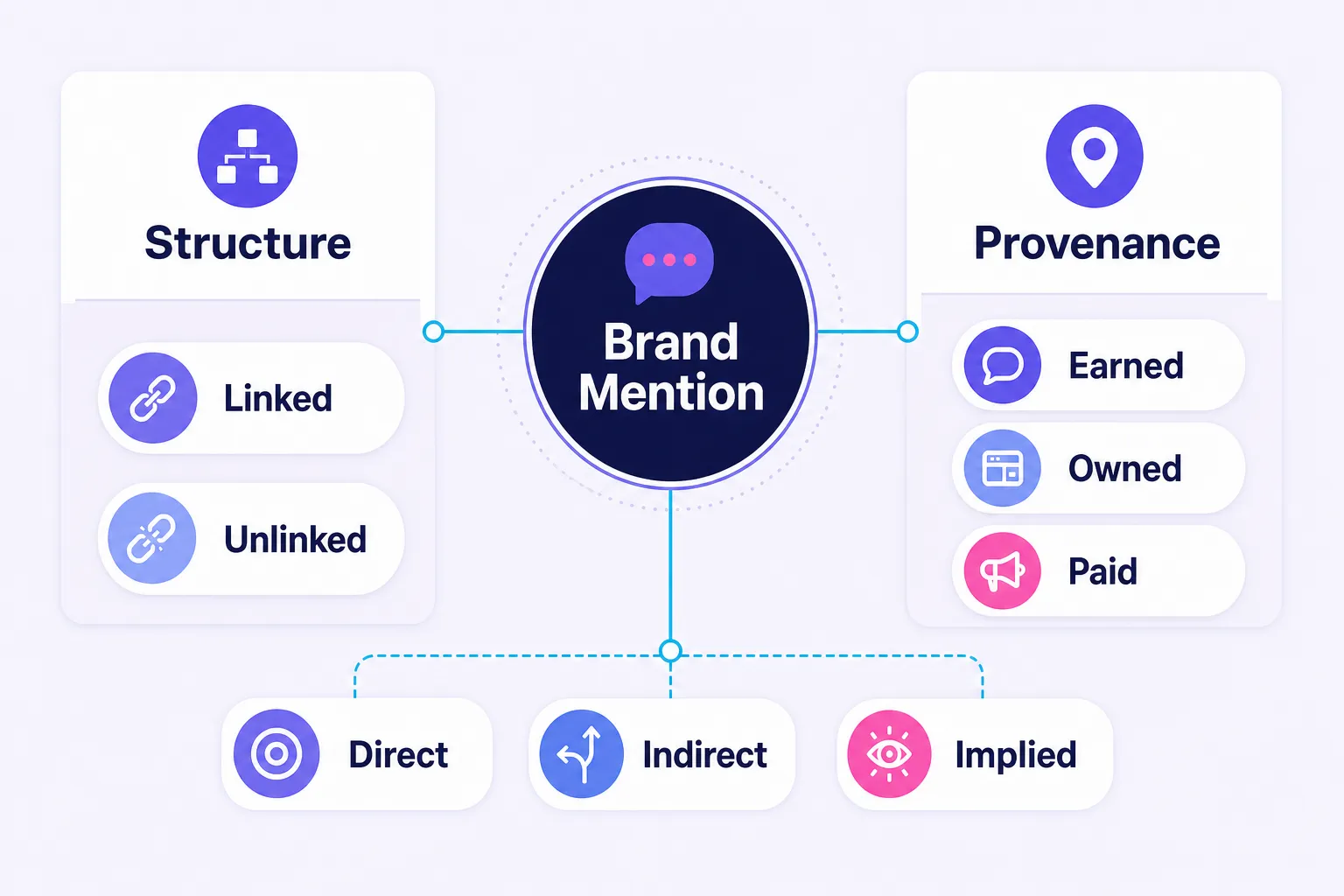
Two axes actually matter. The first is structural: does the mention carry a link? The second is provenance: who created it, and did money change hands? Every mention you will ever track sits somewhere on both axes at once. A third, subtler axis (how the brand is named) closes a blind spot that keyword-only monitoring routinely misses.
Linked vs. Unlinked Mentions
A linked mention names your brand and wraps it in a hyperlink to your site. It does two jobs in one place: it tells a human reader you exist, and it participates in the classic link-based signals search was built on. A journalist writing "tools such as [Your Brand] help teams track conversions" and linking the name is a linked mention.
An unlinked mention names you in plain text with no clickable path back. The author knew who you were and thought you worth naming, but never attached a link. This is far more common than most teams assume. A meaningful share of earned press arrives with the brand named and no link on first publish, which is the entire reason link reclamation exists as a discipline.
The two references are worth the same to a human reader and to a language model, because both read the words. They are not worth the same to the classic link graph, because only one carries the link. Hold that distinction. Most of the confusion around unlinked brand mentions comes from collapsing three separate ideas: human awareness, classic ranking, and AI answer inclusion.
Value an unlinked mention on its own terms. Its worth is not the link you might reclaim later, it is the fact that a credible source named you at all, which is the exact signal an answer engine reads.
Earned, Owned, and Paid Mentions
The provenance axis comes from a media-planning framework that predates the AI era by more than a decade. Gini Dietrich formalized it as the PESO model (paid, earned, shared, owned), described by the PRSA PESO Model certification as a way to integrate paid media, content, social, and PR with measurable outcomes.
Owned mentions appear on channels you control: your site, blog, newsroom, documentation, and branded social profiles. They define the canonical language about your brand. Credibility is lowest here because everyone knows you are speaking about yourself, but consistency matters. If your owned properties describe the product three different ways, external mentions and AI summaries often inherit the confusion.
Earned mentions are references you did not pay for and cannot fully control: press coverage, analyst commentary, independent reviews, forum threads, a podcast host naming you unprompted. Credibility is highest because the source is independent, and that independence is exactly what both consumers and machines were built to weight.
Paid mentions are placements you fund: sponsored content, influencer partnerships, advertorials, paid podcast reads. They buy reach fast, and they are not inherently bad. Hidden paid mentions are the problem. The business value depends on disclosure, audience fit, and whether the placement builds trust rather than simply renting attention.
If your mention profile is mostly owned and paid, you are optimizing the two categories that carry the least independent credibility in the surfaces that now decide discovery.
Direct, Indirect, and Implied Mentions
A direct mention uses the exact brand name. An indirect mention references a product, slogan, or campaign without the name ("Just Do It" without "Nike"). An implied mention describes the brand through recognizable attributes ("the serum with the frosted bottle and blue label"). Implied and indirect mentions are frequently invisible to keyword-based monitoring, which creates a real blind spot: entity-aware systems resolve these references back to the canonical brand, and simple string-matching tools do not. If your monitoring only fires on your literal name, you are undercounting your own footprint.
AI Mention vs. AI Citation
These two are not the same object, and treating them as one wrecks measurement. An AI mention is your brand name appearing inside a generated answer. An AI citation is the engine listing your content as a source for that answer. A brand can be mentioned without being cited (ChatGPT in default mode often names brands with no URL), and a page can be cited without the brand being recommended. The brand impression occurs regardless of whether a link is attached, which is why both modes need separate tracking.
Brand Mention Types at a Glance
| Mention type | What it is | Example | Primary value | Main caveat |
|---|---|---|---|---|
| Linked | Brand name plus hyperlink | A review article links to the brand site | Referral traffic, verification, link-graph participation | Link quality and crawlability matter |
| Unlinked | Brand name, no hyperlink | A Reddit user recommends a tool | Awareness, entity association, AI-answer relevance | Not equivalent to a backlink |
| Earned | Independent third-party reference | Journalist, analyst, customer, creator | Trust, authority, reputation | Low control over wording |
| Owned | Brand-controlled reference | Website, blog, help center | Message consistency, entity clarity | Lower independent credibility |
| Paid | Sponsored or advertised reference | Podcast ad, influencer sponsorship | Reach, campaign support | Requires disclosure; weak in AI citation |
| Review | Customer rating or written feedback | G2, Trustpilot, Google review | Conversion proof, reputation | Can be biased, fake, or stale |
| AI mention | Brand named inside an AI answer | AI Overview lists a brand in a category | Answer-engine visibility, category inclusion | Volatile and query-dependent |
Where Do Brand Mentions Happen?
A mention is not confined to a blog post. The surfaces multiply every year, and each one is read differently by the systems that matter. The useful question is not "where can a mention appear?" It is "which surfaces influence the decisions we care about, and which of those can machines actually access?"
Search-indexed web pages (news, editorial reviews, comparison pages, resource pages, documentation) are the most retrievable by both search engines and AI systems. Google's own Search Central AI features documentation states that AI Overviews and AI Mode may use query fan-out, issuing multiple related searches across subtopics, and that a page must be indexed and eligible for a snippet to appear as a supporting link. Accessibility is a precondition, not an afterthought.
Social platforms produce the highest volume and the fastest decay. A mention on X, LinkedIn, Instagram, TikTok, or Threads can spike and vanish within hours. Not every social mention is equally visible to search or AI systems either. Login walls, robots rules, API limits, transcript availability, and data partnerships all shape what is discoverable, which means "social listening" is always a filtered view of reality, never a complete one.
Forums and communities (Reddit, Quora, Hacker News, niche Slack and Discord spaces) produce the most candid mentions, which is precisely why buyers and AI answer engines trust them. They are also the messiest to interpret: sarcasm, screenshots, slang, and nested replies defeat naive parsing. Some of these spaces are semi-private, which raises real collection and privacy questions covered later.
Reviews and marketplaces (Google, G2, Trustpilot, Capterra, app stores) are structured mentions tied to explicit sentiment, and they feed purchase decisions directly.
Podcasts and video have become disproportionately important, and they are the hardest to monitor because the signal lives in audio that must be transcribed. That difficulty does not lower their weight. It raises it, because fewer competitors are tracking there.
AI answers themselves are now a surface. When ChatGPT, Gemini, Perplexity, Copilot, or Google's AI Overviews name your brand, that is a mention happening inside the layer where a growing share of buyers begin research.
Tracking across all of these at once, in real time, is the operational core of any serious media monitoring program. No manual search covers them, and no single tool sees everything, because access itself is uneven.
Why Do Brand Mentions Matter?
Most guides fold four very different kinds of impact into one vague claim about "authority." They are not the same. They run on different mechanisms, and one of them inverted after 2022. Separating them is the point of this section. The four impacts are reputation and perception, classic SEO, AI search visibility, and revenue and social proof - treated one at a time below.
Reputation and Perception
Every reference is a data point about how the market sees you, and the aggregate of those data points is your reputation whether you manage it or not. Positive mentions compound trust. Negative ones, left unattended, spread. The skill is not collecting every mention, it is filtering for the few that signal a real shift: a complaint about to escalate, a competitor moving on your category, a journalist forming an opinion.
Reputation impact tends to surface as four patterns:
- Issue detection, where negative mentions expose a bug or a policy backlash early.
- Message drift, where the market describes you differently than you describe yourself.
- Category ownership, where repeated references near a category term establish which brands come to mind.
- Trust formation, where independent references create validation your own content cannot manufacture.
This is the layer where online reputation management lives, and where speed matters most, because a problem caught in hour one is a conversation and the same problem caught in week two is a crisis.
Do Brand Mentions Help Classic SEO Rankings?
Brand mentions can help classic SEO indirectly, but Google has not confirmed that unlinked brand mentions work like backlinks or pass link equity. The distinction matters, because a weak theory produces bad measurement and a pitch that will not survive a technical review.
The confusion traces to a real document. In 2012 Google filed a patent later granted as US 8,682,892, "Ranking search results", which defines an implied link as a reference to a target resource that is not an express hyperlink, and separately defines reference queries as search queries that refer to a resource. The SEO community read this as proof that Google counts every plain-text brand mention on a web page the way it counts links. That reading spread for a decade and hardened into folklore.
Two corrections deflate it. First, a patent is not proof that a live system uses the described method, and the patent's language is tied more tightly to resources, reference queries, and modification factors than to the modern idea of "someone typed your brand name in an article." Second, Google addressed the point directly. In a 2021 Search Relations office-hours session covered by Search Engine Journal, John Mueller said he did not think Google used plain brand mentions for PageRank or for understanding the link graph, and pointed to the difficulty of interpreting subjective context, spam, and sarcasm. His practical framing was that plain mentions are too confusing to use as a clean signal.
When Google's own Search Relations team calls a signal too confusing to use, stop selling it internally as a ranking hack. It distracts from the impact mentions genuinely have.
So what do mentions do for classic search? The honest answer is indirect but real. They drive branded search, a demand signal Google does use. They create link-reclamation opportunities, because a warm mention converts to a link far more often than a cold pitch. They reinforce entity understanding and the off-page reputation signals Google references in its quality guidance. What they do not do is pass link equity on their own. Anyone claiming an unlinked mention ranks like a backlink is repeating a decade-old misreading. That is the precise line separating careful thinking about mentions and rankings from SEO mythology.
Why Did Brand Mentions Become More Important in AI Search?
Brand mentions became more important in AI search because answer engines read language patterns, entity associations, and retrieval sources, not link graphs. A backlink is an instruction to navigate somewhere. A language model does not navigate. It reads text, weights how often and how credibly an entity appears across trusted sources, and decides what to name.
The strongest public evidence is Ahrefs' 75,000-brand AI Overview correlation study, which reported that branded web mentions had the strongest correlation with AI Overview brand visibility at 0.664, while number of backlinks correlated at only 0.218. Branded anchors landed at 0.527 and brand search volume at 0.392. Ahrefs' cross-platform AI visibility research extended the pattern across ChatGPT, AI Mode, and AI Overviews, and found YouTube mentions correlated most strongly of all, around 0.737. Every factor in that top tier is an off-site brand signal.
Independent work points the same direction. Muck Rack's What Is AI Reading study, analyzing links cited by ChatGPT, Claude, and Gemini, found earned media accounts for the large majority of AI citations, roughly 82 to 89 percent across editions, with paid and advertorial content accounting for a fraction of a percent. You cannot buy your way into an AI answer.
Two cautions belong here, stated plainly. The Ahrefs numbers are correlations, and the researchers say so themselves: opening a YouTube channel does not trigger citations, and brands with high AI visibility also tend to have broad, credible cross-platform presence. The correlations also come from a specific sample and prompt set, so category, language, and geography can move them. Read the direction as strong and the exact coefficient as context-dependent. Understanding how brand mentions in AI actually function has moved from niche curiosity to a board-level question in eighteen months, and the vocabulary matters: AEO visibility is not "ranking without links," it is answer inclusion, source citation, entity association, and category recall.
AI search does not turn every mention into a vote. It turns repeated, credible public language into a map of which brands belong to which problems, categories, and comparisons.
Revenue and Social Proof
Mentions affect revenue when they reduce perceived risk, increase familiarity, and support the next step in a buying decision. The review layer shows this most cleanly. BrightLocal's Local Consumer Review Survey found that 97 percent of consumers read reviews for local businesses, that positive reviews make 85 percent more likely to use a business while negative reviews deter 77 percent, and that after reading positive reviews 66 percent do further research before acting. That "further research" detail is the mechanism: mentions rarely close a sale alone, they create the confidence for the next click, the next demo, the next stakeholder conversation.
Trust sits underneath all of it. The Edelman Trust Barometer 2026 special report found 88 percent of respondents said trusting a brand is an important or critical purchase criterion, on par with quality and value. Trust is not a brand adjective, it is a buying condition, and independent mentions are one of the few ways to manufacture it without claiming it yourself.
A word of realism on measurement, because this is where revenue stories usually fall apart. Mentions influence pipeline in ways last-click attribution cannot see. Proving it requires methods most teams skip: incrementality tests, holdout regions, attribution windows long enough to capture assisted conversions, sales-call tagging that records "how did you hear about us," and, at scale, media-mix modeling. If you report mention volume against revenue with no such controls, you are describing a correlation, not defending a causal claim.
How a Single Brand Mention Propagates: The AI Mention Dependency Map
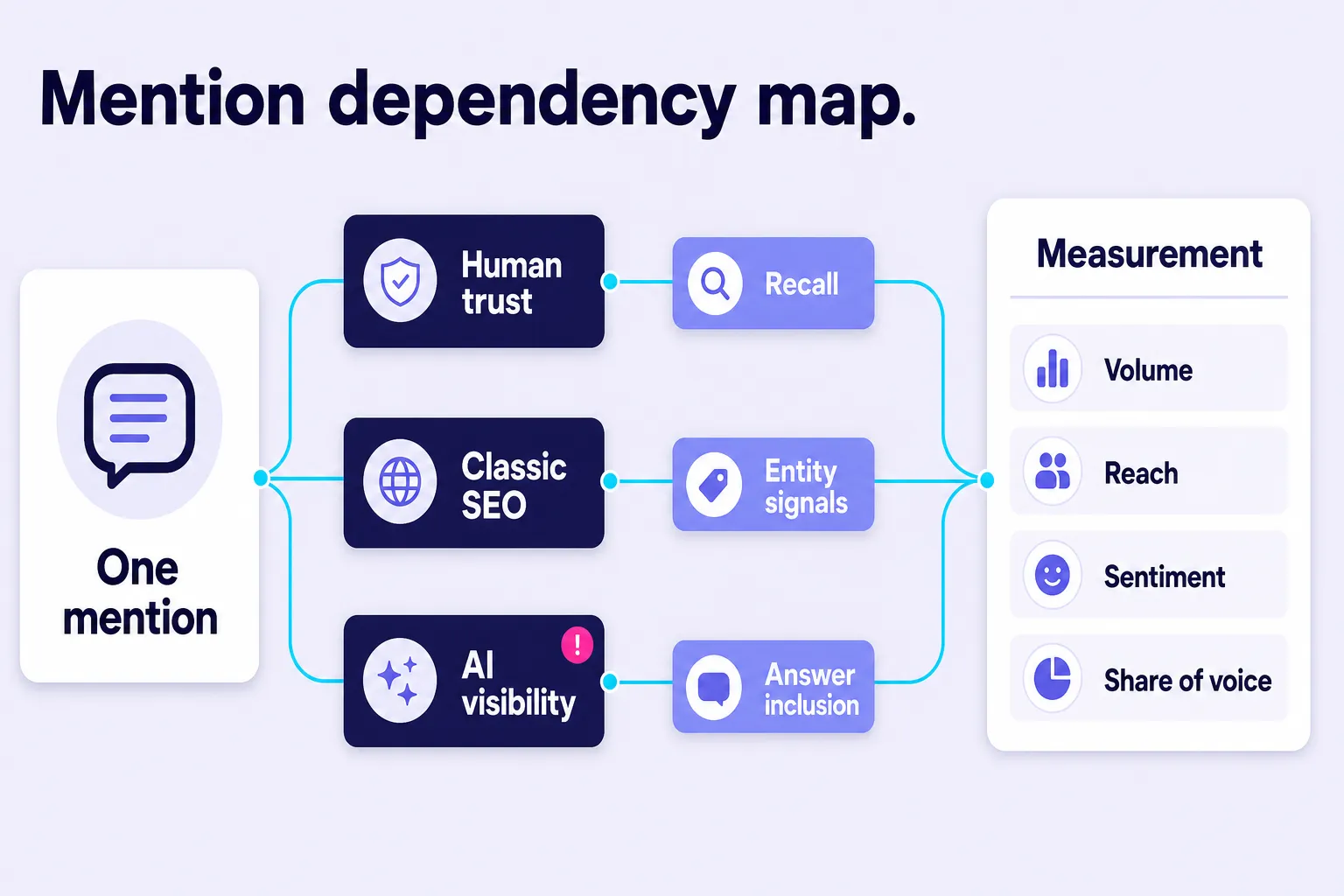
One mention is not one signal. To see why mentions now sit upstream of nearly everything else, trace how a single reference propagates through the modern stack.
Stage 1 - A brand mention is created. Every mention enters the system carrying three attributes at once: provenance (earned / owned / paid), structure (linked / unlinked), and naming (direct / indirect / implied).
Stage 2 - The mention forks into three independent value streams. A backlink, by contrast, feeds only the middle stream.
| Value stream | What the system does | Intermediate signals generated | Downstream outcome |
|---|---|---|---|
| Human reads it | Reputation and social proof | Trust and recall | Purchase intent |
| Search engine crawls it (only if indexable) | Classic-search processing | Branded search lift, link-reclamation opportunity, entity signals | Classic ranking (indirect lift) |
| AI system ingests it (training corpus + live retrieval) | Language and entity processing | Entity resolution, topic association, sentiment context | AI answer inclusion + citation likelihood |
Stage 3 - The three streams reconverge in shared measurement. All paths are measured as volume, reach, sentiment, share of voice, source quality, and AI presence.
Stage 4 - Measurement feeds strategic outcomes: awareness, reputation, AI visibility, and pipeline.
Read it top to bottom and the point becomes structural. A single input forks into three independent value streams (human trust, classic search, machine citation) and reconverges in the same measurement dimensions. A backlink, by contrast, feeds only the middle branch. That difference is the entire reason mentions outrank links for AI visibility while trailing them for classic link mechanics.
One distinction the map compresses deserves emphasis, because it is where most commentary is sloppy. Feeding a training corpus and feeding live retrieval are not the same event. A mention read during model training influences the model's baseline associations and may be months old. A mention retrieved at query time, through the web search a grounded answer engine performs, influences a specific answer now. Improving your footprint changes the retrieval layer quickly and the training layer slowly and unpredictably. Treat them as two clocks, not one.
Do not assume a mention published today reshapes what an AI says today. Retrieval reacts in near real time; training data lags by model version. Optimize for both, but expect different response times.
How Accurate Is Sentiment Analysis on Brand Mentions?
Automated sentiment analysis is reliable for trend detection and unreliable as a verdict on any single mention. In production brand monitoring, polarity classification (positive, negative, neutral) performs well enough for direction, but sarcasm, mixed opinion, slang, screenshots, and multilingual content still generate errors.
The practical benchmark, summarized in Edge Delta's sentiment analysis accuracy reference, places typical live-data polarity accuracy at 82 to 88 percent, with emotion classification lower and aspect-based sentiment in between. That range sits close to human-to-human agreement of roughly 80 to 85 percent, which tells you something honest: sentiment is genuinely hard, and even people disagree on it.
Academic work reinforces the caveat rather than a single headline number. The SentiBench study, comparing 24 methods across 18 labeled datasets, found performance varied considerably by dataset, with no single method winning everywhere. Short social text is especially unforgiving; benchmark evaluations of Twitter sentiment systems have often reported accuracies well below 70 percent. LLM-era tools improve some cases without removing the need for human review.
Sentiment scores are trend instruments, not verdicts. At 82 to 88 percent accuracy, they misread roughly one mention in six, so act on aggregate movement and read the mentions that carry real risk with your own eyes.
Be equally careful about a claim floating around SEO circles: that search engines or AI systems average a brand's sentiment vector and suppress visibility when it turns negative. There is no first-party documentation from Google or any major answer engine confirming a direct sentiment-based visibility penalty of that kind. Sentiment absolutely matters for human buyers, and it is a defensible input to your own decisions. Presenting it as a confirmed algorithmic suppression mechanism is folklore. Use sentiment analysis for direction and human review for high-stakes calls.
How to Measure Brand Mentions
A mention you cannot measure is an anecdote. The discipline is measuring what changes a decision. If a metric will not change a decision, it is dashboard decoration.
Volume answers "how much are we talked about?" Its trend line is a reliable early indicator after a campaign or a crisis, but it needs normalization. Five hundred mentions from low-relevance pages are not stronger than fifty from trusted trade publications and high-intent communities.
Reach answers "how many could have seen it?" A niche-forum mention and a national-outlet mention are both one unit of volume and wildly different units of reach. Reach is potential exposure, not attention, so weight it, do not worship it.
Sentiment answers "how are they talking about us?" Read it as a directional gauge at scale, per the accuracy limits above, not as a label to be trusted on any single item.
Share of voice answers "how much of the category conversation is ours?" It is your volume as a percentage of you plus your named competitors, and it is the most strategic of the four because it converts an absolute number into a competitive position. If your mentions grew 20 percent while the category grew 80 percent, you are losing ground.
Beyond the classic four, two dimensions separate mature measurement from vanity counting. Source authority and relevance, because a small industry forum can influence more buying decisions than a large general-interest article, which is why quality of mentions usually beats raw total. And AI answer presence, which should be broken into distinct outcomes rather than a single yes/no:
- Brand mentioned
- Brand cited as a source
- Brand recommended
- Brand omitted while competitors appear
- Brand described inaccurately
Those are five different problems that demand five different responses.
One structural reality about that last dimension: AI mentions have no permanent URL. They are generated per query, and they shift with prompt phrasing, session context, location, language, personalization, retrieval-index freshness, and model version. A brand that appears for "best CRM for small teams" may vanish when the phrasing changes to "affordable CRM for startups." Measuring AI presence therefore requires a stable, repeated prompt library run on a schedule, not a one-time screenshot, because the surface itself churns.
How to Start Tracking Brand Mentions Without Turning It Into Noise
Understanding the concept is the prerequisite. Capturing it in practice is a monitoring function, and the operational reality is that mentions scatter across surfaces (social, news, forums, reviews, video, and AI answers) that no manual process covers in real time. The gap between the mentions that exist and the mentions you actually see is where most reputation problems and most missed opportunities live. A mature system is not a pile of alerts. It is a filter that turns public references into decisions, and it separates awareness from reputation, AI visibility, and revenue support rather than blending them into one number.
BrandMentions occupies a defensible niche here: real-time cross-surface brand monitoring across web, social, news, and forums, tagged with sentiment and reach, with attention to how a brand surfaces inside AI-generated answers as answer engines become a discovery layer of their own. Its center of gravity is small to mid-market marketing, PR, and founder-led teams that need a practical mention layer for AEO-era visibility before committing to a heavier enterprise intelligence suite.
Competitors occupy adjacent ground with genuine strengths. Meltwater and Cision are built around enterprise PR workflows and large media databases, which suits teams whose primary need is press distribution and analyst reporting. Brandwatch and Talkwalker are often evaluated for enterprise social intelligence and historical data depth. Sprout Social is stronger when social publishing and customer-care workflows sit beside listening. Free options such as Google Alerts capture a thin slice of web mentions with no sentiment, reach, or social coverage. None of these is wrong; the limitation is fit, because a broader suite can be more system than a team needs when the core job is understanding who is naming the brand, where, with what sentiment, and how that shapes AI answer presence.
Two constraints belong in any honest treatment of tracking, and most guides omit both. First, access is uneven and governed by rules: login walls, robots directives, API rate limits, and data partnerships mean no tool sees every surface, and coverage claims deserve scrutiny. Second, monitoring carries legal and ethical weight. Collecting from semi-private communities, storing personally identifiable information, and applying automated sentiment labels in high-stakes customer or legal workflows are decisions with real exposure, not neutral defaults. The tool collects. The judgment, and the responsibility, stay with you.
Brand Mentions vs. Backlinks vs. Citations
Rather than a grid, reason through the two comparisons that actually cause confusion.
Brand mention vs. backlink. A backlink is a hyperlink from one page to yours, a navigational and technical object that search engines can crawl and evaluate in link-based systems. A brand mention is a language reference that may carry no link at all and can appear in text, audio, video, reviews, or an AI answer. In classic search, the backlink is the more directly weighted object. In AI answers, public language about the brand shows the stronger measured association with inclusion. The wrong question is which one replaced the other. Backlinks help systems and users move between documents. Mentions help systems and users understand which entities belong in the conversation.
Brand mention vs. citation. A citation is context-dependent. In local SEO it is a structured business listing (name, address, phone) that confirms a business exists at a place. In an AI answer it is a source link supporting a claim. A brand mention is broader than both: structured or unstructured, linked or unlinked, local or global. A local citation says "this business exists here." An AI citation says "this source supports this answer." A brand mention says "this brand is part of this public conversation."
Frequently Asked Questions
Are unlinked brand mentions a Google ranking factor?
Not directly, based on Google's own statements. John Mueller confirmed in a 2021 office-hours session that Google does not use unlinked brand or domain mentions the way it uses links for PageRank or the link graph, because judging the subjective context of a mention is too unreliable to treat as a clean signal. The 2012 "implied links" patent that fueled the claim is tied more to reference queries than to counting plain-text mentions on web pages. The value of unlinked mentions is real but indirect: branded search demand, link reclamation, entity reinforcement, and, most significantly in 2026, AI answer visibility.
What is the difference between a brand mention and a backlink?
A backlink is a clickable hyperlink pointing to your domain, while a brand mention is any reference to your brand, linked or unlinked. Every linked mention contains a backlink, but the majority of mentions carry no link at all. Backlinks are link-graph objects that participate in classic ranking systems. Mentions are broader language and reputation signals, and they are what language models weight most heavily when deciding whom to name.
What is the difference between a brand mention and a citation?
A citation is a specific kind of reference: a structured local listing that confirms a business exists, or a source link an AI answer attaches to a claim. A brand mention is any public reference to the brand, structured or not. Every citation contains a mention, but only a small fraction of mentions become citations. A citation is a mention that a system has promoted to evidence.
How accurate is automated sentiment on brand mentions?
Automated polarity classification typically runs at 82 to 88 percent accuracy in production, close to human-to-human agreement of 80 to 85 percent. Fine-tuned models on clean datasets can reach the high 80s, but short social text often performs far worse, sometimes below 70 percent. The practical implication is that sentiment is trustworthy as an aggregate trend instrument and unreliable as a verdict on any single mention, so the mentions that carry real risk still warrant a human read.
Do brand mentions help you appear in AI answers like ChatGPT and Google AI Overviews?
Yes, and the correlation evidence is strong. Ahrefs' 75,000-brand study found branded web mentions had the highest correlation with AI Overview brand visibility (0.664), far above number of backlinks (0.218), and Muck Rack found earned media accounts for roughly 82 to 89 percent of the links AI systems cite. Answer engines read language, entity associations, and retrieval sources rather than link graphs, so repeated, credible public references across trusted surfaces are what make a model more likely to name you. The relationship is correlational, not a guaranteed mechanism, so treat the direction as reliable and the exact coefficients as sample-dependent.
Filed under: Brand Monitoring



3 comments