How AI Search Engines Decide Which Brands to Recommend (2026 Guide)
An evidence-based guide to how ChatGPT, Gemini, Perplexity, and Google AI decide which brands to name, backed by citation data and a per-engine breakdown.


Quick Answer: How Do AI Search Engines Decide Which Brands to Recommend? AI search engines do not simply recommend the brands that rank highest for a keyword. They combine retrieved evidence, third-party information, stored model knowledge, and the context of the user's request to decide which brands to name. The available evidence can be organised into five useful signal families.
AI brand recommendation is the selection and presentation of a business, product, or service as a suitable option inside an AI-generated answer, with or without a linked citation to that brand's own domain. In search-grounded systems it combines four processes: query interpretation and expansion, evidence retrieval and ranking, entity attribution, and answer synthesis. "Retrieve, corroborate, synthesize" is an accurate explanatory model of that sequence, but it is not a publicly disclosed universal algorithm, a fixed scoring formula, or a set of mandatory gates every platform executes in the same order.
- Recommendation sits on top of ranking, not instead of it. Search-grounded systems still rank and filter documents; the new layer is evidence selection and answer generation. The unit being selected changed from documents to supported decisions.
- Third-party sources appear to play an outsized role in commercial AI discovery. Across 21,311 brand mentions, 85% were attributed to third-party domains and 13.2% to the brand's own domain. That is a measurement of visible attribution in one query set, not proof that brands control only 15% of their visibility.
- Selection is far narrower than search, and retrieval is a funnel rather than a guarantee. ChatGPT recommended 1.2% of brand locations in a 350,000-location local benchmark, against a 35.9% appearance rate in Google's local 3-Pack - roughly 30 to one for that specific comparison - and of 548,534 pages retrieved across 15,000 queries, only 15% were cited.
- Results can be highly variable across time, prompts, users, and retrieval runs. Reddit's presence in ChatGPT responses fell from around 60% to around 10% over a 13-week window in 2025, and repeated identical prompts produce the same top brand roughly half the time when live search is enabled.
- No signal family has a published weight, so engine, product surface, prompt type, location, and measurement window belong in every serious analysis. No reviewed source supports a "40% authority, 30% mentions" style formula, and there is no single stable "AI ranking" to chase.
The single most important consequence: the decisive evidence usually sits on surfaces a brand does not own.
Five Factors That Influence AI Brand Recommendations
| # | Signal family (AI ranking factor) | What it decides | Strongest evidence in this guide |
|---|---|---|---|
| 1 | Technical eligibility | Whether a brand's evidence can enter the system at all | Google's documented baseline is an indexed page eligible to appear in Search with a snippet; no AI-specific schema required |
| 2 | Query relevance | Whether the material answers the buyer's actual decision, constraints included | Only 15% of 548,534 retrieved pages were cited |
| 3 | Entity clarity | Whether the evidence resolves to the right company, product, version, or location | Knowledge Graph strength correlated +0.68 within category and about -0.10 across category boundaries |
| 4 | Evidential credibility | Whether the claim deserves acceptance, and who stands behind it | 85% of 21,311 brand mentions attributed to third-party domains, 13.2% to owned domains |
| 5 | Content usability | Whether the evidence survives extraction with subject, claim, and conditions intact | 55.7% of quoted spans appeared nowhere in snippet text |
Full detail, limits, and sources for each factor are in the five signal families, and the practical sequence is in the 7-step checklist.
Methodology: How This Guide Was Researched
This brief is built from official platform documentation (Google Search Central, OpenAI's crawler and search help documentation, Anthropic's web search tool reference, Perplexity's engineering and bot documentation), platform update records, peer-reviewed and preprint academic research, and large-scale 2025 to 2026 citation studies. Documented mechanisms, observational findings, and the explanatory model developed here are labelled separately throughout. Studies published in 2025 keep their original dates rather than being re-branded as 2026 evidence. No public source reviewed for this guide discloses universal signal weightings for brand recommendation, and no granted patent reviewed demonstrates a deployed brand-selection scoring formula. Where two datasets disagree, both are reported.
Mentions vs. Citations vs. Recommendations: What Is the Difference?
A mention names a brand in the answer text, a citation is a displayed source link supporting the answer, and a recommendation is an evaluative statement presenting a brand as suitable for the user's need. They overlap but are not substitutable, and each is measured with a different denominator.
Those three endpoints produce three different outcomes.
A brand can be named in an AI answer without its website being cited.
A website can be cited without its brand being recommended.
And a company can hold strong positions in conventional search while being absent from the answer its next customer actually reads.
Collapsing them into one "AI visibility" number is the fastest way to misdiagnose the problem and misallocate the budget - which is why the question we now hear most often, some version of "why does ChatGPT recommend them and not us?", usually turns out to be three separate questions. The answer is neither mystical nor a growth hack. It is a retrieval and generation system with a specific evidence standard, and once the standard is visible, the investment decisions become much less speculative.
| Term | What it is | What it proves | Added nuance | Common reporting error |
|---|---|---|---|---|
| Brand entity | The resolvable identity of a company, product, version, or location inside a model and its sources | That the system can identify the brand at all | An entity formed during pretraining changes far more slowly than a retrievable web page does, so parent company, product line, and single location are not interchangeable measurement units | Mixing parent company, product line, and single location in one count |
| Retrieved evidence | Everything returned into the answer system for the current request | Access to material, not influence | Most retrieved material never becomes visible, and its presence in the candidate set is a stronger indicator of access than a displayed citation is | Treating retrieval as visibility |
| Mention | The brand named in generated text | Presence in the answer | Presence is not polarity - the same count can contain praise, comparison, and warnings | Assuming a mention is positive |
| Citation | A displayed attribution or source link | Where the answer points for support | It identifies where the answer points for support, and it does not endorse the publisher, prove that source caused the recommendation, or confirm that every adjacent claim is supported | Reading a citation as endorsement or as proof of causation |
| Recommendation | An evaluative statement of suitability | That the evidence supported naming the brand as an option | A neutral mention, a comparison reference, a narrow-use-case suggestion, and an explicit warning are separate classifications, so a rising mention rate made up mostly of warnings is not a visibility gain - for the conceptual groundwork, see the primer on understanding brand mentions | Counting warnings and neutral references as gains |
How measurably different these are is worth one number. A July 2026 study of 12,000 responses across four AI surfaces, roughly 200 brands, and three prompt types found that only 23.1% of tracked brand mentions coincided with a citation to that brand's own domain in the same response, falling to 7.2% for open-ended category prompts, as documented in the BuzzStream mentions versus citations study. Mentions and citations are related, not substitutable.
One widely repeated figure deserves a correction here. The "10x mentions-to-citations ratio" often attributed to citation-tracking vendors could not be traced to an original dataset with a stated denominator, so it is excluded from this guide rather than promoted into a benchmark. The verifiable version of the underlying point is narrower and more useful: mentions and citations must be measured separately, each with its denominator stated.
Key takeaway: report mention rate, owned-domain citation rate, and recommendation rate as three metrics with three denominators, never as one "AI visibility" score.
How AI Answers Are Built: Retrieve, Corroborate, Synthesize
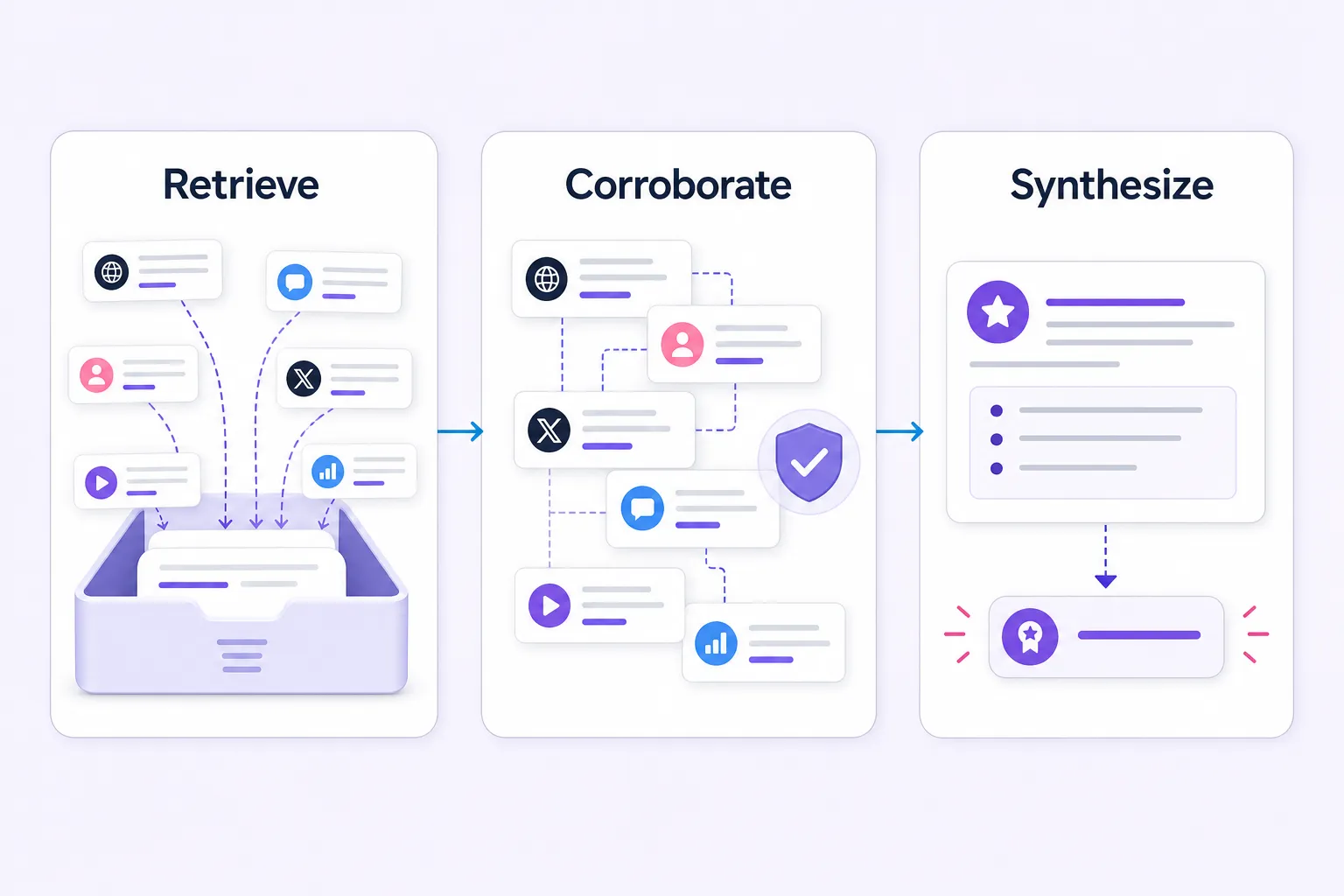
A useful model for understanding search-grounded AI answers is three stages: retrieve, corroborate, and synthesize. Ranking determines which evidence may enter consideration; generation determines which brands ultimately appear in the answer.
The most important conceptual correction for anyone arriving from classical SEO is that there is no ranked list of brands inside an AI answer. There is a ranked, filtered set of documents and passages at the retrieval stage, and then a model reads that set, decides which entities to name, and writes a response.
Retrieve is the construction of the candidate evidence set. Google documents query fan-out, in which AI Overviews and AI Mode issue additional related searches across subtopics and sources, and states that the two surfaces can use different models and techniques, in its Search Central documentation on AI features. A page can therefore enter the answer because it served a supporting subquestion the user never typed, which is why comparing an AI answer only against the result page for the original prompt misses part of the mechanism.
Retrieval is also more granular than "rank ten pages". Perplexity's engineering account of its search stack describes hybrid lexical and semantic retrieval, candidate filtering, and progressively more expensive ranking stages including cross-encoder rerankers, operating at both document and sub-document level, in its write-up on architecting an AI-first search API. That single piece of documentation dismantles two popular claims at once: that AI search abandoned keyword matching for pure vector similarity, and that ranking stopped mattering. Lexical matching, semantic matching, and multi-stage ranking coexist.
Corroborate is the assessment of what the available material actually supports. This is where the useful distinction is repetition versus independent support. Five pages reproducing the same press release provide five distribution points and one underlying source. A product specification, a documented customer implementation, and an independent hands-on evaluation provide three different kinds of evidence about the same claim.
That is an evidence-quality distinction, not a disclosed platform rule. No official documentation reviewed here establishes a universal "two independent domains required" threshold before a brand can be named, and treating such a threshold as fact is one of the more common errors in vendor explanations of this topic.
Synthesize determines the wording, scope, and trade-offs of the recommendation. A source can support the claim that a product has a feature without supporting the much stronger claim that it is the best choice for a specific buyer. A May 2026 preprint analysing 55,393 trending queries collected between March 13 and April 21, 2026 extracted 98,020 atomic claims from Google AI Overviews and classified 11.0% as unsupported by the cited pages, reported in the arXiv preprint on claim fidelity in AI Overviews. The paper was under review and its sample was not a brand-recommendation census, but it settles an important question: engines do not only name brands whose claims they have successfully verified.
Useful mental model: Instead of asking only which page ranks, ask which brands the available evidence makes relevant and supportable for the user's specific request.
There is one more separation worth holding onto: training-time knowledge and retrieved information are different input channels. OpenAI's documentation distinguishes GPTBot (content that may be used for model training) from OAI-SearchBot (inclusion in ChatGPT search) and ChatGPT-User (certain user-initiated fetches), in its reference on OpenAI crawlers and bots. Blocking a training crawler and blocking a search crawler mean different things, and an uncited brand mention does not tell you which channel produced it.
This is the foundation that answer engine optimization rests on. The objective is not simply to appear somewhere in an answer. It is to appear accurately, for a reason relevant to the buyer's decision.
The Five Signal Families: What Are the AI Ranking Factors for Brands?
Current research points to five recurring signal families associated with whether a brand appears in an AI answers: technical eligibility, query relevance, entity clarity, evidential credibility, and content usability. They are analytical categories, not five disclosed coefficients, and no platform publishes a weighting for any of them. They are also the most concrete available answer to how ChatGPT chooses brands, how Perplexity selects what to cite, and what "AI ranking factors for brands" means once the marketing language is stripped out. For the wider strategic context around these families, see how brand mentions feed AI visibility.
| Signal | What it governs | Key data point |
|---|---|---|
| 1. Technical eligibility | Whether a brand's evidence can enter the system at all (indexing, crawler route, snippet controls) | Google's documented baseline is an indexed page eligible to appear in Search with a snippet; no AI-specific schema required |
| 2. Query relevance | Whether the material answers the actual decision, including constraints and comparisons | Only 15% of 548,534 retrieved pages were cited; 20.1% citation rate at ≥50% title-query overlap vs. 9.3% below 10% |
| 3. Entity clarity | Whether the evidence unambiguously refers to the right company, product, version, or location | Knowledge Graph strength correlated +0.68 with recommendation rate within category and about -0.10 across category boundaries (14,140 responses, 12 brands) |
| 4. Evidential credibility | Whether the claim deserves acceptance, and who is standing behind it | 85% of 21,311 brand mentions attributed to third-party domains, 13.2% to the brand's own domain; brands ~6.5 times more likely to surface through external content |
| 5. Content usability | Whether the evidence survives extraction with subject, claim, and conditions intact | Median delivered extracts of roughly 4 KB per result across 21,203 results; 55.7% of quoted spans appeared nowhere in snippet text |
Their influence is stage-dependent. Eligibility governs whether evidence can enter the system at all. Relevance separates candidates. Credibility and usability shape what the final answer can support.
The honest position on weightings is that they are unpublished. Published correlation coefficients are not causal shares of an algorithm, and a larger correlation does not mean a platform assigns that factor proportionally more selection power. Where the underlying research states its own limits, this guide states them too.
Signal 1: Technical Eligibility - Can Your Evidence Enter the System at All?
Technical eligibility determines whether a page can contribute through a particular retrieval route: for Google's AI features, the documented baseline is an indexed page eligible to appear in Search with a snippet.
Google states there are no additional technical requirements and no special AI-specific schema, that snippet controls such as nosnippet, max-snippet, and data-nosnippet apply to AI-generated experiences, and that the Google-Extended token governs Gemini model training rather than inclusion in AI Overviews or AI Mode.
The boundary that most audits get wrong is this: page eligibility is not brand eligibility.
If a company's own site is inaccessible to a given crawler, other accessible pages can still describe that company, and third-party evidence about it remains fully usable. Conversely, successful crawling of a company's own site says nothing by itself about whether the brand will be recommended.
Access rules are also route-specific rather than absolute. Perplexity documents distinct agents, including PerplexityBot for index building and a separate user-initiated fetcher that retrieves a page because a user asked for it, and the two behave differently with respect to robots directives. "Blocking PerplexityBot makes a brand invisible in Perplexity" is therefore too strong a statement. The defensible version: a blocked page cannot contribute through the blocked route.
Published weighting: none. This is an access condition, not a percentage of a score.
Key takeaway: eligibility is a gate you can fail silently and per crawler - audit it bot by bot, and never mistake a crawlable site for a recommendable brand.
Signal 2: Query Relevance - Does the Material Answer the Actual Decision?
Query relevance is the match between the retrieved material and the buyer's full question - category, intended use, constraints, and implied comparison - measured at passage level rather than page level.
"Which project management tool suits a small agency billing clients hourly" is not a category query with a decoration attached. The constraint is the query.
The retrieval funnel is measurable. A March 2026 study covering 15,000 original queries and 548,534 retrieved pages found that only 15% of retrieved pages were cited. Pages with at least 50% title-query overlap were cited at 20.1%, against 9.3% for pages with less than 10% overlap, and pages ranked first in Google showed a 43.2% citation rate in that analysis, per the AirOps research on retrieval fan-out and Google SERPs in ChatGPT. Those are associations inside one dataset, not proof that rewriting a title causes the corresponding lift.
Published weighting: none. The finding supports separating retrieval from citation and examining query alignment at passage level, not assigning relevance a fixed share.
Key takeaway: being retrieved is not being cited - write to the buyer's constraint at passage level, because only 15% of retrieved pages made it into an answer.
Being retrieved is not being cited
Signal 3: Entity Clarity - Does the Evidence Refer to the Right Brand?
Entity clarity is whether the evidence an engine reads resolves to the correct organisation, product, product version, or individual location - an attribution problem before it is a visibility problem.
A company called Northstar, with a product called Northstar, three unrelated businesses sharing the name, and an acquired product still documented under its former identity, produces a mention count that is unreliable before any recommendation analysis begins.
The distinctions that matter are organisation versus product, product versus version, national brand versus individual location, current name versus former name, and genuine brand reference versus an ordinary word used in another context. This is where the relationship between mentions and AI visibility gets decided: what a mention identifies and explains matters more than whether the string appears.
On whether public knowledge-graph presence is a prerequisite, the evidence is genuinely mixed and should be reported that way. A 2026 study of 14,140 responses across 12 athletic apparel brands found Google Knowledge Graph strength correlated with recommendation rate at +0.68 within a brand's coded category and about -0.10 across category boundaries, meaning entity strength was directional inside a category and close to meaningless outside it. The same study observed that the three brands which lost recognition when web search was disabled were the three without an English Wikipedia article. That is a useful hypothesis about parametric recall with a 12-brand sample. It is not evidence that every engine imposes a binary knowledge-graph gate, and Google's own documentation explicitly declines to require any special markup.
Published weighting: none. No reviewed source establishes an entity-clarity threshold or a universal recognition requirement.
Key takeaway: resolve organisation, product, version, and location into distinct units before you measure anything, because an ambiguous entity makes every downstream number unreliable.
Signal 4: Evidential Credibility - Does the Claim Deserve Acceptance?
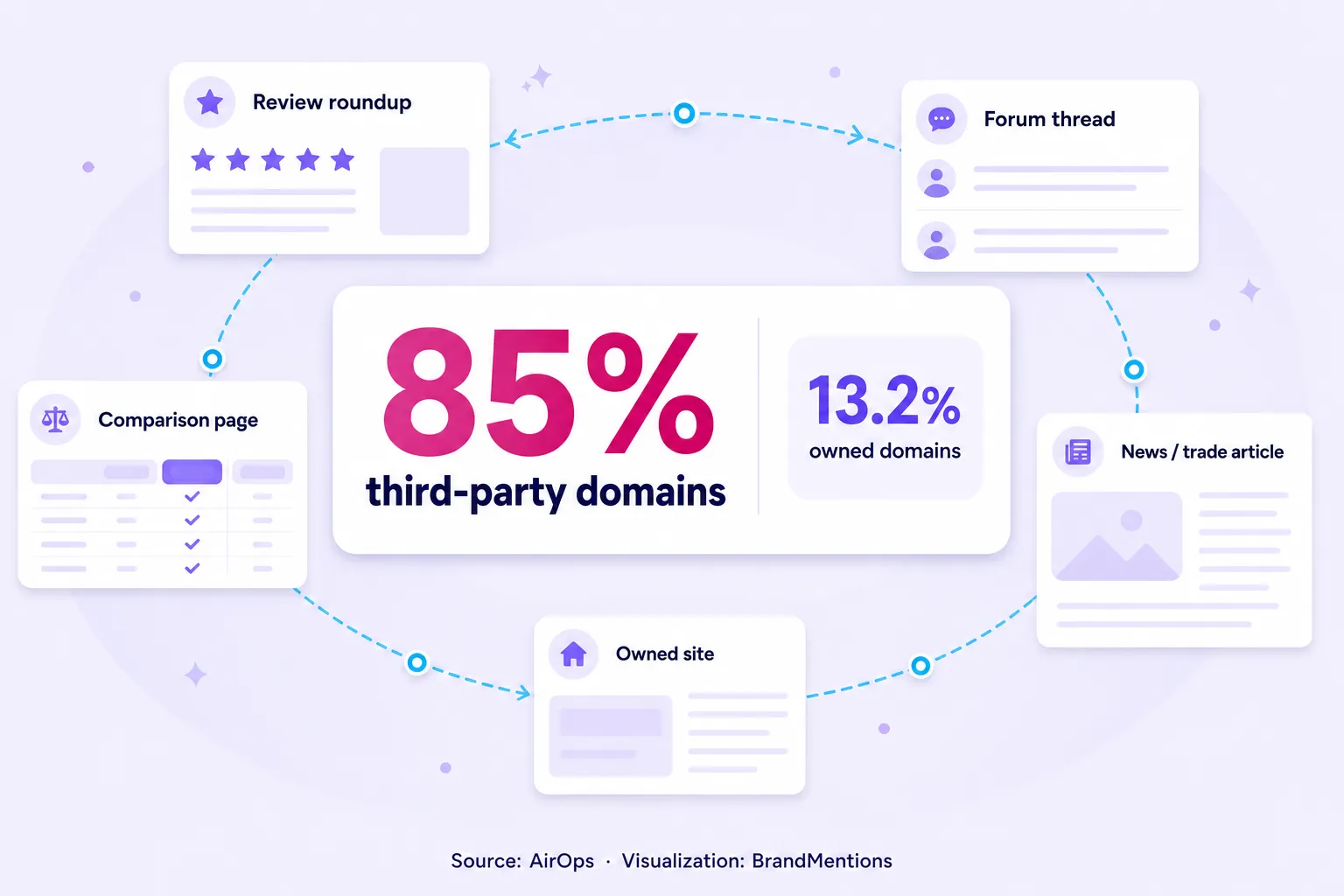
Evidential credibility is whether the source standing behind a claim can support it independently, and it is the signal family most dominated by third-party content: 85% of brand mentions in one 21,311-mention sample were attributed to third-party domains against 13.2% to brands' own domains.
This family carries the most-cited number in the field, and it is the one most often overstated.
The AirOps study on offsite signals in AI search, published October 17, 2025, analysed 21,311 brand mentions across ChatGPT, Claude, and Perplexity over more than 500 commercial-discovery queries. It attributed 85% of brand mentions to third-party domains and 13.2% to the brand's own domain, with the remainder uncited, and found brands roughly 6.5 times more likely to surface through external content than owned content. Nearly 90% of those third-party mentions came from structured formats: listicles, comparison pages, and review roundups.
What that figure is: a measurement of visible source attribution in one large commercial-discovery sample. What it is not: a statement that 85% of an engine's algorithm consists of external mentions, or that brands control only 15% of their outcome. The study classified attribution patterns. It did not inspect causal contribution weights, and it describes owned content as the foundation that informs how external sources describe a brand.
Volume vs. Independence: Do More Mentions Mean More Recommendations?
Volume and independence behave differently. The Ahrefs analysis of brand web mentions and AI Overview visibility, published May 26, 2025, found brands in the highest web-mention quartile averaging 169 AI Overview mentions against 14 in the next quartile, with branded web mentions showing the strongest correlation among the variables it tested, well ahead of backlinks. Ahrefs explicitly labels these correlations rather than causes, and its sampling frame matters (domains above DR 40, a highest-volume keyword of at least 800 monthly searches, zero-mention brands excluded from the correlation), which limits extrapolation to new or obscure brands.
Credibility is also claim-specific in ways that mention counting cannot capture. A manufacturer is a direct source for its own published specifications and not an independent source for the claim that it outperforms every competitor. A single review documents one experience and not a market-wide failure rate. Syndication expands distribution without expanding verification. An older complaint and a recent resolution describe different states of the same product.
Sentiment and Star Ratings: Is There a Rating Cutoff?
Sentiment belongs here, handled carefully. The SOCi 2026 Local Visibility Index reports that locations recommended by ChatGPT averaged 4.3 stars. That is an observed average among recommended locations. It is not a documented cutoff, and claims that brands below 4.3 stars (or below 4.0) are mechanically filtered out are unsupported transformations of descriptive data. What the data supports is weaker but still actionable: poor and thin review profiles are strongly under-represented among recommended businesses, and sentiment sits in the evidence the model reads rather than in an exposed scoring field.
BrightEdge's ecommerce research adds a stage-specific nuance often misquoted: it reports that 19.4% of ChatGPT's negative sentiment occurs in the consideration category. That is the distribution of negative sentiment across stages, not the share of consideration-stage mentions that are negative. The distinction matters, because the first describes where criticism concentrates and the second would describe how hostile an engine is at the moment of purchase.
Published weighting: none. Source ownership is measurable. Trust is not an exposed scalar.
Key takeaway: the evidence that gets brands named mostly lives on other people's domains, so earn independent comparison, review, and roundup coverage rather than republishing your own positioning.
Signal 5: Content Usability - Does the Evidence Survive Extraction?
Content usability is whether a passage still makes a complete, defensible claim once it has been excerpted from its page - subject named, claim bounded, conditions attached.
A claim that loses its conditions when quoted becomes unusable for an engine that has to stand behind the sentence.
Selection pressure at this layer is documented, not inferred. Anthropic's web_search_20260209 tool version introduced optional dynamic filtering, in which Claude can write and execute code to strip irrelevant search-result material before it reaches the context window, described in the Anthropic reference for the Claude web search tool. That is API behaviour, not proof that every consumer session processes results identically, but it shows that evidence is pruned before synthesis and not merely appended.
Source-level tracing shows how much extraction actually carries. An analysis of 1,100 Claude prompts found median delivered extracts of roughly 4 KB per result across 21,203 results, and that 55.7% of quoted citation spans appeared nowhere in the search snippet text, meaning they could only have come from fetched page content. Freshness fits here as a question of validity rather than decoration: a recent publication date cannot repair obsolete specifications, and a stable concept explained well in 2023 is not automatically less useful than a 2026 paraphrase.
Published weighting: none. There is no verified universal length, freshness, formatting, or sentiment multiplier.
Key takeaway: write self-contained passages - subject, claim, and conditions in the same few sentences - because engines quote fragments, not pages.
How to Get Your Brand Recommended by AI Search Engines: 7-Step Checklist for ChatGPT, Perplexity, and AI Overviews
To get recommended - and to get cited by ChatGPT, Perplexity, and Google AI Overviews - make your evidence reachable, constraint-specific, correctly attributed, independently corroborated, extraction-safe, diversified across source categories, and measured per engine.
Each step maps to one of the five signal families (the AI ranking factors above) and to a failure mode in the table above.
- Audit crawler access bot by bot, not as one switch. Check robots directives and access logs separately for GPTBot (training), OAI-SearchBot (ChatGPT search), ChatGPT-User (user-initiated fetches), PerplexityBot and Perplexity's user-initiated fetcher, Google-Extended (Gemini training), and Googlebot, then confirm your key pages are indexed and snippet-eligible and that
nosnippet,max-snippet, ordata-nosnippetare not silently removing you from AI experiences. (Signal 1 · access failure.) - Publish constraint-specific documentation, and write it so a single passage survives quoting. Document use cases, limits, versions, markets, integrations, and who the product is not for, with the subject named, the claim bounded, and the conditions attached inside the same passage rather than spread across a page. (Signals 2 and 5 · evidence and citation failure.)
- Resolve entity ambiguity before measuring anything. Separate organisation, product, product version, and individual location; reconcile former names, acquired product names, and same-name businesses; and keep those units distinct in every count so a mention report is about one identifiable thing. (Signal 3 · identity failure.)
- Earn independent comparison and review coverage in the formats engines read. Prioritise listicles, comparison pages, review roundups, trade evaluations, and reference entries - the structured third-party formats that accounted for nearly 90% of third-party brand mentions in the 21,311-mention sample where 85% of mentions were attributed to third-party domains and 13.2% to brands' own domains. (Signal 4 · awareness failure.)
- Diversify source categories deliberately. If a large share of your AI-relevant evidence sits in one category, spread it across community, editorial, review, video, and reference sources; the 2025 collapse of one community source from roughly 60% to around 10% of ChatGPT responses is the reference case for what single-category dependence costs. (Signal 4 · concentration risk.)
- Run repeated-prompt panels per engine, not one-off checks. Test category, comparison, and named-brand prompts separately; repeat each prompt enough times to report a distribution rather than a single draw, given that the same top brand reappeared only roughly 48% to 68% of the time with web retrieval enabled in one 2026 stability study; and attach engine, surface, prompt set, location, and date to every result.
- Keep separate upstream and downstream records, and diagnose before you spend. Maintain the upstream evidence record (entity, source and authorship, claim, context, dates, sentiment and accuracy) alongside the downstream answer record (mention rate, recommendation rate, owned-domain citation rate, representation accuracy), then match the observed failure mode to its budget - configuration fix, content, entity information, earned coverage, product-fit evidence, remediation, or diversification - instead of buying more coverage by default.
Why AI Recommendations Add a Selection Layer on Top of Ranking
AI-generated answers add another decision layer after retrieval and ranking: the system must select which entities and claims to include in a synthesised response.
A classical search engine distributes the verification work. It returns ten options and the user opens three tabs, compares them, and forms a shortlist. An answer engine internalises that work. It has to commit to a paragraph, and the computationally natural way to commit is to prefer entities that the retrieved material describes consistently and specifically.
The first formal research on influencing that behaviour came from the Princeton and IIT Delhi team behind the original GEO paper on generative engine optimization, published in November 2023. Its headline finding was that adding statistics, quotations, and source citations to a page improved visibility in generative answers by up to 40% in their benchmark, while keyword stuffing reduced it. Much higher figures circulate from that paper (a 115% lift is the one usually quoted), but that number is a specific result for one method applied to fifth-ranked pages, not an across-engine average. The durable insight is directional: content that looks like evidence performs better than content that looks like positioning.
Two things follow that matter more than the percentages. Position seven stopped existing: in a ten-link world a brand at the bottom of page one still received attention, while in a three-brand answer it receives none. And the decisive input moved off the brand's own domain, because independent description can provide stronger corroboration than a brand's own claims, particularly for comparative or evaluative statements.
Stop asking whether your site is optimised for AI. Ask whether the sentences an engine would need in order to recommend you already exist somewhere it can reach, written by someone other than you.
What the Evidence Does Not Support
No reviewed source justifies a formula such as "40% authority, 30% mentions, 20% freshness, 10% schema". The published correlations cannot be converted into relative causal weights, and the five families above are stage-dependent explanations, not a scoring rubric. Any guide that hands you percentages for these signals has performed arithmetic on descriptive data.
The AI Brand Recommendation Dependency Map
The flow below traces how a user need becomes either a brand mention, a recommendation, or a citation - and shows why those three endpoints are separate. It is an analytical asset. It is not a reverse-engineered platform diagram, and every step is a dependency in the explanatory model rather than a documented production step. Its purpose is to keep observable outcomes separate from partly hidden selection processes.
- Input: user need plus constraints, conversation context, and personalization state.
- Interpretation of the task: the system reads the request and expands it into the subquestions it thinks must be answered.
- Two input channels open in parallel: (a) existing model knowledge - parametric, slow to change; (b) search or tool retrieval - bounded by index coverage and access route.
- Candidate evidence available (retrieval channel only): what the system managed to fetch for this request.
- Passages selected and filtered: the candidate set is pruned before it reaches synthesis.
- Claims and entities assembled: both channels converge into the material the answer can stand behind.
- Two separate endpoints, not one: the brand is named or evaluated → a recommendation, a neutral mention, or a warning; supporting links are displayed → a citation to an owned domain or a third party.
Figure: the dependency flow from user need to brand mention, recommendation, or citation. Steps 1 to 6 are partly hidden; only step 7 is observable from outside.
Three properties of this map carry the analytical weight.
The branches are deliberate. A brand mention does not require a citation to the brand's own domain, and a citation does not imply a recommendation of the cited publisher's brand. Any map that funnels both into a single endpoint is encoding a claim the data contradicts.
A citation does not imply a recommendation.
Availability is not influence. A crawler visit proves access. A page appearing in a returned search set is stronger evidence of retrieval than a visible citation alone. Neither shows how much that page moved the brand shortlist.
The retrieval-supported route is multiplicative. For that route only, P(retrieved and recommended) = P(retrieved) × P(recommended | retrieved). This is a probability identity, not a fitted platform model, and it explains why better retrieval performance does not translate proportionally into more recommendations: the second term still depends on what the evidence supports and what the user needs. The identity also excludes recommendations produced without observed retrieval, which do occur.
When examining why a brand is missing from AI search, the productive question is which branch failed: missing evidence, inaccessible evidence, irrelevant evidence, or evidence that exists but does not support the recommendation the brand wants.
How Has AI Search Evolved? Four Phases of Machine-Generated Brand Recommendation
AI brand recommendation has been reorganised four times in roughly three years, moving the decisive asset from training-corpus presence, to retrievable documents, to documents on favoured sources, to corroboration spread across a diversified source set.
| Phase | Period | Mechanism | Decisive input | Added nuance |
|---|---|---|---|---|
| 1. Pure parametric recall | 2022 to early 2023 | Conversational assistants with no retrieval layer; brands named from training-data priors | Total historical corpus presence, frozen at training cutoff | Recently founded brands were structurally invisible, and nothing on their own sites could change that |
| 2. Retrieval-augmented answers | 2023 to 2024 | Live retrieval arrives across Bing Chat, Perplexity, and Google's generative search experiments | Retrievable web document | The first formal research on evidence-dense page construction appeared in this window, because a fresh document could finally move an answer |
| 3. Search as default and source hierarchies | Late 2024 to mid 2025 | Search becomes default mode, AI Overviews roll out broadly, query fan-out enters production, licensing deals coincide with a few dominant citation domains | Retrievable documents on sources a given engine weighted heavily | Licensing agreements coincided with a small set of community and reference domains becoming dominant citation sources, so source choice briefly mattered more than document quality |
| 4. Reweighting, filtering, and configuration | Late 2025 to 2026 | Source shares actively managed, extraction and filtering layers explicit in documentation, same model name behaving differently across consumer, API, enterprise, and government configurations | Corroboration spread across a diversified source set | Observed source shares changed substantially over time, making dependence on a single source category risky |
The direction of travel across all four phases moved influence away from the brand's own domain and toward independent description. It would be an extrapolation to declare that irreversible: platform-level publisher controls and reporting are expanding in 2026, and a future phase that rewards verifiable first-party documentation more heavily is plausible. What has not reversed in any phase is the requirement that a recommendation be defensible with something the engine can point to.
Algorithmic Reality: Source weights inside AI engines are tuned continuously and without announcement. A brand whose visibility rests on one source category holds a position that can be revoked by a configuration change it will never see.
Which AI Engines Recommend Brands Differently? ChatGPT, Google, Gemini, Perplexity and Claude Compared
Each engine runs its own retrieval stack and its own filtering, so the same brand needs a different evidence profile for each: ChatGPT behaves as a shortlist recommender, Google AI Overviews as a source aggregator, Perplexity as a citation-first live retriever, and Claude as a search-tool orchestrator.
How Do the Five Engines Compare at a Glance?
The engine name alone is not a technical specification. Consumer apps, APIs, enterprise workspaces, and research modes expose different tools, different providers, and different filtering behaviour. The table below summarises what is documented and where the popular shorthand breaks down.
| Platform or surface | Documented retrieval relationship | Observed behaviour | Boundary that matters |
|---|---|---|---|
| ChatGPT Search | OpenAI search crawling (OAI-SearchBot) plus search and data-provider integrations; Bing explicitly documented for Enterprise and Edu search | High brand inclusion on commercial queries; behaves as a shortlist recommender | "ChatGPT uses Bing" is not an exclusive-backend statement; Healthcare workspaces are documented as not using Bing |
| Google AI Overviews and AI Mode | Google Search eligibility and retrieval, including query fan-out; snippet controls apply | Low brand inclusion rate, many brands when inclusion happens; heavy reliance on already-trusted domains | The two surfaces can use different models and return different answers and links |
| Gemini with Search grounding | An enabled search tool lets the model decide whether to search, issue queries, process results, and return grounded citations | Fewer sources per answer than ChatGPT; strong dependence on Google's structured data for local and entity queries | API grounding documentation does not describe every consumer Gemini response |
| Perplexity | Proprietary search infrastructure with hybrid lexical and semantic retrieval, filtering, and cross-encoder reranking; distinct index and user-initiated agents | Citation-first output; visible preference for recent documents and diverse domains on time-sensitive queries | Reddit is a source domain, not the underlying index; freshness weighting is behaviour, not a published coefficient |
| Claude web search | Search-tool orchestration with citation and optional dynamic filtering; Brave Search API documented for the Claude for Government connector | Delivered URLs track an independent index closely in tested configurations | An exclusive universal Brave backend should not be assumed across all Claude products |
Does ChatGPT Just Use Bing? A Documented Provider Is Not a Universal Explanation
No - Bing is a documented provider for specific ChatGPT surfaces, not a universal backend, and provider participation is not final selection.
OpenAI's help documentation for ChatGPT search in Enterprise and Edu states that disassociated search queries can be sent to Bing, and in the same document identifies a product-level exception where Healthcare workspaces do not use Bing for web search or specialised data providers. That is enough to retire the blanket claim that every ChatGPT recommendation originates in Bing's index.
Two further distinctions are practical. Provider participation is not final selection: even where Bing supplies results, a Bing position is not a ChatGPT recommendation position, because the answer still selects what to say and which sources to show. And the absence of a citation to a company's website does not establish that the model failed to recognise the company.
Independent reverse-engineering work in 2026 indicates that ChatGPT's retrieval routes differ by account tier and reasoning mode, with materially different corpora behind different configurations. The direction of that finding is credible and useful, the exact mode labels in circulation are inconsistent, and the safe reading is that "ChatGPT visibility" is configuration-dependent rather than a single measurable state.
Google AI Overviews and AI Mode: Do Search Foundations Still Apply?
Yes - Google's AI features stay attached to conventional Search eligibility: an indexed, snippet-eligible page crawled normally, with no special markup required.
The generation layer changes what is assembled, not whether retrieval and eligibility exist.
"Google ranking versus AI inclusion" is therefore not an either-or. Strong Search visibility helps evidence enter consideration, but the original query's result order does not describe sources discovered through fan-out, and nothing about rank determines the final recommendation wording. The ecommerce contrast measured by BrightEdge illustrates how differently the two major surfaces behave: ChatGPT included at least one brand in 99.3% of ecommerce responses, against 6.2% for AI Overviews, and averaged 5.84 brands per ChatGPT ecommerce response against 0.29 per AI Overview ecommerce response. One surface behaves as a recommender, the other as a source aggregator, and the same brand needs a different evidence profile for each.
Perplexity: Live Retrieval, Not a Permanent Source Preference
Perplexity's behaviour is explained by live multi-stage retrieval and question type, not by a standing preference for any single domain such as Reddit.
Its retrieval system supplies candidate evidence, and community threads are one source class inside that process, informative for experiential questions (setup difficulty, support quality, workflow compromises) and much less informative for specification questions.
The productive framing behind why AI cites Reddit is therefore about question type, not domain favouritism. A domain-level citation leaderboard cannot tell you which of your buyer's questions makes first-hand discussion the most useful available evidence.
Claude: Tool Configuration Matters as Much as the Model
For Claude, the search tool and its configuration determine what evidence arrives, and the measured connection to an independent index is strong without implying universal exclusivity.
Anthropic documents a Brave Search API connection for the web-search connector in Claude for Government, and distinguishes that connector from commercial Claude's built-in web search. A real integration exists; universal exclusivity does not follow.
Observationally, the connection is strong where it has been measured. An analysis of 1,100 prompts, published July 14, 2026, matched 95.8% of URLs delivered to Claude against the top 20 results of an independent index, with 79.2% in the top 10, and delivery rates falling from 89.4% at rank 1 to 46.1% at rank 10, documented in the OppAlerts study on how Claude turns Brave results into citations. The same study found that only 37.4% of recommended brands had one of their own pages delivered, while 93% of recommendations were named or linked in the text the search tool delivered, and roughly 1.5% looked like pure model memory. That is unusually direct evidence that recommendations are mostly constructed from third-party page content rather than from the brand's own site, with the caveat that the study covers one model and one prompt family.
Personalization: The Variable Most Analyses Omit
Personalization means sampled answers are not the answers your customers see: memory, conversation context, preferred sources, location, language, and account state all change retrieval.
ChatGPT's search documentation describes how saved memories and conversation context can shape the queries it issues, meaning two users asking the same question can receive different evidence. Google has introduced Preferred Sources, letting users elevate chosen publishers within search surfaces, and location, language, and account state alter results across all engines.
Platform Rule: Every major engine documents crawl-level access controls and none documents a way to buy or guarantee placement in an organic recommendation. The retrieval gate is public. The selection logic is not, and the answer your buyer sees is partly a function of their own history.
Can You Pay to Be Recommended by AI? Organic Recommendation vs. Commercial Placement
No major engine documents a way to buy or guarantee placement in an organic AI recommendation. Four distinct mechanisms now sit inside the same answer interface, and a guide about brand recommendation has to state which surfaces its conclusions cover.
Organic recommendation is the case this guide analyses: a brand named inside generated prose because retrieved or parametric evidence supported naming it. No payment path exists into that mechanism at any major engine.
Sponsored and advertising placements are a separate inventory with separate eligibility rules, typically labelled, and governed by auction and policy systems rather than evidence corroboration. Their presence in an answer interface says nothing about organic selection.
Shopping surfaces and product cards draw on structured commerce data: merchant feeds, product catalogues, price and availability fields, and partner integrations. Eligibility here depends on feed accuracy and merchant program compliance, not on third-party editorial description. A brand can hold strong product-card visibility while being absent from prose recommendations, and the reverse happens too.
Partner-supplied data covers licensed datasets and provider integrations that supply structured facts (business hours, ratings, inventory) into answers. Errors in those pipelines produce visibility problems that no content or PR investment will fix, because the defect is in a data feed.
Conflating these four is a recurring analytical error. The 85% external-source finding and the selectivity ratios below describe organic prose recommendation in commercial discovery. They do not describe merchant-feed eligibility or ad placement.
What Brands Control, Influence, and Cannot Touch in AI Visibility
Brands directly control the accuracy and accessibility of their own information, influence how third parties describe them, and control nothing about indexes, retrieval logic, source reweighting, or personalization. The right frame is not a 15/85 split of power. It is three categories of leverage with different mechanics.
Direct control covers the accuracy and accessibility of owned information: product definitions, documented capabilities and limitations, version and market distinctions, business data, technical accessibility per crawler, snippet permissions, and the evidence the company publishes about itself. These are information-governance decisions. They are necessary and they are not selection guarantees. A precise product page still earns its keep when a third-party review gets the citation, because it is often the reference that lets other publishers describe the product correctly.
Influence without control covers external description: independent evaluations, review platforms, comparison pages, community discussion, trade coverage, and reference entries. A brand can supply accurate information, answer questions, resolve problems, and make verifiable evidence available. It cannot legitimately dictate an independent reviewer's conclusion or require an engine to repeat its preferred positioning. One clarification on the 85% figure belongs here: an external domain is not automatically independent editorial coverage, since the third-party category also contains partner pages, submitted customer stories, and directory listings. External does not mean uncontrollable, and it does not mean uniformly more credible.
No direct control covers the index behind each engine, retrieval and fan-out logic, source reweighting, model versions, and personalization state. When a dominant community source fell from around 60% to around 10% of ChatGPT responses in 2025, every brand whose visibility depended on it lost ground, and nothing on their own domains would have prevented it.
Because the decisive evidence sits on surfaces a brand does not own, the first analytical requirement is knowing what those surfaces currently say. This is the specific role BrandMentions occupies well: continuous tracking of brand mentions, sentiment, and competitive share of voice across news sites, forums, review platforms, community threads, and social channels, which makes it a fit for building the upstream evidence record before any GEO budget is committed. Its coverage is of the public web and social sources it collects, which overlaps with what engines retrieve but is not identical to any engine's corpus, and it does not query the engines themselves. That makes it a diagnostic of the input layer, complementary to prompt-testing platforms that sample the output layer. Neither category can expose an engine's hidden selection weights, and any tool claiming to should be treated sceptically.
Measure what the engines can read before you measure what the engines say. A visibility drop with no corresponding change in your third-party evidence may point to a retrieval, model, competitive, or platform-level change rather than a reputation change. A drop that tracks a change in how independent sources describe you is a reputation event, and the two demand completely different spending.
Why Are AI Recommendations So Much More Selective Than Search Results?
AI recommendations are more selective because a synthesised answer compresses a broad set of relevant options into a small decision-oriented set - but the size of that compression is task-specific and platform-specific, not a universal constant.
The strongest published figure comes from the SOCi 2026 Local Visibility Index, released January 28, 2026, which analysed more than 350,000 locations across 2,751 multi-location brands. It reported ChatGPT recommending 1.2% of brand locations, Gemini 11%, and Perplexity 7.4%, against a 35.9% average appearance rate in Google's local 3-Pack. The ratio between the ChatGPT and 3-Pack rates is approximately 30 to one.
| Surface | Share of brand locations recommended or shown |
|---|---|
| ChatGPT | 1.2% |
| Perplexity | 7.4% |
| Gemini | 11% |
| Google local 3-Pack | 35.9% average appearance rate |
That comparison is specific: location-level recommendation versus local-pack appearance, in one local-business benchmark. The presence of 11% and 7.4% rates in the same dataset is itself the argument against generalising "AI is 30 times more selective" to all engines and all categories. Ecommerce behaves almost inversely, with near-universal brand inclusion on one engine and single-digit inclusion on another.
Two further distinctions keep selectivity interpretable. Relevance is not suitability: a supplier can sell the requested category and still fail a buyer's delivery, compatibility, or service constraint, making it topically relevant and unsuitable for the shortlist. And named-brand prompts are not discovery prompts: "is Brand A right for our agency" supplies the candidate, while "which tools suit our agency" asks the system to generate the candidate set. Averaging the two hides the most strategically important failure mode, which is a brand that is well understood when named and rarely proposed when it is not.
Read your own absence accordingly. A brand missing from ChatGPT's local recommendations sits in the 98.8% majority rather than in an anomaly, and the diagnostic question is whether it failed access, relevance, attribution, or evidence.
Why Do AI Brand Recommendations Change So Often?
AI brand recommendations change because five inputs move independently - the question, the available evidence, the retrieval process, the model, and the product configuration - and observing a changed answer does not reveal which one moved.
The largest published volatility measurement followed more than 230,000 prompts across ChatGPT Search, Google AI Mode, and Perplexity over 13 weeks, from July 14 to October 12, 2025, in the Semrush study of the most-cited domains in AI search. In its ChatGPT sample, Reddit citations fell from appearing in roughly 60% of responses to around 10%, and Wikipedia from roughly 55% to below 20%, while the same sources held far steadier on AI Mode and Perplexity. Those percentages describe response-level citation presence, not each domain's share of all citation links. The study considered a search-parameter hypothesis and explicitly stated that its data does not establish why the shift happened, which is the honest position: confident causal explanations for that collapse are reconstructions, not findings.
Run-to-run instability compounds the problem. A 2026 stability study measured the same top brand reappearing on repeated identical prompts 78% to 87% of the time with live search disabled, falling to roughly 48% to 68% with web retrieval enabled, and found unanimous cross-engine agreement on the top brand in only 27% of the questions tested. Its sample was 26 buyer questions, so the precise percentages should not be treated as population values, but the qualitative conclusion is robust and matters for reporting: with live retrieval on, a single observation is close to a coin flip.
Three separations follow from this. Source volatility is not brand volatility: a domain can vanish from citations while the same brands remain recommended through other evidence, and brands can vanish while the same domains persist. Platform update records establish chronology, not causation: Google's ranking status history logging a spam update beginning September 24, 2026 confirms an update occurred and proves nothing about a specific brand's movement. And a stable test is not a stable system: a fixed prompt holds one variable constant while model version, index state, and personalization continue to move.
There is also a timing question almost nobody measures, and it produces bad decisions. When a brand corrects public information, different layers update on different schedules: live retrieval may reflect changes relatively quickly, search indexes and cached material update on their own schedules, and stored model knowledge may persist much longer.
Can AI Brand Recommendations Be Manipulated? Failure Modes and Evidence Integrity
Yes - any system that rewards third-party description creates an incentive to manufacture third-party description, and five failure modes are already visible. A serious guide has to name them rather than assume clean inputs.
Manufactured consensus. Coordinated mention campaigns, paid inclusion in listicles presented as editorial, and networks of thin comparison sites can produce the appearance of independent agreement. Because corroboration rewards convergence, apparent agreement across many domains that all trace to one underlying source or one paying party is the most efficient attack on the mechanism, and the hardest for an automated reader to distinguish from genuine consensus.
Fabricated and incentivised reviews. Review signals are visible in the evidence engines read, which makes them a target. Platform-level fraud enforcement is the main defence, and it is imperfect, which is one reason blanket claims about star-rating thresholds should be treated as observations rather than rules.
Prompt injection in retrieved pages. Retrieved content is untrusted input. Text designed to instruct rather than inform can attempt to steer an answer, which is part of why filtering layers such as documented pre-context pruning exist. Treat any strategy that relies on instructing a model through page content as both unstable and adversarial to the platform.
Syndication mistaken for independence. The same article republished across a network inflates mention counts without adding verification. This is a measurement problem as much as an integrity problem, and it is why a monitoring record should capture authorship and syndication status rather than counting domains.
Synthetic third-party content at scale. Machine-generated review roundups and comparison pages are proliferating, and they degrade the value of the exact evidence class that drives recommendations. This creates pressure for platforms to improve source-quality and manipulation-detection systems, although the specific signals and weightings used by individual engines are not publicly disclosed.
For sentiment specifically, tool selection deserves scrutiny. Classifier accuracy on forum and review language (negation, sarcasm, conditional praise) is materially lower than benchmark accuracy suggests, so any programme measuring sentiment should validate against a hand-coded sample in its own category rather than trusting a headline score. In monitoring programmes, the most common surprise is not an absence of mentions. It is that the mentions exist, disagree with each other, and describe a positioning the company abandoned two years ago.
How to Read AI Search Research: A Study Quality Ledger
Almost every number in this field comes from a vendor-run sample, and the samples are not comparable. Before any figure enters a strategy document, six questions should be answered about it.
What was the unit and the denominator? Response-level citation presence, share of all citation links, brand mentions per response, and locations recommended are four different measurements. Most misquotation in this field consists of swapping one for another.
What was the sampling frame? The Ahrefs correlation analysis restricted itself to domains above DR 40 with a highest-volume keyword of at least 800 monthly searches and excluded zero-mention brands from the correlation, which makes it poorly suited to predicting outcomes for new or obscure brands. Local-visibility findings drawn from multi-location enterprise brands do not transfer cleanly to single-location businesses or software vendors.
Which surface and configuration? Consumer app, API, enterprise workspace, and grounded-versus-ungrounded modes behave differently. A study that reports "Gemini" without stating the surface and whether grounding was observed has left out a determining variable.
When was it collected, and over how long? A 2025 collection window remains relevant in 2026 but is not current evidence, and no publicly available cross-engine citation panel measured in September 2026 exists to confirm that 2025 source distributions still hold. Claims about today's preferred domains rest on older observations than their framing usually admits.
Were repeated runs handled? Given documented run-to-run instability, a single-observation-per-prompt study measures a draw from a distribution. Most published figures report no confidence intervals.
Correlation or intervention? This is the largest open gap in the entire field. No publicly available study holds product relevance, prior brand strength, search coverage, and time trends constant while adding third-party mentions, then measures the change in recommendation probability. Until such an experiment exists, "more independent mentions cause more recommendations" is a well-supported association with a plausible mechanism, not a demonstrated causal law. Marketers can reasonably act on it. They should size the bet accordingly, and the cleanest available design is a matched-pair test: comparable product lines or categories, one receiving earned-coverage investment, both measured on a fixed prompt panel across engines over several months, with a pre-registered read date.
The same scepticism applies to claims about patents. Several published explanations of AI brand selection cite "algorithmic patents" as evidence. Patent filings describe mechanisms a company considered protecting, not mechanisms verified to be running in production, and no granted patent reviewed here demonstrates a deployed brand-recommendation scoring formula.
How to Monitor AI Brand Visibility: A Measurement and Investment Framework
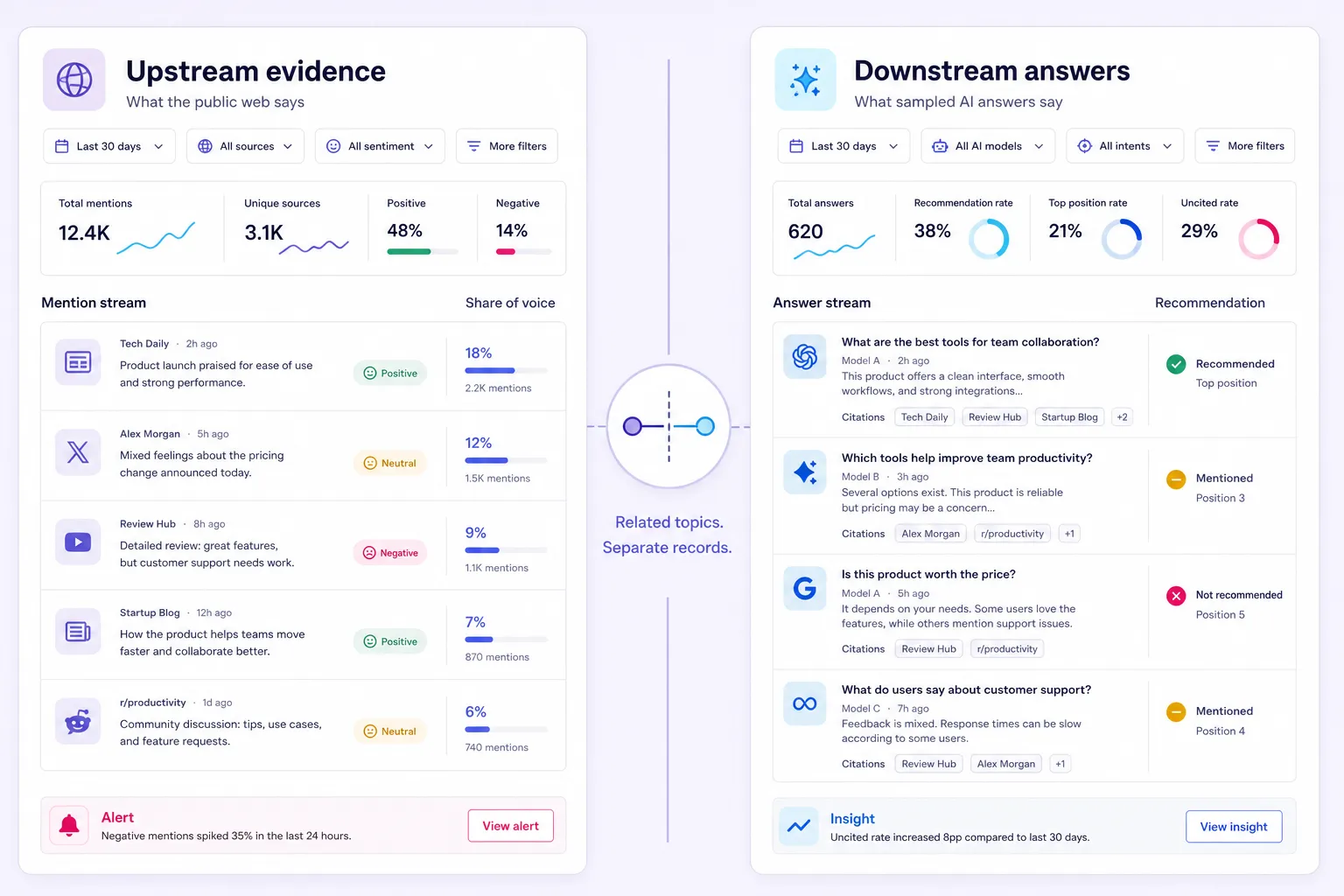
Monitoring AI brand visibility requires two separate records - an upstream record of what the public web says about the brand, and a downstream record of what sampled AI answers say - because the two diagnose different problems and justify different budgets. What follows is a measurement framework, not a procedure. Its purpose is to identify which constraint is actually binding, because different failure modes call for different interventions and budgets.
Keep Two Records, Separately
The upstream evidence record describes what the public web says. It is useful only if each entry captures the entity (which organisation, product, or location the mention concerns), the source and authorship (independent, owned, submitted, or syndicated), the claim itself, the surrounding context (use case, comparison, customer type, limitation), the publication and observation dates, and both sentiment and factual accuracy.
A sentiment score should never replace the underlying statement, because "expensive" can be a complaint, a neutral positioning note, or part of a favourable value comparison.
Share of voice requires a stated denominator: share of collected mentions, share of category conversation, and share of positive recommendations are three different metrics with three different meanings.
This is the record that makes tracking mentions across the web an analytical activity rather than a collection activity. Within a programme like this, BrandMentions fits the specific job of maintaining that upstream record continuously (mention discovery, sentiment trajectory, and competitive share of voice across third-party web and social sources) with alerting when a new thread, review, or article changes the evidence set - the workflow covered by BrandMentions brand monitoring and real-time mention alerts. What it cannot do, and what no monitoring product can do, is show which of those sources an engine retrieved.
The downstream answer record describes sampled AI outputs, with four metrics kept distinct: mention rate (share of eligible responses naming the brand), recommendation rate (share presenting it positively as suitable, under a written classification rule), owned-domain citation rate, and representation accuracy (whether the answer describes capabilities, limitations, availability, and identity correctly). These are reporting definitions, not standardised platform metrics, and every result should carry its engine, surface, prompt set, location, and collection date.
For auditing ChatGPT visibility, the separation of category prompts, comparison prompts, and named-brand prompts matters more than sample size. An average across all three conceals exactly where discovery fails.
Diagnose the Constraint Before Spending
| Failure mode | Symptom | Primary response |
|---|---|---|
| Access failure | Blocked crawler, unindexed page, aggressive snippet restriction | Technical configuration fix |
| Evidence failure | Accessible pages that say nothing about the buyer's constraint | Content and documentation |
| Identity failure | Product confused with parent company, or with a same-name business | Clearer public entity information |
| Awareness failure | Brand rarely enters category discovery at all | Earned coverage |
| Citation failure | Pages get cited while the product stays off the shortlist | Product-fit evidence, not more PR |
| Reputation failure | Recommendations accurately reflect recurring complaints | Product or service remediation |
| Concentration risk | A large share of AI-relevant evidence depends on one source category | Source diversification |
Access failure versus evidence failure. A blocked crawler, an unindexed page, or an aggressive snippet restriction is a configuration fix. An accessible page that lacks any information relevant to the buyer's constraint is a content problem, and no amount of crawl hygiene will solve it.
Identity failure versus awareness failure. Confusion between a product and its parent company, or between two businesses sharing a name, is an attribution problem solved with clearer public information. Rarely entering category discovery at all is a presence problem solved with earned coverage.
Citation failure versus recommendation failure. A useful research page can attract citations while the company's product remains unsuitable for the tested use case. Only one of those is a marketing problem.
Reputation failure versus retrieval failure. If a recommendation accurately reflects recurring customer complaints, the product or service issue outranks anything that can be done to the evidence.
Concentration risk. If a large share of a brand's AI-relevant evidence sits in a single source category, the 2025 source collapse is the reference case for what happens next. Diversification across community, editorial, review, video, and reference sources is the hedge, and it is the only defence available against reweighting.
Platform Reporting Is Improving, and It Is Still a Different Layer
Google announced new generative-AI Search controls and Search Console insights in June 2026, and its August 31, 2026 update on new controls for website owners states that these had rolled out worldwide, including impressions and country information for pages appearing in AI responses, with the opt-out control separating participation in generative AI features from ranking outside them. That retires the older claim that no AI-specific reporting exists.
It does not make publisher reporting equivalent to brand-recommendation measurement. A page impression inside an AI response is not a positive recommendation of the publisher's business.
Connect Visibility to Outcomes, Carefully
Mention rate, citation rate, sentiment, and share of voice are diagnostic metrics. They are not demonstrated substitutes for qualified consideration, pipeline, or revenue, and no published research establishes a conversion rate from AI recommendation to purchase across categories. The defensible attribution approach combines three imperfect sources: self-reported attribution at the point of enquiry ("where did you first hear about us"), referral and assisted-conversion data from AI surfaces where it is available, and category-level correlation between recommendation share and branded demand over quarters rather than weeks.
Treat a rise in recommendation rate as a leading indicator to be validated, not as revenue already earned.
Frequently Asked Questions About AI Brand Recommendations
What Are the AI Ranking Factors for Brands?
There are no published ranking factors with weights, but five signal families explain most of the observed variation: technical eligibility (can your evidence enter the system at all), query relevance (does it answer the buyer's actual decision), entity clarity (does it resolve to the right company, product, version, or location), evidential credibility (does the claim deserve acceptance, and who stands behind it), and content usability (does the evidence survive extraction intact). No platform publishes a weighting for any of them, so any list that assigns percentages such as "40% authority, 30% mentions" has performed arithmetic on descriptive data.
Does Schema Markup Make AI Engines Recommend a Brand?
No. Google states that its AI features have no additional technical requirements and need no special AI-specific schema, and that structured data must match visible page content. Structured data can help search systems understand information on a page, but there is no documented evidence that adding schema directly increases the probability that an AI engine will recommend a brand. Teams with complete Organization, Product, and FAQ markup and no AI recommendations are not looking at a markup problem.
Does Ranking Well in Google Help a Brand Get Recommended by AI?
For Google's own AI surfaces, yes, indirectly, because indexed and snippet-eligible pages are the documented baseline and AI Overviews draw heavily on domains Search already surfaces. Across engines the relationship is weaker and mostly associative: one 2026 retrieval study reported a 43.2% citation rate for pages ranked first in Google within ChatGPT retrieval, which is an association rather than proof that Google position is a direct ChatGPT signal. Claude and Perplexity build their own retrieval independently of Google's assessment, so a strong Google position is a proxy at best there.
What Is the Difference Between an AI Mention and an AI Citation?
A mention is the brand's name appearing in the generated answer text; a citation is a displayed source link the answer points to for support. They coincide far less often than most reporting assumes: only 23.1% of tracked brand mentions coincided with a citation to the brand's own domain in a 12,000-response study, falling to 7.2% for open-ended category prompts. A citation also does not endorse the publisher or prove that source caused the recommendation, which is why mentions, owned-domain citations, and recommendations must be reported as three separate metrics with three stated denominators.
Does Blocking GPTBot Stop ChatGPT From Recommending My Brand?
No. OpenAI documents GPTBot as the crawler for content that may be used for model training, while OAI-SearchBot governs inclusion in ChatGPT search and ChatGPT-User handles certain user-initiated fetches, so blocking a training crawler is not the same decision as blocking a search crawler. Blocking also only closes one route to one set of pages: third-party pages describing the brand remain fully usable, and source-tracing of one engine found that just 37.4% of recommended brands had any of their own pages delivered to the model. The defensible statement is narrow: a blocked page cannot contribute through the blocked route.
Do Reddit Mentions Help Brands Get Recommended by AI?
Sometimes, and it depends on the question type rather than on domain favouritism. Community threads are strong evidence for experiential questions (setup difficulty, support quality, workflow compromises) and weak evidence for specification questions, so their value varies by prompt. They are also volatile: Reddit citations fell from appearing in roughly 60% of ChatGPT responses to around 10% over a 13-week window in 2025 while holding far steadier on AI Mode and Perplexity, which is the clearest available argument for diversifying evidence across community, editorial, review, video, and reference sources rather than concentrating on one.
Why Does ChatGPT Recommend Different Brands Each Time?
Because retrieval, model version, product configuration, and personalization all move between runs, so a single answer is one draw from a distribution rather than a fixed ranking. A 2026 stability study measured the same top brand reappearing on repeated identical prompts 78% to 87% of the time with live search disabled, falling to roughly 48% to 68% with web retrieval enabled, and found unanimous cross-engine agreement on the top brand in only 27% of the questions tested (sample: 26 buyer questions). Practical implication: report distributions across repeated runs with the engine, surface, prompt set, location, and date attached, never a single observation.
Is AI Really 30 Times More Selective Than Google?
That ratio applies to one specific comparison: ChatGPT recommending 1.2% of brand locations against a 35.9% Google local 3-Pack appearance rate in a 2026 local-visibility benchmark of more than 350,000 locations. In the same dataset Gemini recommended 11% and Perplexity 7.4%, and on ecommerce queries one engine includes a brand in over 99% of responses. Selectivity is a property of the engine, surface, and query class together, not a universal multiplier.
Can a Brand Be Recommended Without Its Own Website Being Cited?
Yes. In the commercial-discovery datasets reviewed here, brands were frequently mentioned or recommended without a citation to their own domain. Only 23.1% of tracked brand mentions coincided with a citation to the brand's own domain in a 12,000-response study, dropping to 7.2% for open-ended category prompts, and source-tracing of one engine found that just 37.4% of recommended brands had any of their own pages delivered to the model. Recommendations are typically assembled from what third parties say, which is why mentions, recommendations, and owned-domain citations must be reported as three separate metrics.
How Can I Get My Brand Recommended by AI Search Engines?
Work the five signal families in order: confirm crawler access and index eligibility per bot, publish constraint-specific documentation that survives quoting, resolve entity ambiguity across organisation, product, version, and location, earn useful independent comparison and review coverage in formats that frequently appear in AI discovery datasets, diversify across source categories, and measure with repeated-prompt panels per engine. The 7-step checklist above maps each step to the failure mode it fixes, so the diagnosis comes before the spend.
What This Means for Your AI Visibility Strategy
The next real advance in this field will be attribution, not another universal ranking formula.
The mechanism described here is stable even though its parameters are not. Retrieval, evidence assessment, and synthesis provide a useful framework for understanding today's search-grounded AI answers, even as implementations and product architectures continue to change. What will keep moving is the index behind retrieval, the weight assigned to each source class, the filtering applied before synthesis, and the number of brands an engine is willing to commit to per answer. Personalization will make that harder to measure, not easier, because the answer a buyer receives will increasingly depend on their own history as well as on the evidence available.
Three developments are worth watching over the next cycle. Publisher-side reporting is expanding, which for the first time gives brands platform-sourced data about their presence in AI responses rather than only sampled prompts. Independent retrieval stacks are diverging, which means AI visibility will continue to be a set of engine-specific numbers rather than one score. And the growth of synthetic third-party content will push engines toward evidence that is expensive to fabricate, which favours verifiable documentation, verified customer experience, and sources with editorial accountability over volume.
For marketers, the durable lesson is narrower than “build trust” and more useful than chasing a universal AI ranking formula. Improve the information that AI systems can encounter about your brand: make first-party facts accurate and accessible, build clear entity signals, earn credible third-party coverage, monitor reviews and discussion, and measure the answers AI engines actually produce. The platforms, retrieval systems, and source mixes will continue to change. The goal is to make the evidence about your brand accurate, relevant, specific, and easy to support wherever an AI system encounters it.
Filed under: AI Visibility & SEO



4 comments