How to Find and Fix Wrong AI Information About Your Brand
A definitive, evidence-based process for auditing how ChatGPT, Gemini, Claude and Perplexity describe your brand, measuring recurrence, severity and likely source instead of reacting to a single sc…

To check whether AI is giving wrong information about your brand, test what ChatGPT, Gemini, Claude, and Perplexity say about your business, compare their answers against verified company information, and document any inaccuracies. Repeat important questions to see whether mistakes recur, investigate the sources behind them, and correct outdated or misleading information where possible.
In this guide, you'll learn two ways to check your brand's AI accuracy:
- A quick 15–30 minute check to identify obvious inaccuracies about your business.
- A comprehensive AI brand accuracy audit to measure recurring errors, investigate their possible causes, and track improvements.
You'll also learn what to do when AI gets your company wrong, which information sources to correct, and how brand monitoring can help you identify outdated or misleading information across the web.
AI-generated misinformation can affect how potential customers understand your products, pricing, reputation, and credibility. A false statement that your product is enterprise-only, for example, could discourage smaller businesses from considering it.
The challenge is that AI assistants don't always provide the same answer. A mistake might appear once, repeatedly, or only under particular search conditions. That's why checking a single ChatGPT response isn't enough to understand the scale of the problem.
At a Glance: How to Check and Correct AI Misinformation About Your Brand
| What to do | Why it matters |
|---|---|
| Check ChatGPT, Gemini, Claude, and Perplexity | Different AI assistants may describe your brand differently |
| Ask questions your customers would ask | Real buying questions reveal commercially important mistakes |
| Compare answers with verified business facts | You need an authoritative reference to identify inaccuracies |
| Record false or outdated claims | Documentation helps you investigate and prioritize errors |
| Repeat important questions | One response doesn't establish how widespread a mistake is |
| Investigate cited and potentially outdated sources | Incorrect web information may contribute to misleading AI answers |
| Correct the information you control | Accurate, consistent sources improve the information available to AI systems |
| Retest and monitor changes | Corrections don't guarantee that AI-generated answers will immediately change |
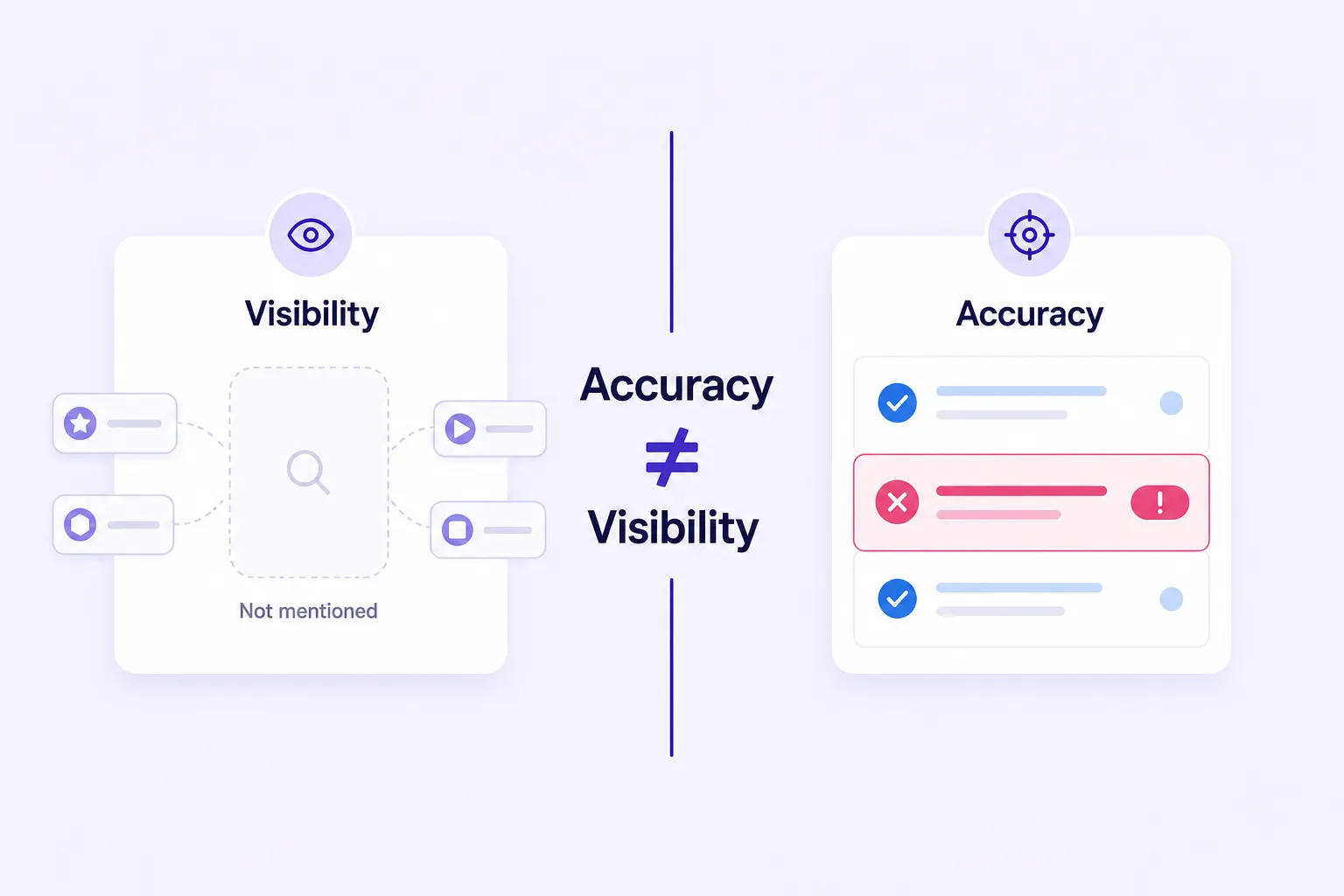
The key distinction: AI visibility measures whether your brand appears in AI answers. AI accuracy measures whether the information provided about your brand is correct. A company can be highly visible and still be described inaccurately.
How Is AI Misrepresentation Different From Poor AI Visibility?
AI brand misrepresentation occurs when an AI assistant provides false, outdated, misleading, or confused information about a company. For example, ChatGPT might claim that a software product costs $299 per month when its actual entry plan starts at $49.
AI brand visibility refers to whether and how often AI assistants mention, recommend, or cite a company in their responses.
The distinction matters because these are different problems. If ChatGPT recommends three competitors but never mentions your business, you have a visibility problem. If it mentions your business but describes its pricing or features incorrectly, you have an accuracy problem.
Keep these separate, because the fixes are opposite. If AI recommends three competitors and skips you, that is a gap in presence, and it belongs in a brand missing from AI workflow, not this one. If AI names you but states something false, that is misrepresentation, and it starts with proof and source tracing.
An accurate negative review isn't misinformation, and a subjective opinion isn't automatically a factual error. Unsupported claims should be investigated, but shouldn't be classified as false without sufficient evidence.
A brand not mentioned is a visibility problem. A brand described wrongly is an accuracy problem. Never fix one while believing you solved the other.
Here is the decision rule that saves the most time. If a claim is true, documented, and fairly framed, it is not misrepresentation, even when it hurts. If it is wrong, outdated, misleading, or unsupported, it is misrepresentation, even when it flatters you.
How to Check What AI Says About Your Brand in 15–30 Minutes
You don't need expensive software or a complicated testing setup to discover whether AI is sharing incorrect information about your business. Start with a simple manual check using four popular AI assistants.
This quick check is designed to identify potential problems. It won't tell you how frequently those problems occur across all users, but it will help you decide what needs further investigation.
Step 1: Open four AI assistants
Check your brand in:
- ChatGPT
- Google Gemini
- Claude
- Perplexity
Start a fresh conversation in each tool. Where available, use settings that minimize personalization, and note whether web search is enabled.
Using different platforms matters because their answers, retrieved sources, and available information can differ.
Step 2: Ask five important questions about your business
Use the same questions across the four platforms, replacing [Brand Name] with your company's name.
| Question to ask AI | What you're checking |
|---|---|
| What does [Brand Name] do? | Company description and positioning |
| How much does [Brand Name] cost? | Pricing, plans, and billing |
| Who is [Brand Name] best suited for? | Target audience and use cases |
| What features or services does [Brand Name] offer? | Product capabilities and limitations |
| Is [Brand Name] a trustworthy company? What evidence supports that assessment? | Reputation claims, reviews, and factual support |
If pricing isn't relevant to your business, replace that question with one about your location, service area, or product availability.
Step 3: Compare AI answers with your official information
Open your company's website, pricing page, product documentation, and other authoritative records.
Look for discrepancies involving:
- Incorrect product prices or subscription plans
- Features or services your company doesn't offer
- Outdated company names, locations, or executives
- Incorrect descriptions of your target customers
- Confusion with similarly named businesses
- Unsupported claims about your reputation or certifications
For example, if ChatGPT says your software starts at $299 per month but your official pricing page lists a $49 entry plan, you've identified a factual discrepancy worth investigating.
Not every negative statement is misinformation. An accurate summary of real customer complaints is different from a fabricated factual claim.
Step 4: Record what you find
Create a simple spreadsheet with the following information:
| AI tool | Question | AI claim | Correct information | Status |
|---|---|---|---|---|
| ChatGPT | How much does [brand] cost? | Starts at $299/month | Starts at $49/month | Incorrect |
| Gemini | Who uses [brand] ? | Enterprise customers only | SMBs and enterprises | Incorrect |
| Claude | Where is [brand] based ? | Chicago | Chicago | Correct |
| Perplexity | Does [brand] offer an API? | No public API | Public API available | Incorrect |
Illustrative example using a fictional company.
Save the response, date, and cited sources where available. These records will be useful if you decide to conduct a more detailed audit.
Step 5: Decide which mistakes need attention
Prioritize inaccuracies that could influence a potential customer's decision.
Incorrect pricing, missing product capabilities, false security certifications, or statements that your product doesn't support a particular audience deserve more attention than minor differences in wording.
If you discover a significant mistake, repeat the same question in fresh conversations over several days and document the results.
What this quick check tells you: Whether you can reproduce potentially inaccurate information about your business under the conditions tested.
What it doesn't tell you: How often all AI users encounter that misinformation, how much revenue it affects, or which source caused the mistake.
For those questions, you need a more structured AI brand accuracy audit.
Why Do Four AI Tools Give Four Different Answers?
AI assistants generate responses using different models, retrieval processes, and contextual information. Even when given identical questions, their answers may vary across platforms, sessions, and dates. Same prompt, same day, same account can still produce different wording, different claims, and different citations. The Tow Center observed ChatGPT returning a different answer when asked the same question twice. SparkToro's experiment across 2,961 prompts found near zero repeatability in brand lists, and Yext found four engines agreeing on a single top local business only 4 percent of the time.
Real-world conditions multiply that variance. Answers shift with the platform and model version, logged-in versus logged-out state, memory and personalization settings, prior conversation context, whether search mode is on, prompt wording, geography, language, and the date. That is why the first thing you write next to every run is the condition it was produced under.
This is also why audits must span more than one engine. Similarweb measured ChatGPT's share of generative AI web traffic falling from roughly 76 percent in June 2025 to around 53 percent by May 2026, with Gemini climbing toward 27 to 28 percent and Claude approaching 9 percent. Your buyers are spread across at least three large engines plus Perplexity. A single-engine audit is already out of date.
How to Fix Wrong Information About Your Brand in ChatGPT and Other AI Tools
If ChatGPT, Gemini, Claude, or Perplexity provides inaccurate information about your company, start by identifying the specific false claim and the evidence that contradicts it. Then investigate whether the error appears in web sources, company information, or other material the AI assistant may have used.
There is no universal correction button that immediately changes every AI-generated answer. However, businesses can take practical steps to improve the accuracy of the information available to AI systems.
1. Identify exactly what AI got wrong
Copy the incorrect statement and compare it with an authoritative source.
For example:
- AI says: "Acme Analytics is an enterprise-only platform starting at $499 per month."
- Correct information: "Acme Analytics offers plans starting at $49 per month and serves small businesses as well as enterprise customers."
- Evidence: The company's current pricing and product pages.
Separating the inaccurate statement from the rest of the AI response is important. An answer may contain several correct facts alongside one misleading claim.
2. Check which sources the AI cited
When an AI assistant provides links or citations, open them and verify whether they actually support the statement.
If ChatGPT cites a comparison article published three years ago, for example, the information may no longer reflect your current pricing.
Remember that an AI citation doesn't necessarily prove where an error originated. It identifies a source worth investigating, not a confirmed cause.
If no citations appear, search the incorrect wording online and look for outdated or conflicting information.
3. Correct inaccurate information on your own website
Start with sources your company controls:
- Product and service pages
- Pricing pages
- About and leadership pages
- Documentation and help centers
- Old blog posts
- Public company profiles
- Structured data describing your organization and products
Make sure important facts are current, explicit, and consistent.
For example, if your pricing changed from $299 to $49, don't update only the main pricing page while leaving the old amount in your FAQs, product documentation, and archived comparisons.
Correct outdated content where appropriate, and ensure redirects and canonical URLs point to the intended current pages.
4. Request corrections from third-party websites
AI assistants may retrieve information from review platforms, directories, news articles, comparison websites, and other external sources.
If these websites contain inaccurate facts about your company, contact the publisher or use the platform's official profile-update or correction process.
Include the incorrect claim, the accurate information, and an authoritative source supporting your correction.
Focus on factual inaccuracies rather than attempting to remove legitimate criticism or negative reviews.
5. Report the incorrect answer to the AI provider
Use the available feedback or reporting feature in the AI assistant.
Where supported, provide:
- The exact prompt
- The inaccurate response
- The correct factual information
- A reliable source supporting the correction
- The date and relevant testing conditions
Platform feedback can help flag a problem, but it doesn't guarantee that the AI assistant will update future answers.
6. Retest after making corrections
Repeat the original question under comparable conditions.
Record whether the error still appears and whether the assistant now gives the correct information.
Don't assume that a single accurate response means the problem has disappeared. Likewise, a correction to a webpage may not immediately affect information stored in a model or retrieved from other sources.
For important errors, test across multiple sessions and dates.
7. Monitor for recurring misinformation
Even after you've corrected outdated information, similar claims may reappear from old articles, replicated directory listings, or other sources.
Monitor relevant brand mentions across the web to identify factual discrepancies that may require investigation. Separately, repeat your AI-answer tests to check whether the original inaccuracies persist.
The goal isn't to control every AI answer about your brand. It's to make accurate, verifiable information easier to find, identify recurring misinformation, and measure whether your corrective actions are associated with improvements.
What Should You Do for Different Types of AI Brand Misinformation?
Different inaccuracies require different corrections. Use this table to decide where to investigate first.
| AI mistake | What to check first | Recommended action |
|---|---|---|
| Incorrect pricing | Official pricing pages, old reviews, directories | Update outdated pricing and request third-party corrections |
| Nonexistent product feature | Product pages, documentation, comparisons | Clarify supported features and correct inaccurate descriptions |
| Wrong company location | Business profiles, official website, company records | Update company information and relevant public listings |
| Confusion with another business | Company name, profiles, entity identifiers | Strengthen consistent brand identifiers and official profile links |
| False certification claim | Certification records, trust pages, directories | Correct unsupported claims and provide authoritative documentation |
| Outdated executive information | Leadership pages, company announcements, profiles | Update official and third-party information |
| Unsupported negative claim | Reviews, publisher sources, cited evidence | Investigate the basis of the claim and request factual corrections where justified |
| Brand not mentioned at all | Category relevance and AI visibility | Conduct an AI visibility audit rather than a misinformation correction |
Important: These are starting points for investigation. They don't establish which source caused an AI-generated mistake or guarantee that correcting the source will change future answers.
What Kind of Wrong Information Can AI Give About Your Brand?
When you can name the failure, you fix the right thing. Each mode gets a different remedy.
| Failure mode | What it looks like | Example |
|---|---|---|
| Fabrication | A feature, office, partnership, award, or certification that never existed | "SOC 2 certified" when it is not |
| Outdated information | Once true, now false, usually from an old page nobody retired | A 2023 price quoted as current |
| Entity confusion | Another company's facts attached to your name | Your software described with a similarly named rival's acquisition history |
| Attribute distortion | Pricing, audience, geography, or positioning stated wrong | "Enterprise only" for a mid-market tool |
| Misleading omission | Technically true details that create a false impression | "Founded in 2019" with no mention of the 2024 acquisition that changed ownership |
| Unsupported evaluative claim | A judgment presented as fact with no cited basis | "Known for poor support," no source attached |
| Citation mismatch | The cited page does not support the claim | A pricing claim cited to a homepage with no pricing |
| False comparison | A competitor difference stated backward | "Unlike X, we charge per seat" when the opposite is true |
| Regional or language inconsistency | Materially different answers across markets | Accurate US description, fabricated German one |
Two cautions before you start hunting. First, do not call every incorrect answer a hallucination. Much of what you will find is outdated truth or entity confusion, which has an identifiable origin and a different fix. AIMCLEAR's May 2026 brand distortion audit traced six of seven distortions to real pages the models degraded, not to invented sources, which is the common pattern.
Second, grading the answer is not the first step. Defining what the answer should say is.
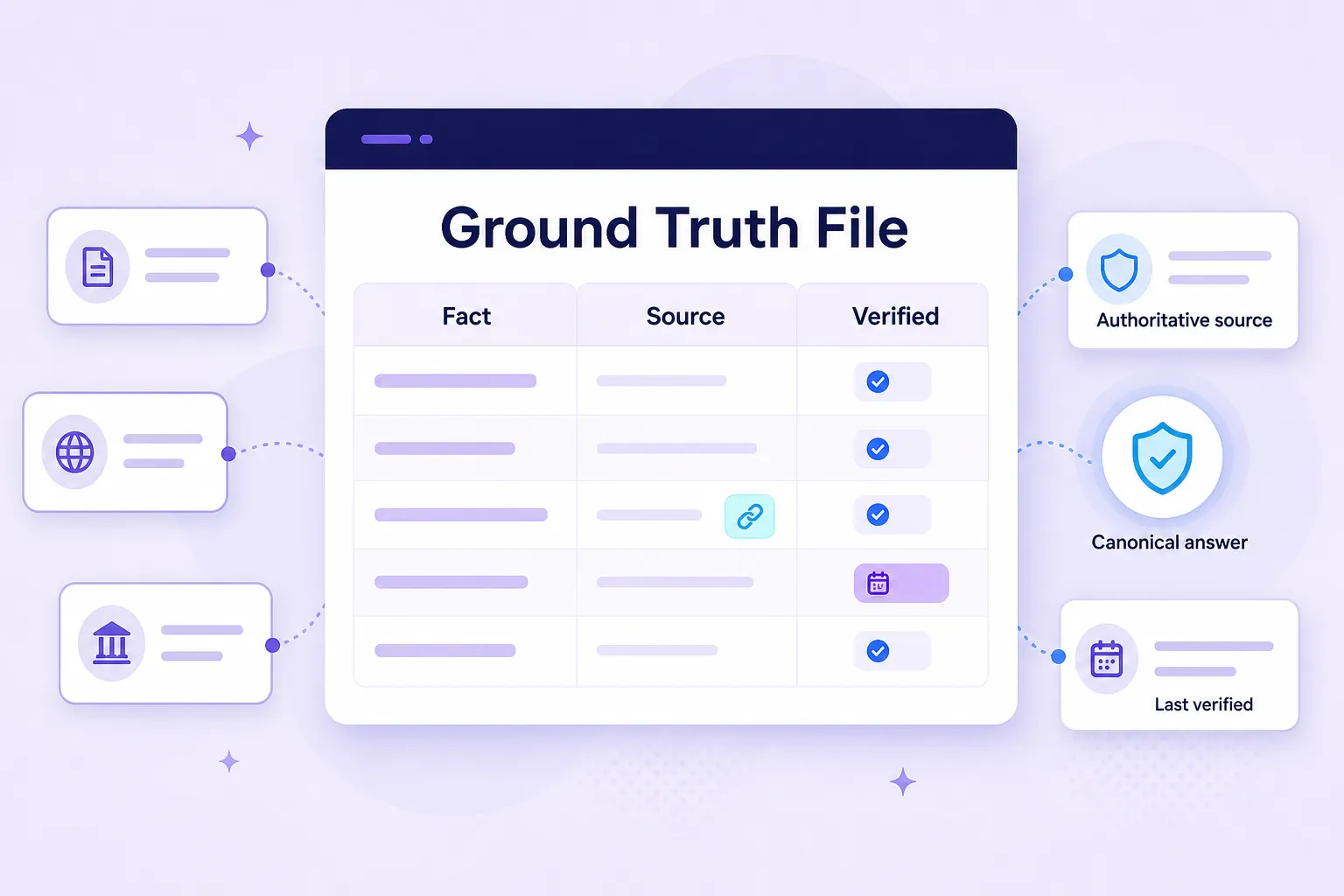
A quick AI brand check can reveal obvious mistakes, but a comprehensive audit helps teams investigate recurring errors, compare results across AI assistants, and prioritize corrective actions.
A structured audit involves building a verified company information reference, testing realistic customer questions, evaluating individual claims, recording recurrence, and investigating potential information sources.
The following process is designed for marketing, PR, SEO, and brand management teams that need more detailed evidence than a one-time manual check.
Step 1: Build Your Brand Ground Truth File First
You cannot audit AI accuracy without first defining ground truth. This is where rushed audits fall apart. If you do not know the canonical answer, you cannot label an AI answer wrong.
Create one document. For each fact, record the canonical answer, the authoritative source, and the date you last verified it. Treat it like the reference layer of any serious brand audit process, because that is exactly what it is.
| Field | Canonical answer | Authoritative source | Last verified |
|---|---|---|---|
| Name and aliases | Legal name, trading name, common variants | Registry filing, style guide | Oct 2026 |
| Products and services | Current lineup, items marked discontinued | Product pages, changelog | Oct 2026 |
| Pricing model | Entry price, tiers, billing | Live pricing page | Oct 2026 |
| Target customers | Segment, size, role, use case | ICP statement, case studies | Oct 2026 |
| Markets served | Countries, regions, limitations | Terms, ops records | Oct 2026 |
| Executives | Current leadership only | Leadership page, filings | Oct 2026 |
| Founding and acquisitions | Dates, parent company | Press releases, filings | Oct 2026 |
| Integrations and features | What exists today, beta flagged | Integration directory, docs | Oct 2026 |
| Certifications | Current compliance | Audit certificates | Oct 2026 |
| Discontinued products | Retired items with dates | Changelog, sunset notices | Oct 2026 |
| Positioning | Approved short description | Messaging docs | Oct 2026 |
| Negative boundaries | What you are not, do not sell, do not serve | Positioning doc | Oct 2026 |
Three rules make the file usable. One canonical answer per row, no hedging. If internal teams cannot agree on pricing or positioning, resolve it now, because AI will surface the unresolved version. Cite the most authoritative source, not the most convenient one: a registry filing beats your About page. And date everything, because an undated fact is a rumor with formatting.
The "negative boundaries" row is the one most teams skip and the one that catches the most distortions. It is far easier to spot "serves enterprise only" as wrong when your file explicitly states "we do not sell an enterprise-only product."
Ground Truth Before Chat Truth. If your own team cannot state what is true about your pricing, ownership, and audience, you are not ready to grade a model for getting it wrong.
Why One Screenshot Proves Nothing
AI outputs are probabilistic. So stop reporting "ChatGPT says X." Report this instead:
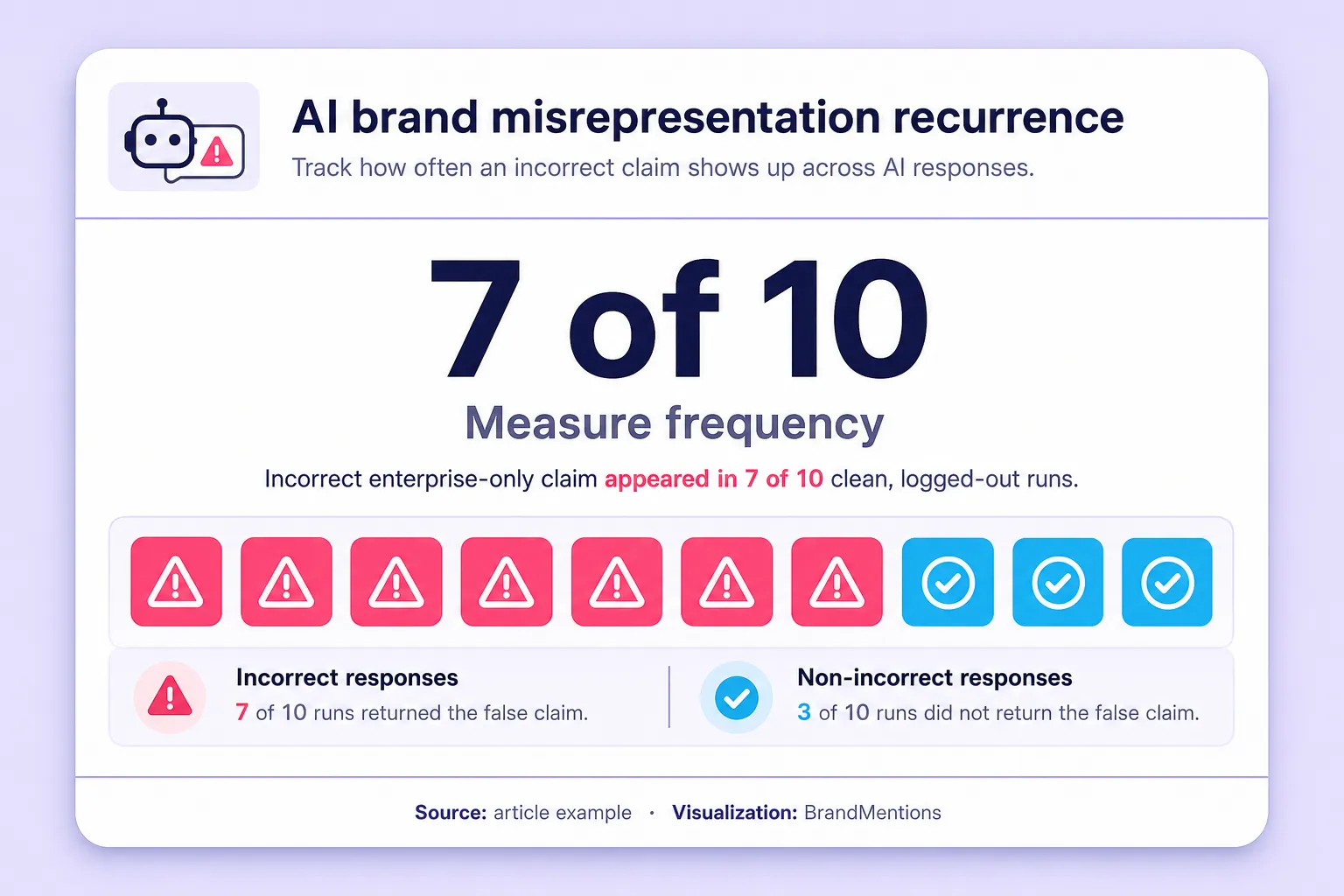
"The incorrect enterprise-only claim appeared in 7 of 10 clean, logged-out runs on ChatGPT and in 3 of 10 on Gemini, tested October 7, 2026."
That sentence is auditable. The screenshot is not.
Measure frequency, not existence.
Here is the metric that anchors your whole report.
Misrepresentation recurrence rate = incorrect responses containing the claim ÷ total responses tested.
Match your sample size to your risk level. These are working conventions, not a statistical standard.
| Audit level | Repeats per prompt per engine | Use when |
|---|---|---|
| Quick scan | 3 | You need to find obvious problems fast |
| Standard audit | 5 | You need a practical marketing or PR readout |
| Evidence audit | 10 | Leadership will make a decision on the data |
| High-risk audit | 20 | Legal, safety, regulated, or major revenue issues |
Spread the runs across three or more days rather than firing ten in one sitting. Day-to-day index refreshes and session variance are part of what you are measuring, and a single-session burst hides that.
Do not oversell small samples. Ten runs is a controlled observation, not a national survey. A difference between 6 of 10 and 7 of 10 sits inside the noise, so do not build a narrative on it. I treat a claim appearing in 3 or more of 10 runs as a recurring pattern worth action, and a single appearance in ten as noise worth watching.
Step 2: Run the Audit Across ChatGPT, Gemini, Claude, and Perplexity
Use a fresh, clean conversation for every run where the platform allows it. For each engine, log the model version, date, search mode, logged-in state, memory setting, and location. Those fields decide whether your runs are comparable.
A note on the rules before you automate anything. Heavy scraping and fleets of fake accounts can violate platform terms of service and privacy settings. Use the official clean-room controls below and a legitimate VPN for geographic testing. Do not build a botnet to save an afternoon.
ChatGPT. Open a temporary chat and choose the unpersonalized option so saved memories and custom instructions stay out, per OpenAI's memory documentation, then run a second set logged out in a browser you do not normally use. Note whether web search is active, because search mode changes the source path entirely. Running this under both personalized and clean conditions is the standard setup for a full ChatGPT visibility audit.
Gemini. Per Google's Gemini Apps memory help, past-chat memory personalizes responses when you are signed in with activity saving on. Signed-out Gemini skips that, which makes it your clean environment. On logged-in tests, record whether memory is toggled on.
Claude. Anthropic's memory guide states that memory is on by default on Free, Pro, and Max plans. Disable it for a single chat from the plus menu before your first message. On paid plans Claude can also search past chats, so a fresh chat is not clean unless memory is off.
Perplexity. The Perplexity Help Center confirms every answer carries numbered citations, which makes it the easiest engine for source tracing. Profile fields such as location and custom instructions still shape responses, so clear them and test with and without a location set.
Build your prompt set from real buying questions, not vanity queries. Design it like a buyer journey, because buyers, journalists, and candidates ask different things.
| Prompt type | Example | What it catches |
|---|---|---|
| Direct brand | "What is Acme Analytics and where is it based?" | Entity confusion, outdated facts |
| Category fit | "Best analytics tools for small ecommerce teams" | Audience and positioning distortion |
| Comparison | "Acme Analytics vs BrightMetrics" | False comparisons |
| Evaluative | "Is Acme Analytics good for agencies?" | Unsupported evaluative claims |
| Pricing | "How much does Acme Analytics cost?" | Pricing distortion, highest intent |
| Trust | "Is Acme a reliable, secure vendor?" | Fabricated certifications, reputation claims |
Non-obvious insight: your most important misrepresentation prompt may not contain your brand name at all. Buyers ask category questions ("best payroll software for startups") before they know you exist. A wrong price inside a category answer sits closer to revenue than a wrong founding year in a direct brand answer.
Use 20 to 50 prompts for a serious first audit, 10 for a fast executive readout, and keep the wording identical across runs. Change one word and you are testing a new prompt, so log it as one.
Step 3: Break Every Answer Into Atomic Claims
Do not grade a paragraph as simply right or wrong. One answer is many claims, and they rarely share a verdict.
Take "Company X is a US-based enterprise platform founded in 2015." That is four claims: location, category, target market, founding year. Three can be correct and one dead wrong, and a paragraph-level grade buries the one that matters. The professional version of this method shows its value: in AIMCLEAR's audit, extracting thousands of brand-authored claims and scoring them one by one is exactly what separated a single pure fabrication from errors caused by degraded real sources, and those two findings led to completely different fixes.
Classify each individual claim using one of these statuses:
- Verified correct: The claim is supported by reliable, current evidence.
- Verified incorrect: The claim contradicts authoritative information.
- Outdated: The claim was previously accurate but is no longer true.
- Unverified or unsupported: Available evidence is insufficient to confirm or refute the claim.
- Subjective or evaluative: The statement expresses an assessment or opinion rather than a directly verifiable fact.
Non-obvious insight: overcorrecting is a real risk. When a team hears "the answer is wrong," the instinct is to rewrite every page the claim touched. But if three claims in one answer are correct, your goal is to keep those stable while fixing the fourth. Stripping accurate mentions is the self-inflicted version of this problem.
Step 4: Measure Visibility, Accuracy, and Narrative Separately
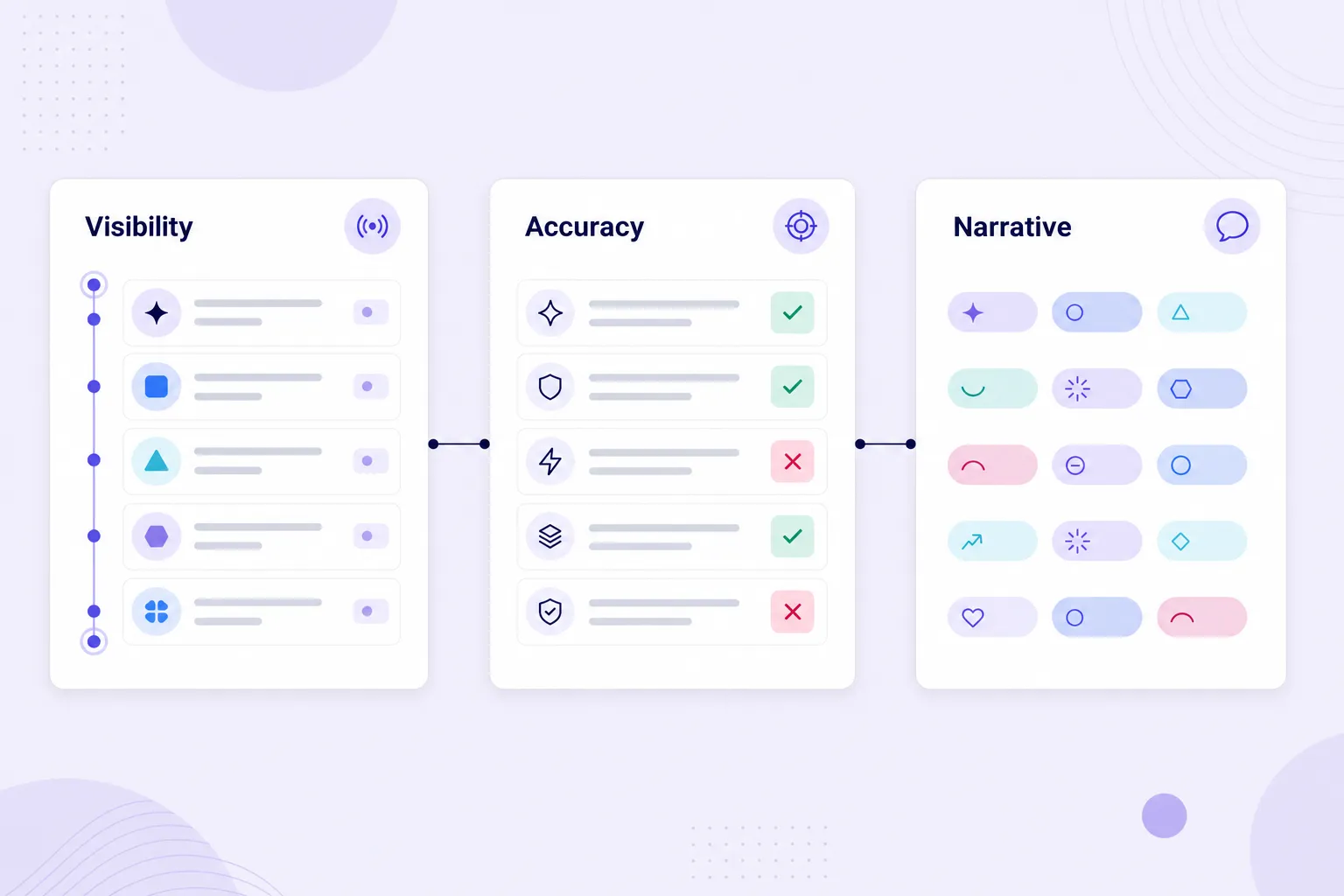
Three scorecards, never one. Blend them and you misdiagnose the problem.
Visibility answers "does AI mention or recommend you?" Track mention rate (responses mentioning the brand divided by total responses), recommendation rate, and share of voice. For the mechanics behind those numbers, how AI recommends brands explains the retrieval and ranking behavior you are measuring.
Accuracy answers "are the claims true?" Track factual error rate (wrong atomic claims divided by total atomic claims), response error rate (responses with at least one wrong claim divided by total responses), and the recurrence rate of each specific false claim. This is the heart of the misrepresentation audit.
Narrative answers "what overall impression does the pattern create?" Collect every evaluative phrase AI attaches to you across runs: expensive, enterprise-focused, beginner-friendly, complex, unreliable. Then run a brand sentiment analysis pass on that phrase list to see which impressions cluster. A brand can be described with zero false facts and still land a damaging impression through selective emphasis. That is a narrative problem, and no fact correction will move it.
Visibility versus accuracy: the core difference in execution. A brand can hit 90 percent visibility with a 30 percent error rate, which means the wrong story travels fast. Different owners, different budgets, different fixes. Report them as separate numbers or the meeting will be about the wrong one.
When Is a Negative Answer Not Misinformation?
Test it with one question: can the negative claim be traced to a real, current, fairly read source? If yes, it is reputation feedback, and you handle it through product, support, or PR, not a fact correction. If no, it is an unsupported evaluative claim, and it goes into the accuracy column and the severity score like any other error.
Step 5: Score Severity Before You React
Not every inaccurate AI statement presents the same level of business risk. A wrong pricing claim appearing in a purchasing comparison may deserve more attention than an incorrect founding date in a rarely asked question.
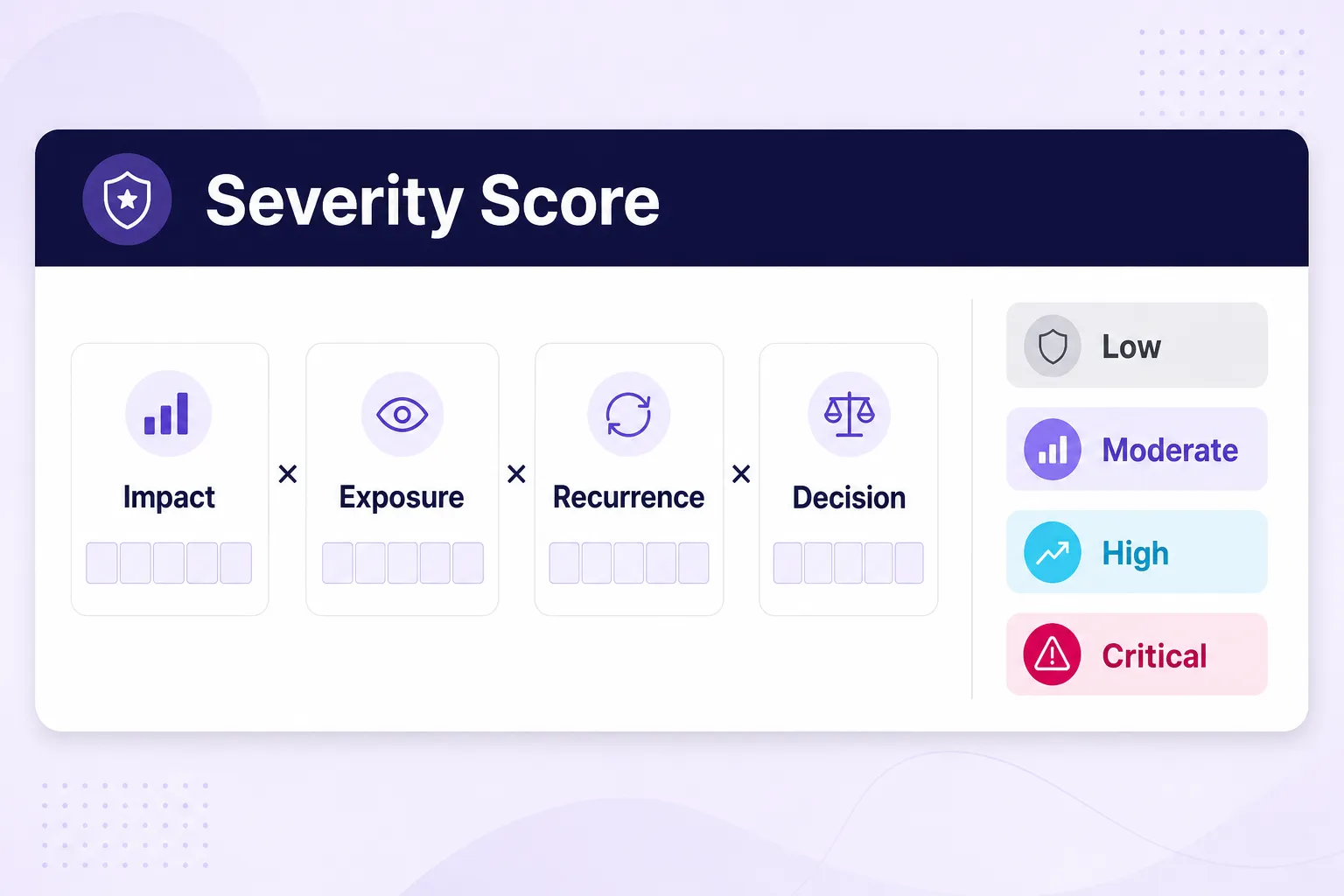
For teams that need a structured prioritization method, the following illustrative scoring model considers four factors: factual impact, likely audience exposure, observed recurrence, and proximity to a purchase or other important decision.
This is an internal prioritization framework, not an independently validated industry standard.
Severity = factual impact × audience exposure × recurrence × decision proximity.
Score each factor 1 to 5 and multiply, for a range of 1 to 625.
| Score | Factual impact | Audience exposure | Recurrence | Decision proximity |
|---|---|---|---|---|
| 1 | Cosmetic detail | Rare niche prompt | 1 of 10 runs | Trivia question |
| 3 | One attribute distorted | Common comparison prompt | 3 to 4 of 10 | Shortlist stage |
| 5 | Changes what the company is | Top brand question on the largest engines | 8 to 10 of 10 | Purchase, legal, or compliance decision |
Classification bands, which are a prioritization convention and not an industry standard: Low 1 to 24, Moderate 25 to 124, High 125 to 374, Critical 375 to 625. The math is deliberate. These scoring bands are suggested categories for internal prioritization. Teams should adjust them to their business risks rather than treating them as universal thresholds.
Decision proximity is the factor most audits forget, and it is the one that moves money. An error that surfaces during "Brand X vs Competitor" is worth more attention than a dramatic falsehood buried in a prompt nobody asks.
Estimating audience exposure is where teams hand-wave. Do not. Combine four inputs into the 1 to 5 score: keyword and search volume for the underlying question, real AI prompt demand (the Semrush AI Visibility Index is built on 126 million real user prompts and is useful for gauging which questions actually get asked), the frequency of the objection in sales calls and support tickets, and what customers tell you in interviews. A claim that shows up in three sales calls a week is a 5 even if its search volume looks modest.
Record source persistence beside each score, because it predicts how hard the fix will be: one weak page, an outdated first-party page, multiple third-party sources, a major publisher, or unclear origin. A wrong claim echoed by ten third-party sites is a harder problem than one living on a single forgotten help article, and the severity number alone does not capture that. Where an error risks real reputational damage, work it through a reputation management guide rather than improvising.
For regulated industries, healthcare, finance, insurance, legal, employment, and education, treat any factual error touching compliance, safety, or eligibility as an automatic factual impact of 5, loop in legal or compliance before you respond, and preserve evidence from the first run.
Fix the error that is wrong, repeated, and close to a buying decision first. A dramatic falsehood nobody sees is a lower priority than a dull one everybody reads.
Step 6: Trace Each Error to Its Likely Source
For anything above your Moderate band, work the trace in order.
- Inspect every citation the engines attach, and read the page, not the snippet.
- Search the exact wrong phrase in quotation marks, and note where the wording appears verbatim.
- Review your own first-party pages, including help centers, old blogs, and archived versions. Old pages rank for brand queries because they are established, and AI retrieves them happily.
- Check the dates. A 2023 page still showing 2023 pricing is often the entire explanation.
- Inspect review sites, comparison sites, resellers, and directories that mirror your data.
- Look for repeated wording across sources. Identical phrasing across ten sites usually means one original and nine copies, and AI tends to repeat the copy. This is also why AI cites Reddit so often: dense community threads carry claims that outrank your official page for long-tail brand questions.
Now the critical discipline. A citation is a lead, not a confession. The Tow Center's work on how ChatGPT handles publisher content found it returning partially or entirely incorrect responses on 153 of 200 quote-identification tests while acknowledging uncertainty only seven times, with a third of responses carrying incorrect citations. When an engine attaches the wrong URL to the wrong claim, the citation is part of the error, not a map to it.
When investigating an AI-generated mistake, distinguish between three levels of evidence.
Observed evidence: The incorrect claim appeared in repeated tests, and the AI assistant cited a specific webpage.
Possible contributing source: The cited webpage contains the same outdated information, making it a reasonable candidate for investigation.
Evidence of improvement: After updating the webpage, subsequent tests show the mistake appearing less frequently.
Weigh your sources with a consistent ladder, both when you set ground truth and when you judge the studies you cite. Official platform documentation and peer-reviewed research sit at the top, followed by government and legal records, then your own canonical first-party pages, then reputable publishers, then vendor studies (useful, but with a commercial incentive to disclose), then marketing blogs, with forums and anecdotes at the bottom. A vendor's AI-accuracy report is a lead worth reading, not a verdict worth quoting as fact.
The machine-readable layer, kept simple. Many recurring errors live in structured data your team forgets exists. Check that your Organization schema is present and current, that your sameAs links point to your real official profiles, that your Wikidata entry is correct, that your pricing page shows a current date, and that retired pages redirect instead of lingering. Consistent facts across these surfaces are what let an engine resolve your entity cleanly instead of blending it with someone else.
Step 7: Benchmark Against a Fixed Competitor Set
Run identical prompts, under identical conditions, in the same time window, against a locked set of three to five competitors. Change the prompts between brands and your comparison is fiction.
Track four numbers per brand: mention rate, share of voice, factual error rate, and the narrative phrases each one collects. Two patterns emerge that no single-brand audit reveals. Error asymmetry, where your brand carries the wrong claim and competitors do not, usually points at your own source hygiene. The Yext data is the reason you benchmark at all: with the same top business chosen in just 4 percent of cases, "AI prefers my competitor" is almost never a single fixed truth. It is a distribution, and the competitor runs show where you actually sit in it.
Between scheduled rounds, a monitoring layer keeps the comparison alive. BrandMentions helps track brand and competitor mentions across web and social sources, providing additional context about reputation and share of voice. AI-generated answers should still be tested separately to measure how accurately different assistants describe your brand.
Worked Example: One Wrong Claim, End to End
Imagine a fictional software company, Westwind Analytics, discovering that ChatGPT incorrectly describes its subscription plans.
The company's actual entry plan costs $299 per month, but ChatGPT sometimes describes it as starting at $499.
Here's how a marketing team could investigate the problem.
| Audit stage | Finding |
|---|---|
| AI question | "How much does Westwind Analytics cost?" |
| Incorrect answer | "Pricing starts at $499 per month." |
| Verified information | Current entry plan starts at $299 per month |
| Authoritative evidence | Official pricing page |
| Repeated testing | Incorrect price appeared in 7 of 10 ChatGPT responses tested |
| Possible contributing source | Outdated review article showing an old subscription price |
| Business risk | Prospective buyers may incorrectly assume the product is more expensive |
| Corrective action | Update first-party content and request correction of the outdated review |
| Follow-up measurement | Repeat the same prompt under comparable conditions and record whether the error recurs |
This is an illustrative example, not the result of a real-world experiment.
Who Owns This, and Where Do You Escalate?
An audit that nobody owns dies after the first spreadsheet. Assign owners by error type before you start. Product marketing owns the ground truth file and positioning distortions. SEO and content own first-party source corrections and the machine-readable layer. PR and comms own third-party publisher outreach. Legal owns regulated claims and evidence preservation. Customer support and CX own the narrative errors rooted in real complaints. One executive signs off on Critical-band escalations. Tie a response SLA to severity: Critical within 48 hours, High within the current sprint, Moderate into the next content cycle.
Escalation routes differ by recipient, and each wants different evidence:
- Your own pages: you control these, so fix them first.
- Third-party publishers and comparison sites: send a factual correction request with your authoritative source attached. State the claim, the correct fact, and the proof.
- Directories and review platforms (G2, Crunchbase, Capterra, Trustpilot): use their official correction or profile-claim process. Do not pressure them to remove fair criticism.
- AI providers: use in-product feedback (thumbs down, report) and official feedback forms. They generally want the exact prompt, the response, the correct fact, and an authoritative source.
- Wikidata and Wikipedia: correct with properly sourced edits, since these feed entity resolution across engines.
Regional and Language Audits
A global brand can look accurate in English and wrong in German. Treat language divergence as its own failure mode, not a glitch. German-language answers often draw from German-language pages, which may be older or thinner than your English sources, and engines frequently infer location from IP or profile.
Run the prompt set per market with location controls set, and build a short country-specific ground truth file where pricing, availability, or legal terms differ. Translation QA matters: a mistranslated feature name becomes an attribute distortion. Keep a local source inventory per market, and route anything with legal or compliance weight through local review rather than a head-office assumption.
How to Monitor Incorrect Information About Your Brand Over Time
An audit tells you what is wrong now. Monitoring tells you whether the pattern persists, spreads, disappears, or changes after you act.
Manual testing is the right way to establish the methodology and get your first defensible baseline. It does not scale to a living reputation. A claim you fixed in March can resurface in June when a new crawl picks up an old forum thread. Teams over-test in week one and under-test in week twelve, and that is exactly when the quietly resurfacing claim does its damage.
Use a cadence that does not eat a team alive. Baseline over three or more days. Re-test Critical issues weekly until recurrence drops below 2 of 10. Re-run the core prompt library monthly on a fixed day. And run an event-triggered test within 48 hours of any pricing change, acquisition, product retirement, rebrand, or major press cycle, because those are the moments old facts and new facts collide.
Once you are tracking dozens of prompts, four engines, competitor share of voice, shifting narratives, and the sources feeding them, spot checks become dishonest.
Best for continuous web and social mention tracking with multilingual sentiment: BrandMentions. Its published product information describes competitor intelligence, share of voice, and LLM-based sentiment across 12-plus emotion types in 100-plus languages, which is the right fit for keeping recurring AI and web narratives visible between manual test rounds, with alerts when a tracked pattern changes. The audit is the diagnosis. Monitoring is the vital-signs chart. Do not confuse one for the other.
The decision rule: if your audit surfaces a handful of low-severity issues, a quarterly manual re-test is fine. If it surfaces anything in the High or Critical band, or more than a dozen tracked claims, you need continuous monitoring, because those are the problems that move while you are not looking.
Frequently Asked Questions
How can I find out what ChatGPT is saying about my business?
Open ChatGPT and ask questions about your company, including what it does, its pricing, features, target customers, and reputation. Compare the answers with reliable, up-to-date company information. For a more complete assessment, repeat important questions across fresh conversations and document any inaccuracies.
Why is ChatGPT giving incorrect information about my company?
ChatGPT may produce incorrect information because it relies on outdated or conflicting sources, confuses similarly named businesses, generates unsupported details, or interprets available information incorrectly. The specific cause cannot always be determined from the answer alone.
How many times should I test each prompt before trusting the result?
There is no universal number of tests that guarantees a reliable AI brand accuracy assessment. A few repeated questions can help identify recurring mistakes, while higher-stakes investigations may require larger samples across different days and testing conditions. Document the exact prompt, platform, date, and results. If an incorrect claim appears in 7 of 10 tests, report that observation without assuming that 70% of all users encounter the same misinformation.
How can I tell whether an AI-generated statement is false?
Compare the statement against authoritative evidence, such as current product documentation, official pricing, business records, or certification information. Separate demonstrably incorrect facts from subjective assessments and claims that cannot yet be verified.
Is an unfavorable AI answer the same as an inaccurate one?
No. An unfavorable answer can be entirely accurate, such as a faithful summary of real negative reviews or a subjective opinion. Misrepresentation is specifically a factual error, an outdated fact, an entity mix-up, a fabrication, or a misleading omission. Grade sentiment and accuracy on separate scorecards, because correcting a fact will not change an opinion, and arguing with an opinion will not fix a fact.
Can I make ChatGPT or Gemini delete a false claim about my brand?
You cannot edit what a model knows, and there is no delete button. What you can influence is the information environment it draws from: your own pages, review and comparison sites, directories, and structured data. Correct the likely sources, make the accurate fact consistent across them, use each platform's feedback mechanism, then re-test on a schedule. Expect weeks, not minutes, and expect that one page edit alone often will not move a claim repeated across many sources.
Can AI misinformation damage my company's reputation?
Yes, inaccurate claims about pricing, services, security, ownership, or product availability can mislead potential customers. However, the real-world impact of any particular AI error depends on whether people encounter and rely on it. An audit helps identify and prioritize potentially harmful claims.
Conclusion: Make Sure AI Gets Your Brand Facts Right
AI assistants can influence how people discover, compare, and evaluate businesses. When they provide incorrect pricing, outdated product information, or misleading company descriptions, those errors may affect potential customers' decisions.
The first step is simple: check what ChatGPT, Gemini, Claude, and Perplexity say about your company. Compare their answers with verified business information and document any inaccuracies.
If you identify a significant mistake, investigate the possible sources, correct the information you control, request factual updates where appropriate, and repeat the tests to assess whether the problem persists.
For teams responsible for brand reputation, combining regular AI accuracy checks with monitoring of relevant web and social mentions can help identify emerging information problems.
Filed under: AI Visibility & SEO