How to Check What ChatGPT Says About Your Brand: The Complete 2026 Method
A rigorous, no-fluff method to audit exactly how ChatGPT describes and recommends your brand — with a clean-room setup, prompt library, run count, and a scoring spreadsheet you can defend in a deck.


If you want to know what ChatGPT says about your brand, typing your company name into a chat and taking a screenshot is not enough. AI visibility is becoming a measurable part of how customers discover, compare, and evaluate brands and a proper ChatGPT brand audit can show whether your business actually appears when buyers ask relevant questions.
The challenge is that ChatGPT does not return the exact same answer every time. Personalization, search settings, location, language, prompts, and changing web sources can all influence what it says. That makes a reliable AI visibility audit different from checking Google rankings. In this guide, you’ll learn how to audit your brand visibility in ChatGPT, including how to create a clean testing environment, build high-value prompts, measure appearance rate, track competitors and citations, identify inaccurate or outdated information, and turn your findings into an actionable AI visibility strategy.
Summary
- ChatGPT is now a first impression at scale. OpenAI announced ChatGPT crossed 900 million weekly active users in February 2026, and Pew Research Center found 49% of U.S. adults had used an AI chatbot, with 44% naming ChatGPT specifically and 24% using chatbots daily. How it describes your category reaches a large share of your buyers.
- One answer is never evidence. Microsoft's Azure OpenAI documentation states that deterministic output is not guaranteed even with a fixed seed, so a single screenshot cannot support a stakeholder claim. Run each prompt at least 10 times and report a percentage.
- The audit only counts in a clean room. OpenAI confirms a non-personalized Temporary Chat does not use memory, custom instructions, or plugins, which strips the personalization that quietly rigs your own results.
- Your source footprint decides your visibility. Muck Rack's May 2026 analysis of more than 25 million AI-cited links found earned media accounted for 84% of citations across ChatGPT, Claude, and Gemini. ChatGPT describes you using other people's pages more often than your own.
- The metric that matters is appearance rate, not yes or no. Record how often your brand is named across repeated clean runs, then report a defensible number with position, sentiment, accuracy, and cited sources attached.
- Region and language change the answer. ChatGPT Search can use approximate IP-based location and rewrite prompts into search queries, so a "best CRM" answer in New York and in Berlin are two different datasets.
Most brands treat "what does ChatGPT say about us?" as a party trick. You type your name, you read the answer, you feel good or bad for about ten minutes, then nothing changes. That is not an audit. It is a mood.
I have run these workflows across content and monitoring programs, and the pattern never changes. The teams that win treat AI visibility as a measurable system, not a vibe. This guide gives you the exact clean-room setup, the prompt library, the run count, the spreadsheet, the scoring model, and the reading rules to turn a noisy answer into a number you can defend in a deck. Let's build it.
At a Glance: Core Tactics by Goal
- Best for a zero-budget check today: The clean-room manual audit. Non-personalized Temporary Chat or a logged-out session, fixed prompts, and a spreadsheet. Defensible in an afternoon, no tools, no spend.
- Best for stakeholder reporting: Appearance-rate scoring. Run each prompt 10 times and report "appeared in 7 of 10 runs," not "ChatGPT recommends us."
- Best for spotting competitive threats early: Competitor-comparison prompts. They reveal when a rival is recommended in your place, which is the most expensive form of invisibility.
- Best for reputation and accuracy control: Citation and sentiment logging. Capture the exact claim, the source behind it, and whether the framing is positive, neutral, negative, outdated, or wrong.
- Best for local and multi-market brands: Region-split and language-split testing. ChatGPT Search uses location and search-provider signals, so audit each market separately.
- Best for ongoing enterprise scale: Monitoring the web sources behind the answers. Once the manual audit shows which articles, reviews, and forums shape ChatGPT, watch those source types continuously.
Why Does ChatGPT Say Something Different Every Time You Ask?
Because it is a probabilistic generator, not a database. It predicts the next token from a distribution, and that distribution shifts with small changes in context, batching, and hardware.
Here is the part most guides get wrong. Setting a low temperature does not guarantee a repeatable answer, and in the ChatGPT app you cannot set temperature at all. Microsoft's Azure OpenAI reproducibility guidance states plainly that even with a fixed seed and matching system fingerprint, determinism is not guaranteed. If developers cannot force it with API controls, you certainly cannot force it from a chat window.
The deeper cause is not floating-point noise. Engineers at Thinking Machines traced it to batch invariance. The same prompt sent to a 235-billion-parameter model at temperature 0, one thousand times, produced 80 different outputs. Only after rebuilding the core inference kernels did results become identical run to run.
So stop chasing a single "true" answer. The truth is a distribution, and your job is to sample it properly.
Treat one ChatGPT answer the way you would treat one survey respondent. Interesting, never conclusive. The insight lives in the pattern across many runs, not in any single reply.
Two more variables sit on top of generation randomness. Personalization changes the answer, because a logged-in account that has discussed your category for months is not a neutral witness. Location and language change it too, because ChatGPT Search can use approximate IP-based location and rewrite your prompt into search queries before fetching results. Control what you can, and record the rest.
How Is Auditing ChatGPT Different From Checking Google Rankings?
Google gives you a list. ChatGPT gives you a verdict. That single difference rewrites the playbook.
In search, position 7 still exists on the page. In an AI answer, there is no position 7. The model pulls candidate pages, evaluates them, and selects which sources to quote, so you are either in the answer or you do not exist for that query. The gap between what gets retrieved and what gets cited is the whole game.
Ranking well on Google no longer guarantees you appear in AI answers either. Google's own AI features optimization guide explains that its AI Overviews and AI Mode are rooted in core Search ranking, use retrieval-augmented generation and query fan-out, and need no special files like llms.txt. That is useful for Google. It tells you nothing about how ChatGPT, Claude, or Perplexity behave, and those systems select on different signals.
The third difference is what feeds the answer. Google shows your page. ChatGPT often describes you using third-party pages, which is exactly why learning answer engine optimization matters. The model synthesizes a view of your brand from the web's consensus about you, not from your homepage copy.
SEO tracking versus ChatGPT auditing: SEO tracking measures page retrieval. ChatGPT auditing measures answer inclusion, narrative framing, and evidence selection.
One caution before you start. Google launched dedicated Search Generative AI performance reports in Search Console in June 2026 and rolled them out worldwide by August 31, 2026. Those reports measure Google's generative surfaces, not ChatGPT. Do not let a Search Console chart stand in for a ChatGPT audit. They are different systems.
Can You Trust a Single ChatGPT Answer Enough to Report It?
You can trust one answer enough to investigate. You cannot trust one answer enough to report a market position.
A single reply is useful when it exposes a wrong description, a stale founder name, or a harmful association. It is worth acting on. But it cannot support a claim like "ChatGPT recommends us" or "ChatGPT does not know us," because you are measuring a generated response affected by phrasing, search availability, source selection, account state, and sampling variation.
The clean way to phrase it climbs a ladder:
- Weak: "ChatGPT mentioned us once."
- Better: "Across 100 valid runs, our brand appeared in 38% of buyer-intent answers."
- Best: "Across 100 valid runs in non-personalized U.S. and U.K. sessions, our brand appeared in 38% of buyer-intent answers, averaged position 3.2 when present, carried neutral sentiment, and was cited from three recurring third-party sources."
That last version gives stakeholders a number, a method, and a reason to believe it.
Is a Manual Audit Still Worth It Now That Tracking Tools Exist?
Yes, and not as a consolation prize. The manual audit is where you learn to read the answers before you delegate the reading to software.
Tracking platforms are strong at scale. They run a fixed prompt set on a schedule, record appearance rate, competitor share, cited URLs, and framing. That is exactly what you want once the problem is defined. A platform cannot tell you which prompts your buyers actually type. You know your sales calls. You know the objection that surfaces on every demo. The manual phase is where you translate real buyer language into a prompt set, and that judgment should not be outsourced on day one.
The honest split is simple. Run manually to design the audit and understand the failure modes, then automate to maintain it. Skip the manual phase and you end up tracking 50 vanity prompts nobody ever asks.
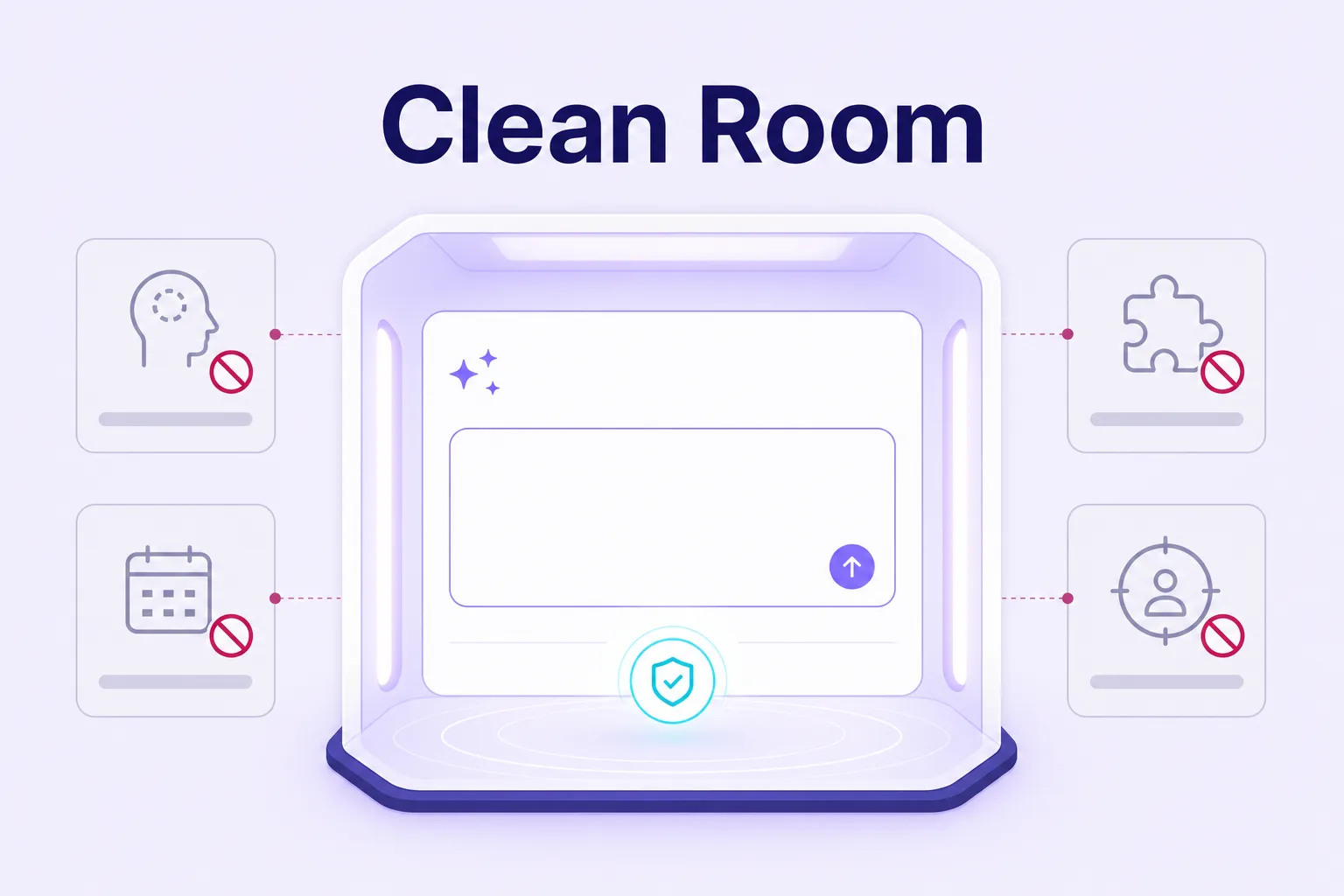
Step 1: Build a Clean Room Before You Ask Anything
What is a clean-room session? It is a ChatGPT session with all personalization stripped out, so the answer reflects what a stranger sees, not what your own history trained the model to show you.
This step is non-negotiable, and it is the one most audits botch. OpenAI's own Temporary Chat documentation confirms that a non-personalized Temporary Chat does not use memory, custom instructions, or plugins, and does not create new memories. If you have ever discussed your own brand in ChatGPT, your logged-in account is compromised as a measurement instrument. It has seen your bias.
The Clean Room Rule: never audit from the account you use every day.
You have three clean options, ranked by rigor:
- Logged-out session. Open ChatGPT without signing in, in a fresh private window. This is the closest thing to a neutral stranger.
- Non-personalized Temporary Chat. Inside an account, start a Temporary Chat and decline personalization.
- A dedicated audit account with memory and custom instructions turned off, used for nothing else.
Then decide what surface you are actually testing, because these are not interchangeable:
- ChatGPT web UI, Search off: model-native recall and older learned associations.
- ChatGPT web UI, Search on: live retrieval, citations, and location signals.
- OpenAI API: developer settings that regular users never see, useful for scale but a different experience from what buyers get.
- Third-party AI visibility tools: convenient, but they query on their own schedule and settings, so treat their numbers as a proxy, not ground truth.
The clean track versus user track split. Run two labeled tracks and never mix the numbers. The clean track (logged out or non-personalized) is your benchmark. A user track (a normal logged-in account with memory and location like a real customer) shows the lived experience. A logged-in answer is more realistic for existing users and worse for benchmarking. Use each for its job.
Now hold the environment constant. Record the model shown, whether Search is on, off, or automatic, and the country, city, browser, device, and date. If you serve multiple markets, run each region using a VPN and log it. Language is a separate variable from location: the interface language and the query language can change recommendations even from the same IP. A prompt written in German and a prompt written in English can pull different source pools. Treat this the way you would treat running a brand audit across channels: define the environment first, then keep it fixed.
A note for teams and enterprise accounts. Company workspaces often carry shared custom instructions, admin-set memory policies, and data-retention rules. Do not audit from a shared company account, because those settings quietly personalize the answer and your data may be logged under workspace retention. Use a clean personal-audit account or logged-out sessions, and check your own corporate policy before using VPNs or storing copied responses, especially in regulated industries like finance, healthcare, or legal.
Personalization does not just change wording. It changes whether your brand appears at all. Audit dirty and you will report a fantasy.
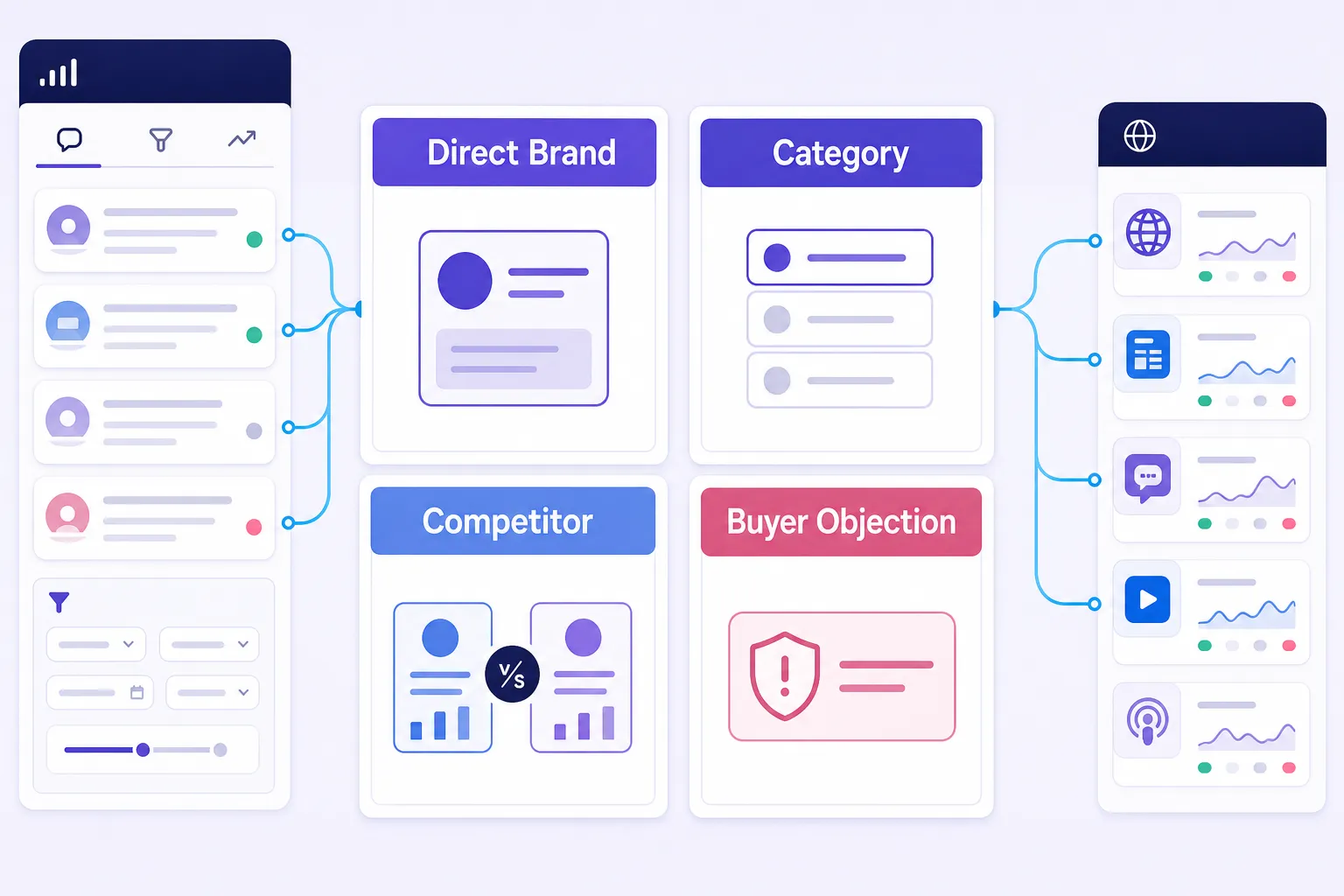
Step 2: The Prompt Library, Four Question Types That Reveal How ChatGPT Sees You
Vanity prompts ruin audits. Typing your own brand name and reading a nice paragraph proves nothing, because you forced your brand into the answer. Pew's 2026 survey is a useful reminder of what people actually do: 42% of U.S. adults said they used chatbots to search for information. Your prompts should mirror those real questions, where your brand has to earn its place.
Use four families. Each answers a different question and carries a different failure mode.
Direct Brand Prompts
Start here, because direct prompts test accuracy, not presence. When someone asks about you by name, ChatGPT answers from its learned view of the web, which leans on reference-style sources. If your most-cited third-party profile is wrong, ChatGPT repeats the error with total confidence.
Examples:
- "What is [Brand]? What do they sell and who are they for?"
- "Is [Brand] a legitimate company? Summarize what public sources say."
- "What is the latest public information about [Brand]?"
Non-obvious insight: the direct prompt is your fact-check, not your bragging test. Record every factual claim, then verify each one. If ChatGPT can describe you only when you name yourself, you have awareness, not recommendation visibility.
Category Discovery Prompts
These are the most important prompts in the audit. They test whether you enter the answer before the user knows your name.
Examples:
- "What are the best [category] tools for [audience] that need [job to be done]?"
- "Create a shortlist of [category] platforms for a [company type] with [constraint]."
- "What good [category] options exist for a team with [budget or team size]?"
Non-obvious insight: vary specificity on purpose. A generic "best CRM" and a narrow "best CRM for a two-person real estate team" often return completely different brand sets. Niche prompts are where smaller brands actually surface, and where you find real openings.
Competitor-Comparison Prompts
These expose your relative standing and any positioning gaps.
Examples:
- "Compare [Brand] vs [Competitor] for [use case]."
- "I currently use [Competitor]. What alternatives should I consider if I need [feature]?"
- "What are the trade-offs between [Brand], [Competitor 1], and [Competitor 2]?"
Non-obvious insight: run the comparison from the competitor's side too. Ask for alternatives to your rival, not only to yourself. If you are never listed as an alternative to the category leader, you have found a specific, fixable positioning hole.
Buyer-Objection Prompts
These find reputation and conversion risk at the moment of decision.
Examples:
- "What are the main drawbacks or complaints about [Brand]?"
- "What should buyers verify before choosing [Brand]?"
- "Summarize the most common positive and negative themes about [Brand] from public reviews and discussions."
Non-obvious insight: these surface objections in the model's own words. Copy them verbatim. They are a free, unfiltered list of the doubts your buyers hear before they ever reach your site.
| Prompt Family | What It Measures | Primary Failure Mode | Runs to Trust It |
|---|---|---|---|
| Direct Brand | Accuracy of description | Repeating a stale third-party fact | 5 to 10 |
| Category Discovery | Presence / appearance rate | Total omission from the answer | 10 |
| Competitor-Comparison | Relative standing | Losing to higher-authority rivals | 10 |
| Buyer-Objection | Sentiment and objections | Outdated info at the decision moment | 10 |
For every prompt, write down the exact wording and do not clean it up between runs. If you change the words, you changed the test. And run each prompt twice where the surface allows, once with Search on and once with Search off, because those two answers can differ sharply and different users see different experiences.
Every prompt you test should mirror a decision a buyer actually makes. If the prompt does not drive a decision, the answer does not touch your revenue.
Step 3: How Many Runs, and How to Compute Appearance Rate
One run tells you nothing. Because output varies run to run, you have to sample.
The 10-Run Floor: run every category, comparison, and buyer-objection prompt at least ten times in fresh clean-room sessions. Direct brand prompts tolerate five, since they vary less. Open a new session for each run. Do not repeat the prompt inside one thread, because earlier answers become context and poison the sample. Fresh session, single prompt, record, close, repeat.
Then compute appearance rate:
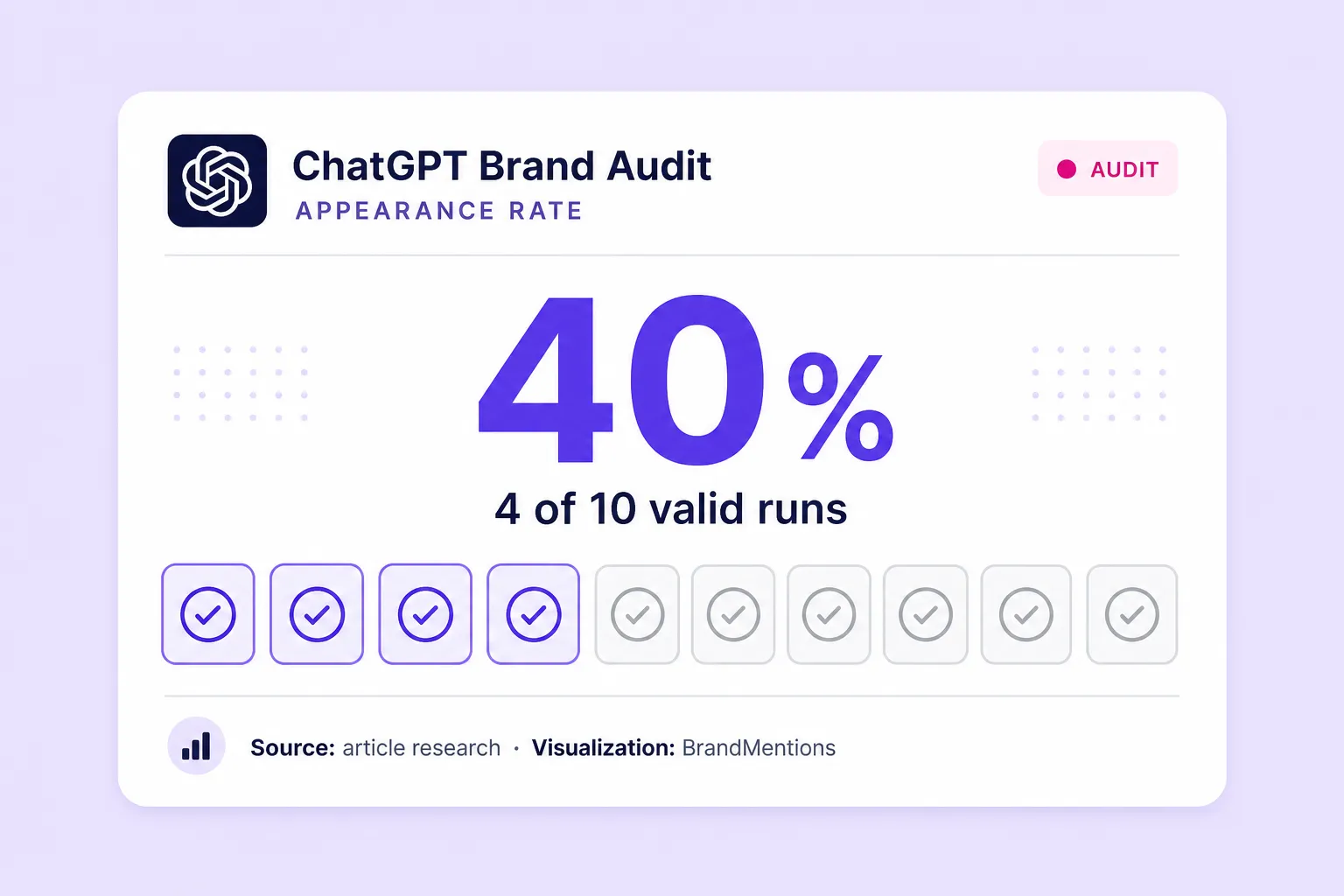
Appearance Rate = (runs where your brand is named ÷ total valid runs) × 100
If your brand appears in 4 of 10 runs, your appearance rate is 40%. Average across the prompt set for a single headline number, and pair it with a share-of-voice count against named competitors. That distribution is the backbone of any real AI visibility guide.
Be honest about what ten runs proves. It gives you a useful operating metric, not scientific certainty. With a sample of ten, the uncertainty around a single rate is wide, roughly plus or minus fifteen percentage points. So do not overreact to small moves.
The 20-Point Movement Rule: with ten runs per prompt, treat any change under 20 percentage points as a signal to retest, not a win or a loss to report. If a brand climbs from 40% to 50%, run it again before you celebrate. If you need tighter confidence, increase runs to 20 or 30 on your highest-stakes prompts.
Size the audit to the stakes, and budget the time honestly:
| Audit Size | Prompts | Runs Each | Total Outputs | Rough Time to Collect and Review | Use Case |
|---|---|---|---|---|---|
| Quick check | 10 | 10 | 100 | 2 to 3 hours | Founder wants a fast read |
| Standard audit | 25 | 10 | 250 | Most of a working day | Quarterly visibility report |
| High-risk audit | 40 | 10 | 400 | One to two days, ideally split | Reputation, funding, rebrand |
| Regional audit | 20 per region | 10 | 200 per region | Half a day per region | Local, travel, healthcare, retail, legal |
A yes/no answer to "are we in ChatGPT?" is worthless. A 40% appearance rate across twelve buyer prompts is a baseline you can improve and defend. Always report the percentage.
Step 4: What to Record, and the Spreadsheet That Turns Answers Into Evidence
A screenshot is a memory. A spreadsheet is evidence. Build one row per run.
Paste this header straight into a blank sheet to start:
audit_date,auditor,region,language,device,account_state,personalization_state,search_mode,model_shown,prompt_family,prompt_id,exact_prompt,run_number,brand_appeared,brand_position,exact_brand_text,sentiment,material_claims,claim_accuracy,cited_sources,citation_support,competitors_named,notes
The five columns that carry the most weight:
- brand_appeared (Yes/No). Drives appearance rate.
- brand_position. First, mid-pack, or last. Order signals the model's confidence ranking inside the answer.
- exact_brand_text. Paste the sentence about your brand word for word. This is your accuracy and sentiment source.
- sentiment. Positive, neutral, mixed, negative, or harmful. Define the labels before you start and score the claim, not your feelings. A structured sentiment analysis step keeps this repeatable across auditors.
- cited_sources. Every URL the model named or linked. This is the most under-used and most valuable column, because it shows which domains own your category's narrative.
Treat citations as claims to verify, not proof. OpenAI's ChatGPT Search documentation warns that citations can be incomplete, outdated, or incorrect, and tells users to open sources and check whether they actually support the answer. Occasionally a cited link resolves to a 404 or does not mention you at all. Verify every one manually.
Then let the metrics fall out with simple formulas. In Google Sheets or Excel, on a per-prompt tab:
- Appearance rate:
=COUNTIF(brand_appeared_range,"Yes")/COUNTA(brand_appeared_range) - Average position when present:
=AVERAGEIF(brand_position_range,">0",brand_position_range) - Positive-or-neutral share:
=COUNTIF(sentiment_range,"Positive")+COUNTIF(sentiment_range,"Neutral"))/COUNTA(sentiment_range) - Top-source dependency: count each domain in the cited_sources column, then divide the most frequent domain's count by total citations.
Build five summary tabs: Prompt Summary, Competitor Summary, Source Summary, an Issue Log for every outdated or false claim, and a one-page Executive Summary.
Log invalid runs so they never pollute your rate. Not every generation is a valid data point. Mark a run invalid and rerun it if any of these happen: Search failed to fire when you needed it, the model refused for a reason unrelated to the prompt, the interface fell back to a different model mid-session, you hit a rate limit, generation was interrupted or incomplete, or you accidentally changed the prompt wording. Only count clean, complete runs in the denominator.
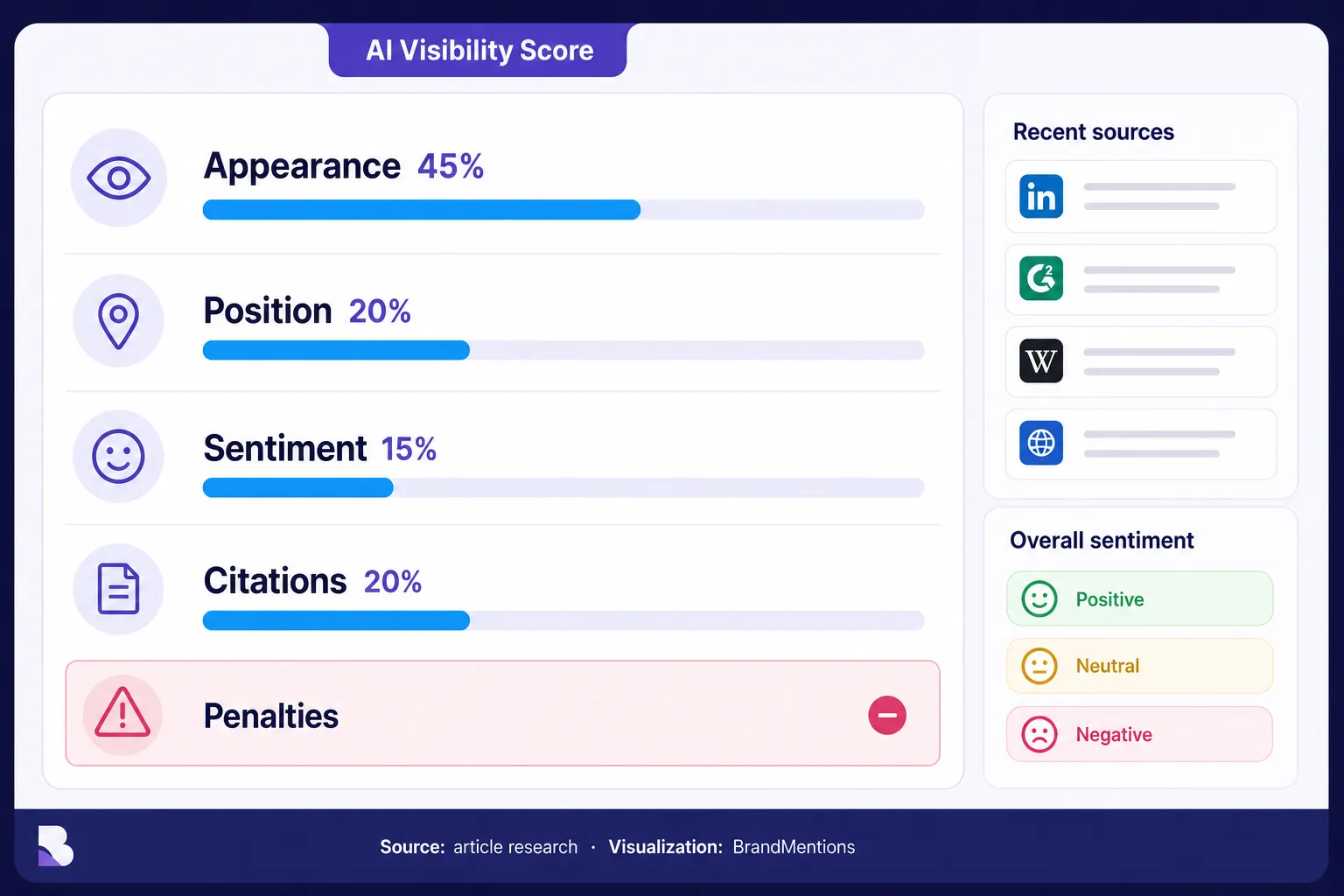
The AI Visibility Score and Diagnostic Model
Marketers do not get budget for "we're kind of visible." They get budget for a number that moved. Here is a scoring model you can run today, weight to your own priorities, and re-run next quarter. Nothing here needs a tool.
Score each input, then apply the weights:
AI Visibility Score = (Appearance Rate × 0.45) + (Position Score × 0.20) + (Sentiment Score × 0.15) + (Citation Support Score × 0.20), minus Accuracy Penalties
| Input | How to Score It | Why It Matters |
|---|---|---|
| Appearance Rate | Valid runs where you appear ÷ total valid runs, × 100 | Whether ChatGPT includes you at all |
| Position Score | Pos 1 = 100, pos 2 = 80, pos 3 = 60, pos 4 = 40, pos 5+ = 20, absent = 0 | List prominence and decision weight |
| Sentiment Score | Positive = 100, neutral = 70, mixed = 50, negative = 20, harmful = 0 | How you are framed |
| Citation Support Score | Accurate current citations = 100, partly useful = 60, weak or outdated = 30, wrong = 0 | Quality of the evidence layer |
| Accuracy Penalty | Subtract 15 for an outdated material claim, 25 for a false one, 40 for a harmful or regulated-risk claim | Stops high visibility from hiding bad information |
Worked example. A brand appears in 7 of 10 runs (70), averages a position score of 68, sits neutral-positive (80), has present but partly outdated citations (60), and repeats one outdated material claim (subtract 15):
(70 × 0.45) + (68 × 0.20) + (80 × 0.15) + (60 × 0.20) − 15 = 54.1
Report it as AI Visibility Score: 54 out of 100, and always show the components, because that is where the work lives. The number matters less than its movement over time, which is how you should measure brand awareness in any channel: set a baseline, change one thing, re-measure.
Why position is not a vanity column. A 2026 study in Electronic Commerce Research and Applications found a first-item preference in AI recommendation lists, where consumers favored the first item even when ranking cues were removed or the first item contained an error. If ChatGPT lists five brands, the first one carries disproportionate decision weight. Appearance rate tells you whether you enter the conversation. Position tells you whether you lead it.
The 30% Footprint Threshold: if your appearance rate on core category prompts sits below 30%, you have a web-footprint problem, not a wording problem. Below that line, editing your homepage will not move the needle. You need earned presence in the third-party sources ChatGPT trusts. Above it, you can start optimizing description and sentiment.
Step 5: How to Read Your Results, Omission, Mis-Description, or Outdated
Three failure modes, three completely different responses. Diagnosing the wrong one wastes a quarter.
| Finding | What It Usually Means | What to Do |
|---|---|---|
| Appears when named, absent from category prompts | Weak discovery evidence | Earn third-party presence in relevant category sources |
| Appears, but low on the list | Competitors have stronger comparative evidence | Build clearer comparison pages, earn better third-party comparisons |
| Appears with wrong positioning | Public descriptions conflict, or your messaging is unclear | Standardize your entity description across site, profiles, press, directories, reviews |
| Appears with outdated facts | Old sources still rank or get cited | Update owned pages, request corrections, publish dated current explainers |
| Appears with negative framing | Review themes or complaints dominate | Fix the underlying issue, then build current credible evidence |
| Cites weak sources | Better sources are missing or blocked | Create and earn source material worth citing |
| Varies heavily by region | Local data and source pools differ | Build region-specific coverage and rerun by market |
The omission versus mis-description frame: omission means ChatGPT lacks a reason to include you. Mis-description means it has reasons, but the public record is messy.
When you find a mis-description or an outdated claim, do not try to argue with the model. Fix the source. Here is the correction playbook by source type:
- Your own pages: update pricing, product names, and boilerplate first, since these are fully in your control.
- Wikipedia: correct factual errors with cited references through proper editing channels. Never edit your own entry promotionally, because it gets reverted and hurts credibility.
- Review platforms and directories (G2, Capterra, and similar): claim your profile and submit current information through their vendor process.
- Journalist or publisher errors: request a correction directly, with the primary evidence attached. Reputable outlets append corrections.
- Stale partner or affiliate pages: ask the partner to refresh the description, or replace the outdated page with a current one you can point to.
A hard line worth stating. Do not astroturf. Fake reviews, synthetic forum posts, and coordinated inauthentic mentions are a short-term trick that backfires. Google's AI guidance is explicit that inauthentic mentions are not a durable strategy in its generative features, and the same fragility applies across engines. You are building an evidence base, not gaming a ranking.
Step 6: Audit the Sources, Not Just the Answers
Your source footprint is the real lever. Muck Rack's May 2026 analysis of what AI is reading examined more than 25 million AI-cited links and found earned media accounted for 84% of citations, with ChatGPT citing sources in 96% of responses and averaging about five citations per response. Third parties describe your brand more often than you do.
For each cited source, ask a short set of questions. Is it owned, earned, review-based, directory, forum, academic, or government? Does it mention your brand directly and place it in the correct category? Is it current? Does it support the exact claim ChatGPT made? And critically, is it accessible to crawlers, or blocked by robots rules, CDN protection, paywalls, or heavy scripts?
That last point has a technical checklist most guides skip. OpenAI's Search documentation says that to be eligible for inclusion, a site should allow OAI-SearchBot and ensure its host or CDN does not block OpenAI's published searchbot IP addresses, and it notes placement is never guaranteed. Google's optimization guide adds the fundamentals: keep important content available as text, make it crawlable, align structured data with visible content, and avoid burying key facts inside images. Ask your technical team to verify OAI-SearchBot is not accidentally blocked, that important public pages return successful responses, and that bot protection is not challenging known crawlers. Do not sell this internally as "we fixed ChatGPT." Sell it as "we removed access blockers."
Non-obvious insight: the best source for a ChatGPT answer is rarely your best-converting page. It is the page that most directly supports the claim the model needs to make. For "best tools for agencies," a neutral comparison article may matter more than your homepage. For "is this brand safe," reviews and policy pages may matter more than product copy.
The source concentration check. Count how often each domain appears across all cited answers. If a single domain supplies more than roughly 20% to 30% of your citations, you have concentration risk. That one page changing, going offline, or shifting its stance can move your visibility overnight. Diversify the sources that connect your brand to the category so no single URL controls your narrative.
How to Scale Beyond the Manual Audit
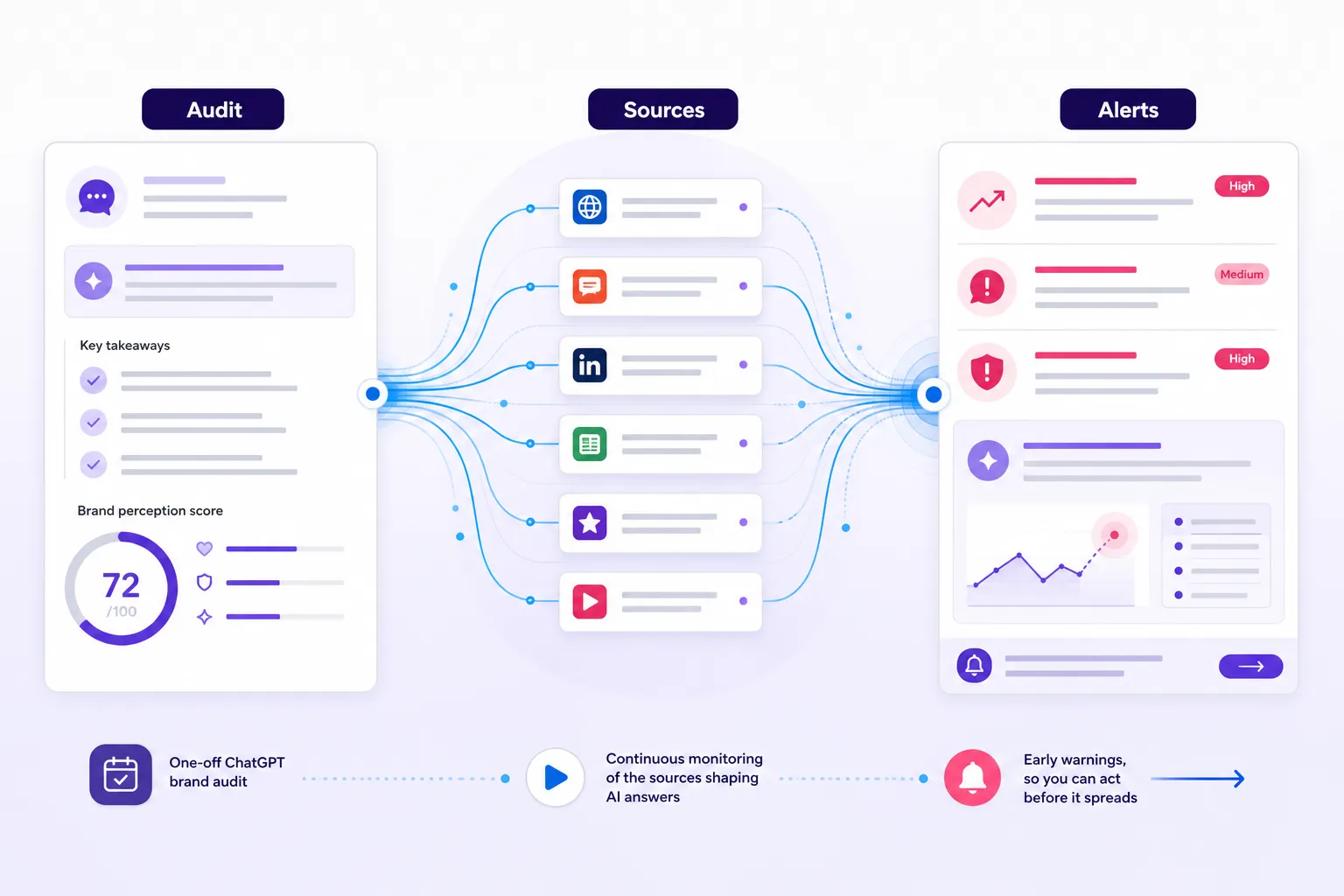
A manual audit is a photograph. True on the day you take it, and a little more false every day after. That is fine for a baseline. It fails as a control system, because answers shift with every model update and every new page published about you.
Once your audit proves your web footprint is the constraint, and below the 30% threshold it usually is, the question changes. You stop asking "what does ChatGPT say today?" and start asking "what is changing in the sources that feed the answer?" That is a monitoring problem, and it is where automation earns its place. The goal is to track web mentions as they appear, because those third-party mentions are the raw material ChatGPT synthesizes into your description.
Scaling has three layers. First, automated prompt tracking that re-runs your fixed prompt set on a schedule and exports appearance rate, competitor share, and cited URLs. Use it once your prompt library is proven, because if the prompts are weak, automation only gives you cleaner bad data. Second, source and mention monitoring, which watches the public record around your brand. Third, the technical access checks above.
For the source-monitoring layer, BrandMentions fits when you need to watch the third-party articles, discussions, and reviews that may later feed AI answers. I would position it as best for deep historical web and social mention monitoring tied to AI visibility diagnostics. It does not replace the manual ChatGPT audit. It keeps watch on the source layer the audit exposes, so a new comparison post or a shifting forum thread reaches you while you can still shape the narrative.
Used that way, the audit and the monitoring do different jobs. The manual scorecard tells you where you stand. Continuous, ongoing brand monitoring of your mention footprint tells you when the ground is moving, so you can act before ChatGPT's version of your brand hardens around a source you never saw coming.
The Stakeholder-Ready Report Template
Your final report should fit on one page, with the spreadsheet behind it.
1. Executive finding. One paragraph: "Across [number] valid ChatGPT outputs collected on [dates], in [regions], using [account state] and [search mode], [Brand] appeared in [rate]% of priority buyer-intent prompts. When present, average position was [position], sentiment was [split], and the most common cited sources were [sources]. The main issue is [omission, mis-description, outdated information, negative framing, or weak citations]."
2. Scorecard.
| Metric | Result | Interpretation |
|---|---|---|
| Total valid outputs | 250 | Standard audit size |
| Appearance rate | 42% | Moderate visibility |
| Average position when present | 3.1 | Present, not leading |
| Positive or neutral sentiment | 78% | Framing mostly acceptable |
| Accurate citation support | 54% | Evidence layer needs work |
| False or outdated claims | 6 | Requires a correction plan |
| AI Visibility Score | 57/100 | Improve category evidence |
3. Top three wins, top three risks. Name the prompt, the source, and the exact claim behind each.
4. Recommended actions, with an owner, a due date, and a success metric per row (for example: correct outdated third-party profile, PR owner, claim disappears in next audit).
Do not report only the score. Scores create urgency. Evidence creates action.
Frequently Asked Questions
Does a paid ChatGPT plan give different brand answers than the free version?
A paid plan can change model access, usage limits, tools, and workspace settings, and it enables browsing on some tiers, but it does not reveal one official version of your brand and there is no paid placement in answers. For a clean audit, strip personalization and the tier barely matters. For everyday use, a paid power user sees the most personalized, least neutral answers.
Should I audit ChatGPT with Search on or off?
Run both when the brand decision matters. Search-off answers show the model's native recall and older learned associations. Search-on answers show how ChatGPT uses current web sources, citations, and location. Label the two tracks separately and never merge the numbers.
How often should I re-run a ChatGPT brand audit?
Set a full manual baseline once, then re-run the same fixed prompt set monthly for active categories and quarterly for stable ones. Re-run immediately after a rebrand, launch, pricing change, funding announcement, or reputation event. Daily checks mostly generate noise.
Why does ChatGPT recommend my competitor but cite my page?
This is a citation-association error. The model can read your comparison page, decide from other signals that a competitor fits better, and still attach your URL as a source for the surrounding claim. You supplied the evidence and lost the recommendation. When you see it, check whether your own page frames the competitor too favorably, and strengthen the third-party sources that make your case.
Conclusion: Stop Reading Answers, Start Measuring Them
The useful question is not "does ChatGPT know us?" It is "when a real buyer asks a real question, does ChatGPT have enough current, credible, and consistent evidence to include us, describe us accurately, and place us where we belong?"
That is the whole shift. AI visibility is not a screenshot. It is a measured pattern across prompts, runs, regions, source types, and time. Treat it as a curiosity and you will overreact to noise. Treat it as an audit and you will find the exact places where your brand story is missing, distorted, stale, or unsupported, then fix the source record behind them.
Your next action is small and concrete. Open a logged-out session, pick your five most important buyer prompts, run each one ten times, and compute your appearance rate before the end of the day. That number is your line in the sand. Everything you do afterward, from correcting a stale profile to earning presence on the domains that feed the model, gets measured against it. The audit is not the work. The audit is how you finally see the work that was always there.
Filed under: AI Visibility & SEO


2 comments