Why Your Brand Isn’t Showing Up in AI Search (And How to Fix It)
AI invisibility isn't one problem but five: recognition, recall, recommendation, citation, and positioning. This playbook diagnoses your exact failure mode, then prescribes the matching fix in prio…


Brands miss AI search visibility because invisibility is not one problem but five distinct failures - recognition, recall, recommendation, citation, and positioning - each looking identical from the outside while demanding a completely different fix. Most teams misdiagnose which failure they actually have, throw a blog rewrite at it, and wonder why nothing moves - because they never identified the stage that was breaking.
Most brands treat "we are not in ChatGPT" as one problem with one fix, throw a blog rewrite at it, and wonder why nothing moves. That instinct is the actual disease. Invisibility in AI answers is not a single failure. It is five distinct failures that look identical from the outside and demand completely different repairs. I have spent years watching how brand mentions behave at scale across the web and social platforms, and the pattern holds: the teams that recover fastest are the ones who diagnose which failure they have before spending a cent on the fix. This framework hands you that diagnosis first, then the prioritized repair order, so you stop applying random tactics to a problem you have not identified.
TL;DR: The Five AI Search Failure Modes
If your brand is missing from AI answers, it is failing at one of five distinct stages. Diagnose which one before you spend on a fix:
- 1. Recognition failure (Tier 0): The engine cannot resolve your brand as a distinct entity - it returns a wrong, empty, or hallucinated description even when you ask about you by name. Fix: entity clarity, not more prose.
- 2. Recall failure (Tier 1): You are named correctly when asked directly but never surface in unbranded category prompts. Fix: earned media, where the largest gains live.
- 3. Recommendation failure (Tier 2): You appear in category answers but never make the shortlist because the engine lacks defensible reasons to suggest you. Fix: proof assets, comparisons, and credible third-party validation.
- 4. Citation failure (Tier 2): You are in the answer, but the machine sources the claim from someone else, capping how favorably it frames you. Fix: fresher, more extractable, cited source-of-truth pages.
- 5. Positioning failure: You show up, but in the wrong category, feature, or segment because your sources contradict each other. Fix: align quantified proof across every source the engine reads.
(A sixth parameter, retrieval eligibility and freshness, is the plumbing beneath all five - it silently caps every mode if your priority pages are not crawlable, indexable, snippet-eligible, and fresh.)
The Diagnostic Premise
An AEO Entity Anchor is the strength of the public evidence, both machine-readable and human-readable, that lets an answer engine identify your brand as a distinct company, file it under the right category, and justify naming it in a buyer-facing answer. It is a business signal, not a math object. Think of it as how firmly the machine knows who you are, what bucket you belong in, and who else vouches for you at the moment it writes a sentence about your market.
A binary read fails because AI visibility is not present or absent. Repeated runs of the same prompt across engines like Perplexity, ChatGPT, Gemini, and Google AI Mode produce different citations and different rankings, so a single answer is a screenshot, not a measurement. If your brand appears in three of ten runs for a query, your visibility is not yes or no. It is a 30 percent mention rate for that engine, date, location, and context. That is why you need an incremental score, because a 5 percent, a 30 percent, and a 70 percent band each point to a different root cause and a different remedy.
The five failure modes are recognition, recall, recommendation, citation, and positioning. This diagnostic spine is adapted from MaxAEO's breakdown of why known brands get omitted from category answers. Branded prompts test recognition. Category prompts test recall and recommendation. A brand can pass the first test and fail the other four. Hold that distinction, because it is the axis everything below turns on.
One editorial warning before you score anything. The thresholds in this framework are benchmark defaults, not published platform constants. Google, OpenAI, and Meta do not publish citation cutoffs, and no study has proven a universal mention rate that flips visibility on. Treat the numbers as starting bands to calibrate against your own category, geography, buyer type, and brand maturity, then adjust once you have your own baseline.
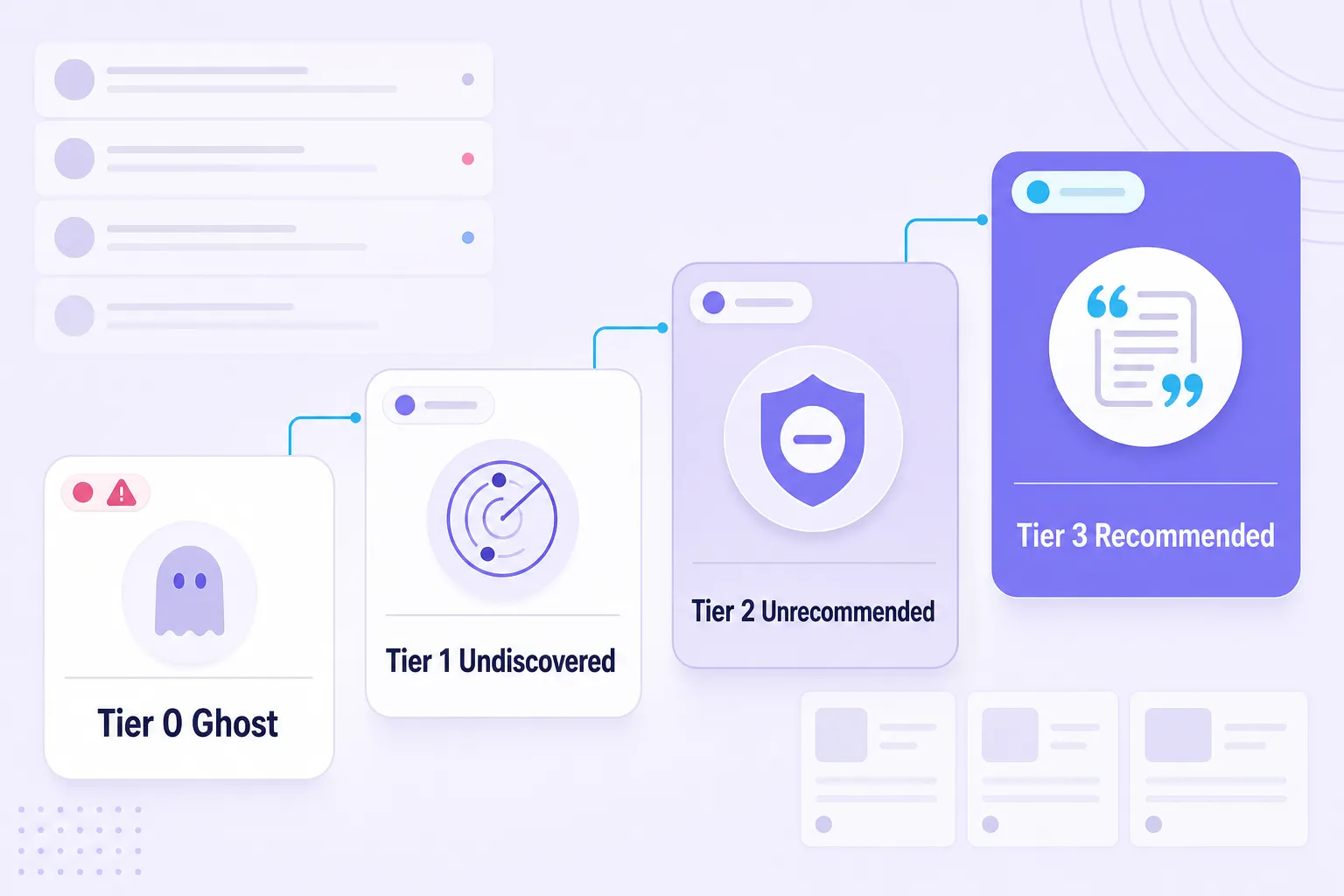
The Baseline Matrix: Operational Tiers at a Glance
Before you audit anything, locate yourself in one of four operational tiers. Each maps a level of brand signal strength to the technical constraint blocking you and the business risk you are carrying.
| Tier | Brand Signal Strength | Dominant Technical Constraint | Business Risk |
|---|---|---|---|
| Tier 0: Ghost | Brand not recognized by name; engine confuses or hallucinates you | Entity ambiguity, weak Organization signals, thin third-party footprint | Severe: invisible and often misrepresented in buyer-facing answers |
| Tier 1: Recognized, Undiscovered | Named correctly when asked directly, absent from all category prompts | No candidate recall; competitors dominate listicles, reviews, comparisons | High: you win zero net-new demand from discovery queries |
| Tier 2: Discovered, Unrecommended | Appears in some category answers but below rivals or without support | Citation gaps, weak proof, inconsistent positioning across sources | Moderate: mentioned but rarely shortlisted; you lose the qualified buyer |
| Tier 3: Cited, Recommended | Consistently named, cited, and framed correctly across engines | Freshness decay, competitor pressure, drift | Low but active: defend share of voice and monitor erosion |
Read across your row. A Tier 0 brand rewriting comparison-page copy is optimizing the wrong stage entirely. A Tier 2 brand rebuilding its schema is polishing a signal that already works. The tier tells you where the leverage actually sits.
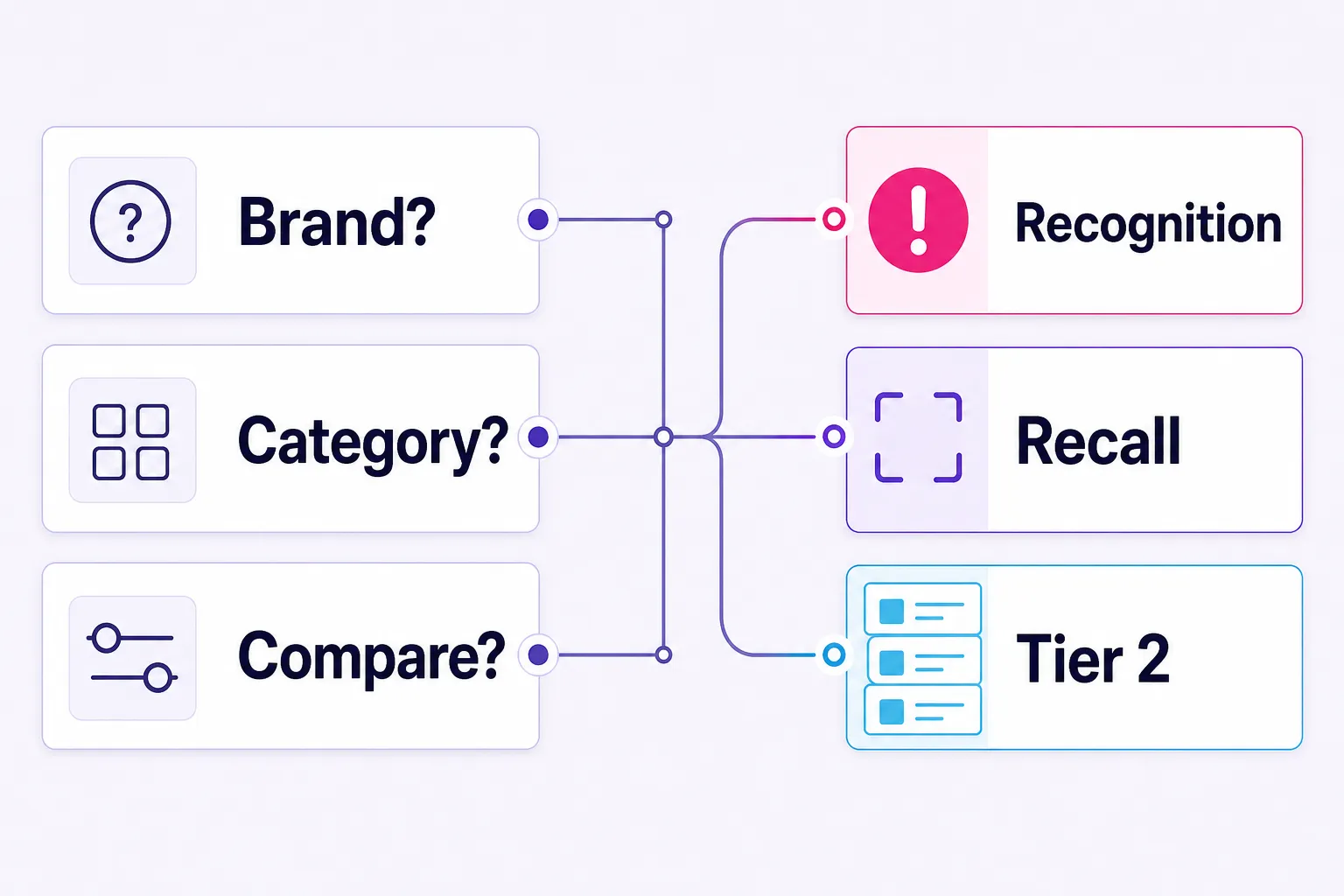
Rapid Self-Diagnosis: Three Prompts
Run three prompt types against one engine right now and tag the result. Ask the exact brand name ("What is [Brand]?"). Ask a pure category question with no brand named ("best [category] for [specific buyer]"). Ask a head-to-head ("[Brand] vs [Competitor]").
If the branded prompt is wrong or empty, you have a recognition failure and you sit in Tier 0. If the branded prompt is clean but the category prompt never mentions you, you have a recall failure, Tier 1. If you appear in the category prompt but land last, undescribed, or attached to the wrong use case, you have a recommendation, citation, or positioning failure, Tier 2. That single spot check tells you which parameter below to read first. It is not the audit. It is the triage.
Parameter 1: Recognition Failure (Brand Not Found or Hallucinated)
If your branded prompt returns a wrong, empty, or hallucinated description in more than roughly 20% of repeated runs: The brand falls into recognition failure and Tier 0, indicating the entity itself is unresolved and every dollar spent downstream is wasted until recognition is repaired.
The mechanism is entity resolution. Answer engines and their underlying models try to identify what your company is, what problem it solves, and for whom, and ambiguous positioning breaks that process. The fix is to make your brand unambiguously identifiable as an entity, not to write more prose.
How to Fix Recognition Failure
Be precise about what schema buys you. Google's own AI features documentation states there is no special structured data or AI-only markup required to appear in AI Overviews or AI Mode. An Ahrefs test across 1,885 pages that added JSON-LD found no clear citation lift. So treat schema as a disambiguation aid, not a citation lever. Use Google's Organization structured data guidance to lock down name, url, logo, description, and sameAs links to your authoritative profiles, then make the harder move: consistent brand facts across Wikidata, Crunchbase, LinkedIn, and the review sites engines cross-check.
Fix recognition before you touch anything else. A brand the model cannot identify is not underperforming in AI search, it is not in the game.
Parameter 2: Recall Failure (Missing From Category Answers)
If your branded mention rate is high (above 70%) but your unbranded category mention rate sits near zero: The brand falls into recall failure and Tier 1, indicating the entity is resolved but the market has not built enough category evidence for the engine to introduce you unprompted.
This is the most common and most misdiagnosed state. The brand is famous to itself and invisible to the buyer who has not heard of it yet. The divergence is real: a 2026 Discovery Gap study of 112 startups across 2,240 queries found that product-name recognition ran far ahead of discovery-style recommendation visibility. Category answers are assembled from where you are talked about, not where you talk about yourself.
How to Fix Recall Failure
This is where the single largest lever lives, and it is not on your website. Muck Rack's analysis of tens of millions of AI-cited links found that earned media accounts for roughly 84 percent of AI citations, with journalism alone making up about a quarter, while paid and advertorial content is a rounding error. Ahrefs studied 75,000 brands and reported branded web mentions correlating with AI visibility at about 0.664, versus 0.218 for backlinks. Read that correlation honestly: earned mentions are a strong correlate and a plausible lever, not a guaranteed causal switch you can flip. But the direction is hard to argue with. Recall is an earned-media problem. Treat it like one - and because that earned footprint accumulates off your own domain, a dedicated brand monitoring workflow is how you see whether your name is actually appearing beside the category term in the sources engines already trust.
Recall is built in other people's articles, not on your blog. If the machine does not see your name beside the category term in sources it already trusts, it will not retrieve you.
Parameter 3: Recommendation Failure (Named but Not Shortlisted)
If your recommendation rate on commercial prompts (best, top, compare, "for [audience]") registers 0% to 5%: The brand falls into recommendation failure, indicating the engine can find you but lacks defensible buyer-facing reasons to suggest you above a competitor.
Being mentioned is not being recommended. A model can name you in a long answer and still refuse to put you on a shortlist, because recommending is a riskier act than describing. It needs material it can safely reuse: pricing context, integrations, customer segments, constraints, and third-party validation.
How to Fix Recommendation Failure
The Princeton GEO research is the canonical reference here. Testing content edits at scale, it found visibility gains of up to 40 percent in its experimental setting, with the strongest edits being cited sources, added statistics, and credible quotations, not keyword repetition. In operator language, the model rewards content that already reads like a citable reference. Watch for hesitation markers in your audited answers too. Phrases like "may be suitable," "less widely known," and "consider evaluating" are not neutral copy. They are the engine telling you the proof is thin.
Parameter 4: Citation Failure (Someone Else Gets the Credit)
If your citation coverage (share of answers that source your own or earned assets) registers 0% to 25% inside answers that already mention you: The brand falls into citation failure and Tier 2, indicating you are in the answer but the machine is sourcing the claim from someone else, which caps how favorably it can frame you.
Two things drive citation selection: what gets retrieved, and how extractable it is once retrieved. On retrieval, the page must be eligible. Google's documentation is explicit that a page must be indexed and snippet-eligible to be a supporting link in AI Overviews or AI Mode, and there is no shortcut markup that changes this. On extraction, the Princeton finding applies directly: quotes, statistics, and cited sources are what let an engine lift a passage and attribute it to you.
How to Fix Citation Failure
Do not over-read that into a bag of tricks. Front-load a canonical answer in the first 20 to 40 words of each section, support it with one verifiable fact a reranker can score, then elaborate. Keyword stuffing does not help and often hurts. Domain authority is a weak shortcut, because retrieval matches meaning, not reputation.
Every AI answer is a source audit in disguise. If a competitor is cited for a claim you should own, the fix is not your opinion, it is a better, fresher, more extractable source.
Parameter 5: Positioning Failure (Wrong Category or Use Case)
If your positioning accuracy (share of runs that place you in your intended category and use case) registers below 60%: The brand falls into positioning failure, indicating message drift that converts visibility into wasted demand.
This is the quietest and most expensive failure. The engine assembles an answer by reconciling what multiple sources say about you, and when your homepage, LinkedIn, review profiles, partner pages, and press disagree, the model hedges, picks the loudest consensus, or files you under the wrong bucket. A confident wrong mention costs more than a missing one.
How to Fix Positioning Failure
Here is the uncomfortable pattern I have watched play out across mention data for years. The brand that invents a category is rarely the one credited for it. Credit drifts to whoever the consensus repeats most consistently, and if your own sources contradict each other, you hand that consensus to a competitor with a tighter story. Consistency is not a branding nicety here. It is a retrieval requirement. If you want to be described a specific way, put verifiable, quantified proof of that description into the sources engines read.
Parameter 6: Retrieval Failure (Stale, Blocked, or Unreadable Pages)
If fewer than 80% of your priority pages are crawlable, indexable, snippet-eligible, and updated within your category's freshness window: The brand carries a hidden ceiling in any tier, and this becomes the first fix regardless of which failure mode dominates.
This is the plumbing, and it rarely causes total invisibility on its own, but it silently caps every other parameter. Two facts matter operationally. First, updating a page does nothing until it is re-crawled and re-processed, and Google states that recrawl and processing can take anywhere from several days to several months. Second, retrieval carries a recency preference: when two pages answer equally well, the fresher source tends to win, though Google publishes no universal decay rate, so treat any fixed "mentions expire every N months" claim with suspicion.
How to Fix Retrieval Failure
Crawler access is broader than Google. If you want inclusion in ChatGPT results, OpenAI's publisher guidance says do not block OAI-SearchBot, and referral traffic carries a chatgpt.com source parameter you can track. Do the same audit for PerplexityBot, ClaudeBot, Google-Extended, and Bingbot, because a robots rule that made sense for classic SEO can quietly cut you out of an entire answer surface.
The Audit Protocol: Prompt Library, Repeated Runs, and Logging
A defensible audit requires at least 20 prompt intents, 3 engines, and 3 repeated runs per priority prompt, with branded and non-branded results reported separately. One run tells you almost nothing given non-determinism, and blending engines hides the truth because citation behavior differs sharply between them.
Define your unit of measurement before you count anything. A valid prompt run is one prompt, in one engine, in one run, where the answer is not refused, broken, off-topic, or unavailable. Build the prompt library around how buyers actually ask: branded, category, use-case, alternative, comparison, and problem-led families. Over-monitoring branded prompts is the classic mistake, because if the user already names you, you are only measuring recall.
Log every run with the fields that survive scrutiny: date, engine, interface, region, login state, prompt text, brand mentioned, answer position, recommendation language, citation URLs, source type, sentiment, factual errors, and the failure mode tag. Then apply one discipline that keeps you honest. Classify a root cause only when at least 60 percent of the failed runs in a prompt cluster point to the same failure mode, and never average a good engine against a bad one into a single blended number. Classify per engine, then fix the weakest engine's dominant failure first.
Two controls separate a real audit from a noisy one. Sentiment, positioning accuracy, and recommendation language are subjective, so double-code a sample of answers with a second reviewer and keep a written adjudication rule for ambiguous cases. And because AI answers personalize by region, login state, device, and history, hold those variables constant per run and log them, so an inconsistent answer gets diagnosed as personalization variance rather than misread as an entity failure.
This is where continuous measurement earns its keep, because the earned-media footprint that drives most citations moves over months and needs a long memory. I built BrandMentions in part to sit at this layer, and its defensible niche is deep historical social data tracking across the web and social sources, the record you need to see whether your off-domain footprint is actually widening after you ship fixes. Pair that history with your prompt-level audit and you can tie a specific coverage change to a change in category mention rate.
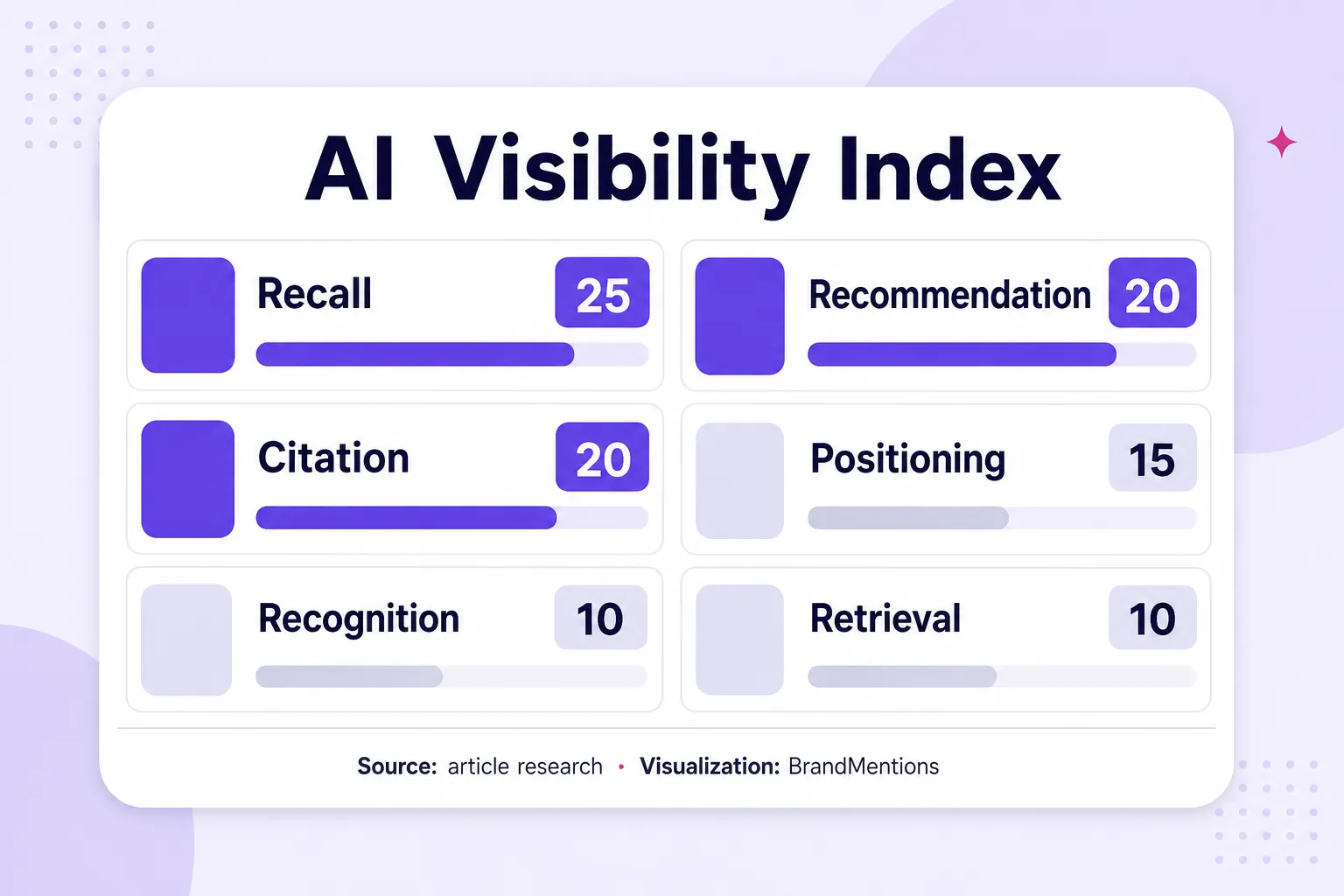
The AI Visibility Diagnostics Index
Now convert the parameters into one weighted score you can report and re-run. The Index assigns each failure mode a weight reflecting its real contribution to AI citations, scores each on a 0 to 100 scale derived from your audit, and produces a composite you track over time.
| Signal (Parameter) | Weight | What You Measure (0-100) | Failure Mode Isolated |
|---|---|---|---|
| Recall | 25 | Non-branded category and use-case mention rate | Recall |
| Recommendation | 20 | Inclusion in best, top, compare, and constraint prompts | Recommendation |
| Citation Provenance | 20 | Share of answers sourcing your owned or earned assets, freshness-weighted | Citation |
| Positioning Coherence | 15 | Share of runs placing you in the intended category and use case | Positioning |
| Recognition Integrity | 10 | Branded prompt accuracy across repeated runs | Recognition |
| Retrieval Eligibility | 10 | Priority pages crawlable, indexable, snippet-eligible, fresh | Eligibility |
Compute the weighted average and read the band. If the composite registers 0 to 39: Tier 0 or Tier 1, and the binding constraint is almost always recognition or recall, so start upstream. If it registers 40 to 69: Tier 2, meaning you are discovered but under-cited or mis-positioned, and the leverage is provenance and positioning. If it registers 70 to 100: Tier 3, and the work shifts to defense, freshness maintenance, and competitor share of voice.
The weighting is the opinionated part, and it is anchored to the citation evidence rather than to what is easiest to fix. Recall, recommendation, and citation carry 65 points between them because that is where the evidence says AI answers are actually built. If your instinct is to spend most of your budget on the 10-point recognition slice with a schema overhaul, the Index is telling you that instinct is backwards for most brands past Tier 0. One caution on the inputs: weight your evidence by source class, treating official platform documentation and controlled studies above vendor blog claims and your own operator inference, because mixing them as equal proof is how teams talk themselves into fake precision.
Root-Cause-to-Fix Mapping
Symptoms lie, root causes do not. Route each tagged miss to its matching remedy instead of applying random tactics.
| Symptom in the Audit | Failure Mode | Matching Fix | Primary Lever |
|---|---|---|---|
| Branded prompt wrong, empty, or hallucinated | Recognition | Organization signals, sameAs, consistent facts across Wikidata, Crunchbase, LinkedIn, G2 | Owned + entity graph |
| Named directly but absent from category prompts | Recall | Earned placement in listicles, reviews, comparisons, community | Earned |
| Present in lists but never on the shortlist | Recommendation | Proof assets, comparisons, customer outcomes, evaluative reviews | Earned + reviews |
| Present but competitors are cited | Citation | Refresh source-of-truth pages, add extractable stats and quotes, earn corroboration | Owned + earned |
| Described with wrong category, feature, or segment | Positioning | Align messaging and quantified proof across all sources | Owned + earned + reviews |
| Engine reads a stale page or old cache | Eligibility/Freshness | Update key pages, confirm crawl and index access, reset freshness | Technical |
Fixes in Priority Order: Steps to Fix AI Visibility
Sequence the work by impact and effort, not by what is nearest to hand. The order runs recognition, then answer-first content, then earned media, then reviews and proof, then freshness maintenance. The dependency is what makes the order non-negotiable: recognition enables recall, recall enables recommendation and citation, and all of them feed positioning.
- Entity clarity, only if recognition is failing. This is cheap and fast: an Organization block plus consistent external profiles, done once. If recognition already scores high, skip it and do not gold-plate schema that is already working.
- Answer-first owned content built to be extracted. Front-load a canonical 20-to-40-word answer, support it with a stat, a quote, or a cited source, and keep each page tight. This is the Princeton finding applied honestly, provenance and fluency over keyword density.
- Earned media, where the largest gains sit for Tier 1 brands. This is the heaviest and slowest lever, so start it early even though it pays late. Aim for the listicles, comparisons, reviews, analyst commentary, and community threads engines actually read, and remember that distributing the same asset across trusted third-party outlets multiplies its citation surface.
- Reviews and proof, which repair positioning and lift recommendation quality. Aggregate review sentiment shapes how you are characterized, so managing it is a visibility activity. Build genuine customer evidence, and do not manufacture it. The FTC Consumer Reviews and Testimonials Rule, in effect since October 21, 2024, authorizes civil penalties for fake or suppressed reviews, and Google filters scaled content built to manipulate rankings or AI responses. Rented coverage gets filtered. Earned coverage counts. G2's buyer research also shows software review sites and AI search have become primary shortlist inputs, so reviews are buyer-research infrastructure, not just reputation hygiene.
- Freshness as ongoing maintenance. Set a refresh cadence for source-of-truth pages, add visible last-updated dates, and confirm re-indexing rather than assuming an edit took effect.
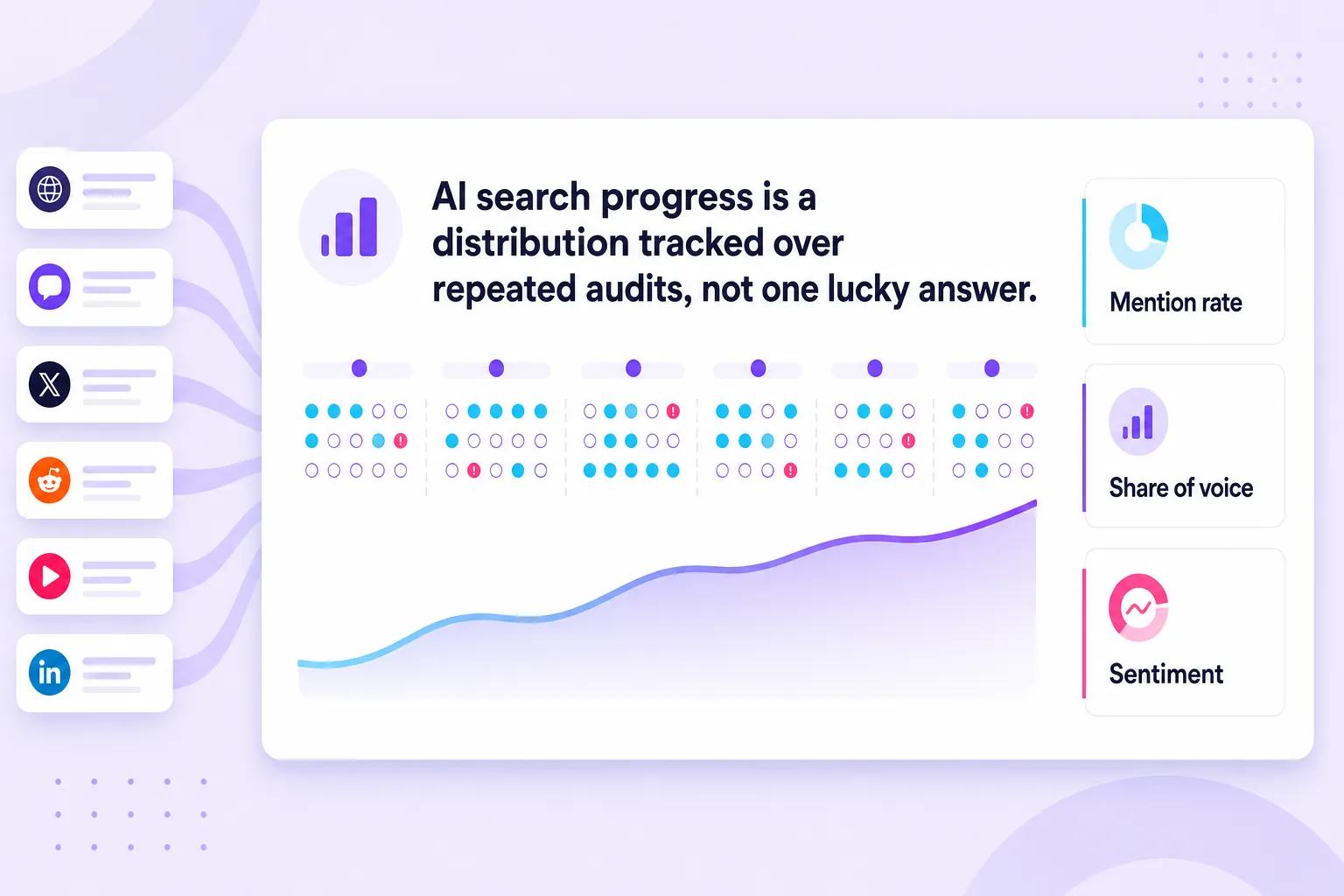
Monitoring Progress as a Mention Rate
Progress is measured as movement in mention rate, recommendation rate, citation coverage, share of voice, and sentiment over repeated audits, never as a screenshot of one good answer. A single favorable response is survivorship bias. The distribution is the truth.
Re-run the same prompt library on a fixed cadence and report which cluster moved, which engine moved, and which source changed. Watch the ratio of owned-to-earned citations in your own results, because that ratio is the clearest signal of whether the reallocation toward earned media is working. Google now exposes a Generative AI performance report inside Search Console, which is a useful first-party leading indicator, and its own guidance warns against third-party tools that claim to use internal Google metrics, so stay skeptical of black-box promises.
For the earned-media half of the equation, watching mention volume, sentiment, and competitor share of voice over a long history in a tool like BrandMentions is how you separate a real widening of coverage from lucky answer variance, and how you connect a specific PR win to a later lift in category mention rate. A disciplined social listening practice is what surfaces those competitor and category shifts early, and tracking share of voice across the same window keeps the comparison honest. Keep the correlation caveat visible even here. A rising mention footprint is strong evidence your fixes are landing, but it is a correlate of AI visibility, not proof of causation, so pair it with the prompt-level Index rather than reporting it alone.
Report the distribution, not the demo. A brand that showed up in ChatGPT once has an anecdote. A brand tracking its category mention rate over time has a system.
Realistic Timeline
Set expectations by lever, because these signals move on different clocks. Retrieval access and entity fixes are fastest, often visible within a recrawl-and-refresh cycle of days to a few weeks. Recognition and citation typically settle over roughly one to three months. Recall, recommendation, and positioning depend on repeated external evidence and usually take three to six months. Sentiment moves slowest of all, often six to twelve months, because reputation changes lag content changes.
There is no shortcut file or markup that accelerates this, which is why the honest timeline is measured in refresh cycles and coverage cycles rather than a launch date. The relationship between coverage and citation is closer to winner-takes-most than linear, so early progress can feel flat before it inflects. Budget patience, and also budget governance: after a rebrand, acquisition, pricing change, or product launch, resync your third-party profiles, review pages, marketplace listings, comparison pages, and product feeds in the same sprint, or the old positioning will keep winning retrieval for months.
Calibration & Edge Cases
Real audits produce contradictory signals. Here is how to classify the common outliers.
Conflicting Signals: High Traffic but Negative Sentiment
Decision rule: Classify as a sentiment and positioning problem, not a discovery problem, and treat it as higher priority than raw visibility whenever unfavorable sentiment exceeds roughly 30 percent across branded or comparison prompts. Traffic proves crawlers can reach you. It does not prove the engine likes what it finds. Segment the sentiment by source (reviews, forums, news, competitor pages, owned content) before prescribing a fix, and never try to bury a real product issue under content volume, because AI systems are very good at finding repeated dissatisfaction.
Conflicting Signals: Strong Reviews but No Citations
Decision rule: Classify as citation failure when review volume and ratings are strong but cited mention coverage stays below 25 percent in citation-capable engines. The reviews are not connected to the prompts you are testing. Convert customer proof into retrievable, cited claims (case studies, integration-specific proof, comparison pages that map review themes to buyer constraints) without fabricating or gating reviews.
Conflicting Signals: Cited on One Engine, Invisible on Another
Decision rule: Do not average across engines. Classify per engine and fix the weakest engine's dominant failure mode first, prioritizing the engine your buyers actually use. Retrieval architectures and freshness dials differ, so one engine surfacing you while another skips you is surface-specific, not a universal entity failure. Confirm it by checking whether the miss persists after you hold region, device, and login state constant.
The Operational Roadmap
Your next move is dictated by the tier you landed in, so act on that and nothing else.
If you are Tier 0, spend the next two weeks making your brand a resolvable entity: consistent Organization signals, matching facts across the external profiles engines cross-check, and clean crawl and index access on priority pages. Re-run the branded prompts before touching anything downstream.
If you are Tier 1, the game is candidate recall. Open an earned-media program aimed at the listicles, comparisons, reviews, and community threads in your category, and start tracking your off-domain mention trend from day one, because it will move before your category mention rate does.
If you are Tier 2, work provenance and positioning in parallel. Refresh your source-of-truth pages into extractable, cited, stat-backed answers, and align your category story across every source until the machine stops contradicting itself.
If you are Tier 3, shift from offense to defense. Hold your freshness cadence, watch competitor share of voice, and treat any drift in your composite Index as an early warning rather than a crisis.
The brands that win the next two years of AI search will not be the ones with the cleverest tactics. They will be the ones who diagnosed the right failure, fixed it in the right order, and measured the distribution instead of celebrating the screenshot. The engines are not judging your preferred message. They are judging the public evidence they can retrieve, reconcile, and cite. Pick your tier, run the Index, and start upstream.
FAQ
Why is my brand not showing up in AI search results?
Because your brand is failing at one of five distinct stages, not one generic "AI problem." Either the engine cannot resolve you as an entity (recognition), it knows you but never surfaces you in category prompts (recall), it names you but never shortlists you (recommendation), it cites a competitor for a claim you should own (citation), or it files you under the wrong category (positioning). A sixth layer - retrieval eligibility and freshness - silently caps all five if your priority pages are not crawlable, indexable, snippet-eligible, and fresh.
How do I diagnose which AI search failure mode I have?
Run three prompt types against one engine: your exact brand name ("What is [Brand]?"), a pure category question with no brand named, and a head-to-head ("[Brand] vs [Competitor]"). If the branded prompt is wrong or empty, you have a recognition failure (Tier 0). If it is clean but the category prompt never mentions you, that is recall (Tier 1). If you appear in the category prompt but land last, undescribed, or attached to the wrong use case, that is a recommendation, citation, or positioning failure (Tier 2).
Does adding schema markup get my brand cited in AI Overviews?
No. Google's AI features documentation states there is no special structured data or AI-only markup required to appear in AI Overviews or AI Mode, and an Ahrefs test across 1,885 pages that added JSON-LD found no clear citation lift. Treat schema as an entity-disambiguation aid, not a citation lever - use Organization structured data to lock down consistent brand facts, then invest the real budget in earned media.
What actually drives AI citations most?
Earned media. Muck Rack's analysis of tens of millions of AI-cited links found that earned media accounts for roughly 84 percent of AI citations, with journalism alone making up about a quarter, while paid and advertorial content is a rounding error. Ahrefs' study of 75,000 brands reported branded web mentions correlating with AI visibility at about 0.664, versus 0.218 for backlinks - a strong correlate, though not a guaranteed causal switch.
How long does it take to fix AI search visibility?
It depends on the lever. Retrieval access and entity fixes are fastest, often visible within a recrawl-and-refresh cycle of days to a few weeks. Recognition and citation typically settle over one to three months. Recall, recommendation, and positioning usually take three to six months because they depend on repeated external evidence, and sentiment moves slowest of all, often six to twelve months.
How should I measure progress in AI search?
As movement in mention rate, recommendation rate, citation coverage, share of voice, and sentiment over repeated audits - never as a screenshot of one good answer. Re-run the same prompt library on a fixed cadence, classify per engine rather than blending, and pair the prompt-level Index with a long historical view of your earned-media footprint using a brand monitoring and social listening workflow so you can tie a specific coverage change to a change in category mention rate.
Filed under: AI Visibility & SEO


3 comments