Best Sentiment Analysis Tools 2026: Ranked & Compared
A rigorously scored, methodology-transparent comparison of 12+ sentiment analysis tools in 2026, covering enterprise suites, mid-market picks, and budget underdogs with honest pros, cons, and real …

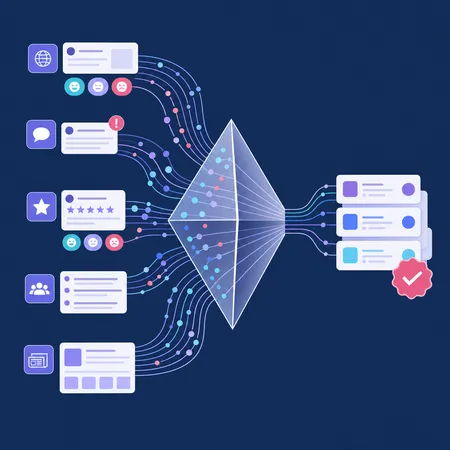
Choosing the right sentiment analysis tool has never been more important. Every platform promises AI-powered insights, real-time monitoring, and industry-leading accuracy, yet the differences between them can mean thousands of dollars in wasted budget or missed reputation risks. In this guide, we've objectively compared the best sentiment analysis tools in 2026 using transparent evaluation criteria, including source coverage, sentiment accuracy, pricing, AI capabilities, reporting, and overall value. Whether you're a startup looking for an affordable monitoring solution or an enterprise evaluating advanced consumer intelligence platforms, this comparison will help you find the tool that best matches your needs—not just the one with the loudest marketing.
Quick answer: The best sentiment analysis tool for most teams in 2026 is BrandMentions, which tracks real-time sentiment across social, news, blogs, forums, and reviews from $99/month and lets you verify every score against the original post. For large enterprises with a dedicated analyst, Brandwatch leads on consumer-research depth, while Talkwalker wins for global source and language breadth across 196 countries.
Before you add another platform to the stack, answer one question: what decision will its sentiment data actually change? If you cannot name the decision, you are buying a dashboard, not an insight. I have sat with marketing and PR teams who signed five-figure contracts for suites they ran at ten percent of capacity, and I have watched a solo founder catch a reputation problem early with a tool that cost less than their monthly ad spend. The gap between those two outcomes is rarely the software. It is the fit.
At a Glance: Best Sentiment Analysis Tools by Use Case
What is sentiment analysis? It is the automated classification of text (and increasingly images, audio, and reviews) as positive, negative, or neutral, often layered with emotion and topic, so a brand can measure how people feel about it at scale instead of reading every mention by hand.
Here is the fastest way to find your match. Read the use case that fits your team, then jump straight to that tool's review below.
- Best for real-time sentiment accuracy on web & social platforms: BrandMentions. Tracks social, news, blogs, forums, and reviews in one feed and lets you verify every score against the source post, at a mid-market price.
- Best for enterprise consumer intelligence: Brandwatch. Unmatched historical depth and query power, if you have an analyst to run it.
- Best for global source breadth: Talkwalker. The widest source and language footprint in this comparison, built for multinational teams.
- Best for PR and traditional media monitoring: Meltwater. News, broadcast, print, and podcast coverage with communications workflows in one suite.
- Best for mid-market value: Brand24. Broad source coverage, AI assistance, and sentiment across a large plan range.
- Best for visual and image-based listening: YouScan. Logo and scene recognition surfaces brand mentions in photos where no text tags your name.
- Best for social workflow and care teams: Sprout Social. Publishing, inbox, and reporting in one polished platform (listening sold separately).
- Best affordable underdog: Awario. Precise Boolean search and a lead-finding module at the lowest serious entry price.
- Best lightweight monitoring: Mention. Straightforward social, web, and review coverage across 75+ review sites.
- Best value specialist: Mentionlytics. A full sentiment stack with multilingual support at a low entry price.
- Best for product and review sentiment: Revuze. SKU-level and aspect sentiment for product, ecommerce, and insights teams.
- Best for survey and VoC sentiment: Qualtrics. Sentence-level sentiment inside a broader experience-management program.
- Best for enterprise CX signal programs: Medallia. Surveys, speech, social signals, and text analytics in one operating system.
Summary: Three Rules Before You Buy
- Source coverage decides accuracy more than the algorithm does. The best tool is the one that collects your real sources (social, news, forums, reviews, and sometimes images) and lets you click from a score to the exact post behind it. Any score you cannot trace is a trend line, not a fact.
- Price splits cleanly by buyer. Enterprise suites (Brandwatch, Talkwalker, Meltwater) run into five figures a year and earn it only with dedicated analysts. Mid-market tools (BrandMentions, Brand24, YouScan) deliver most of the practical insight at a fraction of the cost. Budget picks (Awario, Mentionlytics) cover the essentials for a small team.
- Trial it against your own messy data before you sign. Vendor demos use clean examples. Your brand mentions are full of sarcasm, slang, mixed reviews, and languages the model half-understands. Test there first.
How We Ranked These Tools
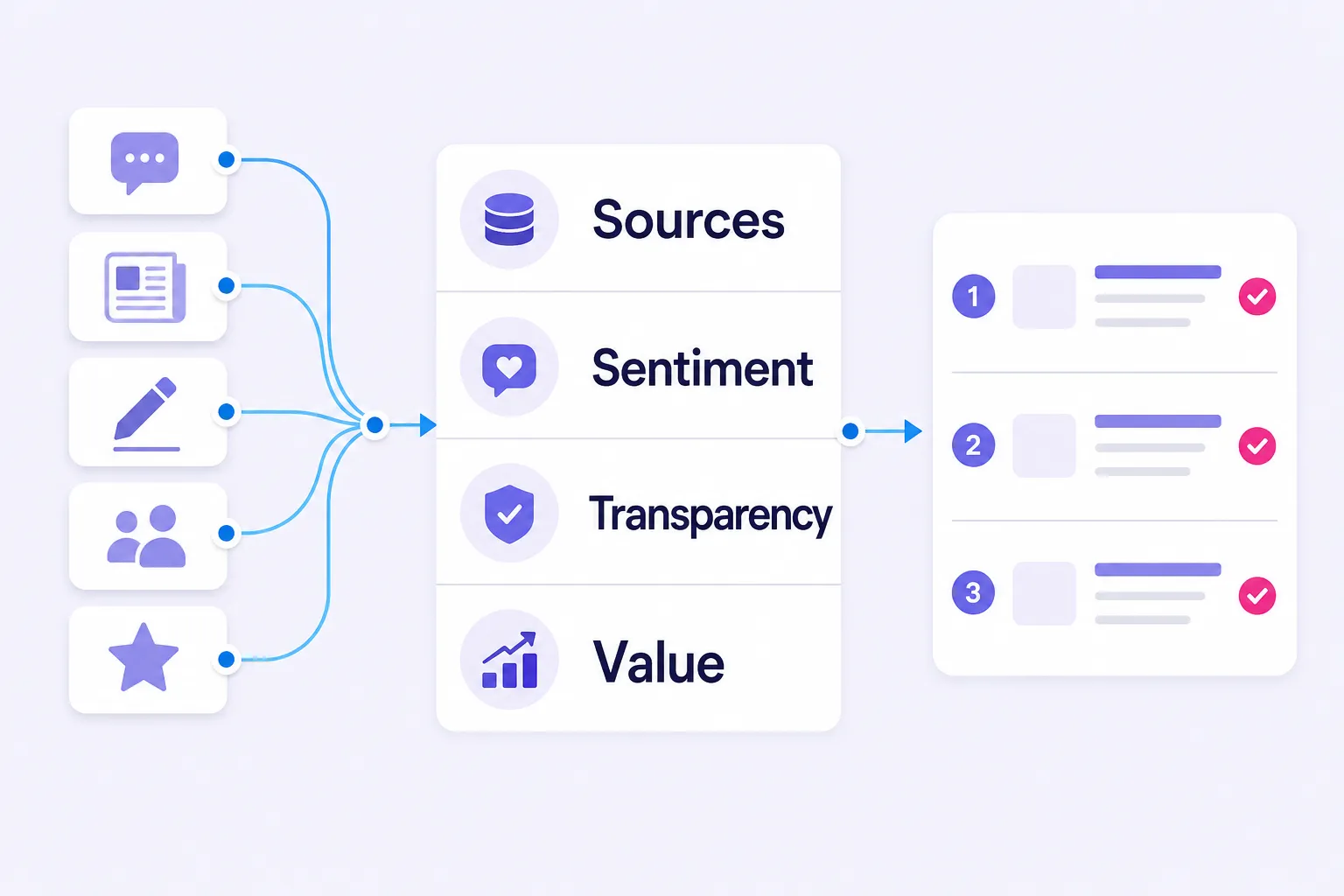
I refuse to publish a ranking without showing the math. Here is the weighted model behind every general-purpose placement.
| Criterion | Weight | What it measures |
|---|---|---|
| Source coverage | 25% | Social, news, blogs, forums, reviews, video, podcasts, and geographic breadth |
| Sentiment and emotion depth | 20% | Polarity vs emotion vs aspect-level, sarcasm handling, verifiability |
| Accuracy and transparency | 15% | Ability to trace a score to its source post and correct misses |
| Value for money | 15% | Public pricing versus capability delivered |
| Multilingual capability | 10% | Number and quality of supported languages outside English |
| Workflow and alerts | 10% | Real-time alerts, spike detection, routing, reporting |
| Verified review signal | 5% | G2 and Capterra patterns, weighted lightly on purpose |
One honest caveat on that last row. G2 and Capterra ratings drift, some are incentivized, and a 4.9 across 90 reviews is not the same evidence as a 4.2 across 1,700. Read ratings alongside review counts and recency, never as a single trophy number. I use them as a small tie-breaker, not a verdict.
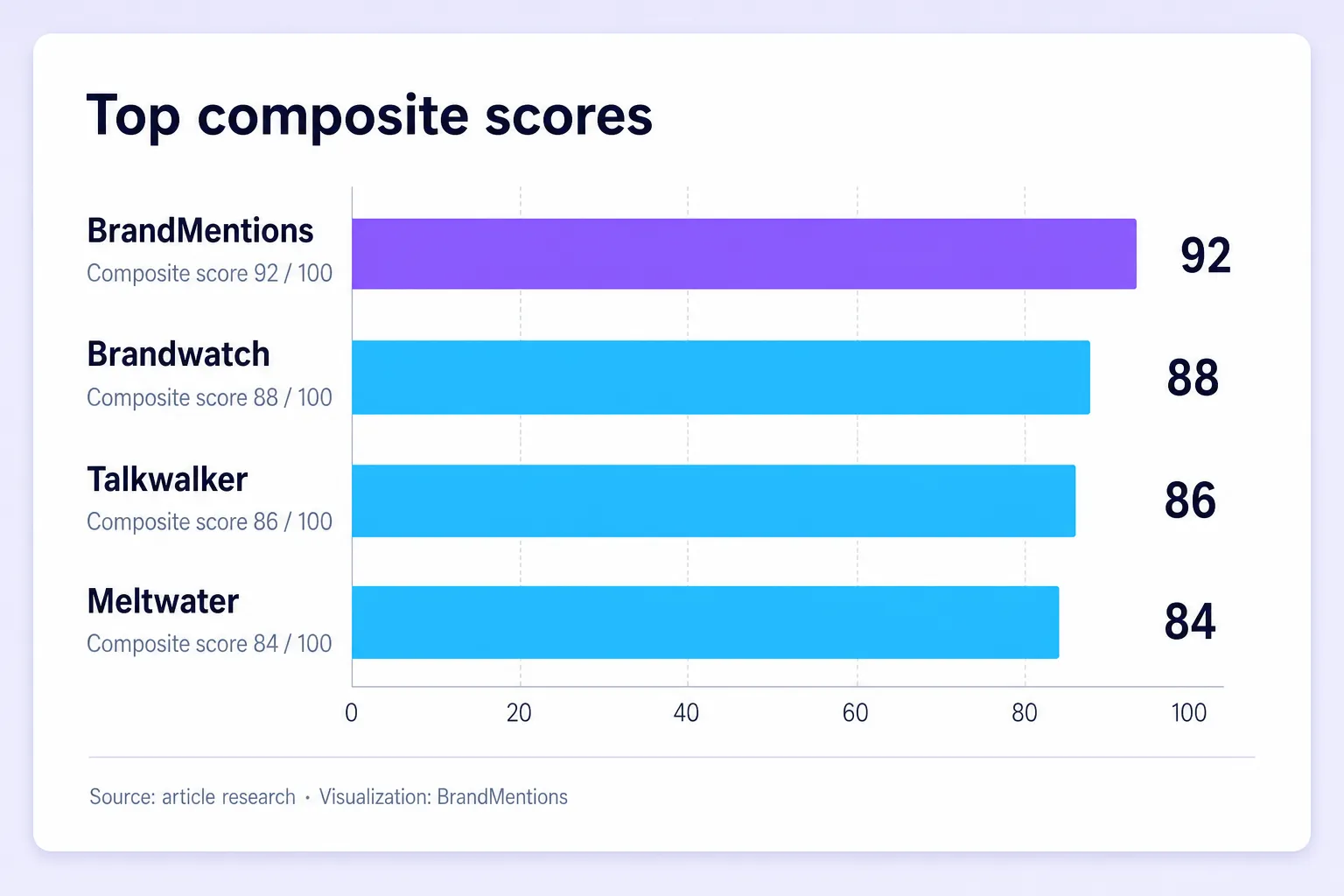
Here is how the general-purpose tools scored. Product, review, and CX specialists (Revuze, Qualtrics, Medallia) are graded inside their own category further down, because ranking a VoC platform against a social listener is comparing two different jobs.
| Rank | Tool | Composite score | Best for |
|---|---|---|---|
| 1 | BrandMentions | 92 | Real-time multi-source sentiment accuracy |
| 2 | Brandwatch | 88 | Enterprise consumer intelligence |
| 3 | Talkwalker | 86 | Global source and language breadth |
| 4 | Meltwater | 84 | PR and media intelligence |
| 5 | Brand24 | 83 | Mid-market value |
| 6 | YouScan | 82 | Visual listening |
| 7 | Sprout Social | 80 | Social workflow and care |
| 8 | Awario | 76 | Affordable monitoring |
| 9 | Mention | 74 | Lightweight monitoring |
| 10 | Mentionlytics | 73 | Value specialist |
How Does Sentiment Analysis Differ From Social Listening and Media Monitoring?
In short: social listening is the collection layer that gathers every public mention, sentiment analysis is the interpretation layer that scores each mention positive, negative, or neutral, and media monitoring is the PR-focused slice that tracks earned coverage across news, broadcast, and print. They are three connected layers of one workflow, not synonyms.
People use these terms as if they mean the same thing. They do not. And a platform can be excellent at one layer and weak at another. Several tools collect millions of mentions and classify them crudely, while a focused tool with fewer sources reads tone far more accurately. Separate the two questions when you evaluate. If you want the mechanics under the hood, our explainer on how sentiment analysis works breaks down the models involved.
The Source-Match Test: identify where roughly 70 percent of your meaningful customer conversations actually happen, then rank tools only by whether they collect those exact sources.
That sounds obvious. In practice, teams buy the platform with the strongest demo dataset, not the one that matches their real customer footprint. A negative customer thread and a negative journalist article do not carry the same operational weight, which is why PR teams also need real monitoring across news sources rather than social alone.
Never buy a sentiment tool on collection volume alone. Ten million mentions with sloppy scoring is more noise, not more insight.
Can Sentiment Tools Actually Read Sarcasm, Slang, and Multilingual Nuance in 2026?
Better than five years ago. Still imperfect. Transformer-based models and LLM-assisted workflows now handle idioms and emotional cues far better than old rule-based systems, but short posts, irony, emoji, quoted speech, and mixed sentiment remain hard. Vendors are unusually candid about this in their own documentation when you look past the marketing pages.
Two documented examples set the honest baseline. Brand24 reports that its deep-learning sentiment model improved from a 61 percent to a 95 percent macro-averaged F1 score across a 50,000-mention evaluation, a figure it publishes in its own sentiment documentation. Sprout, meanwhile, states plainly in its support content that sarcasm remains a challenge and that unsupported languages and media-only posts can go unclassified.
Accuracy also degrades hard outside major languages. If you operate in English, Spanish, French, or German, several tools here will read tone reliably. If you need Arabic, Japanese, or Polish, validate on your own data first, and prioritize tools that surface multilingual work cleanly, which is where dedicated multi-language reporting earns its place.
The rule of thumb: trust the trend, verify the outlier. Aggregate sentiment across thousands of mentions is usually trustworthy. Any single score you plan to act on needs a human to confirm it first.
Should You Buy an Enterprise Suite or a Lean Sentiment Tool?
Buy enterprise when the decision environment is enterprise. That means multiple markets, multiple brands, data-governance obligations, executive dashboards, and an analyst who owns the platform. Brandwatch, Talkwalker, Meltwater, Qualtrics, and Medallia all fit there.
Buy lean when you need faster signal, lower contract friction, and a team that can act on mentions without a six-month rollout. BrandMentions, Brand24, Awario, Mention, and YouScan's entry tier sit closer to that motion. The hidden cost in suites is the add-on: listening and sentiment are frequently gated behind the top tier or sold separately, which quietly inverts the "cheaper because it is bundled" logic.
The Seat-Tax Trap: a low base price becomes expensive when every analyst, social manager, PR lead, and client stakeholder needs a paid seat.
Sprout is the clearest example of why you model the full bill, not the sticker. Its Advanced plan lists at $399 per seat per month, and Listening is a premium add-on that is not included by default in Standard, Professional, or Advanced. Five people who need to see, tag, correct, and report sentiment is five paid seats, not one demo login.
How Do Platform API Limits Quietly Break Your Sentiment Data?
This is the buyer concern almost no listicle covers, and it matters more every year. Sentiment tools do not own the platforms they monitor. They depend on API access and licensing deals with X, Reddit, Meta, TikTok, YouTube, LinkedIn, review sites, and news aggregators, and those terms tighten and reprice regularly. When a source restricts access, your "brand health" line can shift for reasons that have nothing to do with your brand.
You can see this in the fine print. Sprout's own documentation confirms that in Listening, web articles, blogs, and forums are capped at 10kb per item, X data is sampled rather than complete, some sources refresh only every 24 hours, and queries are limited to 2,037 characters with no ability to build a query inside a specific geographic area. Those constraints are documented in Sprout's social listening data availability article. Every platform has its own version of these limits, most of them undocumented.
Before you compare accuracy, compare access. A tool with a brilliant model and sampled, delayed, or capped source data will still hand you a confident picture of an incomplete reality.
Ask three questions during any trial. What is the backfill window (how far back can it pull history)? What are the mention quotas and export or API limits on your tier? And is X, Reddit, or TikTok data complete or sampled? The answers change the value more than any emotion feature.
Master Comparison Table
| Rank | Tool | Best-fit tier | Sources covered | Sentiment depth | Entry price | G2 rating |
|---|---|---|---|---|---|---|
| 1 | BrandMentions | Mid-market | Social, news, blogs, forums, reviews, web | Polarity + source-level context, multilingual detection, verifiable | $99/mo | 4.9 (230+) |
| 2 | Brandwatch | Enterprise | 100M+ social and web sources | Sentiment + emotion, transformer models, manual adjustment | Custom | 4.2 (1,700+) |
| 3 | Talkwalker | Enterprise | 150M data sources, 30+ networks, 196 countries | Sentiment + visual + AI summaries | Custom | 4.4 |
| 4 | Meltwater | Enterprise | News, print, broadcast, podcasts, social | Sentiment + Mira AI reporting | Custom | 4.1 (2,400+) |
| 5 | Brand24 | SMB/mid-market | Social, news, blogs, forums, podcasts, reviews | Polarity + AI insights, 100+ languages | $199/mo | 4.6 (340+) |
| 6 | YouScan | Mid-market/Enterprise | Social, blogs, forums, reviews, news, images | Aspect + visual sentiment, Insights Copilot | $499/mo | 4.7 |
| 7 | Sprout Social | Mid-market/Enterprise | Major social + listening add-on | Inbox + listening sentiment, spike alerts | $79/seat/mo (Essentials) | 4.4 (4,000+) |
| 8 | Awario | Budget | Social, web, news, blogs, forums, reviews | Polarity + Boolean + lead signals | $29/mo | 3.9 (~50) |
| 9 | Mention | Mid-market | Social, news, blogs, forums, 75+ review sites | Sentiment + emotion, 31 high-accuracy languages | $599/mo | 4.3 |
| 10 | Mentionlytics | Budget/SMB | Social, news, web | AI sentiment, multilingual | $69/mo | 4.9 (~90) |
The Detailed Reviews
Every tool below follows the same five sections so you can compare like for like: a pricing snapshot, then Core Strengths, Where It Falls Short, Sentiment and Emotion Depth, Ideal Fit, and the Non-Obvious Insight. Read the ones that match your tier and skip the rest.
1. BrandMentions: Best for Real-Time Multi-Source Sentiment Accuracy
BrandMentions opens the list because it fits the most common buying problem: teams want real-time sentiment across the full web without an enterprise buying process.
| Attribute | Detail |
|---|---|
| Entry price | $99/mo (Starter) |
| G2 rating | 4.9 / 5 (230+ reviews) |
| Sources | Social, news, blogs, forums, reviews, web |
| Key features | Source-level score verification, multilingual detection, real-time alerts, one unified cross-web feed |
| Free trial | Yes |
| Best-fit tier | Mid-market |
| Composite score | 92 / 100 |
Core Strengths
BrandMentions earns its top placement on breadth plus verifiability. It tracks social networks, news, blogs, forums, and review sites in one feed, and every score traces back to the exact post behind it. The $99 entry price undercuts enterprise suites by an order of magnitude while covering the sources most teams actually use.
Where It Falls Short
It is not a full enterprise consumer-research suite with global audience panels or an analyst-heavy workflow. If you need multi-year archives, procurement-grade governance, or custom research operations, compare Brandwatch or Talkwalker alongside it. Its value also depends on tight query setup, because loose keywords create noise for brands with common names.
Sentiment and Emotion Depth
Sentiment spans positive, negative, and neutral with contextual weighting, applied consistently across all source types rather than social alone, plus multilingual detection on collected mentions. That cross-source consistency is rarer than vendors imply. Many tools score social posts well and everything else poorly.
Ideal Fit
Marketing, PR, agency, and reputation teams that need accurate cross-web sentiment and fast alerts without an enterprise contract. It sits in the sweet spot between budget tools that only watch social and suites that require a dedicated analyst.
Non-Obvious Insight
Treat it as a source-difference engine, not a single sentiment number. A product can read positive in news, neutral on social, and negative in reviews at the same time, and the blended average hides that split. The split is usually where the actual strategy lives.
2. Brandwatch: Best for Enterprise Consumer Intelligence
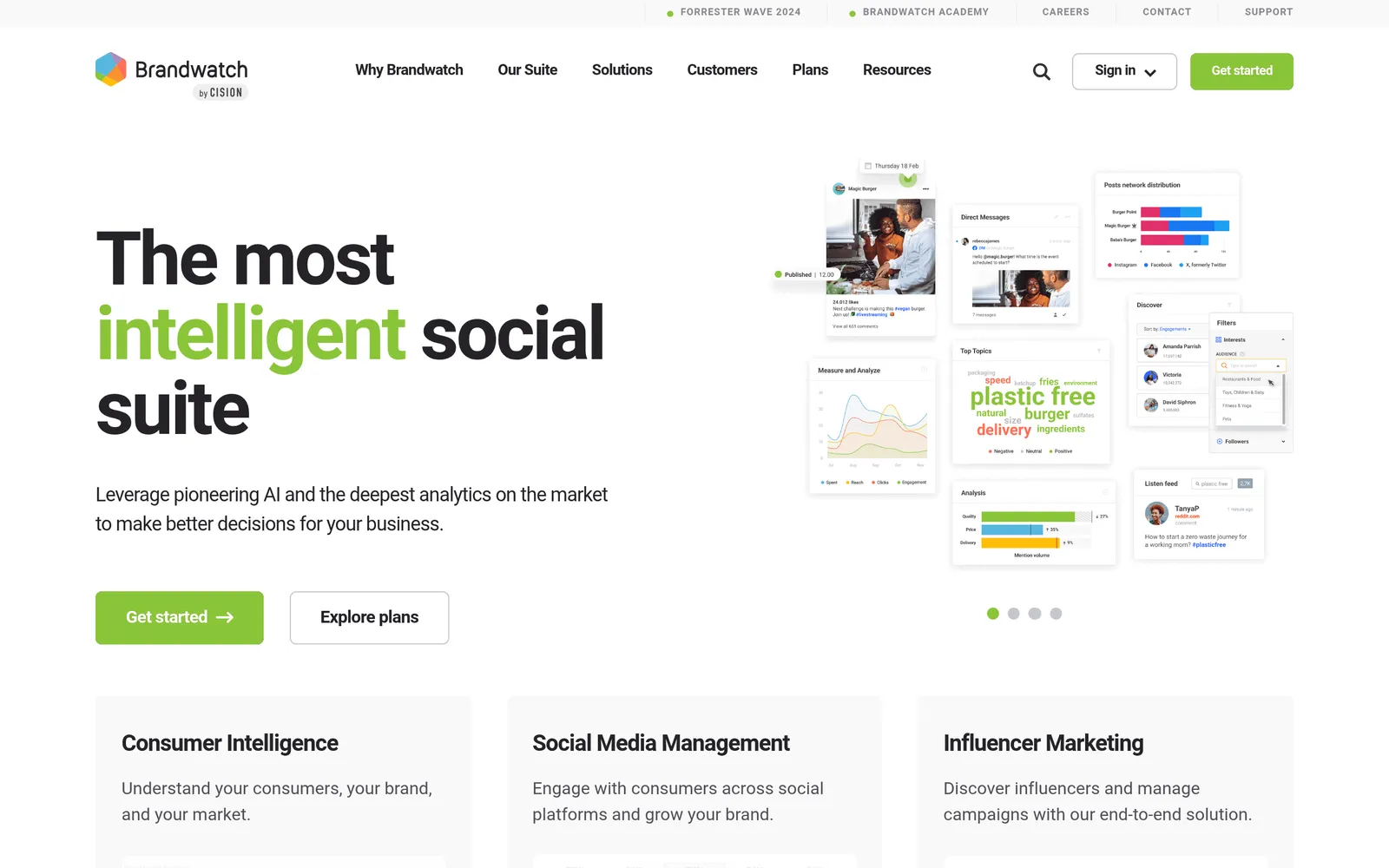
Brandwatch, now a Cision company, is the enterprise research heavyweight of this group.
| Attribute | Detail |
|---|---|
| Entry price | Custom (sales-led) |
| G2 rating | 4.2 / 5 (1,700+ reviews) |
| Sources | 100M+ social and web sources |
| Key features | Transformer-based sentiment models, emotion + image analysis, deep audience segmentation, historical archives, complex query building |
| Free trial | Demo only |
| Best-fit tier | Enterprise |
| Composite score | 88 / 100 |
Core Strengths
Brandwatch is built for analyst-grade depth: segmentation, historical archives, emotion analysis, and complex queries treated as market research rather than monitoring. Its documentation describes transformer-based language models for social sentiment. Teams that invest the setup time get genuine research returns.
Where It Falls Short
The learning curve is steep and pricing is custom and enterprise-grade. It rewards disciplined analysts and punishes casual users, and it can be far too much tool for a team that only needs alerts and a weekly report. Ownership under Cision strengthens PR integration but does not simplify the platform.
Sentiment and Emotion Depth
Sentiment layers with emotion, image analysis, and deep audience segmentation, with manual adjustment for brand-specific context. That depth is where the price is justified for large, multi-market brands, and it is also why bad query governance quietly wastes it.
Ideal Fit
Large organizations running formal brand-intelligence programs with a named analyst or insights team. If nobody will own complex query building on Monday morning, you will underuse it.
Non-Obvious Insight
The 4.2 rating is a fit signal, not a quality knock. Dissatisfaction clusters among buyers who expected plug-and-play and got a research instrument. Match your staffing to the tool before you sign, because the most expensive tool is the one nobody has time to run.
3. Talkwalker: Best for Global Source and Language Breadth
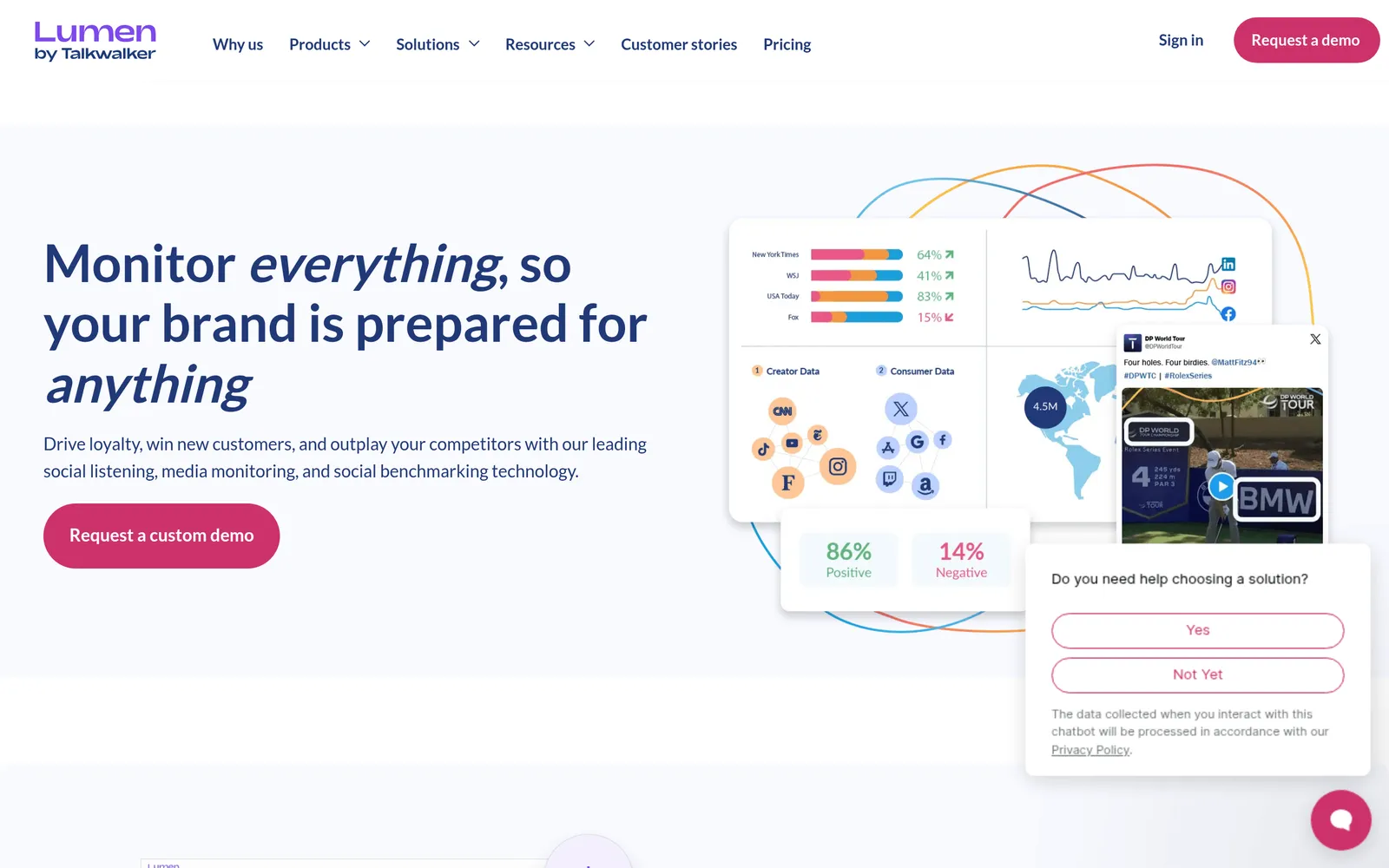
Talkwalker, now owned by Hootsuite, competes on raw coverage.
| Attribute | Detail |
|---|---|
| Entry price | Custom |
| G2 rating | 4.4 / 5 |
| Sources | 150M data sources, 30+ social platforms, 196 countries |
| Key features | AI + visual sentiment, 187 languages, demographic segmentation, AI summaries, unlimited users |
| Free trial | Demo only |
| Best-fit tier | Enterprise |
| Composite score | 86 / 100 |
Core Strengths
Talkwalker's headline is scale. Its pricing page lists 150 million data sources, 30-plus social platforms, 187 languages, 196 countries, and unlimited users across its tiers. For multinational teams that need one intelligence layer across markets and formats, that footprint is hard to match.
Where It Falls Short
It can feel oversized if you only need brand alerts and practical reports, and the sales-led buying motion adds time. The Hootsuite integration is still settling, so confirm which listening features live in which product before committing. Historical setup and query governance again demand real ownership.
Sentiment and Emotion Depth
Broad AI sentiment, visual analysis, and demographic segmentation across a vast source pool, with emotion support that varies by language. Breadth is the strength here; treat precision on individual short posts as something to validate.
Ideal Fit
Global brands, PR departments, and consumer companies operating across many countries, languages, and content formats.
Non-Obvious Insight
The unlimited-user model changes the enterprise math. If your alternative charges heavily per seat, a broad-access custom contract can cost less operationally than it first appears, which is worth modeling before you dismiss it on sticker price.
4. Meltwater: Best for PR and Media Intelligence
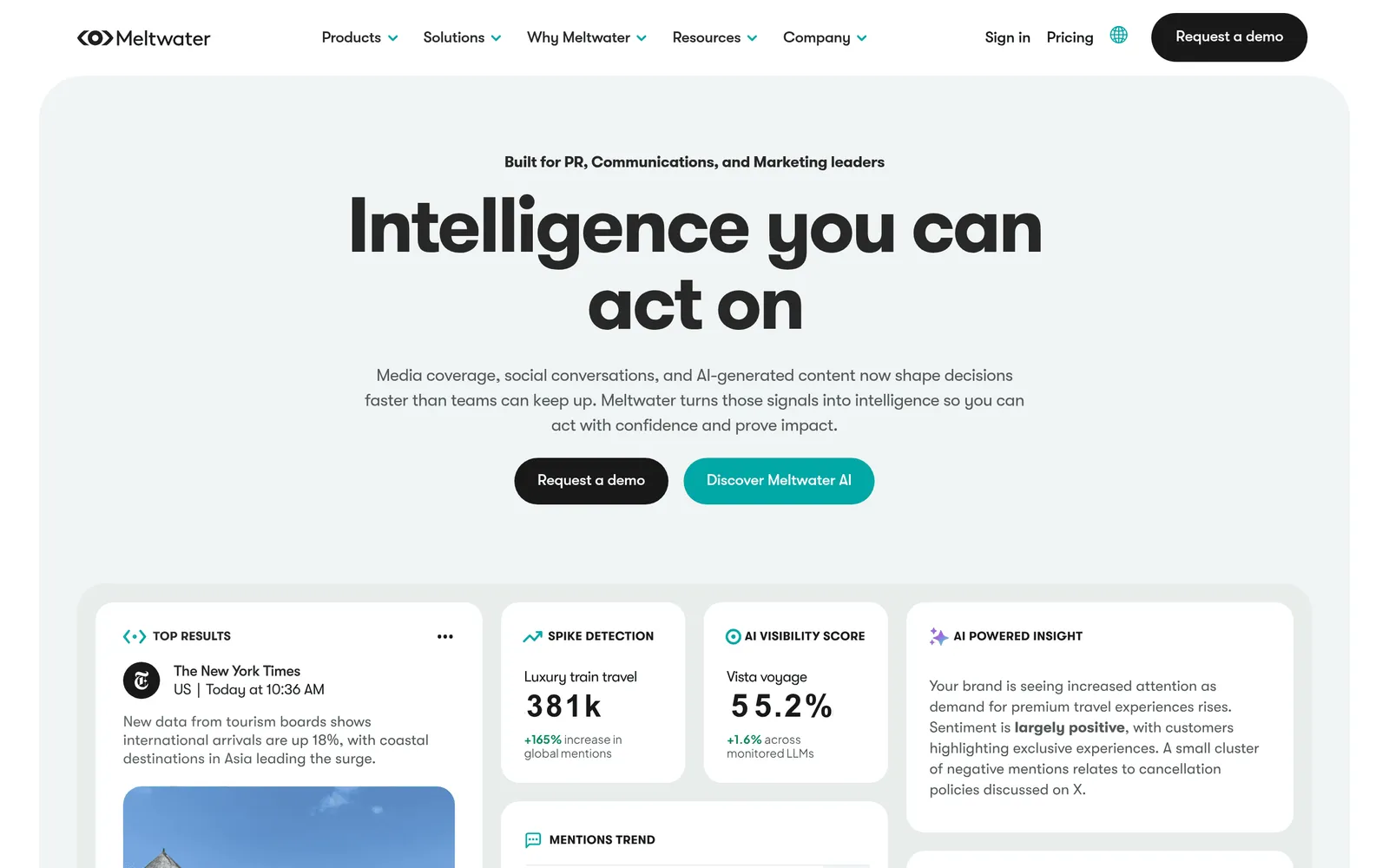
Meltwater is the media-intelligence veteran, strongest where earned coverage drives executive attention.
| Attribute | Detail |
|---|---|
| Entry price | Custom (Starter, Pro, Enterprise, Agency packages) |
| G2 rating | 4.1 / 5 (2,400+ reviews) |
| Sources | News, print, broadcast, podcasts, social |
| Key features | Mira AI reporting, PR and communications workflows, earned + social media in one report, broadcast and podcast coverage |
| Free trial | Demo only |
| Best-fit tier | Enterprise |
| Composite score | 84 / 100 |
Core Strengths
Meltwater's edge is breadth beyond social: online news, print, broadcast, and podcasts, connected to PR workflows and a Mira AI reporting layer. For communications teams that must prove impact across earned media and social in one report, that heritage shows.
Where It Falls Short
Pricing is quote-based across packages, which makes early comparison harder, and the interface is heavy. Buyers should define source scope, regions, users, and integrations before they can judge value fairly. Its news sentiment is trained mostly on journalist-authored content, so cross-check it against a native social tool if your conversation is mostly social slang.
Sentiment and Emotion Depth
Sentiment is competent and improved by Mira's summarization, strongest when tracking brand-level tone across many markets at once. It is built for macro scale, not surgical single-post reads.
Ideal Fit
Corporate communications, media relations, and investor-relations teams that need news, broadcast, and social sentiment in one reporting system.
Non-Obvious Insight
Meltwater is strongest when your organization treats earned media and public conversation as a single operating system. If your team only needs social sentiment, you will pay for a communications suite you rarely fully use.
5. Brand24: Best for Mid-Market Value
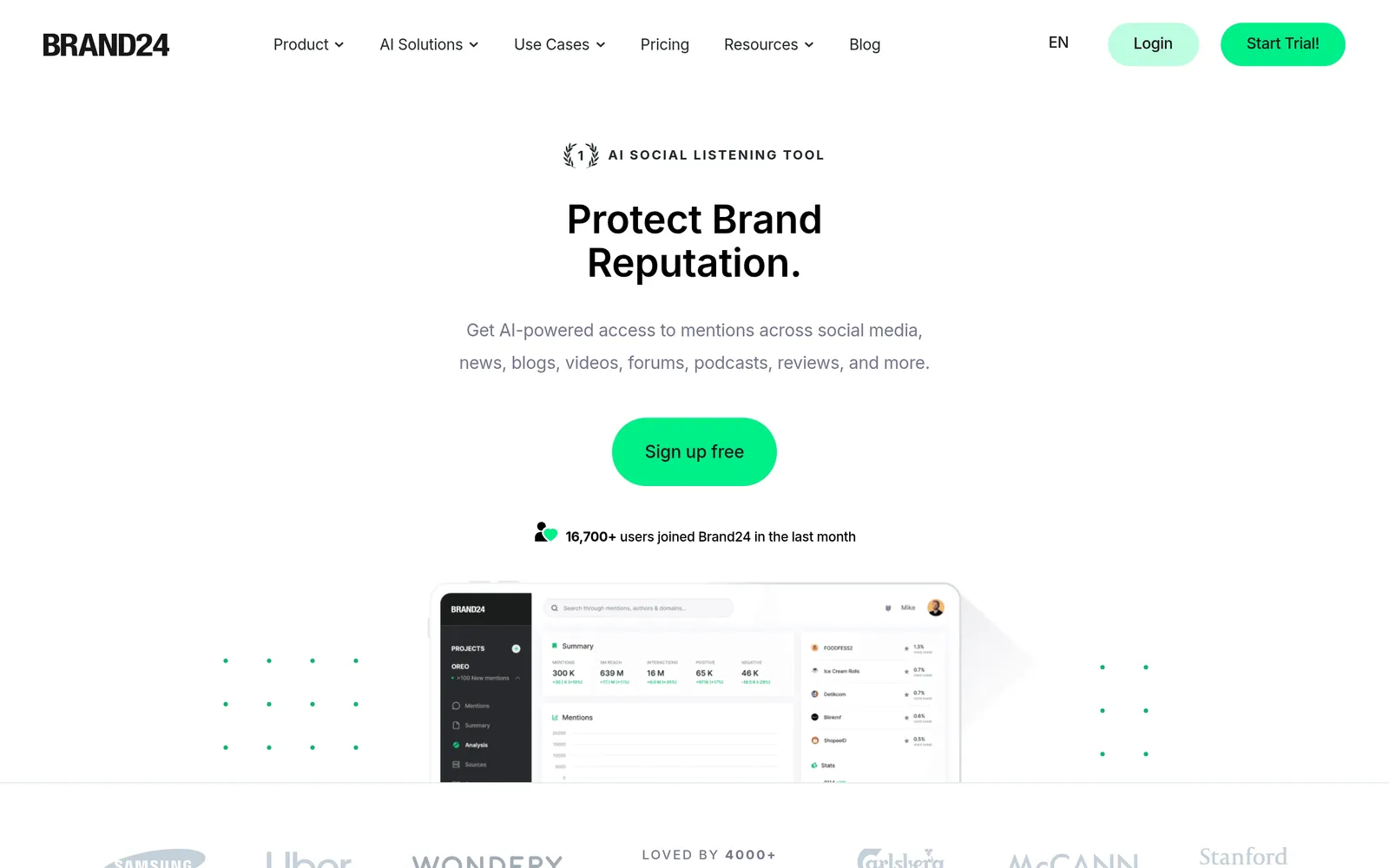
Brand24 has outgrown its old "cheap mention tracker" label.
| Attribute | Detail |
|---|---|
| Entry price | Individual $199/mo (annual), $249 monthly; Pro $399; Business $599; Enterprise from $1,499 |
| G2 rating | 4.6 / 5 (340+ reviews) |
| Sources | Social, news, blogs, forums, podcasts, reviews |
| Key features | AI Brand Assistant, 100+ languages, AI sentiment on every plan, topic analysis, events detection |
| Free trial | 14-day, no card |
| Best-fit tier | SMB / mid-market |
| Composite score | 83 / 100 |
Core Strengths
Brand24 packs a lot of monitoring into a clear plan structure: broad source coverage, AI sentiment on every plan, topic analysis, events detection, and an AI Brand Assistant. Its published F1 improvement (61 to 95 percent on a 50,000-mention evaluation) is more transparency than most competitors offer.
Where It Falls Short
At current public prices it is no longer a bargain-basement pick, so model mention limits and add-ons against BrandMentions and Awario. Lower tiers also throttle updates: the entry plan runs on roughly 12-hour update intervals, and real-time monitoring arrives at the Pro tier.
Sentiment and Emotion Depth
Three-way AI sentiment across 100-plus languages, with emotion and AI insights layered into higher tiers. The sentiment score is a rolling positive-versus-negative average, so pair it with spot checks of the angriest mentions before trusting a calm number.
Ideal Fit
Startups, agencies, and mid-market teams that want AI-assisted monitoring and sentiment without an enterprise contract.
Non-Obvious Insight
The 12-hour delay on the entry plan is the catch nobody flags at signup. For crisis response planning, a half-day lag can let a complaint spread across a full news cycle before you see it. If early warning is the point, budget for Pro from day one.
6. YouScan: Best for Visual Listening
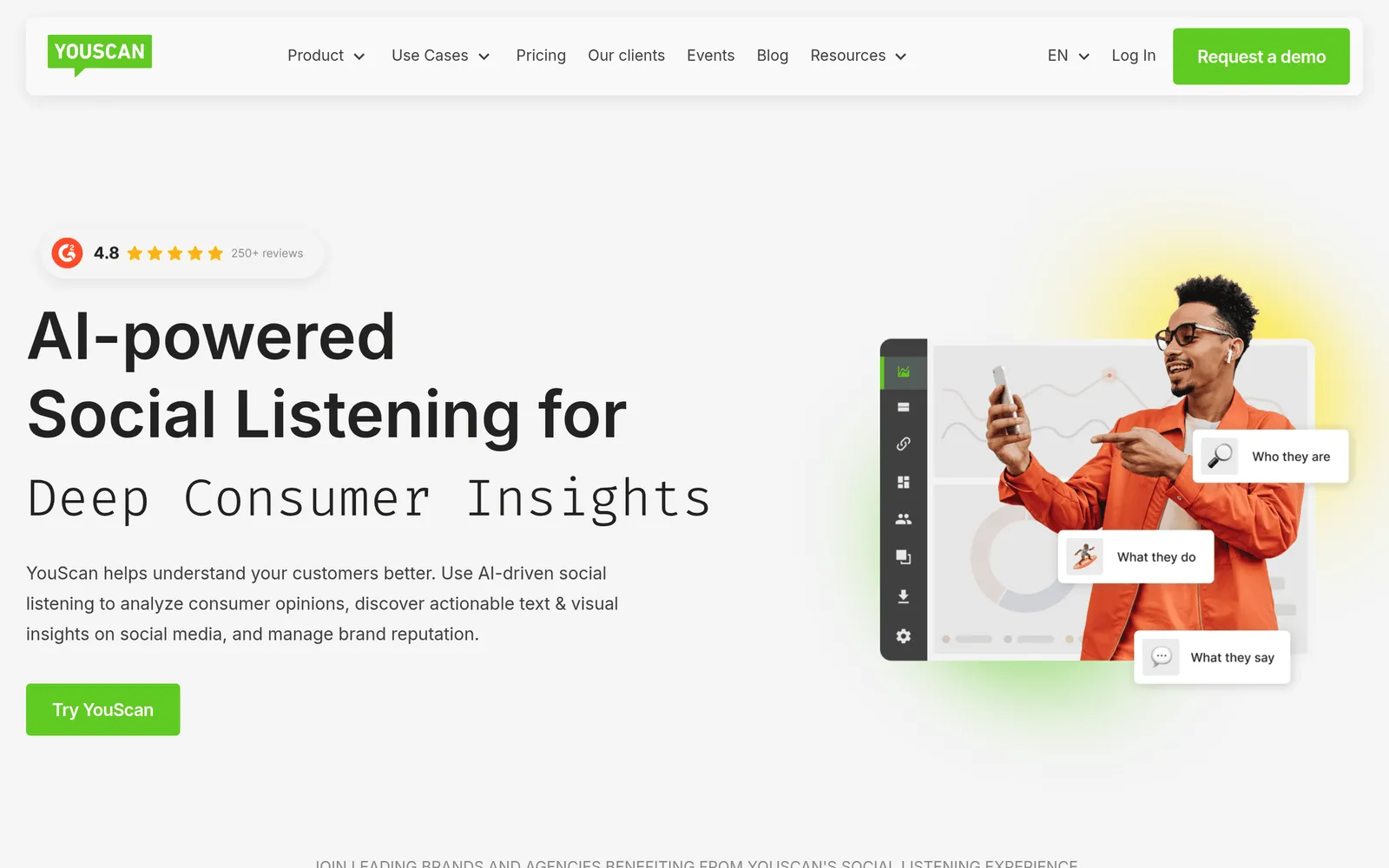
YouScan owns the visual niche that text-only tools miss.
| Attribute | Detail |
|---|---|
| Entry price | $499/mo (Starter 3, billed annually) |
| G2 rating | 4.7 / 5 |
| Sources | Social, blogs, forums, reviews, news, images |
| Key features | Logo + scene image recognition, aspect sentiment, trend detection, Insights Copilot conversational layer, unlimited users |
| Free trial | Demo only |
| Best-fit tier | Mid-market / Enterprise |
| Composite score | 82 / 100 |
Core Strengths
YouScan analyzes images, not just captions. Its Starter 3 plan lists 3 topics, up to 15,000 monthly mentions, unlimited users, aspect sentiment, trend detection, and its Insights Copilot conversational layer. If customers post your product without typing your name, this is often the only way to see it.
Where It Falls Short
The strongest visual features (full image recognition, Audience Insights, API) sit on Unlimited plans that require a quote, and the $499 floor is above budget text tools. Text sentiment is solid but secondary to the visual engine.
Sentiment and Emotion Depth
Aspect-level text sentiment paired with visual context most rivals cannot see, including scene and expression signals. That combination is its differentiator.
Ideal Fit
Consumer brands in beauty, food, beverage, fashion, retail, and travel, where perception lives in photos, creator content, and product-usage scenes.
Non-Obvious Insight
Visual listening often detects a usage problem before text does. A product repeatedly appearing broken, misused, or in unsafe settings can signal a quality issue before customers write a single formal complaint.
7. Sprout Social: Best for Social Workflow and Care Teams
Sprout Social is the most polished all-in-one here, with listening as an add-on rather than a core.
| Attribute | Detail |
|---|---|
| Entry price | Essentials $79, Standard $199, Professional $299, Advanced $399 per seat/mo; Listening add-on |
| G2 rating | 4.4 / 5 (4,000+ reviews) |
| Sources | Major social platforms + listening add-on |
| Key features | Smart Inbox, publishing, deep-neural-network listening sentiment with spike alerts, reporting, response routing |
| Free trial | 30-day |
| Best-fit tier | Mid-market / Enterprise |
| Composite score | 80 / 100 |
Core Strengths
Sprout shines when sentiment ties directly to social operations. A care team can spot negative sentiment, open the raw messages, and route responses from the same screen. Publishing, Smart Inbox, and reporting are genuinely best-in-class.
Where It Falls Short
Sentiment and Listening are not in the base plan, and per-seat pricing compounds fast. Its own documentation confirms Listening is a premium add-on that is not included by default in Standard, Professional, or Advanced. Coverage also skews to mainstream social, so a reputation hit on a niche forum can go unseen early.
Sentiment and Emotion Depth
Smart Inbox and Listening sentiment with spike alerts, built on a deep neural network model, though the documentation is candid that unsupported languages, media-only posts, and sarcasm can go unclassified.
Ideal Fit
Teams that already use Sprout for publishing, engagement, and care, and want sentiment folded into that daily workflow.
Non-Obvious Insight
Its human sentiment tags can double as a training benchmark. Some teams export Sprout's manually labeled messages as a ground-truth set to test other tools' automated scoring, which is a clever way to validate a purchase.
8. Awario: Best Affordable Underdog
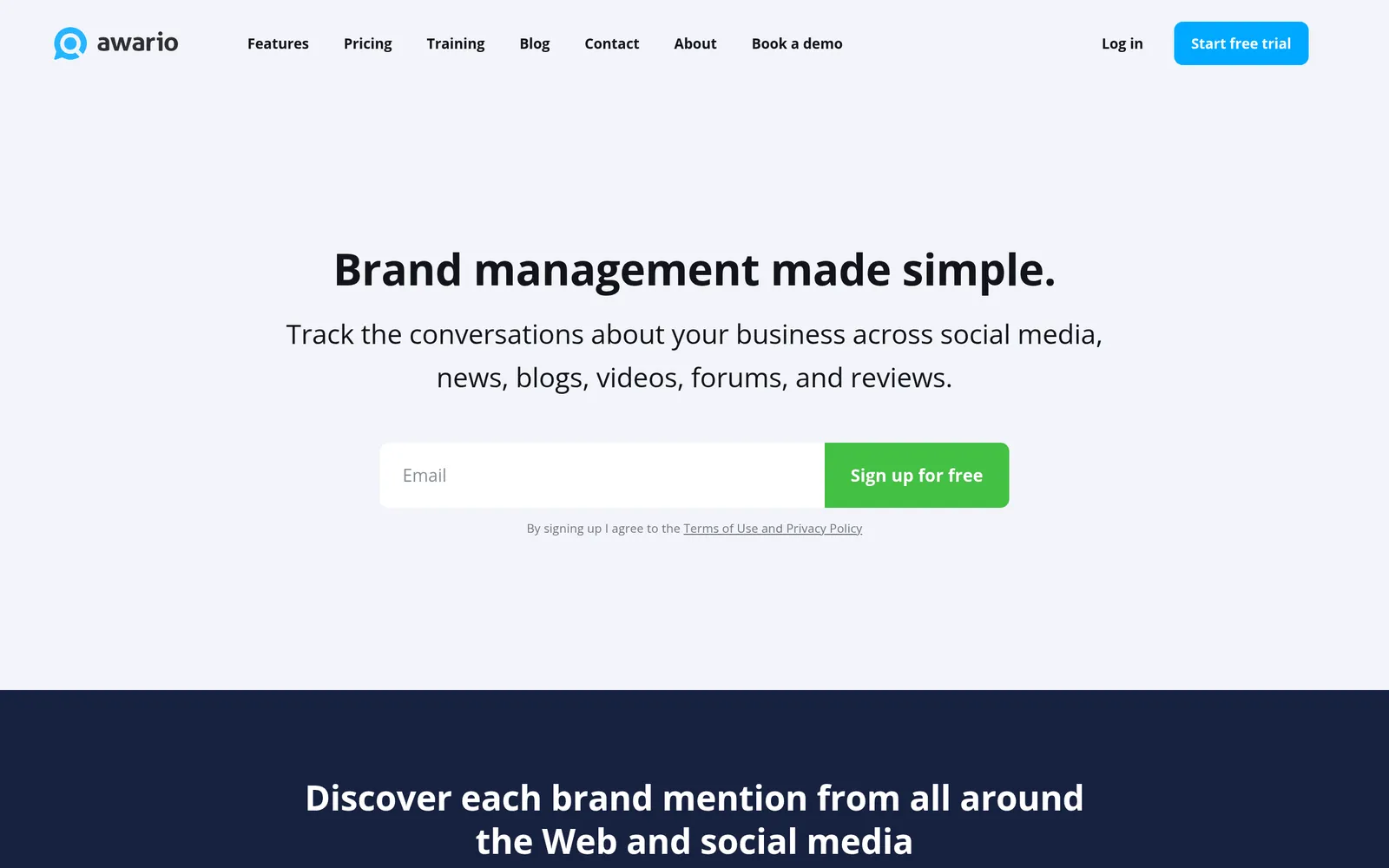
Awario punches above its price for lean, action-focused teams.
| Attribute | Detail |
|---|---|
| Entry price | Starter $29/mo (annual) or $49 monthly; Pro $149; Enterprise $399 |
| G2 rating | 3.9 / 5 (~50 reviews) |
| Sources | Social, web, news, blogs, forums, reviews |
| Key features | Boolean search on all tiers, Leads module for buyer-intent signals, transparent mention limits (30,000 to 1,000,000 monthly) |
| Free trial | Yes (limited) |
| Best-fit tier | Budget |
| Composite score | 76 / 100 |
Core Strengths
Awario includes Boolean search even on lower tiers, which matters more than most buyers realize, plus a Leads module that scans for people publicly asking for recommendations or complaining about a competitor. Its pricing is transparent, and its per-tier mention limits (30,000 new mentions monthly on Starter, up to 1,000,000 on Enterprise) are published openly.
Where It Falls Short
Its review signal is thin (roughly 50 G2 reviews), reporting feels dated next to newer suites, and sentiment accuracy is a known soft spot, with neutral comments sometimes mislabeled. Non-English sentiment weakens outside its core supported languages.
Sentiment and Emotion Depth
Basic three-way polarity. Treat it as directional, useful for spotting obvious praise or anger rather than fine emotion.
Ideal Fit
Bootstrapped founders, solo consultants, and lean marketing or sales teams that want Boolean precision and buyer-intent signals on a tight budget.
Non-Obvious Insight
Awario is a sales tool wearing a listening tool's clothes. The Leads module turns monitoring into pipeline, which most sentiment tools never attempt, so if your goal is revenue over reporting, that reframing changes which features matter.
9. Mention: Best for Lightweight Monitoring
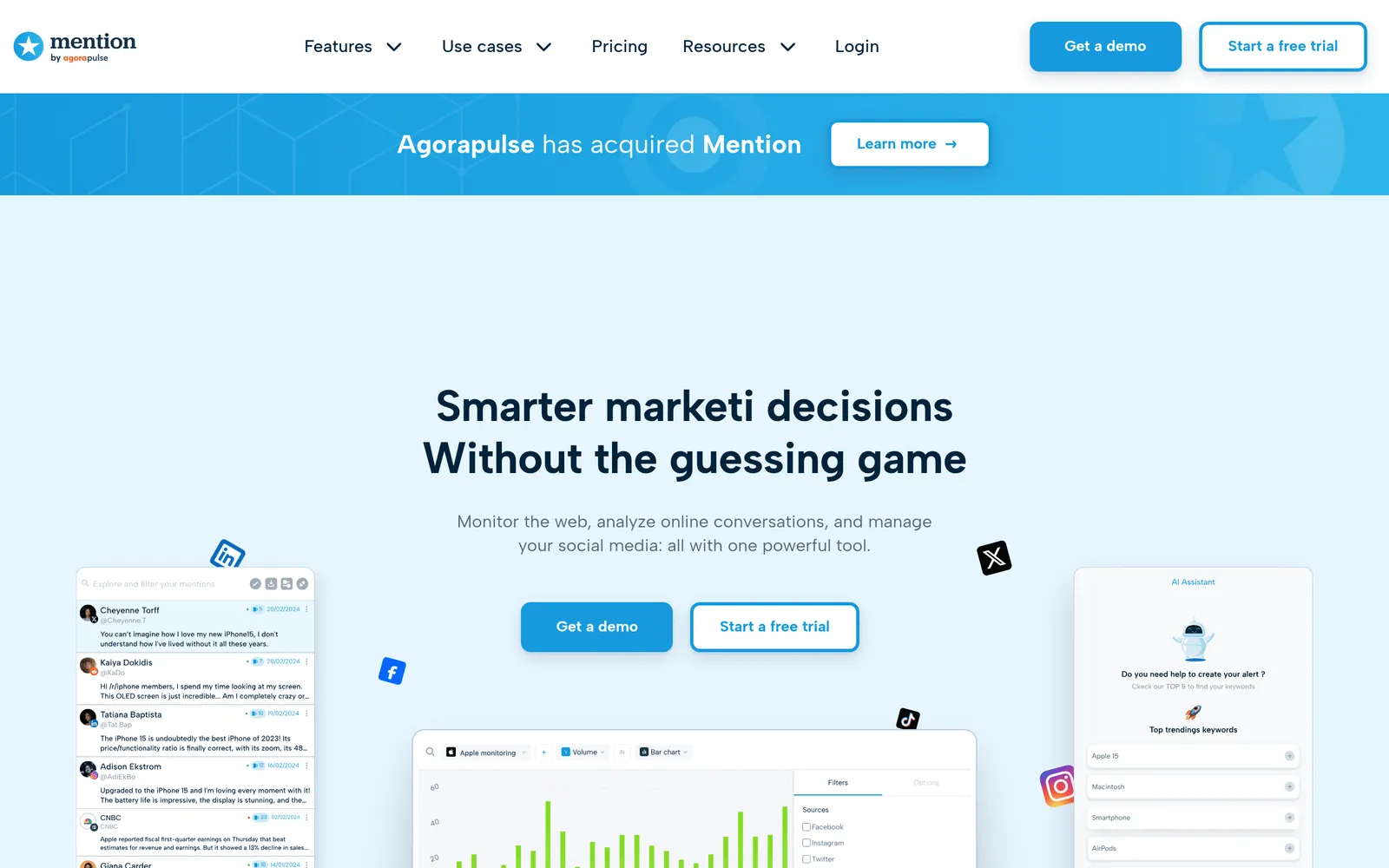
Mention, now part of Agorapulse, offers simpler monitoring with unusually specific sentiment documentation.
| Attribute | Detail |
|---|---|
| Entry price | Company Plan from $599/mo (annual) |
| G2 rating | 4.3 / 5 |
| Sources | Social, news, blogs, forums, 75+ review sites |
| Key features | Boolean search, 75+ review sites, 31+ high-accuracy sentiment languages, emotion detection with manual correction |
| Free trial | Yes (limited) |
| Best-fit tier | Mid-market |
| Composite score | 74 / 100 |
Core Strengths
Mention provides monitoring, sentiment, reporting, review coverage, and Boolean search in a lighter package than the enterprise suites. Its help center lists over 31 high-accuracy sentiment languages, with other languages handled at reduced accuracy, which is refreshingly precise.
Where It Falls Short
Its product packaging has changed under Agorapulse, with legacy standalone plans no longer sold to new customers and the current offering centered on the Company Plan. If long-term platform independence matters, ask direct questions about roadmap and data access before committing.
Sentiment and Emotion Depth
Sentiment plus emotion with manual correction. Its model leans toward marking weakly emotional mentions neutral to reduce noise, which keeps reports clean but can understate faint complaints.
Ideal Fit
Teams that want straightforward social, web, and review monitoring rather than a heavy research suite.
Non-Obvious Insight
Check what "neutral" is hiding. Pull neutral mentions containing words like confusing, slow, price, cancel, or support and read them by hand. That is where a tidy dashboard quietly buries early churn signals.
10. Mentionlytics: Best Value Specialist
Mentionlytics pairs a low entry price with a rating that matches the category leaders.
| Attribute | Detail |
|---|---|
| Entry price | $69/mo (Basic) |
| G2 rating | 4.9 / 5 (~90 reviews) |
| Sources | Social, news, web |
| Key features | Full AI sentiment stack, multilingual support, responsive customer support |
| Free trial | Yes |
| Best-fit tier | Budget / SMB |
| Composite score | 73 / 100 |
Core Strengths
Mentionlytics delivers a full AI sentiment stack with multilingual support at a price small teams can absorb, and reviewers consistently praise its support quality. For a lean team without an analyst, responsive support often matters more than raw feature count.
Where It Falls Short
Its review volume is thinner than the enterprise names, and source depth will hit ceilings on very large, multi-market programs. A 4.9 across roughly 90 reviews is encouraging but not the same evidence as thousands of reviews.
Sentiment and Emotion Depth
AI sentiment with multilingual coverage, where it quietly overdelivers for the price. Depth is modest but consistent.
Ideal Fit
Small businesses and lean agencies that want serious sentiment monitoring without mid-market rates.
Non-Obvious Insight
Cheap plus responsive beats powerful plus abandoned. For a team that will never staff a dedicated analyst, a well-supported budget tool gets used every week, while an unused enterprise suite becomes shelfware.
Specialist Tools for Product, Review, and CX Sentiment
These three are not general brand monitors, and ranking them against social listeners would mislead you. They solve a different measurement problem: sentiment on data you own or on reviews after money changed hands. Scored inside their own category, they are excellent.
Revuze: Best for Product and Review Sentiment
Revuze connects reviews, social, care, and commerce data into category, brand, and SKU-level intelligence.
| Attribute | Detail |
|---|---|
| Entry price | Custom |
| G2 rating | Limited review volume |
| Sources | Reviews, social, care, commerce, surveys |
| Key features | SKU + aspect-level sentiment, original-language review analysis, category/brand/product benchmarking |
| Free trial | Demo only |
| Best-fit tier | Product / ecommerce specialist |
| Composite score (category) | 82 / 100 |
Core Strengths
Revuze answers product-specific questions: which feature drives negative sentiment, which SKU is losing trust, which competitor weakness you can act on. It analyzes reviews in their original language to preserve slang and nuance.
Where It Falls Short
It is not built for PR alerts, broad media monitoring, or social crisis detection. That narrowness is the point, not a flaw.
Sentiment and Emotion Depth
Category, brand, product, SKU, benchmark, and aspect-level sentiment. Deeper on products than any general monitor here.
Ideal Fit
Product, ecommerce, insights, and innovation teams where review drivers matter more than mention volume.
Non-Obvious Insight
Review sentiment is often more commercially useful than social sentiment for product teams. Social tells you what people say in public. Reviews tell you what buyers say after they paid.
Qualtrics: Best for Survey and VoC Sentiment
Qualtrics, which absorbed Clarabridge's text-analytics engine, is strongest when sentiment sits inside a formal experience program.
| Attribute | Detail |
|---|---|
| Entry price | Custom |
| G2 rating | 4.4 / 5 |
| Sources | Surveys, open text, XM Discover feedback |
| Key features | XM Discover sentence-level sentiment (-5 to +5), five sentiment bands, theme detection |
| Free trial | Demo only |
| Best-fit tier | Enterprise VoC |
| Composite score (category) | 87 / 100 |
Core Strengths
XM Discover scores sentiment at the sentence level on a scale from -5 to +5, dividing results into five bands from Very Negative to Very Positive. For owned feedback (surveys, support text, CX programs) inside an existing Qualtrics deployment, that reduces tool fragmentation.
Where It Falls Short
It is not built for open-web brand monitoring. Its center of gravity is experience data, not public mention hunting, and full rollout takes months.
Sentiment and Emotion Depth
Sentence-level sentiment intensity plus theme detection, tuned for structured feedback rather than social chatter.
Ideal Fit
Enterprise CX, research, and VoC teams whose sentiment program starts with surveys and owned channels.
Non-Obvious Insight
Qualtrics sentiment is most useful joined to metadata: segment, plan, NPS, region, support history. Sentiment alone tells you mood. Sentiment plus metadata tells you where revenue risk sits.
Medallia: Best for Enterprise CX Signal Programs
Medallia, which acquired MonkeyLearn in 2022, turns feedback into workflow at enterprise scale.
| Attribute | Detail |
|---|---|
| Entry price | EDR-based custom pricing |
| G2 rating | 4.5 / 5 |
| Sources | Surveys, speech, social signals, digital and video feedback |
| Key features | Text + speech analytics, closed-loop feedback and case management, social signals, unlimited users |
| Free trial | Demo only |
| Best-fit tier | Enterprise CX |
| Composite score (category) | 85 / 100 |
Core Strengths
Medallia's Experience Data Record model bundles analytics, text and speech analytics, social signals, case management, and closed-loop feedback with unlimited users. Its strength is operationalizing sentiment across departments, not just labeling it.
Where It Falls Short
It is heavy if you only need external brand sentiment. A small PR team should not buy a CX operating system to solve a monitoring problem.
Sentiment and Emotion Depth
Text and speech analytics with themes and sentiment across dozens of languages and dialects, geared toward enterprise feedback rather than social slang.
Ideal Fit
Large CX, contact-center, and digital-experience teams that need feedback capture, analytics, and resolution in one system.
Non-Obvious Insight
Medallia's real value is closing the loop, not the label. If nobody owns the workflow after a negative signal appears, most of the platform's value evaporates into another dashboard.
A Quick Note on Tools You Will See in Older Lists
Consolidation has reshaped this category, and a few names in older articles are no longer standalone buyer options. MonkeyLearn was acquired by Medallia and is not a current standalone purchase, so treat any $299 MonkeyLearn pricing you find as stale. Clarabridge now lives inside Qualtrics, Talkwalker inside Hootsuite, Brandwatch inside Cision, and Mention inside Agorapulse. Ownership changes affect roadmap, data access, and support, so always confirm the current product before you compare.
The Core Differences, Head to Head
BrandMentions vs Brandwatch: BrandMentions wins when speed, cross-source coverage, and usability matter more than research depth. Brandwatch wins when you have analysts who can maintain complex queries and interpret large-scale data.
BrandMentions vs Brand24: These overlap most directly. BrandMentions leads on multi-source reputation accuracy and verifiability; Brand24 competes on its AI assistant, plan range, and 100-plus language coverage.
BrandMentions vs Meltwater: BrandMentions gives you focused sentiment and mention intelligence without buying a full PR suite. Meltwater wins when media relations, broadcast, and communications workflows must live in one enterprise platform.
Enterprise vs SMB vs Budget: Which Tier Fits You
Buying the wrong tier is the most expensive mistake in this category, and it cuts both ways. Enterprises underpay for capability and drown in noise. Small teams overpay and use ten percent of a suite.
| Tier | Tools | Typical annual cost | Buy this if |
|---|---|---|---|
| Enterprise intelligence | Brandwatch, Talkwalker, Meltwater | Five figures and up | You have a dedicated analyst, multi-market needs, and formal reporting obligations |
| Enterprise VoC and CX | Qualtrics, Medallia, Revuze | Five figures and up | Your sentiment starts in surveys, reviews, speech, or product data |
| Mid-market growth | BrandMentions, Brand24, YouScan | Roughly $1,200 to $12,000 | You need accurate cross-web sentiment and real workflows without enterprise overhead |
| Budget and lean teams | Awario, Mention, Mentionlytics | Roughly $350 to $7,200 | You are a founder or small team tracking a brand and a few competitors |
The cleanest buying rule: if your team has no dedicated analyst, do not buy an analyst-first platform. And if your team has no response workflow, do not buy a crisis dashboard before you define who replies, who escalates, and who approves.
One more option most buyers overlook: combine two tools. A cheap broad monitor for polarity plus a deeper visual or emotion specialist for high-risk mentions often costs less than a single enterprise suite and covers more of your real footprint.
What Sentiment Tools Really Cost, and What Enterprise Buyers Must Check
License price is the smallest part of the bill. Model total cost of ownership before you compare quotes: onboarding, analyst hours, implementation and services, per-seat scaling, listening or emotion add-ons, export and API access, historical backfill, and overage charges on mention quotas. A tool that looks cheap per seat can become the most expensive line item once five people and an add-on join the plan.
Enterprise procurement adds a second checklist that consumer listicles ignore entirely. Ask every finalist for their SOC 2 and ISO 27001 status, GDPR posture and a signed DPA, SSO and role-based access control, audit logs, data residency options, and retention and deletion controls. If a vendor cannot answer these quickly, that is itself an answer.
Finally, interrogate data quality, because it distorts every percentage you will report. Ask how the tool deduplicates syndicated news, filters bots and spam, and handles quoted reposts and influencer amplification. A sentiment score built on duplicated or bot-inflated mentions is precise and wrong at the same time.
How to Trial and Validate Sentiment Accuracy Yourself
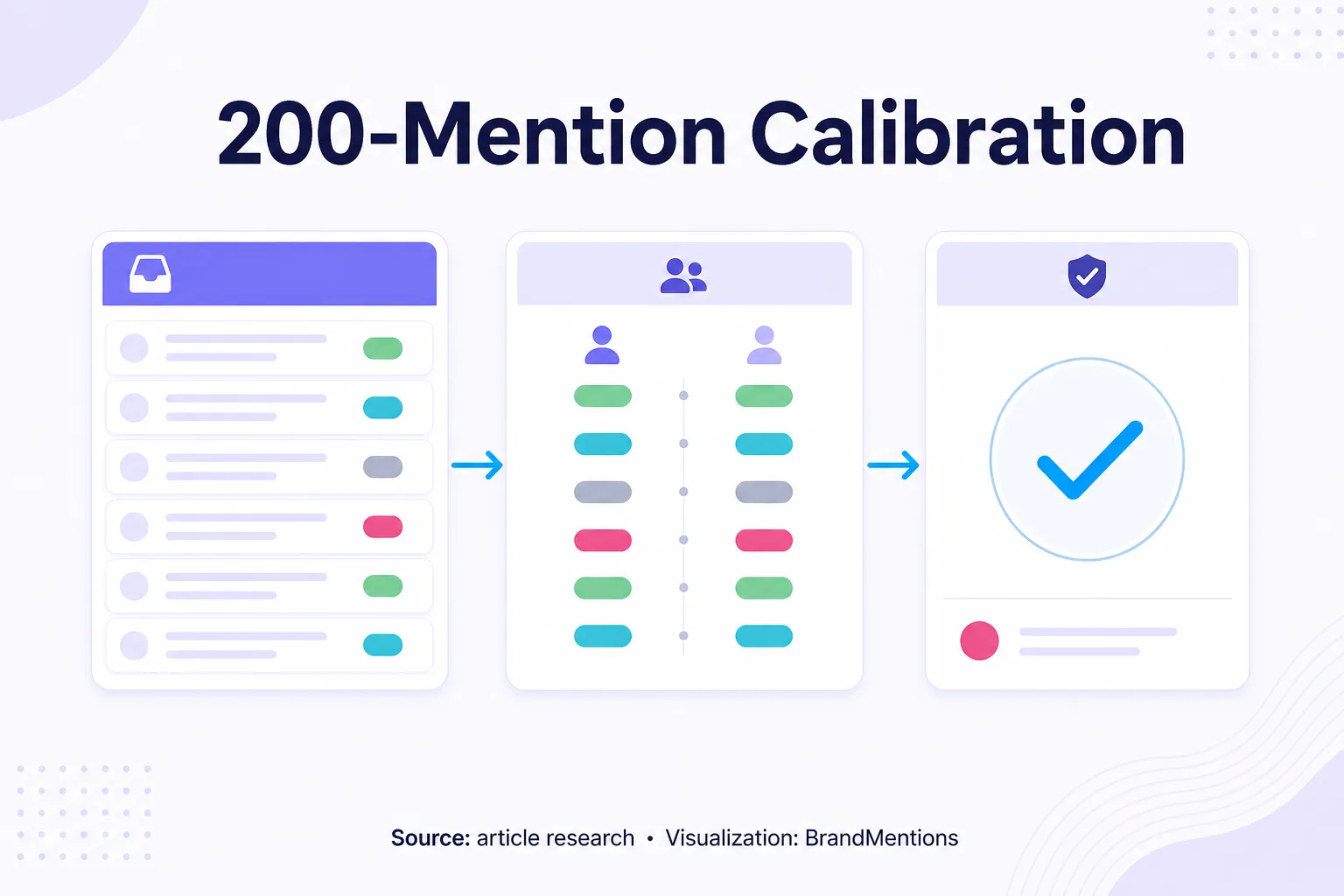
Do not trust a vendor's accuracy claim. Test it with your own data. This takes an afternoon and saves you from a year-long contract mistake.
| Step | What to do | Pass condition |
|---|---|---|
| 1 | Build five real queries: brand, misspellings, product, competitor, one high-risk complaint phrase | Results are relevant without heavy manual cleanup |
| 2 | Pull 200 raw mentions across sources | At least 80 percent are relevant to the topic |
| 3 | Hand-label the sentiment yourself | The tool agrees with your judgment often enough to report on |
| 4 | Check false negatives | Real complaints are not hidden as neutral |
| 5 | Check source coverage | Reviews, forums, Reddit, news, and niche sources appear where you expect them |
| 6 | Test alerts | Negative spikes reach the right person fast |
| 7 | Export data | CSV, PDF, or API access matches your workflow |
| 8 | Run a crisis simulation | The tool surfaces source, velocity, emotion, and a clear next action |
The 200-Mention Calibration Rule: label a sample of your own real mentions and compare the tool's scores against yours before you buy, because messy brand data is the only honest test.
Do not expect perfect accuracy. Expect inspectability. A sentiment tool should let you see why a score moved, which mentions caused it, and who should act next. Test language coverage the same way: run one sentence in English and in your target language, and if the sentiment flips without a cultural reason, the second-language model needs scrutiny. This discipline is the same one that underpins good review response and handling negative feedback programs.
Frequently Asked Questions
What is the most accurate sentiment analysis tool in 2026?
Accuracy depends on your data sources more than any single vendor claim. For cross-web accuracy with source verification, BrandMentions rates highest in this comparison. For enterprise-scale consumer research, Brandwatch leads on depth, and for owned feedback, Qualtrics and Medallia lead. The honest answer: the most accurate tool is the one that covers your sources and lets you verify every score against the original post.
How much does a sentiment analysis tool cost?
Budget tools like Awario start around $29 a month. Mid-market tools like BrandMentions start at $99 a month, and Brand24 at $199 a month. Enterprise suites such as Brandwatch, Talkwalker, and Meltwater use custom pricing that typically reaches five figures a year once you add sources, seats, and onboarding. Always model add-ons and overages, not just the base plan.
Can sentiment analysis tools detect sarcasm?
Partially. Modern deep-learning models handle sarcasm, idioms, and emotional nuance far better than older systems, but no tool is reliable on every individual post, especially short ones. Trust the aggregate trend across thousands of mentions, and have a human verify any single score before you act on it.
Do I need a separate sentiment tool if I already use a social media manager?
Often yes. Many all-in-one suites gate sentiment and listening behind top tiers or sell them as separate add-ons, which inverts the bundled-savings logic. If sentiment drives real weekly decisions for your team, a focused specialist usually reads tone more accurately and costs less than unlocking it inside a suite.
What is the best free or cheapest sentiment analysis tool?
Among the serious options here, Awario has the lowest entry price at $29 a month on its Starter plan (annual), followed by Mentionlytics at $69 a month and BrandMentions at $99 a month. Several vendors, including BrandMentions, Brand24, Awario, and Mentionlytics, offer a free trial so you can test on your own data before paying, and Brand24's 14-day trial requires no card.
Which sentiment analysis tool supports the most languages?
For raw multilingual breadth, Talkwalker leads this comparison, with its pricing page listing 187 languages across 196 countries. Brand24 covers 100-plus languages, and Mention lists over 31 high-accuracy sentiment languages with others handled at reduced accuracy. Outside major languages, always validate tone on your own data first, because accuracy degrades far more than vendor language counts suggest.
Conclusion: Buy the Decision, Not the Dashboard
The category is crowded because sentiment matters more than ever, and the crowd hides a simple truth: capability is not fit. Brandwatch and Meltwater are excellent and wrong for most small teams. Awario is limited and perfect for a lean, revenue-focused crew. There is no single best tool, only the best tool for a named decision, in the languages you operate, with an accuracy you can verify.
So name the decision first. If you need early warning on reputation risk, prioritize real-time updates, source coverage, and honest API access. If you need consumer research, prioritize depth and analyst capacity. If you need product truth, go to reviews and CX data, not social volume. Then run the afternoon-long calibration test before you sign anything.
My closing advice, earned from watching too many teams buy backward: start with the least expensive tool that genuinely covers your real sources, run it for one full quarter, and let real limits, not vendor pitches, tell you when to level up. You will spend less, learn faster, and end up on the right tier for reasons you can actually defend.
Filed under: Brand Monitoring


3 comments