Best Multilingual Social Listening Tools in 2026: Ranked and Compared
An objectively ranked guide to the best multilingual social listening tools, scored on real per-language source depth, native sentiment accuracy and regional-platform reach.

The best multilingual social listening tools help brands monitor conversations across languages, regions, and local platforms, not just translate mentions after they are collected. In this guide, we compare the top tools for 2026 based on multilingual coverage, native-language sentiment, regional platform access, pricing, and real-world use cases.
TL;DR: The three highest-scoring multilingual social listening tools in this comparison are BrandMentions (best for full-web multilanguage coverage, from $79/mo billed annually), Meltwater (best for enterprise East Asia and traditional media, custom pricing), and Sprinklr (best for regional-platform breadth and enterprise governance, custom pricing). No single tool wins in every region, so choose for your worst-covered market, not your best one.
Key Takeaways
- "Multilingual support" and multilingual coverage are two different products. Most roundups score a translated dashboard. This one scores whether the crawler actually reaches non-English sources, whether sentiment runs in the source language, and whether the domestic platforms your market uses are covered at all.
- No tool wins everywhere, and the language count on the pricing page is close to useless. Meltwater and Pulsar lead on East Asian platforms, Determ punches above its price in Europe, Awshar stands out for India-specific language and dialect coverage, and BrandMentions leads full-web multilanguage capture at a self-serve price.
- Every automated sentiment number in this category is an aggregate that hides its own worst case. Not a single vendor here publishes per-language sentiment accuracy, so a headline "95%" tells you almost nothing about your specific Arabic, Thai, or Japanese feed. Test before you trust.
As the founder of BrandMentions, I’ve spent years working with multilingual monitoring at scale, and the biggest gap I’ve seen is not language support on paper, but whether a tool actually captures the right sources and understands the conversation in context.
A tool can score sentiment beautifully in English and still be functionally blind in Warsaw, Riyadh, Seoul, or São Paulo, because it never crawled the sources where those conversations live.
One disclosure up front, because it matters for how you read this. I run BrandMentions, which appears in this ranking. I held it to the exact same five-criterion rubric as every competitor, and I flag where it loses.
What Is Multilingual Social Listening?
Multilingual social listening is the ability to collect, classify, analyze, and alert on public conversation across multiple languages and regions using native-language queries, country and source filtering, and sentiment models that preserve local meaning. It is not the translation of mentions after collection.
In plain terms, it means monitoring what people say about a brand, topic, or competitor in the languages they actually write in, on the platforms they actually use, scored by models that understand the source language rather than an English approximation of it. True multilingual listening rests on three pillars: native-language data capture (crawlers that reach non-English sources), in-language sentiment (scoring before any translation step), and regional platform reach (the domestic networks a market lives on).
That distinction is the whole story. Vendors sell the first thing and let you assume the second.
After years of building BrandMentions, one of the biggest lessons I’ve learned is that language support means very little if the crawler is not actually present where the conversation happens.
At a Glance: Best Multilingual Social Listening Tools by Use Case
- Best for multilingual social listening with full-web coverage: BrandMentions. Covers major social platforms, plus blogs, news, forums, and reviews in 200+ countries & languages with Boolean control for native, transliterated, and misspelled terms, at a self-serve price.
- Best for enterprise East Asia and traditional media: Meltwater. The clearest documented coverage of WeChat, Weibo, RED, Douyin, KakaoTalk, and LINE, plus deep broadcast and print.
- Best for global consumer intelligence and visual listening: Lumen by Talkwalker. Large source scale, image and video recognition, now delivered through Hootsuite.
- Best for regional-platform breadth and governance: Sprinklr. Documented full-firehose VK access plus WeChat, LINE, and Weibo inside one enterprise query builder.
- Best for APAC social depth (Xiaohongshu, Douyin, Naver): Pulsar. The most complete documented Asia-Pacific source list, with unsampled data.
- Best for historical archive research: Brandwatch. 1.4 trillion posts back to 2008, analyst-grade tooling.
- Best European and CEE underdog: Determ. 107 language filters, unlimited users, and Western Balkans traditional media from €99 a month.
- Best for visual plus multilingual: YouScan. Logo and scene detection that catches brand appearances with no text at all.
- Best mid-market all-rounder: Mentionlytics. Broad language claims, an AI advisor, and transparent tiers.
- Best for lean SMB teams: Brand24. Self-serve pricing, published sentiment methodology, easy trial.
- Best for India: Awshar. 20+ Indian languages and hundreds of dialects, built for Hinglish and regional nuance.
- Best budget Boolean control: Awario. Boolean search and API access on the entry plan at the lowest serious price.
The first question I ask about a multilingual monitoring tool is not "How many languages do you support?"
It is "Show me the raw mentions from the market I care about most."
How We Scored: The Multilingual Performance Rubric
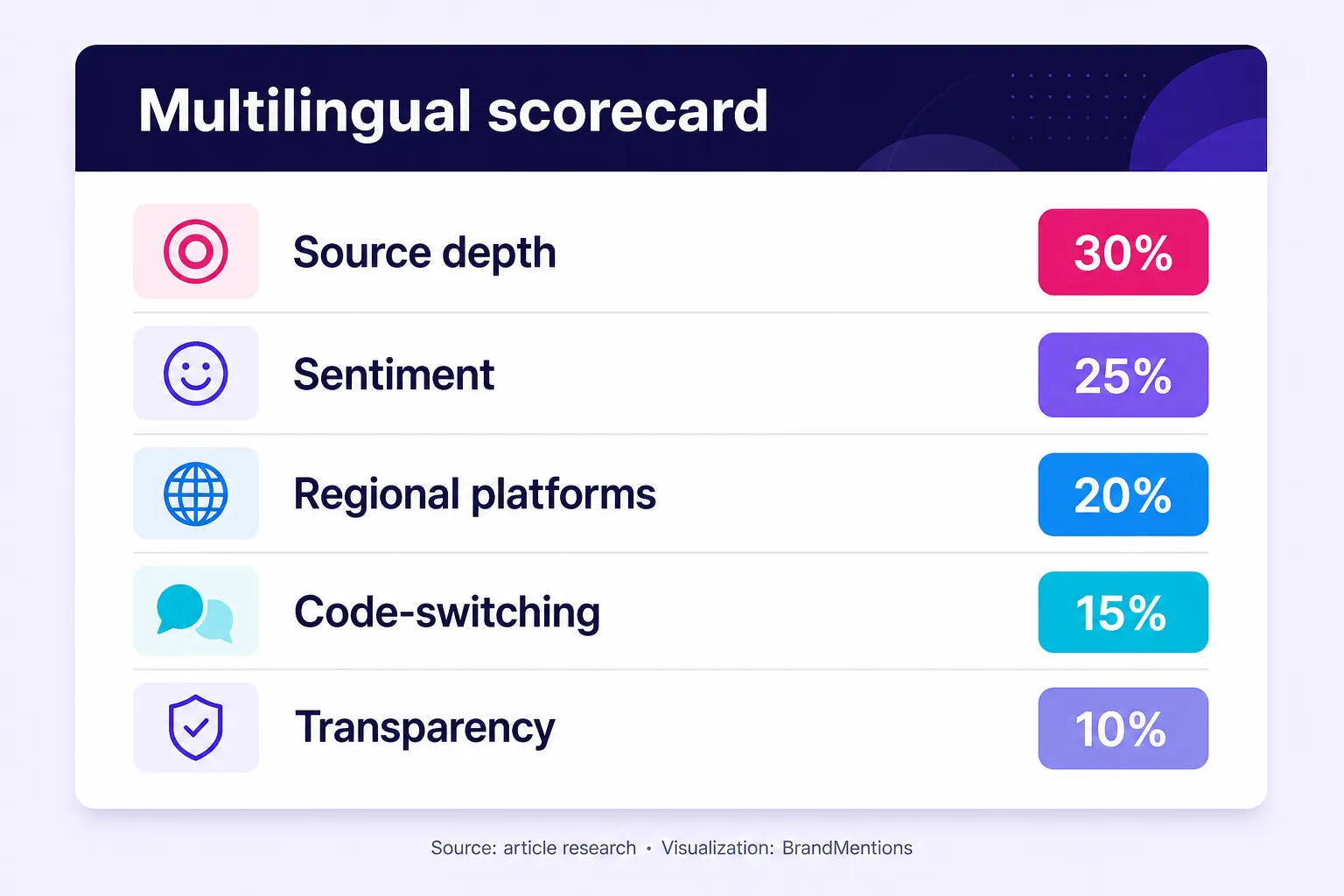
Most "best multilingual" lists rank heavily on brand familiarity. This guide uses five disclosed criteria focused specifically on multilingual performance. Here is the weighting, stated so you can argue with it.
| Criterion | Weight | What we rewarded |
|---|---|---|
| Non-English source depth | 30% | Real regional news, forums, and blogs crawled per market, not the number of UI languages |
| Sentiment methodology | 25% | Native or language-aware scoring versus translate-then-score, plus honest accuracy disclosure |
| Regional platform reach | 20% | WeChat, Weibo, Douyin, RED, VK, LINE, Naver, KakaoTalk, and local forums as first-class sources |
| Code-switching and query control | 15% | Boolean, transliteration, and mixed-script handling for Hinglish, Arabizi, Spanglish |
| Per-language transparency | 10% | Whether the vendor documents which languages are native versus translated |
One thing running a social listening platform teaches you very quickly: source coverage matters more than a big language number on a pricing page.
Scores use a 10-point scale and are weighted according to the methodology above. A high language count alone does not produce a high score: tools earn points for demonstrated source depth, native-language analysis, documented regional-platform access, query flexibility, and transparency about what is actually supported.
The Translation Mirage: a localized interface is not language coverage. If a tool renders its buttons in twelve languages but pipes every foreign mention through machine translation before scoring it, you are buying a mirror, not a microphone.
| Tool | Non-English source depth (30%) | Sentiment methodology (25%) | Regional platform reach (20%) | Code-switching / query control (15%) | Transparency (10%) | Weighted total |
|---|---|---|---|---|---|---|
| BrandMentions | 9.5 | 9.0 | 8.0 | 9.5 | 8.5 | 8.98 |
| Meltwater | 9.0 | 8.5 | 9.5 | 7.5 | 8.5 | 8.70 |
| Sprinklr | 8.5 | 9.0 | 9.0 | 7.0 | 9.5 | 8.60 |
| Pulsar | 8.5 | 8.0 | 9.5 | 7.5 | 7.5 | 8.33 |
| Brandwatch | 9.0 | 8.5 | 6.5 | 8.5 | 9.0 | 8.30 |
| Lumen by Talkwalker | 9.0 | 8.5 | 7.0 | 7.5 | 7.5 | 8.10 |
| Awshar | 8.0 | 8.5 | 5.5 | 9.5 | 5.5 | 7.60 |
| Determ | 8.5 | 7.0 | 5.5 | 7.0 | 7.5 | 7.20 |
| YouScan | 7.5 | 8.5 | 5.5 | 6.5 | 7.5 | 7.20 |
| Brand24 | 7.5 | 8.0 | 5.0 | 6.0 | 9.0 | 7.05 |
| Mentionlytics | 7.5 | 7.0 | 5.0 | 6.5 | 6.0 | 6.58 |
| Awario | 6.5 | 6.0 | 4.5 | 9.0 | 6.5 | 6.35 |
Where weighted totals are tied, final ordering reflects the tool’s fit with the article’s core multilingual-listening criteria, particularly source depth and regional coverage.
How Is Multilingual Coverage Different From Multilingual Support?
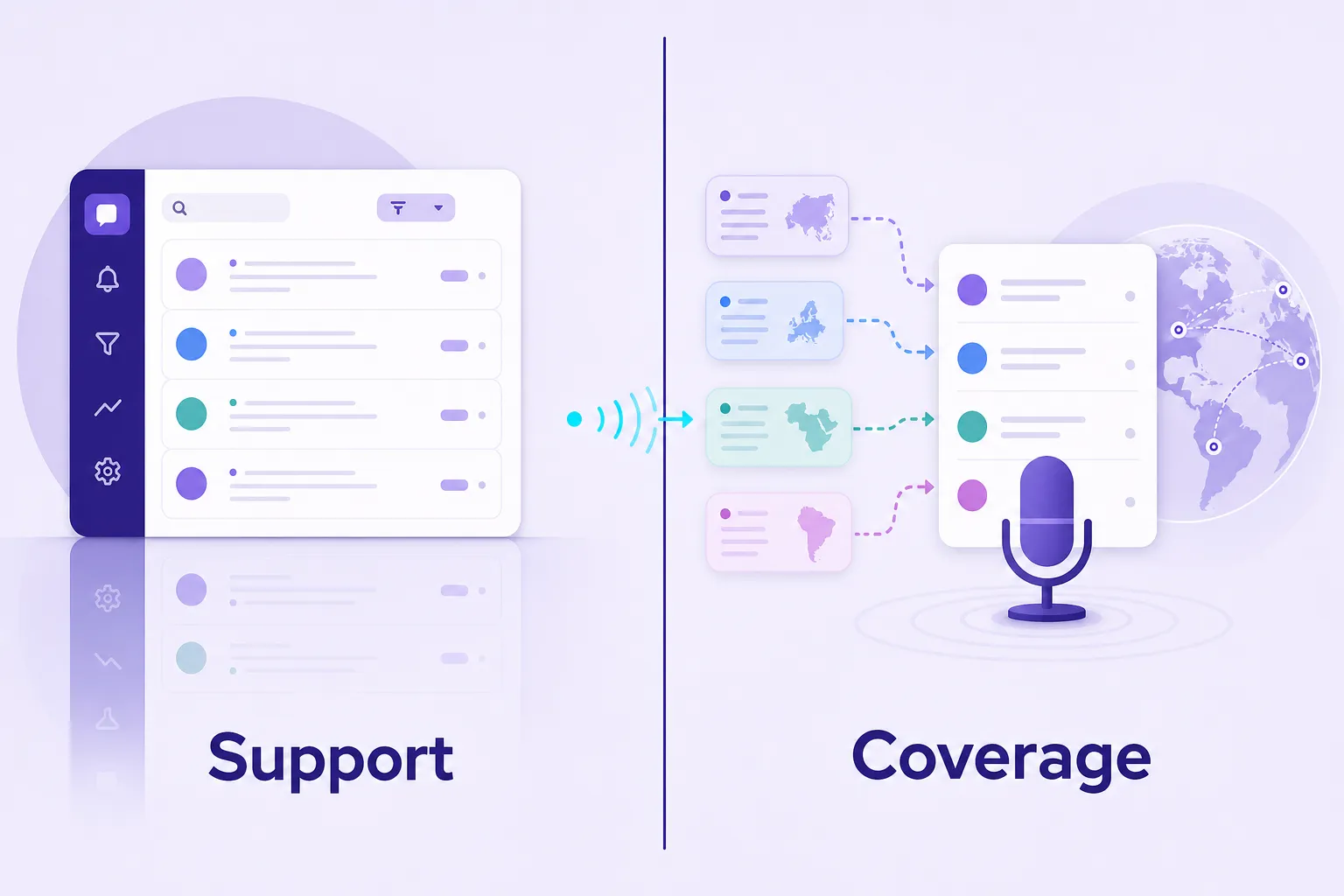
Support is an interface property. Coverage is a data property.
A tool supports a language when its dashboard, reports, and sentiment labels render in it. A tool covers a language when its crawlers reach the sources where that language is spoken and its models read it natively.
The two decouple hard outside English. A vendor can support Japanese because the UI translates Japanese posts into English, while its crawler never touches a Japanese forum, never handles honorifics, and never separates sarcasm from complaint. The practical test is blunt. Ask a vendor to show you 50 raw, untranslated mentions in your target language from the last seven days. If they can only show translated summaries, you found support wearing a coverage costume.
Ask every vendor for 50 raw, untranslated mentions in your priority language from the past seven days. If all they can produce is an English summary, the coverage is not there, whatever the language count on the pricing page says.
Does Native-Language Sentiment Really Beat Translate-Then-Score?
Yes, but only where the vendor built or tuned models for the language, market, and source type. Translate-then-score often survives simple polarity and breaks on sarcasm, idiom, negation, honorifics, and mixed scripts.
Two mechanics break in a translation pipeline. First, machine translation quality on informal social text (abbreviations, slang, emoji-as-grammar) is far lower than on formal prose. A Japanese review that says "悪くない" translates literally as "not bad," which an English model scores neutral, while in Japanese public communication that phrasing is often high praise. Second, the translation step adds its own error before the sentiment model even runs, and the more distant a language is from English structurally, the more the score drifts toward a false neutral, quietly erasing the negative spikes a crisis team needs to catch. If you want the mechanism behind why scores behave this way under linguistic noise, our breakdown of sentiment analysis explained covers it.
The Language Audit. Don't report multilingual sentiment until a native speaker has manually checked at least 100 raw mentions per priority language.
If a vendor tells you they support 200 languages, ask what ‘support’ means. Collection, filtering, sentiment, and translation are four very different things.
Master Comparison Table
Scores are an editorial composite from the five-criterion rubric above, on a 10-point scale. Language figures distinguish recognition from sentiment wherever the vendor documents that split. G2 signals are approximate and move over time.
| Rank | Tool | Best fit | Languages (recognition / sentiment) | Native sentiment | Regional platforms | Starting price | G2 |
|---|---|---|---|---|---|---|---|
| 1 | BrandMentions | Full-web native coverage | 100+ | Yes (Pro+) | VK, Telegram, full web | $79/mo annual | 4.9 |
| 2 | Meltwater | Enterprise + East Asia + media | 240+ | Yes | WeChat, Weibo, RED, Douyin, KakaoTalk, LINE, Naver | Custom | 4.1 |
| 3 | Sprinklr | Regional breadth + governance | 160+ / 100+ | Yes | VK firehose, WeChat, LINE, Weibo | Custom | 4.2 |
| 4 | Pulsar | APAC social depth | 200+ | Yes | WeChat, Weibo, RED, Douyin, Bilibili, Naver, VK | Custom | 4.4 |
| 5 | Brandwatch | Historical research | any collection / 44 sentiment | Yes | Broad Western + archive | Custom | 4.3 |
| 6 | Lumen by Talkwalker | Global consumer intelligence | 187 / narrower sentiment set | Yes | LINE, Weibo, KakaoTalk | Custom | 4.4 |
| 7 | Awshar | India | 20+ Indian, 500+ dialects | Yes | India-first social + web | Quote | - |
| 8 | Determ | European PR | 107 filters | Yes (all plans) | EU web + Balkan traditional media | €99/mo | 4.5 |
| 9 | YouScan | Visual + multilingual | multi-language | Yes | Mainstream + visual social | $499/mo annual | 4.6 |
| 10 | Brand24 | Lean SMB | 90+ sentiment / 24 filters | Yes | Western social + web | $199/mo annual | 4.6 |
| 11 | Mentionlytics | Mid-market all-rounder | 240+ claim | Yes | Telegram, Bluesky | $49/mo annual | 4.9 |
| 12 | Awario | Budget Boolean | ~25 practical | Partial | Western social + web | $29/mo annual | 4.1 |
The language count gets a tool onto your shortlist. The raw mention audit in your hardest language decides the winner. Never let the first number stand in for the second.
The Ranked Profiles
Every tool below is evaluated against the same six questions, in the same order, so you can compare like for like.
1. BrandMentions: Best multilingual social listening tool full web-coverage
BrandMentions takes a different architectural route than most of this list: it crawls the open web (blogs, news, forums, reviews) rather than depending mainly on social APIs, which matters because the long tail of regional conversation often lives outside the major platforms.
| Field | Detail |
|---|---|
| Entry price | $99/mo billed quarterly, $79/mo billed annually |
| Languages | Multilingual coverage across 200+ countries and territories. |
| Regional platforms | Full web, all mainstream social platforms, broad open-web coverage across local news, blogs, forums, reviews. |
| Sentiment method | Native, in-language |
| Free trial | 7 days |
Multilingual Coverage
Almost all supported languages with country and territory filtering across 200+ markets. The web crawl reaches regional blogs, forums, and local news that API-gated tools skip, with the strongest depth in European, LATAM, and MENA markets where the open web remains a primary conversation layer.
Regional Platform Reach
Strong across Western social plus full-web mention tracking, including unlinked mentions and VK. This is the honest weak spot: no WeChat, Naver, LINE, or Xiaohongshu. If East Asian domestic platforms are your core market, the enterprise specialists below cover them better.
Sentiment Method
Native, in-language scoring from the Pro plan across the supported set, with no translate-then-score step for those languages. Accuracy is reported in aggregate, so high-stakes markets still need a human audit.
Pricing and Limits
Starter includes 5,000 mentions a month. Pro is $299 monthly or $249 annually (30,000 mentions), Expert $499 monthly or $399 annually (75,000 mentions, Boolean search, real-time updates), and Enterprise from $1,299 monthly or $1,099 annually with API access and full historical data.
The Non-Obvious Insight
The real multilingual advantage is not the language list. It is combining native-script, transliterated, misspelled, and competitor terms into one controlled query, so a Portuguese or Arabizi variant does not fall through the gaps that per-language topic setups create.
Best-Fit Buyer
Global brand teams and agencies monitoring 5 or 50 markets that need broad native-language capture, Boolean precision, and real-time alerts without an enterprise contract, regardless if the conversation lives on forums, blogs, and regional news or only on social.
2. Meltwater: Best for enterprise East Asia and traditional media
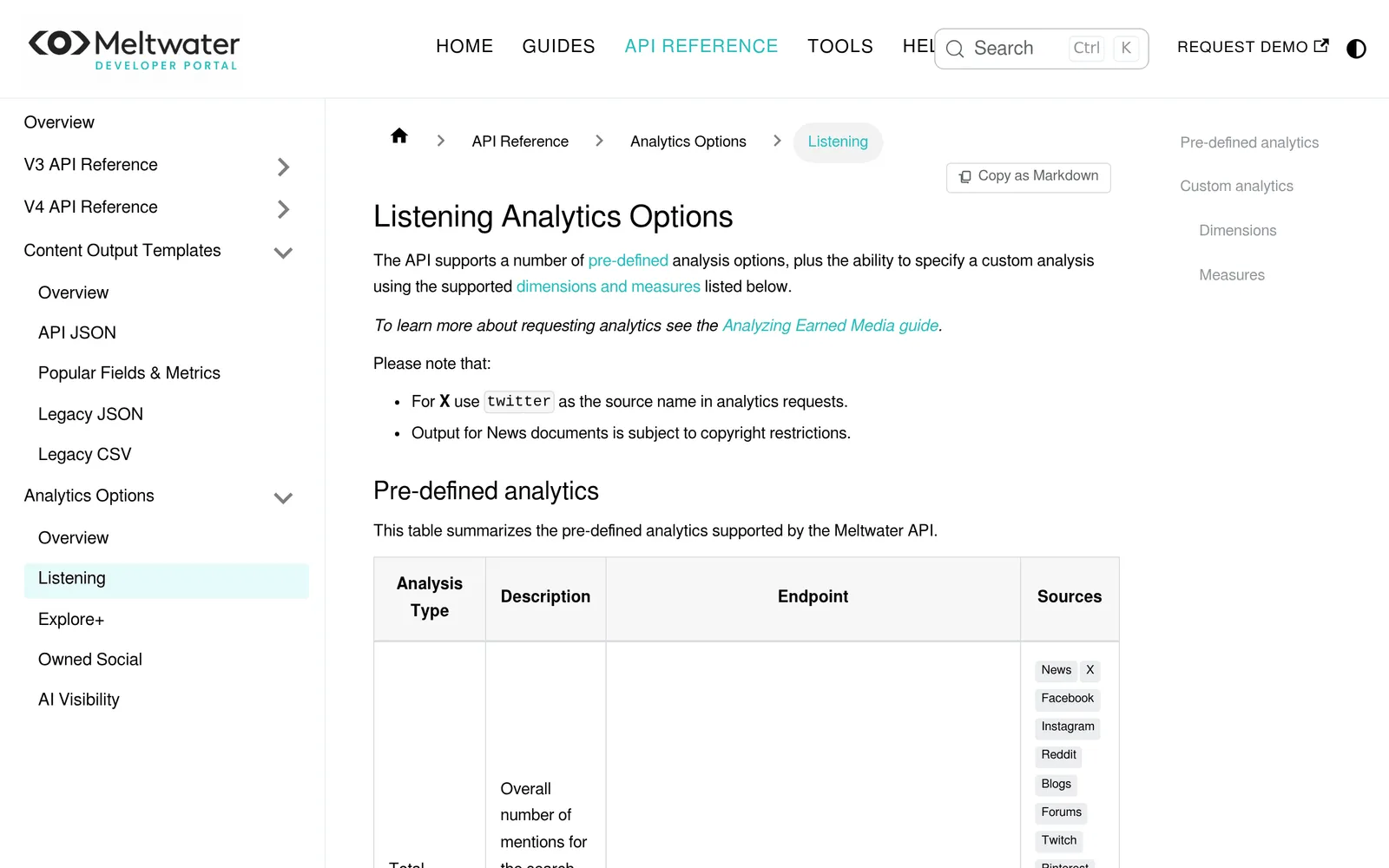
Meltwater publishes the most explicit domestic-platform list in the category and pairs it with deep traditional media.
| Field | Detail |
|---|---|
| Entry price | Custom (enterprise) |
| Languages | 240+ across 200+ countries |
| Regional platforms | Deepest APAC coverage |
| Sentiment method | Native, five-level plus entity analysis |
| Free trial | No (demo-led) |
Multilingual Coverage
Documented coverage across 200+ countries and 240+ languages, backed by broad crawling of hundreds of thousands of traditional media sources including local newspapers, broadcast, and podcasts. This is top-tier documented global reach.
Regional Platform Reach
This is where it separates. Its Meltwater developer documentation exposes fields across Douyin, WeChat, RED (Xiaohongshu), Bilibili, Youku, KakaoTalk, LINE Voom, Weibo, Naver, TikTok, Bluesky, forums, reviews, news, RSS, and broadcast. That source-level proof is what buyers should demand.
Sentiment Method
Native sentiment with five-level scoring and entity-level analysis, useful when a single post praises your brand, attacks a competitor, and names a public figure in three different tones.
Pricing and Limits
Custom and modular. The pricing page states contracts are tailored by goals, coverage, regions, languages, users, integrations, and included solutions.
The Non-Obvious Insight
Do not buy Meltwater on "240+ languages" alone. Buy it if your source map matches the regional platforms its developer docs expose, because that documented APAC access, not the language number, is the defensible reason to pay enterprise pricing.
Best-Fit Buyer
Enterprises with genuine East Asian exposure that need domestic-platform data alongside Western social and traditional media in one procurement.
3. Sprinklr: Best for regional breadth and governance
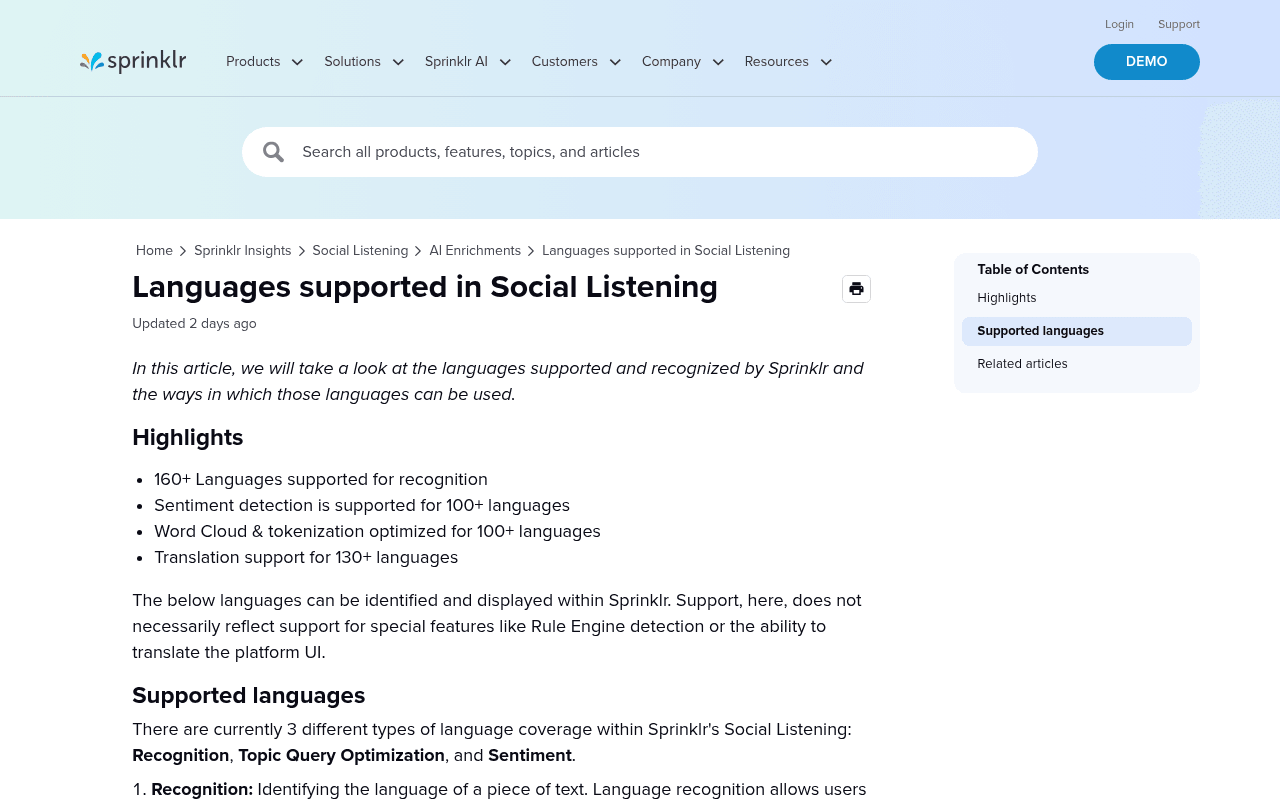
Sprinklr combines broad regional-platform coverage with strong enterprise governance and workflow controls.
| Field | Detail |
|---|---|
| Entry price | Custom |
| Languages | 160+ recognition, 100+ sentiment, 130+ translation |
| Regional platforms | VK firehose, WeChat, LINE, Weibo, Telegram |
| Sentiment method | Native, language-specific matrix |
| Free trial | No (demo-led) |
Multilingual Coverage
Its Sprinklr language support documentation splits 160+ recognition, 100+ sentiment, 100+ tokenization, and 130+ translation languages into separate columns. That honest taxonomy is rare and makes the platform easier to audit than vendors hiding everything under one number.
Regional Platform Reach
One of the strongest documented regional-platform lists in this comparison: VK via official firehose with 1-to-3-minute latency, plus WeChat, LINE, Sina Weibo, and Telegram in the same query builder as Facebook and Instagram. Confirm channel-level access in your contract, since some regional sources carry extra agreements.
Sentiment Method
Native sentiment across 100+ languages with emotion, urgency, and anomaly detection applied identically across supported channels. Code-switching handling is partial and rule-based, not model-native.
Pricing and Limits
Custom only after self-serve was retired. Entry is opaque and high, and a mid-market team monitoring three European languages will find both price and implementation heavier than the job requires.
The Non-Obvious Insight
Use Sprinklr's language matrix as a procurement weapon. Hand it to every other vendor and force them to split recognition, sentiment, tokenization, and translation the same way. Most cannot.
Best-Fit Buyer
Global enterprises operating across Russia, China, Japan, or Southeast Asia that need one governed system to listen, route, and respond across markets.
4. Pulsar: Best for APAC social depth
Pulsar is the specialist pick for Asia-Pacific, with the most complete documented China and Korea source list here.
| Field | Detail |
|---|---|
| Entry price | Custom (enterprise) |
| Languages | 200+ |
| Regional platforms | WeChat, Weibo, RED, Douyin, Bilibili, Naver, VK |
| Sentiment method | Native, ML models plus audience layers |
| Free trial | No (demo-led) |
Multilingual Coverage
200+ languages across 45+ aggregated source types, with unsampled data so you keep the long tail of mentions that sampled tools discard. European and LATAM coverage is solid, but APAC is the standout.
Regional Platform Reach
Best-in-class for Asia. Weibo, WeChat, Xiaohongshu, Douyin, Bilibili, Naver, and VK all appear as documented sources. For South Korea, Pulsar is one of the few platforms in this comparison that explicitly documents Naver coverage.
Sentiment Method
Native sentiment layered with community detection and narrative tracking. No per-language accuracy breakdown is published.
Pricing and Limits
Enterprise-only and quote-based, research-grade in depth, which also means a steeper learning curve than a simple alerting tool.
The Non-Obvious Insight
For Chinese consumer research, where purchase decisions increasingly form on their specific platforms, that gap in rivals is the reason Pulsar exists.
Best-Fit Buyer
Consumer brands and research teams with a heavy APAC focus that need Chinese, Korean, and Japanese platform coverage without stitching together regional point tools.
5. Brandwatch: Best for historical archive research
Brandwatch, part of Cision, owns the deepest archive in the market and the analyst tooling to mine it.
| Field | Detail |
|---|---|
| Entry price | Custom (enterprise) |
| Languages | Collects any language, sentiment in 44 |
| Regional platforms | Broad Western, moderate regional |
| Sentiment method | Native, Iris AI |
| Free trial | No (demo-led) |
Multilingual Coverage
Brandwatch Consumer Research collects data in any language and analyzes sentiment and key topics in 44 languages. That distinction is stated honestly, and it tells you where automated interpretation is strong versus where manual workflows are needed.
Regional Platform Reach
Broad social, blog, forum, news, and review coverage with official firehose access to major platforms, plus an archive of 1.4 trillion posts back to 2008 and roughly 496 million new public posts added daily. East Asian domestic platforms are less of a focus than Meltwater or Pulsar.
Sentiment Method
Analyst-grade native sentiment across 44 languages with two decades of model tuning. If your priority markets include Thai, Vietnamese, most Indian languages, or Arabic dialects, confirm they sit inside the supported set before shortlisting. For the mechanics of choosing between engines, our roundup of sentiment analysis tools is a useful cross-reference.
Pricing and Limits
Custom and demo-led. Its deep Boolean and rules engine rewards trained analysts and overwhelms casual users, so budget for query expertise, not just licenses.
The Non-Obvious Insight
Brandwatch is a research platform, not a lightweight alerting tool. If your team only needs multilingual mention capture and alerts, you will overbuy both capability and complexity.
Best-Fit Buyer
Enterprise research and insights teams that treat social data as primary market research and need long-term trend benchmarking.
6. Lumen by Talkwalker: Best for global consumer intelligence
Talkwalker sets the ceiling for documented source scale and visual listening, now delivered as the Lumen app inside Hootsuite after the April 2024 acquisition.
| Field | Detail |
|---|---|
| Entry price | Custom (enterprise) |
| Languages | 187 recognition, narrower native sentiment set |
| Regional platforms | LINE, Weibo, KakaoTalk |
| Sentiment method | Native, Blue Silk AI, plus visual |
| Free trial | No (demo-led) |
Multilingual Coverage
The pricing page lists 150 million data sources, 30+ social platforms, 187 languages, and 196 countries. Read the language figure carefully. Recognition across 187 languages is not the same as native sentiment across all of them, so ask for the sentiment-language list specifically.
Regional Platform Reach
Strong global breadth with LINE, Weibo, and KakaoTalk present. VK, WeChat, Naver, and Xiaohongshu are absent or unconfirmed, so China's largest platform is a gap.
Sentiment Method
Blue Silk AI drives sentiment and multi-emotion classification with visual and video recognition. The often-quoted 90% accuracy figure is an aggregate with no published per-language breakdown.
Pricing and Limits
Quote-based. The number to clarify is not just cost but unsampled result volume, topic counts, historical depth, and whether you are buying standalone Lumen or Hootsuite Listening powered by Talkwalker.
The Non-Obvious Insight
Ask which product you are actually buying. The analytics engine is shared, but packaging, permissions, workflow, and historical access differ between standalone Lumen and the Hootsuite-integrated version.
Best-Fit Buyer
Enterprise insights and marketing teams that need visual intelligence and source scale, particularly those already running Hootsuite for publishing.
7. Awshar: Best for India
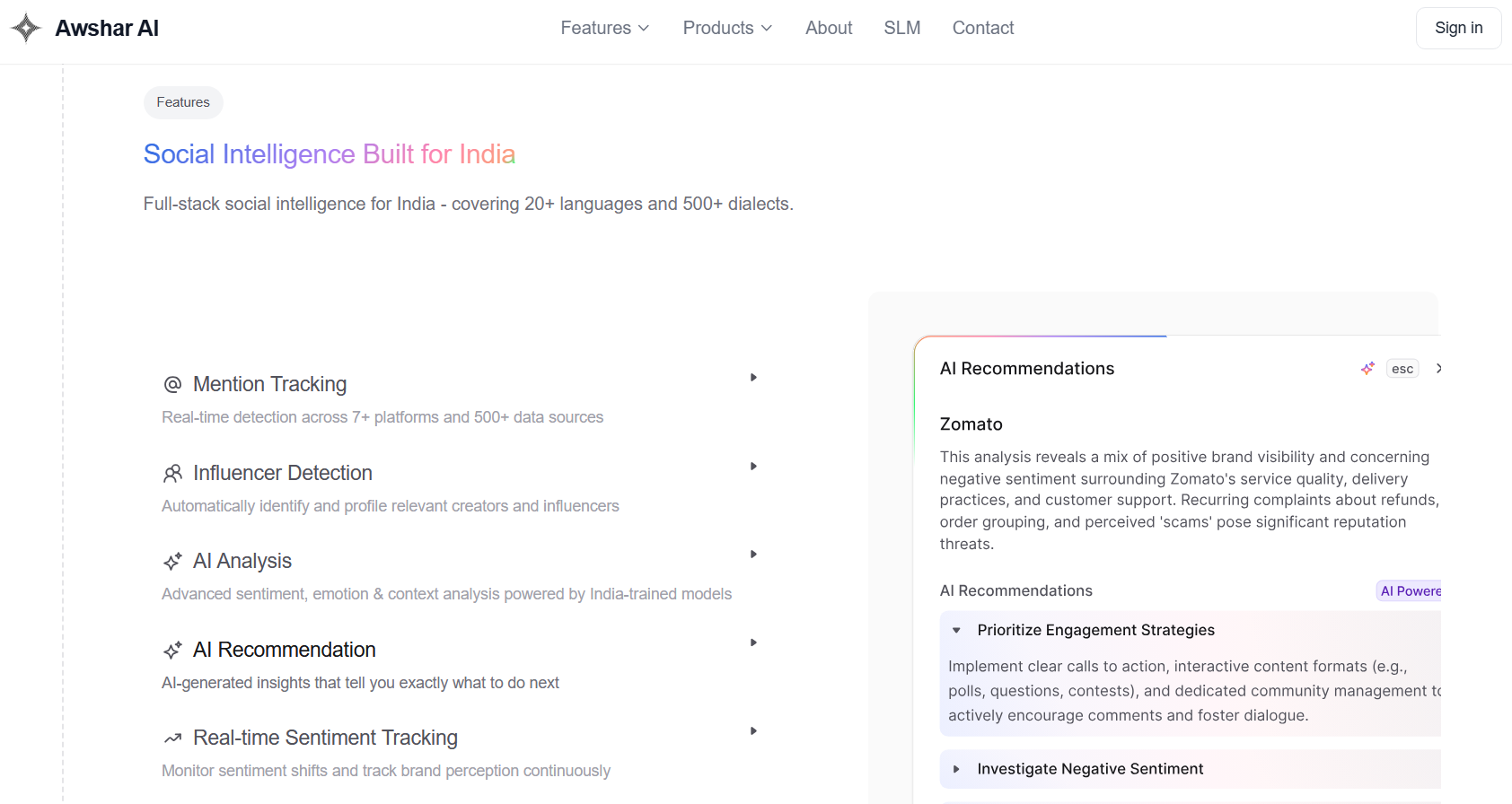
Awshar is a genuinely specialized underdog the big lists skip, built for one geography and built well.
| Field | Detail |
|---|---|
| Entry price | Quote / demo |
| Languages | 20+ Indian, 500+ dialects |
| Regional platforms | India-first social and web |
| Sentiment method | Native, India-trained models |
| Free trial | Demo-led |
Multilingual Coverage
Covers 20+ Indian languages and 500+ dialects, including Hindi, Tamil, Bengali, Telugu, Kannada, Marathi, Gujarati, and Hinglish, across 7+ platforms and 500+ data sources.
Regional Platform Reach
Focused entirely on India across X, Facebook, Instagram, LinkedIn, YouTube, Reddit, and Indian news. That single-market depth is the point.
Sentiment Method
India-trained models tuned for local dialects, slang, sarcasm, and code-switching, with a 95%+ accuracy claim. The claim needs your own audit, but the architecture targets the exact Hinglish failure mode global generalists share.
Pricing and Limits
Not published. Request topic limits, retention, export limits, API availability, and language-level accuracy before committing.
The Non-Obvious Insight
Do not compare Awshar to Brandwatch on archive size. Compare it to global tools on Indian code-switching failure rate. That is the test that matters, and it is the one no Western generalist passes cleanly. Note also that no tool here covers ShareChat, Moj, and other India-specific platforms, so if your audience lives on those, you still need a domestic add-on.
Best-Fit Buyer
Brands whose India market matters enough to justify a dedicated, dialect-aware tool alongside a global platform.
8. Determ: Best European and CEE underdog
Determ is the tool most lists overlook, and it out-crawls far bigger names in its home region.
| Field | Detail |
|---|---|
| Entry price | €99/mo, or €990 annually |
| Languages | 107 language filters |
| Regional platforms | EU web plus Balkan traditional media |
| Sentiment method | AI sentiment, all plans |
| Free trial | 5 days |
Multilingual Coverage
Monitors 100 million+ online sources with 107 language filters and 250 location filters, at a price where most competitors offer a handful of languages. Coverage is genuinely strong across European, CEE, and Balkan sources that US-built crawlers handle poorly.
Regional Platform Reach
European web, news, forums, and mainstream social rather than Asian domestic platforms. No VK, WeChat, LINE, or Naver.
Sentiment Method
AI sentiment, tone of voice, and Synthia summaries included on every plan with no feature-gating by tier. Per-language accuracy is not published.
Pricing and Limits
Focus is €99 monthly or €990 annually with 1,000 mentions, unlimited users, and all AI features. Expand is €299 a month (5,000 mentions), Command €499 (10,000 mentions). Mention caps are low relative to price, so competitive monitoring pushes you up tiers fast.
The Non-Obvious Insight
The Western Balkans traditional media coverage (print, TV, and radio across Slovenia, Croatia, Bosnia and Herzegovina, Serbia, and Montenegro) is a capability no global generalist offers at this price, and for Balkan PR it can matter more than social breadth. Unlimited users on every plan also changes the math when fifteen stakeholders need dashboards.
Best-Fit Buyer
European PR and comms teams, CEE brands, and any group that wants transparent pricing and unlimited seats without enterprise complexity.
If your priority markets are European and non-English, weigh the tool built in Europe seriously. Coverage quality tends to track where the crawler was engineered, not where the marketing budget is largest.
9. YouScan: Best for visual plus multilingual
YouScan finds your brand where the text never mentions it, then adds multilingual sentiment on top.
| Field | Detail |
|---|---|
| Entry price | $499/mo (Starter 3, annual) |
| Languages | Multi-language (count undisclosed) |
| Regional platforms | Mainstream and visual social |
| Sentiment method | Native, text plus image |
| Free trial | Demo-led |
Multilingual Coverage
All customers access the full database of 500,000+ resources. Its published automatic-sentiment language list spans Arabic, Chinese, English, French, German, Hindi, Japanese, Korean, Portuguese, Russian, Spanish, Thai, Turkish, Ukrainian, Urdu, and Vietnamese, among others.
Regional Platform Reach
Strong on mainstream and image-first social, online news, blogs, forums, and reviews. Regional East Asian platforms are not a documented focus.
Sentiment Method
Native sentiment with an aggregate 90% to 95% accuracy claim for positive and negative classes, plus aspect-based analysis. Visual AI detects logos, scenes, and objects in images that carry no brand text.
Pricing and Limits
Starter 3 is $499 a month billed annually with 3 topics and up to 15,000 monthly mentions. Unlimited plans add visual and audience insights, exports, and API access.
The Non-Obvious Insight
Read the API and export documentation before you plan a data warehouse. Reddit responses return only URL and proprietary metrics, X removes text and author fields, Quora is not available through the API, and small sources may be restricted. The UI can look richer than what you can actually pipe out.
Best-Fit Buyer
Consumer brands in visually driven categories (food, fashion, beauty, automotive, travel) that need logo detection alongside multilingual text, best paired with a text-first tool for full coverage.
10. Brand24: Best for lean SMB teams
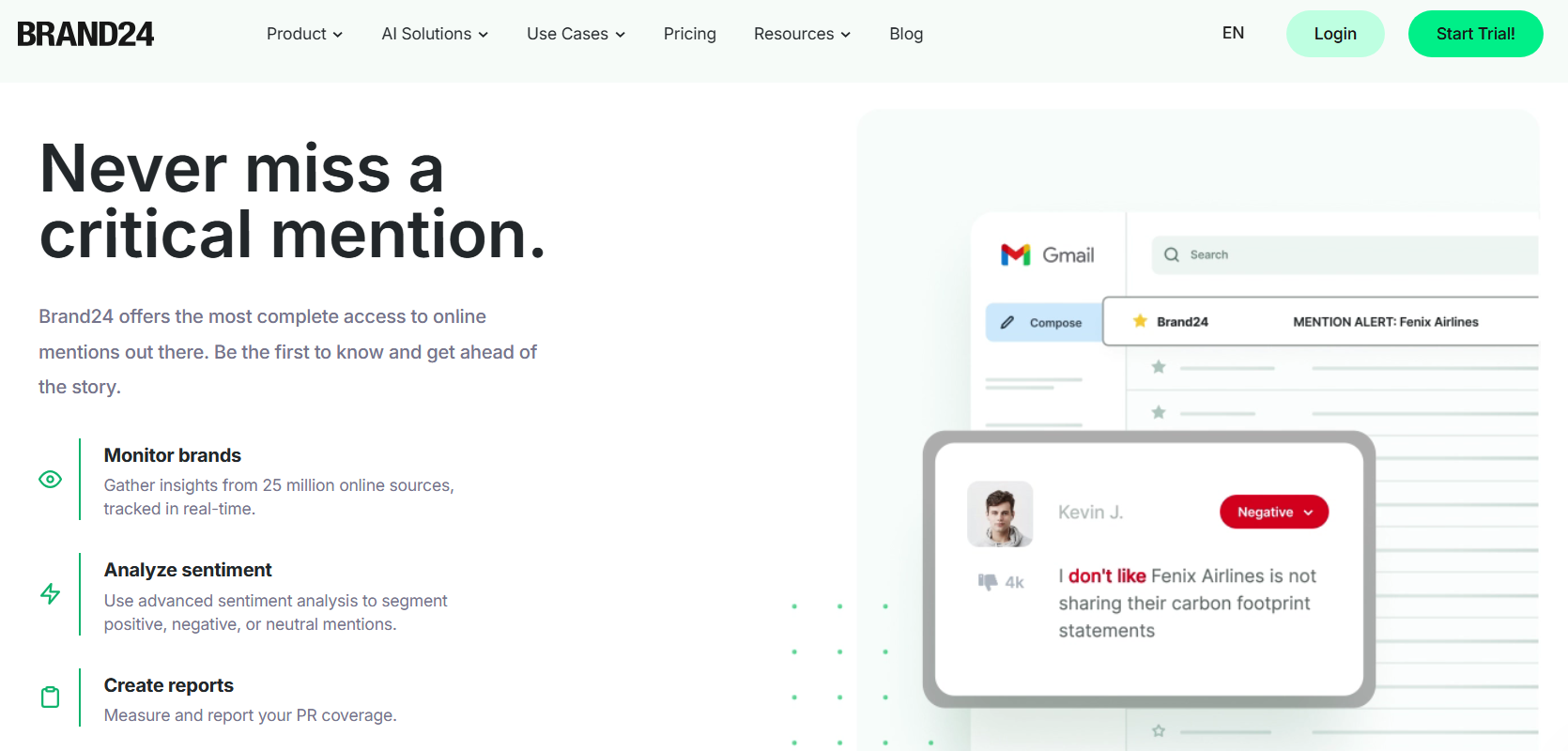
Brand24 wins on transparent, self-serve pricing and unusually honest sentiment documentation.
| Field | Detail |
|---|---|
| Entry price | $199/mo annual ($249 monthly) |
| Languages | 90+ sentiment, 24 filters |
| Regional platforms | Western social and web |
| Sentiment method | AI, published F1 methodology |
| Free trial | 14 days |
Multilingual Coverage
Monitors 25 million+ sources across social, news, blogs, forums, podcasts, and reviews with sentiment in 90+ languages. Note the asymmetry: language filtering is limited to 24 languages even though sentiment runs on more, which can leave scored mentions you cannot cleanly filter.
Regional Platform Reach
Western social and web-first, with no VK, WeChat, LINE, Naver, or Weibo. If your Japanese audience talks on LINE rather than X, Brand24 will not see it.
Sentiment Method
Its Brand24 sentiment help center states the algorithm improved from a 61% to a 95% macro-averaged F1 score on 50,000 mentions, and warns that accuracy varies by language and text complexity. Printing both the metric and the caveat is more honest than most rivals.
Pricing and Limits
Individual is $249 monthly or $199 annually with 3 keywords, 2,000 mentions, one user, and updates every 12 hours. Team $299, Pro $399, Business $599, and Enterprise from $1,499 (annual rates), scaling to 100,000 mentions. Real-time updates start higher up the ladder.
The Non-Obvious Insight
The entry plan refreshes only every 12 hours. For live crisis monitoring across time zones, that delay is disqualifying, and real-time data means stepping up to Pro.
Best-Fit Buyer
SMB teams and agencies that want predictable pricing, an easy trial, and 90+ language sentiment across mainstream Western sources.
11. Mentionlytics: Best mid-market all-rounder
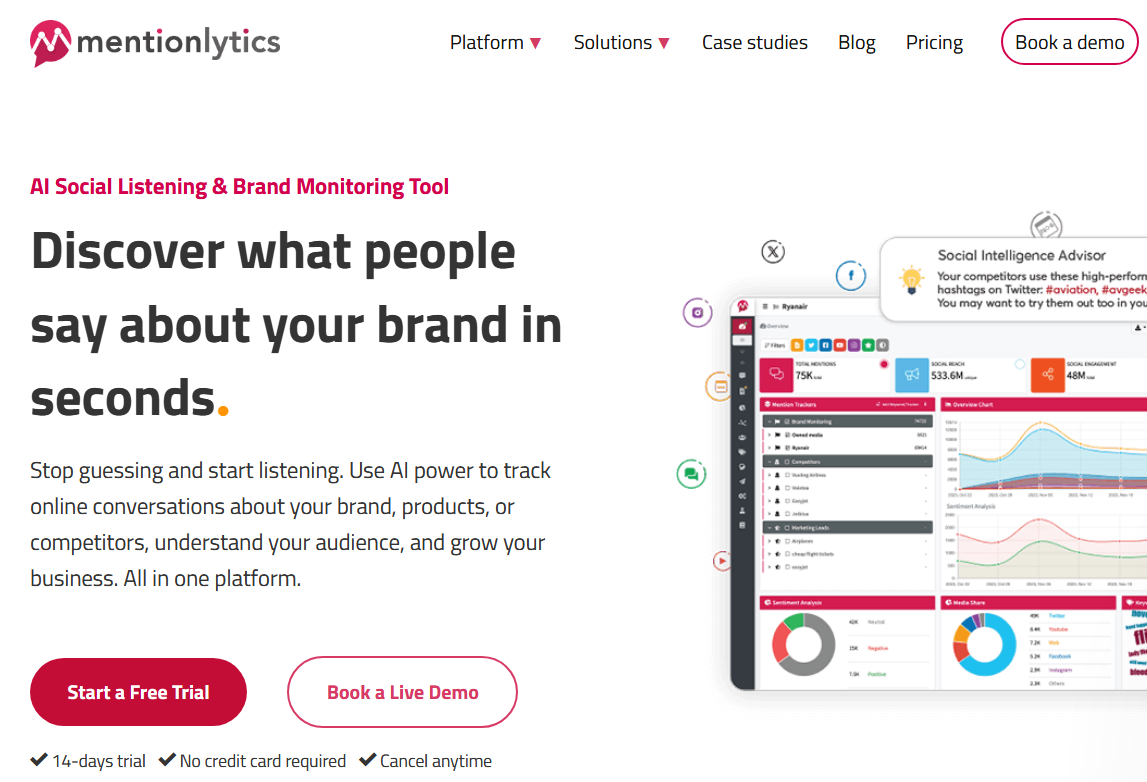
Mentionlytics packs broad language claims and an AI advisor into transparent, self-serve pricing.
| Field | Detail |
|---|---|
| Entry price | $49/mo annually ($69 monthly) |
| Languages | 240+ claimed |
| Regional platforms | Telegram, Bluesky, Western social |
| Sentiment method | AI, 96%+ accuracy claim |
| Free trial | Yes, plus free version |
Multilingual Coverage
Claims monitoring across 240+ languages over web sources plus Facebook, Instagram, X, Reddit, TikTok, YouTube, LinkedIn, Threads, Bluesky, and Telegram. Solid for Western and global platforms, thin on Asian networks.
Regional Platform Reach
Telegram and Bluesky are the only non-Western platforms confirmed. No VK, WeChat, LINE, Naver, Weibo, or Xiaohongshu.
Sentiment Method
An AI advisor (SIA) and a one-click Mention Translate feature, with a 96%+ accuracy claim across all languages. Treat that figure as a claim to test, not a number to report, since it is not broken down by language or independently audited.
Pricing and Limits
Basic from $49 a month billed annually, then Essential $169, Advanced $299, Pro $499, Business $749, and Enterprise from $1,299. Mention caps decide the real price, and a multi-market campaign exhausts entry volumes fast.
The Non-Obvious Insight
The 4.9 G2 rating is the highest here, but it sits on a smaller review base than Meltwater or Brandwatch, so weight it against your own trial rather than the star count.
Best-Fit Buyer
SMBs, mid-market brands, and agencies that want broad language support, an AI advisor, and white-label reporting at an accessible price.
12. Awario: Best for budget Boolean control
Awario is the lowest serious entry point that does not strip out the features analysts actually need.
| Field | Detail |
|---|---|
| Entry price | $29/mo annual ($49 monthly) |
| Languages | ~25 languages |
| Regional platforms | Western social and web |
| Sentiment method | AI, translation-assisted |
| Free trial | 7 days |
Multilingual Coverage
Claims any-language keyword tracking, with practical strength in English, Russian, Spanish, and major European languages. Its own web crawler gives it independence from some platform API restrictions and a real long tail of blogs and forums.
Regional Platform Reach
X, Facebook, YouTube, Reddit, news, blogs, and forums. No VK, WeChat, LINE, or Naver.
Sentiment Method
Positive, negative, and neutral classification with roughly 70% accuracy by third-party estimates, lower than the deep-learning competitors. Best paired with tight Boolean queries and manual review.
Pricing and Limits
Starter is $29 a month billed annually (or $49 monthly) with 3 topics and 30,000 mentions. Pro is $89 annually (300,000 mentions), Enterprise $249 annually (1,000,000 mentions). Boolean search and API access ship on every plan, which is rare at this price.
The Non-Obvious Insight
The self-owned crawler is the quiet advantage nobody markets: it keeps working when third-party API access tightens. The trade is lighter sentiment accuracy and a more manual workflow.
Best-Fit Buyer
Founders, freelancers, and small agencies that want maximum Boolean control per dollar for English-first and European monitoring.
Best Multilingual Tool by Region (Quick Picks)
Coverage quality is regional, so the right tool changes with the market you most need to read. Use the region-by-region picks below to shortlist fast, then run the six-point verification before you book any demo.
Best for LATAM (Spanish, Portuguese)
BrandMentions is the top LATAM pick for full-web native capture and clean multi-language reporting that separates LATAM Spanish from Brazilian Portuguese. Meltwater is the choice for enterprise media depth, and Awario for budget Boolean coverage.
Best for MENA (Arabic, Arabizi)
BrandMentions or Meltwater lead MENA for native Arabic scoring and Arabizi query control. For dialect-heavy work, add an Arabic-first regional vendor to the demo list, since right-to-left script and code-switching punish translate-then-score pipelines hardest.
Best for India (Hindi, Tamil, Bengali, Hinglish)
Awshar is a strong India-specific option for dialect depth and code-switching. Choose BrandMentions or Sprinklr when you also need a broader global workflow around the Indian coverage.
Best for East Asia (China, Korea, Japan)
Pulsar has one of the broadest documented APAC source lists in this comparison, while Meltwater or Sprinklr cover enterprise WeChat, Weibo, RED, Naver, KakaoTalk, and LINE. There is no budget tool that covers this geography well.
Best for Europe and CEE
Determ stands out for European and CEE non-English and Balkan depth. For pan-European enterprise scale, Talkwalker or Meltwater are the alternatives.
Best for Russia (VK)
Sprinklr is a strong option for Russia when VK firehose access is a priority. Pulsar and BrandMentions are the alternatives when firehose latency is not a hard requirement.
How to Verify Coverage Before You Book a Demo
From a product-builder perspective, multilingual listening is less about translation and more about retrieval: if you never collected the conversation, no AI model can recover it later.
Most demo accounts show English results because they load fastest and look cleanest. The sales engineer is not hiding anything, but you need your markets, not the demo dataset. Run this six-point verification against every vendor.
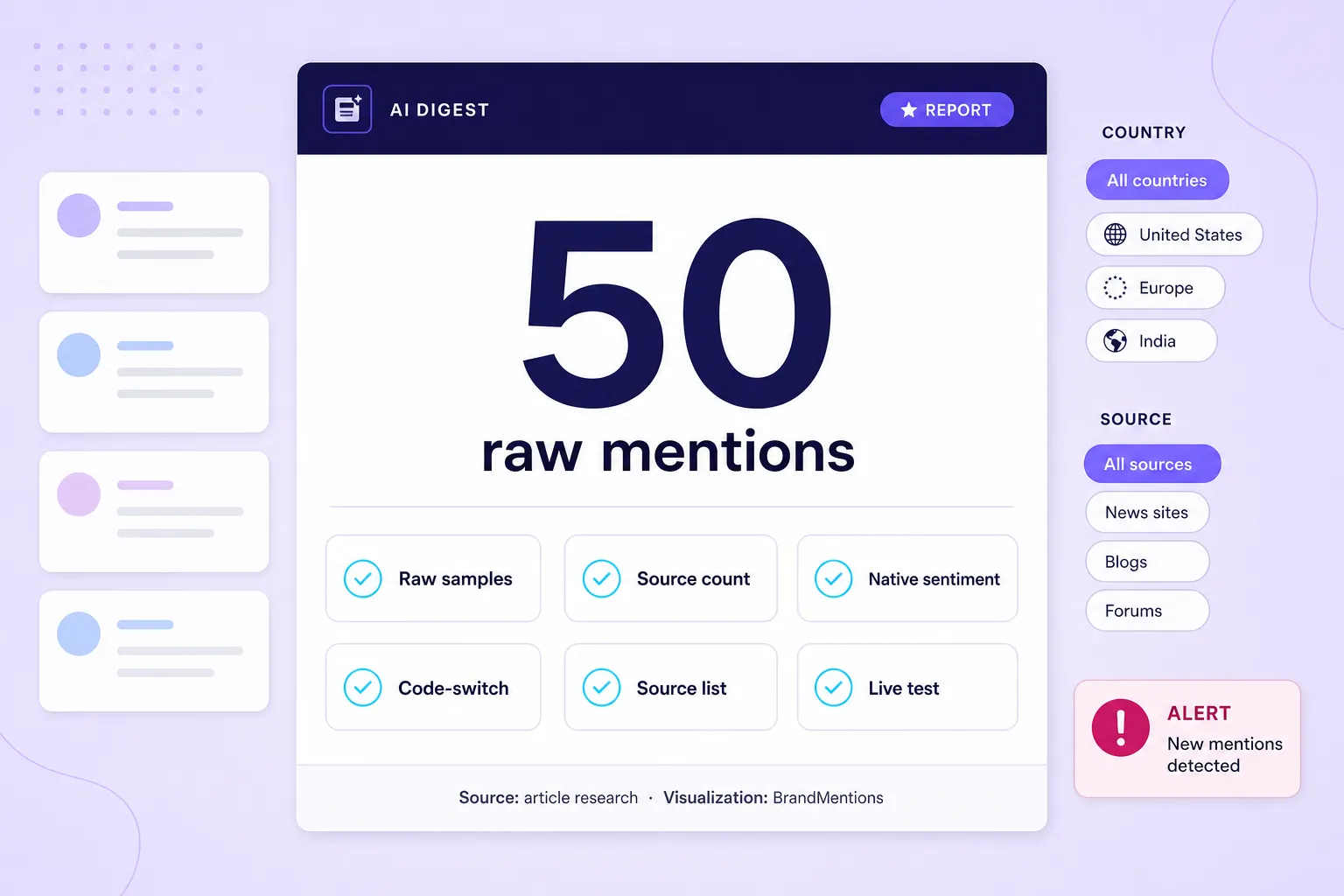
- Demand raw, untranslated samples. Ask for 50 recent mentions in your priority language, unfiltered. Volume and quality tell the truth faster than any feature list.
- Count the sources, not just the mentions. 500 Arabic mentions from three news sites is not coverage. It is three sites you could track with alerts. Click in and count distinct sources.
- Ask where sentiment is scored, in writing. Native in-language or machine-translated first. If the answer is a link to a "200+ languages" page, ask again until you get a clear yes or no for your language.
- Test a code-switched query. Hand them a Hinglish or Arabizi phrase you know produces hits. Zero results means the tokenizer cannot handle mixed scripts, and that is architectural, not a setting.
- Request the source list for your priority countries. Not the global count. The actual domains crawled in Brazil, Indonesia, or Nigeria. If they cannot produce it, they do not have it.
- Verify regional platforms with a live test. If they claim WeChat, ask to see the last 20 WeChat mentions for any keyword. Stale results mean a nominal integration, not an active one.
Because language crises move faster than translation queues, wire whichever tool you choose into real-time mention alerts segmented by market, so a Portuguese spike does not wait for an English summary before it reaches someone who can act.
The most expensive multilingual tool is the one that misses the market you bought it to cover. A €99 platform that genuinely crawls your five priority languages beats an €800 platform that translates English results into 200 languages and calls it coverage.
A few things this ranking deliberately cannot resolve for you, and you should factor them in. No vendor publishes independently verified per-language accuracy, so treat every headline number as a hypothesis. Monitoring closed and regional networks raises GDPR, data-residency, and platform-terms questions, especially in China and Russia, so involve legal before you scope. Syndicated news reposts and bot traffic can inflate a foreign-language mention count into false volume, so ask each vendor how it de-duplicates and weights source authority. And decide the architecture early: for most buyers a single strong global tool plus one local specialist (Awshar for India, an Arabic-first vendor for MENA, a China-native service for the mainland) beats forcing one platform to pretend it covers everything.
Frequently Asked Questions
What is multilingual social listening?
Multilingual social listening is the practice of collecting, classifying, analyzing, and alerting on public online conversation across multiple languages and regions using native-language queries, country and source filtering, and sentiment models that preserve local meaning. It is not the after-the-fact translation of mentions collected in one language. True multilingual listening depends on three things working together: crawlers that reach non-English sources, sentiment scored in the source language rather than a translated approximation, and coverage of the domestic platforms a market actually uses.
What is the difference between multilingual support and multilingual coverage?
Support means the interface, filters, and sentiment engine can process a language, while coverage means the crawler actively indexes sources in that language within the countries where it is spoken. Support is passive and coverage is active. Most tools have broad support and narrow coverage, and the gap is widest for non-European languages and regional platforms. Always test with raw, untranslated samples before trusting a language claim.
Which social listening tools actually cover WeChat, Weibo, VK, LINE, and Naver?
Only a few do, and they are enterprise-priced. Meltwater documents WeChat, Weibo, RED, Douyin, KakaoTalk, LINE, and Naver in its developer docs. Sprinklr offers full-firehose VK plus WeChat, LINE, and Weibo. Pulsar lists the fullest APAC set including Xiaohongshu and Naver. No tool under roughly $300 a month offers genuine WeChat or LINE monitoring as of early 2026, because the API restrictions make low-cost integrations unviable.
Is machine-translated sentiment accurate enough for executive reporting?
Not by itself. Translated sentiment can survive simple polarity but fails on sarcasm, idiom, negation, honorifics, and code-switching, and independent benchmarks put the native-versus-translated gap around 15 to 30 points on languages like Arabic, Japanese, Thai, and Vietnamese. Audit at least 100 raw native-language mentions per priority market before reporting a market-level sentiment number.
Which multilingual tool is best for a small team on a budget?
Awario starts at $29 a month annually with Boolean search and 30,000 mentions, best for English-first and European work. Determ is €99 a month with unlimited users and 107 language filters for European PR. BrandMentions is the mid-budget pick for broad full-web native capture from $79 a month annually. For deep East Asian platforms, none of the budget options will serve you, and you should plan for an enterprise tool or a regional specialist.
What is the single best multilingual social listening tool in 2026?
There is no universal winner, because coverage quality is regional. For full-web native-language capture at a self-serve price, BrandMentions leads from $79 a month annually. For enterprise East Asia and traditional media, Meltwater is the strongest documented choice. For global consumer intelligence and visual listening, Lumen by Talkwalker sets the ceiling. The right pick is whichever tool natively covers the single market where you are most exposed and least able to read the raw feed yourself.
Can a Western-API Tool Actually Cover China, Russia, and South Korea?
Usually not, and the reason is structural. Tools that lean on the public data of X, Meta, and YouTube inherit those platforms' geographic blind spots. The domestic giants run on separate infrastructure with separate access rules that often require compliance agreements, local data partners, or owned-account access rather than open crawling.
The scale of what gets missed is not marginal. WeChat runs past 1.3 billion monthly active users, Weibo sits near 600 million, and VK reports more than 100 million monthly users in Russia and the CIS. A tool that skips these is not slightly weaker in a region. It is absent from the room.
The Domestic-Platform Majority Test. If more than a third of a target market's conversation happens on a home-grown platform (WeChat and RED in China, Naver and KakaoTalk in Korea, VK in Russia, LINE in Japan and Thailand), a Western-API-first tool will miss most of your signal there. Verify the specific platform, in writing, before you sign.
The API Blindspot. When a vendor claims coverage of "every platform in China" without naming its data source for each one, treat that as overpromising until proven with live results.
Can Any Tool Actually Handle Code-Switching?
Mostly no, and the fix is not better AI. Code-switching, alternating languages inside a single post, is the default mode for hundreds of millions of people. Hinglish dominates Indian social media, Arabizi (Arabic in Latin script with numerals for letters) runs across MENA casual conversation, and Spanglish, Taglish, and Singlish are everywhere.
Most sentiment models are trained on monolingual corpora, so a post that opens in Arabic, drops an English product name, and closes with a French hashtag gets classified by its dominant detected language while the rest becomes noise. The tools that cope best are not the ones with the fanciest models. They are the ones that let you build precise queries capturing transliterated brand names alongside native-script versions, then let you review the smaller, cleaner result set by hand.
Boolean query building is the practical workaround. It does not solve the model's limitation, but it ensures you capture the mentions in the first place. Without it, your Arabic monitoring is probably missing every Arabizi post about you.
Conclusion: Buy for Your Blind Spot, Not Your Comfort Zone
This market is not short on tools. It is short on honesty about geography. Nearly every list ranks the same enterprise names on brand familiarity, treats multilingual as a checkbox, and never asks whether the crawler reaches the platform where your customers actually argue in their own language.
So make the decision mechanically. Identify the single market where you are most exposed and least able to read the raw feed yourself. That is your blind spot. Then buy the tool that covers it natively, even if that means Pulsar or Meltwater for China, a Croatian challenger for the Balkans, or a dialect-aware Indian tool nobody else on the results page mentions. English performance sorts itself out. The language you cannot verify is the one that will cost you a crisis you never saw coming.
The next advantage will not come from collecting more mentions. Everyone collects more. It will come from knowing which multilingual signals are real, which are mistranslated, and which ones your competitor's dashboard never saw. Run the six-point verification on your shortlist before a single demo. The vendors who pass it earned the meeting. The rest were selling you a mirror.
Filed under: Social Listening




1 comment