How to Monitor a Brand With a Common Name: Reduce Noise & Catch More Mentions (2026 Guide)
A step-by-step playbook for tracking an ambiguous or dictionary-word brand name, including a 400-record study of Linear, Notion, Slack, and Square examines how brand-monitoring filters reduce noise…


Quick answer: To monitor a brand with a common name, run two queries: a broad control query for your name and its variants, and a filtered query for daily alerts. Use context rules to separate your brand from unrelated meanings, then check a labeled sample of control results to see which genuine mentions those rules reject. A cleaner feed is only an improvement if you know what the cleanup costs.
Our exploratory test shows why that check matters. Among 86 relevant Notion and Slack mentions, phrase exclusions dropped one, a context-word requirement dropped 18, and a 10-word proximity rule dropped 42. These results describe our sample, not guaranteed performance for another brand. The practical lesson is to measure the mentions each rule loses and investigate source coverage separately.
Key terms: the four concepts this method runs on
These four named concepts carry the method. Each one is defined here in a single sentence so you can lift it into your own runbook.
- A control query retrieves matches for your listed identifiers within the platform’s available sources, time window, and collection limits, without your added context rules or exclusions..
- A working query is the filtered query that actually feeds your alerts and dashboards: branch-separated Boolean, context or proximity rules around the ambiguous word, exclusions, and any AI relevance rule on top.
- A must-catch set is a permanent regression set of known relevant mentions - especially ones your setup previously missed and any high-value category you cannot afford to lose - that every future query, filter or classifier change must still retrieve before you ship it.
- An exclusion receipt is the written record attached to every filter change: the exact edit, the noise it removes, the relevant and high-value mentions it costs, the decision, the named owner and the next review date.
Two of these are measurement instruments (the control query and the must-catch set) and two are governance instruments (the working query definition and the exclusion receipt). A common-name program fails when teams keep the working query and drop the other three.
If your common-name feed got quiet without you loosening anything, treat the silence as a defect report until a labeled sample tells you otherwise.
What does "without missing mentions" actually mean?
Precision is the share of retrieved results that are relevant. Recall is the share of relevant results, within the collection being evaluated, that you retrieved. These are standard information retrieval measures, documented in Stanford's information retrieval text, not monitoring jargon invented by vendors.
Read that definition twice, because the phrase "within the collection being evaluated" is where most monitoring promises quietly fall apart. If your platform never collected a Reddit comment, no filter change recovers it, and no audit of your filters will reveal it.
The Two-Ledger Rule: measure collection gaps and filtering losses in separate columns, never as one accuracy score.
Ledger one records relevant mentions you found independently (customer emails, native platform searches, a sales call) that your system never collected. Ledger two records mentions your system collected and then rejected through a keyword rule, an exclusion, a classifier or an alert setting. A broader keyword list fixes one. Removing a country restriction fixes the other. Neither fixes an alert landing in an inbox nobody owns.
Brandwatch states the underlying problem plainly in its brand query guidance: this is one of the most difficult elements of writing queries, because we don't know exactly what's out there, so it is impossible to know how many good results a query should be returning. That is honest, and it is also why a sample-based estimate beats a guess.
The Linear benchmark in numbers (1,000 Hacker News comments)
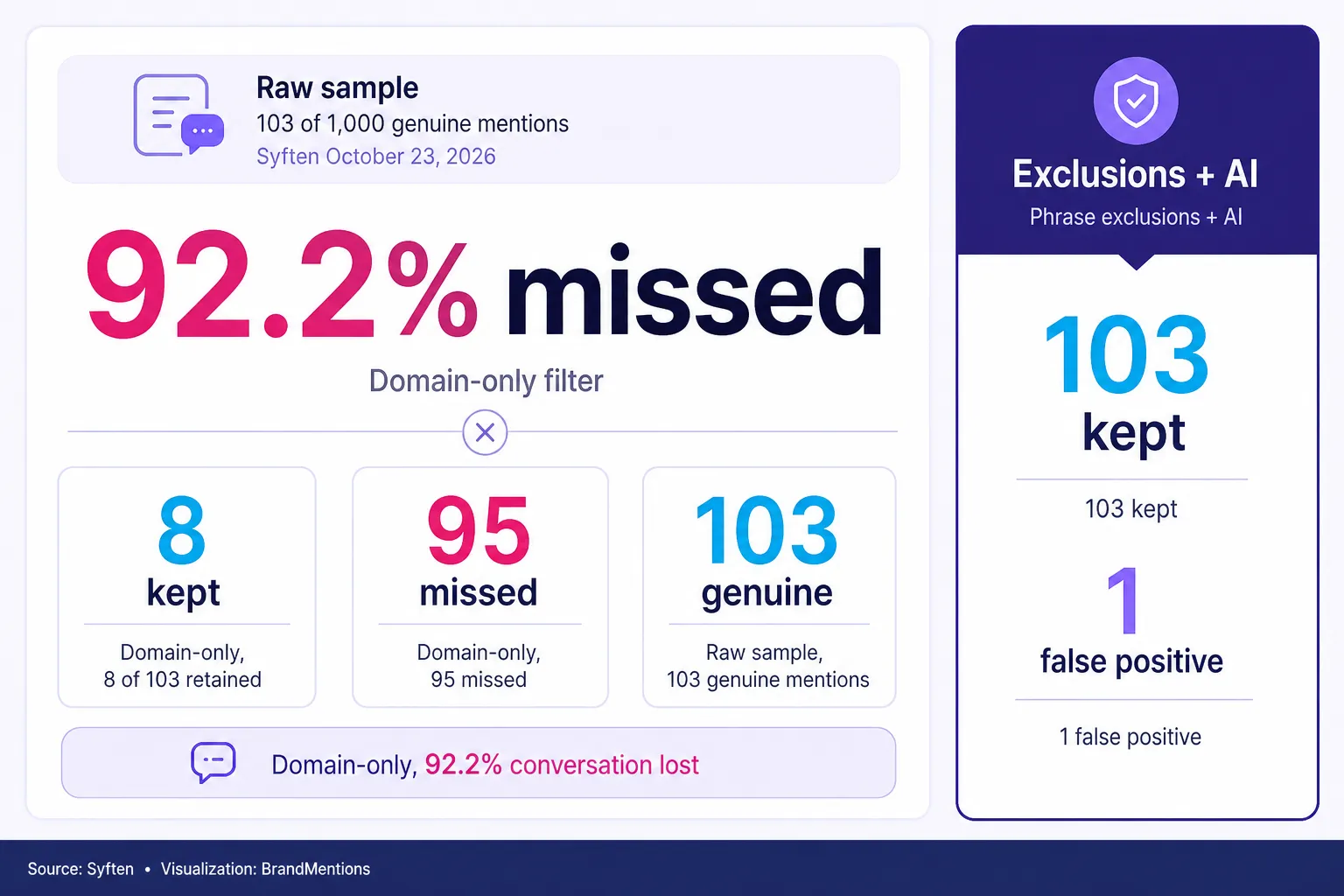
| Stage | What was applied | Result |
|---|---|---|
| Raw sample | Bare keyword "linear," no filters | 103 of 1,000 comments were genuine mentions (10.3%); noise 89.7% |
| Domain-only filter | Required the product domain | 8 of 103 genuine mentions retained (7.8%), 95 missed - 92.2% of the conversation lost |
| Phrase exclusions (NOT) | Exact collision phrases removed | 206 comments removed, 794 remaining, all 103 genuine mentions retained |
| AI relevance rule | Run on the 794 remaining comments | All 103 product mentions kept, 690 of 691 unrelated comments rejected, 1 false positive, 104 comments to review |
| Net effect | Exclusions first, AI second | Noise about 1%, down from 89.7% |
Source: Syften's October 23, 2026 common-word brand monitoring test. It is a vendor-run test on one platform over one window, which is why the method in Step 6 exists: you reproduce the measurement on your own brand rather than inheriting someone else's number.
How is monitoring a common-word brand different from monitoring a unique name?
A common-name brand is a brand whose name is also a dictionary word, place, person, or another company's name, so a string match alone cannot confirm the mention refers to it.
A unique name carries its own context. Match the string, handle a few typos, and you are done. A common name shares its string with thousands of unrelated sentences, so the match tells you nothing about meaning.
That changes three things in practice. The keyword stops being the query and becomes one input to it, with context doing the real work. Volume stops being trustworthy, because a spike could be your brand, a geometry lecture or a town square. And capitalization will not rescue you, since most platforms match without case sensitivity by default.
What Brand-Monitoring Filters Miss: A Four-Brand Study
A cleaner alert feed can hide genuine mentions. To examine that trade-off, we reviewed 400 records across four brands with common-word names - Linear, Notion, Slack, and Square - and tested how different filtering rules changed the results.
The recall analysis focused on 86 relevant Notion and Slack mentions; the Linear and Square samples contained too few relevant items for a meaningful comparison. Phrase exclusions dropped one genuine mention, requiring a context word dropped 18, and a 10-word proximity rule dropped 42.
This exploratory study uses BrandMentions data and rules developed from the reviewed sample. It shows where filters can fail, rather than predicting performance for every brand.
- Noise ranges from 41% to 100%. In each brand's raw feed, genuine brand mentions made up 59% for Slack, 27% for Notion, 1% for Linear and 0% for Square.
- Domain and handle filters catch about 5% of genuine mentions. Only 4 of 86 genuine Notion and Slack mentions carried the domain. That reproduces the Linear benchmark's 7.8% on a different dataset.
- Phrase exclusions were nearly free, and context rules were not. Exclusions kept 85 of 86 genuine mentions. Requiring a context word lost 21%, and a 10-word proximity rule lost 49%.
- The one exclusion loss is the mixed-topic case the guide predicts. An article named Slack as an integration and also used the idiom "pick up the slack".
- A 100-item sample can prove nothing for very noisy names. Linear yielded 1 genuine mention and Square none. That is the guide's "insufficient evidence" state, measured.
- Language filters and video carry hidden losses. 16% of genuine mentions were not in English, and 21% came from video transcripts with almost no surrounding context.
Method and dataset
We adapted the guide’s audit protocol, using day-based sampling and one reviewer. Unlike the recommended protocol, we counted ambiguous items as irrelevant and did not complete a second-reviewer check.
| Item | Detail |
|---|---|
| Data source | BrandMentions, queried 11 November 2026 |
| Window | 12 August to 9 November 2026 (90 days, UTC) |
| Brands | Linear (issue tracker), Notion (workspace app), Slack (team chat), Square (payments) |
| Control query | The bare brand word, no context and no exclusions, across all sources |
| Sampling | 20 randomly chosen days; 5 random items from each day's returned matches; 100 items per brand |
| Labels | Relevant if the text refers to the company or product, irrelevant otherwise. Ambiguous items were counted as irrelevant |
| Filters tested | Domain or handle only; case-sensitive capitalised name; phrase exclusions; context terms (AND); proximity within 10 words (NEAR/10); exclusions plus context |
| Recall test set | The 86 genuine Notion and Slack mentions. Linear and Square produced too few to test |
The context list was 20 generic software words such as app, tool, AI, workspace, integration, Zoom, Teams, Google and Jira. The exclusion lists used only collision phrases seen in the sample, such as "the notion that" and "pick up the slack". Filters were applied to the full title and text of each item, as a monitoring platform would.
Finding 1: Noise ranges from 41% to 100% of a bare common-name feed
How much of the raw feed is genuine depends on how ordinary the word is. The same 100-item method gives a usable estimate for two brands and almost nothing for the other two.
| Brand | Raw matches (90 days) | Genuine in sample | 95% range for genuine share | Estimated genuine mentions | What the noise was |
|---|---|---|---|---|---|
| Slack | 71,423 | 59 of 100 | 49%–69% | ~42,100 | "pick up the slack", slack water, tension, people named Slack |
| Notion | 82,669 | 27 of 100 | 19%–37% | ~22,300 | "the notion that", "notion of", French and Spanish "la notion" |
| Linear | 77,837 | 1 of 100 | 0.03%–5.4% | ~780, could be 20 to 4,200 | Linear algebra, regression, "progress isn't linear", linear accelerators |
| Square | 491,882 | 0 of 100 | 0%–3.6% | Unknown, up to ~17,800 | Square feet, Madison Square Garden, Square Enix, town squares |
Linear accounted for 1% of our sampled matches, compared with 10.3% in the Hacker News benchmark. The different sources and sampling methods prevent a direct comparison.
For Linear and Square, 100 random raw items tell you almost nothing about recall: there are 0 or 1 genuine items to lose. The guide calls this the insufficient-evidence state. In practice, it means a team monitoring a name like Square would need thousands of raw labels, or a pooled set from support and sales, before quoting any recall figure.
Finding 2: Domain and handle filters catch about 5% of genuine mentions
In the labeled sample, 4 of 86 genuine Notion and Slack mentions contained the brand's domain or handle (95% range 1%–11%). None of the 59 Slack mentions did. The guide's Linear benchmark found 7.8%, so two independent tests agree: identifier-only filters keep a perfect-looking feed and lose over 90% of the conversation.
The 90-day API totals show the same gap at full scale.
| Brand | Identifier searched | Identifier matches (90 days) | Estimated genuine mentions | Identifier share |
|---|---|---|---|---|
| Notion | notion.so, notion.com, notion.site | 662 | ~22,300 | ~3% |
| Slack | slack.com | 42 | ~42,100 | ~0.1% |
| Linear | linear.app | 21 | ~780 (20 to 4,200) | ~3%, very uncertain |
| Square | squareup.com, squareup | 69 | Unknown | Unknown |
Notion's figure is higher mainly because people share public Notion pages, which carry notion.site and notion.so links. Slack is talked about as a tool, so its name almost never travels with a link.
This supports the guide's "Identifier Escape Hatch". Identifiers are excellent evidence that a mention is yours, but they make a terrible requirement.
Finding 3: What each filtering tactic costs
Only phrase exclusions kept recall above 95% while cutting noise. Every rule that demanded something extra from the author lost real mentions.
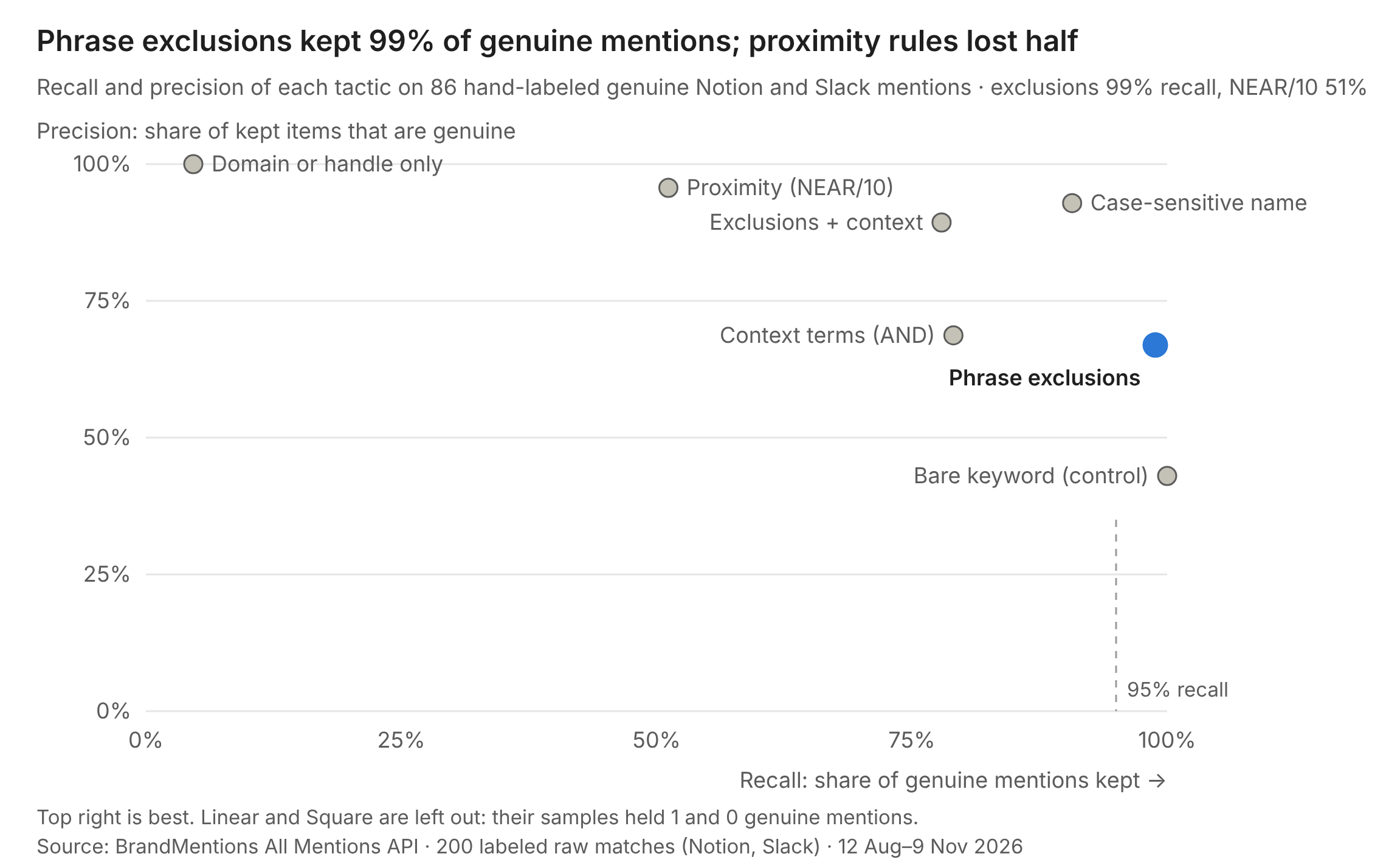
The ranking matches the guide's comparison table. Phrase exclusions removed 72 of 114 noise items for the cost of one genuine mention. Context terms lost 18 genuine mentions (95% range for recall 69%–87%), mostly short posts and video transcripts naming the brand with no software word nearby. Proximity within 10 words was stricter still and lost 42.
Case sensitivity did better than expected, at 91% recall and 93% precision, because the noise words are usually lowercase. It still dropped every customer who typed the name in lowercase (Finding 5).
The single exclusion loss is worth reading in full. A phone-system article listed Slack among integrations, then said a second device "can pick up the slack". This is the mixed-topic case behind the guide's NOT-to-AND test: an exact collision phrase inside a genuine mention.
Finding 4: Noise depends on brand and source together
No source type is reliably clean or noisy. News was the cleanest source for Slack and the noisiest for Notion, so a rule tuned on one brand's sources will not transfer to another.
| Source type | Notion: genuine | Slack: genuine | Both brands |
|---|---|---|---|
| News | 5 of 46 (11%) | 28 of 33 (85%) | 33 of 79 (42%) |
| Video | 8 of 23 (35%) | 10 of 33 (30%) | 18 of 56 (32%) |
| Social | 7 of 11 (64%) | 10 of 13 (77%) | 17 of 24 (71%) |
| Discussions | 2 of 7 (29%) | 6 of 11 (55%) | 8 of 18 (44%) |
| Web pages | 3 of 9 (33%) | 4 of 7 (57%) | 7 of 16 (44%) |
| Blogs | 2 of 4 (50%) | 1 of 3 (33%) | 3 of 7 (43%) |
Counts per cell are small, so read the direction, not the decimals. Two patterns are clear. Journalists use "notion" as an ordinary word far more often than they write about the app. Video had the lowest relevant share for Slack. For Notion, news had the lowest relevant share.
Video is also where context rules fail. Video items are short transcript fragments: about 46 words for Notion and 105 for Slack, against 850 to 1,600 words for other sources. The context rule kept only 9 of 18 genuine video mentions (50%), against 59 of 68 elsewhere (87%). This supports the guide's Step 2 advice to test spoken mentions as a separate surface: a context rule that works on articles can halve recall on video.
Finding 5: Lowercase spelling and English-only filters cut real mentions
Two settings that look harmless removed a measurable share of genuine mentions.
| Setting | Genuine mentions lost | Examples from the sample |
|---|---|---|
| Case-sensitive match on the capitalised name | 8 of 86 (9%) | "remote slack and macbook company", "amas slack outage", "tools without coding like a notion", "notion.so" |
| Keep only English-language content | 14 of 86 (16%) | Spanish, French, German, Polish, Japanese, Indonesian, Arabic and Nepali posts naming the apps |
The lowercase losses came mostly from people, not publishers: posts on X, trending-topic lists and spoken transcripts. Those are exactly the informal complaints and outage reports a monitoring team wants first. The guide's warning that "plenty of customers type your name in lowercase" holds.
The language effect is larger in the full dataset. An English-only filter would remove 29% of Slack's news coverage and 15% of Notion's over the 90 days. In this API, missing language tags were rare (under 1% of news items), so the risk comes from the filter itself, not from untagged content.
The API itself ignores case: "Notion", "notion" and "NOTION" each returned 82,670 matches. Any case rule has to be applied as a separate step, and tested before it is trusted.
What this means for monitoring teams
The data supports the guide's build order: identifiers as evidence, exclusions first, context rules only after an audit, and recall reported with its evidence base.
- Never make an identifier a requirement. Domains and handles caught about 5% of genuine mentions here and 7.8% in the Linear benchmark. Give them their own branch with no context test.
- Start with phrase exclusions drawn from your own noise. In this test they kept 99% of genuine mentions and lifted precision from 43% to 67%. Test each phrase with the NOT-to-AND switch, because the one loss was a genuine article that used the idiom.
- Treat context and proximity rules as costly. Requiring a software word lost 21% of genuine mentions, and a 10-word window lost 49%. If you need them, scope them to long-form sources and audit video separately.
- Size the audit to the name. A 100-item sample gave usable recall evidence for Slack (59 genuine) and Notion (27), but not for Linear (1) or Square (0). Names that noisy need a larger raw sample, or a must-catch set built from support and sales, before any recall figure is quoted.
- Route languages, don't drop them. One in six genuine mentions in this sample was not in English.
Limitations and disclosure
The dataset comes from BrandMentions, which also publishes the guide. The four brands were chosen only because their names are well-known common words, and no brand was consulted.
- One reviewer labeled the samples. Labels were applied with a fixed definition but not double-coded, so the guide's 25-item agreement check was not run. Ambiguous items were counted as irrelevant, which slightly lowers genuine shares.
- Sampling is random by day, not fully random. Each day's five items came from the newest 100 matches the API returned for that day. A few items appear twice, such as one YouTube description posted to two videos.
- Small test set. Recall figures rest on 86 genuine mentions from two brands. The 95% range for context-rule recall is 69%–87%, and for exclusions 94%–100%.
- Our filters were simple. Context and exclusion lists were written once, from the sample, and not tuned. Further tuning may change precision and recall; evaluate both on a fresh sample.
- No AI relevance layer was tested. The guide's benchmark covers that step; this research covers the rule-based layers before it.
- Coverage gaps are out of scope. As the guide's Two-Ledger Rule says, this measures what filters lose from collected content, not what the index never collected.
Data: BrandMentions, queried 11 November 2026 for 12 August to 9 November 2026.
How to Monitor a Brand With a Common Name: the 7 Steps at a Glance
- Build the seed list - enumerate every string that means you (variants, misspellings, handles, domains, product names) before writing a single exclusion. Best for a brand-new setup.
- Inventory the sources and history - record what each platform actually collects, how deep its archive goes, and one known URL per source you expect it to retrieve. Best for telling coverage gaps apart from filter losses.
- Write Boolean with separate branches - OR for variants, AND or proximity for the ambiguous word only, and exclusions scoped to the branch that needs them. Best for immediate, auditable noise reduction.
- Apply source, geography and language as routing filters - decide who reviews a mention before you decide the organization never sees it. Best for another company sharing your name.
- Use AI for identity, then score importance separately - an explicit brief that splits "is this our brand" from "does this matter." Best for ambiguity no rule can resolve.
- Start with 100 randomly selected raw matches as a diagnostic check. For a stronger recall estimate, expand the sample and report the number of confirmed relevant mentions—not just the total reviewed.
- Set a written tuning cadence - recall checks booked as their own calendar item, separate from noise cleanup. Best for long-term reliability.
Also worth knowing before you start: best for zero budget is a spreadsheet, native platform searches and a free alert stream as a second opinion. The validation method in Step 6 costs nothing; software only makes it faster.
Can Boolean still compete with AI relevance scoring in 2026?
Yes, and the sequence matters more than the choice. In the Linear test, phrase exclusions cut the candidate pool from 1,000 comments to 794, and the AI rule then ran on all 794 remaining comments, keeping all 103 product mentions and rejecting 690 of the 691 unrelated ones. Cheap deterministic rules went first. Expensive judgment went second, on a smaller set.
Reverse the order and you lose two things. You lose the ability to point at a readable rule when someone asks why a mention disappeared. And you lose control of whatever your platform meters, because something has to process every candidate.
The vendor documentation is direct about the asymmetry: AI runs after keyword matching, so it can reject an unrelated match, but it cannot recover a genuine mention that an exclusion already removed. That single sentence should govern your build order. Exclusions are the only layer with no second chance.
So Boolean is not the legacy approach that AI replaced. It is the layer that keeps AI's decisions reviewable and your candidate volume predictable.
The playbook: seven steps from seed list to validated alerts
Each step below follows the same shape so you can evaluate them against each other: a direct answer, what it does, how it moves precision and recall, the execution constraints taken from platform documentation, one non-obvious insight, and a concrete check before you move on. Work in order. Step 6 is what converts the rest from a hope into a number.
Step 1: Build the seed list of name variants before you write a single exclusion
Direct answer: list every string that means you - including misspellings, handles, domains and product names - because every variant you fail to list is a mention you have already decided to miss.
Brandwatch's brand query tips open with the right instruction: include as many different ways the brand can be referred to as possible, and remember to include common spelling mistakes for brand names.
What it does. It enumerates every string that means you: trading name, legal entity, former names, spaced and unspaced forms, hyphenated forms, observed misspellings, product and feature names, campaign tags, handles per network, domains, and the names of executives who speak publicly.
Precision and recall impact. Pure recall gain, with some noise cost. You handle that noise in Step 3, not by leaving the variant out.
Execution constraints. Seed lists meet hard ceilings fast. Sprout Social limits a topic to 2,037 characters, and Mention's own description of its query modes notes that its assisted queries handle up to five "ands," five "ors" and five "nots," while Boolean queries allow up to 20,000 characters. Budget your variants: list everything, rank by expected volume, and push the long tail into a separate low-priority configuration rather than dropping it.
The non-obvious insight. Handles and campaign hashtags are your cleanest recall instrument, because nobody uses them to discuss the dictionary word. Give them their own retrieval path with no context requirement, and treat them as a daily sanity signal: if tagged mentions keep arriving while plain-name mentions stop, your name branch broke, not the market. Distinguish a branded campaign tag from a broad category tag when monitoring hashtags, since the second belongs in discovery, not in your brand totals.
Also build a collision list. Trees, cities, bands, mathematical terms, other companies. At this stage these are investigation candidates, not approved exclusions.
One safeguard most teams skip: keep executive monitoring on its own path when the person also has a common name. Adding a bare personal name with OR solves one ambiguity problem by creating a second one.
Check it: every spelling a customer has actually used, and every important product name, has a retrieval path you can point to.
Step 2: Inventory monitoring sources and history depth (what your platform actually collects)
Direct answer: document what each source actually collects and how far back it reaches, so you can tell a coverage gap from a filter loss before you spend a week tuning the wrong layer.
X's search API documentation separates recent search, covering the last 7 days, from full-archive search, which reaches back to 2006 under different access conditions. Those are endpoint capabilities, not a promise about what your subscription stores or exposes to you.
What it does. It tells you which of your "misses" are filter problems and which are coverage problems, before you spend a week tuning the wrong layer.
Precision and recall impact. Neutral on both. It changes what your audit numbers mean, which is why it belongs before query work rather than after.
Execution constraints. For each priority source, record six things:
- Content scope (posts only, or comments and replies too).
- Access conditions.
- History depth.
- Timing between publication and notification.
- Result and export limits.
- One known relevant URL you expect the service to retrieve.
"Covers social media" is not an answer to any of those questions.
The non-obvious insight. Preview and archive behavior is not always identical to live processing. Syften's documentation, for example, notes that its archive includes supported sources such as Reddit, Bluesky, Hacker News and forums, but not X/Twitter or YouTube, and that archive depth and coverage vary by source. A clean preview is useful evidence and not an end-to-end test of the pipeline that will actually deliver your alerts.
The surface nobody tests: spoken and visual references. A podcast reading your name, a screenshot of your dashboard, a logo in a video, a product shot with no caption. These are separate retrieval surfaces that depend on transcripts, OCR or image recognition, each with its own error profile. Test them with three known examples per surface rather than assuming text coverage implies them, and if a surface is unsupported, write it down as a known gap instead of discovering it during a crisis. Building a realistic view of tracking mentions web-wide starts with knowing which surfaces are genuinely in scope.
Check it: confirm a known example from each priority source and content type, and keep unresolved gaps visible in writing.
Step 3: Boolean query architecture for a common brand name (OR, AND, NEAR, NOT templates)
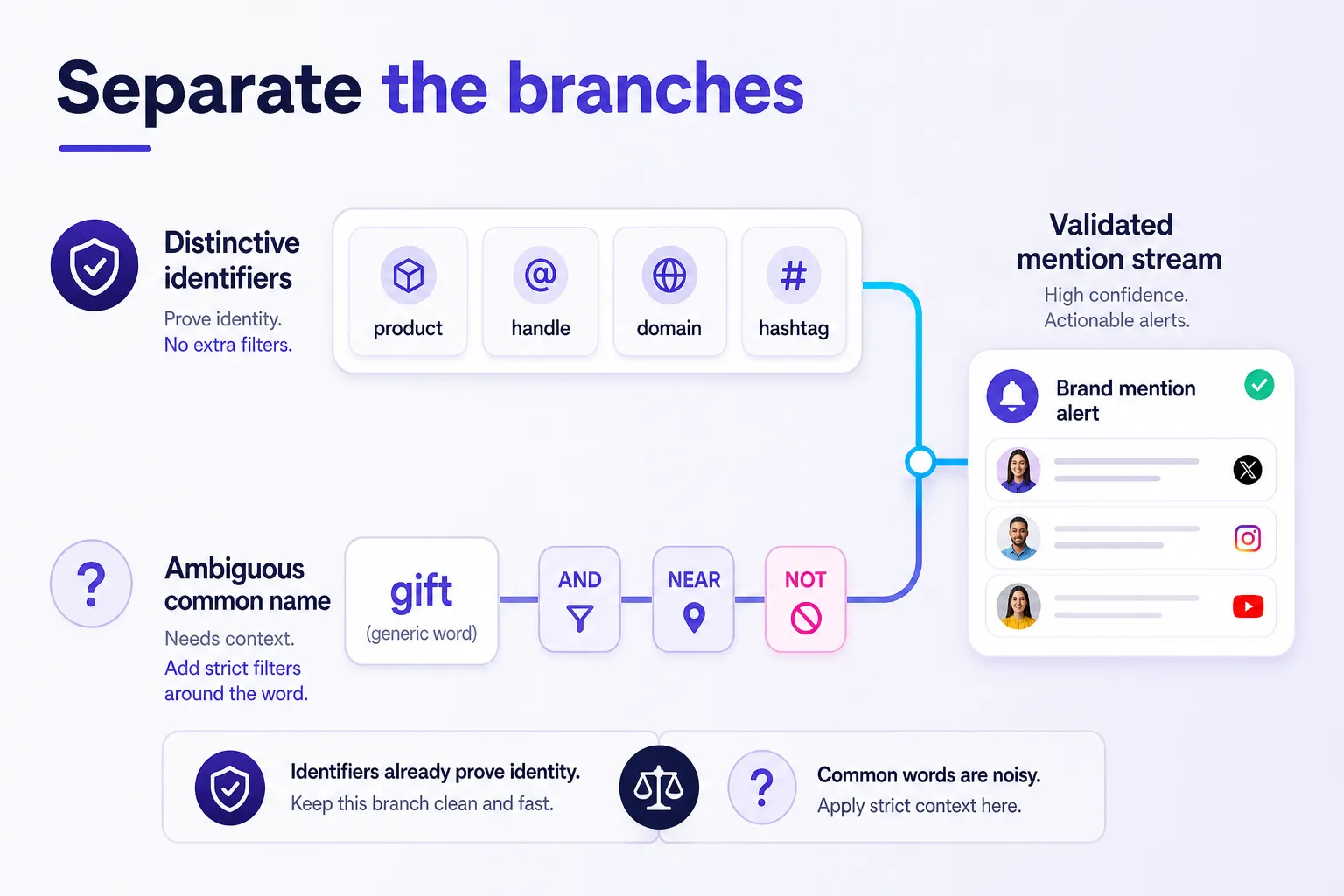
Direct answer: put the ambiguous word in its own branch with context and exclusions attached, and keep distinctive identifiers - product names, handles, campaign tags, domain - in a separate branch that passes with no context test at all.
Brandwatch's Boolean query guide documents the architecture every platform shares: quotation marks for exact phrases, OR to list variants and misspellings, and AND to add context when you are looking for something that doesn't have a unique name. The operators are easy. Placement is where common-name queries are won or lost.
What it does. It defines, in readable logic, which mentions qualify. Done well, it also tells you exactly which clause to edit when the audit finds a loss.
Precision and recall impact. The OR layer raises recall and lowers precision by design. Context and proximity layers raise precision and lower recall by an amount nobody can predict from theory. Exclusions, context requirements, proximity rules, metadata filters, and classifiers can all reject relevant mentions. Audit each layer and retain rejected candidates where possible.
Template A, the broad control (you need this for Step 6):
Cedar OR Ceder OR "CedarDesk" OR "Cedar Desk" OR "@UseCedar" OR "#CedarTeams"
Template B, the working query with branch separation:
("CedarDesk" OR "Cedar Desk" OR "@UseCedar" OR "#CedarTeams")
OR
(
  (Cedar OR Ceder)
  AND (scheduling OR appointment OR booking OR salon OR calendar)
  AND NOT ("cedar lumber" OR "cedar fencing" OR "cedar shingles")
)
Template C, the version to avoid:
(Cedar OR "CedarDesk" OR "@UseCedar") AND (scheduling OR appointment)
Template C fails on the single most common real mention: a short complaint such as "CedarDesk lost my bookings again." A direct product reference should never have to pass a category test.
The Identifier Escape Hatch: distinctive identifiers bypass the restrictions you built for the ambiguous word.
That is the structural lesson of the Linear result. A domain inside an AI instruction helps identify the product; it does not require the author to include a link, and the same logic applies to brackets. Use your domain and handles as evidence, never as a requirement.
Exclude the phrase, then test the phrase. Phrase exclusions in the Linear sample removed 206 comments and cost nothing, but the same source warns that an exact phrase can still appear inside a genuine mixed-topic comment. Brandwatch's query tips offer the cleanest test procedure: temporarily switch the operator from NOT to AND, check that the mentions returned really are the ones you want ignored, then switch it back. Thirty seconds of that will save you a quarter of silent losses.
Execution constraints. Proximity syntax does not transfer between platforms, and neither do defaults. Brandwatch uses NEAR/x; Notified's help documentation sets NEAR to a maximum of 10 words by default, adjustable with forms such as NEAR/15; Mention describes its Near operator as alerting you when two keywords are close together. Copying a number across tools produces a query that looks right and behaves differently.
For teams whose requirement is one readable expression they can open, edit and rerun, BrandMentions supports Boolean query tracking. Its Boolean Query Tracking documentation specifies AND NOT for removing obvious noise, AND NEAR when the relationship between words matters, and brackets whenever you combine multiple operators in one expression. Two constraints to plan around before you switch:
- You can add only one Boolean expression per project.
- Once Boolean query tracking is switched on, your previous keyword settings are no longer active.
Host the control stream as a separate configuration and confirm what your plan allows before the audit week, not during it.
The non-obvious insight. Bracket ambiguity, not operator choice, causes most silent losses. The same documentation gives the canonical example: "BrandMentions OR brand monitoring AND social listening" is ambiguous, because without brackets the app cannot know whether you mean either term plus "social listening," or the first term alone or the combination of the other two. Write every multi-operator expression fully bracketed, then read it out loud.Without explicit grouping, the platform may apply operator precedence differently from what you intended. Use parentheses and test the resulting matches. A refresher on Boolean search operators is worth sharing with whoever inherits the query.
Put strict context around the ambiguous word. Never around the identifiers that already prove it is you.
Check it: run four test cases through the query before shipping. A short complaint with no category word. A long mixed-topic article. A misspelling. A mention containing both your product and an excluded phrase.
Step 4: Source, geography and language filters as routing controls for same-name companies
Direct answer: use location, language and source filters to decide who reviews a mention first, not to decide the organization never sees it - because location filters on X exclude every message with no location attached.
Sprout Social's Query Builder documentation carries a warning that should change how you use geo filters: location-based filters are very strong, applying one excludes every message that doesn't have a location tied to it on X, and the filter should be used wisely.
What it does. It separates entities that share your name but not your world: a company in another country, a band, a town, a product in another category.
Precision and recall impact. High precision gain when the collision is concentrated in identifiable places. Real recall risk when it is not, because unknown is not the same as outside your market.
Execution constraints. Sprout's own strategy guidance repeats the problem in plainer terms: while filters can be useful for targeting specific content, many users do not specify location information, and using these filters may inadvertently exclude conversations you are interested in. Determ's Boolean operators guide documents language, location, author and source controls alongside Boolean syntax, plus case-sensitive matching, which can help when your brand uses intercaps and the common noun does not. Test case sensitivity against real lowercase references before trusting it; plenty of customers type your name in lowercase.
The order of preference we use:
- Exclude a confirmed irrelevant publisher before excluding a platform.
- Route a language to the right reviewer before discarding it.
- Suppress a verified repetitive author before suppressing the topic they post about.
The non-obvious insight. Source exclusions are more reliable than geographic ones because sources are observed and geography is inferred. When an irrelevant source warrants exclusion, use the narrowest supported rule: a subreddit identifier or URL path for one community, or a domain for a dedicated publication. Check for relevant mentions before applying it. Then re-check that excluded source once a quarter with a bare-name search, because entities move and conversations migrate. If you operate across markets, compare multilingual monitoring tools carefully, since a platform that indexes little non-English content applies a language filter you never chose.
Check it: inspect the unknown-location group and any relevant mentions outside your expected language before you make a geographic restriction permanent.
Step 5: AI relevance classification for ambiguous brand names (identity vs. importance)
Direct answer: ask the classifier one question - is this our brand - and score how much the mention matters as a separate output, because prominence and identity are different measures and filtering on prominence deletes the brief references PR teams want.
Syften's common-word brand monitoring benchmark is the clearest public worked example. On the 794 comments remaining after phrase exclusions, AI kept all 103 product mentions, rejected 690 of 691 unrelated comments, left one false positive and 104 comments to review, which is about 1% noise, down from 89.7%.
What it does. It resolves the ambiguity rules cannot reach: identical string, identical casing, different meaning. The published false positive shows the boundary precisely, since it was a comment about phpBB forums describing "linear forum threads," meaning conversations arranged in a sequence rather than a branching comment tree.
Precision and recall impact. Large precision gain. Recall held at 100% in that sample, on one platform, over one window. Treat it as a potential precision improvement whose recall risk must be measured on your own data.
The Relevance Split: "is this our brand" and "how much does this matter" are two different scores. LSEG's Intelligent Tagging documentation distinguishes confidence from relevance, explains that company relevance measures prominence within a document, and advises against filtering on it when the objective is to preserve hints and indications. Vendors use similar words for different things. A passing reference can identify you correctly and score low on prominence, which is exactly the mention a PR team wants.
Tone is a third score again, and it belongs in its own column: identity answers whether the mention is yours, priority answers how fast someone must act, and sentiment analysis answers how the author feels. Collapsing the three into one "relevance" number is how negative brief references end up filed as low value.
Write the brief like a query, not a wish. Name the company and product, state that brief references count, state explicitly that you do not require the website, a category word, positive sentiment or substantial discussion, and ask for three outputs: a verdict (relevant, irrelevant, uncertain), the exact text supporting it, and a separate priority label. The published benchmark makes the same point: avoid vague instructions such as "accept valuable posts," and instead name the product, identify its domain or purpose, and say which mentions to keep.
Execution constraints, including two nobody mentions:
- Ask where filtering happens in the pipeline and which stage consumes your allowance, because a rejected mention can still be collected, stored and metered. Syften's own tooling exposes stored matches searchable by configured filter, content query, AI verdict, read state or time range, which means rejected items remain inspectable rather than vanishing. That is a feature worth demanding: if you cannot read what the classifier rejected, you cannot audit it.
- Treat the classifier as a system that reads untrusted text. Public posts can contain instructions aimed at whatever reads them, and you are feeding public text into a model. In practice that means three habits:
- Keep the instruction and the content in clearly separated fields.
- Review the evidence span rather than the verdict alone.
- Define up front who can access collected personal data, how long you retain it, and whether sending mention text to a third-party model is permitted under your own policy. That decision belongs to someone, in writing, before the first batch runs.
The non-obvious insight. Point the classifier at your broad control stream as well as your working feed, and keep the uncertain bucket alive. A reviewed uncertain pile is where new use cases and new customer segments show up first, which is why filtering quality mentions should mean sorting by action value, not deleting by prominence.
Check it: inspect accepted, rejected and uncertain results side by side, including short references and mixed-topic discussions.
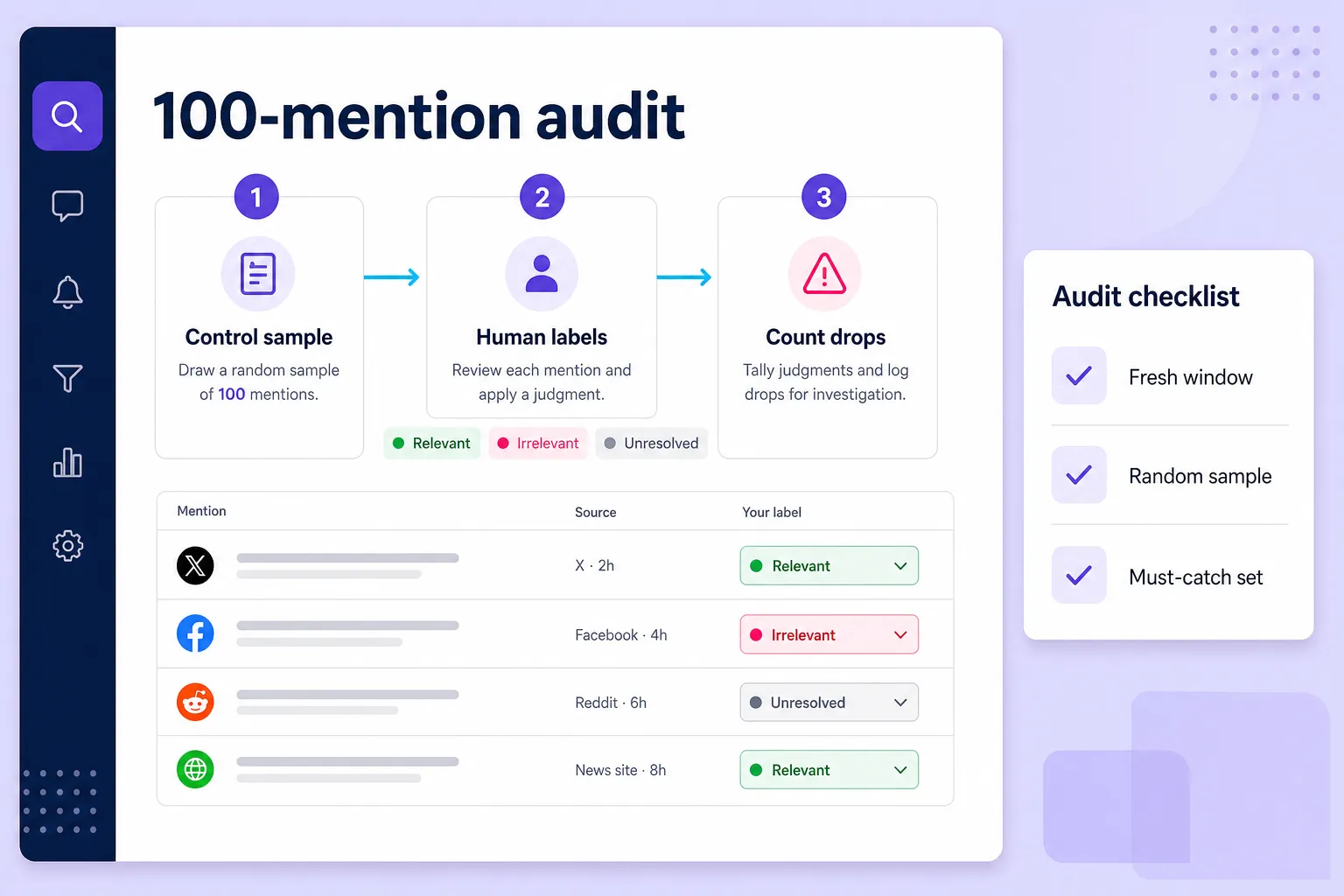
Step 6: How to validate recall with a labeled 100-mention sample
Direct answer: export a window of raw matches from the broad control query, label 100 of them at random as relevant, irrelevant or unresolved, then apply your proposed filter and count how many relevant items it drops - that count, divided by the relevant items only, is your false-negative rate.
Stanford's guidance on assessing relevance describes how human relevance judgments work and how results from multiple retrieval methods get pooled before evaluation. The practical translation is one sentence: never let the filtered feed define what counts as the complete set.
What it does. It replaces "we think we're catching everything" with a number, a date and a known margin.
The protocol.
- Fix a window and record its dates, sources and content types.
- Export the broad control results for that window, before applying the proposed exclusions.
- Remove duplicate records, and flag syndicated copies and comments from the same thread.
- Select 100 raw matches at random. Not the newest, not the most engaging, not the ones already accepted.
- Label each one relevant, irrelevant or unresolved, with a separate high-value flag. Define "high-value" before you start: unresolved complaints, journalist requests, purchase questions, safety issues, material misinformation.
- Resolve the unresolved by reading surrounding context or asking a second reviewer. Do not silently fold them into "irrelevant."
- Apply the proposed rules and record which relevant items survive and which disappear.
The arithmetic, with a hypothetical 100-item sample:
| Human judgment | Filter keeps it | Filter rejects it | Total |
|---|---|---|---|
| Relevant | 36 | 4 | 40 |
| Irrelevant | 9 | 51 | 60 |
| Total | 45 | 55 | 100 |
Precision is 36 ÷ 45 = 80%. Observed filter recall is 36 ÷ 40 = 90%. The observed false-negative rate is 4 ÷ 40 = 10%. The denominator is the relevant portion, never all 100 records, and that distinction is where most published "95% accuracy" claims quietly break.
What zero misses actually licenses you to say. Using the NIST exact binomial method, zero misses among 100 independently sampled relevant mentions gives a one-sided 95% upper bound of 2.95% on your miss rate. With zero misses among 15 independent relevant observations, the one-sided 95% upper bound on the miss rate is about 18.1%. Report that uncertainty; it does not support a strong recall claim. And independence is a real condition, not a formality: the benchmark authors noted that several comments came from the same threads, so they should not be counted as separate customer conversations.
The low-volume policy nobody writes down. If your sample contains only two relevant items, you can calculate observed recall, but the evidence is too limited for a reliable performance claim. Report the counts and mark the estimate as highly uncertain. You have an insufficient-evidence state, and the honest response is to say so. Widen the sampling window where appropriate. Use independently discovered examples from support and sales to investigate coverage gaps and expand the must-catch set; report those results separately from the random-sample recall estimate.
Run the audit on fresh material. Tune on the first sample, freeze the rules, then evaluate a second sample of 100 raw matches. Keep previously missed mentions as permanent regression examples and report them separately, because passing the same familiar items repeatedly proves memorization, not performance.
Execution constraints. You need the control and working configurations collecting over the same window, and you need export access to compare source URLs rather than screenshots. Note also that editing a live query can rewrite your evidence: Sprout documents that if you add a competitor to a topic after creating it, you won't have access to historical data, and the updated topic starts collecting new data from the time it's saved. Export first, change second.
For hosting the broad control stream, BrandMentions covers news, blogs, forums, public social sources and review sites, and its real-time alerts, sentiment analysis and AI visibility tracking keep generated-answer checks next to published mentions, which is useful when your recall question spans both surfaces. Breadth of coverage supports the audit; it does not prove complete recall, and you should still verify what your plan permits in terms of parallel configurations and exports.
The non-obvious insight. Read your false negatives as content, not only as errors. When misses cluster around a context word you never thought to include, you are usually looking at a use case or customer segment the business has not named yet. That is market information arriving disguised as a query bug.
A 100-mention audit is a starting point, not a certificate. Report the bound, the date, and the number of relevant items it rests on.
Check it: trace one known high-value mention end to end, from collection through classification and notification to a human actually acknowledging it.
Step 7: Query maintenance cadence for brand monitoring (drift, evidence and alert routing)
Direct answer: book recall checks as their own recurring calendar item, version every query beside the reports it produced, and keep a free bare-name alert stream running as a second opinion, because query decay is the default state.
Query decay is the default. New collisions appear, your brand enters new contexts, and the exclusion that was safe in March starts cutting real mentions in September. The cheapest second opinion remains a free bare-name alert stream set to return all results rather than only the best ones, which catches source-level outages your main platform will not report.
What it does. It turns drift detection into a process instead of an accident.
The cadence we recommend.
- Daily: review high-value and uncertain items, and investigate any source that has gone unexpectedly silent.
- Weekly: inspect control results absent from the working feed and log new collision patterns without acting on single occurrences.
- Monthly: evaluate a fresh labeled sample and review each exclusion individually.
- After launches, renames or incidents: rebuild the seed list.
- After any platform or model change: rerun the must-catch set and test notification delivery.
Precision and recall impact. Weekly work mostly raises precision. Monthly and post-change work protects recall, because those are the only moments when anyone questions an existing exclusion. Book them as separate calendar items or precision work will eat the recall work every single week.
Execution constraints. Save query versions beside your reports. Without them, a volume drop after a stricter filter looks exactly like a change in public conversation, and someone will present it as one. Your mention alerts setup should also separate immediate escalation from routine digests, with a named owner and a backup for each destination.
The non-obvious insight. Track the ratio of unambiguous mentions (handles, campaign tags, domain references) to plain-name mentions. If plain-name volume falls while tagged volume holds, investigate the query. If both fall together, investigate the market. The ratio is not proof of anything on its own, but it is a free daily tripwire that requires zero labeling.
Check it: confirm that last month's exclusions still have an owner, a date and a reason recorded against them.
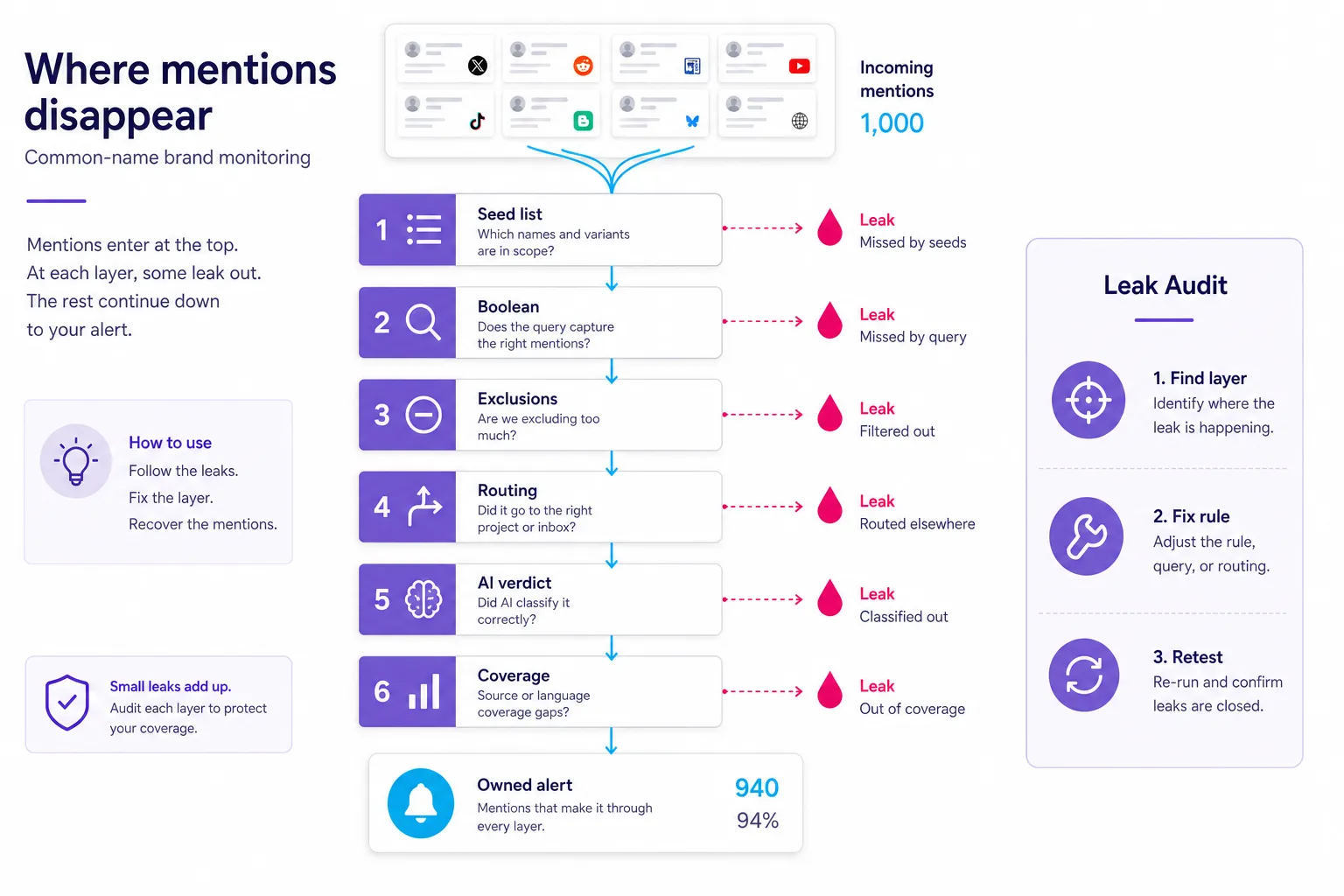
The Leak Audit: a diagnostic matrix for where mentions disappear
This is the asset we would hand a new monitoring owner on day one. It assumes the audit found misses, which it will, and it tells you which layer to open.
Match each miss to the layer that caused it
| Miss cause (from the labeled sample) | Layer responsible | Fix | Act when |
|---|---|---|---|
| Variant absent (misspelling, spacing, old name) | Step 1 seed list | Add to the OR branch | 1 or more. Variants are cheap |
| Named with no category word | Step 3 AND layer | Add the observed context term, or move the identifier to the distinctive branch | 2 or more sharing vocabulary |
| Context present but distant | Step 3 proximity layer | Widen distance, or drop proximity for long-form sources | 2 or more from articles |
| Exclusion matched a mixed-topic mention | Step 3 NOT layer | Narrow to the exact collision phrase and retest with the NOT-to-AND trick | 1 miss. Exclusions get no benefit of the doubt |
| Removed by location, language or source rule | Step 4 | Replace with a narrower publisher or author rule | 1 miss from a market you serve |
| Classifier rejected a genuine mention | Step 5 | Add the missed case type as an explicit example in the brief | 1 miss, plus a regression entry |
| Found independently, absent from the control | Coverage, not filtering | Add the source, add a surface, or record a known gap | 1 miss. This is ledger one |
| Collected and classified, never acted on | Step 7 routing | Reassign the destination and name an owner | Any occurrence |
Keep an exclusion receipt for every change
| Record | What to enter |
|---|---|
| Proposed change | The exact keyword, filter or instruction edit |
| Noise removed | Count of irrelevant sample items it rejects |
| Relevant mentions lost | Count plus URLs |
| High-value mentions lost | Count plus escalation category |
| Decision | Keep, revise or reject |
| Owner and review date | Named person, next check |
Our release rule: reject any change that loses a known high-value mention, and investigate every other relevant loss before accepting the cleanup. It is a policy, not a benchmark. Teams that write it down stop arguing about filters in the abstract.
Report recall by subgroup, not just in aggregate
An aggregate recall figure can look healthy while the rare and expensive categories fail. Keep a small table with one row per important group: news and press, forums and communities, review platforms, non-English content, and complaints specifically. Record the number of relevant items observed in each row alongside the misses, and mark any row with fewer than roughly 10 relevant observations as insufficient evidence rather than quoting a percentage from it.
One warning on sampling design. Do not build the sample to mirror your working feed's source mix, because that feed is the thing under investigation. Sample from the control. You may oversample high-risk groups for diagnosis, but report their results separately or weight the aggregate estimate to reflect the sampling design.
Measure your labels, not just your filters
Before you trust any recall number, have two reviewers independently label the same 25 items and compare. Use the 25-item exercise to identify unclear labeling rules. Review disagreements and agreement on relevant items separately; high overall agreement can hide poor recognition of rare brand mentions. Persistent confident disagreement means the definition is the problem, not the query, and no amount of Boolean tuning will fix a test set that two reasonable people read differently.
A maturity check, in four honest levels
- Level 0: Keyword alerts, no exclusions, nobody reads the feed.
- Level 1: Boolean structure with branch separation, exclusions logged with reasons, noise tolerable.
- Level 2: One completed labeled audit, recall reported with its relevant-item count and date, must-catch set in place.
- Level 3: Audits on fresh samples each month, subgroup reporting, coverage gaps tracked in their own ledger, generated-answer checks recorded separately.
A clean feed alone does not demonstrate Level 3 maturity; that requires fresh-sample audits, subgroup reporting, and documented coverage gaps.
Tactic comparison table: precision versus recall impact
Benchmark figures below are from the 1,000-comment Linear sample, which is a vendor-run test on one platform and one window. Directional effects follow from the mechanics of each rule and are not performance forecasts for your brand.
| Tactic | Precision effect | Recall effect | Benchmark evidence | Reviewability | Setup effort |
|---|---|---|---|---|---|
| Bare keyword, no filters | Very low | Maximum | 103 of 1,000 relevant (10.3%) | Full | Minutes |
| Seed list variants (OR) | Slight decrease | Increase | Not isolated | Full | 1 to 2 hours |
| Domain or handle only | Maximum | Severe loss | 8 of 103 retained (7.8%) | Full | Minutes |
| Phrase exclusions (NOT) | Moderate increase | No loss observed, not guaranteed | 206 comments removed, 103 retained | Full | Ongoing, weekly |
| Context terms (AND) | Large increase | Falls with every gap in your context list | Not isolated | Full | 2 to 4 hours plus audit |
| Proximity (NEAR) | Larger increase | Larger loss on long documents | Not isolated | Full | Platform-dependent syntax |
| Source, geo, language rules | High for concentrated collisions | Risk where location is inferred or absent | Not tested | Full | 1 hour plus quarterly recheck |
| AI relevance classification | Very large increase | Held in sample; depends on the brief | 103 of 103 kept, 1 false positive | Partial, verdicts only | Hours, plus brief writing |
| Labeled recall audit | Measures, does not filter | Measures, does not filter | Method | Full | About 1 hour per 100 items |
Phrase exclusions vs. context terms: the difference in execution. You can check whether a phrase exclusion removes relevant mentions in the reviewed sample. Retest it on fresh material because future mentions may use the same phrase differently. You cannot prove a context list complete, because that requires predicting every way a stranger will phrase a real mention. One is testable; the other is only auditable after the fact.
AND vs. NEAR: the difference in risk. AND fails on long documents by admitting anything that touches your category anywhere on the page. Proximity fails on the same documents by rejecting real coverage where the category word sits two paragraphs from your name. Use proximity where thoughts are short, use AND where documents are long, and let the audit decide the split rather than a rule of thumb.
Boolean vs. AI: the difference in accountability. When a Boolean clause drops a mention, you can point at the clause. When a classifier drops one, you can only point at the brief you wrote and the evidence span it returned. Both are fixable. Only one is visible without a test set, which is why the test set stops being optional the moment AI enters the pipeline.
Frequently Asked Questions
How to monitor a brand with a common name without missing relevant mentions?
Run a broad control query alongside a filtered working query, keep distinctive identifiers (products, handles, campaign tags, domain) outside the context rules you built for the ambiguous word, then label 100 raw matches and count the relevant ones your filter drops. The Linear benchmark shows the cost of skipping that check: a domain-only filter returned 8 of 103 genuine mentions, while phrase exclusions plus an AI relevance rule kept all 103 with one false positive.
What is a common-name brand?
A common-name brand is a brand whose name is also a dictionary word, place, person, or another company's name, so a string match alone cannot confirm the mention refers to it. For these brands the keyword stops being the query and becomes one input to it, with context doing the real work, and volume stops being trustworthy because a spike could be your brand, a geometry lecture or a town square. Capitalization will not rescue you either, since most platforms match without case sensitivity by default.
What is a broad control query in brand monitoring?
A broad control query is an unfiltered query that collects everything carrying your name - variants, misspellings, handles, hashtags - with no context terms and no exclusions applied. Its job is not to feed alerts but to act as the denominator for your recall audit: you sample raw matches from the control, label them, and then see which relevant ones your working filter would have dropped. Never let the filtered feed define what counts as the complete set.
What is a working query, and how does it differ from a control query?
A working query is the filtered query that actually feeds your alerts and dashboards: branch-separated Boolean, context or proximity rules around the ambiguous word, exclusions, and any AI relevance rule layered on top. The control query measures; the working query delivers. Run both over the same window, because the control is the only evidence that tells you what the working query is costing you.
What is a must-catch set in brand monitoring?
A must-catch set is a permanent regression set of known relevant mentions - especially ones your setup previously missed, plus every high-value category you cannot afford to lose - that any future query, filter or classifier change must still retrieve before you ship it. Rerun it after any platform or model change, and report it separately from fresh-sample recall, because passing familiar items repeatedly proves memorization, not performance.
What is an exclusion receipt?
An exclusion receipt is the written record attached to every filter change: the exact keyword, filter or instruction edit, the count of irrelevant items it removes, the count and URLs of relevant mentions it costs, any high-value mentions lost with their escalation category, the keep-revise-reject decision, and a named owner with a review date. Our release rule is to reject any change that loses a known high-value mention and to investigate every other relevant loss before accepting the cleanup.
Should I use NEAR or AND for a common brand name?
Use proximity where thoughts are short and AND where documents are long, then let a labeled audit decide the split rather than a rule of thumb. AND fails on long documents by admitting anything that touches your category anywhere on the page; proximity fails on the same documents by rejecting real coverage where the category word sits two paragraphs from your name. Remember that proximity syntax does not transfer between platforms - Brandwatch uses NEAR/x, and Notified's help documentation sets NEAR to a maximum of 10 words by default, adjustable with forms such as NEAR/15.
Can I filter a common brand name by location or language?
You can, but use these as routing rules before you use them as deletion rules. Sprout Social's documentation warns that location-based filters are very strong: applying one excludes every message that doesn't have a location tied to it on X, and many users never specify location information at all, so the filter may inadvertently exclude conversations you are interested in. Source exclusions are more reliable than geographic ones because sources are observed and geography is inferred - exclude the other entity's home forum or publisher by domain and leave country and language open.
How many mentions do I need to label to trust my monitoring?
Label enough raw matches to produce 100 confirmed relevant ones, since recall is calculated against relevant items rather than against the whole sample. Zero misses among 100 independently sampled relevant mentions supports a one-sided 95% upper bound of 2.95% on your miss rate, and clustered comments from a single thread do not count as independent observations.
Should I use negative keywords or context terms to filter a common brand name?
Use both, in different ways. Exclude only exact phrases you have seen in your own noise, and test each one by temporarily switching NOT to AND to confirm the mentions it removes really are irrelevant. Context terms raise precision further but drop real mentions phrased in ways you did not anticipate, so never ship them without a recall audit behind them.
Is AI relevance filtering better than Boolean for ambiguous brand names?
They solve different problems, and the order is what matters. Boolean matches strings cheaply and leaves an editable rule; AI judges meaning in context, which is how noise in the Linear sample fell to about 1% from 89.7%. Run Boolean first, because AI runs after keyword matching and cannot recover a mention an exclusion already removed.
How do I check if AI answers confuse my brand with another company of the same name?
Run scheduled prompt checks and record four things each time: the exact prompt, engine, date and account state; whether the answer describes you or a same-name entity; whether the website and category are correct; and which sources it cites. Keep misattribution in its own queue, because another company's complaint attached to your name is not noise. Expect variation between checks - Google documents that AI Overviews and AI Mode may use a "query fan-out" technique and may use different models and techniques, so the set of responses and links they show will vary.
Conclusion: make every exclusion accountable
Before tightening another filter, export a random sample from your broad control query and label it. Record which relevant mentions the working query rejects, preserve high-value misses as regression tests, and assign an owner for the next review. Report observed recall with the relevant-item count and its uncertainty.
Credit where it is due: the practice of reviewing a sample before tightening a rule is not new, and the benchmark authors say so themselves, advising readers to start with a broad preview in the communities they care about, then review 100 matches before making the rule stricter. What most teams lack is not the idea. It is the operating discipline around it: a fixed denominator, a defined high-value category, a written release rule, a receipt for every exclusion, and an honest insufficient-evidence state when the volume is too low to support a number.
So change the definition of done. A query is not finished when the noise stops. It is finished when a labeled sample from an unfiltered control shows the losses you accepted, the bound is written down with its date and its relevant-item count, and someone owns the next check.
Start this week with the broad query, before you touch another exclusion. Let it collect for a few days, export it, and label your first 100 matches. By the end of that session you will know something no dashboard has told you yet: not whether the feed looks cleaner, but which conversations your cleanup was costing you.
Methodology: figures in this guide come from vendor and platform help documentation consulted in November 2026 (BrandMentions,Syften, Brandwatch, Sprout Social, Mention, Determ and monitoring-platform help centers), Google Search Central documentation, the X API reference, LSEG's tagging documentation, Stanford's information retrieval text, and NIST's statistical reference. No proprietary data was used; worked examples illustrate method, not measured product performance.
Filed under: Brand Monitoring