Social Media Crisis Monitoring: How to Set Alert Thresholds
A practical guide to setting baseline-calibrated alert thresholds, with worked calculations, a replay results table, and a calibration worksheet for PR and monitoring leads.


Social media crisis monitoring works best when alert thresholds reflect your brand’s normal activity, the severity of a potential issue, and your team’s capacity to investigate. Compare mention volume with your historical baseline, test candidate rules against past data, and give credible safety, privacy, or legal concerns a path to review, even when only one mention appears.
A universal threshold such as “100 mentions an hour” misses that context. For a large retailer, it might flag an ordinary afternoon. For a niche software company, it could stay silent while a serious complaint spreads. Negative sentiment alone is no better: unhappy comments do not automatically signal a crisis, and an urgent reporter inquiry may sound entirely neutral.
This guide explains how to set social media crisis alert thresholds, establish a reliable baseline, adapt rules for low-volume brands, and test for false alarms, missed incidents, and detection delay. The goal is an alert your team can act on: specific enough to limit noise, sensitive enough to surface potential harm, and clear about why a human needs to look.
Key findings
- A universal cutoff cannot fit every brand at once. The same "100 mentions an hour" line is a quiet afternoon for an airline and the biggest week of the year for a regional nonprofit.
- The statistical backbone is old and tested. The NIST Engineering Statistics Handbook treats a point beyond three standard deviations as the signal worth investigating, and notes that A conventional two-sided three-sigma chart averages about 371 observations between false alarms under independent normal observations with known process parameters. This theoretical rate does not directly describe an upper-tail alert applied to seasonal, correlated social mention counts.
- Evaluate rules with two plain formulas. Google defines recall as TP / (TP + FN) and precision as TP / (TP + FP), which translates directly into missed incidents versus noisy alerts.
- Platform collection limits set a floor your rule cannot beat. YouTube's Data API defaults to 10,000 units per day, Reddit allows 100 queries per minute per client averaged over 10 minutes, and TikTok's Research API can take up to 48 hours for new videos to enter search.
- Negative sentiment is not crisis severity. Velocity, source authority, evidence, and the number of independent authors decide escalation, not the raw count of unhappy comments.
- Low-volume brands need a witness rule, not a spike rule. When your baseline sits near zero, a percentage jump is unstable, so you count independent voices and severity instead.
Which threshold strategy fits your scenario?
The right rule is the one whose failure mode you can live with, given your volume, risk, and review capacity. Match yourself to a row before you touch a single setting.
- Best for high-volume consumer brands (hundreds to thousands of mentions a day): Verdict: baseline-relative rule. Key metric: spike ratio against the same weekday and hour. Limitation: it can quietly normalize a slow-burning issue if you recalibrate too soon.
- Best for mid-volume B2B brands: Verdict: combined rule (baseline multiple plus absolute floor plus a gate). Key metric: true incidents caught per analyst hour. Limitation: you must define severity terms and trusted sources before anything happens.
- Best for low-volume or niche brands (single or double digits a day): Verdict: severity-first escalation with a statistical backstop. Key metric: missed high-severity incidents. Limitation: it creates alerts without a spike, so ownership must be assigned in advance.
- Best for your first 30 days with no history: Verdict: a conservative absolute cutoff as a placeholder. Key metric: reviewable alerts per day. Limitation: it is blind to your baseline, so flag it as provisional and replace it fast.
- Best for agencies running many brands: Verdict: per-brand baselines with a shared alert budget. Key metric: total alerts per analyst per shift. Limitation: it demands discipline to stop one noisy client from consuming the whole team.
Alert thresholds are investigation promises, not verdicts. A threshold does not decide whether you are in crisis. It decides whether a human has to look right now.
When is a mention spike actually a crisis?
A spike is a crisis when volume, velocity, source, and evidence move together and your baseline did not predict it. A spike alone is a busy day wearing a scary costume. A viral meme, a launch, or a positive moment all produce tall bars, and none of them is a war room.
The signal worth watching is the shape of the curve, not its height. Repeated acceleration can justify closer review, but growth patterns alone do not distinguish a crisis from a meme, promotion, or routine news cycle. Assess potential harm, evidence, relevance, and urgency alongside volume. Composition matters more than count: a thousand consumer mentions are less dangerous than eleven mentions that include two journalists and a trade reporter asking for comment.
Duration alone does not distinguish a crisis from routine attention. Escalate based on credible potential harm, evidence, urgency, and organizational exposure. Sustained growth can strengthen the signal, but a serious allegation may require review before any spike develops.
Modern monitoring now has a fourth surface worth checking: how AI answer engines describe your brand. A claim that never trends on social can still be summarized into an AI answer and repeated at scale, so treat a sudden shift in how assistants frame your brand as its own low-volume signal, not an afterthought.
Research: What a real-data backtest revealed about crisis alert thresholds
We tested three crisis alert rules across eight brands and 448 brand-days.
The clearest finding: a mention spike can signal a change in data collection, not a brand crisis.
Using daily counts retrieved over a 90-day period, we built trailing 28-day baselines and evaluated each rule across 56 test days per brand. Median daily volumes ranged from 5 to 438 mentions, allowing us to compare how the same thresholds behaved across brands of different sizes.
The replay exposed six practical problems with relying on volume alone:
- One fixed threshold produced frequent alerts for some brands and none for others. A cutoff of 500 mentions a day triggered on 25 of Shopify’s 56 test days, but never triggered for five of the eight brands.
- The robust rule flagged more days, not fewer. The median-and-MAD rule produced 56 alert days, compared with 33 for mean plus three standard deviations. Resistance to outliers did not translate into a lower review workload.
- Most alerts clustered around a collection shift. Forty-two of the 51 alerts from the robust rule with a minimum-volume floor occurred between 13 and 23 October. During that period, collection expanded and control terms such as “weather” rose four to fivefold, suggesting that increased coverage contributed to the apparent spikes.
- Review of the panel-adjusted alerts found routine content and irrelevant matches. After adjusting for each brand’s share of total panel volume, the rule flagged 12 brand-days. Reviewing up to 100 of the newest mentions per day found stock-market coverage, cycling reports, unrelated uses of “peloton,” syndicated articles, forum discussions, and product listings—not evidence of a crisis in the reviewed content.
- Collection changes also shifted the baseline. As the higher counts entered the rolling window, Peloton’s calculated alert threshold rose from 119 to 597 mentions a day—approximately fivefold. The same collection shift that initially triggered alerts subsequently raised the bar for new ones.
- Weekend patterns differed substantially by brand. Average weekend volume was 1% to 38% lower than weekday volume. HubSpot showed the largest gap, with weekends at 62% of weekday activity, highlighting why comparable time periods matter when setting a baseline.
These results show how alert rules behave under real collection conditions; they do not establish which rule detects crises best. That requires an independently labeled set of incidents, including incidents that generated no alert.
Method and dataset
Data comes from BrandMentions, queried 16 November 2026. We pulled daily mention totals across all sources for 12 August to 9 November 2026.
| Item | Detail |
|---|---|
| Brands | Shopify, Duolingo, HubSpot, Peloton, Grammarly, Glossier, Airtable, Allbirds |
| Clean window | 18 August to 9 November. Earlier days returned zero for every brand, which is a collection gap, not silence |
| Baseline | The preceding 28 complete daily observations, excluding the day being scored. The accompanying methods record must specify the API endpoint, exact queries, timezone, missing-data treatment, standard-deviation convention, zero-MAD handling, and executable rule definitions. |
| Test days | 56 days per brand (15 September to 9 November), 448 brand-days in all |
| Rule A: absolute | 500 or more mentions in a day |
| Rule B: classic | More than the 28-day mean plus 3 standard deviations |
| Rule C: robust | Modified z-score of 3.5 or more, using median and MAD, as the guide recommends |
| Rule C + floor | Rule C, and at least 10 mentions and twice the baseline median |
| Control | We also tested changes in each brand’s share of total mentions across the eight-brand panel. This adjustment can reduce proportional shifts shared across brands, but can distort results when collection changes affect brands differently or one brand dominates panel volume |
| Labels | Every alert day left after the control was read from that day's newest 100 mentions and labeled by hand |
The guide works in hours. The API gives daily totals, so this backtest tests the rule logic at a daily grain. Daily rules add up to 24 hours of alert-rule delay, as the guide's two-clock model notes.
Finding 1: One universal cutoff, two kinds of failure
The 500-a-day line fired 43 times, all for the two largest brands and once for Peloton. For Shopify it fired on 45% of test days, which makes it a daily notification rather than an alert. For the five smallest brands it could never fire, because none of them reached 400 mentions on its busiest day.
| Brand | Typical day (median) | A: 500 a day | B: mean + 3 SD | C: median + MAD | C + floor |
|---|---|---|---|---|---|
| Duolingo | 438 | 17 | 1 | 2 | 0 |
| Shopify | 247 | 25 | 5 | 8 | 8 |
| HubSpot | 150 | 0 | 3 | 5 | 3 |
| Peloton | 61 | 1 | 8 | 17 | 17 |
| Grammarly | 24 | 0 | 6 | 6 | 6 |
| Glossier | 21 | 0 | 4 | 9 | 9 |
| Airtable | 21 | 0 | 4 | 9 | 8 |
| Allbirds | 5 | 0 | 2 | 0 | 0 |
| All brands | 43 | 33 | 56 | 51 |
Alert days out of 56 test days per brand.
This is the guide's opening point in numbers. The same cutoff is a quiet afternoon for one brand and an impossible bar for another. The baseline rules spread alerts far more evenly across brand sizes.
Finding 2: The robust rule was more sensitive, not quieter
The guide recommends median and MAD because outliers can't drag them around. In this data that choice made the rule fire more often: 56 alert days against 33 for the classic mean-plus-3-SD rule.
The reason is the one the guide gives, seen from the other side. A spike inflates the mean and standard deviation of the classic baseline, so after the first big day the classic rule raises its own bar and goes quiet. The median and MAD barely move, so the robust rule keeps firing for as long as volume stays high. Peloton shows it clearly: 17 robust alerts against 8 classic ones, most of them on consecutive days.
Adding the guide's floor, at least 10 mentions and double the median, removed only 5 of the 56. That suggests the floor matters most for very quiet brands, which matches the guide's witness rule. Allbirds, at 5 mentions a day, got 2 alerts from the classic rule and none from the robust one.
The practical lesson is that robustness is a trade, not a free gain. A robust rule catches a sustained problem the classic rule would absorb, but it also keeps paging through a long, harmless plateau. Teams that switch should expect more alerts at first and plan review capacity for it.
Finding 3: What the spike days actually were
We found no crisis evidence in the sampled mentions reviewed for the 12 panel-adjusted alert days. The review does not establish that all 51 original alert days were non-crises Most were caused by the data pipeline, and the rest by ordinary news, name collisions and duplicate content.
The largest cause was a change in collection. From the week of 13 October, the index widened what it collects: video and discussion volume grew most, and control words with no link to any brand jumped four to five times. Every brand's daily count rose at once, and 42 of the 51 robust alerts (82%) fell between 13 and 23 October.
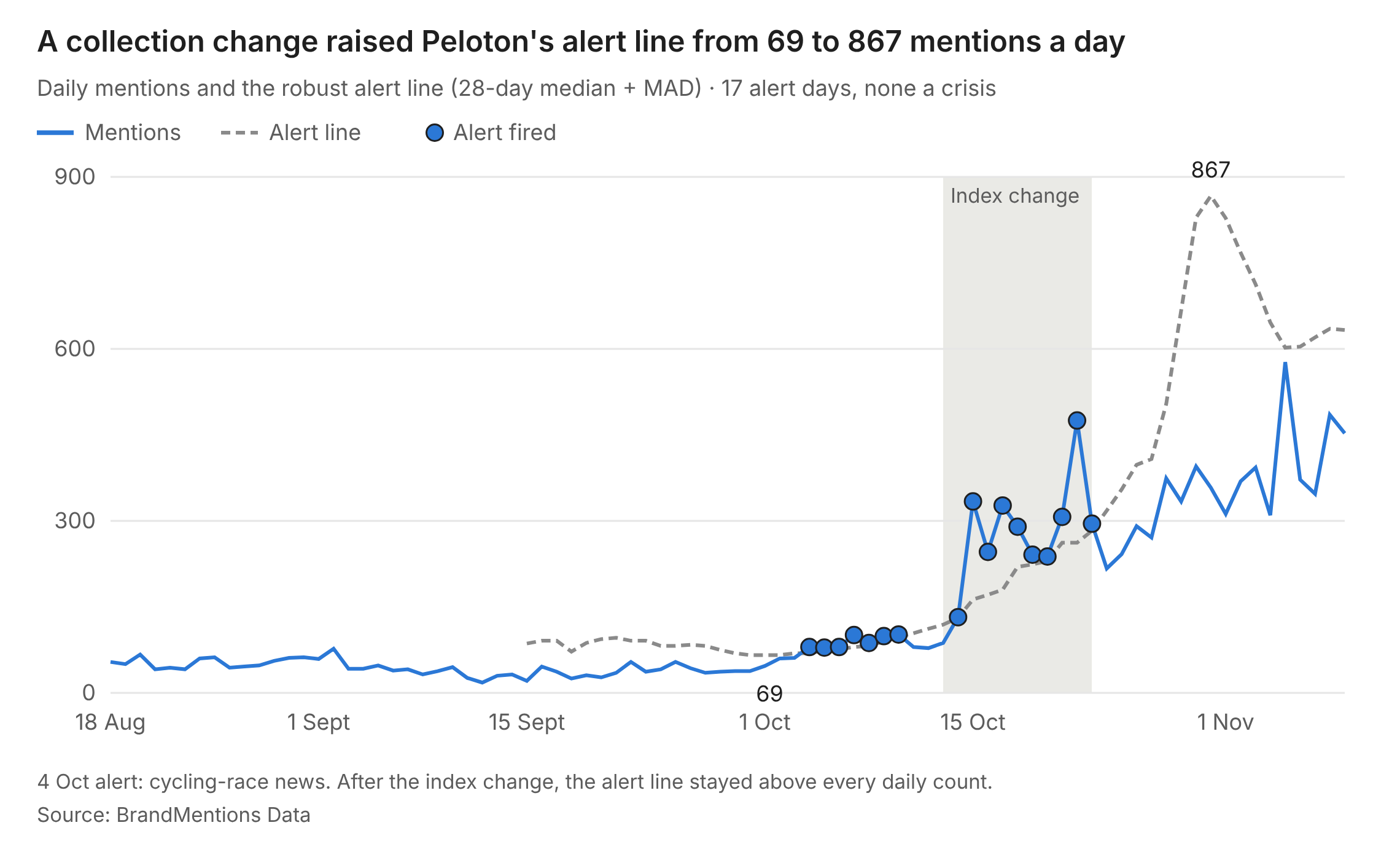
To remove the pipeline effect, we reran the rule on each brand's share of the eight-brand panel. Twelve alert days remained. We read the content behind each one.
| Brand | Date | Mentions | What drove the spike |
|---|---|---|---|
| Shopify | 3 Nov | 1,435 | Stock-market roundups naming Shopify shares |
| Grammarly | 30 Oct | 111 | One study on teens and AI chatbots, syndicated 63 times |
| Shopify | 20 Oct | 952 | Routine store-owner and freelancer posts as discussion collection grew |
| Shopify | 16 Oct | 930 | One repeated forum post ("I want to work for a dropshipping store") plus tutorials |
| Peloton | 15 Oct | 334 | Spanish and French news about a firing squad ("pelotón de fusilamiento") |
| Glossier | 15–17 Oct | 81–91 | Routine beauty discussions, listicles and ingredient databases as discussion collection grew |
| Airtable | 14 Oct | 51 | Berkshire Hathaway investment news about Bending Spoons |
| Grammarly | 9 Oct | 43 | Productivity-tool listicles |
| Peloton | 4 Oct | 80 | Cycling-race news ("peloton" is also a group of riders) |
| Allbirds | 26 Sep | 12 | Stock-info pages and shoe listings |
This is the guide's warning that "a spike alone is a busy day wearing a scary costume", with real examples. It also shows why the guide's dedupe and query-hygiene steps matter: a syndicated story and a repeated post each produced an alert on their own.
Finding 4: Weekday rhythm and baseline contamination
Two of the guide's calibration rules show up clearly in the data: segment by weekday, and keep abnormal periods out of the baseline.
Weekday rhythm. Every brand was quieter at weekends, but by very different amounts.
| Brand | Weekend volume as a share of weekday volume |
|---|---|
| HubSpot | 62% |
| Shopify | 72% |
| Airtable | 79% |
| Duolingo | 83% |
| Allbirds | 85% |
| Grammarly | 90% |
| Glossier | 94% |
| Peloton | 99% |
B2B brands like HubSpot fall off sharply at weekends, while consumer brands like Peloton and Glossier barely change. A flat daily baseline would read a normal HubSpot Monday as a jump, and miss a real Saturday spike.
Baseline contamination. The guide warns never to let a crisis week into the baseline. The collection change in this data did the same thing without any crisis. Once the higher volume entered the 28-day window, every brand's alert line rose sharply.
| Brand | Alert line before (12 Oct) | Alert line after (9 Nov) | Increase |
|---|---|---|---|
| Peloton | 119 | 597 | 5.0× |
| Shopify | 466 | 1,382 | 3.0× |
| Glossier | 38 | 113 | 3.0× |
| Airtable | 31 | 90 | 2.9× |
| Grammarly | 45 | 119 | 2.6× |
| Allbirds | 11 | 23 | 2.0× |
| HubSpot | 301 | 515 | 1.7× |
| Duolingo | 737 | 1,030 | 1.4× |
For two weeks after the change, Peloton's line sat above every daily count, so a genuine incident in that period would have had to be roughly double normal volume to fire. Exclude temporary incidents from baseline updates. After a lasting collection change, flag the break in comparability and rebuild the baseline using stable post-change data, while keeping severity-based review active.
Limitations and disclosure
The data comes from BrandMentions, which publishes the guide. The index's own collection change is reported here as found, because it is the main result.
- No known incidents to test recall against. We did not establish an independent incident inventory for the full test window. This replay measures alert frequency and describes sampled alert content; it cannot establish recall or a complete false-alarm rate.
- All sources together. The guide recommends separate baselines for news, social and forums. These series combine every source.
- Labels by one reader. Alert days were labeled from each day's newest 100 mentions by a single reviewer, not two blind reviewers as the guide advises.
- No query cleaning. Brand names were matched as plain phrases. Cleaner queries would have removed the Peloton collisions and some duplicates, which is itself the guide's point.
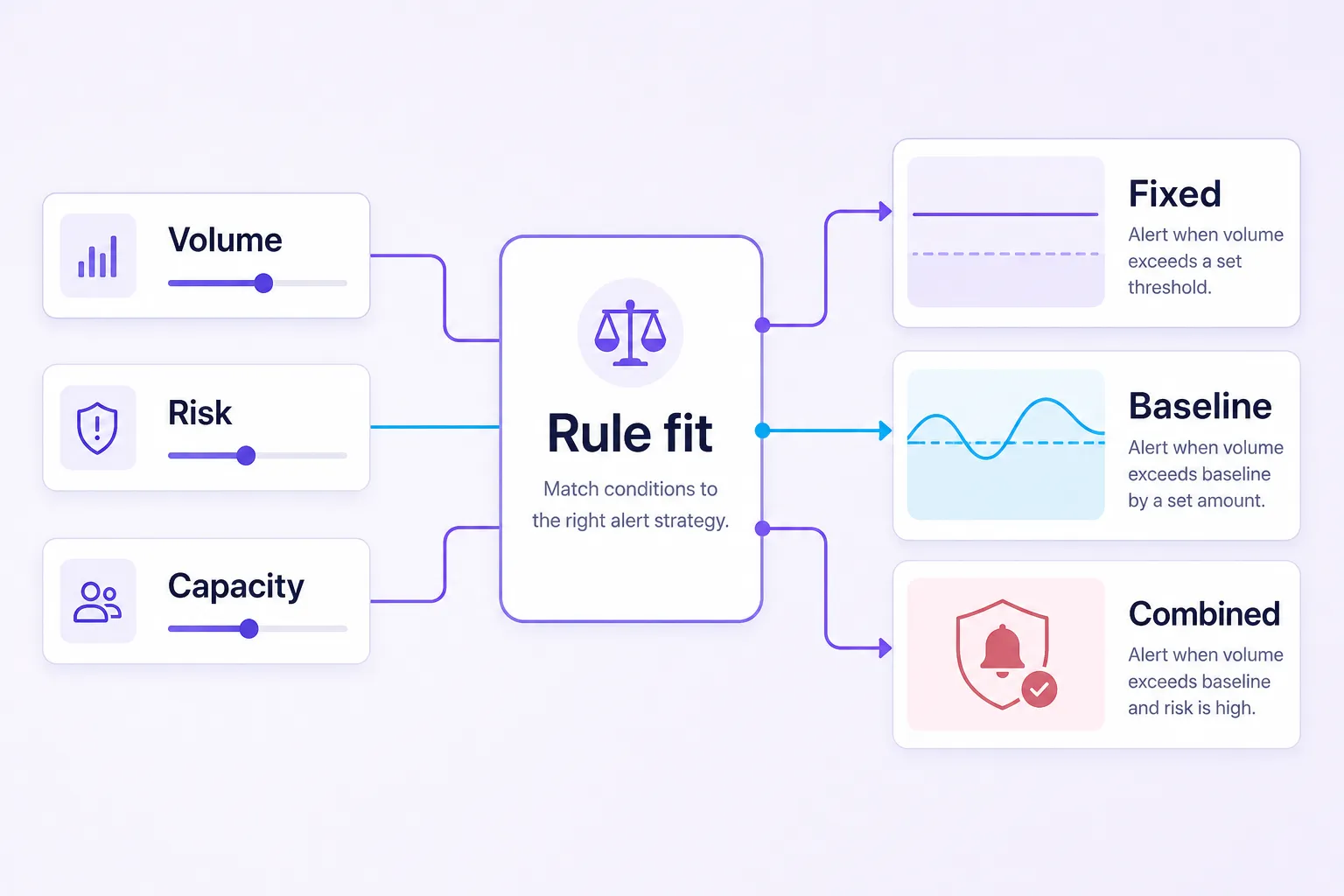
How is a baseline-calibrated alert different from a universal cutoff?
A baseline-calibrated alert measures today against your own normal rhythm, while a universal cutoff applies one number to every brand regardless of size, season, or audience. That difference sounds small. In practice it decides whether the alert is useful or theatrical.
Your normal is never one number. A Tuesday 2 p.m. looks nothing like a Saturday 2 a.m., and a flat daily average will cry wolf every weekday morning or sleep through a weekend problem. Before any math, clean the inputs. Build separate measures for original relevant mentions, distinct observed authors, and amplification. Deduplicate repeated records, flag suspected automation, and tag owned and paid activity so expected campaign volume can be modeled separately. A tight Boolean query setup does more to lower false alarms than any threshold tweak, because a query that pulls unrelated uses of your name poisons the baseline before you calculate anything.
Three rule families do the work, and each fails in a different, predictable way. The numbers below are tunable starting points, not validated truths to copy.
Absolute-count rule
An absolute-count rule fires when raw volume crosses a fixed line, and it should be tested as a simple competitor, not accepted as a default, using the plain evaluation logic in Google's classification reference. It is the model most help-center templates and vendor defaults still ship.
Verdict: Best fit for launch days and the first 30 days before you have history. Key metric: reviewable alerts per day. Limitation: the same cutoff under-alerts a small brand and floods a large one.
Non-obvious insight: keep an absolute rule alive even when it is not your main trigger. If your baseline system breaks after a data migration, a blunt line like "500 mentions in 30 minutes" still catches the obvious.
Baseline-relative rule
A baseline-relative rule fires when current volume deviates from your rolling baseline by a set margin, borrowing directly from statistical process control as described in the NIST Engineering Statistics Handbook, where three standard deviations became the accepted line for a point worth investigating.
Verdict: Best fit for brands with four or more weeks of clean history. Key metric: incident recall on a held-out period. Limitation: on very low volume, one standard deviation is a tiny number, so random chatter trips it.
Non-obvious insight: never recalibrate during or right after a crisis. If the crisis week enters your new baseline, you teach the system that abnormal attention is normal, and the next incident hides under a raised bar. Freeze baseline updates during incidents and for a short cooldown after.
Combined rule
A combined rule layers a baseline-relative trigger, an absolute floor, and a severity-or-source gate. Its performance must be tested against your own incident history. Separately, research on true and false news diffusion on Twitter illustrates why propagation speed can matter; it does not validate this alert design.
Verdict: Best fit for any team that has lost trust in a noisy alert, and for regulated or safety-sensitive brands. Key metric: missed high-severity incidents. Limitation: if the gate is too strict, you suppress a fast incident that has not yet turned negative.
Non-obvious insight: order the gate carefully. A real incident often reads neutral in its first hour, when a journalist is still asking questions. Let a qualified source override the sentiment gate so composition, not tone, can trigger the alert.
A baseline multiple tells you something changed. An absolute floor tells you it is big enough to matter. You need both, or a quiet brand drowns in statistically significant nothing.
How do I establish my normal mention baseline?
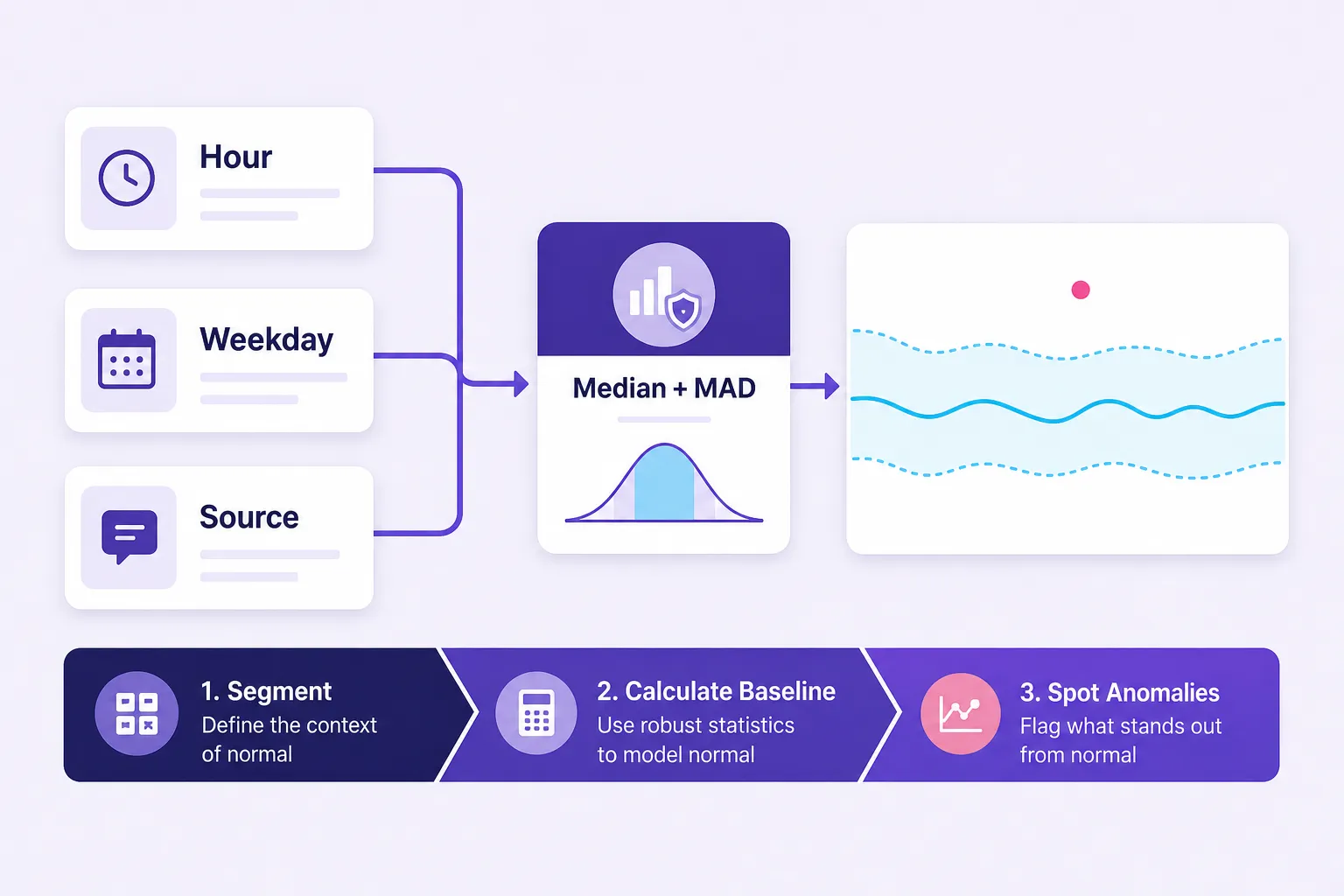
Start with 4 to 6 weeks of mention history, but check how many observations remain in each segment. Six weeks provides only six observations for a specific weekday, hour, and source combination. Where samples are sparse, collect more history or pool comparable time periods. Use robust statistics to reduce the influence of outliers. Use 60 to 90 days if your brand has strong seasonality, paydays, billing cycles, or recurring campaigns. Normal is not one number, so a single flat average measures the calendar instead of the crisis.
Use the median and Median Absolute Deviation instead of the mean and standard deviation. The mean is dragged around by exactly the outliers you are hunting, while the median and MAD tolerate up to half the data being anomalous without breaking, a property established in the outlier-detection literature (Leys and colleagues, 2013). The modified z-score is (current value minus baseline median) divided by (1.4826 times MAD). If MAD is zero, the score is undefined. Use a provisional count-and-severity rule or a broader comparison window until the baseline supports a usable variability estimate.
Segment by source, because press and social behave differently. A jump from 2 to 6 news articles is a real move that a blended baseline, dominated by flat social volume, would never notice. Build separate baselines for news, social, and forums or review sites, then compare equivalent time periods where enough historical observations are available. This can reduce false alarms caused by predictable weekly patterns; measure the effect on your own validation data. A standing monitoring routine keeps those baselines from drifting as the brand grows.
One rule people skip: hold out a block of recent weeks, untouched, before you test anything. If you calibrate and test on the same weeks, you are grading your own homework.
This is also the part of the workflow where historical depth decides whether calibration is even possible. BrandMentions, which tracks mentions across social, news, blogs, forums, review sites, and spoken mentions in videos and podcasts, with sentiment across 100+ languages and up to 10 years of history on its Enterprise plan per its published facts, fits here when a mid-market PR or agency team needs a deep historical web and social export to set a defensible baseline. Its defensible niche is deep historical web and social data for baseline calibration. Sprout Social is strong on the response and engagement side of the same workflow, and Meltwater is credited for its media-database depth when you need to track specific journalists. Pick for the job in front of you, not the longest feature list.
What changes if my brand gets very few mentions?
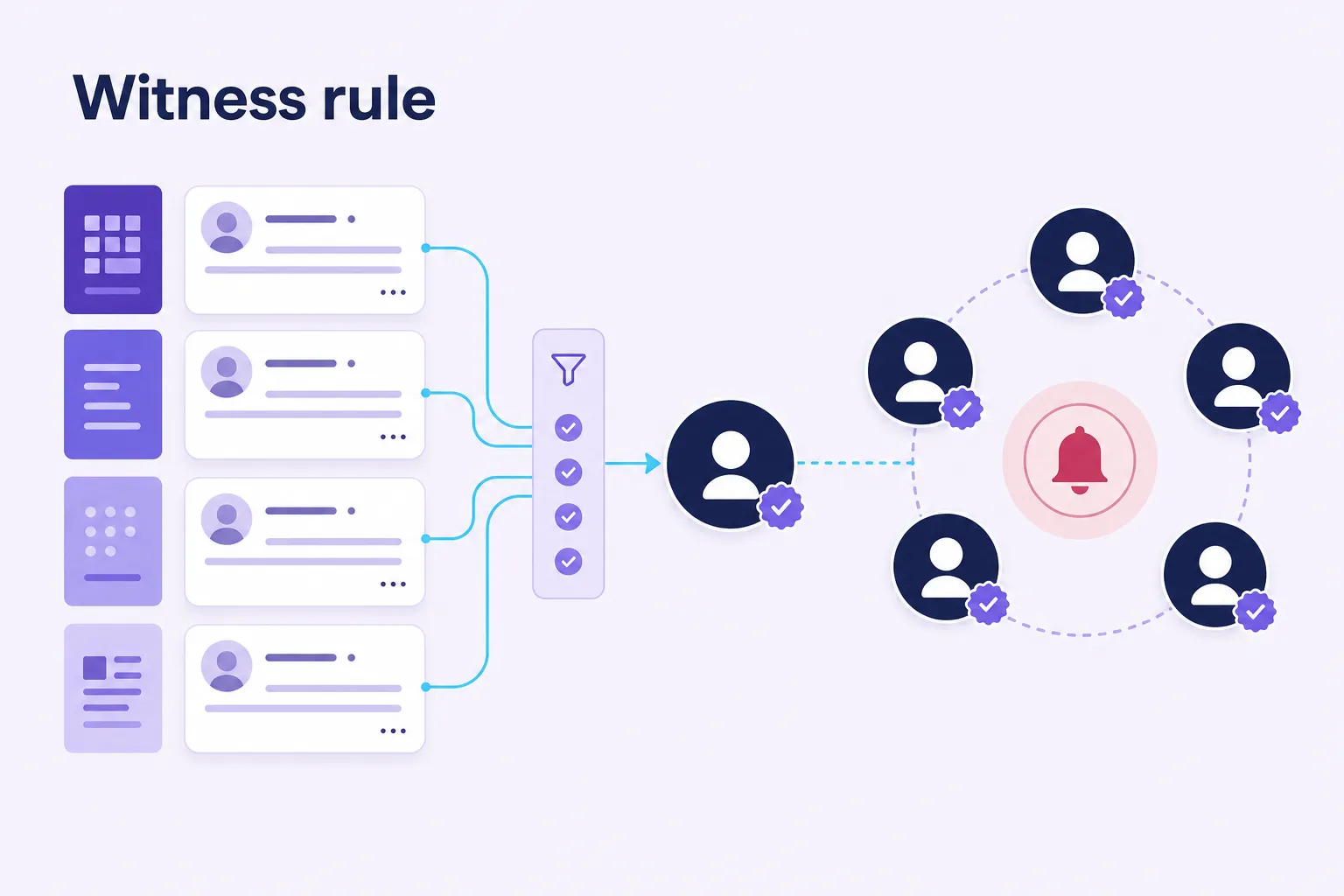
For a low-volume brand, percentage math breaks down and you lean on severity, source, and independent voices instead. If you average 4 mentions a day, a jump to 12 could be your entire early warning, yet a move from 1 to 3 is a 200% spike that should wake no one. This is exactly where copied thresholds fail the brands that can least afford it.
Use three gates. Keep a low absolute floor, around 3 to 5 mentions from distinct authors in one window, so a single loud account does not page anyone. Add severity bypass rules that trigger prompt human review regardless of volume. Examples include a relevant safety allegation, a credible reporter’s inquiry, or a specific claim involving fraud or data exposure. Check entity relevance, recency, source credibility, and context before deciding the escalation level. Then widen the window to 48 or 72 hours so small-sample noise smooths out while sustained shifts still surface.
Define "independent author" honestly. One person posting the same claim on X, Reddit, TikTok, and YouTube is one witness, not four. Count distinct observed accounts and flag likely cross-posts using available identity evidence and text similarity. Record uncertain matches rather than assuming they represent the same person. Treat independent corroboration as a separate judgment: different accounts may repeat one original claim.
A quiet brand needs a witness rule, not a spike rule. The question is not how many people are talking. It is how many independent witnesses are saying the same thing.
Worked low-volume example. A niche B2B SaaS brand averages 4 mentions a day, typical range 1 to 8. On a Tuesday, 6 negative mentions appear across 2 platforms from 5 distinct authors within 4 hours, all about one service outage. A threshold requiring 10 mentions would not fire on these six mentions alone. A rolling six-hour rule requiring three distinct authors could fire when the third qualifying author appears. A severity bypass could trigger review earlier. Exact detection times require the individual mention timestamps and a defined rule-evaluation schedule. At this volume you also have time to read every mention, and your plan for handling negative mentions should route these qualitative flags differently from volume alerts.
How do I test whether my alerts fire too often?
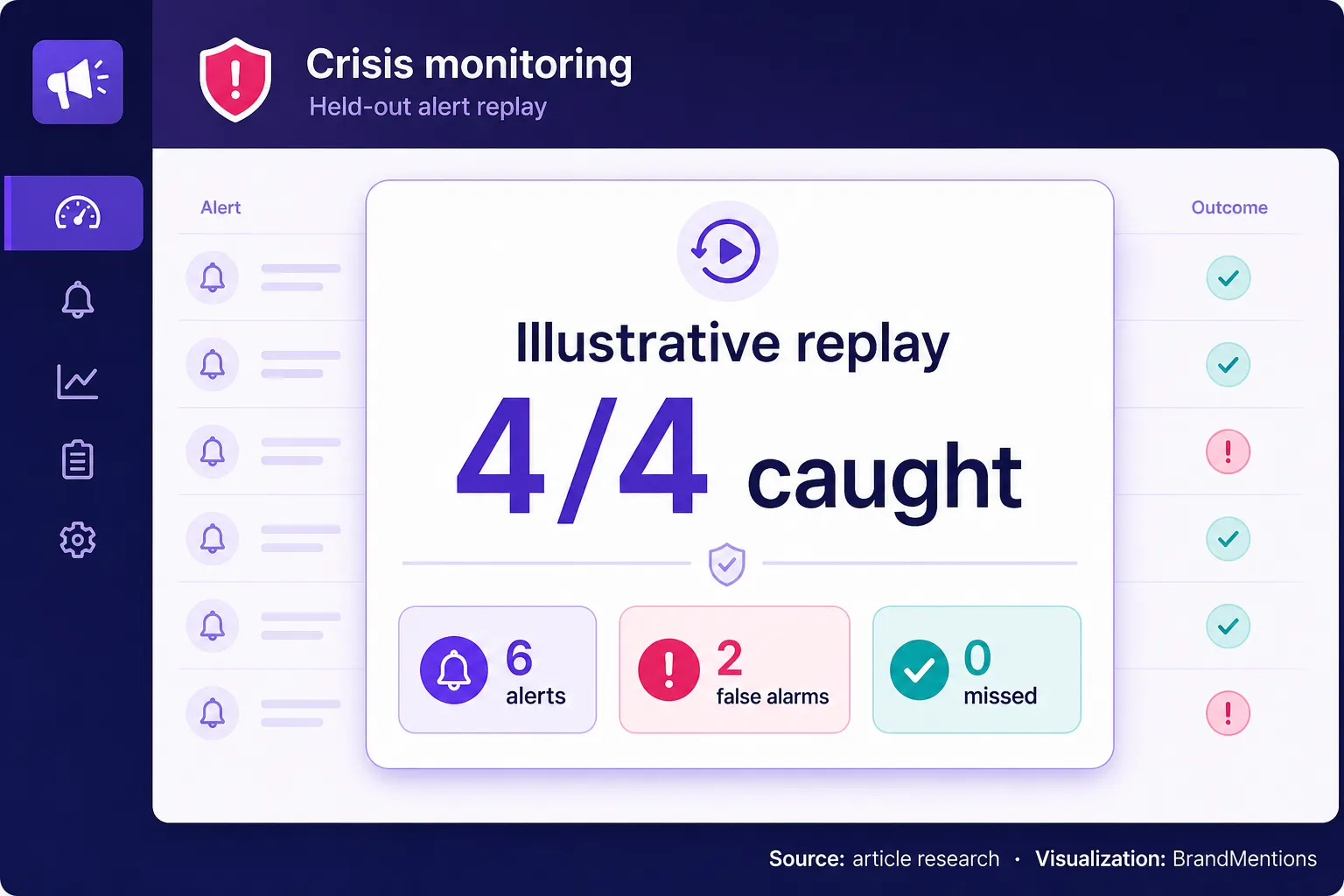
Use an earlier period to establish baselines, a separate validation period to compare and tune rules, and an untouched final period to evaluate the selected rule. Report false alarms, missed incidents, and detection delay. If you tune the rule after reviewing the final results, evaluate it again on new data. An alert rule you have never backtested is a guess with a notification sound.
Label outcomes properly. Use two independent reviewers working from the same written labeling guide, blind to which rule fired, each marking every candidate as incident, non-incident, or needs-more-context. Track how often they agree, resolve disagreements with a documented tiebreak, and keep a few borderline examples in the guide so future labels stay consistent. Blinding matters, because a reviewer who knows the "smart" rule fired will unconsciously validate it.
Here is an illustrative replay on a mid-size DTC brand with a same-hour baseline median of 22 mentions. For this example, repeat notifications about the same issue are grouped into one alert episode, and each detected incident matches one episode. Precision is true-positive alert episodes divided by all alert episodes; recall is detected incidents divided by all labeled incidents. The held-out window held four labeled incidents plus a launch and a promo day. These figures are a calibration example, not a product benchmark.
| Rule | Alerts fired | Incidents caught (of 4) | False alarms | Missed | Precision | Recall | Median collection delay | Median alert-rule delay |
|---|---|---|---|---|---|---|---|---|
| Absolute count (>=100/hr) | 9 | 2 | 7 | 2 | 22% | 50% | 12 min | 70 min |
| Baseline-relative (>=3x median, +20) | 12 | 4 | 8 | 0 | 33% | 100% | 12 min | 40 min |
| Combined (>=2x + severity/source gate) | 6 | 4 | 2 | 0 | 67% | 100% | 12 min | 52 min |
In this example, the combined rule caught every labeled incident with the fewest false alarms. That is the only kind of statement you are allowed to make, and only after your own held-out test produces it. It is not a universal result and not a claim about any tool.
A row-level log is where teams find the real problem, because it splits the clocks:
| Issue | First public mention | First collected | Alert sent | Collection delay | Alert-rule delay | Label |
|---|---|---|---|---|---|---|
| Product safety allegation | Oct 6, 13:05 | Oct 6, 13:17 | Oct 6, 13:45 | 12 min | 28 min | Incident |
| Meme backlash | Oct 10, 19:22 | Oct 10, 19:31 | Oct 10, 20:00 | 9 min | 29 min | Non-incident |
| Data exposure claim | Oct 18, 08:14 | Oct 18, 08:26 | Oct 18, 08:40 | 12 min | 14 min | Incident |
Sometimes the threshold is fine but nobody opens the alert for three hours. Sometimes the alert is fast but the query missed the first source. Tune the workflow, not just the number, and tune one parameter at a time so you know what changed.
Log every alert, label every outcome, and treat your first month as a calibration run, not a production system. A rule that never fires is a rule you cannot improve.
The alert calibration worksheet
Work through this in an afternoon with your own data. Every blank replaces a guess with a measured value. One practical reminder before you pull data: collect only public mentions, respect each platform's terms, and keep a short, defined retention window so your monitoring stays on the right side of compliance.
Section A, baseline. Baseline period (minimum 4 weeks). Baseline median per hour. Baseline MAD. Modified z-score cutoff: a parameter to tune on validation data. The reported replay uses ≥3.5; neither 3.0 nor 3.5 is a validated crisis threshold. Minimum count floor (start at 5 for mid-volume, 3 for low-volume). Observation window (1 hour for high-volume, 6 hours for low-volume).
Section B, severity bypass rules. Safety or harm terms (injury, recall, contamination) route to immediate escalation. Relevant legal, safety, privacy, and executive-related signals enter prompt human review. The reviewer checks entity relevance, recency, evidence, and potential harm before assigning an escalation level. Data breach or privacy claim escalates. These are policy decisions made once with legal and compliance, then hard-coded.
Section C, evaluation ledger. For the held-out period, log alert number, timestamp, rule that fired, count, z-score, sources, label, and for any miss, the first-signal time plus the separated collection and rule delays. Tag known campaigns and account for their expected volume when evaluating anomalies. Keep severity rules active, and investigate unexpected topics or audience reactions during campaign periods. Track reshare volume separately from distinct-author counts to preserve visibility into amplification.
Which issues need escalation without a volume spike?
Some issues demand escalation at low volume because severity lives in the content, not the count. A verified journalist asking for comment, a legal term like "recall" or "lawsuit," a safety claim, a data-breach allegation, or a named executive will never trip a volume threshold, yet any one can define your week. Ten angry tweets about slow shipping are routine customer service. One calm tweet from a reporter is not.
Build a tiered model where severity and source modify escalation independently of the statistical trigger.
| Tier | Trigger | Response |
|---|---|---|
| L0: Log | Within baseline, no severity flags | Weekly review |
| L1: Watch | Baseline anomaly or repeated topic cluster | Analyst reviews within 4 business hours |
| L2: Coordinate | Sustained cross-source growth or journalist pickup | PR and support notified, incident record opened |
| L3: Escalate | High-severity allegation, rapid cross-platform spread, or legal involvement | Crisis process activated, executive aware within 1 hour |
Not every issue deserves a response, which is the point. CDC risk communication guidance is direct that teams should weigh both the consequence and the prevalence of inaccurate information before acting, because responding to a small claim can amplify it. The WHO's social listening guidance frames listening as analysis across diverse sources to understand concerns, not a post-count contest, and the OECD's work on communication in the age of algorithms warns that platform feeds, not followers alone, shape what people see, so social volume is a limited proxy for public opinion. Validate high-consequence signals with source evidence before you treat them as a broad verdict. Keep this document focused on detection, and connect it to your separate crisis management planning for who decides and what you say.
If a single mention from the right account can ruin your week, a volume threshold alone will never protect you. Build the content rule too.
Why should detection delay be split into two clocks?
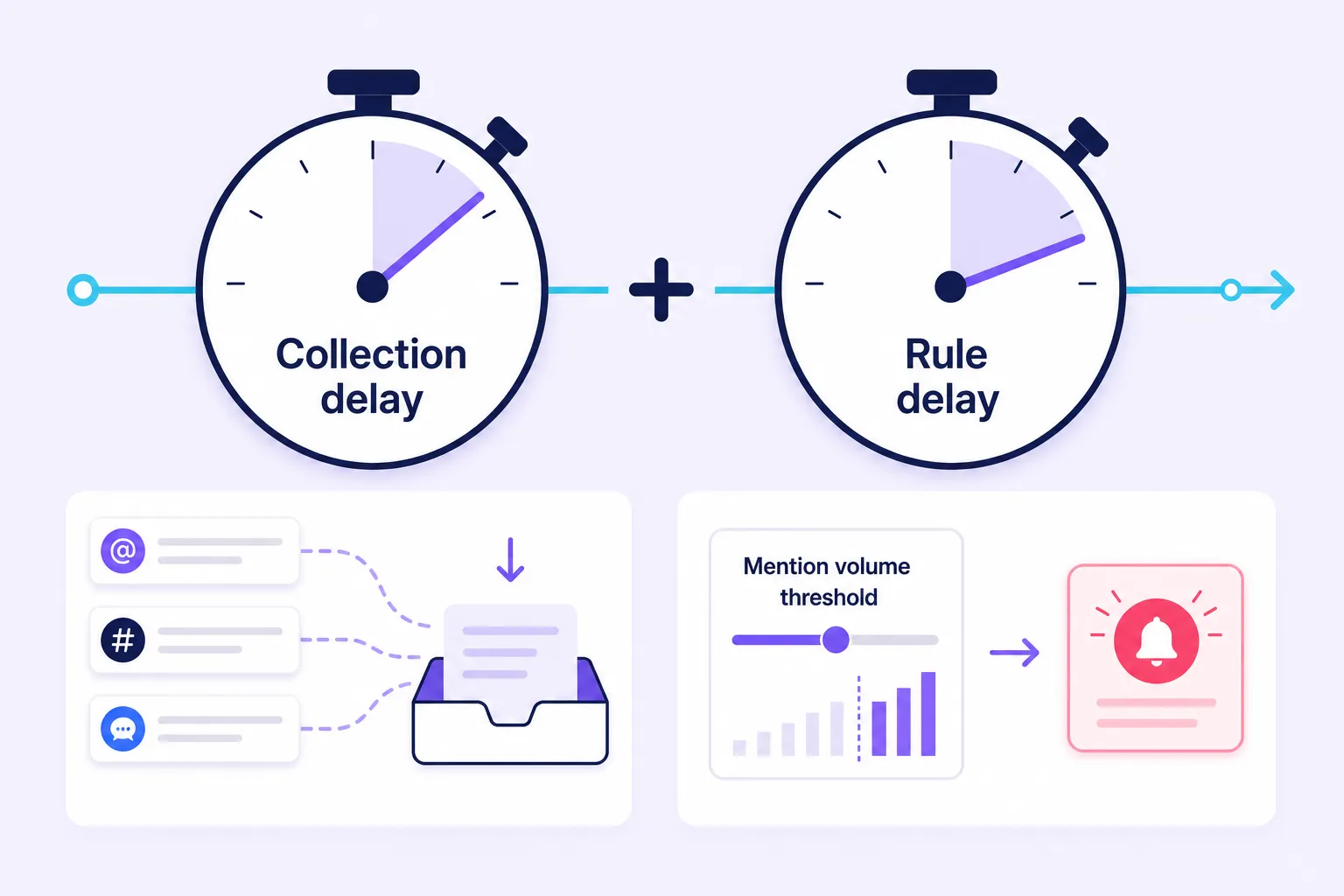
Detection delay should be split into collection delay and alert-rule delay because the two have different causes and different fixes, and teams routinely blame the wrong one. Collection delay is the time from a post appearing publicly to it landing in your tool. Alert-rule delay is the time from the data being present to your rule firing. A daily-aggregated rule can add up to 24 hours of alert-rule delay even when collection is instant.
Collection delay is largely a platform constraint, not a knob you own. Official limits set a floor no rule can beat, so test your coverage against them rather than assuming real-time.
| Platform source | Official constraint that affects monitoring | Why it matters for alert testing |
|---|---|---|
| YouTube Data API | Default daily allocations currently include 100 search.list calls, 100 videos.insert calls, and 10,000 units combined for other endpoints. Verify the quota for the endpoints your monitoring workflow uses | A replay that ignores quota overstates live coverage |
| Reddit Data API | For eligible free-access usage, Reddit documents 100 queries per minute per OAuth client ID, averaged over a 10-minute window. Confirm the access terms and limits applicable to your integration. | Bursty monitoring must respect the rate window |
| TikTok Research API | New videos can take up to 48 hours to enter search; some stats update for up to 10 days | These constraints apply to TikTok’s Research API, which is not available to commercial users. |
| X API | Rate limits vary by endpoint and authentication context, commonly using 15-minute or 24-hour windows. Check the relevant endpoint limits and rate-limit response headers | Reliability can drop exactly when demand rises |
Log these five timestamps on every evaluated issue, then do the subtraction:
| Field | Meaning |
|---|---|
| incident_started_at | When the issue first occurred or became public |
| first_public_mention_at | First verifiable public mention |
| first_collected_at | When your tool collected that mention |
| alert_sent_at | When the rule produced an alert |
| review_started_at | When a human opened the alert |
Collection delay is first_collected_at minus first_public_mention_at. Alert-rule delay is alert_sent_at minus first_collected_at. If collection is slow, fix coverage, ingestion, or your plan cadence, and map real-time notifications to escalation ownership, not just inbox delivery. If the rule is slow, shorten the aggregation window. Do not tighten a rule to fix a collection problem. Total time from the first public mention to the alert equals collection delay plus alert-rule delay. Time to human review adds a third interval: review_started_at minus alert_sent_at.
Detection has two additive delays. Platform availability constrains collection, but polling frequency, ingestion reliability, provider coverage, and processing capacity can also affect it. Rule design determines the additional wait before an alert fires.
Frequently Asked Questions
How to Set Alert Thresholds?
Set thresholds with a 4-to-6-week brand baseline segmented by hour and source, a held-out test period, and three candidate rules (absolute count, baseline-relative using a modified z-score threshold and a minimum mention count, with a baseline-multiple rule tested as a separate alternative, and a combined severity-plus-volume rule), then select a rule using predefined priorities for incident severity, missed incidents, detection delay, and review workload. Report results on untouched test data, including the number of incidents evaluated and the uncertainty created by a small sample. Report detection delay as two numbers, collection delay and alert-rule delay, and let a universal cutoff survive only if it wins that test for your brand.
How often should I recalibrate my thresholds?
Recalibrate monthly for high-volume brands and quarterly for stable or low-volume ones, and Review the baseline after a potential structural change, such as entering a new market. Recalibrate only after enough stable post-change observations show that the shift persists. Exclude incident periods and temporary campaign spikes from the new normal. Never recalibrate during or right after a crisis, because folding the crisis week into your new normal teaches the system that abnormal attention is baseline and hides the next incident.
What is the difference between collection delay and alert-rule delay?
Collection delay is the time between a post appearing publicly and your tool indexing it, which platform APIs cap (YouTube's default 10,000-unit daily quota and TikTok's up-to-48-hour search indexing are examples you cannot override). Alert-rule delay is the extra time your threshold waits before firing, set by your observation window, and it is the only one of the two you control.
Should negative sentiment alone trigger a crisis alert?
No. Negative sentiment is a constant feature of every brand's mentions, so its presence is not severity, and automated sentiment misreads sarcasm, quoted rebuttals, and non-English text. Pair sentiment shift (change from your own historical mix) with velocity, author diversity, source authority, and alleged harm before anything escalates.
Conclusion: calibration beats the copied number
A threshold is a decision, not a setting. When you copy "100 mentions an hour" from somewhere, you are not borrowing a number. You are borrowing someone else's brand, someone else's normal, and someone else's tolerance for false alarms, and none of those are yours.
The move that improves triage is unglamorous and repeatable. Pull your own history, clean it, compute a baseline by time bucket using outlier-resistant statistics, add a floor and a severity gate, and backtest the whole thing against a held-out period with incidents someone else labeled. Split the two delay clocks. Give quiet brands a witness rule. Give high-severity issues a path to escalate without waiting for a spike. The team that can point to its false-alarm count and its missed-incident count has a defensible alert. The team that cannot is guessing with confidence.
Your next step is small and concrete. Export enough history to build adequately populated comparison windows and separate baseline, validation, and final test periods. Tune candidate rules on validation data, evaluate the selected rule once on untouched data, then run a monitored pilot with an assigned reviewer.
Filed under: Brand Monitoring