How to Test Social Listening Data Coverage Before You Buy: The Complete 2026 Playbook
Test social listening data coverage before you buy with seven practical checks for missing mentions, accuracy, alert speed, and historical data.

Quick answer: To test social listening data coverage before you buy, run a live trial against a checklist of required sources and verified mentions. Confirm that the trial matches the plan you would purchase, then measure missed mentions, irrelevant results, sentiment errors, competitor-query consistency, alert speed, and historical coverage. Compare the results against your team’s requirements to decide whether the tool’s coverage gaps are acceptable.
Summary
- Coverage and accuracy are separate failure points and must be tested separately. A tool can return 100% of the conversation and label it at 65% accuracy, or label beautifully while missing 40% of your mentions.
- Independent commercial sentiment research reports accuracy from roughly 66% to 85% on English text (for example Microsoft Azure near 61.8%, Google Cloud near 73.4%, IBM Watson NLU near 79.2% on specific datasets), and human annotators agree with each other only about 70% of the time. Treat any claim far above that band as a methodology question.
- Platform limits, not vendor engineering, cap most coverage. Instagram hashtag search returns only the last 24 hours with a 30-hashtag rolling weekly quota, the TikTok Research API returns 1,000 requests and 100,000 records per day with new videos delayed up to 48 hours, and X caps pay-per-usage at 3 million post reads per month.
- The seeded known-item recall test is the single highest-signal check because it creates a known denominator. A 10% Twitter sample has been measured recovering about 91% of news tweets, while a 1% sample recovered roughly half, so sampling losses are real and they compound across sources.
- Share of voice is defensible only when every brand gets the same Boolean logic, source set, language, geography and time window. On TikTok, symmetric competitor queries are structurally impossible through official APIs.
- Trial environments routinely hide sampling, history and export caps. If you test the sales version instead of the production pipeline, a passing result proves nothing and a failing one may be unfair.
At a Glance: Which Test Fits Your Scenario?
- Best for a fast, zero-engineering reality check: The 50 to 100 mention precision and sentiment audit. You can run it in an afternoon with a spreadsheet and no technical help, and it exposes noise and label error at once.
- Best for proving a coverage gap to a skeptical stakeholder: The seeded known-item recall test. Planted mentions you can verify turn "I think it misses things" into "it missed 7 of 25 known items."
- Best for defending a share-of-voice claim in a board deck: The competitor symmetry check. It stops you comparing a deep brand query against a thin competitor query.
- Best for crisis and PR teams: The historical backfill and known-crisis test, paired with the alert-speed test. If a tool cannot reconstruct an event you lived through, it cannot be trusted to catch the next one.
- Best for enterprise buyers signing annual contracts: The source-requirement table plus trial-cap neutralization. These two protect you from buying production performance you will never actually receive.
The rest of this playbook takes each test apart the same way, so you can score them side by side and walk into the vendor call with a protocol instead of a hunch.
How Is Coverage Testing Different From Reading a Vendor's Source List?
A source list answers "what could this tool theoretically see." Coverage testing answers "what did it actually return for my brand, this week, under my conditions." Those are different questions, and the money is lost in the gap between them.
A source list says "we cover X, Reddit, TikTok, Instagram, news and blogs." It rarely says how. The how is everything. One vendor might hold a firehose partnership, another runs a 10% sample, a third polls a rate-limited search API. All three print the same platform logos.
The non-obvious part is that even full access does not guarantee you get the content. Some partners strip post text and most metadata from API responses for compliance, so you can hold access to a conversation and still be handed a redacted version of it. Access and usable exported fields are two different questions. This is why you test the output, never the brochure.
Why Does Social Listening Coverage Fail Quietly?
Coverage fails quietly because dashboards hide absence well. If a tool misses 40 Reddit threads, you do not see 40 empty rows. You see a clean chart with fewer mentions, and it still looks professional.
The problem surfaces later, usually in the worst way. Your sales team mentions prospects are discussing a competitor in communities your listening report never captured. A complaint that was building on an unindexed forum becomes a news story. The dashboard reported zero, so the team reported calm.
A missing mention is more dangerous than a wrong mention. You can delete noise in seconds. You cannot act on a conversation your tool never captured.
There is a second distortion worth naming. On most platforms a small minority of users produce the majority of posts, so the loudest voices in any listening dataset are the most active posters, not a representative sample of your audience. If a tool under-indexes the exact channel where your active critics gather, you do not just lose volume. You lose the conversation that was about to move.
Can You Still Test Coverage When Platforms Keep Locking Data Down?
Yes, and it matters more precisely because the data supply keeps shifting under you. The job of the test changes from "does this tool crawl everything" to "does this tool still reach the channels I care about under current platform rules, and is it honest about where it cannot."
The economics have hardened. X moved new developers to pay-per-usage pricing and caps those reads at 3 million posts per month, with recent search limited to 450 requests per 15 minutes per app and filtered stream to a single connection and 1,000 rules. Reddit now requires a negotiated contract for commercial use, allows 100 queries per minute for authenticated free OAuth clients and 10 for unauthenticated ones, and charges higher-usage apps $0.24 per 1,000 API calls. These rules decide whether the tool you are testing pulls licensed live data or leans on a sampled feed that can break the day a platform changes something.
So you do not test whether a tool defeated the platform. You test whether it is honest about the ceiling and still delivers what you need below it.
In-House Research: How Sources and Filters Change Social Listening Results
We ran two of the playbook's checks on real data for four e-commerce platforms: Shopify, Wix, Squarespace and WooCommerce. Both show that how you set up the test can move the result as much as the tool itself.
- Share of voice depends on which sources you count. WooCommerce holds 20.5% of news share of voice but 6.8% of video share of voice. Change the source set and the second-place brand changes too.
- One asymmetric filter moved a competitor by 6 points. Applying an English-only news filter to WooCommerce alone cut its news share from 20.5% to 14.7%. That is the playbook's Query Symmetry Rule, measured.
- The first 100 rows are not a sample. The newest 100 mentions covered only the last 4 to 55 hours. Their source mix differed from the true 90-day mix by 18% to 32%, and they held no blog posts at all.
Finding 1: Share of voice changes with the source set, and with one filter
The same four brands, queried the same way, produce different rankings depending on which sources go into the calculation. That supports the playbook's advice to compare source distribution, not just the final percentage.
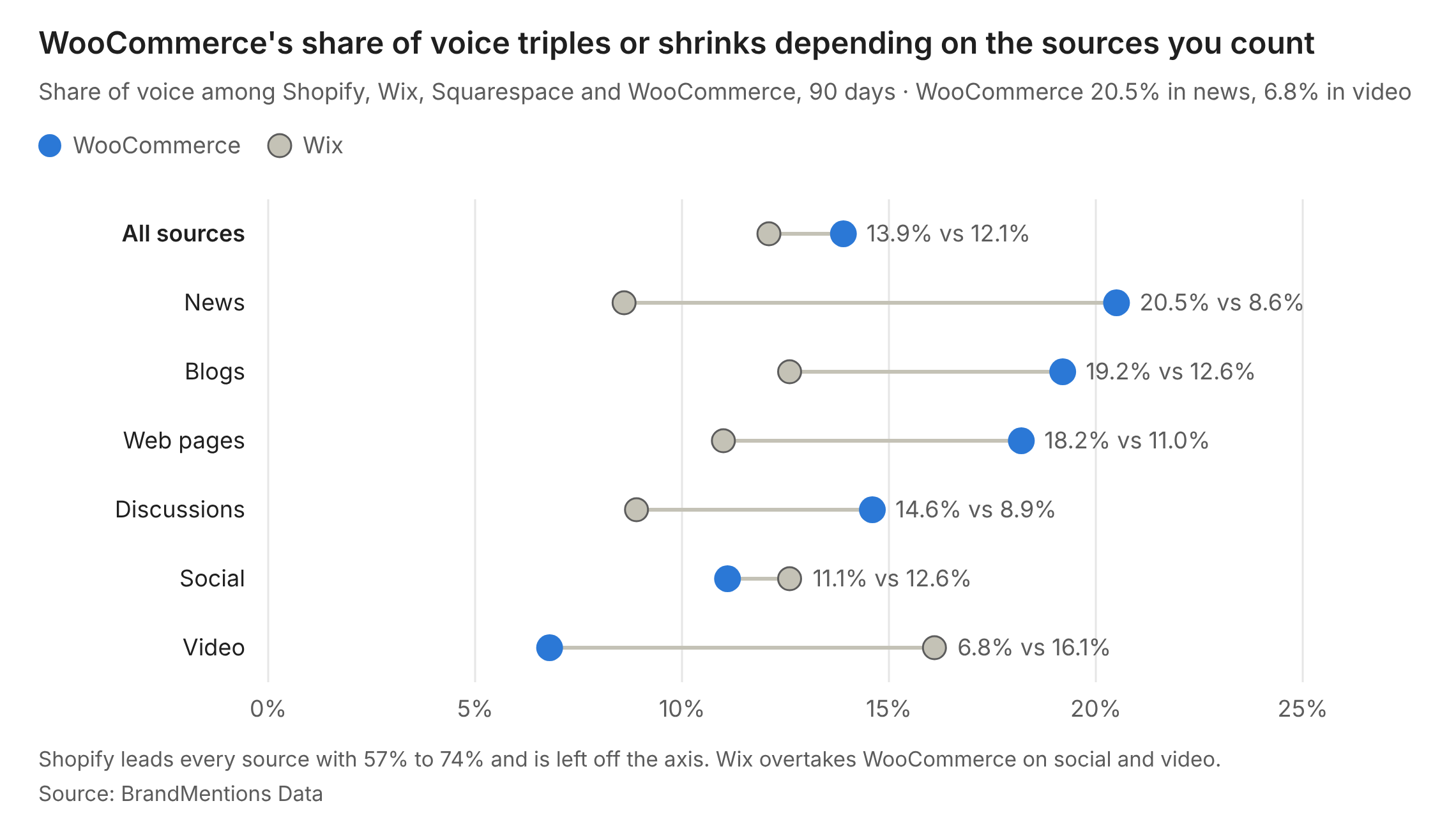
Within this BrandMentions dataset and date range, WooCommerce’s captured mentions skewed toward news and web sources, while Wix’s skewed toward video. A report built on news would call WooCommerce the clear runner-up. A report built on social or video would put Wix ahead.
Then we broke symmetry on purpose, the way the playbook warns buyers not to. Adding an English-only filter to WooCommerce's news query, and to no one else's, cut its news share from 20.5% to 14.7%. Applying the same filter to all four brands gave 17.1%. A single setting, applied to one brand, created a 6-point swing that a share-of-voice chart would show as a real market change.
Finding 2: The first 100 rows are not a sample
The playbook tells buyers to stratify their audit sample by source rather than grabbing the first 100 rows. The data shows why. For every brand, the newest 100 mentions came from a few hours of activity and over-represented whichever source happened to publish most in that window.
| Brand | Hours covered by newest 100 | Biggest over-count | Biggest under-count | Mix distance from true 90 days |
|---|---|---|---|---|
| Shopify | 4 | Video: 50% vs 35% | Discussions: 6% vs 13% | 19% |
| Wix | 11 | News: 34% vs 18% | Discussions: 2% vs 9% | 18% |
| WooCommerce | 12 | News: 65% vs 38% | Web: 10% vs 20% | 27% |
| Squarespace | 55 | Video: 65% vs 33% | Blogs: 0% vs 9% | 32% |
Mix distance is the share of the sample that would have to move between sources to match the true 90-day mix.
Two patterns repeat. Blogs appeared 0 times across all 400 rows, though they make up 4% to 9% of each brand's mentions. Discussions were under-counted for all four brands, at 2% to 6% of the rows against 9% to 13% of the true volume.
An audit built on those rows would score precision and sentiment mostly on video and news, and would barely test the forums and communities where the playbook says buyers research.
Method, limitations and disclosure
Data comes from the BrandMentions API, queried 9 November 2026 for 12 August to 8 November 2026. Each brand was queried as an exact phrase across all sources, then per source type, then with the API's English-language filter on news.
- This tests test design, not tool quality. All numbers come from one index, so the findings show how setup choices move results inside a single tool. They do not compare vendors.
- Share of voice reflects the index. Source shares depend on what BrandMentions collects.
- Brand names were not hand-checked. Wix is a short name and may include some unrelated matches.
- The newest-100 sample is ordered by each item's stored date. News uses the published time, so late-dated articles can crowd the top of the list.
BrandMentions publishes the playbook and is one of the tools it lists. No tool is scored here.
Is Real-Time Coverage the Same as Complete Coverage?
No. Real time describes latency. Complete describes recall. A tool can deliver a mention in two minutes and still miss 30% of what you seeded because its query logic or source set is incomplete. A tool can also be slow and complete.
Buyers conflate the two because a fast alert feels like proof of coverage. It is not. The alert-speed test and the seeded recall test measure different things, and a serious buying decision needs both.
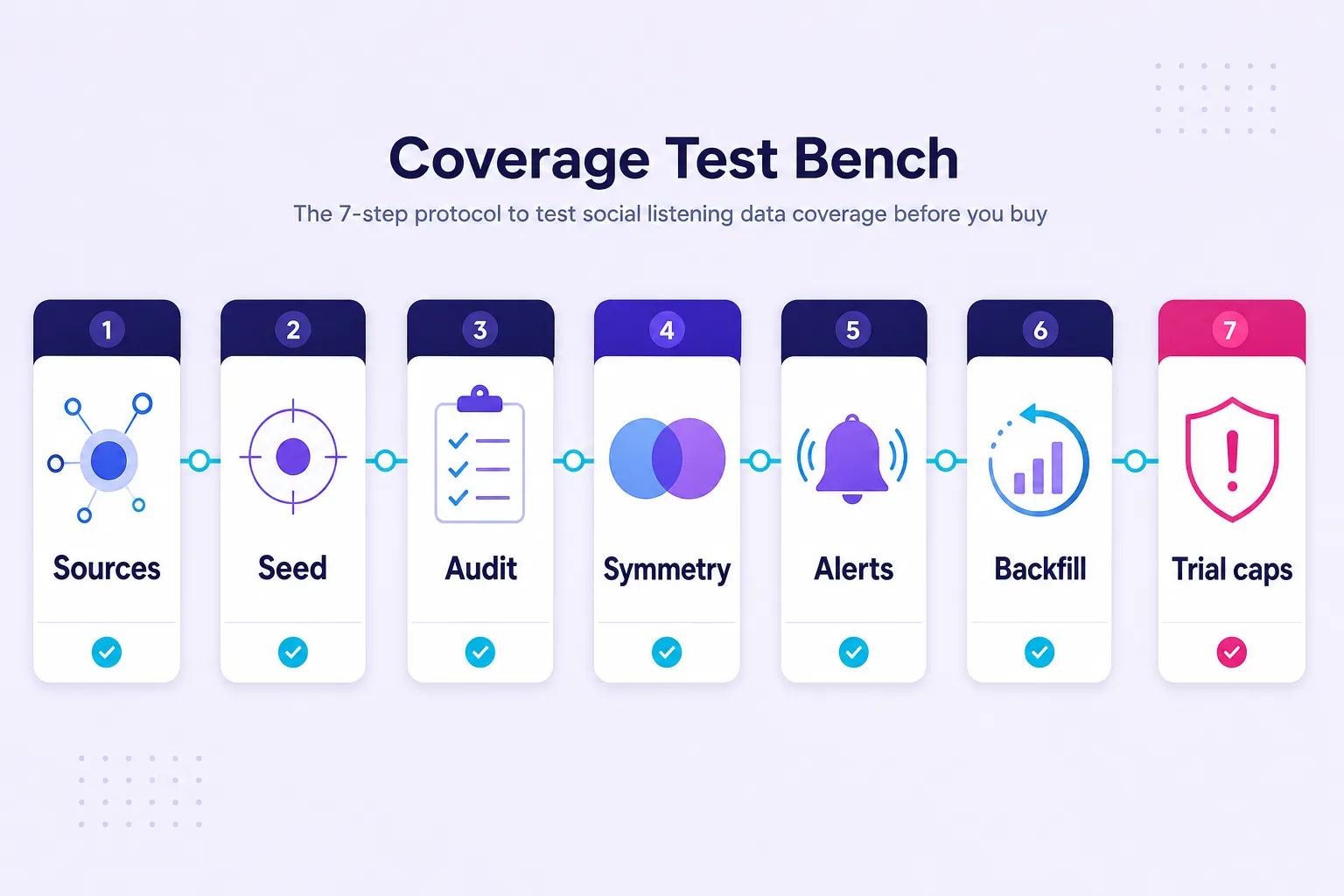
The Seven-Test Coverage Protocol
Each test below follows the same shape so you can evaluate them head to head: what it proves, how to run it, the decision threshold, and the failure mode to watch. Run them against a live trial, in order.
Test 1: Build the Source-Requirement Table
The Source-Requirement Test: A process of verifying, with seeded evidence and mirrored queries, that a tool actually ingests the channels, content types, languages, geographies and history windows your team depends on, not just the ones it lists.
Start from what you need, not from what the vendor sells. A good disclosure model to borrow is ISO/IEC 25012, the data-quality standard used to define requirements and evaluate them before you commit. Build the table before the first demo. If your team cannot agree on this table, you are not ready to buy.
| Channel | Content type you need | Language | Geography | History needed | Frequency | Priority |
|---|---|---|---|---|---|---|
| X | Posts, replies, quote posts | EN, FR | US, UK, CA | 12 months | 2,000/mo | Must-have |
| Posts and comments | EN | Global | 6 months | 800/mo | Must-have | |
| Hashtag posts | EN | US | 3 months | 500/mo | Nice-to-have | |
| TikTok | Brand hashtag posts | EN | US | 90 days | 300/mo | Nice-to-have |
| YouTube | Titles, descriptions, comments | EN | Global | 12 months | 50/mo | Must-have |
| News | Articles | EN | US, UK | 24 months | 150/mo | Must-have |
| Blogs and forums | Posts and threads | EN, DE | Global | 12 months | 200/mo | Must-have |
| Reviews | G2, Trustpilot, app stores | EN | US | 12 months | 100/mo | Nice-to-have |
Two columns carry the weight: content type and history. A vendor that says Instagram is covered usually means hashtag posts only, not comments and not open keyword search. A vendor that says TikTok is covered means registered brand hashtags, not a competitor's open feed. Write the exact content type into the row so nobody hides behind a source logo.
Content type also forces a channel taxonomy most teams skip. Separate owned from earned from paid, and decide whether you need dark social, private groups, podcasts, newsletters and syndicated news. A tool strong on earned news can be thin on the comment layer where buyers actually research.
The Access-Tier Rule: if a vendor cannot name the exact access method for a channel in one sentence, assume that channel is scraped or sampled and score it accordingly.
Language and geography deserve their own rows because coverage collapses unevenly across them. A tool fluent in English can be nearly blind in the market where your next crisis starts, so pressure-test multilingual listening coverage explicitly if you operate across borders.
These examples describe specific access routes, not universal vendor limits. For each row, record the official documentation link, endpoint, access tier, quota scope, and verification date. Confirm the vendor’s actual entitlement during the trial. No single number is a universal ceiling, so always name the access path.
| Platform | Access path | Keyword listening reality | Hard limit to verify |
|---|---|---|---|
| X | Firehose, decahose, or search API | Full keyword search on higher tiers | Pay-per-usage capped at 3M post reads/month; recent search 450 req/15 min |
| Graph API hashtag search | Hashtag-only, no usernames returned | 30 hashtags per rolling 7 days, last 24 hours only | |
| TikTok | Research API (noncommercial) | Public video search, archive-based | 1,000 requests and 100,000 records/day, up to 48-hour delay |
| TikTok | Business Mentions API | Your own registered brand hashtags | Top 1,000 posts by likes, 90-day rolling window |
| Data API or firehose contract | Full public keyword search | 100 queries/min authenticated free OAuth | |
| YouTube | Data API | Search and comments | Default 100 search.list calls/day |
Non-obvious insight: the row that catches people out is history depth, because vendors quote their best channel and let you assume it applies everywhere. Make them fill it in per channel. You will often find 12 months on one platform and 30 days on another.
Test 2: The Seeded Known-Item Recall Test
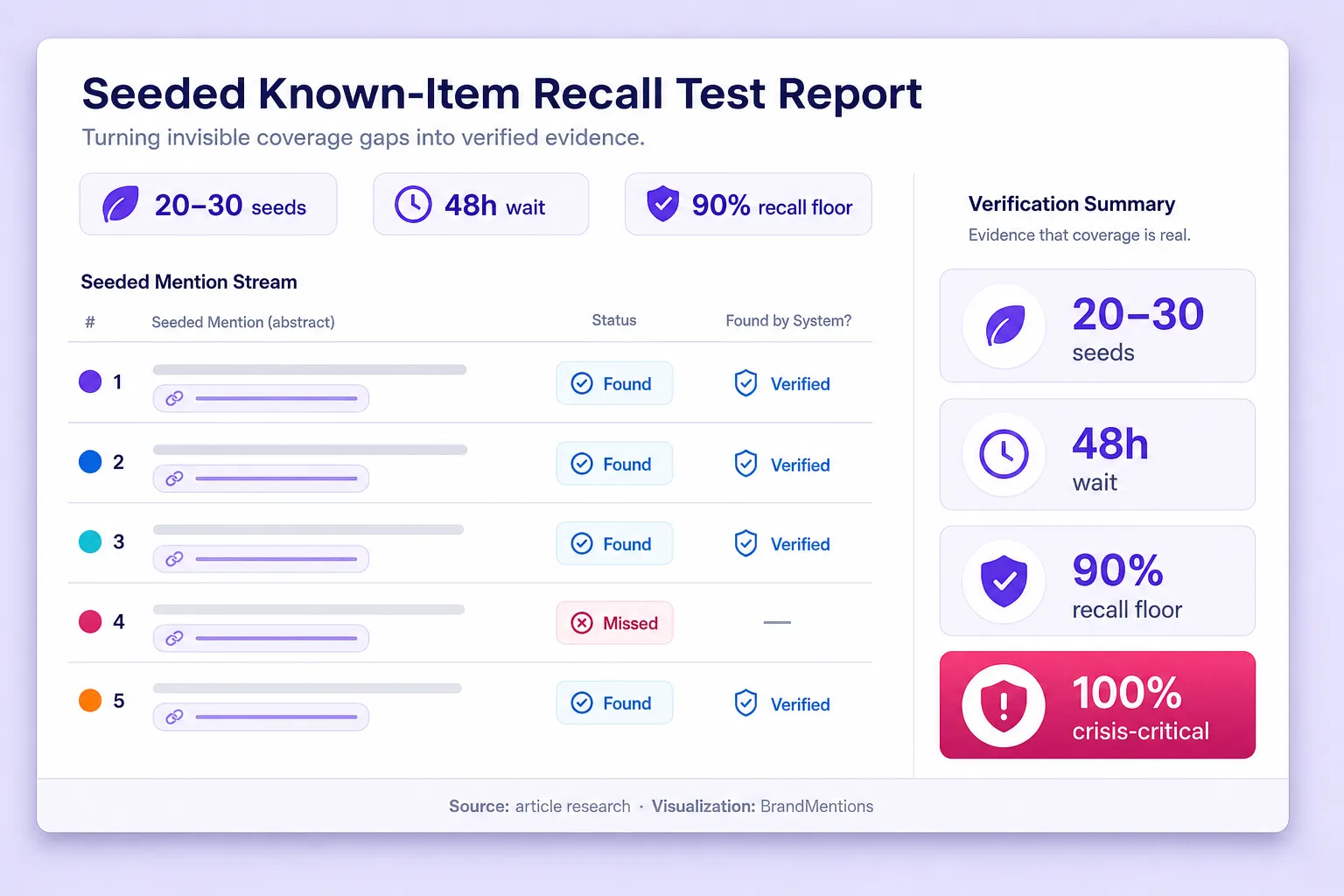
The Seeded Known-Item Recall Test: A coverage test where you create a controlled set of real mentions yourself, wait for the ingestion window, then measure how many the tool finds. It gives you something the open internet never will: a known denominator.
This is the test almost nobody runs, and it is the most honest one you can design. The principle comes straight from information retrieval evaluation, the same logic behind NIST's TREC program: you cannot score recall without judged, known items.
Here is the protocol. Identify or create 20 to 30 real, verifiable mentions across your must-have channels. A mix works best: a few owned posts, a Reddit comment, a forum thread, a blog mention, a press release, a review, a YouTube description. Record each one's exact URL, timestamp and text. Wait 48 hours for indexing. Then run your query, export the results, and check how many seeded items came back. Known-item recall = eligible test mentions found ÷ eligible test mentions checked × 100. This measures retrieval of your test set, not every relevant mention online. Start with 20–30 items to identify obvious gaps, report the numerator and denominator for each source, and expand testing on critical channels.
Run this with legal and comms awareness. Use real low-risk posts or pre-existing public mentions. Do not post fake complaints, do not seed private communities, and do not pollute public discourse with deceptive content. If you use test accounts, confirm they comply with platform terms and your own policies first.
A seeded recall test is the only test in this playbook where 100% is the passing grade on crisis-critical sources. In a crisis, the one mention you missed is the one that matters.
The Seeded Recall Threshold: 90% recall or better across your must-have sources is the floor for a tool you will cite in decisions. For crisis-critical sources, a single missed seeded item is a fail. Between 75% and 90% overall, use the tool for trend direction only. Below 75%, the volume charts will mislead you.
Do not stop at one blended number. Calculate recall per source, because a healthy total can hide the one channel that drives your category. If forums shape buyer research and forum recall is 40%, that is a buying risk even when the overall score looks fine. Sampling is usually the cause. A recall study of the Twitter Decahose found a 10% sample recovered about 91% of news-related tweets while a 1% sample recovered roughly half, and those losses multiply when a tool samples X, news and Reddit all at once.
The original analysis reported here examines source mix and query symmetry within BrandMentions. The seeded-recall and alert-speed sections provide protocols readers can run; results for those tests are not reported here. We seeded a blog post, a forum thread and a news mention, then logged the find time for each. The value was not speed. It was that every seeded item either appeared in the export or forced a specific question about which source was missed and why.
| Seeded item | Source | URL | Posted at | Found? | Time to appear | Notes |
|---|---|---|---|---|---|---|
| Launch test post | X | Day 1, 09:00 | Y/N | |||
| Review comment | Day 1, 09:10 | Y/N | ||||
| Forum thread | Niche forum | Day 1, 09:20 | Y/N | |||
| Blog post | WordPress | Day 1, 09:30 | Y/N | |||
| Press release | Wire service | Day 1, 10:00 | Y/N |
When you pull Reddit coverage testing into the seed set, remember the 100 queries-per-minute free ceiling shapes what any vendor on a cheap tier can poll, which directly limits recall.
Non-obvious insight: seed at least one item you never disclose to vendor support, and seed in your weakest channel on purpose. A support team can quietly fix a query for a known test. A manually patched query tells you nothing about the product you will run alone on a Monday morning.
Test 3: The 50 to 100 Mention Precision and Sentiment Audit
The Precision and Sentiment Audit: A manual check that measures noise (precision) and label accuracy (sentiment), the two errors that corrupt every readout.
Pull 50 to 100 mentions from the last 30 days. If your brand is high-volume, Randomly sample across the evaluation window within each source. Report precision separately by source. If you oversample smaller channels, weight the overall precision estimate by source volume. Calculate sentiment agreement only on relevant mentions, using a documented mapping between your labels and the vendor’s labels. If your brand is low-volume and 100 recent mentions do not exist, use the full trial window and note the smaller sample in your score. Hide the tool's sentiment label in a second column, then manually tag each mention yourself: relevant or not, and positive, negative, neutral or mixed.
Then compute two numbers. Precision is relevant mentions divided by total returned. Sentiment agreement is how often the tool's hidden label matched yours. Expect error. Independent commercial research summarized in a peer-reviewed sentiment comparison reports services landing anywhere from about 66% to 85% overall, with specific results like IBM Watson NLU near 79.2% and Google Cloud near 73.4% on given datasets, and neutral text the hardest class of all. Sentiment performance depends on the dataset, language, label definitions, and class balance. Ask vendors to disclose their evaluation method, then test a blinded sample of your own mentions. Report overall agreement and negative-class recall, with a second reviewer checking a subset of the human labels.
The 85% Question Rule: any sentiment accuracy claim above 85% triggers one request. Show me the evaluation set, the labels and the class distribution. If the vendor cannot produce all three, discount the number.
What matters more than the headline is where the errors cluster. Tag each miss against the categories classifiers still struggle with: sarcasm, category slang, mixed sentiment inside one post, and non-English text. If more than half your errors sit in one bucket, flag that bucket in every report that uses the score. A tool that is 80% accurate overall but blind to sarcasm will mislead you specifically during a backlash, which is the one moment sarcasm spikes.
For PR teams, compute one more figure: negative recall, the share of truly negative mentions the tool labeled negative. Missing a negative is operationally worse than mislabeling a neutral, because it delays escalation. If you are weighing classifiers specifically, read a current comparison of sentiment analysis tools alongside your own audit, because the vendor's stated accuracy and your observed accuracy on your brand's language will rarely be the same number.
Non-obvious insight: re-run the agreement math with neutral mentions removed. Neutral posts can be 60 to 70% of a topic, so a model that labels everything neutral earns a flattering score. If agreement drops more than ten points once neutrals are gone, the tool was coasting on the neutral majority and its real sentiment skill is weaker than the headline. Save the wrong examples too; a vendor who can explain a repeatable error pattern is more useful than one who says sentiment is "usually right" and moves on.
Test 4: The Competitor Symmetry Check
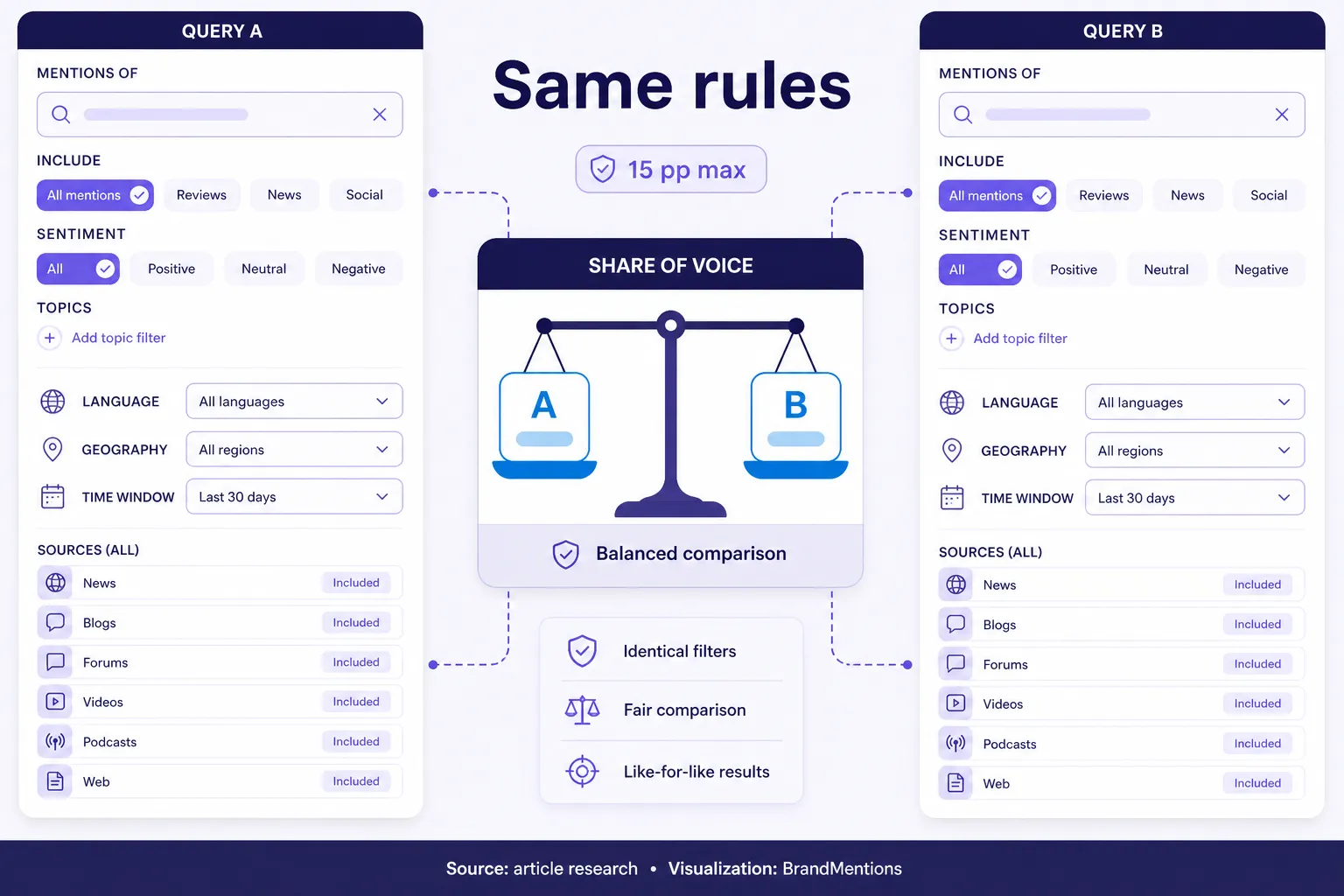
The Competitor Symmetry Check: A fairness test that proves whether your share-of-voice comparison is defensible, or merely an artifact of unequal queries.
This is where defensible competitive claims go to die. You build a deep, well-tuned query for your own brand with every spelling variant, handle and product name, then drop in a one-word query for each competitor. The resulting chart makes you look dominant for reasons that have nothing to do with reality.
The fix is symmetry. Build competitor queries with the same source types, the same language and geography filters, the same depth of variants and the same spam exclusions as your own. Treat identical Boolean query building across all brands as a precondition, not a nice-to-have. The disclosure principle behind this is the same one the Media Rating Council's Social Measurement Guidelines apply to any audience measure: partial data streams and underlying assumptions must be disclosed and sized.
The Query Symmetry Rule: never report share of voice until your brand query and every competitor query use the same source set, filters and keyword depth. Asymmetry on even one channel invalidates the percentage.
Read the result as a signal, not a fact. Share of voice measures captured mentions within a defined comparison set, not sales market share. An unexpected result is a reason to investigate campaigns, news events, ambiguous names, duplication, and source coverage, not proof that the tool is biased. Accept no more than about 15 percentage points of unexplained divergence between mirrored queries before you demand a source-level explanation.
| Query | You | Comp. A | Comp. B | Your SOV | Read |
|---|---|---|---|---|---|
| X, 30 days, EN | 420 | 610 | 380 | 30% | Plausible |
| News, 30 days, EN | 95 | 140 | 70 | 31% | Plausible |
| Reddit, 30 days | 210 | 90 | 65 | 58% | Investigate |
There is a structural trap most buyers meet too late. On TikTok, symmetric competitor queries are impossible through the Business Mentions API, because listening works only for brand hashtags registered to your own business account. Any tool that shows a competitor's TikTok share is using licensed data, an estimate, or something you should ask about directly. The symmetry check belongs in your weekly rhythm too, not just the buying process, so choose competitor analysis tools that let you clone a query structure cleanly.
Non-obvious insight: do not judge symmetry by the final percentage alone. Compare source distribution. If your mentions are 60% news and a competitor's are 80% X, the chart is measuring source bias as much as market attention. Deduplication matters here too. Syndicated news and quote-reposts can count once or many times depending on the tool's canonicalization rules, which quietly shifts every SOV figure.
Test 5: The Real-Time Alert Speed Test
The Real-Time Alert Speed Test: A timed measurement of how fast the tool actually notifies you, measured against the clock, not the promise.
Alert speed is a coverage dimension in disguise. A mention found four hours late is, for a crisis team, a mention it effectively missed. Platform cadence sets the floor. X's rate limits allow recent search only 450 requests per 15 minutes per app, which is one reason dashboards refresh differently by source. TikTok’s Research API uses archived video data and is not available to commercial users. Its delays should not be used as a benchmark for commercial listening tools. Ask each vendor to identify its authorized access route and demonstrate latency for the content you need.
Seed one fresh mention each on X, Reddit and a news page, with known timestamps. Then track four clocks, which is the only way to separate a collection delay from a notification delay.
| Timestamp | Meaning |
|---|---|
| Native publish time | When the post or article went live |
| Native visible time | When you could see it manually |
| Tool capture time | When it first appeared in the dashboard |
| Alert delivery time | When the email, Slack or webhook arrived |
Run the test three times at different hours, because alert pipelines batch and a 2 a.m. post may travel on a different schedule than a 10 a.m. one. For a small pilot, report every observation and the slowest result by source. With a larger set of repeated observations, also report median and P90 latency. Agree dashboard and alert deadlines before testing, based on your response needs and the vendor’s documented access route.
| Source | Reasonable dashboard latency | Reasonable alert latency |
|---|---|---|
| X | 5 to 15 minutes | Under 30 minutes |
| 5 to 15 minutes | Under 30 minutes | |
| News and blogs | 15 to 60 minutes | Under 60 minutes |
| Instagram public | Up to 4 hours | Under 4 hours |
| TikTok | Up to 24 hours | Under 24 hours |
Non-obvious insight: read the alert payload, not just the arrival time. A mention can hit the dashboard in two minutes while the email fires hours later on a batch job, or arrives stripped of the text, source and link. An alert that forces you to log in to find out what happened is half an alert.
Test 6: The Historical Backfill and Known-Crisis Test
The Historical Backfill and Known-Crisis Test: A test of whether the tool can reconstruct the past, using an event you already lived through as the answer key.
This is the most elegant test in the set because you already know the correct answer. Pick a documented brand moment from the past year: a launch, a viral complaint, an outage, a PR incident with a known peak day and known coverage. Ask the tool to backfill that window and compare its output against what you remember actually happening. If it cannot rebuild an event you witnessed, it cannot be trusted to catch the next one.
Backfill depth is a checkable spec, so demand it in writing per channel. Good vendor documentation shows exactly this kind of precision, for example Sprout Social's listening data availability page, which discloses backfill per source and message type. That is the standard to hold everyone to. For PR teams especially, pair this with a hard look at media monitoring coverage, since news pickup is usually the backbone of reconstructing an incident.
Test historical coverage on a crisis you already survived. You are the answer key. If the tool's reconstruction does not match your memory, its forward-looking crisis detection is already compromised.
The Known-Crisis Rule: a tool that reconstructs fewer than 80% of the mentions you personally remember from a past event should not be bought for crisis monitoring, no matter how good its real-time demo looked.
Non-obvious insight: vendors use "historical data" to mean three different mechanisms. Backfill is how far a new query reaches on day one. Retention is how long collected data stays searchable. Archive is a separate, usually paid, layer for older data. Ask for all three, per source. And remember the platform wall: Instagram hashtag search returns only the last 24 hours with no keyword backfill, and TikTok exposes only a rolling 90 days. An API’s retrieval window does not establish every vendor’s historical coverage. Ask whether older results come from previously collected data, a licensed archive, or another authorized source. Verify availability and retention rights by channel.
Test 7: Neutralize the Trial Throttle Before You Score Anything
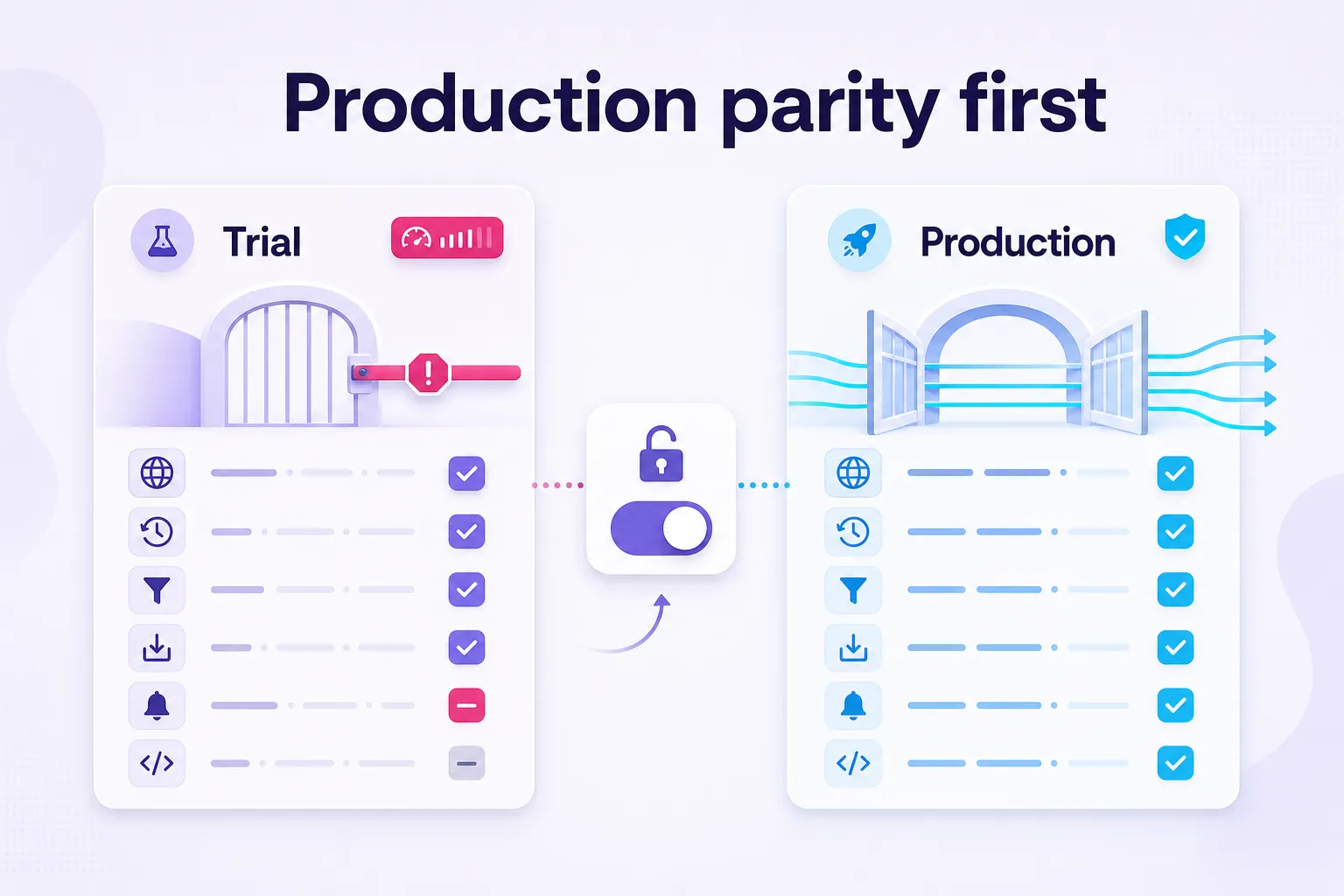
The Trial-Throttle Neutralization Test: A parity check that confirms your trial is running under production-equivalent sampling, history and export conditions before any score counts, so a capped trial cannot distort the result.
Everything above assumes you are testing production-equivalent conditions. You usually are not. Trial accounts are frequently capped below the plan you would buy, which means a tool can fail your recall test for a reason that vanishes the moment you pay, or pass and then throttle you after signing.
Neutralize this first. Research shows platform samples are not always random and can over-represent certain users, as an EPJ Data Science study on Twitter sampling bias documented. Sampling at low trial volume hides that bias; running at production volume exposes it. Give each vendor a parity sheet and get the answers in email, not on a call.
| Trial condition | Trial setting | Production setting | Same? | Impact on test |
|---|---|---|---|---|
| Sources enabled | Y/N | |||
| Historical depth | Y/N | |||
| Sampling rate | Y/N | |||
| Mention volume cap | Y/N | |||
| Export rows and fields | Y/N | |||
| Query and concurrency limits | Y/N | |||
| Alert channels | Y/N | |||
| API access | Y/N |
The Trial-Throttle Trap: never score a tool on trial data until you have written confirmation that the trial matches production sampling, history and export rights. A passing test on a throttled trial proves nothing, and a failing one may be unfair.
Two practical moves. Ask the vendor to lift caps to production-equivalent levels for seven days, even on a paid pilot; a refusal is itself information. And test the export cap specifically, because a trial that limits you to 1,000 rows is preventing the exact precision validation you came to run. The non-obvious cap to check is query concurrency: a trial that allows three saved queries cannot show how the tool behaves when 25 poll at once, and that concurrency is exactly where real coverage degrades.
The Coverage Confidence Scorecard: A 100-Point Decision Model
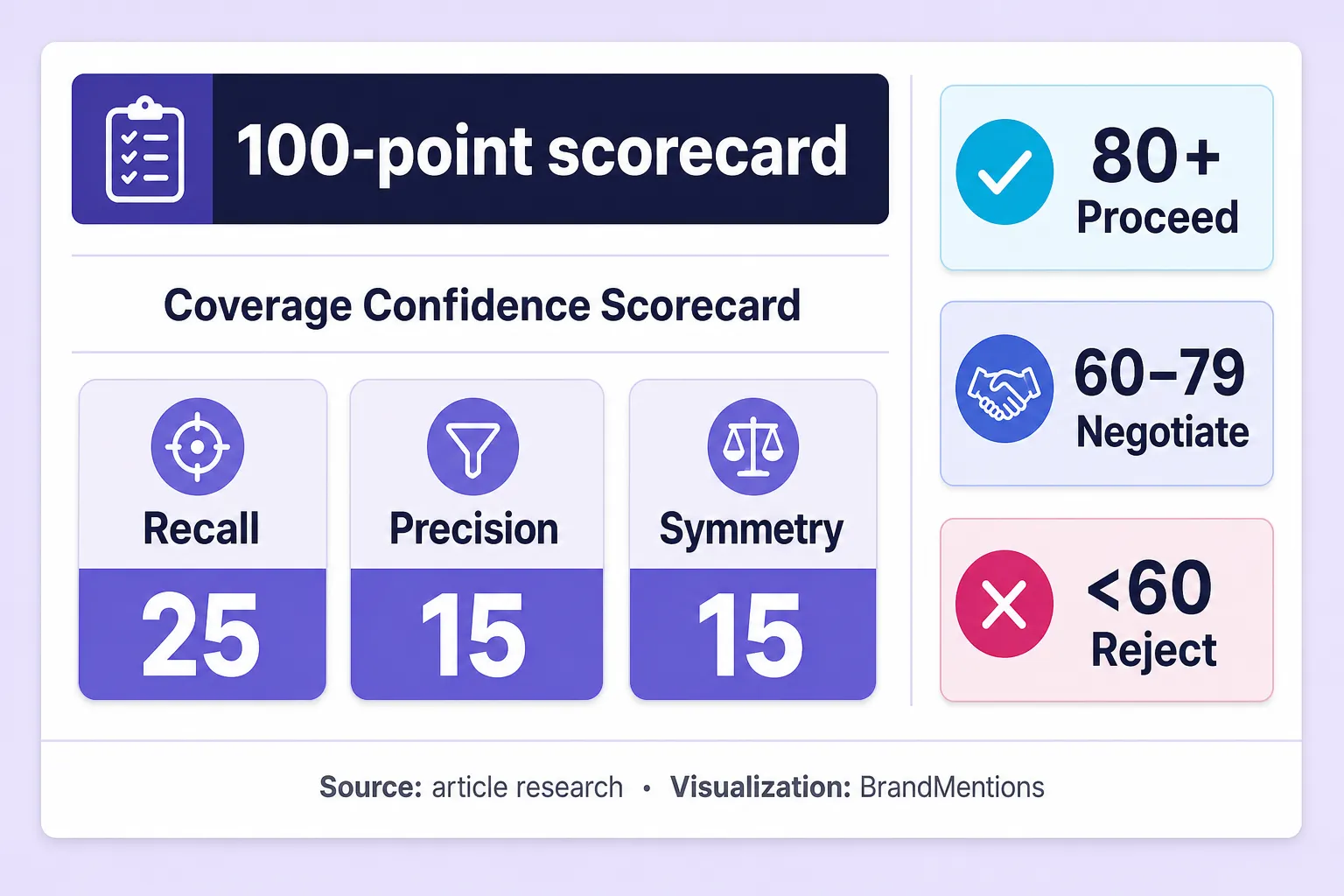
This is the artifact I wish every buying team had before the sales call. Copy it into a Google Sheet or CSV, run the tests, and let the score decide. Set acceptance criteria before testing. Award each row its listed weight when it passes and zero when it fails. Mark untested rows as pending and postpone the decision until testing is complete. Missing a must-have source, an unresolved crisis-critical miss, or unverified trial-to-production parity blocks approval regardless of the total. The weights and decision bands below are suggested procurement rules, not validated industry benchmarks.
| Test | What it scores | Pass threshold | Weight |
|---|---|---|---|
| Source-requirement match | Must-have channels and content types present with evidence | All must-haves documented | 10 |
| Seeded known-item recall | Miss rate on verified items | 90%+ overall, 100% on crisis-critical sources | 25 |
| Precision on 50 to 100 mentions | Relevance of returned mentions | 85%+ | 15 |
| Competitor symmetry | Fairness of share of voice | 15 points or less unexplained divergence | 15 |
| Sentiment agreement | Label accuracy vs human | 70%+, errors not concentrated in one bucket | 10 |
| Real-time alert speed | Latency to dashboard and alert under load | Within source-appropriate windows at P90 | 10 |
| Historical backfill | Crisis reconstruction | 80%+ of a remembered event, peak day and key items present | 10 |
| Trial parity and export rights | Production-equivalent access, clear export | No hidden caps, export rights confirmed | 5 |
| Total | 100 |
Decision rule. 80 and above: proceed, with remaining gaps written into the contract. 60 to 79: negotiate the specific failures, get remediation in writing, and re-run the failed tests at production volume. Below 60: reject. The pipeline failed the protocol you built, and no dashboard polish changes that.
Write the coverage into the contract, not just the scorecard
A passing test protects you this quarter. Contract language protects you for the term. Before you sign, ask for written commitments on the clauses vendors rarely volunteer: a source-change notice period if a must-have channel is dropped mid-contract, a sampling-disclosure obligation per source, export rights that survive cancellation (format, row limits, and whether historical exports remain yours), audit rights to re-run the seeded test on renewal, and a production-parity commitment so the plan you tested is the plan you receive. Coverage can shrink mid-term when a data license lapses, so ask when their key platform licenses renew.
Never sign a six-figure contract from a dashboard you only ever saw at trial volume. Validate the pipeline at the volume you will actually run, then write the coverage you verified into the agreement.
One compliance note that belongs in every buying process: if you store full-text social data, confirm how the tool handles GDPR and CCPA obligations, data retention windows, PII minimization and deletion requests, and whether you are legally permitted to export and retain the text at all. A tool can pass every coverage test and still create a data-governance problem you did not price in.
A 10-Day Execution Plan
| Day | Action | Output |
|---|---|---|
| 1 | Build and approve the source-requirement table | Agreed must-haves |
| 2 | Collect 20 to 30 known URLs, build the seed log | Seed set |
| 3 | Write equivalent queries for each vendor | Query sheet |
| 4 | Start trials under documented conditions | Trial-parity sheets |
| 5 | Run seeded recall, per source | Recall table |
| 6 | Export and hand-label 50 to 100 mentions | Precision and sentiment sample |
| 7 | Run competitor symmetry queries | SOV fairness notes |
| 8 | Run the four-timestamp alert test, three times | Latency table |
| 9 | Run the historical backfill on a known crisis | Known-event comparison |
| 10 | Score and decide | Coverage Confidence Scorecard |
Validate the tool's output against a second source where you can. Native platform search, Google or Bing indexed results, a web archive, or your own CRM and PR logs all work as a sanity check on whether the tool's count is believable.
The Tools Worth Running This Protocol On
Build a test bench, not a beauty contest. Include tools that span different access models, then make all of them run the identical protocol. The brief entity profiles below mirror what each vendor publishes in its own documentation, and the table that follows lays them out side by side. Verify every figure during your trial, because access terms change.
BrandMentions
BrandMentions tracks real-time social, news, blog and forum mentions in a single query workspace, making it best for cross-source mention monitoring and for teams extending coverage into AI answer-engine citations.
Brandwatch
Brandwatch is built around a deep historical archive and full X firehose access, suited to large research teams needing broad source diversity.
Meltwater
Meltwater leans heavily on news and media intelligence with broad language coverage, aimed at global PR and communications teams.
Sprout Social
Sprout Social publishes transparent per-source backfill documentation, a fit for social-first teams that value clear disclosure.
YouScan
YouScan specializes in visual and image analysis of social content, serving visual-heavy consumer brands.
PeakMetrics
PeakMetrics focuses on reputational risk and issue detection for risk and issue-monitoring teams.
| Tool | Documented strength | Limit to verify in trial | Best-fit scenario |
|---|---|---|---|
| BrandMentions | Real-time social, news, blog and forum mentions in a single query workspace | Current historical depth and export rows by tier | Best for real-time cross-source mention tracking across social, news, blogs and forums, and for teams extending coverage into AI answer-engine citations |
| Brandwatch | Deep historical archive, full X firehose | Quick searches may default to 30 days and sample for one-year history | Large research teams needing deep archive and broad source diversity |
| Meltwater | Heavy news and media intelligence, broad language coverage | 15 months on a new search; confirm sampling per source | Global PR and communications teams |
| Sprout Social | Transparent per-source backfill documentation | Instagram and TikTok limited by platform APIs | Social-first teams that value clear disclosure |
| YouScan | Visual and image analysis of social content | Topics sampled above volume thresholds; analytics extrapolated | Visual-heavy consumer brands |
| PeakMetrics | Reputational risk and issue detection | Confirm commercial alerting latency for your use case | Risk and issue-monitoring teams |
Frequently Asked Questions
How to Test Social Listening Data Coverage Before You Buy?
Run seven checks against a live trial: a source-requirement table, a 20 to 30 item seeded recall test, a 50 to 100 mention precision and sentiment audit, a competitor symmetry check, a timed alert-speed test, a historical backfill test on a known crisis, and a trial-cap audit, then score them on a weighted 100-point card where 90% recall on must-have sources is the floor. Neutralize trial throttling first with written confirmation that the trial matches production sampling, history and export rights, because a passing result on a capped trial proves nothing.
How many seeded mentions do I need to test a social listening tool?
Use 20 to 30 known public mentions for a practical buying test. That is enough to expose major source gaps across channels while staying small enough for a marketing or PR team to verify by hand. High-volume brands can seed more for sharper per-source diagnosis; low-volume brands should seed across every must-have channel even if the total is smaller.
Can I trust automated sentiment in social listening tools?
Trust it for directional triage only after you validate it against 50 to 100 human-labeled mentions. Independent commercial research puts accuracy roughly between 66% and 85% on English text, and human annotators agree only around 70% of the time, so sentiment should never drive crisis escalation without manual review. Re-run the agreement math with neutral mentions removed to see the tool's real skill.
Can a social listening tool track AI answer engines like ChatGPT and Google AI Overviews?
Coverage now extends to AI surfaces, and the engines cite brands very differently, so ask the vendor directly which engines they monitor, whether AI citations are tracked as a source, and whether that data is exportable. If AI visibility matters to you, add it as its own row in the source-requirement table. Evaluate AI visibility separately using a documented prompt set, engine or model, location, test date, repeated runs, and saved answers and citation URLs. A published mention is not guaranteed to appear in an AI-generated answer.
Conclusion: Buy the Coverage You Verified, Not the Coverage You Were Shown
The single shift that changes everything is this. Stop evaluating social listening tools on what their dashboards display, and start evaluating them on what you can independently prove they captured. A mention count is a claim. Recall, precision, symmetry, speed and backfill are evidence. This protocol exists to convert the claim into evidence before money changes hands, and every test in it runs inside a single trial window with a spreadsheet and no engineering team.
The market context only raises the stakes. Platform data is getting more expensive, more gated and more contractual by the quarter, so two tools with identical source lists can deliver wildly different real coverage depending on their licenses and their willingness to sample. The brochure will never tell you which is which. Your seeded items will.
So your next step is not another demo. It is a spreadsheet with the scorecard, a list of must-have sources, 20 verifiable seeded mentions, and an email to each shortlisted vendor asking for production-equivalent access for seven days. Build that first. The team that tests coverage buys an insight engine. The team that trusts the demo buys a very expensive chart.
Filed under: Social Listening