Social Listening Tool Migration Checklist: A Step-by-Step Guide
A social listening tool migration checklist with owners, rollback dates, vendor-specific backfill limits, and a calibration protocol to tell a real brand trend from a measurement change.


A social listening tool migration is the process of moving your monitoring, queries, alerts and reporting from one platform to another. To migrate successfully, audit your current setup, export permitted data, run both tools in parallel, rebuild essential workflows and validate the results before cancelling your old service.
This seven-step checklist covers decide, prepare, back up, pilot, migrate, verify and retire. Each phase identifies an owner, practical checks and completion criteria to help you preserve usable history, maintain monitoring and explain reporting differences after the switch.
The 7-phase social listening migration checklist at a glance
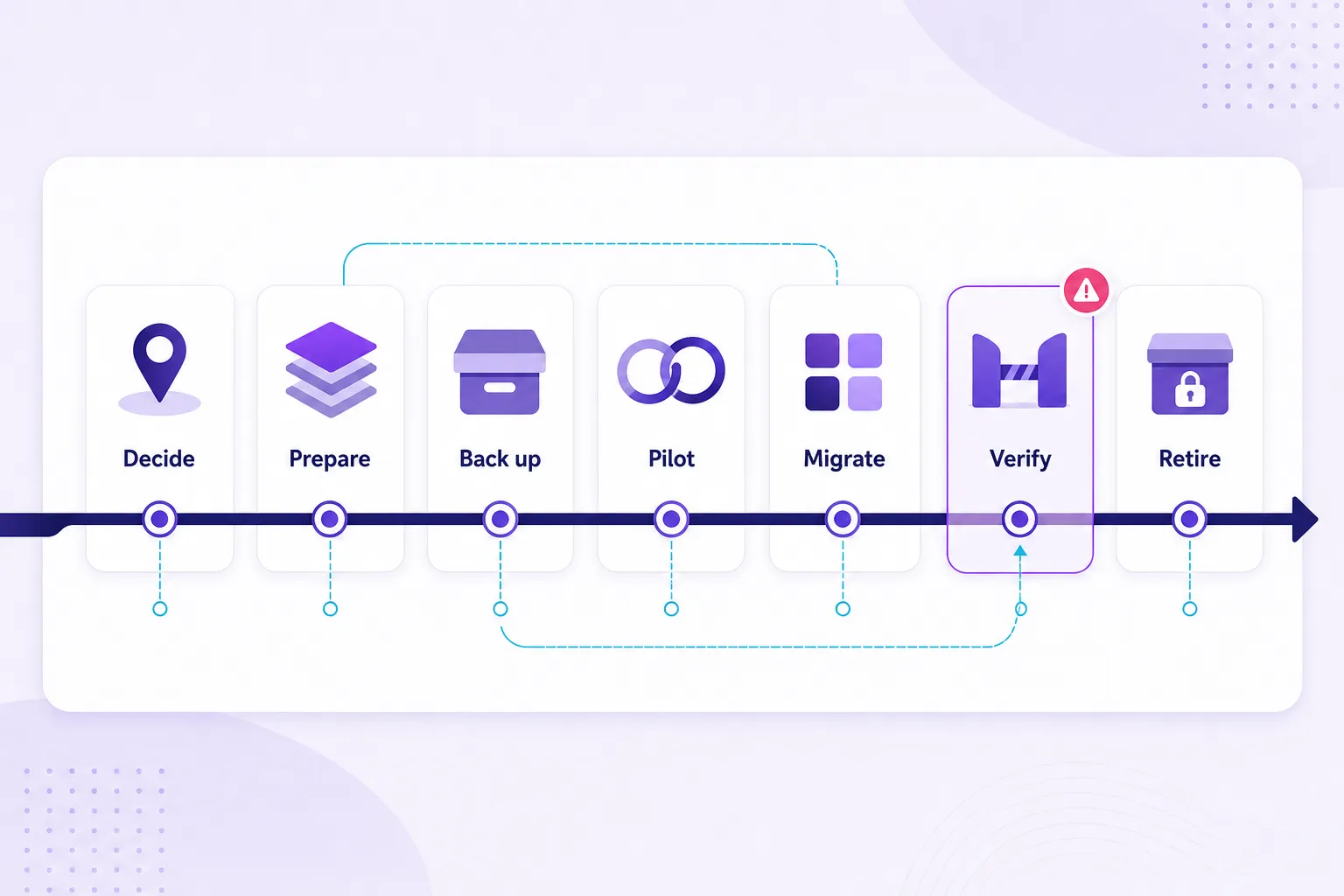
- Decide - migration lead (with a named PR or marketing sponsor) - 1 to 2 weeks - exit when the sponsor has approved scope, budget, acceptance rules and the fallback, six dates are in a shared calendar, and a month-to-month extension option is negotiated.
- Prepare - listening analyst, supported by account administrators - 2 to 4 weeks - exit when every business-critical output has an owner, a documented input and a destination, including undocumented manual workflows and tagging rules.
- Back up - data owner, with procurement and vendor support - 2 to 4 weeks - exit when you can open the archive, reconcile it against the manifest, explain its gaps and fund the chosen historical strategy.
- Pilot - listening analyst, with the PR escalation owner - one full reporting cycle, 14 days minimum - exit when every material volume and sentiment difference has a documented explanation and the destination demonstrably meets the agreed use cases (matching headline totals is not a pass).
- Migrate - monitoring administrator, with dashboard and integration owners - 2 to 4 weeks, overlapping the pilot - exit when the new configuration reproduces the required decisions and workflows, with a translation log, recalibrated thresholds and a completed surge rehearsal.
- Verify - migration lead, with a named daily monitoring owner - 2 weeks plus cutover day - exit when cutover gate criteria are met, rollback was available with a live collector behind it, material failures are resolved and the team knows which historical comparisons remain valid.
- Retire - account administrator, with the archive owner and a privacy or legal contact - 1 to 2 weeks - exit when you no longer depend on the old platform for collection, reporting, escalation or permitted historical retrieval, and cancellation and deletion are confirmed in writing.
At a Glance: Which Migration Approach Fits Your Scenario?
- Best for board-level or crisis-sensitive reporting: Comparable-source calibration. Build one restricted dashboard that matches the old tool's source mix and one that shows everything the new tool adds, so continuity and improvement never get mixed in the same line.
- Best for a hard contract deadline or a tool being sunset: The export-first sprint. Extract everything you are entitled to extract before anything else, because access can close faster than a project plan moves.
- Best for small teams and tight budgets: Archive plus a declared new baseline. Preserve permitted records outside both tools, mark the measurement start date on every chart, and skip the paid multi-year backfill you cannot justify.
- Best for teams whose value sits in historical analysis: The backfill-led shortlist. Choose the vendor on documented per-source depth and quota consumption, not on the headline number in the deck.
- Best for agencies and multi-brand portfolios: Workspace-by-workspace. Complete one representative brand end to end, write down what broke, then repeat. Parallel chaos across twelve clients is how alerts go missing.
- Best for teams with heavy Instagram dependence: Early collection. Stand the new tool up months before cutover, because hashtag collection starts the day you add it and no cheque fixes that later.
Phase 1. Decide: how to scope a social listening tool migration, set owners, budget and rollback
Borrow the governance from disciplines that migrate systems for a living. The AWS pre-cutover guidance requires documented task owners, test plans, dependency mapping and a rollback procedure before any switch. Apply the same controls here, before anyone discusses dashboard layouts.
Owner: migration lead, with a named PR or marketing sponsor who can say no. Typical duration: 1 to 2 weeks.
Write a one-page brief covering the business problem the switch must solve, the brands, markets and languages in scope, the sources and alerts you cannot lose, who may approve or reverse the switch, and six dates: cutover, rollback deadline, cancellation notice deadline, final access date, overlap start, and the end of post-switch monitoring.
Keep cancellation and cutover separate. A commercial deadline quietly becoming your technical acceptance criterion is the single most common way these projects go wrong.
The total transition cost worksheet
Overlap cost is the line everyone budgets and the only one. Build the full picture before you ask for money, because an approved budget that omits staff hours gets re-litigated in week three.
| Cost line | How to source the number | Commonly missed because |
|---|---|---|
| Overlapping subscriptions | Old monthly rate plus new monthly rate, times overlap months | Teams assume a free trial covers the pilot |
| Historical backfill or archive add-on | Written quote, per source and per query tier | Quoted as a feature, priced as a project |
| Mention quota consumed by backfill | Vendor preview before activation | Historical Data draws on your monthly quota |
| Implementation and onboarding services | Vendor statement of work | Bundled verbally, invoiced separately |
| Internal hours | Analyst, admin, reporting and integration owner days | Never costed, always spent |
| Archive storage and access control | Storage plus the owner who maintains it | Treated as a one-off download |
| Training and report re-education | Sessions per audience, including stakeholders | Only the analysts get trained |
| Cancellation obligations | Notice period, auto-renewal date, early-exit terms | Auto-renewal fires mid-migration |
| Contingency | One extension month on the old contract | The extension option was never negotiated |
Negotiate the extension option when you sign the new contract, not when you need it. A month-to-month extension you can decline costs nothing and buys the only real insurance in this project.
Destination security and procurement checks
Listening data is third-party personal data, and most migration checklists skip this entirely. Get written answers before signature: data residency and processing locations, subprocessor list, encryption at rest and in transit, SSO and MFA support, role-based permissions granularity, breach notification terms, the data processing agreement, deletion timelines on termination, and whether security review is required by your own legal team. Add the retrieval deadline after cancellation, in writing.
Finish this phase when: the sponsor has approved scope, budget, acceptance rules and the fallback, and the six dates are in a shared calendar.
Phase 2. Prepare: how to audit your social listening setup before you switch tools
Inventory first, rebuild later. Your audit has one job: to separate what drives a recurring decision from what merely exists. You are auditing the monitoring system, not the account.
Owner: listening analyst, supported by account administrators. Typical duration: 2 to 4 weeks.
| Audit area | Record before rebuilding | Why it matters |
|---|---|---|
| Topics and queries | Exact string, exclusions, aliases, hashtags, languages, geography, owner, last report appearance | A query name does not preserve its logic |
| Sources | Network, content type, public versus connected access, authentication required | "Instagram coverage" is too broad to validate |
| Classification | Tags, categories, manual sentiment overrides, spam rules | The reasoning behind corrected data lives nowhere else |
| Metrics | Formula, denominator, timezone, duplicate policy, engagement snapshot date | Identical labels hide different calculations |
| People | Admins, analysts, guests, clients, backup owner | Permissions must be tested with real roles |
| Workflows | Email digests, Slack routes, tickets, scheduled reports, exports | A dashboard can work while delivery fails |
| Commercial terms | Renewal, notice, export limits, deletion terms | Your extraction plan must fit your remaining access |
Document data coverage differences at content-type level, not network level. Public hashtag posts and owned-account comments are different products. So are video descriptions and transcripts, original posts and replies, article bodies and headlines.
Two audit habits worth stealing. Sort queries by last appearance in a published report, not by creation date, and archive the definitions of anything that has not surfaced in six months rather than rebuilding it. And ask each report recipient which single number they would escalate on, because that answer rarely matches what the dashboard emphasises.
The dependency that breaks most often is a person, not an integration. One analyst who maintains the tagging taxonomy and recategorises mentions every Friday. One comms manager whose escalation rule lives in their head. If that is not written down before cutover, the tags do not just fail to transfer, the meaning of the tags leaves with the tool.
If your audit shows that half the value sits in press and web coverage rather than social networks, map your media monitoring sources explicitly, because news licensing is where vendor coverage diverges hardest and where sales demos are least specific.
Finish this phase when: every business-critical output has an owner, a documented input and a destination.
Phase 3. Back up: what transfers when you switch social listening tools and what you rebuild
Start with the export ceiling, because it sets your schedule. Brandwatch documents that Listen searches typically index a maximum of 2,500 mentions per day, varying by contract, and its Listen export documentation caps mention exports at 5,000 per organization per day, shared across saved searches and resetting at 00:00 UTC. For an archive of 100,000 mentions, that is 20 daily allocations. Start three weeks earlier than feels necessary, or agree another permitted extraction route in writing.
Owner: data owner, with procurement and vendor support. Typical duration: 2 to 4 weeks.
Keep four words apart
Backfill: retrieving older content through the destination's available sources. Retention: how long collected records stay accessible while you are a customer. Import: loading records you supply from another system. Export: taking permitted records out.
An export is not proof of import compatibility. A long backfill window is not proof of complete historical coverage. Active-subscription retention is not proof of access after cancellation. Ask about all four separately, and get each answer in the contract rather than the demo.
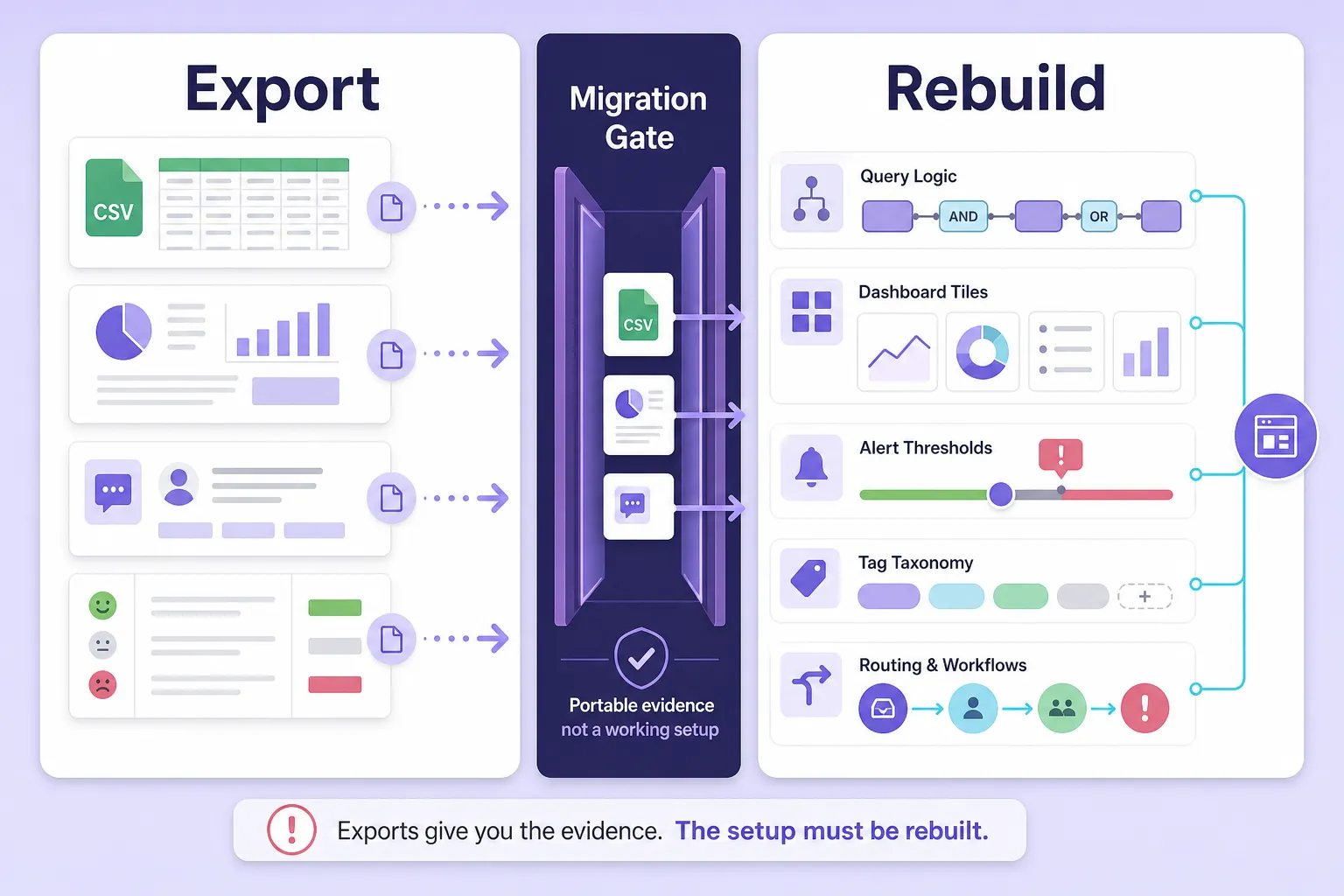
What transfers between social listening tools, and what you rebuild
| Asset | Realistic outcome |
|---|---|
| Mention records (text, URL, date, author, source) | Exports as CSV or XLSX, subject to daily or per-report caps |
| Old sentiment labels and manual overrides | Export as data columns. Treat as reference, not as live scores |
| Query strings | Copy as text. Then translate, because syntax is not portable |
| Aggregate metrics and report PDFs | Export as the baseline evidence for annotating trend breaks |
| Tags, categories, workflow states | Rebuild. No major vendor imports a competitor's taxonomy |
| Dashboards and report templates | Rebuild. Screenshot the old ones first |
| Alert rules and thresholds | Rebuild, then recalibrate against the pilot |
| Influencer and author scores | Rebuild. Proprietary scoring does not travel |
| Deleted or protected content | Gone, correctly. No legitimate tool restores it |
One genuine exception is worth knowing, because it is the only documented query portability in this category: Brandwatch states that queries created in Consumer Research can be copied into Listen as long as the query is under the 100,000 character limit. Portability exists inside a vendor family, not across vendors. If you are moving between two products from the same provider, ask for it explicitly.
Vendor-documented historical access and export limits: Brandwatch, Sprout Social, Mention, Hootsuite Lumen and Sprinklr
These are product-specific rules, read from current documentation. Do not apply Brandwatch Listen limits to Brandwatch Consumer Research, or full Sprout Listening behaviour to Listening Lite.
| Product | Historical access | Documented constraints that change your plan |
|---|---|---|
| Brandwatch Listen / Social Listening | Saved Searches load one year immediately on saving; two years as a premium add-on. Quick Searches default to 30 days, with an optional one-year view at 5% sampling | Quick Searches show no sentiment or emotion on mentions until saved. Quick Searches cap at 600 characters, Saved Searches at 100,000. Searches typically index up to 2,500 mentions per day, and search and mention limits describe high-volume searches having daily mentions reduced by 75% |
| Brandwatch Listen content sources | 365 days of history when you add a content source, except hashtags, which collect only from the date added | LinkedIn updates every 2 hours and fetches the last 200 posts as far back as 1 year. An owned LinkedIn Company Page pulls all posts and comments regardless of your query string, with a 600-character keyword filter as the workaround. Threads offers up to 400 days for owned posts and comments, but up to 14 days for brand mentions |
| Sprout Social Listening | 30 days pulled automatically for all networks except Instagram; more history requires a conversation with Customer Success | No historical collection for Instagram messages, and 30 unique hashtags per Business Profile per rolling 7 days across all tools. Collection stops when an Instagram or Facebook token expires. 2,037-character query limit on all plans, Facebook listening limited to Pages, X data sampled. Message exports contain the top 10,000 messages by table sort |
| Mention, Company plan | Historical Data collects mentions up to two years in the past, as an add-on on the Company plan; defaults to 30 days | Only on Advanced Alerts, and only during alert creation. Quota deduction shown before activation. You cannot modify the alert until fetching completes. With X historical active, queries cap at 2,048 characters and the wildcard and NEAR operators do not function |
| Hootsuite Lumen (formerly Listening by Talkwalker) | Quick Search covers 7 or 30 days by plan; saved Topics carry 13 months | The Results widget export is limited to 50,000 mentions for the entire Listening project and 20,000 for individual users. Ask how the allowance resets before scheduling bulk extraction |
| Sprinklr | Retention varies by tier; backfill depth varies by source | Sprinklr's historical backfill documentation caps a single backfill request at 5 million mentions, which forces sequencing on large brand portfolios |
Two of these rules have cost teams entire projects. Mention's creation-time-only rule means that if you build 30 alerts and then decide to backfill, you rebuild all 30. And a Sprout token lapse during migration week creates a permanent hole that no later backfill fills.
The extrapolation gap
Here is the reconciliation trap nobody writes about. When a search is sampled, the number on the chart and the number of rows you can export are answering different questions. The chart may be scaled up from a sample; the mention list contains only the sampled records.
So before you spend a week chasing a "failed" export, ask the vendor one question in writing: is this headline figure a count of stored records, or an estimate scaled from a sample? If it is scaled, your export will never reconcile to the chart, and that is working as designed. Record the answer in your archive manifest, because in eighteen months somebody will compare the two and call it data loss.
The export manifest
Export the records and the reports stakeholders actually received. Keep original files untouched and clean working copies separately.
Capture, where available: source URL or platform ID, text, source, publication time, collection time, export time, engagement figures with their measurement date, old sentiment labels and manual overrides, tags, query definitions, filters, dashboard screenshots and metric formulas, alert recipients and escalation rules.
Then write a manifest listing each file's date range, source, filters, row count and known truncation. Check that the first and last dates match what you asked for, and open three files at random to confirm they are readable outside the vendor's environment. An archive nobody has opened is a rumour.
Export early, reconcile immediately, and store the archive somewhere a second person can reach it. The project lead's download folder is not a data retention strategy.
Finish this phase when: you can open the archive, reconcile it against the manifest, explain its gaps, and fund the chosen historical strategy.
Phase 4. Pilot: how to run two social listening tools in parallel and calibrate the difference
The pilot is the phase that decides whether anyone trusts your reporting next quarter. The sentiment service comparison by Jung, Salminen and Jansen is the reason: when commercial classifiers agree on roughly half of the same content, the only evidence that a sentiment shift is real comes from testing identical content yourself.
Owner: listening analyst, with the PR escalation owner. Typical duration: one full reporting cycle, 14 days minimum.
How long should you run two social listening tools in parallel?
Fourteen days is a planning floor, not an answer. The real driver is your reporting cycle: the overlap should cover at least one full cycle of the report that carries the most weight, plus a weekend, plus any recurring low-volume market you report on separately.
Extend it when weekly mention volume on a core query is low enough that a single viral post moves the ratio, when you monitor multiple languages, when the pilot period contains a campaign or an incident that distorts both tools, or when any crisis-critical test case is still untested. Common guidance in this category clusters at 14 and 30 days; neither number is an industry standard, and publishing one as though it were is how teams end up with an overlap that stops the week before their quarterly report.
Choosing and standing up the destination tool
Evaluate the exact plan you intend to buy. A demo running different history depths, source permissions or monitoring frequencies has not validated your production setup.
Selection criteria for a migration differ from a first purchase. You are buying speed to a working equivalent query, documented per-source history at creation, configurable multi-source alerts, and export flexibility that will not block you if you ever leave again. That last one matters more than people admit at signature.
Best for a guided rebuild of web and social mention monitoring during the overlap: BrandMentions is worth shortlisting when you want assistance moving historical mentions and rebuilding queries, tags, segments and alerts rather than running the rebuild unaided. Its product documentation describes migration assistance, automatic 30-day retrieval on new projects with longer historical access on higher tiers, and real-time monitoring on its Expert and Enterprise plans, which is the plan detail to confirm before you rely on it for escalation. Apply the same source and alert tests below; onboarding help is not evidence of continuity.
Stand up in this order: the three to five queries that appear in executive reporting first, saved and with history enabled, then one crisis-sensitive topic, then alerts into a review channel, then one integration, then everything else. Keep the old tool authoritative for live escalation throughout.
The continuity test: a calibration design you can defend
Run three checks together. Each isolates a different reason your numbers move.
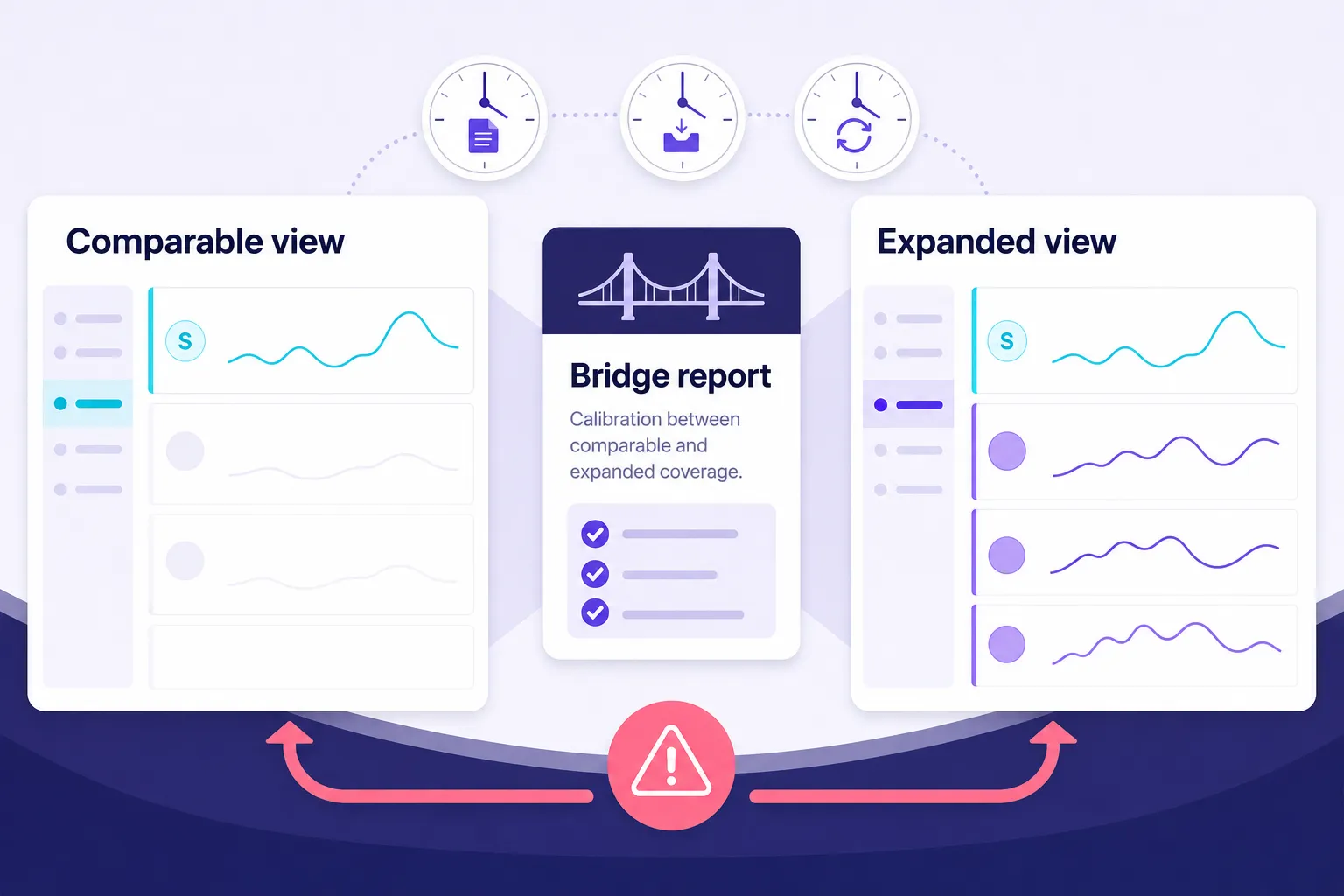
The Two-View Bridge: separate shared coverage from expanded coverage. Build two dashboards in the new tool. A comparable view restricted to equivalent sources, content types, languages and duplicate rules, used for continuity. An expanded view containing everything the new platform adds, used to show the value of broader monitoring.
Report them separately, always. Presenting new coverage as organic brand growth is the fastest way to lose credibility twice: once when you claim it, once when a colleague finds the extra forum.
And do not multiply history by a single correction factor. A gap caused by added forums will not hold during a news-driven crisis, when the source mix changes entirely.
The Three-Clock Test: separate publication time, collection time and metric-refresh time. Ask when the content appeared, when the tool collected it, and when its engagement figures last refreshed.
Plot trends by publication date. Keep backfill arrivals out of live incident counts, or a completed historical pull will look exactly like a spike. And remember that a backfilled post carries today's engagement total, not the figure the original report measured, so engagement comparisons across a migration need an equivalent observation point or an explicit caveat.
The Shared-Error Check (above) completes the set: before you call agreement between tools a confirmed trend, check the platform change logs.
The quantitative design, specified
Most calibration advice stops at "compare the numbers". Here is a method that survives a sceptical reader.
- Pool, do not average. Compute the volume ratio as total new-tool mentions divided by total old-tool mentions over the whole window, per query and per source. The mean of daily ratios overweights quiet days and inverts the picture on low-volume queries.
- Set a minimum daily count before a day enters the ratio. Calculate the pooled ratio across the full agreed observation window, including low-count and zero-count days. Flag those days separately for investigation. If the old tool’s total is zero, report the counts without calculating a ratio. Zero-count days are reported as zero-count days, never as a ratio.
- Report the spread, not a point estimate. Publish the pooled ratio plus the range of daily ratios across the window. A pooled 0.9 with daily values between 0.85 and 0.95 is a coverage difference. A pooled 0.9 with daily values between 0.4 and 1.6 is an unresolved collection problem, and you are not ready to cut over.
- Deduplicate before you count. Syndicated articles, reposts and quote posts inflate one tool and not the other. Decide one rule, apply it to both exports, and write the rule into the methodology note.
- Match on identity for sentiment. Compare labels only on posts both tools collected, matched by URL or platform ID, with the vendor names hidden from whoever adjudicates disagreements. Aggregate distribution gaps prove nothing on their own, because the two tools collected different content.
- Preserve the denominator. Negative share "of all mentions" and negative share "of positive plus negative" answer different questions, and migrations are where teams silently swap one for the other. Fix the definition before you rebuild brand sentiment scoring in the new tool.
Refuse to publish a universal acceptable variance percentage. You will see 10% and 15% quoted as industry standards. No published evidence supports them as thresholds, and a small overall difference can conceal a missing source carrying your most important complaints. Set project-specific acceptance rules instead, tied to named sources and named test cases, and have your sponsor sign them.
The reference set and its observed miss rate
A false-negative rate needs a denominator you built, not a total nobody can know.
Assemble 60 to 100 verified items before the pilot starts: known mentions across each source you care about, in each language you report on, including complaints, neutral mentions, an ambiguous brand-name case, a misspelling, and two items from a past incident. Record each item's URL, date, source and expected classification.
Then score both tools against that set with explicit rules: found or not found, found within the alert window or late, classified as expected or not. Report missed eligible items divided by all eligible items in the reference set, broken down by source. This measures performance on the selected test cases; it does not estimate the miss rate across all relevant conversations. Mentions a colleague remembers are a prompt for investigation, not a measurement.
The Known-Event Rebuild: pick one documented incident from the last 90 days and have both tools reconstruct it from history.If the new tool cannot reconstruct a past event, investigate historical coverage, query scope and backfill limits. Test live detection and alert delivery separately.
Diagnose before you approve
| Observation | First explanation to test | Evidence you need | Reporting decision |
|---|---|---|---|
| More mentions overall, shared sources similar | Added coverage | New-only source list with relevant examples | Report as broader visibility, separately |
| Identical posts, different labels | Classification difference | Blind matched-content review | Reset or bridge the sentiment baseline |
| Recent mentions arriving late | Collection or delivery latency | Publication, collection and alert timestamps | Fix before relying on escalation |
| Old content appearing as a spike | Backfill arrival or date-field handling | Publication date versus arrival date | Exclude backfill from live incident counts |
| Both tools move together | Real event or shared upstream change | Underlying content, platform change logs, business context | Investigate before assigning a cause |
Finish this phase when: you can explain every material difference and demonstrate the destination meets the agreed use cases. Matching headline totals is not a pass.
Phase 5. Migrate: how to rebuild queries, dashboards and alert routing in the new tool
Rebuild intent, then syntax. Mention's historical data documentation is the clearest illustration of why: the wildcard operator will not function with the Twitter source activated for historical queries, and nor will NEAR. A query that behaves correctly live can behave differently against history in the same tool.
Owner: monitoring administrator, with dashboard and integration owners. Typical duration: 2 to 4 weeks, overlapping the pilot.
Translate intent, not strings
Write the requirement in plain language first. "Find our company, our product names and the three common misspellings, exclude the unrelated sports team, English and German only, news and forums included."
Then translate into supported syntax and test each inclusion and exclusion against known examples. Operator symbols, nesting depth, proximity behaviour, wildcard support, case sensitivity and character limits all differ. Sprout caps queries at 2,037 characters across all plans; Mention documents a 2,000-character limit for Advanced Alerts and a separate 2,048-character limit for queries using X historical data. Confirm the applicable limit for your account; Brandwatch Saved Searches allow up to 100,000. A query that fits one platform may need splitting into several topics in another. Keep a translation log with old syntax, new syntax and the reason for every forced change, because that log is the only defence when a volume difference turns up later. The mechanics of operator-by-operator translation are covered in more depth in this walkthrough on rebuilding Boolean queries.
Maintain two query versions deliberately: a continuity query frozen to the agreed comparison scope, and an improvement query where you add terms, sources and refinements. Without that split, every query improvement becomes an invisible measurement change.
Never edit a live query to test an idea. Sprout documents that editing a query reprocesses historical data in the Topic, removing messages that no longer match, and recommends archiving the Topic first to preserve the history. Data collection for newly added keywords begins from the date of modification, not retroactively. That combination means a careless edit can delete history you paid to backfill and replace it with a forward-only collection you did not ask for.
Rebuild reports around definitions
For every chart, record the business question, included sources and content types, the formula and denominator, the date field and timezone, the duplicate policy, how unclassified content is treated, the query version, and the measurement start date.
Share of voice deserves particular care, because coverage differences hit each brand in the set differently. A competitor with heavy forum presence gains share in a tool with better forum coverage while nothing changes in the real world. Keep competitor queries symmetrical with your own, and recompute share of voice metrics from the pilot rather than splicing the old series onto the new one.
The widgets most likely to mislead are not the trend charts. Those get annotated. It is "top sources" and "top authors", which quietly reflect the new tool's coverage profile and get read in the room as "the conversation has moved". Annotate those too, for at least two reporting cycles.
Rebuild alerts around action, then rehearse a surge
Specify trigger, recipient, backup recipient, acknowledgement expectation and escalation path. Separate urgent incident alerts from routine digests, and give exactly one system responsibility for production escalation so parallel collection does not create duplicate incident handling.
Copying the old numerical threshold is a trap. If the new collector returns 1.3 times the volume on a query, a 50-mentions-per-hour trigger now fires at a lower real-world intensity. Recalibrate against pilot data, not the old settings screen. And be honest about direction: raising a spike trigger from twice to three times baseline reduces sensitivity, which is the opposite of conservative if your worry is a missed crisis.
Then run the test almost nobody runs. The Surge Rehearsal: before cutover, deliberately push the new setup toward its limits and watch what breaks. Use a separate test query with agreed quota limits and alerts routed to a test channel. Increase volume within those limits, and confirm with the vendor how to test throttling and quota exhaustion. Check what happens when a report request exceeds the export cap, how the tool behaves when quota runs out mid-month, and how long the backlog takes to clear afterwards. A functional test proves alerts work on a quiet Tuesday. A crisis arrives on a Friday night with ten times the volume.
For the alert and dashboard layer specifically, a monitoring setup you can stand up quickly is useful here: during the rebuild, BrandMentions can carry brand, product and executive-name alerts across web, news, social and forum sources so coverage does not lapse while the primary platform is half-configured. If answer engine visibility is part of your remit, keep that as a separate stream rather than folding generated answers into customer sentiment: log the engine, prompt, language, location, date, the answer and the pages it cited, and report AI brand mentions as their own evidence class. They measure how a system describes you, not how customers feel about you, and mixing the two corrupts both numbers.
Finish this phase when: the new configuration reproduces the required decisions and workflows, not merely the old interface.
Phase 6. Verify: how to cut over with rollback ready and monitor for 14 days
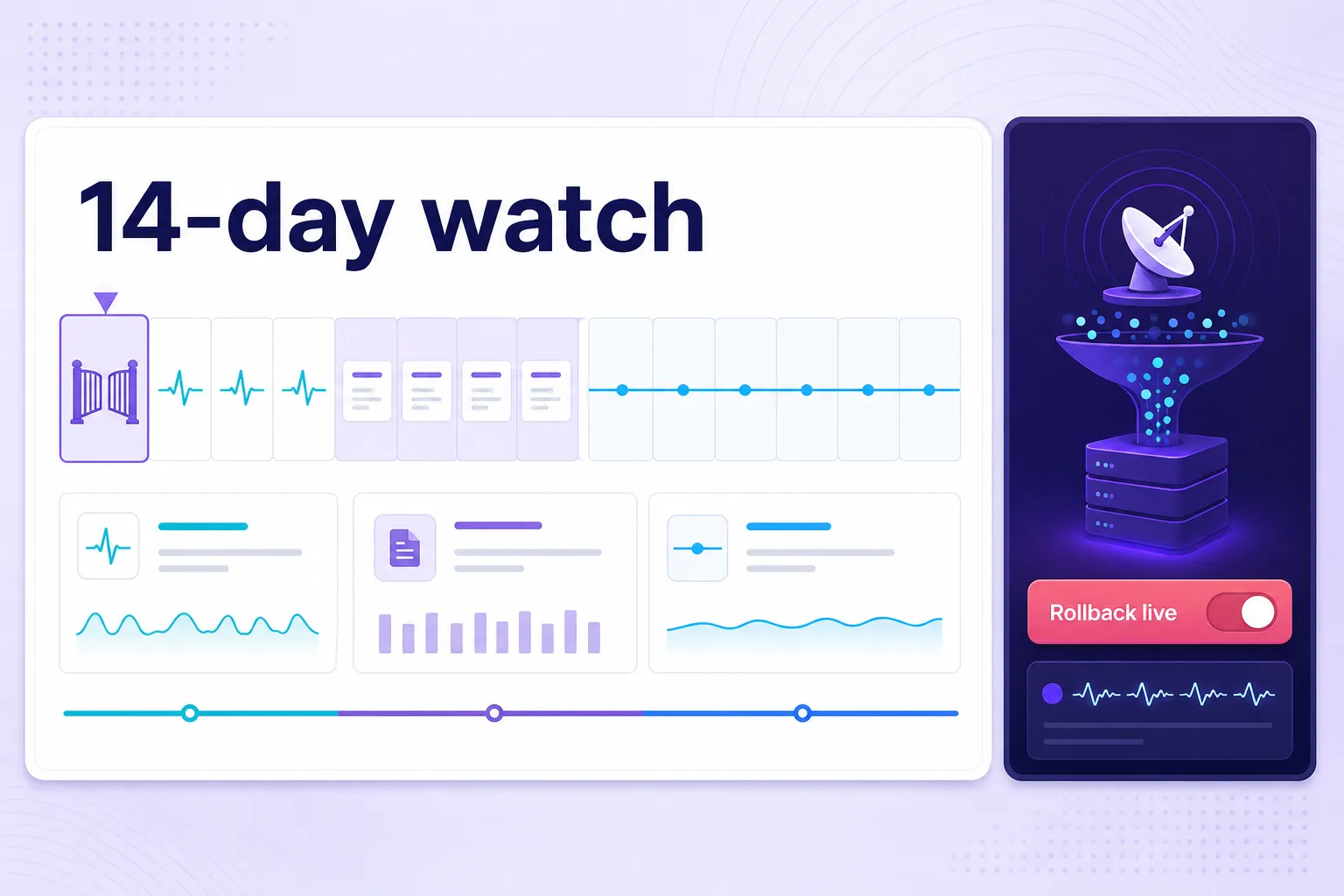
Cutover is a gate, not a date. Approve it only when required sources collect under the purchased plan, no crisis-critical test case has an unresolved failure, exports and imports reconcile against the manifest, every material sentiment and volume difference has a documented explanation, alerts reach the right people, permissions are correct, and a representative report has been produced and reviewed.
Owner: migration lead, with a named daily monitoring owner. Typical duration: 2 weeks plus cutover day.
Write the rollback procedure before you switch
Document who may trigger rollback, which failure conditions justify it, the last date and time it remains available, how old alert routing and report delivery get restored, how records and incident notes created in the new tool get preserved, and who tells stakeholders.
Then keep the old collector actually running through that window. This is the distinction almost every migration guide blurs: an unexpired login is not a fallback. Muting duplicate notifications is different from stopping collection, and a read-only or dormant account cannot catch tomorrow's crisis. If the vendor offers a reduced-cost dormant mode, get the collection behaviour confirmed in writing.
One more sequencing rule. Because collection stops the moment a token expires, reauthenticate everything on the old tool before cutover week rather than during it.
A rollback plan needs a working collector, not just an unexpired login.
The 14-day monitoring window
Fourteen days is an operational convention, not a proven failure distribution. It is long enough to cover two weekends, one weekly report and one scheduled delivery cycle, which is why it works. Extend it whenever a material failure is unresolved.
| Period | Required checks | Evidence to record |
|---|---|---|
| Cutover day | Connections, source activity, access, alert recipients, reporting timezone | Signed cutover record, successful workflow tests |
| Days 1 to 3 | Silent source drops, latency, duplicates, false alerts, quota consumption against the pilot-adjusted baseline | Daily exception log with named owners |
| Days 4 to 7 | Sentiment disagreements, source mix, weekend coverage, scheduled delivery arriving | First report review and correction log |
| Days 8 to 14 | Recurring failures, escalation handling, archive access, stakeholder understanding | Exit decision and remaining issue list |
Investigate silence as hard as you investigate spikes. Check source health and three known eligible mentions before you read a flat line as a quiet week.
Then publish two things on day 14. A one-page known-gaps document listing what the new tool does not do that the old one did, with workarounds. And a migration note placed beside the affected chart rather than in an appendix: collection moved on this date, comparisons use the shared source set, expanded coverage and the new sentiment baseline are shown separately. The footnote matters more than the number, and your first listening report setup after cutover should carry it for at least two cycles.
Turn off the old tool's scheduled reports on cutover day, not at contract end. The most common week-two failure is not technical. It is two reports for the same week, with different numbers, landing in the same inbox.
Finish this phase when: exit criteria are met, material failures are resolved, and the team knows which historical comparisons remain valid.
Phase 7. Retire: how to cancel your old social listening tool without losing the evidence
Retirement is a data governance step, not a cancellation. Two documents should reshape how you think about your archive.
Hootsuite's acceptable use rules state that once the services expire or terminate, it has no obligation to retain historical content or mentions and may delete them, and that you must ensure affected mentions are removed from your own systems on termination. The same terms place responsibility for lawful use of exported mentions on you once they leave the platform. And Reddit's data deletion guidance requires parties accessing its public content to stop using or displaying content that users or Reddit delete.
Read together, those create an obligation most teams have never budgeted for. Your export is not a permanent possession. It is a dataset with a maintenance duty attached.
Owner: account administrator, with the archive owner and a privacy or legal contact. Typical duration: 1 to 2 weeks.
Before closing the old account: complete the final permitted export and reconcile it against the manifest; confirm archive ownership, access controls, retention rules and a deletion-handling process; record unresolved coverage gaps and measurement breaks in writing; transfer essential incident notes and manual classifications; disable obsolete scheduled reports and integrations; revoke credentials only after checking that nothing else depends on them; and confirm cancellation, final billing, account deletion and any retrieval deadline in writing.
Keep the methodological documentation even where content rules require deleting individual records. Query versions, source lists and metric formulas let you explain a 2025 report without pretending you still hold every underlying post. Two years from now, that one page answers an auditor's question in five minutes instead of five days.
Finish this phase when: you no longer depend on the old platform for collection, reporting, escalation or permitted historical retrieval.
Phase comparison: effort, risk and what each phase protects
| Phase | Typical duration | Effort | What it protects | Highest-risk omission |
|---|---|---|---|---|
| Decide | 1 to 2 weeks | Low | Budget, authority, the fallback | No negotiated extension option |
| Prepare | 2 to 4 weeks | Medium | Knowing what to rebuild | Undocumented manual workflows |
| Back up | 2 to 4 weeks | Medium | The offline evidence base | Starting after the export cap makes it impossible |
| Pilot | One full reporting cycle, 14 days minimum | High | Trend continuity and stakeholder trust | Calibrating on a sampled or unsaved search |
| Migrate | 2 to 4 weeks, overlapping | High | Operational monitoring | Untested alerts and uncalibrated thresholds |
| Verify | 2 weeks plus cutover day | Medium | Early failure detection | A rollback plan with no live collector |
| Retire | 1 to 2 weeks | Low | Clean exit and compliance | Auto-renewal firing mid-migration |
Parallel run versus backfill: the core difference. Backfill tells you what the new tool believes happened in the past. The parallel run tells you how the new tool's present compares with the old tool's present, and only the second produces a translation you can publish. Teams that buy two years of history and skip the overlap end up with a long archive on a scale nobody can relate to the old charts.
Comparable view versus expanded view: the core difference. The comparable view answers "did the brand change". The expanded view answers "was the new tool worth buying". Put them on the same axis and you have answered neither.
If your switch is driven by one vendor rather than a general refresh, shortlists of Brandwatch alternatives are a reasonable starting point, but apply the backfill, sampling and export questions above to every candidate before the demo rather than after.
What to do when there is no overlap at all
Sometimes the old contract has already lapsed, the vendor has shut the product down, or the archive is inaccessible. You cannot calibrate against a tool you no longer have. Do this instead.
Declare the break explicitly. Set a measurement start date, mark every chart that crosses it, and state in writing that pre-break and post-break figures are not comparable. An honest discontinuity beats a spliced series that quietly misleads for a year.
Then rebuild confidence from fixed points rather than from a comparator. Use the reference set method against documented past events you can verify independently: a product launch with a known press cycle, a complaint thread still live on X or Reddit, a campaign with its own analytics. Reconstruct two or three of those in the new tool and record how completely each came back.
Stand up emergency monitoring in parallel on day one, even something lightweight, so you are not single-sourced during the rebuild. And give yourself a longer watch period, 30 days rather than 14, because you have no second instrument to cross-check against. Write the resulting limitation into the methodology note and stop apologising for it. Stakeholders accept a documented gap. They do not forgive a number that turned out to mean something else.
The copyable migration checklist, with owners and rollback dates
There is no file to download here, deliberately. The checklist your team actually updates is the one living in your own workspace, so copy the fields and the table below into Google Sheets or Excel and save it as listening-migration-checklist.xlsx. Replace role labels with named people, and use calendar dates rather than "next week".
Project fields
- Cutover date and timezone: ______
- Overlap start date: ______
- Rollback deadline (last date rollback is still possible): ______
- Post-switch monitoring start and end: ______
- Cancellation notice deadline: ______
- Final old-tool access date: ______
- Migration approver: ______
| Done | Phase | Required task | Accountable owner | Due date | Evidence or status |
|---|---|---|---|---|---|
| ☐ | Decide | Approve business case, scope and total transition cost | Sponsor | ___ | ___ |
| ☐ | Decide | Approve acceptance criteria and rollback authority | Migration lead | ___ | ___ |
| ☐ | Decide | Negotiate month-to-month extension option on old contract | Procurement | ___ | ___ |
| ☐ | Decide | Complete security, residency and data processing review | Legal or IT | ___ | ___ |
| ☐ | Prepare | Inventory topics, queries, exclusions and sources | Analyst | ___ | ___ |
| ☐ | Prepare | Record users, permissions, integrations and recipients | Administrator | ___ | ___ |
| ☐ | Prepare | Document formulas, denominators and timezone per chart | Reporting owner | ___ | ___ |
| ☐ | Prepare | Interview owners of manual workflows and tagging rules | Analyst | ___ | ___ |
| ☐ | Back up | Confirm export rights, caps and remaining access in writing | Data owner | ___ | ___ |
| ☐ | Back up | Export records, reports and configurations | Analyst | ___ | ___ |
| ☐ | Back up | Reconcile manifest, test readability outside the tool | Data owner | ___ | ___ |
| ☐ | Back up | Confirm whether headline totals are counts or estimates | Analyst | ___ | ___ |
| ☐ | Back up | Approve source-specific backfill and import costs | Procurement | ___ | ___ |
| ☐ | Pilot | Build continuity queries and the verified reference set | Analyst | ___ | ___ |
| ☐ | Pilot | Compare pooled volume ratio by source, record the spread | Analyst | ___ | ___ |
| ☐ | Pilot | Blind-review sentiment on matched mentions | Analyst | ___ | ___ |
| ☐ | Pilot | Prove crisis alert delivery and acknowledgement | PR lead | ___ | ___ |
| ☐ | Migrate | Rebuild queries with a translation log | Administrator | ___ | ___ |
| ☐ | Migrate | Rebuild dashboards with definitions and annotations | Reporting owner | ___ | ___ |
| ☐ | Migrate | Recalibrate alert thresholds against pilot volume | Administrator | ___ | ___ |
| ☐ | Migrate | Run the surge rehearsal on quota, latency and exports | Workflow owner | ___ | ___ |
| ☐ | Migrate | Test integrations and workspace permissions | Workflow owner | ___ | ___ |
| ☐ | Verify | Approve cutover gate and rehearse rollback | Migration lead | ___ | ___ |
| ☐ | Verify | Disable old-tool scheduled reports on cutover day | Administrator | ___ | ___ |
| ☐ | Verify | Complete daily failure checks for 14 days | Monitoring owner | ___ | ___ |
| ☐ | Verify | Publish known-gaps document and migration note | Reporting owner | ___ | ___ |
| ☐ | Retire | Final export, reconciliation and archive governance | Data owner | ___ | ___ |
| ☐ | Retire | Add calibration record to reporting methodology | Reporting owner | ___ | ___ |
| ☐ | Retire | Cancel service, revoke access, confirm deletion in writing | Administrator | ___ | ___ |
Attach an exception log with the affected source, expected behaviour, observed failure, owner, deadline and rollback decision. An unticked box with an explanation is worth more than a complete checklist hiding a known gap.
Research: What Public Discussions Reveal About Social Listening Tool Migration
We examined public discussions and comparison content mentioning 13 tools between August 25 and November 20, 2026, using the BrandMentions database. Of 85 discussion posts containing switching-related language, we identified 30 competing-vendor pitches and just four firsthand accounts of tool dissatisfaction, switching considerations or cancellation experiences.
The findings offer useful context for a social listening tool migration, but they reflect the retrieved sample, not the entire market. Use these discussions to identify questions for vendors. Base the migration decision on documented capabilities, contractual terms and a pilot that tests your actual reporting and monitoring needs.
All data comes from the BrandMentions Database API, queried 23 November 2026 for 25 August to 20 November 2026.
| Step | What we did |
|---|---|
| Tools | Brandwatch, Meltwater, Sprout Social, Hootsuite, Talkwalker, Brand24, Sprinklr, Awario, BrandMentions, YouScan, Agorapulse, Cision, Mention (as "mention.com", because "mention" is an ordinary word) |
| Discussions | We retrieved 544 posts for the selected queries and date range. These results reflect the coverage and query design, not every public discussion |
| Switching filter | Posts using switching language: switch, migrate, move from, replace, alternative, cancel, leave, renewal, contract, too expensive and similar |
| Coding | All 85 matching posts were read and sorted by who wrote them and why. Vendors were identified by self-disclosure ("I'm the co-founder", "I work at") or by publishing their own product's pricing table |
| Alternatives content | For each tool, the share of all its mentions that also contained the word "alternatives" |
| Forced migrations | Mentions of Talkwalker, "Lumen by Talkwalker", Talkwalker with Hootsuite, "Agorapulse Listening", and Mention with Agorapulse |
The index covers only mentions from discussion platforms.
Finding 1: We identified vendor pitches in 30 of 85 switching-related posts
A team researching a switch online will mostly read sellers. Of the 85 discussion posts that used switching language about these tools, 30 were competing vendors and 13 were listicles or comparison pages. Only 4 were users talking about their own switch.
The vendor posts follow a pattern. A user asks a question, and several founders reply with their own product, often disclosing it: "Come on over to OneUp! (I'm the cofounder)", "I work at Recur Post". One product, Mydrop, appeared in 11 of the 85 posts with near-identical pricing tables. Some threads that look like user questions, such as "Anyone switch from Hootsuite lately?", carried a link to a competing product in the opening post.
The same is true outside forums. Among the 12 tools shown in the table, approximately 3% to 30% of retrieved mentions contained the word "alternatives". Most of those were "best alternatives" lists and comparison pages.
| Tool | Mentions | With "alternatives" | Share |
|---|---|---|---|
| Awario | 409 | 124 | 30% |
| Agorapulse | 541 | 155 | 29% |
| Sprinklr | 831 | 147 | 18% |
| Brand24 | 1,665 | 268 | 16% |
| Talkwalker | 813 | 129 | 16% |
| YouScan | 221 | 36 | 16% |
| Sprout Social | 2,267 | 345 | 15% |
| Hootsuite | 2,844 | 376 | 13% |
| Brandwatch | 1,847 | 239 | 13% |
| BrandMentions | 322 | 38 | 12% |
| Meltwater | 2,217 | 162 | 7% |
| Cision | 5,748 | 201 | 3% |
This matters for the article's Phase 1. The evidence a buying team gathers before deciding to switch is mostly written by someone selling the destination. The article's pilot, reference set and written acceptance rules are the counterweight.
Finding 2: What the people switching actually said
Four posts are a small sample, but each one lines up with a specific phase of the article. Together they cover the main reasons a team leaves: the tool feels dated, the cost no longer makes sense, the contract traps them, or the product is bigger than the job.
| What the user wrote (Reddit, 2026) | Reason | Article phase it maps to |
|---|---|---|
| "Every time I log in to brandwatch or critical mention, I can't help thinking there has to be a better way to do this nowadays. Have any of you made the switch?" | Dated workflow, wants AI | Phase 1: name the business problem the switch must solve |
| "Why pay $$$ for Brandwatch or equivalent when I can literally build my own" | Cost of 4–5 figure annual fees | Phase 1: total transition cost, including internal hours |
| "I missed notifying Meltwater of my intent to cancel my contract by 12 hours, even though the new term doesn't start in 2 months" | Notice period and auto-renewal | Phase 1 and 7: cancellation notice deadline in the shared calendar |
| "Hootsuite and Sprout were total overkill even if they were free" | Product larger than the job | Phase 2: audit what drives a recurring decision |
The Meltwater story is the clearest example of a risk the article flags: a commercial deadline overriding the migration plan. The user had two months left on the term and still missed the notice window. The article's advice to put six dates in a shared calendar, including the cancellation notice deadline, would have caught it.
The vendor pitches tell a different story about why people switch. Five competing products led with price, and the most common target was per-seat billing: "the unit decides the bill, not the sticker", as one put it. That pitch is aimed at publishing suites. For listening tools the price comparison is harder, because the large platforms publish no prices at all, which one comparison post described as attaching "a dollar figure only through a demo".
Finding 3: Forced migrations leave old names behind
Two listening products have been absorbed into larger platforms: Talkwalker now sits inside Hootsuite as Lumen by Talkwalker, and Mention stopped being sold standalone on 1 July 2026 after Agorapulse acquired it. Product changes can affect migration planning, but a rebrand or acquisition does not necessarily require existing customers to move. Mention stopped new standalone sales on July 1, 2026; existing customers can retain their current plans. Almost none of them talked about it in public, but the content around both products shows how slowly the market catches up.
| Measure | Mentions, 25 Aug–20 Nov 2026 |
|---|---|
| "Talkwalker" | 813 |
| "Talkwalker" together with "Hootsuite" | 260 (32%) |
| "Lumen by Talkwalker" | 63 (8%) |
| "Agorapulse Listening" | 38 |
| "Mention" together with "Agorapulse" and "acquired" | 14 |
| User discussion posts found about either migration | 0 |
Two out of three Talkwalker mentions still describe it with no reference to Hootsuite, and fewer than one in ten use its current name. Guides published in November, including a Polish explainer, still present Talkwalker as a standalone platform. For Mention, a page titled "7 Best Mention Alternatives for B2B SaaS Teams" was published in October, after the product had stopped being sold to new customers.
This matters for a migration in two ways. First, a buyer comparing destinations online may be reading about products that no longer exist in that form, so the article's advice to evaluate "the exact plan you intend to buy" applies to the product name too. Second, a forced migration gives no time to run the article's Phase 4 pilot properly. The article's section on what to do when there is no overlap, declaring the break and rebuilding confidence from known events, is the plan these customers needed.
Limitations and disclosure: The data comes from BrandMentions, which publishes the article and is one of the tools counted here. BrandMentions appears in the tables on the same basis as every other tool.
Why a listening migration is not a publishing migration
Most migration guides on this topic are really about scheduling tools. Those migrations are reversible. You reconnect profiles, re-upload a content queue, and your own posts are still sitting on the network waiting to be pulled again.
Listening breaks that assumption in three places.
The data is not yours to re-fetch. A listening tool collects other people's public content under licences it negotiated, and when you leave, the archive leaves with you only as far as the export button and the contract allow.
The measurements are not standardised. Two tools running the identical Boolean string will report different volumes because they index different sources, filter spam differently, deduplicate differently and sample differently.
And the stakeholders already trust the old numbers. Your share of voice, your crisis baseline, your campaign lift charts all live on the old instrument's scale. The day you switch, every one of those series breaks, and someone senior will ask why negative sentiment jumped.
Treat the switch as a change of measuring instrument. On day one with the new tool, the question you must be able to answer is not "what are the numbers" but "how do these numbers map to the old ones".
How does a listening migration differ from switching a publishing tool?
With publishing you move content, permissions, approvals and schedules. With listening you also replace the system that decides what counts as evidence and what that evidence means.
So run it as two projects on one timeline. The operational project asks whether collection, alerts, integrations and reports work. The measurement project asks whether a number means the same thing before and after cutover.
Do not approve the second because the first passed. A dashboard that loads perfectly can still be reporting a different reality.
There is a third difference that catches agencies in particular: audience. A CRM migration disrupts sales operations and gets scrutinised by people who expect row counts to reconcile. A listening migration disrupts PR, comms and brand strategy, and the questions arrive in a board deck phrased as performance, not as data quality.
Can trend continuity survive a change of sentiment model?
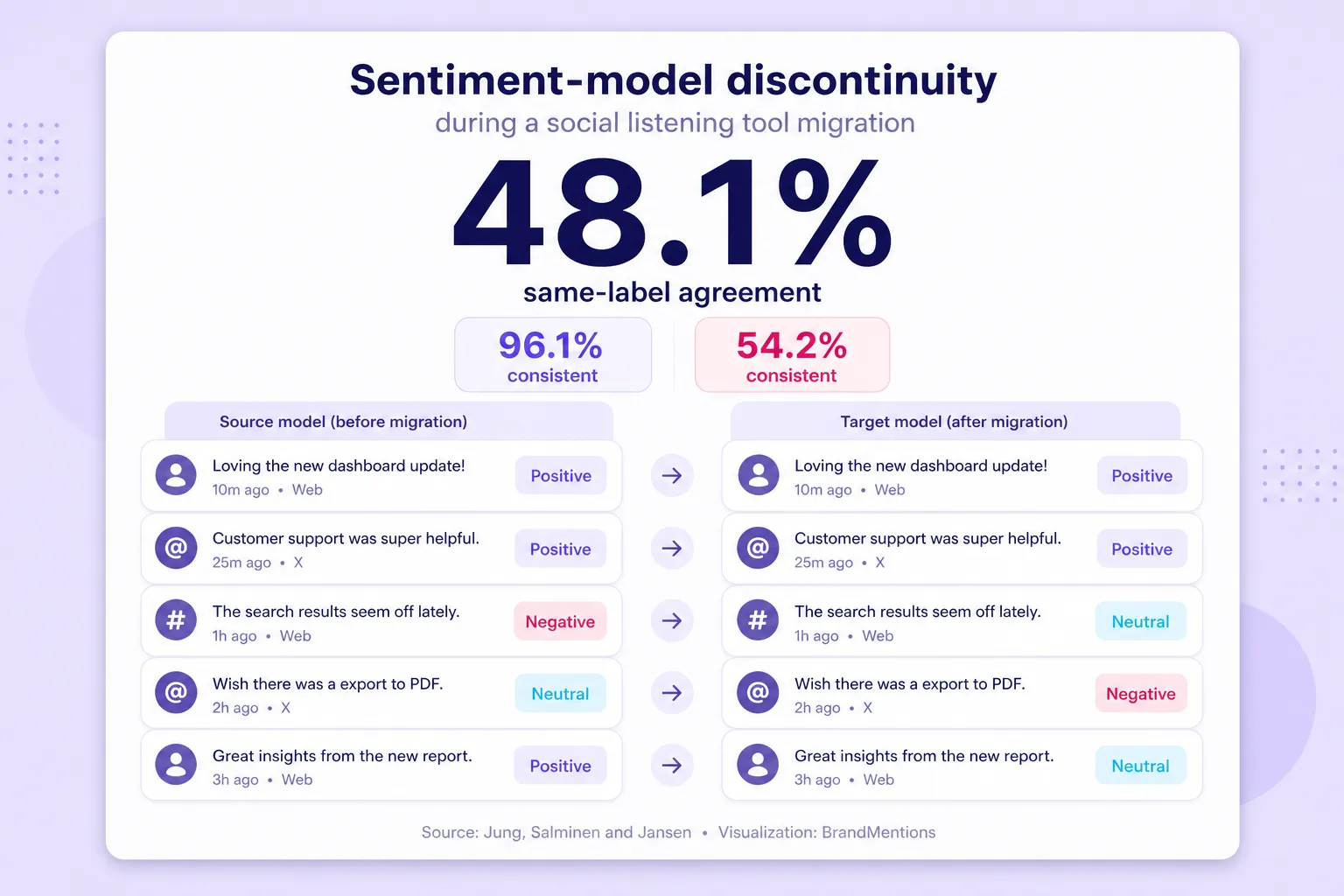
Not automatically, and this is the most underestimated risk in the project. Sentiment is a classifier output. Each vendor trains its own, sets its own neutral band, handles sarcasm and emoji its own way, and updates the model without a version number you can see. Brandwatch, for example, documents that Listen sentiment comes from a machine learning classifier trained on over 500,000 hand-labelled mentions, which tells you it is a trained artefact, not a measurement.
The research is blunt about how far two trained artefacts can diverge. A peer-reviewed comparison of commercial sentiment services by Jung, Salminen and Jansen found four major services assigned the same label to 48.1% of the content studied. More useful for migration planning: when the same services were re-tested 16 months later, one held 96.1% self-consistency while another fell to 54.2%, and the paper attributes part of that drop to a newly introduced uncertainty label rather than a decline in quality.
Read that second finding carefully, because it reframes the whole problem. A taxonomy change can look exactly like a model getting worse, and a model that adds an "uncertain" class will mechanically reduce your positive and negative shares without anybody's opinion changing. When you compare two vendors, compare their label sets first and their accuracy claims second. If you want the mechanics behind why classifiers diverge on the same sentence, start with sentiment analysis basics before you design your comparison sample.
Measure classification and coverage separately or you will measure neither. Comparing two random samples of 500 mentions tells you nothing clean, because the two tools collected different content. Hold the content constant (the same posts, matched by URL or platform ID) and you are testing the classifier. Hold the classifier aside and compare equivalent sources, and you are testing coverage.
How do you tell a real brand trend from a measurement change?
Before you report any post-cutover movement, test three explanations in this order: the conversation changed, your collection changed, or your measurement changed.
Collection changes are the quiet ones. A token expiring, a source not purchased on the new plan, a hashtag slot unavailable, a query edit that silently dropped a clause. Sprout documents that any time an Instagram or Facebook token expires, data collection stops, and a stopped collector looks identical to a calm week.
Measurement changes include the upstream kind that neither vendor controls. The YouTube Data API revision history records that from November 16, 2026, public video view counts include television co-viewers, while engaged views exclude co-views. If your migration straddles that date, you need a platform-change annotation as well as a tool-change annotation.
The Shared-Error Check: two tools agreeing does not prove a brand trend. Both may inherit the same upstream definition change, the same licensed feed, the same deduplication rule. Agreement narrows the explanations. It does not close the question.
How much history do you actually need to buy?
Less than procurement assumes across the board, and more than the budget allows on the two or three queries that matter. Work backwards from the comparisons your reports actually publish.
Here is the arithmetic most teams get wrong.
The 15-Month Rule: a quarterly year-over-year report needs 15 months of contiguous history, not 13. To compare the third quarter of 2026 with the third quarter of 2025 in the same tool, you need unbroken coverage from July 1, 2025 through September 30, 2026. Thirteen months is the right floor only for a monthly chart with a prior-year comparator. Apply the monthly number to a quarterly report and you will discover the gap in the first board meeting after cutover.
Then triage. Tier one queries (brand health, crisis detection, the competitor set in the board deck) earn the full window. Campaign and event queries usually need the campaign window plus a baseline month. Exploratory queries start fresh and cost nothing.
The cheapest backfill is the one you never buy. If a switch looks likely within six months, stand the core queries up in the candidate tool now, even on an entry plan. Native collection that starts early beats a retrospective pull that depends on a platform still permitting historical access.
Frequently asked questions about switching social listening tools
Can I transfer my saved searches and sentiment history to a new listening tool?
BrandMentions offers a complete data migration service. You can export mention records, old sentiment labels and query strings as reference data, and some vendors support importing supplied records, but queries, dashboards, tags, alert thresholds and proprietary scores are rebuild-and-test items.
How much historical data can a new listening tool backfill?
It depends on the vendor, the plan and the individual source. BrandMentions can offer for up to 10 years of data on the Enterprise plan. Sprout pulls 30 days automatically for all networks except Instagram, Brandwatch Listen loads one year on saving a search with two years as a premium add-on, and Mention's add-on reaches up to two years.
How long should you run two social listening tools in parallel?
Fourteen days is a planning floor, not an answer. The overlap should cover at least one full cycle of the report that carries the most weight, plus a weekend, plus any recurring low-volume market you report on separately. Extend it when a core query's volume is low enough that one viral post moves the ratio, when you monitor multiple languages, when a campaign or incident distorts both tools, or when any crisis-critical test case is still untested.
Should I buy historical backfill or run a parallel pilot?
Run the parallel pilot first, then buy only the backfill your published comparisons actually need. Backfill tells you what the new tool believes happened in the past, while the parallel run tells you how the new tool's present compares with the old tool's present, and only the second produces a translation you can publish. Teams that buy two years of history and skip the overlap end up with a long archive on a scale nobody can relate to the old charts.
Why did my sentiment scores change after switching tools?
Because sentiment is a classifier output with a vendor-specific label set and neutral threshold, not a fixed measurement. Research on commercial sentiment services recorded 48.1% four-way agreement on the same content, and a taxonomy change such as adding an uncertainty class will shift your positive and negative shares without any change in opinion. Compare labels on identical posts before concluding that anything about your brand moved.
What happens to my social listening data after I cancel?
Retention while you are a customer is not access after cancellation, so treat them as separate contractual rights. Hootsuite's terms state that once the services expire or terminate it has no obligation to retain historical content or mentions and may delete them, and that you must ensure affected mentions are removed from your own systems on termination. Reddit's deletion guidance also requires parties accessing its public content to stop using or displaying content that users or Reddit delete, so your export is a dataset with a maintenance duty attached rather than a permanent possession.
Why does editing a query delete historical data in Sprout?
Sprout documents that editing a query reprocesses historical data in the Topic and removes messages that no longer match, and it recommends archiving the Topic first to preserve that history. Collection for newly added keywords also begins from the date of modification rather than retroactively. That combination means a careless edit can delete history you paid to backfill and replace it with forward-only collection, which is why you should keep a frozen continuity query and never edit a live query to test an idea.
Conclusion: protect the decision, not the dashboard
A good listening migration does not make every historical chart look seamless. It makes every important difference explainable, which is a harder standard and a much more useful one. The vendors will handle provisioning. The networks will keep changing what anyone is allowed to collect. The part only your team can do is preserve the meaning of the numbers across the break.
So start narrow and start now. Name an owner for the source inventory, an owner for the export plan, and an owner for the continuity test, and get those three documents written before anyone picks a cutover date. Teams that choose the date first are choosing it before they know what has to survive it.
Then stand up your top five executive-reporting queries in the candidate tool this week, saved, with history enabled, even if the contract is unsigned and the switch is months away. Collection that starts early is the cheapest backfill you will ever buy, and the overlap data it quietly accumulates is the only evidence that turns a tooling change into a defensible measurement change. Everything else on the checklist follows from those five.
Filed under: Social Listening