Earned vs Paid vs Owned vs Organic Media: The Complete 2026 Guide (With Examples)
A plain-English guide that finally defines and distinguishes earned, paid, owned and organic media—with real brand examples, a master comparison table, measurement methods and where the lines blur.


These four categories - Earned, Paid, Owned, Organic Media- are not interchangeable synonyms invented to give marketers more words. They describe who pays for the placement, who controls the message, and why an audience does or does not believe what they see. Get the definitions right and your reporting gets honest. Get them wrong and you will defund the channel doing the quiet credibility work and pour budget into the one that only looks efficient on a last-click chart.
TL;DR: The 4 Media Types in One Line Each
- Paid media is any exposure you buy: search ads, social ads, display, sponsorships and paid influencer posts.
- Owned media is any property you control: your website, blog, email list, app, documentation, podcast and branded profiles.
- Earned media is attention created by independent third parties who were not paid for that specific placement: press coverage, reviews, customer posts, analyst mentions and forum threads.
- Organic media is unpaid visibility handed to you by a discovery system: search rankings, non-promoted social reach, marketplace results and AI answer mentions.
- The lines blur most around influencers, SEO and employee advocacy - and a newer frontier now sits on top of all four: whether AI answer engines mention your brand at all.
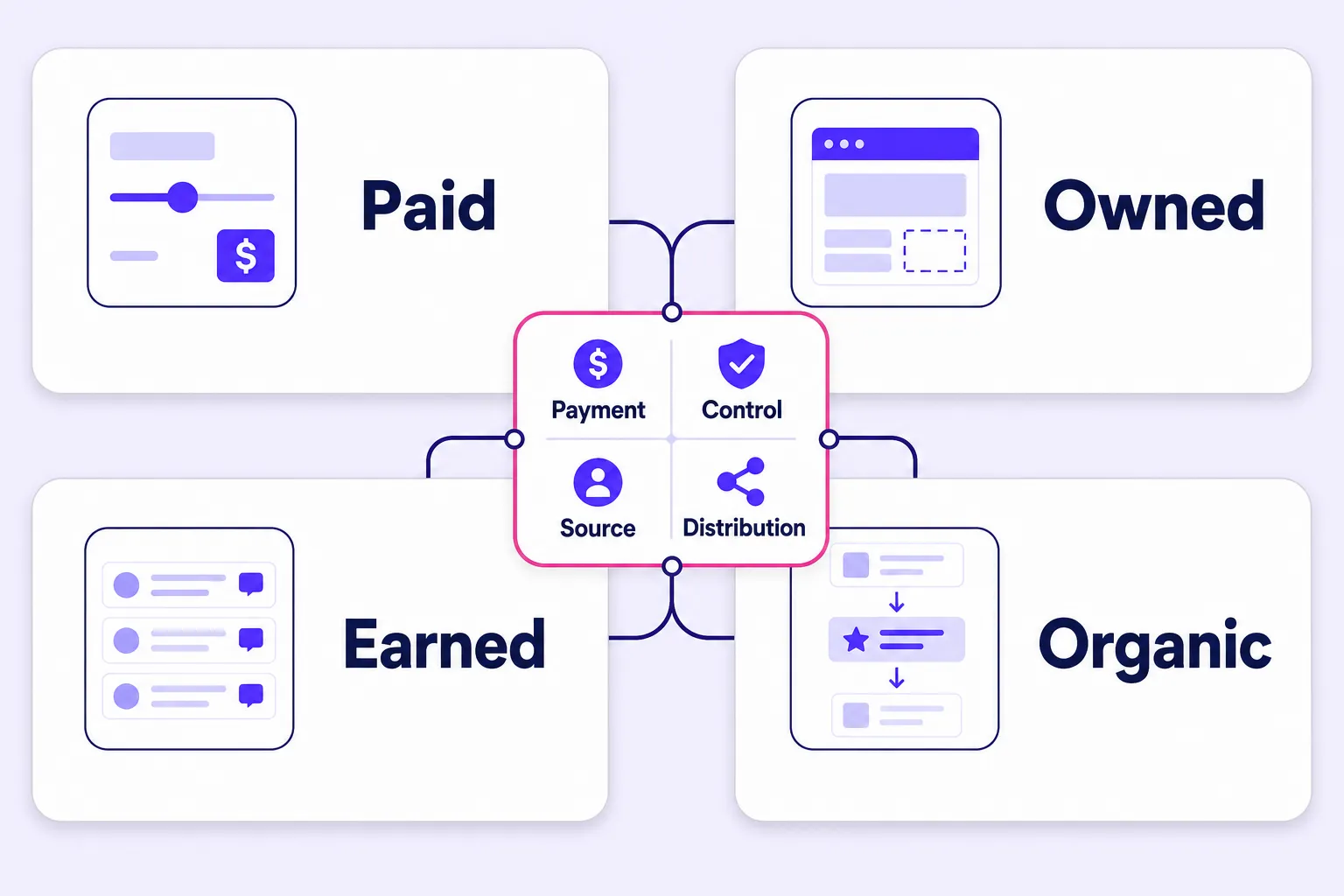
The cleanest distinction is not the channel. It is payment, control, source and distribution.
- Summary: The 4 Types of Media Defined
- What Are the Core Media Types? A Conceptual Taxonomy
- Where Does the Paid, Owned and Earned Framework Come From?
- What Is Paid Media? Definition and Examples
- What Is Owned Media? Definition and Examples
- What Is Earned Media? Definition and Examples
- What Is Organic Media? Definition and Examples
- Paid vs Owned vs Earned vs Organic: Master Comparison Table
- Why Did the Paid, Owned and Earned Model Need an Organic Layer?
- Is SEO Earned Media or Organic Media?
- What Makes Earned Media More Credible Than Paid Media?
- Where the Lines Blur: Hybrid and Edge Cases
- The AI Mention Dependency Map
- How to Measure Each Media Type
- How Paid, Owned, Earned and Organic Media Work Together Across the Funnel
- How Do AI Answer Engines Change the Media Model?
- Frequently Asked Questions
- Strategic Synthesis
Summary: The 4 Types of Media Defined
Earned, paid, owned and organic media are the four structural categories of brand visibility, separated by two variables: who pays for the placement and who controls the message. Paid media is bought placement, owned media is brand-controlled publishing, earned media is independent third-party attention, and organic media is unpaid discovery through search, social, marketplace or AI ranking systems. A single asset can pass through more than one of these categories over its life, so accurate classification depends on who created the message, who controls the channel, whether the placement was paid for, and how the audience discovered it.
At a glance:
- Paid media - you pay for the placement; you control the message within platform rules.
- Owned media - you control the property and the message; you build the audience yourself.
- Earned media - an independent third party creates the message; you control nothing.
- Organic media - an unpaid discovery system distributes the content; you may own the content but not the reach.
What Are the Core Media Types? A Conceptual Taxonomy
These are not four tactics you pick from a menu. They are four positions in a single visibility ecosystem, each defined by a distinct relationship to payment, control and distribution.
Paid media: Visibility created through a commercial exchange for placement, reach, sponsorship or amplification. The brand pays a platform, publisher, creator or media owner to access an audience, and controls the message within platform rules.
Owned media: Visibility created through assets the brand controls directly. Websites, blogs, email programs, apps, product documentation, help centers, podcasts, research libraries and branded social profiles all sit here. The brand controls the message completely but has to build the audience itself.
Earned media: Visibility created by independent sources who were not paid for the specific placement. Editorial coverage, customer reviews, unpaid social posts, forum conversations, analyst references, podcast mentions and word of mouth. The brand controls nothing, which is exactly why audiences trust it.
Organic media: Visibility created through unpaid discovery systems. Search rankings, unpaid social distribution, recommendation feeds, marketplace rankings and AI answers that surface a brand without payment. Organic describes the distribution mechanism, not who owns the underlying asset.
One layer of confusion is worth naming before anything else. Media type, channel, asset, source, message and distribution mechanism are separate things. A "channel" like LinkedIn can carry owned posts, paid ads and earned employee commentary at once. An "asset" like a research report can be owned when you publish it and earned when a journalist cites it. Keep those layers distinct in your head and the hybrid cases stop being confusing.
Core Axiom: Media ownership and media distribution are not the same thing. A brand can own the content and not own the audience path that reaches people, which is the single distinction most definition posts skip.
Where Does the Paid, Owned and Earned Framework Come From?
The four-part model is younger than it feels. The three-category version was publicly described in 2009 by Daniel Goodall, then a marketing manager at Nokia, whose team had been using owned, bought and earned media as overlapping circles for roughly a year to plan digital campaigns.
Forrester turned the idea into standard industry vocabulary. In the December 2009 report No Media Should Stand Alone, analyst Sean Corcoran argued that marketers were being asked to manage a wide range of paid and unpaid communication while their departments were still organized around traditional paid channels, and that paid, owned and earned media each play specific roles, especially when working together.
Institutional definitions still anchor the model today. Harvard Business School Online describes earned media as exposure created through word of mouth, reviews, social mentions or media coverage that results from the quality and relevance of your content or product, while Smart Insights frames paid as bought distribution and owned as the channels a company controls.
The "organic" label has separate roots in the search industry, where it was coined to distinguish unpaid results from ads. For years marketers folded organic into "earned" and moved on, because early social reach was effectively unlimited and organic search was a simpler surface. That shortcut stopped working once platforms throttled unpaid distribution, which is why this guide treats organic as a full fourth category.
What Is Paid Media? Definition and Examples
Paid media is any visibility a brand receives because it paid for access, placement or amplification. The key word is not "ad." The key word is paid.
The category includes PPC and paid search, paid social, display, native ads, sponsored newsletters, paid podcast reads, creator sponsorships, paid product placement, affiliate placements, event sponsorships and boosted posts. The defining property is that distribution depends on a commercial relationship, not on an independent source deciding you deserved attention.
Paid media runs on auction and reservation systems. In Meta's advertising system, the ad with the highest total value wins, where total value combines the advertiser bid, an estimated action rate and ad quality, a mechanism the company describes in its own paper Toward Fairness in Personalized Ads. Quality and relevance still matter, but the placement is bought.
Example. A DTC skincare brand runs a Meta Advantage+ campaign targeting women 25 to 44 who follow competitor pages. The brand writes the copy, picks the creative, sets the budget and reads cost per acquisition daily. Total control, total cost, and no credibility bonus from being an obvious ad.
Paid media vs. earned media. Paid media is bought visibility. Earned media is granted visibility. If you pay a publication to run a sponsored article, that is paid. If a journalist covers you because the story is newsworthy, that is earned.
Paid media vs. organic media. Paid guarantees or influences distribution through spend. Organic depends on unpaid ranking or recommendation. A paid search ad and an organic result can sit on the same page while following completely different systems.
What Is Owned Media? Definition and Examples
Owned media is everything the brand publishes on property it controls: the message, the format, the timing and the data it collects. Website, blog, resource center, help docs, newsletter, app, podcast, research library and branded social profiles all count.
Owned media is the only category where you set every variable. The cost is patience, because an owned audience is built visitor by visitor and subscriber by subscriber. Publishing something on an owned channel guarantees control, not attention.
There is a boundary worth respecting. A brand's LinkedIn page is only partially owned. You control the post, but LinkedIn controls the reach. That difference is not academic. It changes how you report on the same piece of content.
Example. A SaaS company's comparison page is owned media: the company controls the claims, structure and calls to action. If that page later ranks for a non-branded query, the ranking is organic, not owned. If a journalist cites it, that citation is earned.
Owned media also earns more trust than teams expect. In Nielsen's Global Trust in Advertising research, branded websites are trusted by roughly 70 percent of respondents, well above most paid ad formats. Your site is not just a brochure. It is one of the more credible surfaces you own, which is why it does much of the work when someone is deciding whether the claims what brand mentions are making about you actually hold up.
Treat owned media as your permanent asset base, not a campaign. Paid and earned attention is rented; owned is the only visibility you keep when the budget resets.
What Is Earned Media? Definition and Examples
Earned media is exposure a brand receives because someone outside the brand chose to mention, cover, cite, review or recommend it, without being paid for that specific placement. The defining property is independent creation.
You may have influenced the environment through product quality, PR, community or a strong point of view. You did not buy the placement, and you cannot dictate the framing. A journalist may frame the story differently from your release. A customer may praise one feature and criticize another. A Reddit thread may surface a problem before your team has a response ready. That is why earned media is valuable and uncomfortable at the same time.
It is also the most trusted bucket. In Nielsen's research, recommendations from people you know are the most trusted source at 83 percent, and online consumer opinions sit around 66 percent, both above paid advertising formats. Audiences believe earned media precisely because they assume you could not manufacture it.
Example. The ALS Ice Bucket Challenge remains one of the clearest modern earned-media cases. The scale came from independent participation, celebrity involvement and press coverage, not from a media buy the organization controlled. A similar dynamic drove Stanley's viral moment when a customer's video of a tumbler surviving a car fire spread on its own. No media plan produced either. People did.
Reviews, testimonials, unboxing videos, analyst reports, podcast mentions and press coverage all belong here, as does the broad field of user-generated content customers create on their own initiative. The strategic problem is that you cannot schedule it.
One caution most guides skip: earned media is not automatically favorable. Complaint threads, critical coverage, recall stories and spreading misinformation are earned media too, and they move faster than praise. A hundred mentions after a product recall are not a hundred wins. Favorable earned media, crisis mentions and reputational risk are different objects and should be tracked as such, because complaint velocity and negative sentiment are early signals, not noise.
What Is Organic Media? Definition and Examples
Organic media is unpaid visibility handed to you by a discovery system's algorithm. It is unpaid like earned media, but unlike earned media the content is often yours, and unlike owned media the distribution is not. A machine stands between your content and the audience.
Organic search results are the results a search engine calculates algorithmically and that no one paid to place. The same logic applies to non-promoted social reach: a TikTok that the For You feed picks up, a LinkedIn post the algorithm distributes, a YouTube video that surfaces in suggestions. TikTok's own For You recommendation explanation says the system ranks videos on factors such as user interactions, video information, and device or account settings. Organic reach is not free reach. It is algorithmically allocated reach.
Example. A B2B company publishes a comparison page on its own site (owned). The page ranks first for a high-intent query and pulls 4,000 visits a month at no per-click cost (organic). The company controls the content but not the ranking. Google can change its systems and that traffic can halve, which is the defining risk of organic media.
The useful way to hold the distinction: owned media is a static asset, organic media is a dynamic performance that asset has to earn continuously. Stop satisfying the relevance signals and the reach decays.
Platform Rule: Google's documentation on how Search works states that Search operates through crawling, indexing and serving, and that Google does not accept payment to rank pages higher in organic results. Organic placement is granted by the ranking system, not bought.
Paid vs Owned vs Earned vs Organic: Master Comparison Table
One table earns its place, because six variables move at once and prose alone hides the tradeoffs.
| Dimension | Paid | Owned | Earned | Organic |
|---|---|---|---|---|
| Who pays | Per placement or amplification | To build and host | No direct payment | No direct payment |
| Control of message | Full, within platform rules | Full | None | Content yes, distribution no |
| Credibility | Lowest (recognized as paid) | Moderate to high | Highest (independent source) | Varies by source and context |
| Speed to impact | Immediate | Slow to build | Unpredictable | Slow, then compounds |
| Longevity | Stops when spend stops | Long if maintained | Fades unless renewed | Durable but algorithm-dependent |
| Measurability | Very high (platform metrics) | High (first-party data) | Low to moderate (needs monitoring) | High for search, weaker for social and AI |
| Primary risk | Cost, fatigue, low trust | Low distribution, maintenance debt | No control, attribution gaps | Algorithm volatility |
The pattern reads diagonally. As you move from paid toward earned, cost and control fall while credibility rises. Organic sits off that main line because it borrows from both sides: your content, the platform's audience.
Why Did the Paid, Owned and Earned Model Need an Organic Layer?
The model needed an organic layer because modern discovery is no longer controlled only by media owners, brands or journalists. Search engines, social feeds, marketplaces and AI answer engines now decide which unpaid content gets surfaced, ranked and summarized, and that mechanism behaves differently from both owned content and earned mentions.
A first-page Google ranking is not a customer becoming the channel, and it is not a property you control. It is a system deciding, per query, whether your content deserves an audience. A blog post is owned media when published and organic media when Google ranks it. A customer review is earned media when written and organic media when a platform surfaces it to a new audience. The classic model was built before that split existed, which is why folding organic into "earned" now produces bad attribution.
Is SEO Earned Media or Organic Media?
SEO is organic media, but the asset being ranked can be owned, earned or third-party content. This is the single most common misfiling in marketing reports.
People call a ranking "earned" because it was unpaid, but earned media requires that a third party create the message. In SEO you wrote the page, so what you "earned" is the algorithm's judgment, not a human endorsement. The backlinks and independent references that help you rank are closer to true earned media, because other sites chose to point at you. The ranking they contribute to is organic.
Report the components separately: content production is owned, links and citations acquired are earned, and the traffic delivered is organic. That is what keeps attribution honest. Some of the most influential results for a branded query are not your pages at all. They are reviews, comparison articles and community threads, each of them earned content receiving organic distribution.
If your brand created the message, it is never earned media, no matter how unpaid it feels. Earned media requires someone outside your building to speak for you.
What Makes Earned Media More Credible Than Paid Media?
Earned media is more credible because the audience assumes the source had no financial incentive to praise you, which is the exact assumption that collapses the moment payment is disclosed. This is not a cultural preference. It is a response to information asymmetry.
Signaling logic explains the mechanism cleanly. A signal is only credible when it is costly or hard to fake. Any brand with a budget can buy a paid placement, so paid carries little proof. A genuine review or an independent news feature is expensive to obtain honestly and expensive to fake without penalty, so audiences and algorithms treat it as the stronger signal. Nielsen's trust hierarchy has held for over a decade for the same reason: recommendations and independent opinion sit above ad formats because they read as disinterested.
The planning lesson is not "abandon paid." Paid buys reach you can point at people. Earned buys belief you cannot manufacture. Confusing the two produces campaigns that reach millions and convince no one.
Where the Lines Blur: Hybrid and Edge Cases
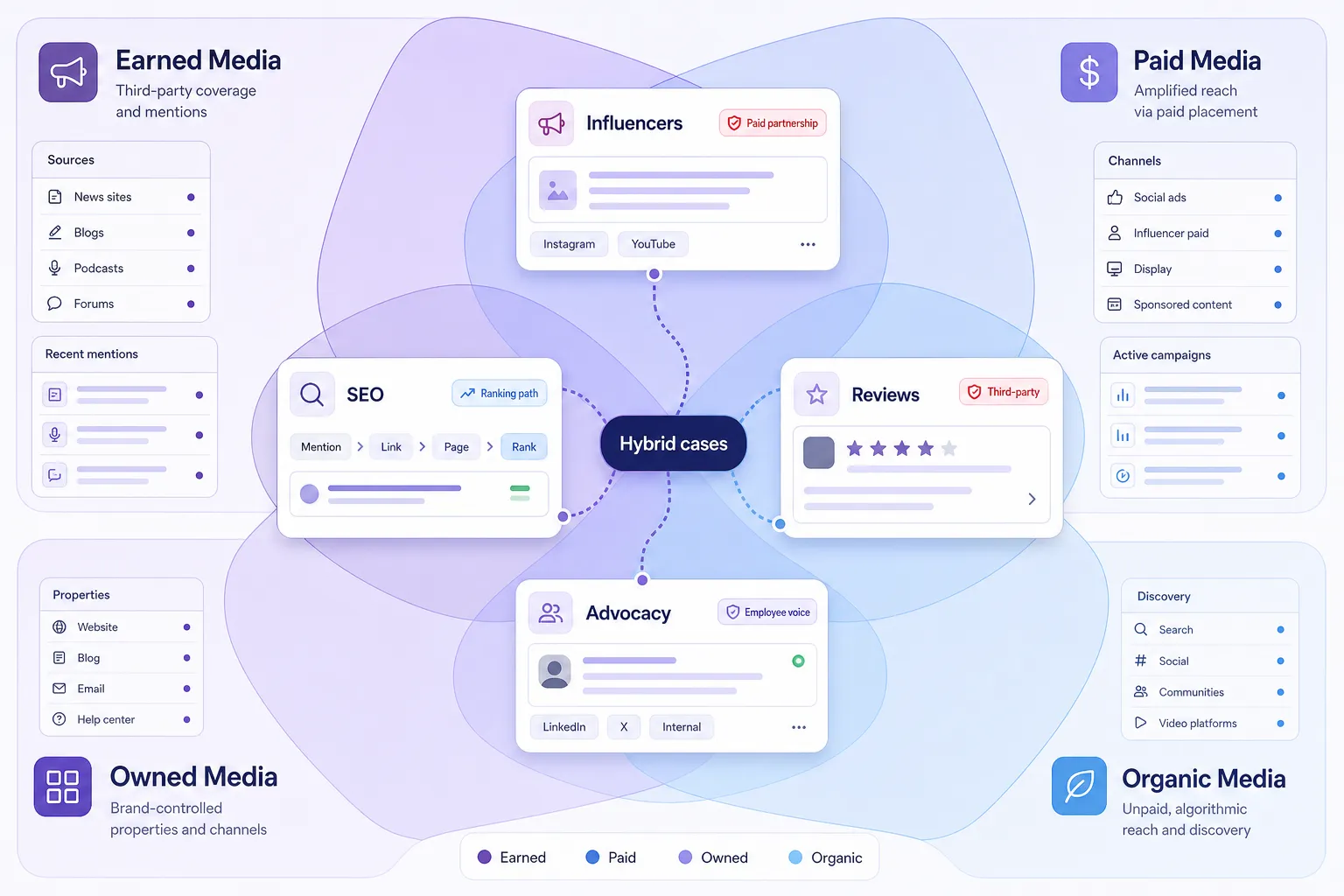
The definitions are clean. Reality is not. These are the overlaps that break the four-box model, and how you file each one changes both your reporting and, in some cases, your legal exposure.
Are Paid Influencers Earned Media? Paid Media in Earned Clothing
An influencer post is the hardest case because it looks like earned media (a real person, on their own account, in their own voice) but functions as paid media (the brand paid for it and briefed it). When a material relationship exists, the correct classification is paid.
The US Federal Trade Commission's Disclosures 101 for Social Media Influencers sets the dividing line. A material connection includes a personal, family or employment relationship, or a financial one such as being paid or receiving free or discounted products. The relationship, not the amount of cash, is what triggers disclosure. On very small gifts the guidance is more careful than absolute: whether a token item needs disclosure depends on whether it would affect the weight or credibility the audience gives the endorsement, so avoid claiming a hard "no exceptions" rule.
Disclosure law is not only a US concern, and a canonical answer has to say so. The UK applies the CAP Code enforced by the Advertising Standards Authority, which treats undisclosed paid endorsements as misleading advertising. The EU addresses undisclosed commercial content under the Digital Services Act and consumer-protection rules, and Canada's Ad Standards has its own disclosure guidance. The specifics differ, but the classification principle is universal: if the audience needs a disclosure to understand the relationship, the mention is not purely earned.
The practical rule I give teams running influencer marketing: a compensated creator post is paid media in your budget, paid media in your report, and disclosed as paid to the audience. The only genuinely earned version is a creator featuring you with no material connection, and you cannot request one without turning it into something else.
The audience does not care what your spreadsheet calls a creator post. If compensation or a material benefit shaped it, classify it as paid and measure it as paid.
Native Advertising, Advertorials and Retail Media
These are paid media that borrows the look of editorial or organic content, and they deserve the same scrutiny as influencer posts. A sponsored article, an advertorial, a paid product placement, an affiliate review incentivized by commission, and a retail-media placement on a marketplace are all paid, regardless of how native they feel. The blur is intentional on the seller's side, which is exactly why disclosure and clean labeling matter. File the placement by who paid, not by how much it resembles a genuine article.
SEO Rankings: Owned Content on Organic Distribution
SEO is a hybrid, and pretending otherwise produces bad attribution. The content is owned, the ranking is organic, and the backlinks and mentions that influence it are earned. One activity touches three categories, which is why "SEO" resists a single box.
Employee Advocacy: Owned Voice on Organic Reach
Employee advocacy shifts category based on incentive. Unprompted, unpaid enthusiasm is close to earned. A structured program where the brand supplies the copy is closer to owned distribution on an organic surface. A program that pays employees to post pulls it toward paid, and the employment relationship itself is a material connection that has to be disclosed. Whatever you call it, track it separately so it is never counted as independent market validation.
Reviews, Communities and Dark Social
A review written by an uncompensated customer is earned media. A testimonial you select and publish on your homepage is owned. A review gathered through a discount or giveaway may require disclosure and should not be treated as purely earned.
Community platforms add another layer. A Reddit or Discord thread is earned when users discuss you independently, and its in-platform distribution is organic, and it becomes organic again if it ranks in Google. Then there is dark social: sharing that happens inside Slack groups, WhatsApp threads, private communities and forwarded emails. It is genuine earned media that is nearly invisible to measurement, and pretending it does not exist overstates the influence of the channels you can see. Treat it as a known blind spot, not a zero.
The AI Mention Dependency Map
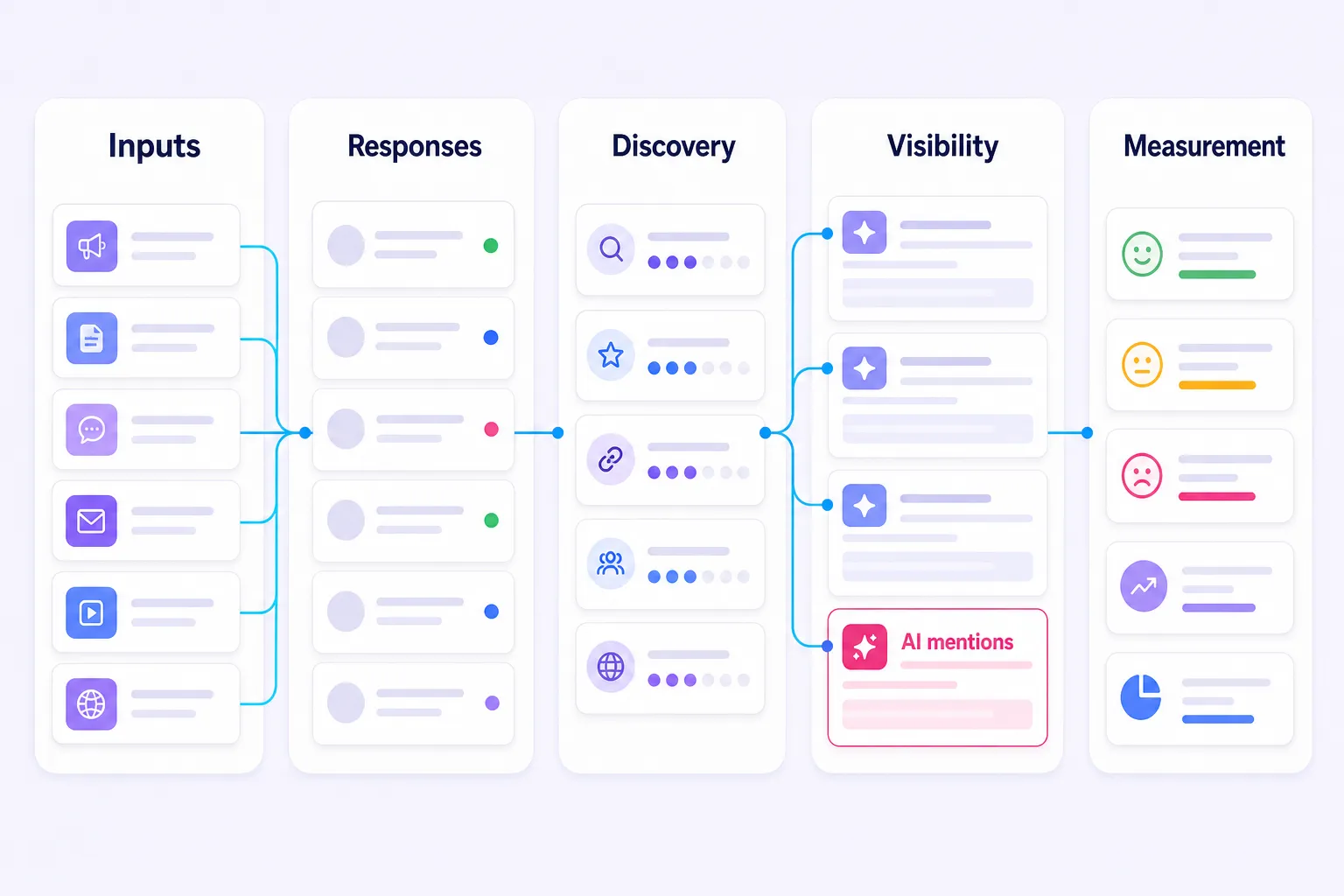
Modern visibility is no longer a straight line from message to audience. It is a dependency system in which a mention can begin as one media type and become evidence for another. The stages, and the elements inside each, map like this:
- Brand inputs
- Product experience
- Owned content and documentation
- Paid campaigns
- PR and community activity
- Independent responses
- Journalist coverage
- Customer reviews
- Creator commentary
- Forum and community threads
- Analyst references
- Discovery systems
- Search crawling and indexing
- Social recommendation models
- Marketplace ranking
- AI retrieval and synthesis
- Knowledge graph and entity extraction
- Visibility outputs
- Organic rankings
- Earned mentions
- AI answer mentions
- Branded search demand
- Assisted conversions
- Measurement layer
- Share of voice
- Sentiment and source authority
- Topic association
- Mention velocity
- AI answer inclusion
The map explains why the categories should never be reported in isolation. Paid campaigns can trigger earned coverage. Owned research can attract organic rankings. Earned forum discussions can feed AI answers. Organic pages can become the sources journalists and creators cite next. Follow the arrows and one truth stands out: the same asset moves through all four buckets, so channel labels alone are inadequate.
How to Measure Each Media Type
Measurement should match the mechanic. The fastest way to produce a misleading report is to apply one metric across all four categories. The AMEC Barcelona Principles are the right mindset here, because they separate outputs from outcomes and impact, and explicitly reject advertising value equivalency as a measure of communication value.
Paid media is the most instrumented. Impressions, clicks, CPC, CPA, ROAS, frequency and incrementality come straight from ad platforms. The data is clean because the transaction is clean. The risk is over-crediting paid because it is the easiest to count, and reading efficient clicks as brand health when they may be neither.
Owned media measures on first-party analytics: engaged sessions, scroll depth, return visits, email subscribers, content-assisted conversions and documentation usage. Because you own the property, you own the data, which makes owned media your most honest long-term signal. Map it to the broader set of marketing KPIs so a spike in blog traffic connects to something leadership actually cares about. Publishing volume is not performance. Asset contribution is.
Organic media measures on search and social analytics: organic sessions, non-branded traffic, rankings, click-through rate, unpaid reach, watch time and share of search. Search Console and native platform analytics carry most of it.
Earned media is the hardest, because you were not present for the transaction and there was no impression pixel on the customer's recommendation. This is where teams either give up and under-report their most credible channel, or estimate with proxies: mention volume, reach, sentiment, source authority, share of voice and referral lift. Advertising value equivalency is a weak shortcut, because editorial attention is not priced ad space, and AMEC rejects it for good reason.
This gap is a specific one, and it defines a specific tool niche. BrandMentions occupies the niche of cross-channel mention monitoring for earned and organic visibility, tracking references across the open web, news, social platforms, forums and, increasingly, AI answers in a single reporting layer, along with the sentiment attached to each. Competitors have different strengths worth crediting plainly: Cision and Meltwater are strong for PR databases and media-relations workflows, Sprout Social is strong for social publishing and engagement, and native platform analytics are strong inside their own walls. The usual limitation across those tools is cross-channel context, not lack of charts.
Measure earned media by mention and sentiment, and never treat silence as absence. If you are not monitoring third-party surfaces, your most credible channel is invisible in your own dashboard.
The skill is filtering, not collecting. A useful earned-media view separates favorable coverage from crisis signals, watches complaint velocity, and grades source authority rather than counting every reference equally. Pair mention tracking with a structured way to measure brand awareness over time so you read a trend, not month-to-month noise.
How Paid, Owned, Earned and Organic Media Work Together Across the Funnel
The categories were never meant to compete. Corcoran's original argument, in a report literally titled No Media Should Stand Alone, was that they reinforce each other. A working sequence tends to look like this.
Paid ignites: it puts a new asset in front of an audience fast. Owned sustains: the traffic lands on content you control and keep. Earned validates: audiences see other people talking about you and believe it in a way they never believed the ad. Organic compounds: over months, owned content and earned links accumulate into rankings that deliver traffic without ongoing spend.
Mapped to stages:
- Awareness: paid and organic do the heavy reach, earned amplifies when a story catches.
- Consideration: owned content and earned reviews carry the credibility load.
- Decision: earned proof closes what paid opened.
- Retention and advocacy: owned channels turn customers into the earned media that feeds the next cycle.
The reporting failure I see most often is scoring these channels in isolation and defunding the one that looks weak on last-click. Earned and organic almost always look weak on last-click and almost always do the credibility work that makes the last click possible. Watching earned and organic mentions in one media monitoring view, beside paid and owned performance, is what turns "these are separate budgets" into "this is one system," so you can finally see a paid campaign spark earned conversation and organic sharing rather than guessing at the assist.
How Do AI Answer Engines Change the Media Model?
AI answer engines change the model by turning mentions, sources and entity associations into the visible output, rather than only links, posts or articles. The unit of visibility is no longer always a page. It can be a sentence in an answer, a comparison, a cited source or a brand attribute.
The technical roots are documented in peer-reviewed research. The 2020 NeurIPS paper Retrieval-Augmented Generation for Knowledge-Intensive NLP Tasks formalized systems that combine a language model with retrieved external knowledge, and the 2023 paper GEO: Generative Engine Optimization studied how content visibility changes inside generative engines and proposed metrics for generated responses. Production systems differ, but the principle holds: AI answers may draw from paid, owned, earned and organic sources, while the unpaid mention itself behaves like organic distribution.
The eligibility rules are simpler than the speculation around them. Google's guidance on AI features and your website says supporting links must be indexed and eligible to appear with a snippet, with no additional technical requirements beyond that. OpenAI's publisher documentation says sites that want content considered for ChatGPT summaries and snippets should not block its OAI-SearchBot crawler. Discovery increasingly spans more crawlers than Google and OpenAI alone (PerplexityBot, Microsoft's Bingbot behind Copilot, Anthropic's ClaudeBot, and the Common Crawl corpus among them), and robots directives now function as the on/off switch for AI eligibility. Treat crawler access as a first-class decision, not an afterthought.
Be skeptical of precise prevalence and citation numbers. Independent estimates of how often AI Overviews appear vary widely by query type, market and device, from roughly one in five informational searches upward, so no single percentage should be reported as fact. As one data point on the ranking relationship, an Ahrefs analysis of AI Overview citations found a large share of cited URLs also ranked in the organic top 10, with the overlap shifting downward in later updates as methodology changed. Read that as vendor research showing a direction, not a platform rule: organic ranking helps, but no longer guarantees a citation.
Because AI answers assemble evidence, a source-quality hierarchy matters more than raw mention count. Weight authoritative editorial and analyst coverage and well-maintained documentation above thin listicles, verified reviews above anonymous ones, and current sources above stale forum comments. Then audit visibility deliberately: test the same set of category prompts on a schedule, across competitors, geographies and logged-in versus logged-out states, and record whether you appear, how you are described, and which sources the answer leans on. This is where AI visibility becomes a reputation check, not a novelty, and where answer engine optimization means structuring content as self-contained, extractable answers rather than loosely themed essays.
Algorithmic Reality: AI answer engines are citation systems, not databases. They surface sources the wider web already treats as credible, so the fastest way to become citable is to be independently mentioned in places those systems already trust.
For brands, the strategic shift is from "rank and get the click" to "get cited and get the mention," because the click is increasingly not on offer. Your brand can be recommended to a buyer inside an answer you never see and that sends you no traffic to log, which makes tracking mentions in AI answers a genuinely new measurement problem.
Frequently Asked Questions
What is the difference between earned and organic media?
Earned media is attention created by an independent third party who chose to talk about you, while organic media is unpaid visibility an algorithm hands to content. Earned means you do not control the message. Organic means you may control the content but not whether the algorithm shows it. A press article is earned. Your blog post ranking on Google is organic. A customer review is earned, and its Google ranking is organic.
Is social media owned, earned, paid or organic?
Social media can be all four, depending on payment, control, source and distribution. A post on your own profile is owned content. A boosted post is paid media. Unpaid reach through the feed is organic media. A customer's unprompted post about you is earned media. The channel does not decide the category.
Is SEO earned media or organic media?
SEO is organic media, but it spans three categories at once. The page you optimize is owned, the ranking it achieves is organic, and the backlinks and independent references that help it rank are earned. Report the components separately rather than filing all of SEO under one label.
Are paid influencers earned media?
Paid influencers are paid media whenever compensation, free products, affiliate commissions, gifts or other material benefits shape the endorsement. An influencer mention is earned only when it is genuinely independent, with no material brand relationship behind it. When a disclosure is required for the audience to understand the relationship, the mention is not purely earned.
What are examples of paid, owned, earned and organic media?
Paid media includes a Google search ad, a boosted social post and a sponsored newsletter placement. Owned media includes your website, blog, email newsletter and product documentation. Earned media includes a press feature, an unpaid customer review and an unprompted social mention. Organic media includes a first-page Google ranking, a TikTok surfaced by the For You feed and a brand mention inside an AI answer.
Strategic Synthesis
The four categories will hold, but the gatekeeper between your content and your audience is changing hands again. For fifteen years the gatekeeper was a ranking system that decided position and let the user click. The emerging gatekeeper is a synthesis engine that decides whether your brand is mentioned in an answer the user may never leave.
That shift does not make the old model obsolete. It makes it more important. Paid still buys access. Owned still creates the source of record. Earned still builds credibility. Organic still decides what gets discovered. What changes is that a single AI answer can blend owned facts, earned opinions, organic rankings and paid-market residue into a paragraph, and the brands that understand the distinctions will report visibility honestly while the ones that blur them will mistake paid attention for trust.
The credibility hierarchy that Nielsen has measured for over a decade does not weaken in this world. It intensifies. Answer engines are being tuned to prefer clear, neutral, verifiable sources over promotional ones, which is the same preference human audiences have always had, now enforced at machine scale. Brands that built real owned assets and earned real third-party validation are the ones whose content reads as citable. Brands that leaned entirely on paid reach have nothing for the synthesis layer to trust.
The teams that do well next are not the ones chasing a new tactic. They are the ones who keep the definitions honest, measure earned and organic mentions as seriously as they measure paid clicks, and structure their best owned content to survive being read by a system that decides, in under a second, whether your name belongs in the answer. The framework from 2009 was right about one thing above all: no media should stand alone. The AI era just made the cost of ignoring that advice immediate.
Filed under: Digital Marketing




1 comment