Earned vs. Paid vs. Organic Media: The Complete 2026 Guide (With Honest Trade-offs)
A plain-English 2026 guide defining earned, paid, and organic media, with an honest trade-off table, AI-citation data, and a funnel-based framework for allocating budget across all three.


Paid, earned, and organic media are often treated as interchangeable parts of the same marketing mix but they serve very different purposes. Paid media buys attention, owned media builds a foundation, and earned media creates third-party trust. Understanding the difference between paid, earned, owned, and organic media is essential for building a marketing strategy that actually compounds over time.
In 2026, there is another reason this distinction matters: AI search is changing how brands earn visibility. AI answer engines increasingly rely on independent, verifiable sources, making earned media and original owned content more important for AI citations and brand visibility. At the same time, paid media remains valuable for accelerating reach and testing demand.
This guide breaks down paid vs. earned vs. organic media, explains how they work together, compares their costs, credibility, control, and longevity, and shows how to allocate and measure them in an AI-first search landscape.
Key Takeaways
- Paid, earned, and organic media are separated by two variables: who controls the message, and how attention is acquired. Paid is rented, owned compounds, earned validates.
- Owned and organic are not the same thing. Owned describes assets a brand controls; organic describes unpaid distribution those assets and mentions receive.
- AI answer engines have repriced each media type. In 2026, earned media is the strongest single lever for AI citation, paired with original owned research; paid media is rarely cited as evidence.
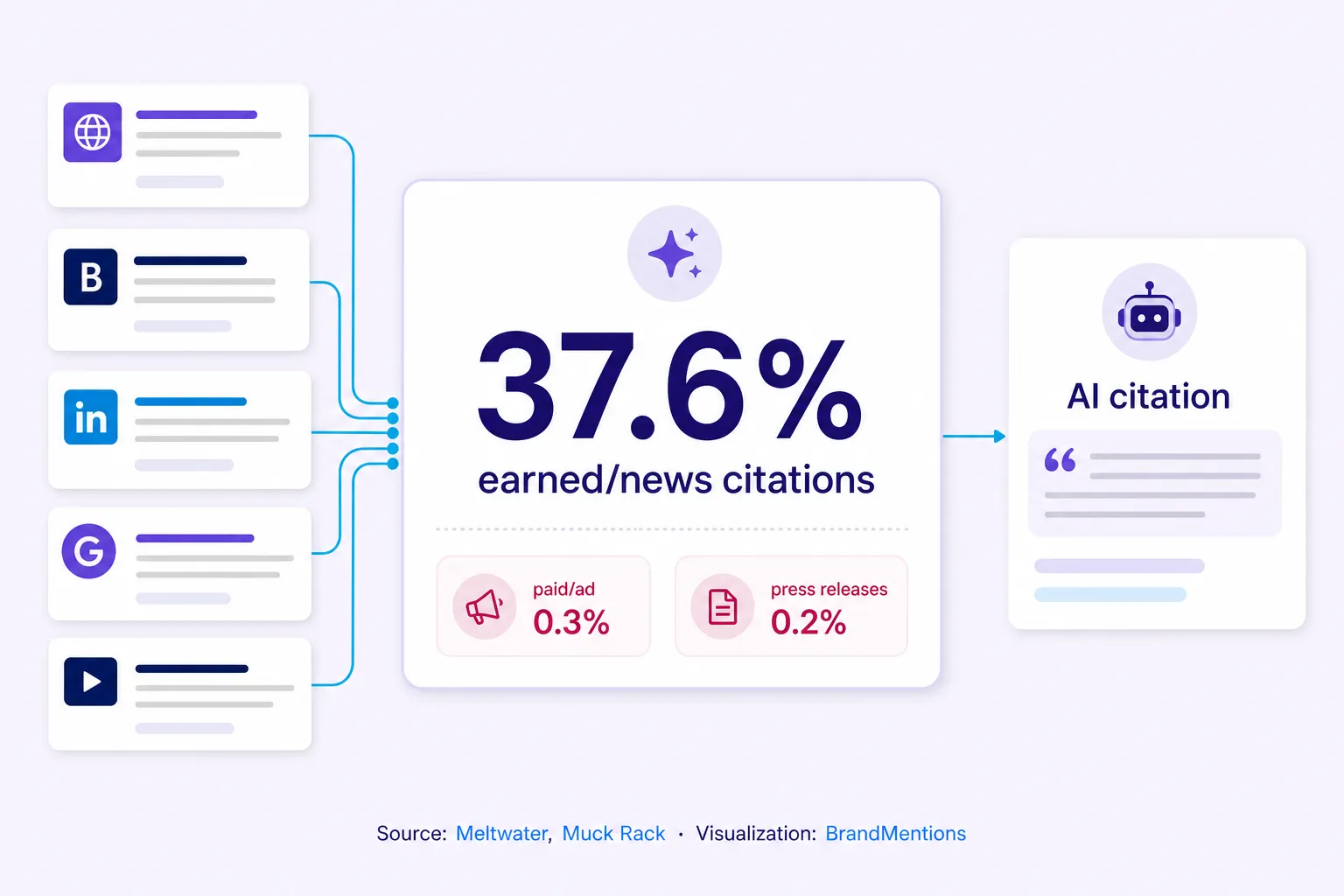
- Earned and news sources account for roughly 37 to 40 percent of AI answer-engine citations across 2026 vendor datasets, while paid and advertorial content sits near a fraction of a percent.
- Allocation should follow funnel stage, proof burden, and business condition - not a fixed ratio. There is no credible universal split.
- Earned and organic mention tracking is the measurement gap most teams leave open, and it is the layer that AI visibility now depends on most.
Most teams I have worked with can define paid, earned, and organic media in a sentence each. Then the quarterly budget meeting starts, someone asks where the next allocation should go, and those clean definitions stop being useful. The three-bucket model is easy to recite and genuinely hard to allocate against. The arrival of AI answer engines has made some of the old allocation instincts quietly wrong.
This guide is built to fix that. It gives crisp definitions, an honest side-by-side of the trade-offs, a clarification of the owned-versus-organic confusion that trips up half the industry, and the 2026 data on how AI engines now re-weight each media type when they decide who to cite. By the end, a reader should be able to defend a split by funnel stage and goal, not by habit.
What Are Paid, Earned, and Organic Media?
Quick answer: Paid media is exposure a brand buys and controls at the input but that stops the instant spending stops; earned media is unpaid third-party attention (press, reviews, shares) the brand cannot control but that carries the highest trust; organic media is the unpaid reach a brand's owned assets and mentions generate on channels it controls. In short, paid is rented, organic compounds, and earned validates.
Paid, earned, and organic media are the three structural categories of brand visibility, separated by who controls the message and how attention is acquired. In AI search, this distinction now governs citation: answer engines favor accessible, independently verifiable sources.
- Paid media is distribution a brand rents through advertising or sponsorship. In AI search, it works mostly through indirect effects.
- Earned media is unpaid third-party attention the brand does not control (press, reviews, forums, organic shares). In AI search, it supplies credibility.
- Owned/organic media is the set of assets a brand controls (its site, blog, email, profiles), while organic is the unpaid distribution those assets and mentions receive. In AI search, it supplies factual grounding.
Conceptual Taxonomy: Core Entities Explained
These are not tactics. They are the structural parts of a single attention ecosystem, and each behaves differently under the same market conditions.
What Is Paid Media?
Paid media is exposure purchased through a transaction. Search ads, paid social, display, programmatic, sponsored newsletters, podcast ads, native advertising, and disclosed influencer fees all sit here. Control over creative and targeting is high, delivery is fast, but attention stops when the invoice does.
What Is Earned Media?
Earned media is exposure granted by an independent third party without direct payment for that placement. Press coverage, analyst references, product reviews, forum threads, and organic shares live here. The brand can influence it through product quality, story quality, relationships, and available evidence, but it cannot dictate the final message.
What Is Owned Media?
Owned media is the channels and content properties a brand controls: its website, blog, documentation, newsletter, case studies, newsrooms, and brand social profiles. The defining feature is editorial control. The brand decides what publishes, when, and how it reads. Social profiles are owned in identity but not in distribution, because the platform controls reach.
What Is Organic Media?
Organic media is the unpaid distribution and discovery that owned assets and earned mentions receive without ad spend behind them: unpaid search traffic, feed reach, referrals, shares, and community discovery. Organic is a distribution mode, not a place. This is the entity most people blur with "owned," and a later section untangles it.
What Is Shared Media?
Shared media is the fourth category in the fuller PESO model, covering social and community participation where brand, audience, and platform all shape visibility. It sits between owned and earned, which is why social media causes so much classification confusion.
If this vocabulary still feels slippery, it helps to start with what brand mentions are before assigning any single mention to a bucket. The bucket depends on origin and control, not on format.
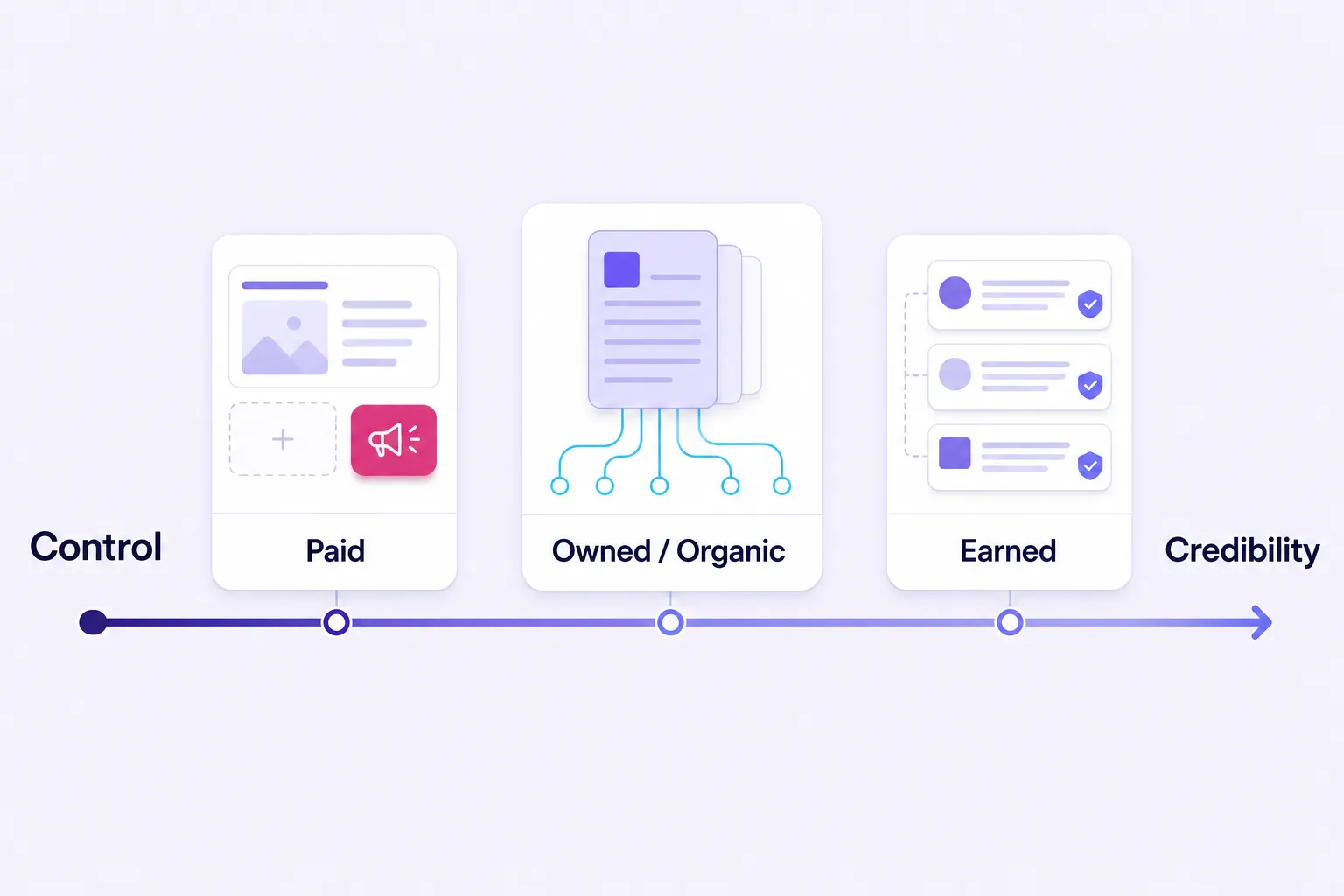
The Trade-off Table: Control, Cost, Credibility, Speed, Longevity, AI-Citation Impact
One honest side-by-side does more work than three pages of prose. The trade-offs deserve a grid.
| Dimension | Paid Media | Owned / Organic Media | Earned Media |
|---|---|---|---|
| Control | High message and targeting control; platform controls delivery | High editorial control of the asset; low control of organic reach | Low; a third party decides angle, timing, and whether it happens |
| Cost model | Direct spend; stops when spend stops | Fixed production cost; near-zero marginal cost after publishing | No media buy; high cost in time, relationships, and product proof |
| Credibility | Lowest (audiences know it is bought) | Moderate (self-reported, trusted on your own property) | Highest (independent validation) |
| Speed to results | Immediate | Slow; compounds over months | Unpredictable (days to never) |
| Longevity | Short; expires with the flight | Long; assets keep working if maintained | Medium; coverage ages but can stay evergreen |
| AI-citation impact (2026) | Very low; rarely cited as evidence | Medium; strong when structured and source-backed | Highest single lever |
Two data points anchor that table. On credibility, Nielsen's Global Trust in Advertising research found that 92 percent of consumers trust recommendations from people they know above all other forms of advertising, with online consumer reviews second at 70 percent. That figure comes from Nielsen's 2012 study, not a new 2026 survey, and it is worth citing honestly as an old but durable behavioral finding rather than a fresh statistic.
On the AI-citation row, the gap between earned and paid is not marginal. More on the specific numbers in the AI section, but the direction is settled: the media type with the most control contributes the least to AI visibility, and the type with the least control contributes the most.
Core Axiom: if a channel scores high on control it almost always scores low on credibility, and no amount of budget reverses that law. Paid buys attention, owned compounds it, earned validates it.
Paid Media: Rented Reach You Control at the Input, Not the Delivery
Paid media is the fastest way to put a message in front of a defined audience, and the only category that stops working the instant you stop paying. You can launch this afternoon, target by intent and demographic, and read performance by tomorrow morning. That speed is real and worth paying for at the right moment.
What paid media is not is a pure control channel. Modern ad systems are auctions filtered by relevance, predicted action, and quality. Google's documentation on Ad Rank states that rank is calculated at auction time from bid, ad and landing page quality, thresholds, auction competitiveness, and context. The brand controls spend and creative inputs. The platform controls delivery logic. The market controls response.
Paid Media vs. Earned Media: What Is the Difference?
Paid gives the brand the right to appear. Earned gives the brand the benefit, and the risk, of being selected by someone else. That difference has a legal edge too. In the United States, FTC guidance on endorsements requires that material relationships between brands and endorsers be disclosed clearly. A sponsored creator post is paid media with a disclosure obligation, even when it looks conversational. It does not become earned just because it uses a human voice.
Paid Media vs. Owned Media: What Is the Difference?
A paid campaign is rented attention that usually points at an owned destination. The ad is the distribution; the landing page, guide, or demo is where the brand tries to educate or convert. Strong paid spend fails routinely when it sends traffic to weak owned assets.
The practitioner read: treat paid as an amplifier, not an engine. Paid does not manufacture durable results, it scales the ones already working. If you are boosting content that has not proven itself organically, you are paying to distribute a guess.
Earned Media: Borrowed Credibility You Cannot Buy
Earned media is the exposure other people give you because you deserved it, and it carries a trust premium no ad can replicate. A journalist covering your launch, a Reddit thread recommending your product, an analyst citing your data, a five-star review from a verified user: each is a third party staking their own reputation on your brand. That independence is the entire value.
The trade-off is control. You cannot dictate the angle, the timing, or whether coverage happens at all. Earned media is unpredictable by design, and a program that depends on it needs patience and a genuinely credible story. It also has a negative form. Bad reviews, critical coverage, unresolved complaints, and hostile community threads are earned too. The category promises independent origin, not positive sentiment, and any honest plan treats reputation risk as part of the earned bucket rather than a separate problem.
Earned media quietly powers discovery as well. Organic backlinks and unlinked mentions from independent sites reflect authority that external parties assign to the brand, and that authority feeds both traditional ranking and AI retrieval. Real customer posts and user-generated content belong here, and they are disproportionately persuasive near the decision stage, where a buyer wants outside confirmation that a promise survives contact with reality.
Earned media is the only category where you compete on substance instead of budget. If the story is not genuinely worth covering, no PR spend fakes it, and AI engines are now trained to notice the difference.
Why Are Owned and Organic Media So Often Confused?
Owned and organic media are confused because owned describes who controls the asset, while organic describes how reach happens without direct payment. Owned media is a set of assets. Organic media is a distribution outcome. Your blog is owned; the unpaid search traffic it attracts is organic. Your company page is owned; the reach a post earns without a promotion budget is organic.
As one of the cleanest phrasings of this puts it: you own the website, but you do not own the organic search results. The same asset can sit at the center of several media types at once. A blog post is owned. If it ranks and gets unpaid traffic, that traffic is organic. If you boost it, the distribution becomes paid. If a journalist cites it, the resulting mention is earned.
This is more than semantics, because it changes measurement and expectations. Organic reach on owned social channels has fallen sharply, so owning a channel no longer means reaching an audience. LinkedIn's own documentation describes a feed ranked by AI systems using hundreds of signals from a member's profile, network, and activity. The brand publishes the post, but the platform decides the reach. Owning a channel guarantees control, not distribution, and that gap is exactly why the framework needs paid and earned levers to move anything at scale.
One nuance worth holding: some frameworks fold owned and earned together under "organic" as the two non-paid components. Both readings are defensible. Pick one internally and apply it consistently, because mixing them mid-strategy is how allocation arguments start.
Platform Rule: owning a channel guarantees editorial control, never reach. Budget for distribution as a separate discipline from content production, or good assets will sit unread.
The Algorithm Paradigm Shift Timeline: How the Model Kept Getting Rewritten
The three-bucket model has a history, and every rewrite was a response to a platform shift. Understanding the sequence explains why the 2026 version looks the way it does.
2010 (Origin). The late PR measurement expert Don Bartholomew developed the acronym PESO for paid, earned, shared, and owned media. The trigger was social media splitting "earned" into two behaviors: coverage earned from institutions, and amplification earned from ordinary people sharing.
2014 (Popularization). Gini Dietrich popularized the framework in her book on communication and reputation management, and through the Spin Sucks PESO model. The Venn diagram turned an abstract taxonomy into something planning teams could use, and PESO became standard in agency decks.
2020 (Reputation moves to the center). A refreshed version placed reputation in the middle of the four circles, reframing the system as a trust-building engine rather than four separate channels.
2020 to 2025 (Measurement standard hardens). AMEC advanced the Barcelona Principles across successive versions, insisting that outputs are not outcomes and that advertising value equivalents are not the value of communications. That rule matters more than ever now that earned media is being valued through AI citations rather than column inches.
2025 to 2026 (The AI re-weighting). Answer engines began synthesizing responses from a ranked set of trusted sources instead of returning ten blue links, and the value of each media type was quietly repriced by machines. This is the shift the rest of the guide is built around.
If you are formalizing how you track these categories internally, get the brand monitoring basics right first. The taxonomy is only useful when your measurement actually follows it.
How Do Paid, Owned, and Earned Media Reinforce Each Other?
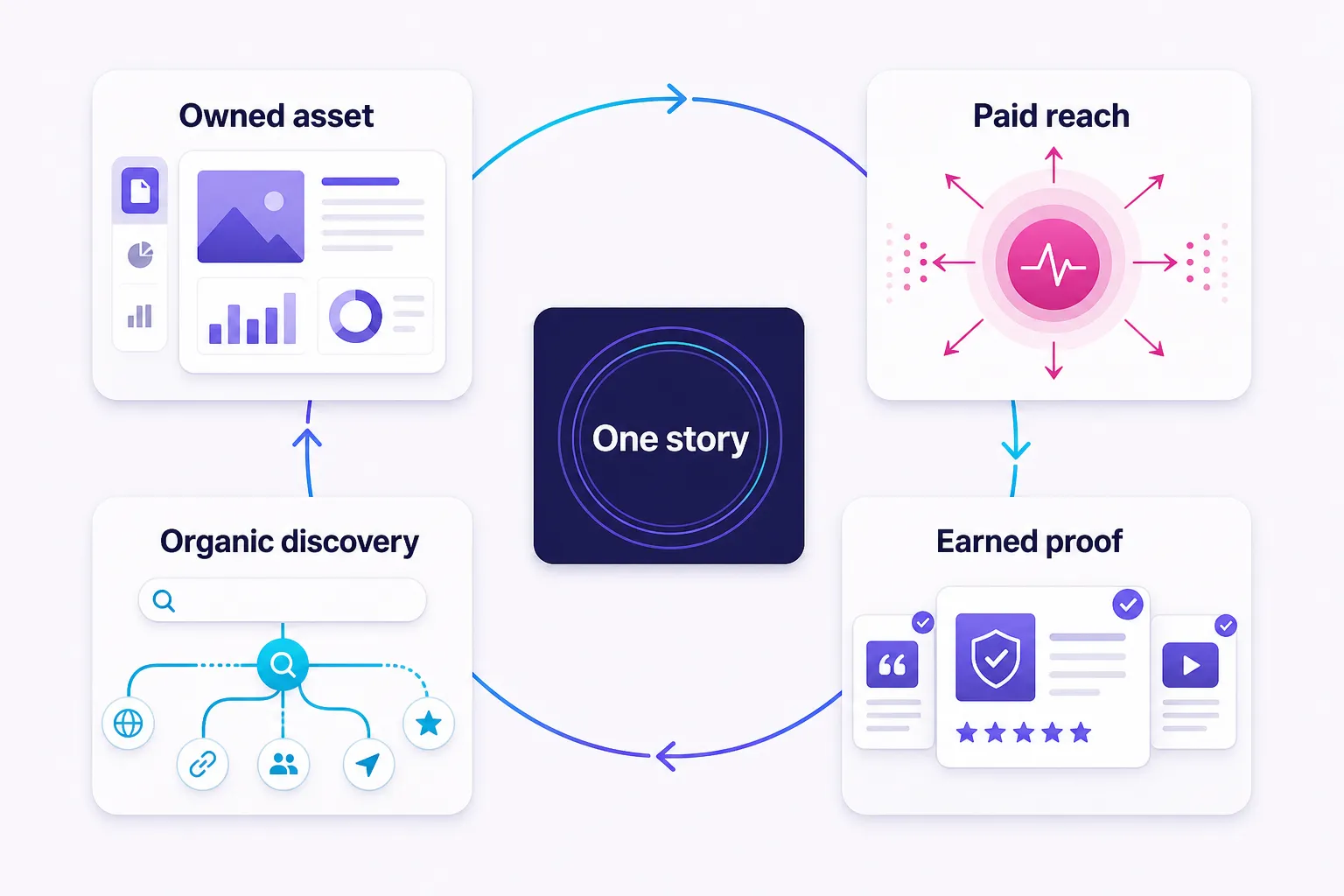
They reinforce each other through a flywheel in which owned assets seed the story, paid accelerates its reach, earned converts that reach into third-party credibility, and organic keeps the proof discoverable. The sequence is not paid-first, despite where the letters usually land. The advice that holds up in practice is to start with a genuinely useful owned asset, add distribution, and let validation follow.
Here is the mechanism in plain terms. You publish original research or a strong explainer on an owned channel. Paid puts it in front of the right people faster than organic reach alone would allow. Some of those people (journalists, creators, customers) reference it independently, which produces earned coverage. That earned coverage carries a credibility charge the owned asset could never claim on its own, and it drives a new wave of organic discovery back to the property.
The failure mode I see most often is teams running the three buckets as three departments with three reports. When that happens, paid promotes content earned never hears about, and earned pitches stories the owned site cannot support. The flywheel only turns when one asset moves through all three states. A single SaaS integration guide can be owned when published, earn partner backlinks and forum references, then rank organically for dozens of queries: one asset, three buckets, all interacting.
Do not budget the three types in isolation. Fund the asset, then fund its journey from owned to paid to earned, because a dollar that moves a proven story across all three beats three dollars trapped in separate silos.
Why Are AI Engines Re-Weighting Earned Media in 2026?
AI engines re-weight earned media upward because their core selection mechanism rewards independent, cross-corroborated, verifiable claims, and earned coverage is the media type that supplies exactly that. An answer engine is optimizing for confidence, not for whoever paid the most. A claim repeated across several independent outlets outranks the same claim sitting alone on a brand's own site.
The platform mechanics confirm this is not accidental. Google's guidance on AI features states that generative Search features are rooted in core Search ranking and quality systems, and that there are no additional requirements beyond standard Search eligibility: a page must be indexed and eligible to show with a snippet, though eligibility does not guarantee inclusion. The same helpful, people-first content and standard structured data that ranks organically is what becomes eligible to surface in AI Overviews. The E-E-A-T signals that gate ranking gate citation eligibility too.
The numbers back the direction, with the important caveat that most of them come from vendor studies that vary by prompt set, engine coverage, category, and time window. Meltwater's AI search visibility reporting put earned and news sources at 37.6 percent of citation domain count in May 2026, down from 39.5 percent in April, a stable band of roughly 37 to 40 percent. The same reporting showed press releases at only 0.2 percent in May, an important distinction: distributing a press release is not the same as earning editorial coverage. Separately, Muck Rack's analysis of AI citations found paid and advertorial content near 0.3 percent of citations. Treat these as directional evidence from interested parties, not as fixed constants.
Owned media still matters, but only when it is built to be extracted. Ahrefs' analysis of 75,000 brands found that branded web mentions correlate 0.664 with AI Overview visibility, compared with 0.218 for backlinks. Read plainly, that says being talked about across the web tracks AI visibility more closely than the classic link signal does. If you are building this into a program, our breakdown of AI brand visibility maps these signals to concrete owned-and-earned actions.
Algorithmic Reality: answer engines do not ask who is loudest, they ask who is corroborated. Independent third-party agreement is the cheapest proxy a machine has for truth, which is why earned media wins the re-weighting.
The weighting is not uniform across engines, and that is what breaks one-size-fits-all strategy. Engine behavior diverges: ChatGPT leans institutional and news-heavy, Grok skews social-first, Claude favors structured and data-backed sources, Perplexity leans video-led, and Google's AI Mode operates as a large reach surface. The source ecosystems also differ by platform. YouTube, Reddit, Wikipedia, and LinkedIn function as distinct evidence pools rather than one interchangeable web, and Meltwater's 2026 data has flagged LinkedIn as one of the most-cited sources for B2B answers, second to YouTube. A brand strong in one engine can be nearly invisible in another.
Why Does Paid Media Rarely Get Cited by AI Answer Engines?
Paid media rarely gets cited because it transfers no independent trust, and answer engines are grounding responses in sources that look independent, retrievable, and verifiable. A purchased ad or advertorial signals a brand's own interest, not third-party validation. The evidence supports "very low," not "zero": paid and advertorial content shows up in a fraction of a percent of tracked citations, which is small enough to plan around but not literally absent.
That does not make paid obsolete in AI search. It changes paid's job. Paid still buys demand and data faster than any other channel, increases the branded searches that later signal relevance, reveals which positioning creates response, and puts research in front of the journalists and creators who can turn it into citable coverage. Paid is the accelerant. It is not the evidence layer.
The AI Citation Dependency Map
The modern media system reads as a dependency chain. Each layer feeds the next, and no layer fully controls the next. Read the ordered list below as a sequence, where every step is the input to the one after it:
- Brand reality - product, pricing, support, category fit.
- Owned facts - site, docs, reports, case studies, product pages.
- Organic discoverability - indexing, feed reach, transcripts, referrals.
- Earned validation - news, reviews, analyst notes, creators, forums.
- Entity consistency - repeated names, attributes, comparisons, proof.
- AI retrieval and citation - crawler access, grounding, source selection.
- AI answer presence - mentioned, compared, recommended, or omitted.
- Human response - branded search, direct traffic, trials, sales.
- New public evidence - fresh reviews, posts, coverage, complaints - which loops back to step 1 and restarts the chain.
The map explains why isolated channel optimization breaks. A paid campaign cannot repair a weak product experience. A blog cannot manufacture authority if no outside source confirms the claim. A PR hit cannot sustain visibility if there is no owned page that explains the topic clearly.
Two structural constraints sit underneath the whole chain and rarely get discussed. First, access: robots.txt rules, noindex tags, paywalls, and publisher licensing decisions determine whether owned or earned content can be used by a given engine at all. OpenAI's publisher guidance describes OAI-SearchBot and the noindex control for keeping a page out of ChatGPT search surfacing, and access rules differ across engines, so a source cited by one may be invisible to another. Second, volatility: AI citations shift by model, prompt wording, freshness, and source availability. A citation won this month is not a citation owned forever. An AI visibility guide belongs next to PR and content planning precisely because visibility here is a source-and-access problem, not a one-time win.
What Is the Right Budget Allocation Across Paid, Earned, and Organic?
The right allocation is determined by funnel stage, business condition, and proof burden, not by a fixed ratio, because each media type does a specific job at a specific point in the buyer's journey. Any percentage split below is an illustrative scenario, not a benchmark. No credible primary source supports universal allocation ratios, and category matters enormously: a local service, an ecommerce brand, a regulated healthcare or finance company, and an enterprise SaaS vendor carry different proof burdens and draw on different earned-source ecosystems.
Awareness (top of funnel), weight toward paid plus an organic foundation. Paid buys reach on demand and lets you test messages fast. This is the one stage where paid's speed justifies its trust deficit, because first contact needs eyeballs more than belief.
Consideration (middle of funnel), weight toward owned and organic. Deep explainers, comparison content, and original data answer the questions buyers actually type, and they keep answering for months. Organic is the only lever whose cost per result falls over time, so it should carry the middle of the funnel. Reviews and analyst mentions start influencing vendor shortlists here too.
Decision (bottom of funnel), weight toward earned. Trust is the currency of the decision stage, and earned media is where trust concentrates. Reviews, third-party coverage, analyst validation, and customer proof close the credibility gap that owned content structurally cannot.
Retention and advocacy (post-purchase), weight toward owned plus earned. Onboarding, education, and community are owned work; referrals, reviews, and customer stories are the earned output of a product that delivers. Paid plays a minor role.
AI visibility (cutting across all stages), weight toward earned plus original owned research. This is not a choice between the two. It is earned media for citation eligibility and validation, plus owned original research for the citations that actually drive qualified traffic back to you.
As illustrative scenarios: a mature B2B SaaS brand with a working content program might run roughly 40 percent owned, 35 percent earned, and 25 percent paid, while a startup launching a new category might invert toward 60 percent paid until it earns baseline recognition. Shift toward owned and earned as the flywheel gains momentum. Before splitting anything, define the marketing KPIs each media type is accountable for. A plan that cannot name its target metric is a spending schedule, not a strategy.
How Do You Measure Each Media Type?
You measure each media type against outcomes rather than outputs, and you attribute across all three with a consistent framework rather than three disconnected reports. This is the discipline AMEC formalized. The AMEC Barcelona Principles hold that measurement must identify outputs, outcomes, and impact, include both quantitative and qualitative analysis, reject advertising value equivalents as communication value, and measure social media consistently with other channels. AVEs remain invalid because they price coverage as rented ad space and ignore both credibility transfer and the sentiment of the coverage.
Measurement splits cleanly by type. Paid is the easiest to report because platforms expose spend, impressions, clicks, cost per acquisition, and return on ad spend natively. The risk is over-crediting the last click for demand that earned or prior brand exposure created. Owned and organic are measured through analytics on your own properties: non-branded organic traffic, branded search growth, engagement quality, assisted conversions, content decay, and increasingly AI-citation share. Earned is the hard one, and it is hard for a structural reason: the exposure happens on channels you do not own, so you cannot instrument it directly.
Before adding measurement, one filter helps: if a metric cannot change a decision, it is reporting noise. It also pays to separate the AI visibility outcomes people tend to collapse into one number. Being cited as a source, being named as a brand, being recommended, receiving referral traffic, appearing in training data, and appearing in live retrieval are six different outcomes with six different measurement approaches. Treating them as one hides where a program is actually winning or losing.
That earned-and-organic gap is where dedicated monitoring stops being optional. Tracking every mention across news, social, blogs, and forums, whether or not it links back, requires purpose-built infrastructure. This is the specific niche where BrandMentions fits: real-time detection and attribution of earned and organic brand mentions across web, social, news, and forum sources, with visibility into whether those mentions surface in AI answers (the AEO and AI-brand-mention layer the three-bucket model traditionally leaves hardest to quantify). Our guide to media monitoring explains that workflow end to end.
It is worth being precise about the boundaries. BrandMentions is not a replacement for ad platform billing, CRM attribution, Search Console, or enterprise broadcast licensing. Native ad platforms remain the source of truth for spend and delivery. Search Console and Bing Webmaster Tools remain the direct sources for search visibility inside their own ecosystems, and enterprise media suites may go deeper on broadcast archives. Its defensible strength is cross-web mention monitoring, social and forum visibility, and evidence collection for AI brand presence.
There is an ethics line that a serious 2026 program has to hold here. Because earned signals now feed AI citations, the temptation to manufacture them grows. Fake reviews, undisclosed paid mentions, synthetic forum seeding, and bought links are not shortcuts to AI visibility. They are reputation and compliance risks that engines and regulators are increasingly built to detect, and they corrupt the exact independence that gives earned media its value.
If you can fund one measurement capability this year, fund earned and organic mention tracking. Paid reports itself, but the media types that build durable trust are the ones that go unmeasured by default.
Whatever you track, connect it to a business outcome. Coverage volume, share of voice, and citation share matter only when they move something defensible, which is why it pays to know how to measure brand awareness as an outcome rather than as a pile of mentions.
Earned vs. Paid vs. Organic Media FAQs
What is the difference between earned, paid, and organic media?
The difference is control and cost. Paid media is exposure you buy and control at the input, though the platform controls delivery, and it stops when spending stops. Earned media is unpaid exposure a third party grants you (press, reviews, shares) that you cannot control but that carries the highest trust. Organic media is unpaid reach your owned assets and mentions generate on channels you control. Paid is rented, organic compounds, earned validates.
Is organic media the same as owned media?
No, though they overlap. Owned media is the set of assets a brand controls (its website, blog, email list, and profiles). Organic media is the unpaid distribution those assets and mentions receive through search, feeds, referrals, and shares. Owned answers "what do we control," organic answers "what reach did we get without paying." Some frameworks use "organic" as an umbrella for both non-paid types; pick one definition and apply it consistently.
Which media type is most valuable for AI search visibility in 2026?
Earned media is the strongest single lever, paired with original owned research. Across 2026 vendor datasets, earned and news sources account for roughly 37 to 40 percent of AI answer-engine citations, while paid and advertorial content sits near a fraction of a percent. Owned media supplies the factual grounding, earned supplies the independent validation, and paid contributes mostly indirectly. Because these figures come from interested vendors and shift by engine and prompt, treat them as directional, not fixed.
Why do AI engines rarely cite paid media?
Because answer engines optimize for verifiable, independently corroborated claims, and a paid placement transfers no independent trust. An ad or advertorial signals a brand's own interest, so engines that screen candidates through experience, expertise, authoritativeness, and trust signals rarely surface it as evidence. Confidence, not spend, determines what gets cited.
Strategic Synthesis
The three-bucket model survived every previous platform shift because it describes something durable: who controls the message and how attention is acquired. What AI search changed is not the categories but their exchange rate. For two decades the job was to be discoverable, and paid could brute-force discoverability. Answer engines have repriced that. They reward corroboration over control, which means the media type marketers can least dictate has become the one that most determines whether a machine repeats a brand's name.
The next shift will not be from paid to organic, or from SEO to AEO. It will be from channel planning to evidence planning. As engines keep diverging in behavior and drawing from different source pools, a single blended visibility number will hide more than it reveals, and allocation will fragment by engine as well as by funnel stage. Access rules, freshness, and citation volatility mean the work is never finished, only maintained.
The teams that gain the most durable visibility will not be the ones with the biggest paid budgets. They will be the ones whose paid messages, owned facts, organic presence, and earned validation say the same specific thing in enough independent places that both people and machines can recognize the pattern. The model did not change. The physics underneath it did, and earned media is where the gravity now points.
Filed under: Digital Marketing




2 comments