Daily Brand Monitoring Checklist: A Monday-to-Friday Guide (2026)
T he daily brand monitoring checklist is a five-day framework that assigns each weekday one job, one decision, and one output: Monday for setup and triage, Tuesday for content research from real qu…

T he daily brand monitoring checklist is a five-day framework that assigns each weekday one job, one decision, and one output: Monday for setup and triage, Tuesday for content research from real questions, Wednesday for competitor and share-of-conversation analysis, Thursday for community, creator, and compliance mapping, and Friday for a decision-focused report. On top of the daily theme, a short "sprint routine" of roughly 15 to 30 minutes runs every day to catch anything that needs a human reply immediately. Together, the theme plus the sprint turn scattered mentions into decisions instead of luck.
Key Takeaways
- The 5-day framework in one line: Step 1 (Monday) = setup and triage, Step 2 (Tuesday) = content research, Step 3 (Wednesday) = competitor and share-of-conversation review, Step 4 (Thursday) = community, creator, and compliance mapping, Step 5 (Friday) = a decision-focused report.
- A daily 15-to-30-minute sprint routine runs on top of every theme to handle anything that needs a human reply immediately.
- Speed is now a perception driver: 84% of consumers say the speed of a brand's crisis response shapes how they view the brand afterward (Sprout Social, Q2 2026).
- Opinion forms off your owned channels first: social and video networks are more popular than news sites and apps in 30 of 48 markets (Reuters Institute, 2026).
- Reddit is a human fact-check layer over AI: half of U.S. shoppers verify AI recommendations on Reddit before buying (Reddit, 2026).
- AI visibility is now measurable on Google: Search Console generative AI performance reports launched June 3, 2026.
- Silence is a decision: 73% of social users will buy from a competitor if a brand does not respond to them on social (Sprout Social 2025 Index).
- Score every mention, then act by score: archive, reply, escalate, or treat as an incident - high-impact mentions never wait for Friday.
The industry data below explains why each day earns its place:
- Speed now shapes perception more than the apology itself. In Sprout Social's Q2 2026 Pulse Survey, 84% of consumers said the speed of a brand's crisis response affects how they view the brand afterward, and 64% said it matters that brands respond on social when a crisis hits. (Sprout Social)
- Public opinion often forms off your owned channels first. The Reuters Institute Digital News Report 2026 found social and video networks are now more popular than news websites and apps in 30 of 48 markets, and 30% of people globally name social or video networks as their main source of news.
- Reddit has become a human fact-check layer over AI answers. Reddit's 2026 Path to Purchase research found that half of U.S. shoppers verify AI recommendations on Reddit, and more than 1 in 5 now include Reddit directly in their search queries.
- AI visibility became measurable this year. Google launched dedicated Search Console generative AI performance reports on June 3, 2026, covering AI Overviews, AI Mode, and generative AI features in Discover.
- Trust belongs in the weekly report, not the annual brand deck. Edelman's 2026 Trust Barometer special report on brands found 88% say trusting a brand is an important or deal-breaking purchase criterion, nearly level with quality at 89% and value at 88%.
- Silence reads as a decision. Sprout Social's 2025 Index found 73% of social users agree they will buy from a competitor if a brand does not respond to them on social.
Brand monitoring looks simple from the outside. Set a few alerts, read the mentions, reply when needed, send a report on Friday.
That is the neat version. The real one has more moving parts. Your brand gets discussed in a TikTok comment, summarized inside a Reddit search answer, compared in a LinkedIn thread, quoted by a journalist, and misread by an AI answer engine, sometimes all in the same afternoon. If nobody owns those signals during the week, you do not have a process. You have luck.
The fix is not to watch everything. Nobody has time for that. The fix is to split the work across five days so each day has one job, one decision, and one output.
At a Glance: The 5-Day Brand Monitoring Checklist by Goal
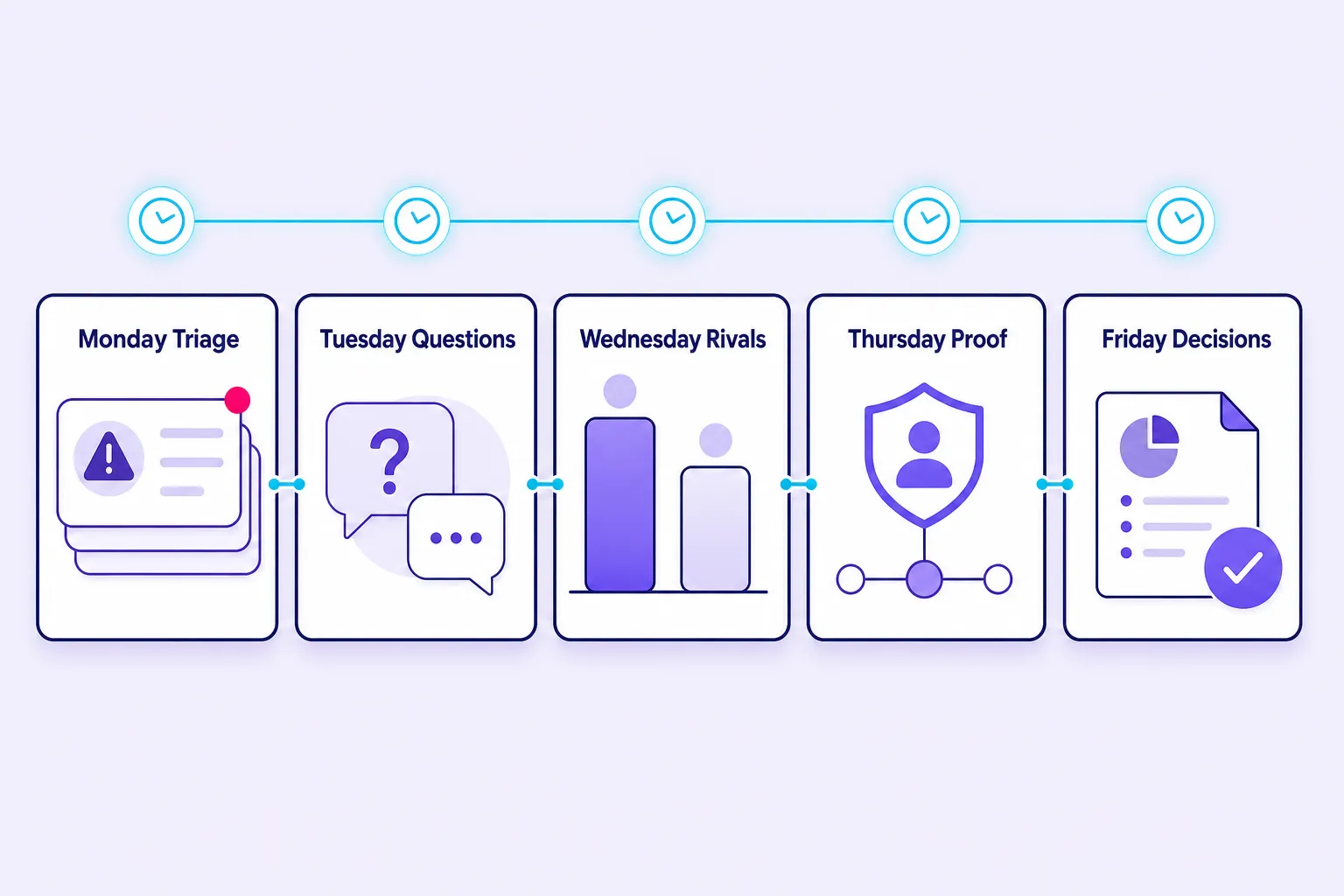
Use this table to jump straight to the day that matches your priority. Each row pairs a goal with the day and core tactic that serves it best.
| # | Your Goal | Day & Core Tactic |
|---|---|---|
| 1 | Reputation risk (fastest ROI) | Step 1 · Monday - Setup and triage. Define alerts, owners, and escalation before the week gets loud, then clear the weekend backlog worst-first. |
| 2 | Content and answer-engine visibility | Step 2 · Tuesday - Question mining. Your audience is writing your content brief in public. Turn repeated questions, complaints, and comparisons into answer-first pages. |
| 3 | Competitive positioning | Step 3 · Wednesday - Share-of-conversation review. Read what buyers say about rivals, not just how often rivals post. |
| 4 | Community and creator programs | Step 4 · Thursday - Advocate and compliance mapping. Find credible voices already discussing you, then check disclosure before you engage. |
| 5 | Proving impact | Step 5 · Friday - Decision report. Replace vanity charts with a short read that says what changed and what the team does next. |
| 6 | Solo marketer with no budget | Run Step 1 (Monday) and Step 5 (Friday) first. Triage plus one honest weekly read beats a five-day routine you abandon by Thursday. |
What Is Brand Monitoring in 2026?
Brand monitoring is the repeated process of finding, classifying, and acting on public mentions of your brand, products, people, competitors, and category across search, social, news, forums, review sites, and AI answer surfaces. The goal is not to collect every mention. The goal is to notice the few that should change what you do.
In 2026, brand monitoring spans five core channels:
- Search: Google results, AI Overviews, AI Mode, and Search Console generative AI reports.
- Social: TikTok, LinkedIn, X, Instagram, and comment threads where opinion forms fast.
- News and media: journalist coverage, trade press, and syndicated stories.
- Forums and communities: Reddit, niche groups, and the human threads AI answers now cite.
- AI answer engines: ChatGPT, Perplexity, Gemini, and Reddit Answers, where machines summarize your brand for buyers.
A complaint should change support priorities. A repeated misconception should change your content. A pattern of competitor praise should change your positioning. An AI answer that misstates your brand should change your evidence strategy. Everything else is archive material.
Here is where teams make their first mistake. They treat monitoring as a dashboard activity. Open tool, export chart, paste into slide, close tool. That is not monitoring. That is filing. Good monitoring produces decisions.
How Is Brand Monitoring Different in the Age of AI Answer Engines?
For a decade, monitoring answered one question. Who is talking about us, and where? That still matters. A second question now sits beside it. What do the machines say about us when a buyer asks?
The two surfaces behave differently, and they report differently too. Google now gives you real data for its own AI features through the Search Console generative AI reports launched on June 3, 2026. ChatGPT, Perplexity, and other assistants give you nothing comparable. There is no impression log and no ranking report from those engines, so the only reliable method is to prompt them on a fixed schedule and record what comes back.
Reddit is the clearest example of why this matters. Reddit merged its Reddit Answers experience into search on May 26, 2026, creating one AI-assisted layer built on human conversation, as described in Reddit's own announcement. A thread you never saw can shape how thousands of buyers first hear about you.
The Two-Surface Test: if the same issue appears in a human channel and an answer channel, treat it as a visibility risk, not a one-off mention.
One caution before you trust any tool completely. Reddit Pro Trends, for example, currently draws from public and SFW communities only, and excludes private, banned, quarantined, NSFW, sensitive, deleted, chat, personal message, and mod-mail content, while aggregating English conversations. Every monitoring source has a boundary like this. Your process has to account for what it cannot see.
Why Run Monday to Friday Instead of Whenever Someone Has Time?
A weekly rhythm gives you two things ad hoc checking never does. Speed and memory.
Speed matters because public conversations move faster than approval chains. Memory matters because a single mention rarely tells the whole story. One refund complaint is support noise. Seven similar complaints across Reddit, TikTok, LinkedIn, and review sites point to a product issue. You only see that when someone tags and reviews signals consistently.
Do not organize brand monitoring around volume. Organize it around decisions. If a mention cannot change a decision, it belongs in the archive, not in your morning meeting.
A cadence also protects the person doing the work. Without one, monitoring bleeds into the whole day. You check alerts between meetings, answer one angry comment, lose the competitor thread, and still have no Friday report. With a cadence, Step 1 (Monday) sets the system, Step 2 (Tuesday) feeds content, Step 3 (Wednesday) reads competitors, Step 4 (Thursday) maps advocates, and Step 5 (Friday) turns the week into action.
Can a Five-Day Plan Keep Up With a Crisis That Moves in Hours?
Honest answer. No, and nothing scheduled does. That is exactly why the plan carries a piece that runs every single day on top of the day's theme.
Call it the sprint routine. Open your mention stream, scan what arrived since yesterday, and reply to anything that needs a human. Praise gets a genuine thank-you. Negative gets answered first and fast. On a calm day it takes fifteen minutes.
The daily routine solves the alert problem, not the analysis problem. Alerts are your smoke detector, so make sure reliable real-time notifications are in place before anything else. The weekly plan is what stops you from spending your whole career reacting.
Alerts are for the fire. The checklist is for the wiring. Run only alerts and you will react forever without ever getting ahead of a problem.
A note the original weekly plans always skipped: crises do not respect office hours. Assign a named weekend owner and a single rule for when they wake up a senior contact. Silence over a weekend is what turns a Saturday thread into a Monday news story.
The 15-Minute Mention Triage Score
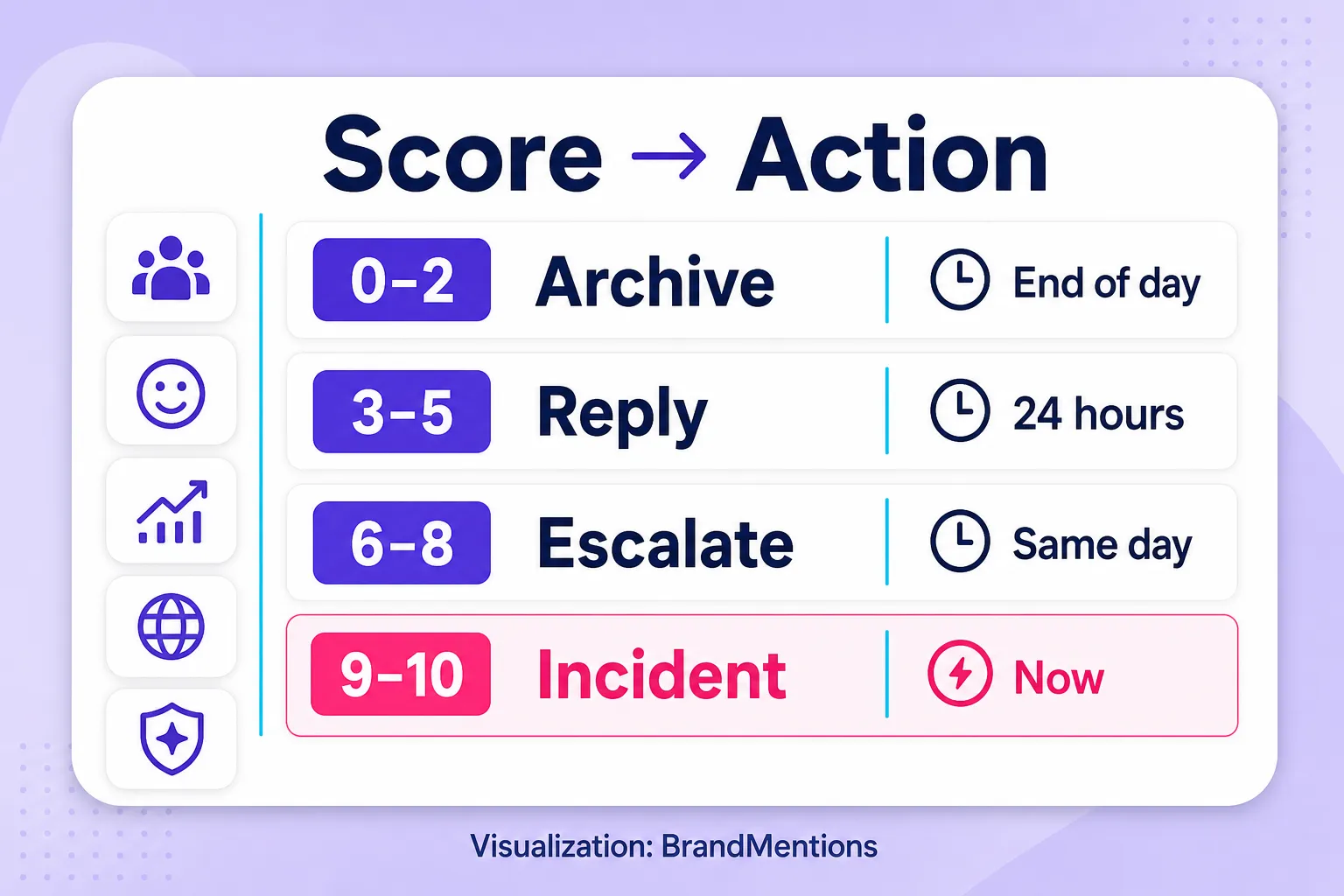
You do not need a long meeting. You need a scoring habit that runs while your coffee cools. Score each mention on five axes, then let the score set the queue. This is the model I hand teams the moment their inbox outpaces their staffing.
| Signal | 0 points | 1 point | 2 points |
|---|---|---|---|
| Audience impact | Low-relevance user or spam | Real user, small reach | Customer, journalist, creator, partner, analyst, employee, or investor |
| Sentiment and risk | Neutral or positive | Mild confusion or friction | Complaint, accusation, safety or legal issue, false claim, refund threat, boycott language |
| Channel velocity | Isolated mention | Some replies, shares, or reposts | Spreading across channels or communities |
| Source context | Weak context or unclear identity | Relevant or mid-trust community | High-trust community, review site, publication, or recurring expert voice |
| AI and search risk | Unlikely to influence search or AI answers | Sits on an indexable public page | Appears in Reddit, YouTube, reviews, news, or AI answers for buyer questions |
Then read the total against a fixed set of actions.
| Score | Action | Time frame |
|---|---|---|
| 0 to 2 | Archive and tag | End of day |
| 3 to 5 | Reply or assign | Within 24 hours |
| 6 to 8 | Escalate to a named owner | Same business day |
| 9 to 10 | Treat as an incident | Immediately |
Two rules keep it honest. Any mention that scores a 2 on sentiment and risk jumps a tier regardless of reach, because a small angry thread today is a large one tomorrow. And the archive pile is not trash. It is your Tuesday content raw material and your Wednesday competitor context.
The Mention Half-Life Rule: the more a mention can move trust, buying behavior, press coverage, or AI answers, the shorter its half-life. A high-impact mention never waits for Friday.
The score does one quiet thing well. It lets a junior team member triage confidently without escalating everything, and it gives you a defensible answer when a stakeholder asks why one mention was handled and another was not. If your category runs in a regulated space like finance, healthcare, or a publicly traded company, add a sixth rule: anything scoring 6 or higher routes through legal or compliance review before a public reply, and you retain the record.
Step 1 (Monday): Setup, Engagement, and Target Research
Monday earns its place because of one uncomfortable number. Sprout Social's 2025 Index found that 73% of social users will buy from a competitor if a brand does not respond to them on social. Silence is not neutral. It is a purchase decision made against you.
Monday has four jobs.
1. Build your keyword universe. Track your brand name, product names, executive names, abbreviations, common misspellings, campaign names, slogans, and branded hashtags. Then add the phrases confused and angry buyers use: "[brand] alternatives," "[brand] vs," "[brand] refund," "[brand] not working," "[brand] safe," and "[brand] worth it." Do not stop at what happy customers call you.
2. Add exclusions. If your name carries a common meaning, subtract it. "Apple" needs filters for fruit and recipes. "Notion" needs filters for philosophy. A bad alert setup does not just create noise, it trains the team to ignore the system, so treat careful setting up alerts as the hour that saves the rest of your week. On a zero budget, Google Alerts covers a useful web layer across news, blogs, video, discussions, and finance, with as-it-happens, daily, or weekly delivery, though it will miss most social conversation.
3. Set ownership tiers so nothing depends on who happens to notice.
| Tier | What belongs here | Owner | Response expectation |
|---|---|---|---|
| Red | Safety claims, legal accusations, viral complaints, journalist questions, executive mentions, AI misinformation | PR or senior owner | Same business day, often immediately |
| Yellow | Product confusion, negative reviews, competitor comparisons, recurring feature requests | Marketing, support, or product | Within 24 hours |
| Blue | Positive mentions, neutral references, content ideas, category chatter | Marketing | Weekly planning |
4. Run the engagement pass. Reply only where a reply helps. For the genuinely hostile threads, follow a real process for handling negative mentions instead of improvising under pressure. Acknowledge in public, resolve in private, and never let the back-and-forth amplify the original complaint.
Do not forget review platforms on Monday. Google reviews, G2, Trustpilot, app store ratings, and marketplace reviews feed both human trust and AI summaries, and they rarely trigger a social alert. Add them to the sweep.
A dedicated platform earns its keep here when a name creates noise or spans channels. BrandMentions, best for cross-channel mention monitoring with sentiment triage, lets you exclude misleading terms and classify sentiment so the Monday feed stays clean enough to actually read. Choose a tool based on the decision you need to make, not on the size of the dashboard.
Non-obvious Monday insight: the mentions worth studying are not the loudest. They are the unexpected authors. When nurses, developers, or finance creators start naming you in language your personas never used, that is a market telling you where it wants you to go. Most teams read that signal months too late.
Step 2 (Tuesday): Content Research From Real Conversations
Tuesday flips monitoring from defense to creation. Google's own AI features documentation explains that AI Overviews and AI Mode use query fan-out, issuing multiple related searches to build an answer, and that pages simply need to be indexed and eligible for snippets to appear as supporting links. There is no secret technical trick. AI visibility depends on clear, current evidence.
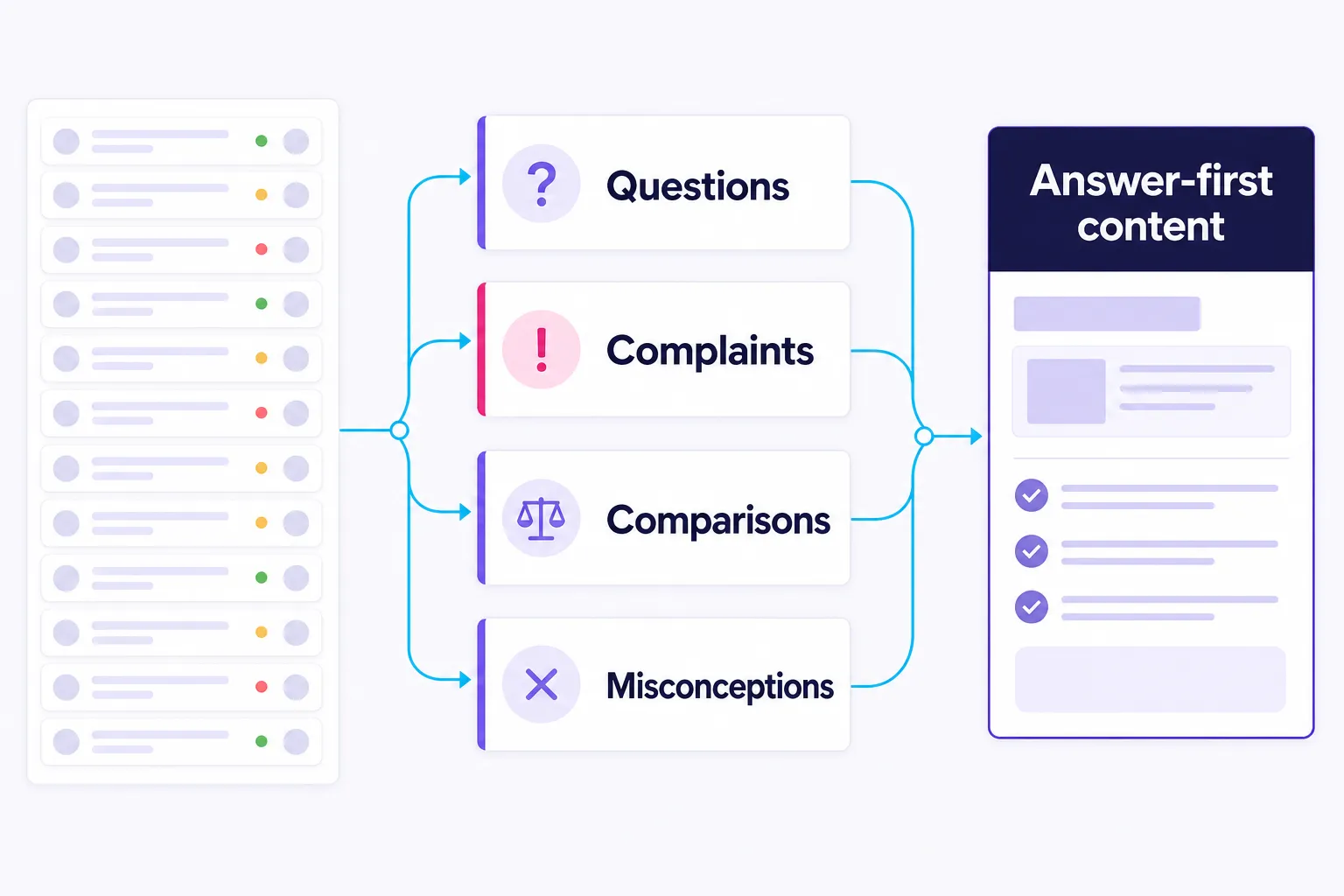
So Tuesday's job is to mine mentions for the questions your content missed. Sort them into four buckets.
| Mention type | What it reveals | Content action |
|---|---|---|
| Repeated question | The market lacks a clear answer | Build an answer page, short video, or help article |
| Complaint | Product or expectation failed | Publish a fix only after support or product owns the issue |
| Comparison | Buyers are choosing between options | Write honest comparison guidance with proof |
| Misconception | Positioning is unclear | Rewrite product copy, onboarding, and FAQs |
Extract the job behind the comment, not the comment itself. A buyer asking why you cost more than a rival is not asking for a pricing page. They are asking for value evidence. Answer in the first sentence, add the date or version when freshness matters, name the product plainly, state the limitation honestly, and end with one next step. That structure serves people and machines at once.
The best content ideas are not hiding in a keyword tool. They are sitting inside repeated confusion. Find the sentence your customers keep writing, then build the cleanest answer to it.
Non-obvious Tuesday insight: treat unanswered repeated questions as content decay. Most marketers think content decays when rankings drop. In practice, it decays when people keep asking the same thing after you already explained it. If the question survives the content, the content failed.
Step 3 (Wednesday): Competitor Analysis and Share of Conversation
Wednesday is not for spying. It is for understanding why the market gives attention, trust, or doubt to someone else. LinkedIn's own feed-ranking guidance is a useful reminder that visibility comes from relevance inside networks, not a posting schedule, and that its systems do not use demographic fields like age, race, or gender as visibility signals.
Track the competitor set the same way you track yourself, then compare four things.
| Signal | Question to ask | Decision it should change |
|---|---|---|
| Share of conversation | Are they discussed more in the channels that matter? | Channel focus and distribution |
| Sentiment gap | Are buyers happier, angrier, or more specific about them? | Product proof and objection handling |
| Feature language | What words do users use for their strengths and gaps? | Positioning and roadmap feedback |
| Proof sources | Who or what makes people believe them? | Case studies, reviews, creator strategy |
Keep share of conversation honest. It is your mentions divided by your mentions plus a competitor's, measured in the same channel set and time window. Comparing your LinkedIn mentions to a rival's TikTok mentions is not analysis, it is a messy fraction. Broaden the same scan into press and trade coverage with structured media monitoring, so a competitor's recall or funding round does not reach you third-hand.
Watch for coordinated noise too. A sudden spike of nearly identical negative posts, brand-new accounts, or copy-paste phrasing usually signals astroturfing or a competitor smear rather than a genuine shift. Flag the pattern, do not react to the volume.
One competitor campaign you reverse-engineer beats ten you merely admire.
Non-obvious Wednesday insight: competitor praise is more useful than competitor criticism. Criticism tells you what buyers reject. Praise tells you what they now expect from the whole category. When users praise a rival's onboarding or clear pricing, they are quietly raising the baseline you are measured against.
Step 4 (Thursday): Community, Creators, and Reputation Proof
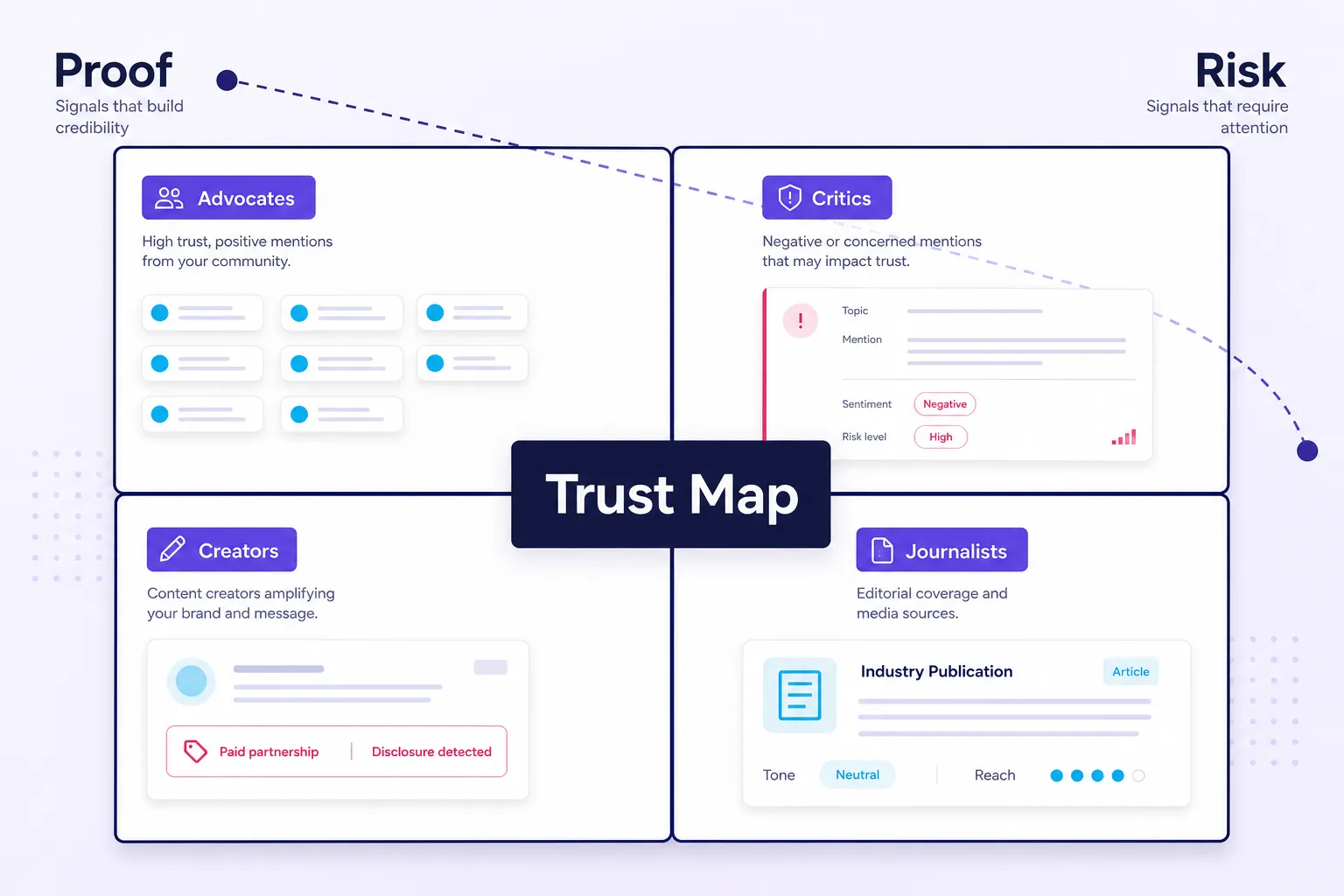
Thursday replaces the old backlink-hunting habit with something more useful for 2026. Who can credibly shape trust around your brand, and who creates risk? The FTC's Endorsement Guides set the frame: endorsements must be honest, material connections a reasonable consumer would not expect must be disclosed clearly, and companies should monitor tagged posts from gifted product and contracted creators, including for a period after a contract ends.
So Thursday is not only influencer discovery. It is mapping proof and risk together.
| Voice type | What to monitor | When to engage | Main risk |
|---|---|---|---|
| Organic advocates | Unpaid mentions, tutorials, community answers | Thank, amplify, invite feedback | Over-commercializing a real fan |
| Credible critics | Detailed negative reviews, expert objections | Listen, fix if valid, reply with specifics | Defensive replies |
| Creators and affiliates | Sponsored posts, gifted posts, discount codes | Engage only with clear disclosure | Undisclosed material connections |
| Journalists and analysts | Source requests, trend stories, roundups | Offer data or expert access | Generic pitching |
Cision's 2026 State of the Media report explains why relevance beats volume here. In a survey of 1,899 journalists, 66% said they rely on PR-provided content for story ideas, yet 72% said fewer than a quarter of pitches are relevant. If your monitoring finds a journalist discussing your category, send one useful thing: original data, a qualified expert, or a verifiable asset. Not a template. Widen the sweep by monitoring hashtags tied to launches, events, and user-generated campaigns to find clusters of participation you would otherwise miss.
This second front, tracking whether AI answers represent you correctly, is where a monitoring workflow saves hours of tab-hopping. Use a tool to track web and social mentions, classify sentiment, surface recurring authors, and log how your brand shows up in AI answers as part of a reputation view. The tool should surface candidates. Your team decides who is credible.
Non-obvious Thursday insight: your highest-value advocate may not have the highest reach, and repetition beats reach. A niche moderator or a 4,000-follower practitioner who mentions you unprompted three times will move more buying decisions than a 200,000-follower account posting once for a fee. Filter for frequency before follower count.
Step 5 (Friday): Report Analysis That Ends in Decisions
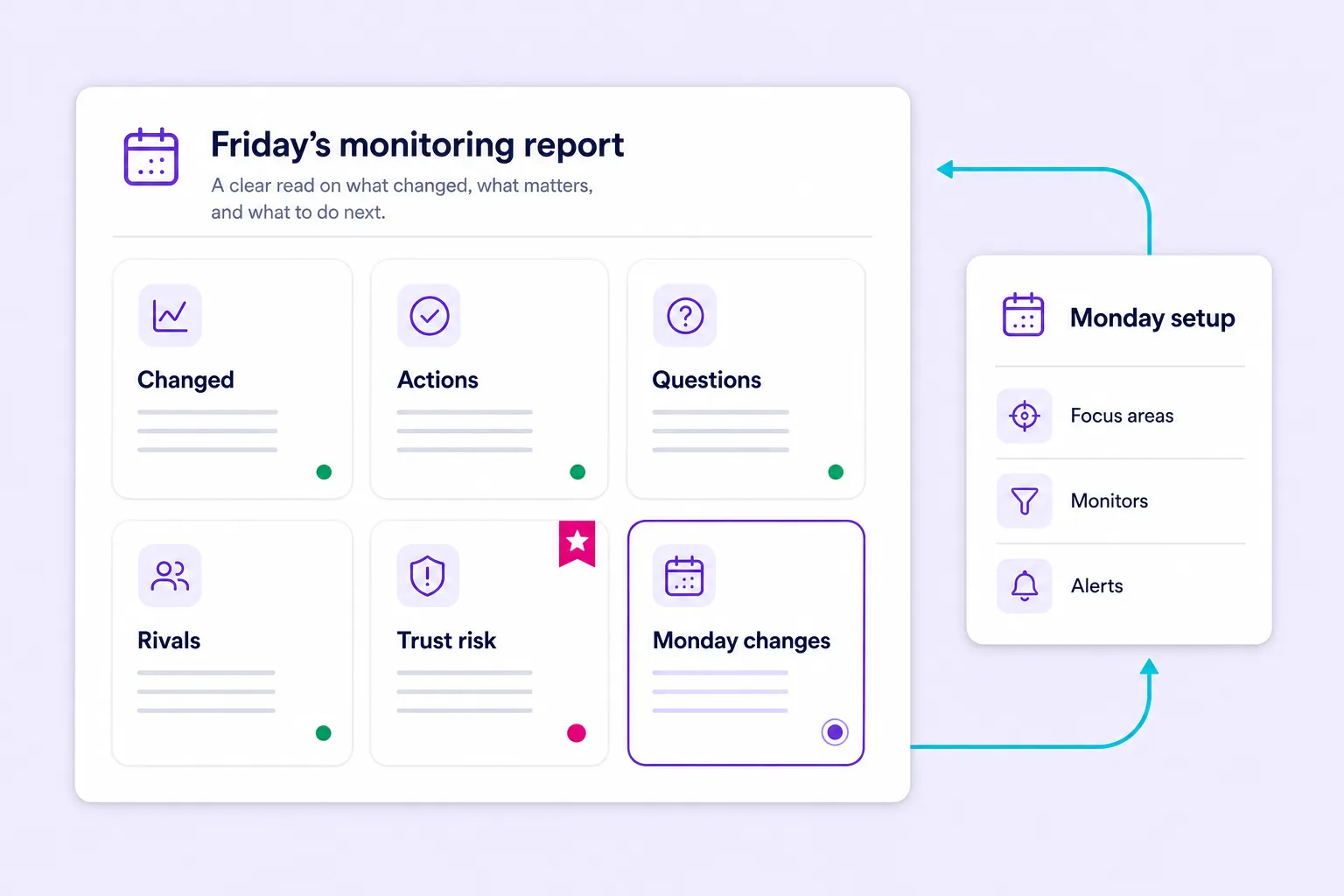
Friday is where a monitoring program becomes either useful or decorative. Start by separating your results from platform noise. Google's Search Status Dashboard shows that, as of August 10, 2026, the most recent confirmed ranking update was the June 2026 spam update, dated June 24, 2026, lasting 2 days and 1 hour, following the May 2026 core update that began May 21, 2026 and ran 11 days and 21 hours. If your mention volume or visibility shifted during a confirmed update, say so. Do not credit your campaign for platform weather.
Your Friday report should answer six questions and nothing more: what changed, which mentions needed action, which questions repeated, which competitor signal matters, which trust risk is still open, and what changes on Monday. Structure it so a busy executive reads it in two minutes.
| Section | Include | Leave out |
|---|---|---|
| Executive snapshot | 5 bullets on meaningful change | Every chart from the dashboard |
| Risk queue | Red and Yellow items, owner, status | Low-quality noise |
| Sentiment read | Main positive and negative themes with example quotes | A score with no examples |
| Content backlog | Repeated questions and objections | Random ideas with no evidence |
| Competitor read | Share of conversation, praise, complaints | Screenshots with no interpretation |
| AI and search visibility | Branded prompts, presence, cited or missing sources | One-off tests with no date or query |
| Monday changes | New alerts, exclusions, owners, updates | Vague "monitor more" notes |
Never report sentiment as a bare percentage. Pair it with the three phrases that explain it, because automated sentiment analysis still struggles with sarcasm, memes, screenshots, mixed reviews, and non-English mentions. Use it as a sorting layer, then let a human read the mentions that carry real weight. Define, in writing, what counts as a meaningful change versus normal week-to-week volatility, so you are not chasing every three-point wobble.
The Friday-to-Monday Loop: a report only matters if it changes Monday's setup. If Friday does not add, remove, merge, or reprioritize an alert, an owner, or a content task, your system is not learning.
Non-obvious Friday insight: archive high-impact mentions exactly as they appeared. Save the URL, a screenshot, the date, the market, the platform, the query used, and whether you were logged in. Feeds and AI answers are personalized and change over time, and a clean archive protects your team from the "I can't see it anymore" argument three weeks later.
Google Alerts vs. Native Search vs. Paid Monitoring: The Difference in Execution
These options do not compete on the same job. They answer different questions, and the right stack depends on your mention volume and your team's discipline.
| Method | Best fit | Strength | Constraint | Weekly role |
|---|---|---|---|---|
| Google Alerts | Zero-budget web monitoring | Fast setup across web, news, blogs, video, discussions | Thin social and community depth | Monday baseline |
| Native platform search | Platform-specific checks | Shows how content really appears in TikTok, Reddit, LinkedIn, X | Manual, inconsistent, hard to report | Tuesday to Thursday spot checks |
| Dedicated monitoring platform | Cross-channel workflow | Centralizes mentions, sentiment, authors, alerts, reports | Needs setup discipline and budget | Daily triage and Friday report |
| Enterprise media suite | Global PR and comms teams | Deeper media databases and journalist workflows | Higher complexity and cost | Thursday journalist and Friday PR work |
The rule I use is plain. Start with the cheapest system your team will actually maintain, and upgrade when the work breaks, not when a dashboard looks impressive. Fewer than roughly 20 meaningful mentions a week? Alerts and native search may be enough. Need daily assignment, sentiment review, competitor tracking, and AI visibility in one place? A dedicated platform earns its cost. Managing global markets, journalists, and executive reputation? That is enterprise territory.
Frequently Asked Questions
How much time should brand monitoring take each day?
For most small and mid-sized teams, daily triage should take 15 to 30 minutes, plus the day's themed job. Active launches, crisis periods, and regulated markets need longer coverage and tighter escalation rules. If everything feels urgent, your scoring is broken, not your schedule.
Do I need a paid tool, or is Google Alerts enough?
Google Alerts covers indexed web and news reasonably well and costs nothing, so it is a fair starting point for a solo marketer. It misses most social conversation, does not score sentiment, and shows nothing about AI answers. If your brand lives on social or gets debated in AI responses, a dedicated platform usually pays for itself the first time it flags a spreading complaint you would have missed.
How do I track whether ChatGPT or Google's AI answers mention my brand?
For Google's own surfaces, use the Search Console generative AI performance reports launched on June 3, 2026. For ChatGPT, Perplexity, and Gemini, there is no analytics dashboard, so prompt them on a fixed schedule with buyer-intent questions and record who gets named, or use a monitoring tool that runs those prompts for you.
Should I respond to negative mentions publicly or privately?
Acknowledge publicly, resolve privately. A short public reply tells onlookers you take feedback seriously, then move the detailed fix to a direct message so the exchange does not amplify the original complaint. For anything touching safety, legal, or a regulated claim, route it through approval before you post.
What are the 5 steps of the daily brand monitoring checklist, one line per day?
Step 1 (Monday) sets up alerts, owners, and triage; Step 2 (Tuesday) mines conversations for content; Step 3 (Wednesday) reads competitors and share of conversation; Step 4 (Thursday) maps advocates, creators, and disclosure risk; and Step 5 (Friday) turns the week into a decision report that resets Monday. A daily 15-to-30-minute sprint routine runs on top of each theme to handle anything urgent.
Conclusion: The Habit Beats the Heroics
Brand monitoring rarely fails because the tools are weak. It fails because it never becomes routine. A brilliant monitoring project abandoned in week three protects no one. A modest five-day rhythm you keep for a year quietly compounds into something rivals cannot buy: you always know, before they do, what the market thinks of you.
The job has widened, and this checklist reflects it. You are no longer only watching what humans say. You are also auditing what machines say when a buyer asks, because that conversation now happens at the scale of billions of answers, whether or not you are in the room. Treat your presence in AI answers with the same discipline you once reserved for search rankings and press coverage.
So start next Monday. Run the five steps in order: build the keyword universe and add the exclusions (Step 1), mine conversations for content (Step 2), read competitors (Step 3), map advocates and disclosure risk (Step 4), and turn the week into a decision report (Step 5) - with the sprint routine scoring every mention that matters each day. By Friday, do not ask how many mentions you collected. Ask the better question. What did we learn this week that changes what we do next week? Answer that honestly for five weeks, and the habit holds itself up.
Filed under: Growth