6 Essential Social Media Audit Tools for 2026
Quick answer: The best social media audit tools in 2026, compared by audit job rather than by feature count, are BrandMentions (reputation, sentiment and share of voice), Sprout Social (owned perfo…


Quick answer: The best social media audit tools in 2026, compared by audit job rather than by feature count, are BrandMentions (reputation, sentiment and share of voice), Sprout Social (owned performance and customer care), Hootsuite (multi-account teams), BuzzSumo (content and digital PR), Agorapulse (recurring stakeholder reporting) and Talkwalker (enterprise intelligence across markets and media). Pick by the audit decision you need to make and by how much history the plan actually stores - not by feature count. Entry prices run from $79/month flat (BrandMentions) and $79 per seat or user (Sprout Social, Agorapulse) to $99/user/month (Hootsuite) and $199/month (BuzzSumo), with Talkwalker quote-priced only.
Key facts: price, trial and history at a glance
- BrandMentions - $79/month flat (annual billing) - 7-day trial - 30 days of pre-project history on Starter, Pro and Expert; up to 10 years on Custom and Enterprise.
- Sprout Social - $79/seat/month (annual billing) - 30-day trial - history varies by report and network; Listening and Premium Analytics are add-ons from Standard upward.
- Hootsuite - $99/user/month (annual billing) - 14-day trial, no credit card - backfill up to 12 months on several account types; 59 days for TikTok page-level metrics.
- BuzzSumo - $199/month flat with user caps (annual billing) - 30-day trial - 2 years of historical content data on the entry plan, up to 5 years on Suite and Enterprise.
- Agorapulse - $79/user/month (annual billing), 10 profiles included - 15-day trial, extendable once - rolling retention by plan; Report Studio replaces legacy custom reports.
- Talkwalker - custom quote, unlimited users - demo only, no self-serve trial - history negotiated, with additional depth on higher tiers.
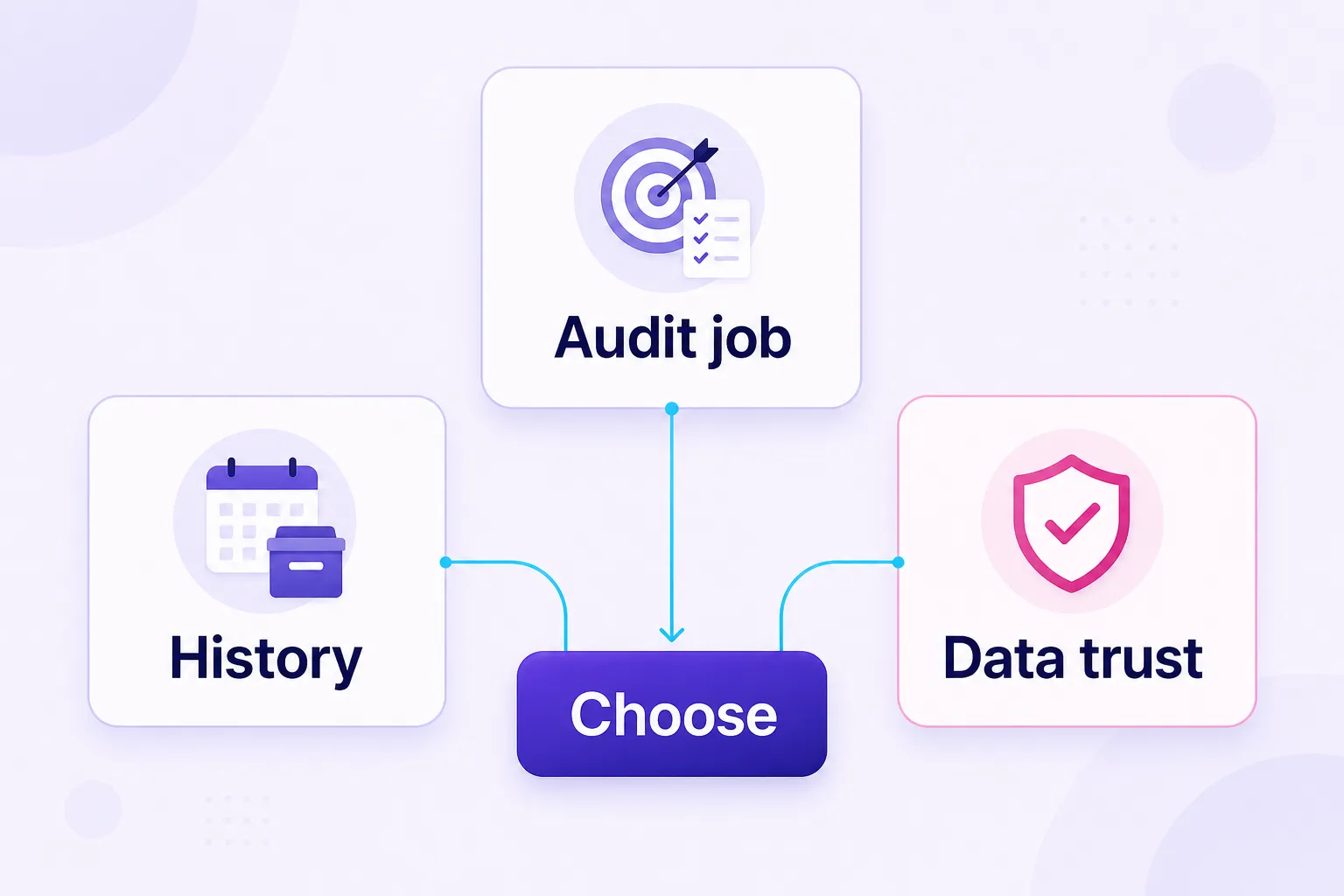
Summary: The Three Things That Decide a Social Media Audit Tool
- Buy by audit job, not by feature count. BrandMentions answers "what do people say about us", Sprout Social and Hootsuite answer "how did our accounts and our team perform", BuzzSumo answers "which topics and assets earn attention", Agorapulse answers "can we produce this report every month without drama", Talkwalker answers "can several departments work from one intelligence layer".
- History is the limit that breaks audits, not price. Coverage of a network does not mean recovery of every metric for your reporting window. BrandMentions documents 30 days of pre-project data on Starter, Pro and Expert, Hootsuite documents 59 days for TikTok page-level metrics, and BuzzSumo's historical depth runs from 2 years to 5 years by plan.
- Half your audit findings can come from data collection, not marketing. Source-pool changes, disconnected accounts, cached engagement counts and deprecated report builders all move your numbers in 2026 with no change in performance. Two dated examples sit in this article, both actionable this week.
Most social media audits die in the same place. Someone exports follower counts from five networks, colours the cells, presents it, and nothing in the strategy changes. The data was fine. The question was never defined.
So before you compare the six tools below, answer one thing: what decision will this audit change? Cut a channel, shift budget, rewrite the content mix, reprioritise a competitor. If you cannot name it, you are shopping for a dashboard.
Our team has run enough content and monitoring programs to know where these tools break. It is almost never the feature list. It is the missing quarter of history, the report that quietly stopped being delivered, or the seat count nobody priced before the renewal call.
At a Glance: Best Social Media Audit Tools by Use Case
- Best for reputation and share-of-voice audits: BrandMentions - Flat pricing, no per-seat multiplier, and coverage of the earned conversation across social, news, blogs, forums and review sites in one project.
- Best for established teams auditing content plus customer care: Sprout Social - The deepest owned-channel reporting here, with competitor, tag and paid insights from the Professional tier upward.
- Best for organisations managing many accounts: Hootsuite - Unlimited social accounts from Professional, plus the audit and the follow-up publishing work in one environment.
- Best for content and digital PR audits: BuzzSumo - Flat pricing with real user allowances, and the only tool here built to benchmark your content against the niche average rather than against last month.
- Best for lean teams producing recurring stakeholder reports: Agorapulse - 10 profiles on every paid plan, transparent per-user pricing, and Report Studio for repeatable branded audit reports.
- Best for global enterprises needing multi-department intelligence: Talkwalker - Custom-quoted enterprise listening with unlimited users, visual and broadcast coverage, and AI-answer visibility tracking.
These are use-case fits, not a universal ranking. Two of these tools can be the right answer for the same company at different budgets.
The Six Best Social Media Audit Tools Side by Side (Pricing, Trials, History Limits)
| Tool | Primary audit job | Entry price (annual billing) | Pricing model | Trial | Documented history limit |
|---|---|---|---|---|---|
| BrandMentions | Earned conversation, sentiment, share of voice | $79/month | Keywords and mentions, flat | 7 days | 30 days pre-project on Starter, Pro, Expert; up to 10 years on Custom and Enterprise |
| Sprout Social | Owned performance, competitors, customer care | $79/seat/month | Per seat | 30 days | Varies by report and network; Listening and Premium Analytics are add-ons from Standard |
| Hootsuite | Multi-account publishing and performance review | $99/user/month | Per user | 14 days, no credit card | Backfill up to 12 months on several account types; 59 days for TikTok page-level metrics |
| BuzzSumo | Content and topic performance research | $199/month | Flat, with user caps | 30 days | 2 years (entry) to 5 years (Suite, Enterprise) |
| Agorapulse | Recurring reporting and operational follow-through | $79/user/month | Per user, 10 profiles included | 15 days, extendable once | Rolling retention by plan; Report Studio replaces legacy custom reports |
| Talkwalker | Enterprise intelligence across markets and media | Custom quote | Enterprise contract, unlimited users | Demo only | Negotiated; additional history sits on higher tiers |
All prices are the annual-billing monthly equivalents published on each vendor's pricing page in September 2026. Per-seat plans multiply with headcount. Flat plans do not.
Quick head-to-head: the three comparisons buyers actually run
| Head-to-head | Choose the first if | Choose the second if |
|---|---|---|
| BrandMentions vs. Sprout Social | You are auditing reputation, sentiment and competitor share of voice, and up to 10 people need the same data - $399/month flat on Expert | You are auditing owned-channel depth and customer care - $79/seat/month entry, competitor and paid insights from Professional at $299/seat/month |
| Hootsuite vs. Agorapulse | You run dozens or hundreds of accounts and need approvals, routing and governance - unlimited accounts from Professional at $199/user/month | You are two to ten people who must ship the same report monthly - $79/user/month with 10 profiles included |
| BuzzSumo vs. Talkwalker | The audit question is editorial: which topics and assets earn attention - flat from $199/month | The audit question is enterprise brand health across markets, media types and departments - custom quote, unlimited users |
The full version of each comparison, with the deciding factor spelled out, sits in the head-to-head section after the reviews.
Which Social Media Audit Tool Should You Choose?
| Your situation | Choose | Why |
|---|---|---|
| You need to know what the market says about you, and how that compares with rivals | BrandMentions | Mentions, sentiment and competitor share of voice across social, news, blogs, forums and review sites in one project; flat $79/month entry, 10 users on Expert at $399/month |
| Social is a service channel and several people work in the tool every day | Sprout Social | Deepest owned-performance and customer-care reporting here; competitor, tag and paid insights arrive on Professional at $299/seat/month |
| You manage dozens or hundreds of accounts across regions, brands or franchises | Hootsuite | Unlimited social accounts from Professional ($199/user/month), governance on Advanced, and Talkwalker-grade listening on Enterprise |
| The audit question is editorial: which topics, formats and assets earn attention | BuzzSumo | Content Analyzer benchmarks against the niche average; 2 years of history on the $199/month entry plan up to 5 years on Suite and Enterprise |
| A two-to-ten-person team must ship the same branded report every month | Agorapulse | 10 profiles on every paid plan from $79/user/month, plus Report Studio on Advanced for repeatable branded exports |
| One dataset has to serve marketing, comms, research and risk across markets | Talkwalker | Quote-priced enterprise listening with unlimited users, visual and broadcast coverage, and LLM Insights for AI-answer visibility |
| Your audit must compare Q3 2026 against Q3 2025 | The tool whose documented history covers the window | Check the archive first: 30 days pre-project on BrandMentions Starter, Pro and Expert; 59 days for Hootsuite TikTok page-level metrics; 2 - 5 years on BuzzSumo by plan |
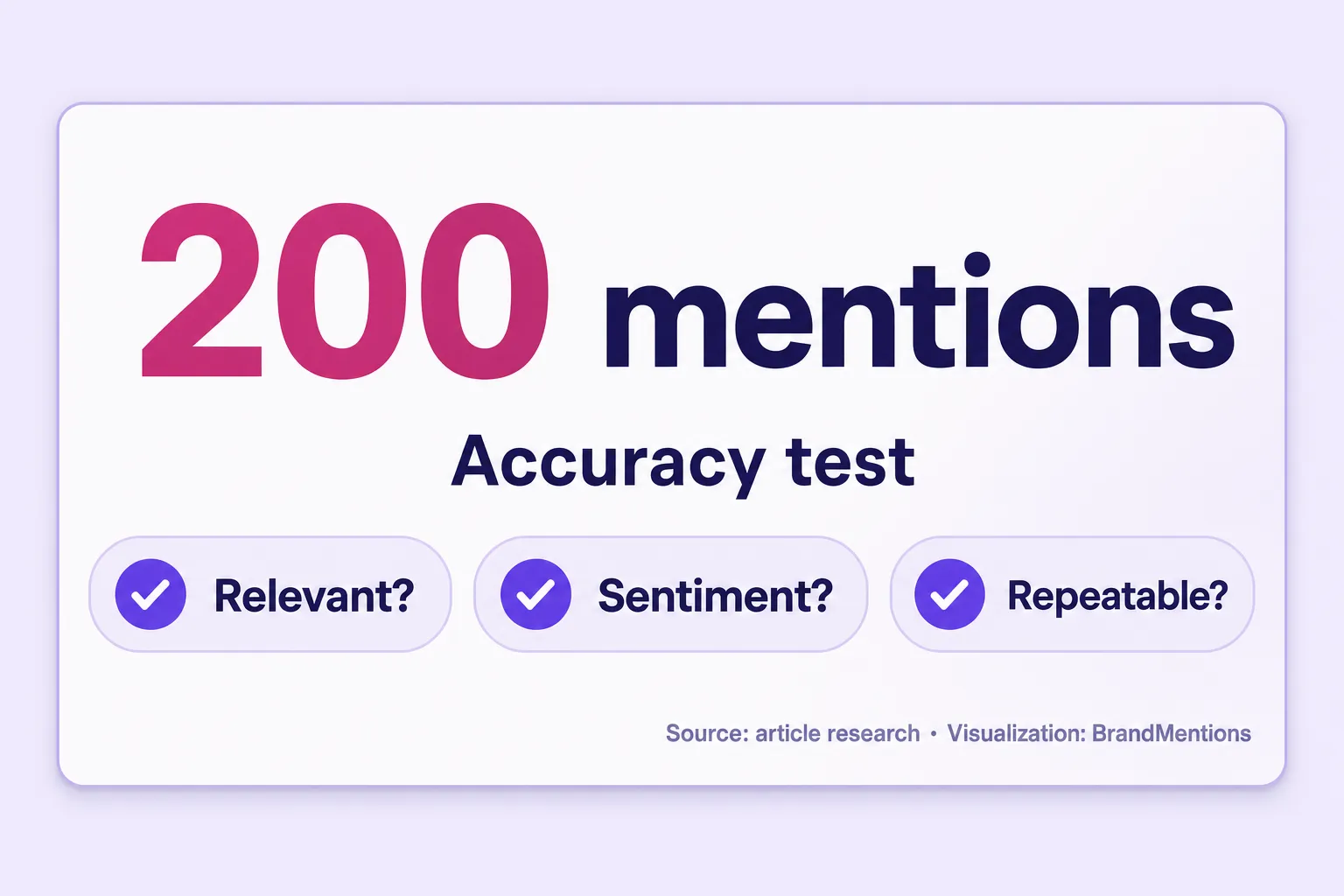
One honest caveat before the reviews: there is no public, vendor-independent benchmark measuring recall, false positives, sentiment accuracy or export completeness across these six products. Nobody should call any of them "the most accurate" without that test, including us. Later in this article there is a 200-mention protocol you can run yourself during the trials, which is the only accuracy evidence that will ever match your own brand and language.
1. BrandMentions
| Plan | Price (annual billing) | Users included | Audit-relevant allowance |
|---|---|---|---|
| Starter | $79/month | 1 | 5 keywords, 5,000 mentions/month, AI sentiment, daily updates |
| Pro | $249/month | 2 | 20 keywords, 30,000 mentions/month, multilingual sentiment |
| Expert | $399/month | 10 | 50 keywords, 75,000 mentions/month, Boolean search, white-label reports, real-time updates |
| Enterprise | From $1,099/month | Custom | Custom keywords and mentions, API access, extended historical data |
Starter also runs at $99 per month billed quarterly, with Pro and Expert at $299 and $499 on monthly billing. The free trial is 7 days, the shortest on this list. Full plan limits sit on the BrandMentions social media monitoring pricing page.
What it audits best
The earned half. Mentions across social plus news, blogs, forums, Q&A sites and review platforms, scored for sentiment, grouped by source, and comparable against competitor keywords inside the same project.
Use it when your audit question is "what is being said about us and how does that compare to them", not "which of our Reels earned the most saves".
Pricing and access
Keyword and mention based, never per seat. Ten people on Expert cost $399 a month on annual billing, which is the structural difference from every management suite here.
The ceiling moves too. Fifty keywords is the Expert limit, so agencies tracking many brands hit the keyword wall long before the mention wall.
Standout audit capabilities
Competitor keywords sit next to your own, so share of voice comes out of one project rather than three exports. Expert adds full white-label reporting, which matters when the deliverable carries a client's identity. The Reviews integration pulls star ratings and review text into the same analytics view, and Expert's AI assistant summarises what shifted in a period instead of leaving you 4,000 mentions to read.
Where it falls short
There is no publishing, scheduling or inbox. Pair it with a management platform if your workflow moves from insight to published reply in one login.
Two details deserve a direct question to support before you buy. First, plan documentation is not fully consistent on refresh frequency for the middle tier, so get your plan's update cadence confirmed in writing if crisis response depends on it. Second, image monitoring should be demonstrated against genuinely uncaptioned posts during the trial, because logo detection quality is the one thing no marketing page quantifies.
Ideal fit: who BrandMentions is best for
BrandMentions is best for in-house teams and agencies auditing reputation, competitor share of voice, review sentiment and campaign reach beyond owned accounts. It is strongest where three or more people need access to the same monitoring data, because the price does not move with headcount.
Non-obvious insight
The Backfill Budget: buy the history your audit needs, not the mention volume your brand produces. The BrandMentions help center documents 30 days of pre-project historical data on Starter, Pro and Expert, with Custom and Enterprise extending to as much as 10 years depending on the request.
Read that carefully, because it inverts the usual upgrade logic. Moving from Starter to Expert buys you volume, speed and Boolean control, not a year-over-year retrospective. If your audit must compare Q3 2026 against Q3 2025, start the project now or negotiate historical retrieval, then pick the tier.
Second habit worth stealing: split review mentions into their own segment and plot their sentiment against social sentiment. When the two curves separate, you usually have a product or support issue rather than a social issue, and that is a different meeting entirely. Test that split during the trial using your own vocabulary before you trust any score, which is also the right way to evaluate sentiment analysis tools generally.
2. Sprout Social
| Plan | Price (annual billing) | Users included | Audit-relevant allowance |
|---|---|---|---|
| Essentials | $79/seat/month | Per seat | 5 profiles, profile-level and post-level reporting |
| Standard | $199/seat/month | Per seat | 5 profiles, Smart Inbox, keyword monitoring, review management |
| Professional | $299/seat/month | Per seat | Unlimited profiles, competitor, tag and paid insights |
| Advanced | $399/seat/month | Per seat | Inbox sentiment, message spike alerts, customer-care and productivity reporting |
| Enterprise | Custom quote | Custom | Tailored configuration, SSO, enterprise support |
The trial is 30 days. Listening and Premium Analytics are separate add-ons available from Standard upward, so a core subscription does not include the full listening package.
What it audits best
Owned performance at depth, plus the customer-care side most audits skip entirely. Response times, resolution patterns, tagged conversation themes.
Essentials covers a narrow reporting need honestly, since it includes profile and post reporting. Professional is where competitor, tag and paid analysis arrive, which is the realistic starting point for a full audit brief.
Pricing and access
Per seat, and it compounds. Three Professional seats cost $897 a month on annual billing before any add-on, which is the number to compare against a flat-priced monitoring platform.
Price the people who need to log in, not the person building the report. Viewer-only stakeholders are usually served by scheduled exports instead.
Standout audit capabilities
Message tagging is the underused asset. Tag inbound conversations by theme for one quarter and the audit half writes itself, because you get a quantified answer to why people contact you rather than how many did.
Cross-platform profile and post reports remove the manual export step, competitor reports pull public rival metrics across networks, and the API lets you push the whole dataset into a BI model for a custom audit framework. If your audit lives in a warehouse rather than a PDF, that matters more than report styling. Pair it with dedicated social media analytics tools only if you need a second modelling layer.
Where it falls short
Five profiles on Essentials and Standard is tight for brands with regional accounts. Listening pricing sits outside the headline seat cost, so the real budget is seats plus add-ons.
Ideal fit: who Sprout Social is best for
Sprout Social is best for mid-market and enterprise teams where social is a service channel and several people work in the platform simultaneously. Choose it when owned-performance depth and customer-care reporting outrank web-wide mention coverage.
Non-obvious insight
Two dated items in Sprout's August 2026 release notes change how you should read your own charts. On August 20, 2026 Sprout changed the web data feed behind Listening, expanding coverage while noting that some previously tracked sites may no longer appear. Any audit spanning that date should treat a mention increase as something to investigate, not as proof of rising awareness.
The second is a deadline. The legacy Tag Performance Report was replaced, and scheduled deliveries and shared links from the old version expire on October 14, 2026. Rebuild them before that date or a stakeholder report simply stops arriving.
3. Hootsuite
| Plan | Price (annual billing) | Users included | Audit-relevant allowance |
|---|---|---|---|
| Standard | $99/user/month | Per user | 10 social accounts, brand and competitor monitoring, unified inbox |
| Professional | $199/user/month | Per user | Unlimited accounts, custom performance reports, 90-day trend forecasting |
| Advanced | $399/user/month | Per user | Approvals, message routing, team performance measurement |
| Enterprise | Custom quote | Custom | Advanced analytics, advanced listening, SSO, compliance and governance |
The trial runs 14 days with no credit card. Hootsuite's plan page lists its AI teammate across plans, which means the AI layer is not the differentiator between tiers; account limits, reporting and governance are.
Hootsuite announced its agreement to acquire Talkwalker on April 8, 2024 in its newsroom, with the deal completing later that year, and Talkwalker technology now underpins the advanced listening sold on Enterprise.
What it audits best
Breadth. Dozens or hundreds of accounts across regions, brands and franchises, with the audit and the resulting publishing or care work in the same environment.
Professional removes the account cap and adds custom reports you can rerun identically each quarter. Advanced is the tier to pick when you are auditing how the team handles the work, not only how the content performed.
Pricing and access
Per user, and the jump from Professional to Advanced quadruples the entry cost. A four-person team on Professional pays $796 a month on annual billing.
Enterprise is negotiated annually. If you already hold an Enterprise contract, check which listening components it includes before buying a separate listening product, because the answer is often "more than you are using".
Standout audit capabilities
Custom performance reports let you standardise one audit template and repeat it, which is the discipline most teams lack more than they lack data. The 90-day trend forecasting on Professional and above gives the "what next" section of an audit something better than a hunch. Enterprise listening adds sentiment, share of voice and demographic breakdowns the mid tiers cannot produce.
Where it falls short
Ten accounts on Standard is restrictive for anyone running regional profiles. Meaningful listening depth lives on Enterprise, so the mid-tier audit is largely an owned-data audit with light monitoring.
The trial is also not a full product test. Bulk scheduling is unavailable during the trial and daily posting limits apply, which matters if bulk workflows are exactly why you are evaluating it.
Ideal fit: who Hootsuite is best for
Hootsuite is best for mid-size to large teams that want one login for publishing, inbox and reporting. It also suits enterprises that prefer management and Talkwalker-grade listening under a single contract.
Non-obvious insight
The Reconciliation Test: explain one mismatch before you automate any report. Hootsuite's analytics documentation states that Analytics metrics are reported in GMT, that Instagram reach appears as daily totals where Instagram itself shows reach across a selected period, and that disconnected X accounts can leave gaps that reconnecting does not fully repair.
None of that is a defect. All of it will make your numbers disagree with native analytics, and the team that cannot explain why will eventually present a timezone artefact as a performance drop. For a US team reporting near midnight local time, check which GMT date holds the activity before you investigate a phantom decline.
Make one trial user reconcile a single completed report against native analytics and explain every gap out loud. That exercise tells you more about a reporting tool than a month of dashboard building.
4. BuzzSumo
| Plan | Price (annual billing) | Users included | Audit-relevant allowance |
|---|---|---|---|
| Content Creation | $199/month | 1 | 2 alerts, 2 years of historical content data |
| PR & Comms | $299/month | 5 | 5 alerts, 3 years of history, media database and coverage reports |
| Suite | $499/month | 10 | 10 alerts, 5 years of history, YouTube Analyzer, article uploads |
| Enterprise | $999/month | 30 | 50 alerts, 5 years of history, billed annually only |
The trial is 30 days without a credit card. Flat pricing with user caps is friendlier than per-seat economics for small teams: five users on PR & Comms cost $299 in total, not per person.
What it audits best
The content chapter. Which topics, formats, headlines and assets earn attention in your category, yours and everyone else's.
It audits subjects rather than profiles, which is exactly why it belongs on this list and why it cannot be your only tool.
Pricing and access
Predictable and flat, with alerts as the real constraint. Two alerts on the entry plan will not serve a brand tracking a handful of competitors plus its own name.
Historical depth scales with price, from 2 years to 5. That is usually the feature you hit first.
Standout audit capabilities
Content Analyzer benchmarks your assets against the niche average instead of against your own last month, which reframes "our best post" into "our best post relative to what normally works here". Question Analyzer mines forum and Q&A questions in the audience's own words. Coverage reports on PR & Comms and above turn a manual media audit into a recurring export.
The workflow worth copying: pull the top questions your audience asks, map them against everything you published in the same period, and mark the gaps. That comparison reorders an editorial calendar faster than any performance chart, because it measures demand you never served.
Where it falls short
No account connection, no inbox, no publishing, and no mention text with sentiment. Its social data is engagement counts on content, which answers a different question than conversation analysis.
It is also not a real-time monitoring product. Alerts exist, but the platform is built for research cycles.
Ideal fit: who BuzzSumo is best for
BuzzSumo is best for content teams, digital PR teams and publishers whose audit lens is topic and asset performance. It also fits agencies producing content strategy recommendations inside a wider audit.
Non-obvious insight
The Two-Clock Rule: record when content was published and when its engagement was retrieved. BuzzSumo caches engagement counts and refreshes them on a schedule, and its help center explains that entering an article's canonical URL into Content Analyzer prompts an update within 30 minutes.
The inference is the useful part. Two exports taken days apart can differ because collection caught up, not because the article earned more shares in between. Timestamp every export, and give new and old assets separate treatment rather than comparing a week-old post with a two-year-old guide that has had 700 days to accumulate.
5. Agorapulse

| Plan | Price (annual billing) | Users included | Audit-relevant allowance |
|---|---|---|---|
| Standard | $79/user/month | Per user | 10 profiles, publishing, inbox, basic social media ROI with Google Analytics |
| Professional | $119/user/month | Per user | 10 profiles, team workflow and team performance reports |
| Advanced | $149/user/month | Per user | 10 profiles, Report Studio, advanced reporting, inbox sentiment, competitor benchmarking |
| Custom | Custom quote | Custom | Additional profiles, reporting API, enterprise integrations and support |
Monthly billing runs $99, $149 and $199 per user for Standard, Professional and Advanced. The trial is 15 days and can be extended once by another 15, and inbox sentiment is not part of the trial experience, so plan your evaluation around that.
What it audits best
Repeatable reporting for small teams. Ten profiles on every paid plan is the detail that makes agency maths work, because the profile allowance does not scale with headcount.
Basic ROI reporting and the Google Analytics connection start at Standard. Advanced is the tier for Report Studio, competitor benchmarking and deeper report configuration.
Pricing and access
Per user with no volume discount, so every additional seat costs what the first one costs. Profiles beyond the included 10 are an add-on, and the listening module is a separate add-on priced per search query.
For a two-person team managing 10 client profiles, Standard at $158 a month on annual billing is the hardest price to beat among the management platforms here.
Standout audit capabilities
Report Studio assembles published-content metrics, competitor benchmarks and listening insights on one canvas with branded PDF export. The advanced listening add-on covers social networks alongside Reddit, news, blogs and forums, with source-specific connection and volume limits, so it is a real listening layer rather than a keyword box, just not an enterprise-scale one.
The best workflow here is labelling. Label a full quarter of posts by format, theme and objective, then cross-reference label performance in one report. You get a content-mix audit in under an hour, which is the difference between doing it quarterly and meaning to.
Where it falls short
Listening priced per search gets expensive once you track several brands, competitors and topics at once. Retention is shorter than enterprise archives, which limits multi-year comparisons.
Basic ROI reporting is also attribution, not proof of incremental revenue. More on that distinction below, because it is where most ROI slides overclaim.
Ideal fit: who Agorapulse is best for
Agorapulse is best for in-house teams of two to ten people and small agencies that need publishing, engagement and credible reporting from one platform. Choose it when speed to a finished, branded report matters more than a large research environment.
Non-obvious insight
Reporting reliability includes delivery, not just accuracy. Agorapulse moved legacy Custom Reports to read-only on July 20, 2026 and, per its legacy custom reports deprecation notice, places the migration window closure at the end of September 2026. Migration carries scheduled exports across; reports left unmigrated lose them.
If you are an existing customer reading this in late September 2026, that is today's task, not next quarter's. Add report ownership, destination, schedule and last successful delivery to your audit checklist permanently, and start from the marketing KPIs each stakeholder is accountable for rather than from whatever the template offers.
A dashboard that is technically correct and no longer reaching the client has still failed. Audit the delivery of your reports with the same rigour you audit the content.
6. Talkwalker
| Plan | Price (annual billing) | Users included | Audit-relevant allowance |
|---|---|---|---|
| Core | Custom quote | Unlimited | Social listening and media monitoring, dashboards, alerts, AI summaries, LLM Insights |
| Analyze | Custom quote | Unlimited | Higher non-sampled result volume, additional topics, filters and channels |
| Business | Custom quote | Unlimited | Further volume, additional historical data, more workspaces, enterprise governance |
Presented in its current offering as Lumen by Talkwalker, it is quote-priced with a personalised demonstration rather than a self-serve trial. Unlimited users on every tier is the structural counterpoint to per-seat suites.
What it audits best
Enterprise conversation intelligence shared across departments. Multi-market, multi-language brand health where one dataset has to serve marketing, comms, research and risk at the same time.
Its distinctive audit inputs are visual recognition and broadcast plus print coverage, which no other tool here offers. Both should be demonstrated on your categories during the evaluation rather than accepted from a coverage claim.
Pricing and access
Custom, annual, procurement-led. Make the quote specify non-sampled result volume, historical access, channel and language list, API access, workspaces and implementation support, because those terms decide whether the package answers your brief.
If your total audit budget is under four figures a month, this is not your tool. That is a scale statement, not a criticism.
Standout audit capabilities
Visual recognition changes what an audit can count, since a sponsor can measure logo exposure in fan-posted photo and video that never mentions the brand in text. Ask for a visual-to-text mention ratio for your own brand during the demo; if it is high, every text-only report you have ever presented understated your earned exposure.
The newer capability is AI-answer visibility. Talkwalker's LLM Insights tracks how AI assistants discuss brands, and a September 2, 2026 product update added citation tracking and prominence scoring across ChatGPT, Gemini, Claude and Perplexity. Report that separately from social mentions. Blending them into one volume number destroys both signals.
Where it falls short
No public price, no self-serve path, and a configuration effort that assumes analyst time. A three-person marketing team will pay for depth it cannot staff.
Since the Hootsuite acquisition, clarify in writing what is sold standalone versus bundled with Hootsuite Enterprise, and whether the components you need share one login and one workflow or simply arrive on one invoice.
Ideal fit: who Talkwalker is best for
Talkwalker is best for global brands with multi-language audiences and sponsorship-heavy marketing where visual exposure is the point. It suits organisations that need one intelligence source of truth across social, web and broadcast.
Non-obvious insight
The completeness risk sits in your integration, not in the platform. Talkwalker's Streaming API documentation distinguishes a volatile connection, which matches data only while connected, from a persisted collector, which buffers results for 7 days.
That buffer is a recovery window for one collection method, not seven days of product-wide history. If you pipe audit data into your own warehouse, simulate a connection failure during evaluation and check what your copy is missing afterwards. Data can vanish from your dashboard while the source platform runs perfectly.
Head to Head: Which Tool Wins Each Comparison?
| Comparison | Pick the first if | Pick the second if | Deciding factor |
|---|---|---|---|
| BrandMentions vs. Sprout Social | The audit question is reputation, sentiment and competitor share of voice, and up to 10 people need the same data for $399/month flat on Expert | The audit question is owned-channel depth, customer care and tagged conversation themes, with competitor, tag and paid insights from Professional at $299/seat/month | Earned conversation vs. owned performance - and flat pricing vs. per seat |
| Hootsuite vs. Agorapulse | You run hundreds of accounts and need approvals, routing and governance; unlimited accounts start on Professional at $199/user/month | You are a team of two to ten with a reporting brief; Standard is $79/user/month with 10 profiles, basic ROI and Google Analytics from the entry tier | Scale and governance vs. cost per report produced |
| BuzzSumo vs. Talkwalker | The question is editorial - which topics and assets earn attention - at a public flat price from $199/month | The question is enterprise brand health across markets, media types and departments, at negotiated pricing | Topic demand vs. multi-market intelligence, not feature count |
BrandMentions vs. Sprout Social. BrandMentions audits the conversation around you, flat-priced for up to 10 users on Expert. Sprout audits what your accounts and your team did, with more owned-channel depth than anyone here, priced per seat with listening sold separately. Reputation question, BrandMentions. Care and content-performance question, Sprout.
Hootsuite vs. Agorapulse. Both are per-user management platforms. Hootsuite's $99 Standard caps at 10 accounts and offers a path to enterprise listening; Agorapulse's $79 Standard includes 10 profiles, basic ROI reporting and Google Analytics from the entry tier. Under ten people and a reporting brief, Agorapulse. Hundreds of accounts and governance requirements, Hootsuite.
BuzzSumo vs. Talkwalker. BuzzSumo answers editorial questions at a public flat price from $199. Talkwalker answers enterprise brand-health questions across media types at negotiated pricing. Choose on the question, not the size of the feature list.
The Seat-and-Search Test: compare total configured cost, not entry prices. Entry price decides nothing. Add the tier that actually contains your required report, the number of people who must log in, extra profiles, listening searches or add-ons, historical retrieval and implementation, then compare.
Run it as a worked example. Three people needing competitor, tag and paid analysis on Sprout Professional cost $897 a month on annual billing before add-ons. The same three people on Agorapulse Advanced cost $447 with 10 profiles, plus listening add-ons if the brief includes external conversation. Ten people needing shared reputation data on BrandMentions Expert cost $399 flat, with a 50-keyword ceiling as the trade.
None of those numbers picks your tool. They tell you which product category you are actually buying, which is the decision most teams skip.
The Governance Questions Nobody Puts in a Comparison Table
Procurement will ask these eventually. Asking them during the trial is cheaper than asking them during a renewal dispute.
- Data separation. If you run multiple clients or business units, can projects and workspaces be isolated, with least-privilege access per user?
- Processing terms. Is there a data processing agreement, and which sub-processors handle mention collection and AI analysis?
- Retention and exit. What happens to your collected data after cancellation, how long is it retained, and can you export the full historical dataset before you leave?
- AI reuse. Are your queries, mentions or uploaded content used to train the vendor's models, and can that be switched off contractually?
- Access control. Is SSO gated to the top tier, and can you remove a departing employee's access without losing their saved reports and scheduled deliveries?
Get the answers in the contract, not in the sales call. A tool that cannot export your history on exit has quietly made your year-over-year audit its property.
What Does a Social Media Audit Tool Actually Measure?
A social media audit is a structured review of the accounts you own, the content you published, the audiences you reached and the conversation you generated, measured across a fixed period against a defined objective. The output is not a chart. It is a short list of decisions: keep, fix, cut, start.
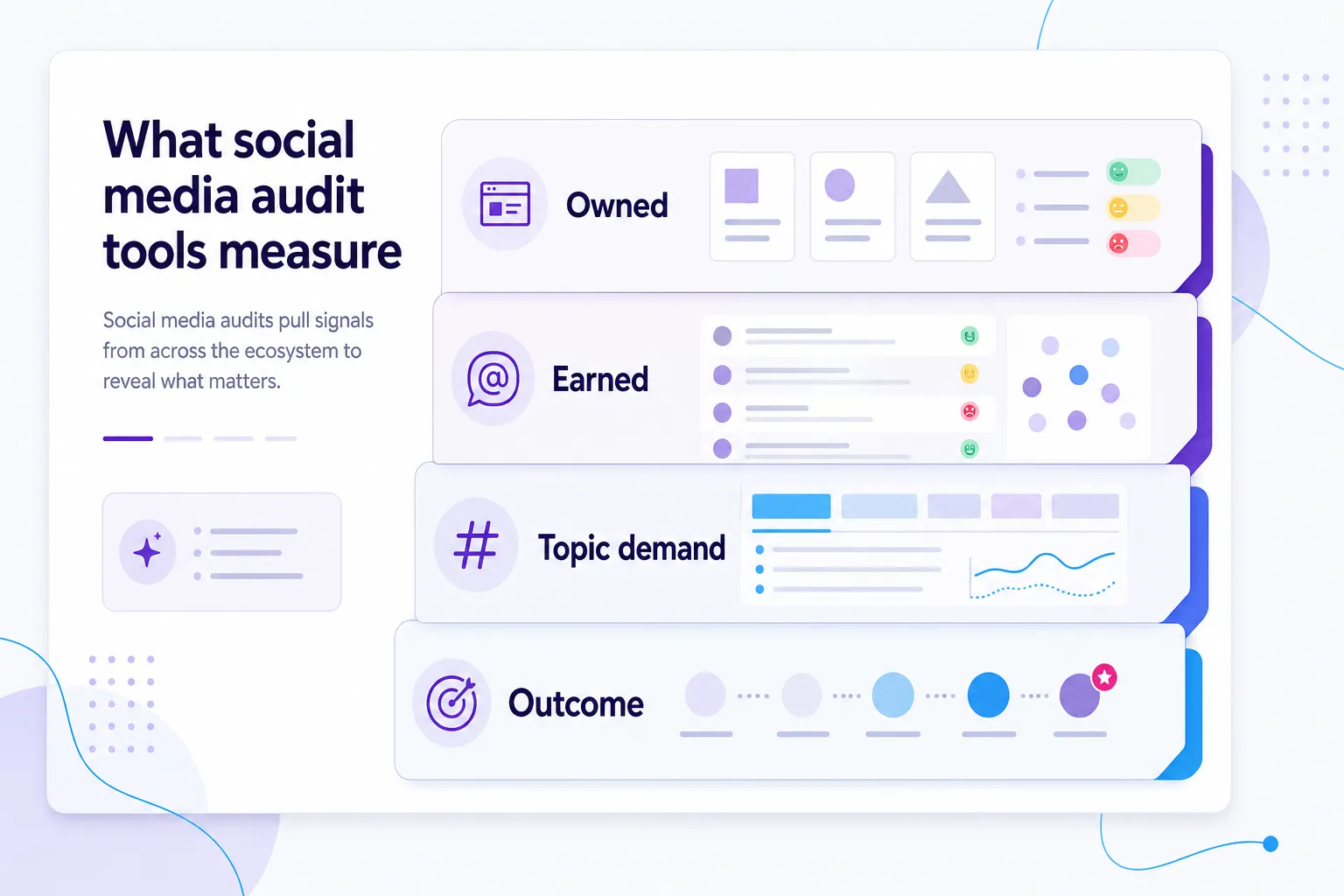
Audit tools split cleanly across three evidence layers. Most buying mistakes happen because a team buys a tool that covers one layer and expects answers from all three.
| Audit layer | Question it answers | Evidence you need | Where the six tools sit |
|---|---|---|---|
| Owned-account performance | Which content and channels deserve more investment? | Post results, audience change, publishing volume, response times | Sprout Social, Hootsuite, Agorapulse |
| Earned conversation | What does the market associate with our brand? | Relevant mentions, sentiment, recurring complaints, competitor share of voice | BrandMentions, Talkwalker |
| Content and topic demand | Which subjects and assets actually attract attention? | Article-level engagement, topic trends, audience questions | BuzzSumo |
| Business outcome | Which activity contributed to revenue or pipeline? | Sessions, leads, transactions, defined conversions | Agorapulse (basic ROI reporting from Standard), plus your own analytics stack |
Keep the layers separate before you combine them. Rising mentions do not prove your posts improved, and better engagement does not prove anyone bought.
If the brief also covers positioning, messaging and visual identity, treat that as a wider exercise and work from a brand audit guide. No social reporting product resolves those questions for you.
Social Media Audit Checklist: 10 Items to Copy Into Your Template
This is the social media audit checklist and template in one: copy the ten lines below into a document or spreadsheet, add a column for owner and date, and you have a reusable audit template that works with any of the six tools. Nothing to download, nothing to gate.
- 1. Name the decision. Write the one decision this audit must change (cut a channel, shift budget, rewrite the content mix, reprioritise a competitor) at the top of the document.
- 2. Inventory every account. Owner, purpose, access status, audience size, and whether the profile is consistent with the rest of your brand presence. Include dormant and unclaimed accounts.
- 3. Fix one completed reporting period. Confirm every required metric exists for the whole window before you compare anything.
- 4. Check the archive against the window. Verify your plan's documented history covers the comparison period - 30 days pre-project on BrandMentions Starter, Pro and Expert; 59 days for Hootsuite TikTok page-level metrics; 2 to 5 years on BuzzSumo by plan.
- 5. Write the measurement rules first. Engagement definition, denominator (followers, reach or impressions), paid versus organic split, timezone, attribution scope, filters. Save the record with the export.
- 6. Audit owned performance. Post results, audience change, publishing volume, response and resolution times, by channel and by format.
- 7. Audit the earned conversation. Mention volume, sentiment, recurring complaints and competitor share of voice - deduplicated by canonical URL, spam excluded, sampling status stated.
- 8. Audit content and topic demand. The topics, formats and questions your audience engages with, benchmarked against the category rather than against your own last month.
- 9. Audit the report delivery. Report owner, destination, schedule and last successful delivery. A correct report that no longer arrives has still failed.
- 10. Close with three dated decisions. Each with an owner, a deadline and a defined way to check the outcome - designed as a controlled change, not a claim.
Run items 1 to 5 before you touch a dashboard. Items 6 to 10 are where a tool earns its subscription, and the trial protocol further down turns this checklist into a working audit in one reporting period.
How Is a Social Media Audit Different from Social Listening?
Vendors blur this line because it sells both products. The real difference is time and intent.
Social listening runs continuously and is built for interception. An audit is periodic and retrospective, built for reallocation. Listening tells you that complaints about delivery times spiked yesterday. An audit tells you that your response time on X has degraded across two quarters and that the channel now costs more attention than it returns.
They feed each other, which is why archive depth matters more than dashboard design. An audit that compares this quarter to the same quarter last year needs data that existed before you bought the tool.
That single requirement eliminates more shortlists than pricing does.
Buy the archive, not the dashboard. A beautiful chart of the last 30 days cannot tell you whether this quarter beat the same quarter last year.
Can Social Media Audit Tools Still Access Competitor Data in 2026?
Yes, but only partly and unevenly: commercial audit tools can still collect competitors' public posts and public account metrics through official platform APIs, while comment-level and historical-metric access now varies by network, object type and the plan you buy. Platform access tightened sharply after 2023, and it now shapes what a competitor audit can honestly claim.
Meta shut down CrowdTangle on August 14, 2024 and replaced it with the Meta Content Library, which is restricted to approved academic and non-profit researchers. Commercial tools therefore work through official APIs, and coverage varies by object type. Sprout's own listening documentation, for example, distinguishes what it can collect from public Facebook Pages, including posts, visitor posts and comments, from Instagram, where public hashtag posts and comments on connected accounts follow different rules.
The practical read: competitor access is neither blocked nor unlimited. Ask each vendor, per network, whether you get captions only, captions plus comments, public profile metrics, or nothing. X coverage in particular depends on paid API volumes that vendors purchase and pass through, so ask what your specific plan includes rather than reading the platform logo list.
Three measurement problems sit underneath all of this, and no vendor page will raise them.
The Coverage Break: a bigger source pool looks exactly like brand growth. When a vendor changes which websites it collects, your mention volume moves for reasons that have nothing to do with your marketing. Annotate every source change directly in the report, or someone will read a collection change as a campaign win.
Then there is duplication and noise. Syndicated news republishes the same article across dozens of domains, and bot or spam accounts inflate volume selectively. Before you present share of voice, deduplicate by canonical URL and near-identical text, exclude the obvious spam domains, and state whether the data is sampled. Sampling is the quiet one: a sampled dataset can rank competitors in a different order than a non-sampled one, which is why enterprise plans sell non-sampled volume as a feature.
Finally, separate historical content from historical metrics. Finding a two-year-old post does not mean you can reconstruct the reach, follower count or engagement curve it had at the time. When you measure brand awareness across years, confirm which of those two things the tool actually stores.
For scale context, DataReportal counted 5.79 billion social media user identities at the start of April 2026, equal to 69.9% of the global population, with the typical user active on 6.5 platforms and spending 18 hours 36 minutes per week on social media. Identities are not deduplicated people. The number matters only for one reason: the conversation about any mid-sized brand passed human reading capacity years ago, so filtering is the job, not collecting.
How We Chose These Social Media Audit Tools
Six tools, five selection criteria. Each product had to earn its place on evidence we could check on a vendor-controlled page, not on positioning.
- Audit layer coverage. The tool had to own at least one of the three evidence layers above - owned performance, earned conversation, or content and topic demand - well enough to carry that chapter of an audit on its own.
- Documented history limits. The vendor had to publish, in a help center or pricing page, how far back data goes. An audit that cannot span a comparison period is not an audit, so undocumented archive depth was disqualifying.
- Pricing transparency. Published prices, published plan limits, and a clear model (flat, per seat, per user, per search). Where pricing is quote-only, as with Talkwalker, we say so and explain what the quote must specify.
- Trial availability. A self-serve trial or a demonstration path, because every accuracy claim in this category has to be tested on your own brand vocabulary: 30 days on Sprout Social and BuzzSumo, 15 days extendable once on Agorapulse, 14 days with no credit card on Hootsuite, 7 days on BrandMentions, demo only on Talkwalker.
- 2026 product changes. Dated release notes, deprecation notices and API documentation from 2026, so the review reflects the product you would buy this quarter rather than the one that existed two roadmaps ago.
Methodology: every price, plan limit, trial length and product change below was taken from the vendors' own pricing pages, help centers and update logs on September 28, 2026, then cross-checked against a second official source where one existed; interface screenshots are deliberately omitted, because several of these products changed their reporting interface during 2026 and an undated screenshot misleads more than it explains.
Disclosure: BrandMentions publishes this article and is one of the six tools reviewed.
Why Rival IQ, Socialinsider, Buffer and Native Analytics Are Not in the Six
They are legitimate tools; they answer narrower questions than the six above, so we scoped them out rather than padding the list.
- Rival IQ and Socialinsider are competitive-benchmarking specialists. They sit inside the owned-and-rival account layer, which Sprout Social, Hootsuite and Agorapulse already cover here alongside publishing, inbox and reporting workflow - so adding them would duplicate a layer instead of completing one.
- Buffer is publishing-first. If your audit question is scheduling throughput rather than performance depth, competitor context or earned conversation, it belongs in a different comparison.
- Native analytics (Meta Business Suite, LinkedIn page analytics, TikTok analytics, YouTube Studio, X analytics) are the honest free baseline and the source of truth you should reconcile every paid tool against. They fail criteria 1 and 2: short history, no competitor context, no web-wide mentions. See the FAQ below for how far they take you.
- Anything quote-only without a documented audit layer was excluded for the same reason: if we cannot show you the limit, you cannot plan an audit around it.
Social Media Audit Checklist: 8 Steps to Run During the Trial
Use the trial to produce one decision, with evidence you can reproduce. These eight steps are the working version of the 10-item checklist above.
- Inventory the accounts. Owner, purpose, access status, audience, and whether the profile is consistent with the rest of your social media presence. Dormant and unclaimed accounts are audit findings on their own.
- Fix one completed reporting period. Confirm every required metric exists for that whole window before you compare anything. Where one dataset starts later, shorten the window or label that part separately, and check what your social media analytics tools actually retain for that period.
- Write the measurement rules first. Which interactions count as engagement, the denominator (followers, reach or impressions), paid versus organic separation, timezone, attribution scope and filters. Save that record with the export.
- Run a 200-mention accuracy test. Pull 200 mentions or posts for your brand, label them manually as relevant or not and positive, neutral or negative, then compare against the tool's output. You now have your own recall and sentiment accuracy figures for your language and category, which no vendor benchmark can give you - the same protocol applies when you shortlist sentiment analysis tools.
- Deduplicate before you present share of voice. Collapse syndicated copies, exclude obvious spam sources, and note whether the data is sampled.
- Investigate the outliers in both directions. Check whether paid support, missing data, a source change or content age explains the result before you credit the creative.
- Test the actual deliverable. Build the report stakeholders will receive, schedule it, and confirm it arrives. Then compare it against the previous version.
- Close with three dated decisions. Each with an owner, a deadline and a defined way to check the outcome. Then design the check as a test, not a claim: hold one channel or format steady, change another, and compare. Attribution reports show credited conversions; only a controlled change gives you evidence of incremental impact, and dark social sharing, offline purchases and consent-limited tracking will always sit outside the attributed number.
Pick a cadence you can keep. A 90-minute monthly review on the metrics tied to live decisions, plus a deeper quarterly audit, beats an annual exercise that arrives six months after the channel started sliding.
Frequently Asked Questions
What is a social media audit tool?
A social media audit tool is software that measures the accounts you own, the content you published, the audiences you reached and the conversation you generated across a fixed period, so you can decide what to keep, fix, cut or start. Some cover owned performance, some earned conversation, some content demand.
Is there a social media audit template?
Yes. The 10-item social media audit checklist in this article is the template: copy the ten lines into a document or spreadsheet, add columns for owner, date and finding, and reuse it every quarter. It works with any of the six tools reviewed here, and the 8-step trial version turns it into a full audit inside a single reporting period.
How do you audit social media with a tool?
Four steps. Inventory every account and fix one completed reporting period. Write the measurement rules first: engagement definition, denominator, paid versus organic, timezone. Test the tool on 200 of your own mentions and deduplicate before presenting share of voice. Close with three dated decisions, each with an owner and a defined check.
What is the best free social media audit tool?
Native analytics are the honest answer for owned performance: Meta Business Suite, LinkedIn page analytics, TikTok analytics, YouTube Studio and X analytics all come straight from the source. Their limits are short history, no competitor context and no web-wide mentions, so a manual audit of five profiles typically costs several hours of export and formatting. No free product delivers competitor sentiment or open-web coverage at useful depth, which is why the trials here matter: 30 days on Sprout Social, BuzzSumo and (with the extension) Agorapulse, 15 days initially on Agorapulse, 14 on Hootsuite, 7 on BrandMentions.
Are Rival IQ, Socialinsider or Buffer good social media audit tools?
They are legitimate products, but they answer narrower questions than the six here, so we scoped them out rather than padding the list. Rival IQ and Socialinsider are competitive-benchmarking specialists inside the owned-and-rival account layer already covered by Sprout Social, Hootsuite and Agorapulse, and Buffer is publishing-first - see why they are not in the six for the full reasoning.
How often should you run a social media audit?
Quarterly for the full audit, monthly for a light review of the three or four metrics tied to active decisions. Add a focused audit after a major campaign, an account or agency change, or a reporting-system migration. Annual-only audits leave too long between corrections, and weekly audits produce noise instead of signal.
Do social media audit tools include competitor analysis?
Yes, with limits that vary by network and metric. Management platforms such as Sprout Social (Professional and above) and Hootsuite report competitors' public account and post metrics; monitoring platforms such as BrandMentions and Talkwalker report competitor mentions, sentiment and share of voice across social and the open web. No commercial tool reaches a competitor's private analytics, and since CrowdTangle closed on August 14, 2024, comment-level access to competitor content depends on the specific network, object type and vendor, so ask for it per network rather than assuming it.
What is the difference between a social media audit tool and a social media management tool?
A management tool publishes, schedules, handles the inbox and reports on accounts you own. An audit tool evaluates performance and conversation across a fixed period, including sources you do not own. Sprout Social, Hootsuite and Agorapulse are management platforms with audit reporting; BrandMentions and Talkwalker supply the earned-conversation half; BuzzSumo audits content rather than accounts. Most complete audits use one from each group.
How much do social media audit tools cost in 2026?
Entry pricing on annual billing runs $79/month flat for BrandMentions, $79 per seat or user for Sprout Social and Agorapulse, $99/user/month for Hootsuite and $199/month flat for BuzzSumo, while Talkwalker is quote-priced only. The number that matters is total configured cost: the tier that contains your required report, the people who must log in, extra profiles, listening searches and any historical retrieval.
Conclusion: Audit the Brand, Not the Calendar
The six tools here divide along one line, and it is the line most shortlists ignore. Sprout Social, Hootsuite and Agorapulse tell you how your content and your team performed. BrandMentions and Talkwalker tell you what the market said back. BuzzSumo tells you which subjects earned attention in the first place.
Most teams already own something from the first group and are missing the second. That is why so many audits read like a publishing report with a sentiment score bolted on.
Data access will keep tightening, and vendors will keep changing their source pools, report builders and pricing tiers. Two deadlines in this article prove the point: the Sprout legacy Tag Performance links expiring on October 14, 2026 and the Agorapulse legacy report migration closing at the end of September 2026. Build your audit so it survives that kind of change, with documented metric definitions, timestamped exports and a saved measurement record.
Then do the one thing software cannot do for you. Write down the three decisions your next audit could change, pick the tool from this list that produces the specific number each decision depends on, and run a real reporting period through the trial. If you finish that exercise with one recommendation you can defend and reproduce, you bought an insight. If you finish it with a prettier chart, you bought a dashboard.
Filed under: Growth