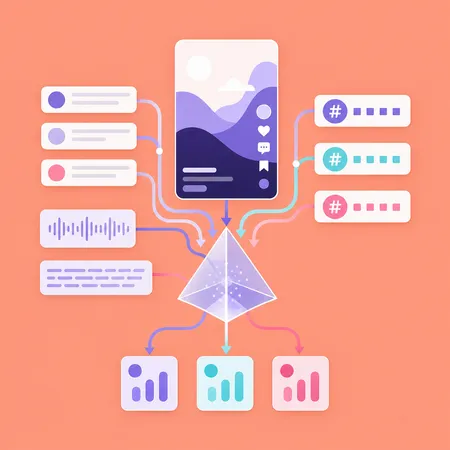
T ikTok sentiment analysis uses natural language processing (NLP) and machine learning to determine whether public TikTok conversations about a brand, product, creator, or trend are positive, negative, neutral, or mixed. It typically analyzes signals such as comments, captions, hashtags, mentions, and speech-to-text transcripts.
But TikTok creates a problem traditional sentiment analysis was not built for: much of the meaning lives outside the text. Sarcasm, facial expressions, trending sounds, stitches, duets, slang, and visual context can completely change what a comment or video means.
That makes TikTok sentiment analysis useful but imperfect.
A sentiment score should be treated as a directional signal, not a literal measurement of how customers feel.
Most teams reach for TikTok sentiment analysis at the wrong moment.
They open a dashboard after a video has already gone sideways, stare at a red bar labeled "negative," and try to reverse engineer what happened. That is monitoring as autopsy, and it teaches you almost nothing you can act on.
In this guide, you'll learn how TikTok sentiment analysis works, what data it can and cannot analyze, how sentiment scores are calculated, how accurate they are, how to run an analysis step by step, and how brands can use the results for marketing, product, reputation, and crisis decisions.
What Is TikTok Sentiment Analysis?
TikTok sentiment analysis is the use of natural language processing, machine learning, and social listening to classify the emotional tone of public TikTok conversation about a brand, product, creator, campaign, or trend. It turns accessible signals - captions, comments, hashtags, and transcripts - into structured outputs such as positive, negative, neutral, and mixed polarity. Because TikTok communicates through video and audio too, every score is a probabilistic approximation of feeling, not a literal measurement.
A one-line example makes it concrete. If 1,000 comments under a creator's review of your product classify as 70% positive, 20% neutral, and 10% negative, the tool is not telling you 70% of your customers are happy. It is telling you that, of the comments it could access and successfully read, 70% used language its model scored as positive - a very different, much narrower claim.
The fuller definition adds the layers that matter for decisions: it converts observable signals such as captions, comment threads, hashtags, mentions, transcripts, and engagement context into polarity, discrete emotions, aspect-level sentiment, and trend-level perception. Everything downstream in this article is just detail on those two sentences.
For a deeper grounding in the underlying discipline, the sentiment analysis basics hold across every platform, not just TikTok.
How Does TikTok Sentiment Analysis Work? A 5-Step Pipeline
TikTok sentiment analysis works by collecting accessible public signals, converting them into machine-readable text and metadata, classifying tone, aggregating the outputs over time, and interpreting the result against business context. Here is the pipeline in one view:
1. CAPTURE        Query the entity → pull public captions, comments,
                  hashtags, transcripts, engagement metadata
        │
        ▼
2. NORMALIZE      Clean text carefully → keep emojis, negation, and
                  repeated letters that carry meaning
        │
        ▼
3. CLASSIFY       Assign polarity, intensity, emotion, aspect, intent
                  with lexicon, ML, transformer, or multimodal models
        │
        ▼
4. AGGREGATE      Combine thousands of classifications into a
                  distribution, trend line, and theme clusters
        │
        ▼
5. INTERPRET      Tie the output to a decision and a decision owner
The clean version is short. The real version is where distortion creeps in at every layer.
1. Data capture. The process starts with an entity query, which is especially difficult on TikTok. Users shorten brand names, misspell them, invent nicknames, tag the wrong account, or show a product without naming it. The TikTok Research API codebook defines the official public scope: videos, comments, users, and related fields such as video description, hashtags, music ID, like, comment, share and view counts, favorites, duration, and voice-to-text where available. Comment data includes the text with other user information removed, and a single request returns up to 100 comments, sometimes fewer because comments were deleted. Public video access is limited to creators aged 18 and over, posted in supported regions across the US, Europe, and Rest of World, and excludes Canada. That scope is the first honest caveat of the whole discipline. Sentiment analysis is a view of accessible signals, not of the platform.
2. Text normalization. Raw social text is messy by design, so models normalize casing, emojis, repeated letters, hashtags, mentions, and punctuation. On TikTok, normalization must be careful rather than aggressive. "NOOOOO" is not "no," and stripping negation words like "no" or "not" during stop-word removal can delete the sentiment entirely. Emojis should be retained or converted to tokens rather than discarded, because a skull emoji here means "I am laughing," not something grim.
3. Classification. This is where the model assigns a label or score, and the choices sit on a spectrum. Lexicon and rule-based systems are transparent and fast but brittle on slang drift and sarcasm. Classical supervised models such as Naive Bayes and SVM generalize better when trained on the right language and category. Transformer and LLM-based classifiers use contextual representations and can handle polarity, emotion, aspect, intent, and risk in one pass, though they still depend on data quality and domain fit. Aspect-based models isolate the target of an opinion, and multimodal models attempt to fuse text, audio, and visual cues.
4. Aggregation. A single classified comment is noise. Value appears when thousands are combined into a distribution, a trend line, a negative-theme cluster, or a sentiment-weighted share of voice. The output you eventually read is a rollup, which means it carries every individual error underneath it, averaged and smoothed.
5. Interpretation. The final layer is human and analytical work that connects an output to a decision. A negative spike means something very different if it comes from loyal customers begging for a restock versus critics calling a product unsafe.
Here is where TikTok breaks the standard playbook. Text pipelines assume meaning lives in words, but a large share of TikTok meaning lives in the video and the audio. Many TikTok sentiment implementations primarily analyze textual signals such as captions, comments, hashtags, and available transcripts rather than performing full multimodal analysis of every video. That means visual cues, facial expressions, gestures, on-screen text, and visual irony, may be missing from the sentiment score.
Important limitation: Most tools that claim "TikTok sentiment analysis" are running text models on captions, comments, and transcripts. They are not watching the video. Treat the score as a read on what was written and said, not on what was shown.
A TikTok Sentiment Analysis Example (Worked End to End)
The easiest way to understand the process is to follow an analysis from raw comments to a business decision. The example below is an illustrative worked dataset - a composite built to demonstrate the method on the kind of conversation a viral product actually generates. The comments are representative teaching examples, not a named brand's private data, and the point is the reasoning, not the brand.
The scenario. A skincare serum goes viral after a creator review. Over a two-week collection window, a monitoring query for the product name, handle, and campaign hashtag captures 1,842 mentions and comments. The aggregate classification lands like this:
| Polarity | Share | Mentions |
|---|---|---|
| Positive | 61% | 1,124 |
| Neutral | 24% | 442 |
| Negative | 15% | 276 |
If you stop here, you write "61% positive, we're winning" on a slide and move on. That is the mistake. The aggregate is the least useful number in the dataset. The value is underneath it.
Step below the aggregate: the drivers. Topic clustering separates what the sentiment is about:
- Positive drivers: product effectiveness ("my skin actually cleared up"), design ("the bottle is so pretty"), and value ("cheaper than the one everyone else uses").
- Negative drivers: shipping cost and speed, packaging that leaks in transit, and price relative to expectations.
- Mixed drivers: overwhelmingly love the product, hate that it keeps selling out - a demand-planning signal disguised as complaints.
That single move - going from "15% negative" to "the negative is shipping and packaging, not the product itself" - changes the owner of the problem from marketing to operations. No headline score can do that.
Step below the drivers: individual comments. Here is where you see the classifier earn its keep or fail. A sample of anonymized, illustrative comments:
| # | Comment | Naive lexical read | Correct read | Where models fail or succeed |
|---|---|---|---|---|
| 1 | "I fear I need this 😭" | Negative ("fear," crying emoji) | Positive - strong purchase intent | A naive model reads "fear" and the sobbing emoji as distress. A context-aware model recognizes a TikTok idiom for wanting something badly. |
| 2 | "Amazing. Broke after one day 🙃" | Positive ("amazing") | Negative - sarcastic complaint | Lexical polarity anchors on "amazing" and misses that the upside-down-face emoji flips the whole sentence. Classic sarcasm failure. |
| 3 | "been using it for 3 weeks and my skin actually cleared up" | Positive | Positive | Straightforward, literal, on-topic. Almost any model gets this right - and this is the kind of comment that inflates confidence in a tool. |
| 4 | "why is shipping $12 lol" | Neutral/mixed ("lol") | Negative - aspect: shipping | The opinion is real and specific, but it targets shipping, not the product. Aspect-based models catch this; headline polarity buries it as neutral. |
| 5 | "the packaging leaked all over my bag but the serum itself is unreal" | Mixed | Mixed - negative packaging, positive product | Only aspect-level reading separates the two opinions in one sentence. A single-label model must pick one and loses half the meaning. |
| 6 | "this is so unserious 💀" | Negative ("unserious," skull) | Positive/affectionate - amusement | The skull means laughing, and "unserious" here is praise. English-tuned lexicons routinely invert this. |
| 7 | "restock PLEASE i'm begging" | Neutral (no polarity words) | Positive product love + availability frustration | The strongest commercial signal in the set - high desire, blocked purchase - and a keyword model sees almost nothing. |
| 8 | "mid. save your money" | Negative | Negative - aspect: value | Short, slangy, correctly negative. Slang-aware models handle "mid"; older lexicons treat it as unknown and default to neutral. |
Three lessons fall out of this table immediately. First, the easy comments (like #3 and #8) are not where tools differ - everyone gets those. Second, the highest-value commercial signals (#1, #7) look neutral or negative to naive models, which means a weak tool systematically under-reads purchase intent. Third, the aspect-level comments (#4, #5) are where a headline polarity score is actively misleading, because it collapses "the product is great but shipping is broken" into a meaningless average.
This is the whole discipline in miniature:
The aggregate shows the direction. The drivers explain why it moved. The individual comments reveal whether the model interpreted the conversation correctly.
TikTok Analytics vs. Social Listening vs. Sentiment Analysis
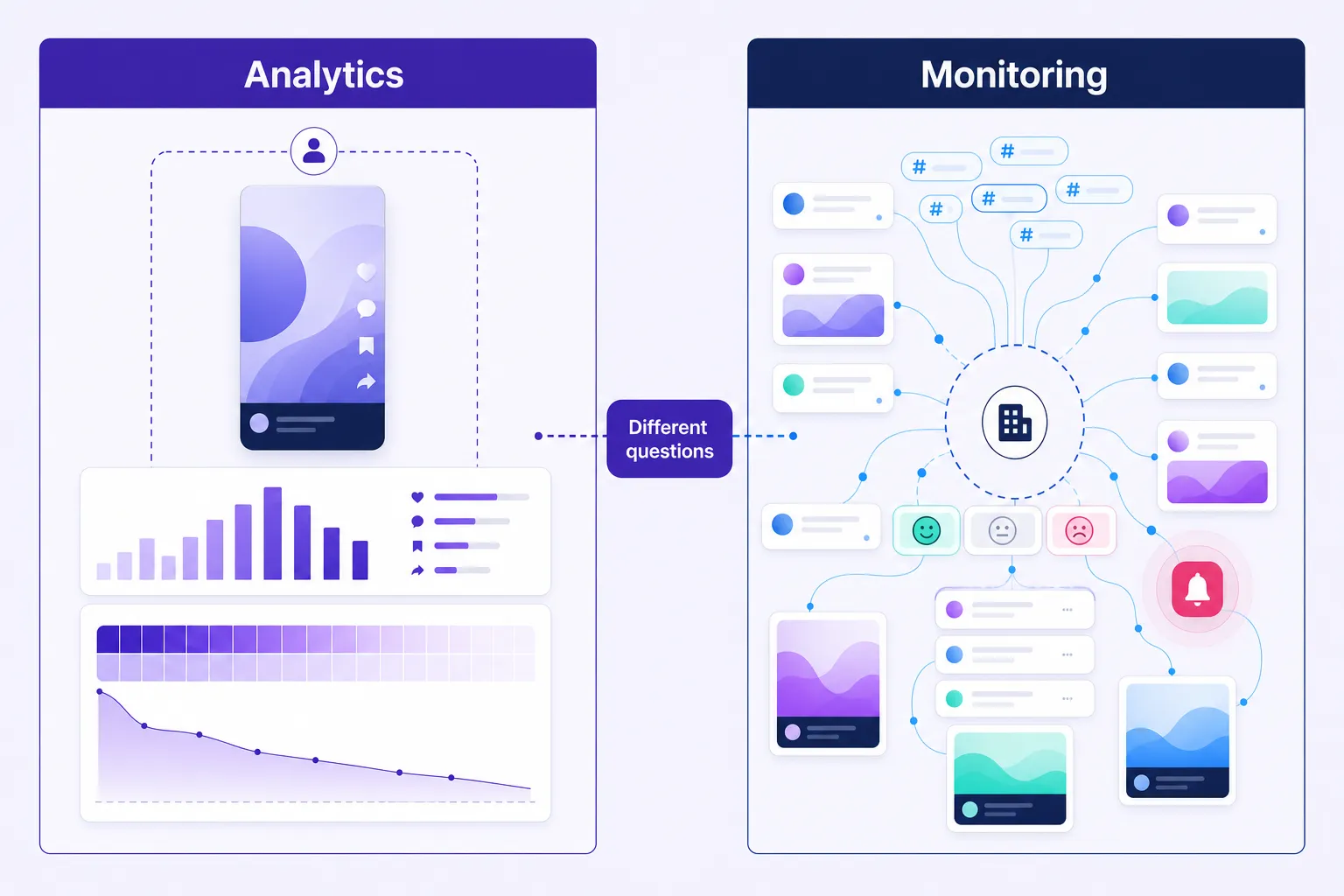
These are three functions, not one, and confusing them can produce misleading conclusions because each one measures a different part of TikTok activity.
- Analytics measures performance on content you control.
- Social listening / monitoring captures public conversation happening anywhere on the platform, on or off your posts.
- Sentiment analysis interprets the emotional tone inside that captured conversation.
A video can carry high engagement and negative sentiment at the same time. A hashtag can carry low volume and high risk. Blending all three into a single vague "social report" is how teams end up confident and wrong.
| Dimension | TikTok Analytics | Social Listening / Monitoring | Sentiment Analysis |
|---|---|---|---|
| What it does | Measures your own content's performance | Detects and captures conversation about you | Classifies the emotional tone of that conversation |
| Data type | First-party | Third-party | Applied to either, usually third-party |
| Orientation | Inward-facing | Outward-facing | Interpretive layer |
| Scope | Bounded by your own account | Public conversation anywhere on the platform | Whatever text the listening layer captured |
| Reports | Video views, profile views, follower growth, likes, comments, shares, watch time, and average watch time (across Overview, Content, and Followers) | Mentions, hashtags, stitches, duets, and comment sections on creators you do not control | Positive / negative / neutral / mixed polarity, emotions, aspects |
| Question it answers | "How did my videos perform?" | "What is being said about me, everywhere?" | "How do people feel about what they're saying?" |
| Catches a crisis three accounts over? | No | Yes | Only if the listening layer captured it first |
Native analytics is first-party and inward-facing. TikTok's own analytics documentation describes sections such as Overview, Content, and Followers, reporting video views, profile views, follower growth, likes, comments, shares, watch time, and average watch time. It answers "how did my videos perform," and it is bounded by your account.
Native analytics and monitoring answer different questions.
Analytics measures content you control. Monitoring extends the view to public conversations about your brand beyond your own account. Sentiment analysis interprets the tone inside that conversation.
Monitoring is the only layer that catches the fire starting three accounts over. This is the foundational point of brand monitoring explained: watching the conversation you do not own.
Analytics tells you how your content performed. Monitoring tells you whether your brand is in trouble. If you can only fund one, and you have a brand worth protecting, fund the second.
How TikTok Sentiment Monitoring Works in BrandMentions
In practice, a monitoring tool captures mentions across platforms and then runs sentiment on that captured stream. Rather than describe BrandMentions in the abstract, here is the actual flow it runs for a TikTok mention:
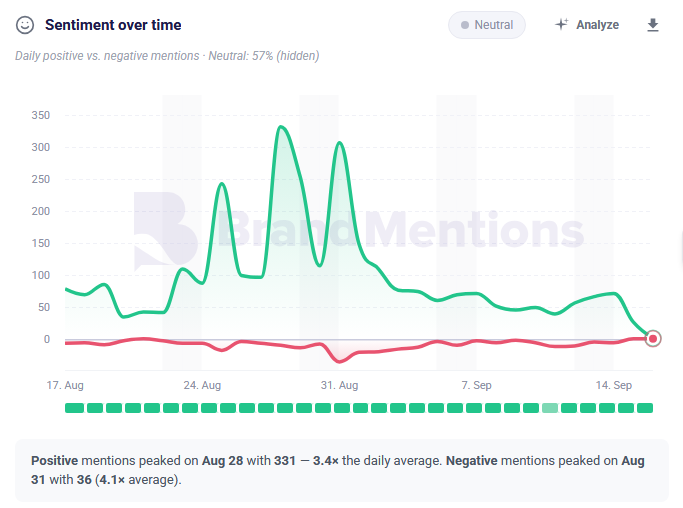
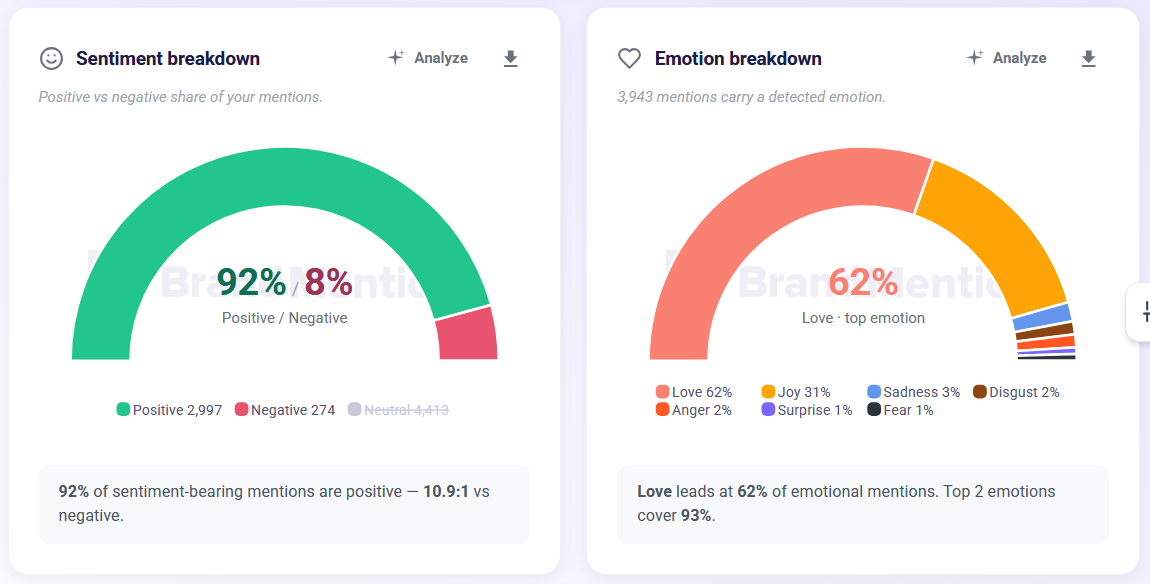
- Detection - a new public TikTok mention matching your query is captured.
- Sentiment classification - the comment is scored positive, negative, or neutral.
- Emotion analysis - it is grouped with related mentions that share the same tone (Joy, Love, Anger, Fear, Surprise, Sadness, Disgust).
- Cross-platform placement - the TikTok signal appears beside mentions from social, web, forum, news, so you see one stream instead of one platform.
- Alerting - a spike or a flagged mention pushes a notification instead of waiting for you to log in.
That cross-platform placement is the point that matters, because reputation issues rarely stay on one platform. One TikTok criticism can become a Reddit thread, a YouTube reaction, a news quote. A TikTok-only view cannot see that propagation; a cross-platform monitor can.
The competitor set is real and worth describing plainly. Enterprise suites such as Sprout Social and Brandwatch pair listening with deep publishing, approval workflows, and paid-social reporting, which serve large multinational teams well but carry heavier setup and cost. Building a custom pipeline on raw APIs and headless scrapers gives total control over the data at the price of constant maintenance every time the platform changes. The right choice depends on whether your bottleneck is capture and alerting, full-suite social management, or engineering-grade control. One neutral limitation runs across the entire category: no vendor escapes TikTok's data-access limits, private content, deleted comments, or the difficulty of multimodal interpretation.
The skill, and I mean this literally, is filtering, not collecting. Anyone can drown in mentions. The value sits in surfacing the handful that signal a real shift, which is why media monitoring programs live or die on workflow design far more than on tool selection.
What Are the Core Components of TikTok Sentiment Analysis?
A useful TikTok sentiment system has four layers: signal source, polarity, emotion, and aspect-level sentiment.
- Signal source - the observable TikTok material that carries meaning: public captions and descriptions, comment threads and replies, hashtags, tagged accounts and creator mentions, stitch and duet overlay text, engagement metadata such as views, likes, shares, and favorites, and speech-to-text transcripts where available. A model can only ever read the signal it is given access to, which is far less than the full platform.
- Polarity and intensity layer - the base classification of a unit of text as positive, negative, or neutral, often expressed as a score on a scale (for example, from -1 to +1). A graduated version rates intensity, so a comment might land as mildly positive rather than euphoric. This is the layer most dashboards show first, and it is also the layer that hides the most.
- Emotion detection - a different axis entirely, naming the feeling rather than its direction, assigning labels such as joy, anger, fear, sadness, surprise, disgust, trust, or disappointment. Two comments can both be "negative" while one is anxious and the other is furious, and that distinction changes how you respond.
- Aspect and entity-level sentiment - the most decision-useful layer, separating the target of an opinion from the overall tone. A single comment section might love a product's formula and hate its shipping. Aspect-based reading is what tells them apart, which is why it matters more to a product team than any headline score.
Sitting above all four is an interpretation layer, the human and analytical work that connects an output to a decision. A negative spike means something very different if it comes from loyal customers begging for a restock versus critics calling a product unsafe.
Sentiment is not one number. It is a stack of layers (source, polarity, emotion, and aspect), and a tool that only surfaces the top layer is hiding the layer that actually drives decisions.
The TikTok sentiment signal dependency map
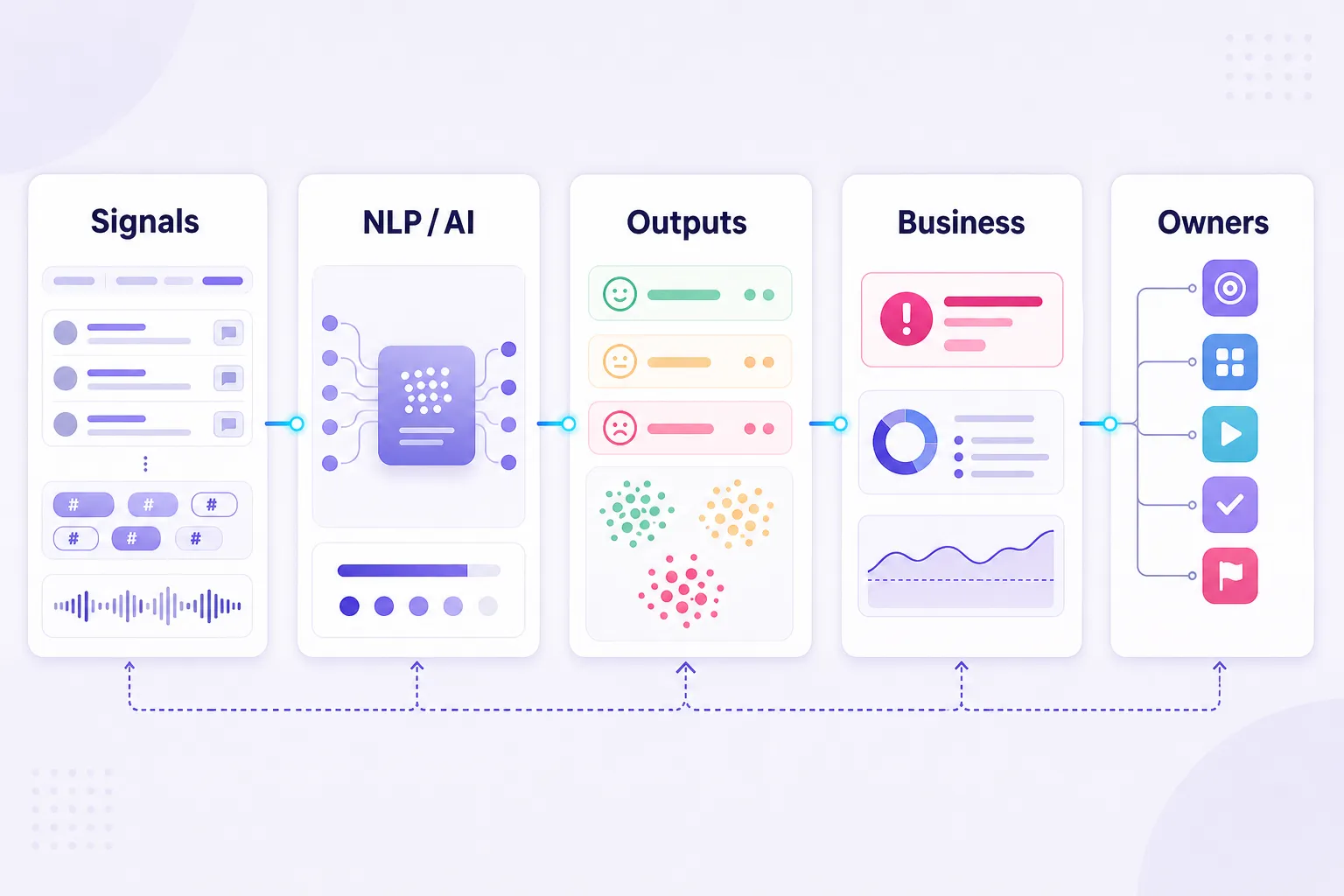
TikTok sentiment is most useful when treated as a dependency chain, not a standalone score. Each layer depends on the quality of the one before it, and a weakness low in the chain quietly corrupts everything above it.
- Accessible TikTok Signals
- Captions and descriptions
- Comments and replies
- Hashtags and branded tags
- Mentions and tagged accounts
- Stitch and duet overlay text
- Speech-to-text transcripts
- Engagement, creator, region, and time context
- NLP and AI Interpretation Layer
- Entity detection and disambiguation
- Polarity and intensity classification
- Emotion detection
- Aspect and entity-level sentiment
- Topic clustering
- Confidence scoring
- Anomaly and velocity detection
- Aggregated Sentiment Outputs
- Sentiment distribution and trend
- Negative-theme clusters
- Purchase-intent signals
- Complaint recurrence
- Creator and community influence context
- Cross-platform spread
- Business Signals Influenced
- Brand perception
- Reputation risk
- Campaign read quality
- Product feedback
- Customer support demand
- Search demand
- AI brand mention quality
- Decision Owners
- Communications escalation
- Product messaging and roadmap
- Creator strategy
- Customer care triage
- Inventory and demand planning
- Executive risk reporting
The important dependency is not "positive equals good, negative equals bad." It is whether sentiment explains a shift that no other metric can explain. If views are rising and sentiment is turning negative, attention is becoming risk. If views are flat but sentiment is intensely positive inside a niche buyer group, you may have a positioning signal. If sentiment is mixed but the negative theme is one product feature, the issue is precise rather than existential.
A useful TikTok sentiment system connects emotional evidence to a specific decision or decision owner.
Why TikTok Sentiment Analysis Is Different From Traditional Sentiment Analysis?
TikTok sentiment analysis needs its own definition because TikTok conversations are algorithmically distributed, video-led, audio-influenced, and culturally compressed, so meaning does not sit where a text model expects it.
Traditional sentiment analysis grew from text-heavy environments: product reviews, survey responses, support tickets, forums, and later short posts on Twitter-style networks. The core task there is the same, identify subjective meaning in human language. TikTok changes the container around that task.
The platform's own newsroom explainer on recommendations describes a personalized system that ranks videos using signals such as user interactions, video information like captions, sounds, and hashtags, and device or account settings. It also states that these signals are weighted, and that finishing a longer video can carry more weight than a weaker signal like a shared country setting. That matters because TikTok sentiment does not spread like a chronological thread. It spreads through personalized distribution, which means a small cluster of angry comments under one creator's video can matter more than a larger, calmer discussion somewhere the algorithm is not pushing.
Then there is language. TikTok comments are dense with irony, abbreviations, memes, and trend formats. "I'm crying" often signals delight. "This is so unserious" can be criticism, affection, or both. "I fear I need this" is usually purchase intent, not fear. A definition that stops at "positive or negative comments" will misread the platform on its very first pass.
What Does TikTok Sentiment Analysis Measure, and What Does It Miss?
TikTok sentiment analysis measures the opinion-bearing signals available in public conversation, and it misses private behavior, silent viewers, most visual meaning, and any context the model was never given. A serious explanation owes you both halves of that sentence.
| What TikTok Sentiment Analysis Reads Well | What It Reads Poorly or Cannot See |
|---|---|
| Captions carry the creator's explicit framing. | Sarcasm is the classic failure, because lexically positive words carry negative intent. "Wow, amazing quality, broke on day one" is savage and reads as praise to a keyword model. On video the problem compounds, and multimodal sarcasm detection research presented at IJCAI 2024 notes that sarcasm often requires tone, facial expression, and visual context that text simply does not contain. |
| Comments are usually the richest sentiment source, where audiences react, debate, and describe experiences in blunt language. | Visual irony is invisible to text tools: a creator can roll their eyes at a product while a neutral caption and an upbeat sound push the classifier toward positive. |
| Hashtags structure community meaning and can carry the opinion outright, as with #TikTokMadeMeBuyIt, #deinfluencing, or a #brandfail tag. | On-screen text may also be missed unless the system uses visual-processing methods. |
| Engagement context helps weight attention, because a negative comment with 4,000 likes is not the same as one with none. | Sentiment toward an unnamed brand fails entirely, since text-based mention detection cannot catch a product that is shown but never mentioned. |
| Speech-to-text brings spoken reviews and rants into the text pipeline where a transcript exists. |
TikTok's remix mechanics deserve to be treated as first-class sentiment objects, not afterthoughts. A stitch can invert the meaning of the video it quotes. A duet can mock or endorse. A reused audio template can carry a shared sarcastic or nostalgic meaning that the caption never states. A reply video can escalate a comment thread into its own conversation. Any monitoring setup that reads only standalone captions and comments will miss the propagation that actually moves sentiment across the network.
Platform Rule: TikTok exposes text, transcripts, and engagement counts. It does not hand you a "sentiment" field. Every score you see was inferred by a model reading that text, which means every score inherits that model's blind spots.
Choose your TikTok listening tools with these limits in front of you, and ask vendors directly which modalities they actually process rather than which they advertise.
How Do You Run TikTok Sentiment Analysis? 7 Steps
Running sentiment analysis well is a workflow, not a button. These seven steps turn a raw feed into a signal someone can act on.
- Define the entity and query. Brand name plus products, common misspellings, nicknames, handles, and campaign hashtags. On TikTok this step decides how much real conversation you ever see, because a product shown but not named will never enter the query.
- Choose the data scope. Decide explicitly which signals you analyze: captions, comments, transcripts, mentions, hashtags. Documenting scope now prevents you from over-claiming later.
- Establish a baseline. Do not interpret "30% negative" without knowing whether normal is 28% or 5%. Sentiment is only meaningful against its own history; the first read is a reference point, not a verdict.
- Classify sentiment. Run the model, ideally one that handles polarity, intensity, emotion, and aspect rather than a single positive/negative flag.
- Cluster by topic and aspect. Separate what people feel about from how they feel. "Negative" is useless; "negative about shipping" is a task.
- Validate a sample manually. Hand-check a representative slice against the model's labels. This is the step almost everyone skips, and it is the one that tells you whether the number is trustworthy.
- Set action thresholds. Decide in advance what movement triggers what response, and who owns it.
Example action-threshold table
These are decision logic, not universal thresholds - every brand tunes them to its own baseline and risk tolerance.
| Signal | Interpretation | Action |
|---|---|---|
| Negative % rises, volume stable | Possible perception shift | Review negative themes |
| Negative volume + velocity spike | Emerging issue | Alert comms |
| Safety theme appears | Potential high-severity issue | Human review immediately |
| Positive purchase-intent spike | Demand signal | Notify marketing / inventory |
Pre-agreeing these triggers is the difference between a dashboard people glance at and a system that actually fires. That jump is a workflow problem, not a software problem, which is why monitoring TikTok mentions succeeds on process discipline far more than on tool sophistication.
How is a TikTok sentiment score calculated?
A common baseline formula is:
Net sentiment = (positive mentions − negative mentions) / total classified mentions × 100
Applied to the worked example above: (1,124 − 276) / 1,842 × 100 = +46.
Note: There is no universal TikTok sentiment-score formula. Different tools may use different denominators, weighting methods, and scoring scales.
But that single number hides everything. Vendors use different formulas and different weighting schemes - some weight by comment likes, creator reach, or recency; some exclude neutral from the denominator; some scale to -1 to +1 instead of a percentage. As a result, a "+46" from one platform is not directly comparable to a score from another. Always read the formula before you compare two tools' numbers.
How Accurate Is TikTok Sentiment Analysis?
TikTok sentiment analysis is directionally useful but not literally precise, and its accuracy degrades sharply on sarcasm, slang, mixed-language comments, and any meaning carried by video or tone rather than text. There is no single defensible "accuracy percentage" for the platform, and you should distrust any vendor who quotes one without naming the dataset, language, task, and evaluation method behind it.
The reason is that accuracy is contingent. It depends on language and region, comment length, slang density, sarcasm frequency, the class balance between positive, negative, and neutral examples, whether the model was trained on social data at all, and whether it sees multimodal cues or only text. A study of TikTok app reviews reached roughly 82 percent accuracy with an LSTM model, but that was relatively clean, review-style text. On rapid-fire, meme-infused comment threads in dozens of dialects, performance drops well below that, and multimodal sarcasm benchmarks generally struggle to cross the high-70s in F1 score. Those numbers describe different tasks on different data, which is exactly why none of them is "the" accuracy of TikTok sentiment analysis.
Read accuracy through the metric that matches your decision.
A brand that wants to avoid crying wolf should optimize precision. Building this properly means maintaining a labeled validation set with clear annotation guidelines, checking inter-annotator agreement, reading the confusion matrix rather than a single score, benchmarking per language, and calibrating alert thresholds so a crisis trigger fires on real velocity rather than noise.
Two failure modes deserve naming. "Neutral" is a dangerous label when overused, because a model that cannot decide will over-assign it, quietly burying mixed, sarcastic, or low-confidence content that was about to matter. And speech-to-text adds its own error layer, because transcription quality varies with accent, background music, overlapping speakers, and whether captions were machine-generated or written by the creator. A garbled transcript produces a confident, wrong sentiment reading downstream.
Why Multilingual and Code-Switched TikTok Comments Are Hard to Analyze
Multilingual sentiment becomes harder when comments mix languages, transliteration, slang, emojis, and culture-specific expressions. TikTok frequently combines several of these signals inside a single short comment, making language identification and sentiment classification separate, but interconnected, problems.
There are three broad approaches, each with a real trade-off:
- Translation-first: translate everything into English, then classify. It is cheap and simple and lets you reuse strong English models, but translation frequently destroys the slang, idiom, and irony that carry the sentiment. "This is so unserious 💀" does not survive a literal translation round-trip.
- Native multilingual models: classify directly in the original language. This usually preserves context far better, but quality varies enormously by language - strong for high-resource languages, weak for under-represented ones.
- Language-specific models: a dedicated model per language. This is the strongest specialization and the most expensive to build, tune, and maintain across dozens of markets.
Then there is code-switching, which is where almost no generic explainer goes deep here. A single Romanian TikTok comment can contain Romanian, English, an emoji, and trend slang in one sentence. That is fundamentally different from clean single-language text, and it is far more common on TikTok than in the review corpora most models were trained on. Almost no generic explainer goes deep here, which is precisely why it is worth interrogating any vendor's multilingual claims comment by comment, not language by language.
There is also the question of weighting, which most explainers ignore. Unweighted sentiment treats every comment equally. Weighted sentiment accounts for comment likes, creator authority, reach, and recency. The two can point in opposite directions, and neither is automatically correct.
A brand should decide, deliberately, whether one loud creator's negative video outweighs a thousand quiet positive comments, because the tool will not decide it for you.
Finally, keep description and causation apart. Sentiment analysis can show that negativity rose after a creator video. It cannot prove, on its own, that the video caused a sales drop, a return spike, a support backlog, or a search-demand shift. Establishing cause requires additional data joined to the sentiment signal. Confusing correlation with proof is how a directional read gets oversold into a strategy nobody can defend.
A sentiment score is a hypothesis about feeling, not a measurement of it. Build your process to test the hypothesis, not to obey it.
Why TikTok Sentiment ≠ Customer Sentiment: Data Access, Sampling, and Compliance
TikTok sentiment analysis lives or dies on where the data came from, and this is the section thin competitor pages skip entirely. Accessible data is not the same as total platform reality, and treating it as though it were is how confident conclusions go wrong.
The cleanest way to see the problem is as a funnel. Every stage discards people, and the sentiment you finally read describes only the survivors:
Everyone who SAW the video
        │  (most never engage)
        ▼
People who ENGAGED (like / share / watch through)
        │  (a fraction leave text)
        ▼
People who COMMENTED
        │  (some comments are private, deleted, or hidden)
        ▼
Comments your COLLECTOR could access
        │  (API scope, region limits, rate caps)
        ▼
Comments your QUERY recognized
        │  (missed misspellings, nicknames, unnamed products)
        ▼
Comments your MODEL successfully classified
   ← THIS is your "sentiment"
By the bottom of that funnel, you are looking at a small, self-selected, query-filtered, model-approved slice of the people who saw the video.
A comment section is not a representative sample of a customer base.
Silent viewers, private shares, direct messages, and private accounts never enter the dataset, so a large share of real sentiment is structurally invisible. Representativeness is further shaped by recommendation distribution, moderation, comment deletion, bot activity, creator audience skew, and the fact that a small, highly engaged minority produces most visible comments.
On the compliance side, official access through the Research API is scoped and gated, as the codebook makes clear: public creators aged 18 and over, specific regions, Canada excluded, comment text stripped of other user information, and capped result sizes. Third-party scraping exists and is widely used, but it carries real exposure: platform terms, rate and access restrictions, and data-protection obligations under regimes such as GDPR and the EU Digital Services Act. Handling minors' data, deleted content, and any visual emotion analysis adds further sensitivity, because inferring emotion from faces edges toward biometric processing in some jurisdictions. Any program that touches this data should document its legal basis, its retention rules, and how it handles content that a user later deletes.
Because of this, every serious sentiment report should state its data source, collection window, query terms, included and excluded languages, which data types were analyzed, whether results were engagement-weighted, how low-confidence classifications were handled, and whether humans reviewed a representative sample.
Documentation is not bureaucracy here. It is the thing that lets a reader trust the number.
Why Does TikTok Sentiment Analysis Matter Now?
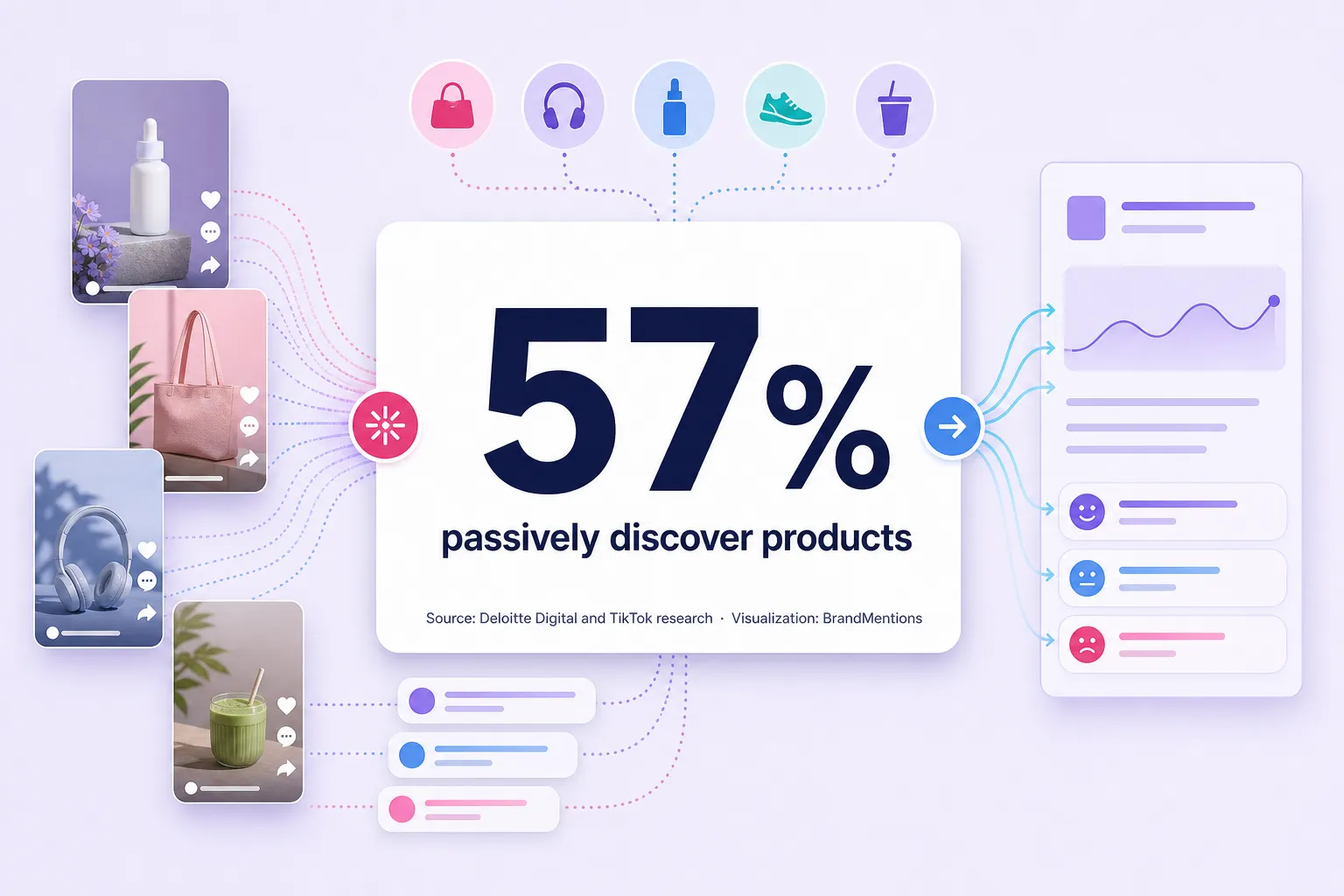
TikTok sentiment analysis matters now because TikTok shapes discovery, validation, and purchase confidence in the same environment where public opinion forms, which means the comment sections and creator conversations move demand before a customer ever reaches your site.
The discovery shift is documented. Deloitte Digital and TikTok research, "From Query to Cart" found that 57 percent of TikTok users passively discover products on the platform, and additional shares of users treat it as a place to actively seek shopping ideas, research and compare products, and search for where to buy. By the time a shopper reaches a product page, the opinion layer is often already formed. That is why sentiment matters before conversion, not after it.
Four decision domains flow from this, and each one uses sentiment differently.
- Discovery and demand. Sentiment separates exposure from persuasion. High positive volume around "where do I buy this" is a different signal from high neutral volume around "what even is this," which is different again from negative volume around "not worth it." Those distinctions shape creative, retail, and support planning.
- Reputation and trust. Reputation issues rarely begin as crises. They begin as repeated jokes, doubts, and accusations: "scam," "fake," "unsafe," "dupe," "deleted my comment," "never buying again." The job is not to panic at every phrase. It is to see when isolated language hardens into a pattern, which belongs inside broader reputation management guide thinking rather than a standalone dashboard.
- Crisis detection. A TikTok issue becomes a crisis when volume, velocity, emotion, credibility, and spread converge. Negative sentiment alone is not enough, because a viral joke can be negative and harmless while a low-volume safety complaint can be urgent. A serious crisis management planning framework treats sentiment thresholds as pre-agreed triggers, not as things to debate while a video climbs.
- Product and customer insight. Comments contain blunt, aspect-level feedback that no survey captures: "runs small," "leaks in my bag," "too sweet," "better than the expensive one," "works but smells weird." A negative comment is a roadmap note. A mixed comment is often the most commercially useful signal of all, because it shows what people accept and what still blocks the purchase.
There is a nuance most explainers skip. Positive sentiment can hide operational risk. If people love a product and cannot find it, desire curdles into frustration, and a positive spike that goes unmanaged becomes a stockout complaint within days.
A positive spike is not a victory lap. Read the topics underneath it, because loved-but-unavailable is a demand-planning emergency wearing a green bar.
One more caution matters here, because it separates good analysis from wishful analysis. There is a difference between the engagement TikTok rewards and the sentiment you want. High engagement does not necessarily mean positive sentiment. A critical or controversial video can generate substantial comments, shares, and watch time because audiences disagree with it, debate it, or want others to see it.
Engagement measures attention; sentiment helps interpret what that attention means.
Who Uses TikTok Sentiment Analysis? Use Cases by Role
Sentiment analysis is a different instrument in each function's hands, and the mistake is buying one dashboard and expecting it to serve everyone.
- Marketing and brand. They read sentiment as a live pulse on campaigns and creator partnerships. A collaboration can generate high view counts while producing confusion or mockery, or modest reach with strong intent among the right audience. Useful reads segment sentiment by campaign hashtag, creator, product claim, and trend format. Sentiment should inform the interpretation of a campaign's quality, not appear as decoration on the last slide.
- Communications and PR. Their job is the outlier, not the average. They use sentiment to spot when a story is changing shape - a product complaint becoming a values issue, a service thread becoming a news story. BrandMentions supports this by capturing TikTok mentions, applying sentiment across public profiles and hashtags, and surfacing anomalies alongside coverage on other platforms, so a comms lead sees one prioritized feed instead of monitoring each network by hand. The discipline is triage: isolating the mention that is about to move.
- Product and insights. They want aspect-based sentiment, not headline polarity. Knowing that sentiment is "negative" in the abstract is useless. Knowing that negativity is attached to sizing, price, durability, or packaging turns social noise into a prioritized backlog.
- Customer support. They use sentiment to catch recurring service issues before the ticket queue reflects them. When comments repeat "no one answers emails," "arrived broken," or "app crashes on upload," the issue is already public, and proactive communication beats a silent backlog.
- Executives. They read sentiment as a trend, not an incident. Is favorability drifting up or down over a quarter, what topic is driving the change, is it contained to TikTok or spreading, and which function owns the response. A dashboard everyone glances at and no one acts on is a cost, not an asset.
If a report cannot be tied to a specific person's specific decision, stop generating it. Naming the decision first is the difference between buying an insight and buying a chart.
TikTok Sentiment Tool Selection Checklist
Before you commit to any tool or pipeline, run it against this checklist. Each item maps to a failure mode described above, and a vendor's willingness to answer plainly is itself a signal.
- Coverage: Does it capture mentions, hashtags, comments, stitches, and duets - or only your own posts?
- Languages: Which languages are natively supported, and is the approach translation-first, native multilingual, or language-specific? How does it handle code-switched comments?
- Transcripts: Does it ingest speech-to-text, and how does it handle low-quality or machine-generated captions?
- OCR / on-screen text: Does it read text embedded in the video frame, or ignore it?
- Sarcasm and slang: How does it handle emoji meaning, negation, and platform idioms? Ask for examples, not assurances.
- Aspect sentiment: Can it attach sentiment to a feature (shipping, price, sizing), or only to the whole mention?
- Confidence scoring: Does it expose model confidence so low-certainty items can be reviewed?
- Weighting: Can you choose weighted vs. unweighted sentiment, and see which one a score used?
- Validation: Can you export a sample to hand-label and measure precision, recall, and F1 by class?
- Data source and API: Does it use official access, scraping, or a mix - and can it document the legal basis?
- Deletion handling: What happens to a mention when a user deletes the underlying comment?
- Alerting: Can you set velocity and theme-based triggers routed to the right owner?
If a vendor cannot answer half of these, you are buying a green bar, not a sensor.
How Did Sentiment Analysis Evolve From Opinion Mining to Multimodal Reading?
Sentiment analysis was once called "opinion mining," and the older name is honest about the limits. The system does not measure emotion directly. It extracts signs of opinion from human expression, which is a very different thing.
Early social systems leaned on rules and lexicons. A word like "excellent" scored positive, "terrible" scored negative, and punctuation, capitalization, and emoji adjusted the weight. Hutto and Gilbert's 2014 VADER paper (*VADER: A Parsimonious Rule-based Model for Sentiment Analysis of Social Media Text*, ICWSM) is the clearest example of this lineage, because it was tuned for the short, informal, punctuation-rich language of social platforms and still reads emojis, booster words, and capitalization as signal.
Supervised machine learning came next. Instead of relying only on dictionaries, models learned patterns from thousands of human-labeled examples across positive, negative, and neutral classes. Then transformer architectures reset the baseline again. Devlin, Chang, Lee, and Toutanova's 2018 BERT paper (*BERT: Pre-training of Deep Bidirectional Transformers for Language Understanding*) showed how pre-trained bidirectional language representations could be fine-tuned for many tasks, which matters for sentiment because the model can use surrounding context rather than isolated keywords.
Emotion analysis widened the output. Rather than forcing every mention into three buckets, it asks which emotions appear. Demszky and colleagues' 2020 GoEmotions paper (Google Research, *GoEmotions: A Dataset of Fine-Grained Emotions*) labeled 58,000 English Reddit comments across 27 emotion categories plus neutral. It is not a TikTok dataset, but it shows the direction of travel: richer taxonomies and multi-label outputs, not a single polarity flag. The frontier now is multimodal interpretation, studied in work like a survey of multimodal sentiment analysis, which explains why single-channel text is often insufficient for modern social content. TikTok is exactly the environment that breaks text-only reading, because the meaning may live in the sound, the facial expression, the stitch target, or the shared knowledge of a trend.
Methodology and Sources
This explainer prioritizes primary sources over secondary summaries. The core references are:
- TikTok Research API codebook - official public data scope, fields, and access limits (Tiktok Developers).
- TikTok newsroom: how we recommend videos - the platform's own account of weighted recommendation signals (Tiktok).
- Deloitte Digital and TikTok, From Query to Cart - commerce and discovery behavior research (Deloittedigital).
- Hutto & Gilbert (2014), VADER, ICWSM - rule-based social-media sentiment (Aaai).
- Devlin, Chang, Lee & Toutanova (2018), BERT - pre-trained bidirectional transformers (Arxiv).
- Demszky et al. (2020), GoEmotions, Google Research - fine-grained emotion dataset (Arxiv).
- Survey of multimodal sentiment analysis - why single-channel text is insufficient (Sciencedirect).
- Multimodal sarcasm detection research, IJCAI 2024 - the role of tone and visual context in sarcasm (Ijcai).
- Google Search Central: AI features documentation - how AI Overviews and AI Mode surface information (Google Developers).
- OpenAI documentation on ChatGPT search - how public content can appear in generated answers (Openai).
The worked example in this article is an illustrative composite built to demonstrate method, not a named brand's private data.
Mini Glossary
Aspect sentiment: Sentiment assigned to a specific feature or topic rather than the whole mention. Positive about the formula, negative about shipping.
Emotion analysis: Classification beyond positive, negative, and neutral into emotions such as anger, joy, fear, sadness, disgust, surprise, trust, or disappointment.
Entity recognition and disambiguation: Identifying the brand, product, person, creator, or hashtag being discussed, including nicknames, misspellings, and abbreviations, and separating real mentions from lookalike noise.
Mixed sentiment: A mention that carries both positive and negative meaning. "Love the formula, hate the packaging."
Multimodal sentiment analysis: Sentiment analysis that uses more than text, combining audio, video, image, facial expression, or visual context.
Net sentiment: A summary score, commonly (positive − negative) / total classified × 100. Formulas and weighting differ by vendor, so scores are not directly comparable across tools.
Polarity: The basic sentiment direction of a mention, usually positive, negative, or neutral.
Sentiment analysis: The automated classification of opinion or emotional tone in text or other signals.
Sentiment confidence score: A model's estimated confidence in its own label. Low-confidence outputs are review candidates, not conclusions.
Sentiment velocity: The rate at which sentiment changes over time. A fast negative increase usually matters more than a stable negative baseline.
Share of voice by sentiment: Conversation volume across brands or topics, segmented by emotional tone.
Social listening: The ongoing collection and analysis of public conversations about a brand, topic, product, or competitor.
Topic clustering: Grouping mentions into themes such as price, quality, sizing, safety, or purchase intent.
Frequently Asked Questions
What is the difference between sentiment analysis and social listening on TikTok?
Sentiment analysis is a technique; social listening is the practice that uses it. Sentiment analysis classifies the emotional tone of text into positive, negative, neutral, or specific emotions. Social listening is the broader activity of capturing brand-relevant conversation across the platform, then applying sentiment analysis alongside volume, reach, influencer identification, and topic detection to interpret it. You can run sentiment analysis on a single spreadsheet of comments. Social listening is the ongoing system that feeds it.
How is a TikTok sentiment score calculated?
A common baseline is net sentiment = (positive mentions − negative mentions) / total classified mentions × 100. On a dataset of 1,842 comments split 61% positive, 24% neutral, and 15% negative, that yields +46. However, vendors use different formulas and weighting schemes - some weight by likes, reach, or recency, some exclude neutral from the denominator, and some report a -1 to +1 scale instead - so scores from different platforms are not necessarily directly comparable.
Can TikTok sentiment analysis detect sarcasm?
Partially, and not reliably. Sarcasm is one of the hardest problems in the field because positive words carry negative intent, and on TikTok the giveaway often lives in tone, facial expression, or a reused audio template rather than the text. A comment like "Amazing. Broke after one day 🙃" reads as praise to a keyword model. Specialized multimodal models that combine text with audio and video improve detection, but most commercial tools read text alone and will misclassify a meaningful share of sarcastic comments. Assume some sarcasm slips through as false positives.
What data does TikTok sentiment analysis actually use?
Primarily text and transcribed audio. Through official research access, available public information includes videos watchable by everyone, comment text with other user information removed, engagement counts, hashtags, video descriptions, and voice-to-text or subtitles where available. Tools typically process captions, comments, hashtags, and transcripts. The visual channel, including facial expression, gesture, and on-screen text, is rarely analyzed by mainstream sentiment tools despite carrying real meaning.
How well does TikTok sentiment analysis handle non-English comments?
It varies sharply by approach and language. Translation-first pipelines are cheap but often destroy slang and irony; native multilingual models preserve context better but perform unevenly across languages; language-specific models are strongest but expensive to maintain. TikTok makes this harder because comments frequently code-switch - mixing two languages, emoji, and trend slang in a single sentence - which most general-purpose multilingual models were not trained to handle.
Is TikTok sentiment analysis accurate enough for business decisions?
It is accurate enough as a directional signal and an early-warning mechanism when paired with human oversight, and not accurate enough to be treated as fact on any single comment. For high-stakes calls in reputation, product safety, legal, health, or finance, treat automated scores as one input beside qualitative sampling and community observation. A sudden shift in polarity is always worth investigating, regardless of the exact number attached to it.
Can TikTok sentiment analysis analyze videos?
Sometimes, but not always. Many implementations primarily analyze captions, comments, hashtags, and transcripts. Full video sentiment analysis requires multimodal systems capable of interpreting visual, audio, and textual signals together. Ask a provider which modalities its system actually processes rather than assuming “TikTok sentiment” means the video itself was analyzed.
What is the best way to measure TikTok sentiment?
Combine automated classification with trend analysis, topic or aspect detection, and manual validation. A single positive/negative percentage is less useful than understanding what changed, which topics caused the change, how quickly it is spreading, and whether a human review confirms the model's interpretation.
The Bottom Line on TikTok Sentiment Analysis
TikTok sentiment analysis can help brands understand whether public conversations are becoming more positive, negative, mixed, or emotionally intense but the score is only as reliable as the data and context behind it.
The bigger shift is that TikTok sentiment no longer stays on TikTok. Public language on the platform seeds web content, reviews, creator summaries, and discussion threads, and AI systems then synthesize that evidence into answers. Google Search Central's AI features documentation describes how AI Overviews and AI Mode surface and summarize information from Search, and OpenAI's documentation on ChatGPT search explains how public content can be included in generated answers. That creates a reputation loop in which the emotional consensus of a TikTok conversation can migrate into the answers customers see when they never open the app at all.
The question to ask is not simply “What is our TikTok sentiment score?”
Ask four questions instead:
What changed? Why did it change? How confident are we in the interpretation? Who needs to act on it?
That is the difference between treating sentiment as another dashboard metric and using it as a decision signal.