How to Track Every TikTok Mention of Your Brand in 2026 (Tagged and Untagged): The Complete Guide
A definitive, step-by-step system for capturing every TikTok brand mention, tagged, untagged, spoken and on-screen, using native tools, Content Suite, keyword tiers and social listening.
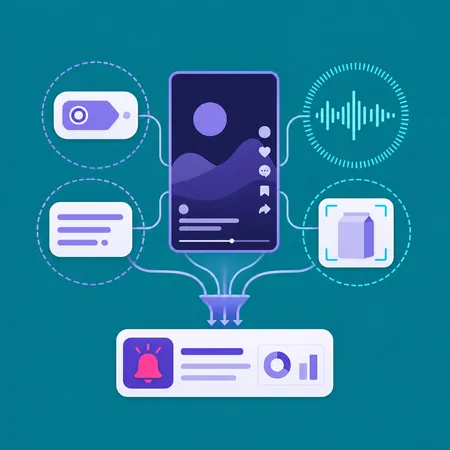
Here is the uncomfortable part most guides bury. The mention you get notified about is almost never the mention that matters. The @tag is the polite version of your reputation, the small share of people who bothered to link your handle. The conversation that actually moves purchase intent usually happens without your handle, often without any text at all, spoken into a phone camera or printed across a video frame.
I build tools that watch how brand mentions behave at scale. On TikTok the pattern is sharper than anywhere else. Text is the exception. Speech and on-screen references are the rule. If your monitoring stops at the notification bell, you are reporting on a rounding error and calling it coverage.
This guide fixes that with an actual system. The free native layer. The native discovery layer most teams have never opened. The paid layer that hears what humans and hashtags miss. Plus the operational plumbing that turns a caught mention into a decision.
Summary
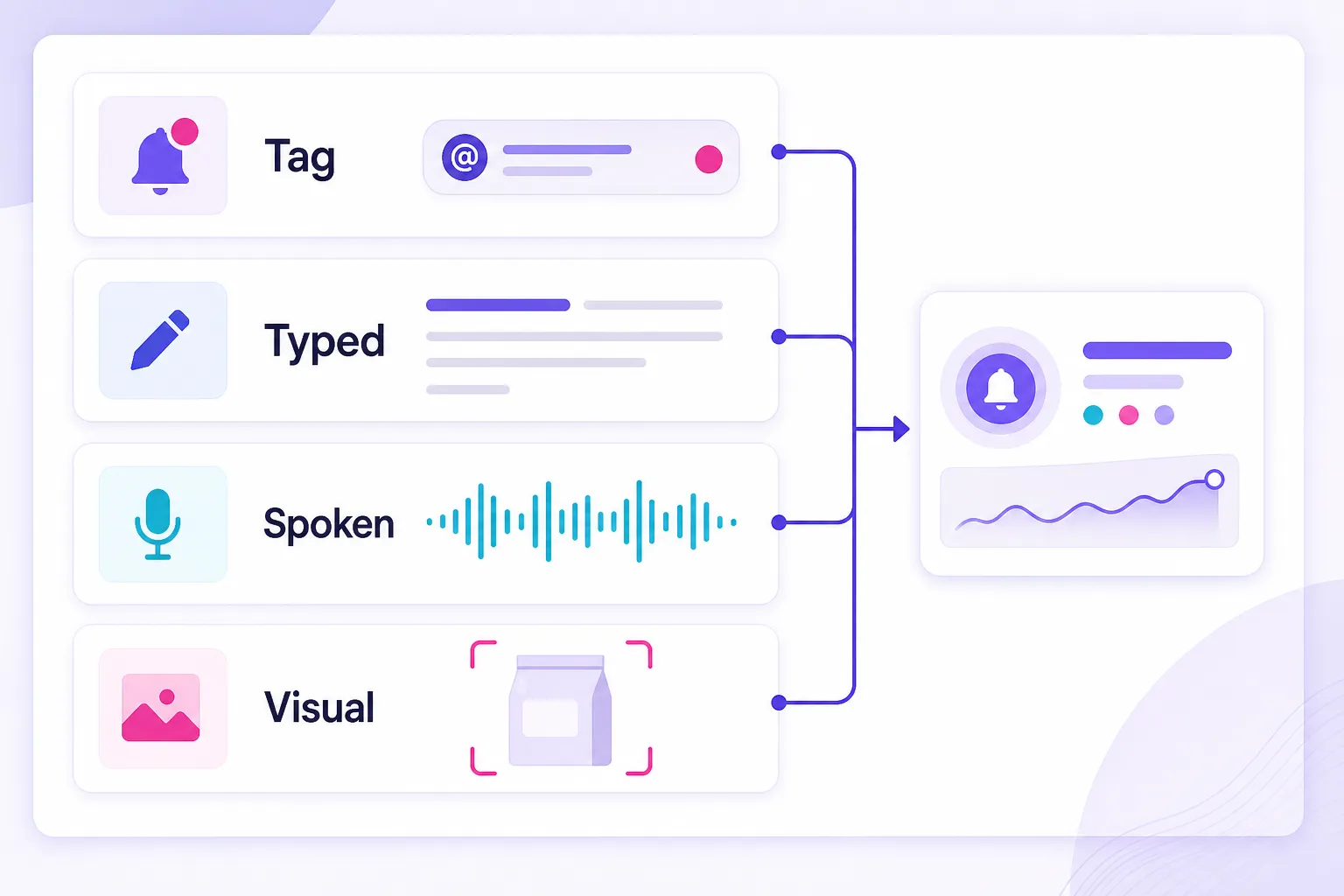
- TikTok mention tracking in 2026 needs four capture layers, not one: the tag, typed text (captions, hashtags, comments, on-screen overlays), the spoken word, and the visual mark (logo or packaging). Each layer needs a different detection method.
- Native TikTok notifications only surface @-tagged mentions. You reach them through Inbox, then Activities, then All activity, then the "Mentions and tags" filter. Everything untagged, spoken, or shown stays invisible to that bell.
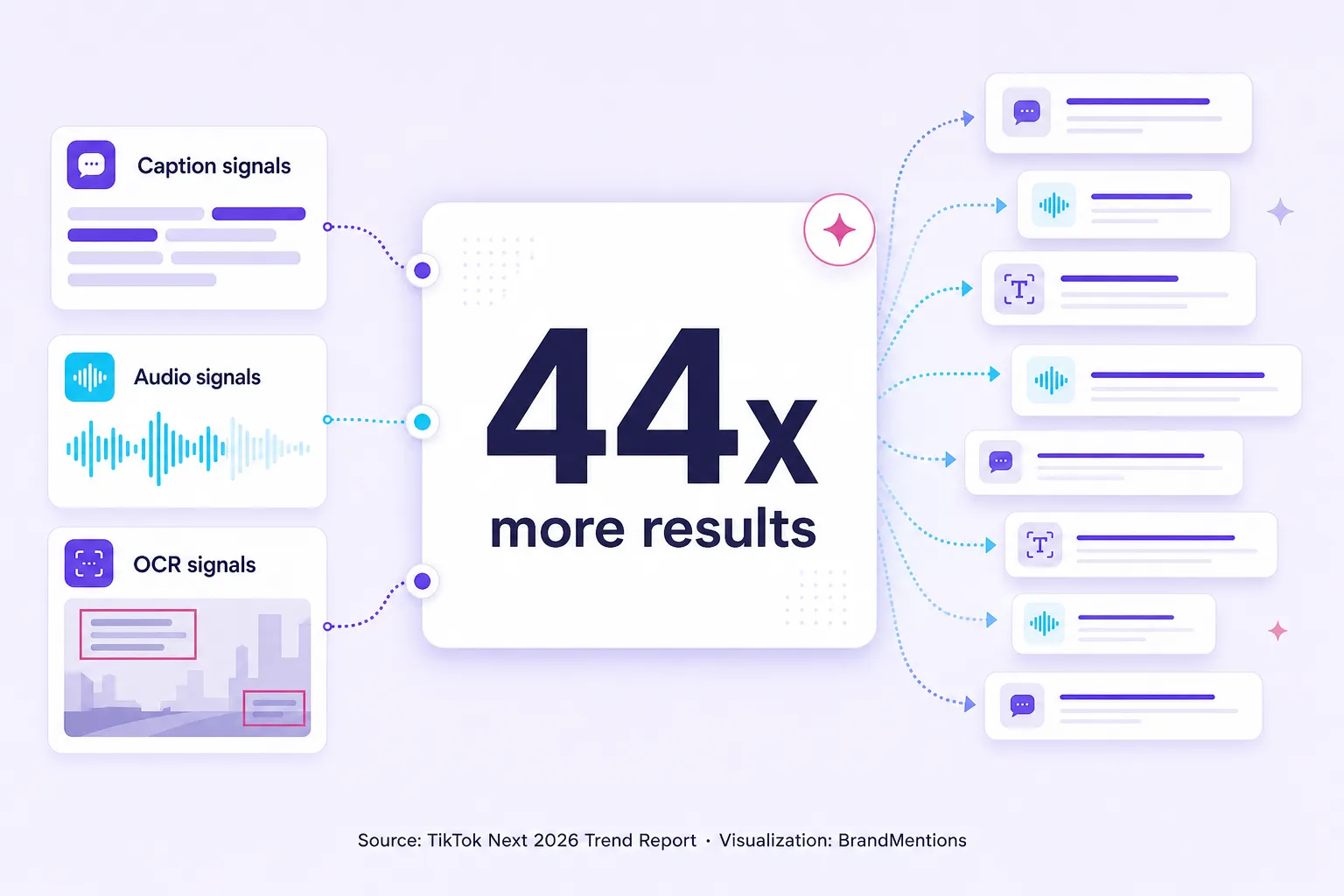
- TikTok's own Content Suite reads more than captions. Its documentation names captions, hashtags, voiceover automatic speech recognition, and on-screen optical character recognition as brand-relevance signals, and TikTok's Next 2026 Trend Report states Content Suite can surface up to 44 times more results than manual search.
- There is no open TikTok search API for marketers. TikTok's Research API is restricted to qualified non-commercial researchers, and Business API mention endpoints are narrow. Every third-party tool reaches untagged, spoken, and on-screen mentions through collection methods that can shift.
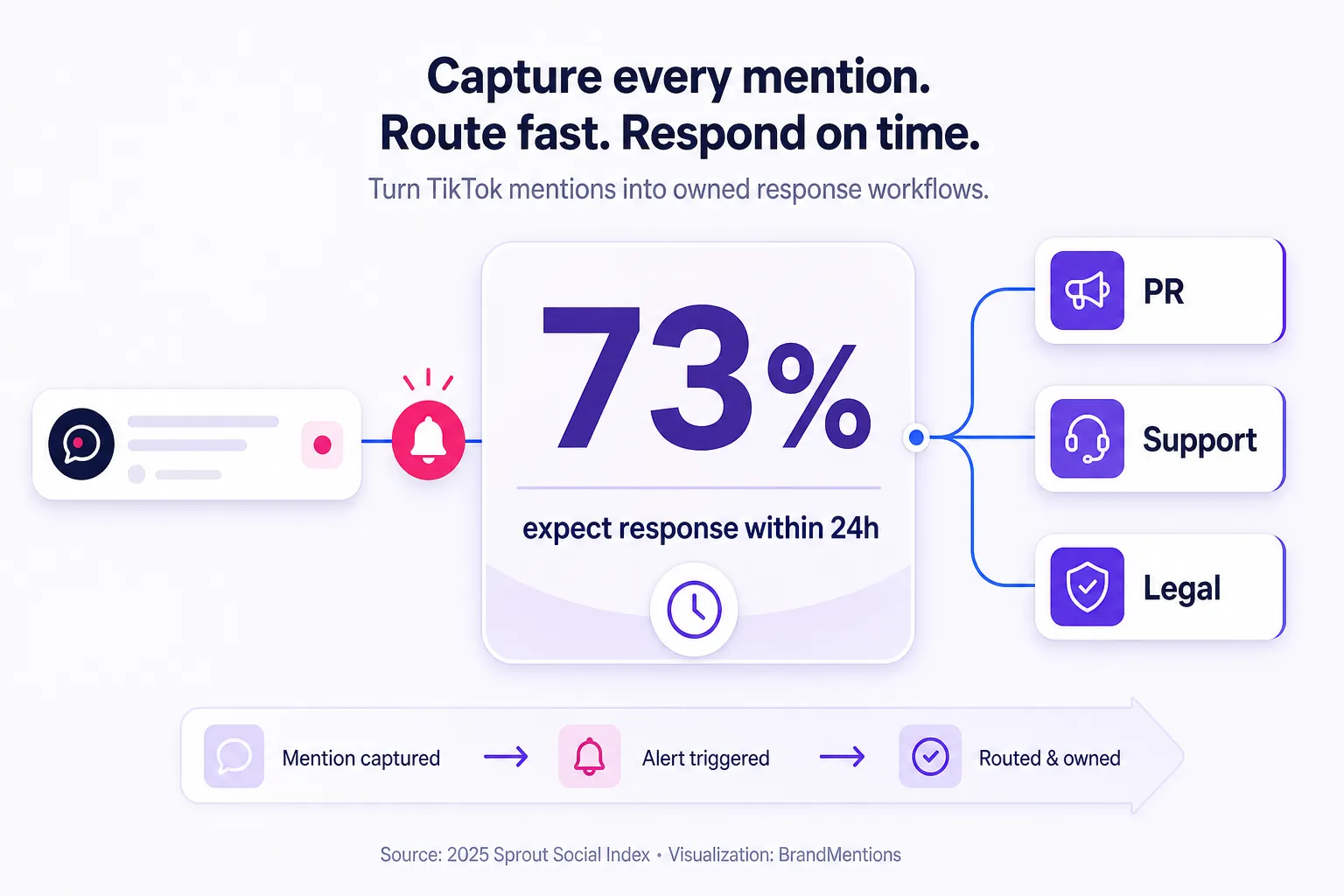
- Response speed is now graded. The 2025 Sprout Social Index found 73% of social users expect a brand to respond within 24 hours. On a fast platform, that is a ceiling, not a target.
- TikTok mentions feed AI answers indirectly. McKinsey found only 1% of sources cited by large language models for consumer brand queries came from brand-owned sites, so third-party TikTok conversation increasingly shapes what an answer engine repeats about you.
At a Glance: Which Tracking Method Fits Your Scenario
- Best for zero budget and low volume: The Native Inbox Workflow. If you get a light stream of mentions and mostly need tagged replies, the "Mentions and tags" filter plus scheduled manual search covers Layer 1 and a slice of Layer 2 for the price of your time.
- Best for turning fan videos into ads: TikTok Content Suite. It surfaces organic creator videos that name your brand in speech and on-screen text, but access is gated through a TikTok representative and it is built for advertisers, not crisis monitoring.
- Best for catching untagged, spoken, and on-screen mentions at scale: Third-party listening with ASR and OCR. This is the only layer that hears a creator say your name without typing it.
- Best for PR and customer care: Layered alerting with response SLAs and named owners. Once volume climbs, routing beats discovery.
- Best for executive reporting: Sentiment and spike analysis against your own baseline. Volume alone is noise with a dashboard; the trend line is the signal.
- Best for high-volume or high-risk brands: A hybrid workflow. Native tools confirm tagged signals, Content Suite finds native UGC, and a listening layer handles the untagged, spoken, visual, and cross-channel context.
What Is a TikTok Brand Mention in 2026?
A TikTok brand mention in 2026 is any public reference to your brand, product, campaign, or people inside a TikTok video, comment, or its metadata, whether that reference is tagged, typed, spoken aloud, or shown on screen. That definition is the whole game, because each layer needs a different capture method. If you have never formalized what brand mentions are for your team, start there before you buy anything.
The Four Layers Where a TikTok Mention Hides
Think in four layers.
Layer 1, the tag. Someone types @yourbrand. This triggers a notification. It is the only layer native TikTok reliably shows you, and it is the smallest.
Layer 2, typed text. Your brand name or a campaign hashtag appears written in a caption, a comment, or a text overlay burned into the video. No @, no notification. On-screen overlays in this layer are readable by optical character recognition (OCR), which converts visible text into searchable text. You have to search or transcribe for all of it.
Layer 3, the spoken word. A creator says your name on camera and never types it. TikTok's own commercial-content rules treat a spoken product recommendation as a brand mention, and the FTC's Endorsement Guides treat a verbal shout-out as a disclosable endorsement. You will not find it with a text search. You need automatic speech recognition (ASR).
Layer 4, the visual mark. Your logo sits on a package in frame, or your product appears with no name said or written. This is a separate technical problem from OCR. Reading a text overlay is not the same as recognizing a logo or a package, and most tools handle the first far better than the second. Be precise about that difference when you evaluate coverage.
If your TikTok reporting only counts Layer 1, you are measuring how polite your audience is, not how often they talk about you. The mentions that shape demand almost always live in Layers 2 through 4.
The rest of this guide is a method for each layer, plus the routing and interpretation that make a mention worth catching.
How Is Tracking Video Mentions Different From Tracking Text Mentions?
Text mentions are a search problem. Video mentions are a perception problem. That one distinction reorganizes your entire stack.
With text, the brand name is already a string. A tool matches it and you are done. With video, the brand name may exist only as sound waves in someone's audio, or as pixels in a frame. Neither is searchable until a machine converts it. ASR transcribes what is said. OCR reads what is shown. Without both, a video is a black box to a text tool.
The scale of what gets lost is not subtle. A creator can hold up your product, say your name in the first three seconds, compare you to a rival, and never tap the @ button once. That video can move demand. A text-only monitor sees nothing.
Text tracking versus video tracking, the core difference: text tracking answers "who wrote my name," and you can do a meaningful slice of it for free. Video tracking answers "who said or showed my brand," and you cannot do it manually at any real volume, because a human would have to watch every second of every video to find a five-word spoken mention at minute four. That gap is what money actually solves on TikTok.
How Do TikTok Mentions Shape AI Answers and Search in 2026?
TikTok mentions affect AI visibility indirectly, not magically. An answer engine does not need to scrape every video in real time for TikTok conversation to matter. It absorbs the public web around TikTok: indexed pages, videos embedded in articles, creator recaps, Reddit threads, reviews, and comparison pages that repeat the same claims.
The direction is clear in the research. McKinsey's consumer work found that only 1% of sources cited by large language models for consumer brand queries came from brand-owned websites, which means third-party discussion often shapes the answer more than your own site does. Pew Research Center found that 62% of U.S. adult TikTok users use the platform to look for product reviews or recommendations. TikTok is a recommendation layer, not just entertainment.
The Citation Drift Frame: an AI answer rarely cites the original TikTok. It cites the article, review, or Reddit thread that repeats and validates the TikTok claim.
That is why your TikTok workflow should log the claim, the source, the sentiment, and the spread path, not just the single video. One video is an event. The repetition path is the reputation risk, and it is what feeds the answer engine later.
Why Does Getting Bigger Make Native Tracking Worse?
Here is the counter-intuitive part almost nobody says out loud. Growth makes native tracking worse, not better.
A tiny brand gets tagged because fans want to be noticed by it. A household name gets discussed like a common noun. People stop addressing the brand and start referencing it to their own audience. So the exact moment you most need coverage, when you are big enough to be talked about casually, is the moment your notification bell becomes least representative.
Analysis suggests roughly half of TikTok mentions carry no tag at all, which is consistent with what I watch across mention data everywhere. Popularity actively hides you from your own notifications. Plan your system for the brand you are becoming, not the one you were when tagging was the norm.
Method 1: The Free Native Workflow (Inbox Filter and Saved Searches)
What it is: the tag-and-manual-search layer you run inside the TikTok app at no cost, covering Layer 1 fully and Layer 2 partially.
Start with the filter. In the app, tap Inbox, then Activities, then All activity, then choose "Mentions and tags," per TikTok's notification settings. Turn on push for this category only if your volume is low enough to review each one. Check it daily. This gives you every @tagged video and comment, and nothing else.
Then run manual searches to reach untagged text. Type your brand name, common misspellings, and campaign hashtags into the search bar on a schedule, and review the Top, Videos, and date-sorted tabs. Save those searches as a repeatable checklist. This is the backbone of most free listening options teams cobble together before they buy software.
The constraint, stated plainly: TikTok search returns ranked, personalized results, not a complete mention index. Two teammates searching the same brand can see different results because search is a product experience, not a neutral export. Manual search also gives you zero sentiment, zero reach data, and zero history.
Non-obvious insight: do not run these searches from your personal account. Your own watch history biases what surfaces. Use a clean, work-only brand account, and have a second teammate run the identical search once a month as a sanity check on personalization drift. It costs nothing and it catches blind spots you cannot see from inside your own feed.
A second non-obvious source: your best free supply of untagged text is often the comment section under other people's viral category videos, not standalone posts about you. When a big creator reviews your category, buyers name-drop brands in the comments. Native search barely indexes those, so read the comments under the top videos in your niche by hand.
Method 2: TikTok Content Suite for Creator and UGC Discovery
What it is: TikTok's native discovery product that surfaces organic videos mentioning your brand so you can review and, if you choose, turn them into ads.
This is the layer almost nobody outside performance teams has opened, and it is the only native tool that reaches speech and on-screen text. Per the TikTok Content Suite documentation, it is integrated into TikTok Ads Manager and TikTok One, searches organic videos across the platform, and captures brand relevance through captions, tagged Business Accounts, hashtags, voiceover via ASR, and text within video via OCR. It then ranks what it finds by ad potential and filters for brand safety.
The headline number most marketers remember comes from the TikTok Next 2026 Trend Report: Content Suite can surface up to 44 times more results than manual search. In practice that means it can hand you a video where a creator said your name out loud and never typed it, which the Inbox filter will never do. It doubles as a way to find creator UGC worth amplifying.
The constraints, honestly. Content Suite is built for advertisers, not real-time defense. Access is not self-serve; TikTok's documentation states you must be granted access by a TikTok representative and set up a brand profile first (brand names, alternates, misspellings, logo, handle, keywords, and blocklists). It skews toward positive, ad-worthy content, because its job is to find videos you would want to boost, not the complaint at minute six of a rant. Its newer AI Search is rolling out to select customers only, so access is uneven.
Non-obvious insight: Content Suite improves your creative even if you never run a Spark Ad. Pull the phrases creators already use for your product, then write future briefs around that language instead of your internal slogans. Your best positioning copy often appears first in unpaid creator speech.
Content Suite is a discovery engine, not an alarm. Use it as a weekly harvest for advocacy and UGC, and keep your crisis monitoring on a separate, faster system. Confusing the two is how teams admire a folder of happy clips while a problem quietly spreads.
Method 3: Build Your Keyword-Tier System First
What it is: the taxonomy that decides what counts as a mention, feeds every search and every tool, and keeps your alerts from drowning you.
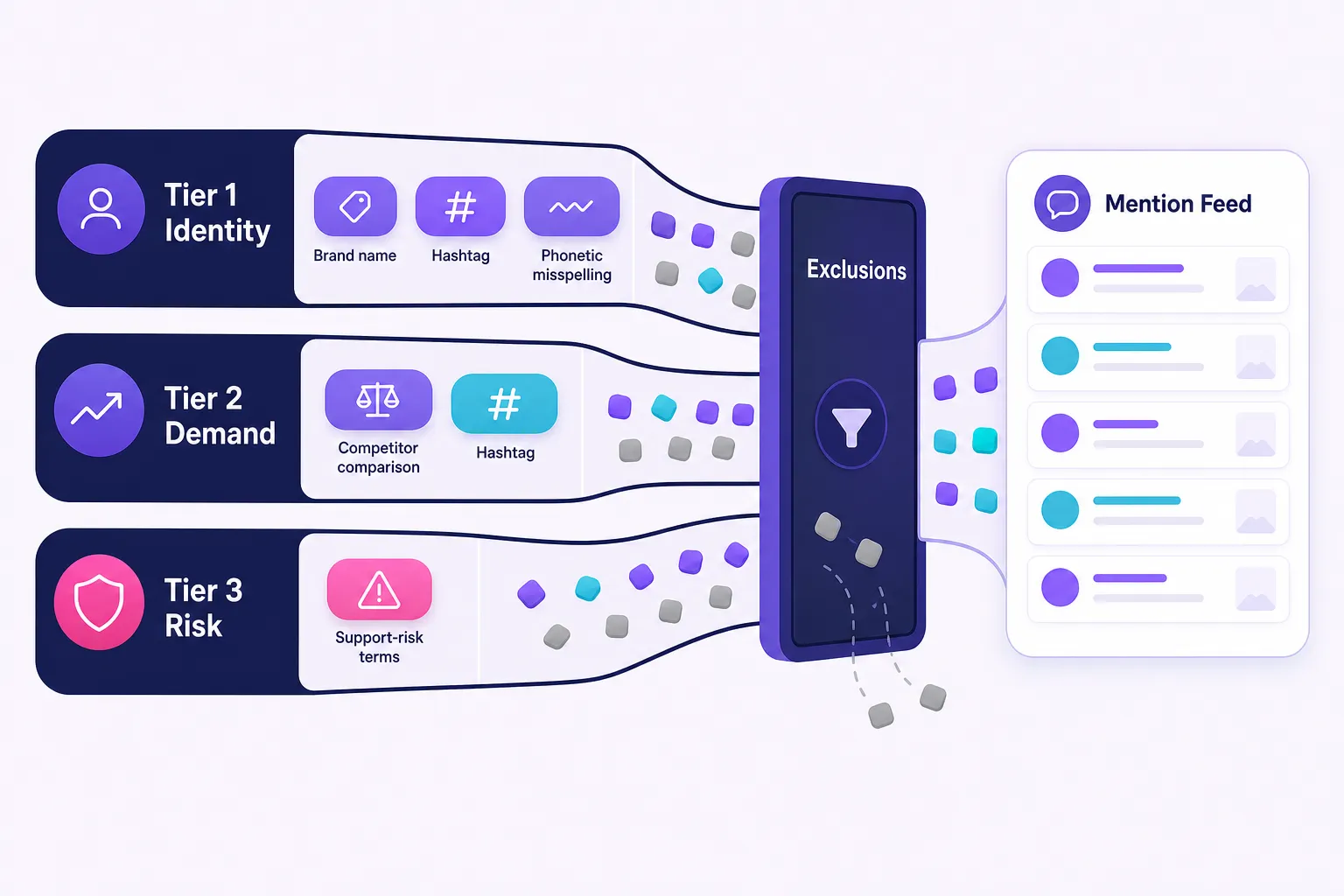
Before any tool matters, define what you are listening for, because the FTC's endorsement rules make clear that a brand reference includes what is said and shown, not just what is tagged. Build the map in three tiers.
Tier 1, identity. Exact brand name, @handle, and owned hashtags. Near-certain to be about you. Highest priority, tightest match.
Tier 2, demand. Product line names, campaign terms, founder or spokesperson names, and the misspellings and pronunciation variants people actually use. If your brand is pronounced differently than it is spelled, this tier captures what ASR transcribes phonetically.
Tier 3, risk and category. Competitor comparison phrases ("vs," "dupe," "alternative," "better than," "worth it"), purchase-intent language, and support red flags like "refund," "broken," "scam," or "rash." Noisier, but this is where crises and switching moments live.
Then add exclusions. If your brand name is also a common word, a city, a song, or an unrelated app, you need negative terms, which is exactly the job Boolean search operators were built for (for example, "product X" AND (refund OR broken) minus the homonyms). A query without exclusions is a firehose. A query with smart exclusions is a feed you will actually read. Feed branded and community hashtags into the same rules so you monitor hashtags and text mentions in one view.
The Misspelling Tax: budget roughly a fifth of your Tier 2 terms for wrong spellings and voice-transcription errors. Spoken mentions get transcribed phonetically, so a tool listening only for the correct spelling silently drops part of your audio layer. This is why two tools pointed at the same brand return different numbers.
Non-obvious insight: the most valuable Tier 3 keyword is usually "vs" plus your competitor's name. Comparison videos are pure purchase-intent content, they rank in TikTok search, and they reveal exactly which objections cost you sales. Track your rivals' comparison language as aggressively as your own name.
Method 4: Using TikTok Social Listening Tools for Untagged, Spoken, and On-Screen Mentions
What it is: the paid third-party layer that continuously scans public TikTok content and applies ASR and OCR to reach Layers 2, 3, and 4 at scale.
This is where the free ceiling breaks. A listening platform ingests captions, comments, and hashtags automatically, then transcribes spoken audio and reads on-screen text, so a creator saying your name becomes a searchable, sentiment-scored, routable mention. The media-monitoring vendor Mynewsdesk claims up to 40% of relevant mentions can live only in audio or video and never hit text sources. Treat that as an attributed vendor claim, not a universal law, but the mechanism is correct: if the mention lives only in sound or frames, text-only monitoring cannot collect it.
The market is real and differentiated, so choose on your actual need, not the longest feature list. Brand24 offers transparent pricing and broad source coverage and is strong on caption, hashtag, and comment tracking, though its verbal-mention capture depends on added media processing. Exolyt goes deep on native TikTok research like sounds and transcription. Sprout Social and Brandwatch bring enterprise workflow and analytics, with enterprise pricing to match. Shortimize is a short-form performance microscope for reverse-engineering why a video won. Each is strong at what it was built for. None is automatically right for you.
The pattern I watch across tens of millions of mentions a month is that untagged and spoken references now shape sentiment long before the tagged ones arrive. That is why, at BrandMentions, the tool leans toward surfacing TikTok mentions in the same feed as web mentions and AI answer-engine visibility. Its defensible niche is teams that want TikTok mentions tracked alongside their wider public-web mentions and how the brand shows up in AI answers, rather than in a TikTok-only silo. If your priority is purely native TikTok metrics like per-sound breakdowns, a TikTok specialist will go deeper on that axis. When you are still learning tracking TikTok mentions, a shared spreadsheet used every morning beats a dashboard nobody owns.
Non-obvious insight, the vendor question that separates real coverage from marketing: ask whether ASR and OCR run before retrieval to discover videos, or only after text retrieval to analyze videos already found by caption text. A tool that only transcribes videos it already found through captions will still miss the videos where your brand appears only in speech or frames. That single question predicts real coverage better than any feature grid.
Method 5: Alerting, Routing, and Response SLAs
What it is: the operational layer that turns caught mentions into owned decisions, with defined speed targets.
Discovery without routing is just a bigger inbox. This is the step competitors skip, and the one that protects revenue. The 2025 Sprout Social Index, built on a survey of more than 4,000 consumers, found 73% expect a response within 24 hours.
The 24-Hour Ceiling: 24 hours is not your SLA. It is the point at which most people already expected an answer.
Build alerts in tiers that match your keyword tiers, and route by risk, not by platform. Wire your mention alerts so a 200-follower complaint and a 200,000-follower safety claim never share a queue. Reliable real-time notifications are what make a sub-24-hour SLA physically possible.
| Mention type | Owner | Triage target | Response target |
|---|---|---|---|
| Safety, legal, regulated claim | PR plus legal | 15 minutes | Plan within 1 hour |
| High-reach negative video | PR plus support | 30 minutes | Public acknowledgment within 4 hours |
| Product bug, refund, defect | Support | 1 hour | Same business day |
| Purchase question | Commerce or community | 2 hours | Same day |
| Competitor comparison | Social plus product marketing | Same day | 24 hours |
| Positive creator UGC | Social or creator team | Same day | 24 to 48 hours |
Your SLA should also flex by industry. A healthcare, finance, or CPG brand facing a safety or regulated claim needs a tighter clock than an entertainment brand handling a meme. Set stricter targets where a wrong or slow answer creates real harm.
Non-obvious insight: the first response is often classification, not a public reply. "This gave me a rash" is not "shipping was slow." The wrong fast answer in public can make a small problem larger. And the mention that most needs a fast owner is rarely the angriest one. It is the neutral, high-reach video asking a genuine question, because answering it in an hour converts a fence-sitter's whole audience before a competitor answers for you.
A mention you cannot route to a named owner is not a mention you tracked. It is a notification you received and forgot. Build the routing before you scale the listening.
Method 6: Sentiment and Spike Analysis
What it is: the interpretation layer that tells you whether your mention volume is helping or hurting, and when something is breaking.
Volume is the vanity number. Ten thousand mentions means nothing until you know whether they cheer or complain. Two mechanics matter.
First, a spike is only meaningful against your own baseline. Define a normal week for your brand, then set "urgent" as a percentage change from that, not an absolute count. A hundred mentions is a crisis for one brand and a quiet Tuesday for another. Watch the slope, too. A mention count that doubles over a week is a trend you can plan for; the same count reached in six hours is a fire. Most dashboards show the total and hide the slope, so plot mentions per hour during any surge.
Second, treat every sentiment score as a claim to be checked. TikTok breaks classifiers with sarcasm, slang, duets, and spoken tone. Use sentiment analysis as a triage signal, then separate content sentiment from comment sentiment, because a positive video can sit under a negative comment thread, or the reverse. A blended score hides the action.
A spike is not automatically a crisis. In a documented YouScan case study on Dentsu Creative and Nutter Butter, a viral moment that some feared was backlash produced 26.3 million earned views, 1.9 million earned engagements, 2,400 earned mentions, and 83.6% net positive sentiment between September 15 and 17, 2024. Sometimes a strange-looking spike is cultural traction, not damage.
A sentiment score is a prediction with an error rate nobody printed on the dashboard. Treat it as a hypothesis you audit against the raw video, never a verdict you forward upstairs.
Coverage Limits, Compliance, and the Details Most Guides Skip
A monitoring system is only as trustworthy as the boundaries it admits. Four operational realities deserve explicit handling.
Say what you can and cannot see. Never write "we track every TikTok mention" in an executive report. Say "we track public, discoverable TikTok mentions across tagged notifications, native search, Content Suite where available, and third-party listening. Private accounts, DMs, deleted posts, restricted data, and provider-specific gaps are excluded." That sentence is less flashy and far more defensible. A flat mention chart that quietly excludes spoken mentions can convince leadership no crisis is forming when the collection layer simply cannot hear it.
Deduplicate before you count. Reposts, stitches, duets, screenshots, re-uploads, and the same creator cross-posting the same claim inflate volume. Deduplicate on video ID, creator, and near-identical transcript before reporting, or your spike math lies to you.
Watch TikTok Shop, affiliates, and LIVE. For commerce brands in 2026, a large share of reputation now lives in Shop reviews, product-card comments, affiliate content, and livestream chat. These surfaces sit outside the standard caption-and-hashtag view, so audit them separately rather than assuming your listening tool covers them.
Preserve evidence and respect rights. For any mention that could become a legal or PR matter, capture the URL, a screenshot, the timestamp, the creator handle, an engagement snapshot, and the deletion status at the moment you find it. And discovering a creator's UGC is not permission to reuse it. Repurposing requires the creator's authorization, through Spark Ads or a direct agreement, every time.
The Mention Leak Audit: Score Where Your Coverage Fails
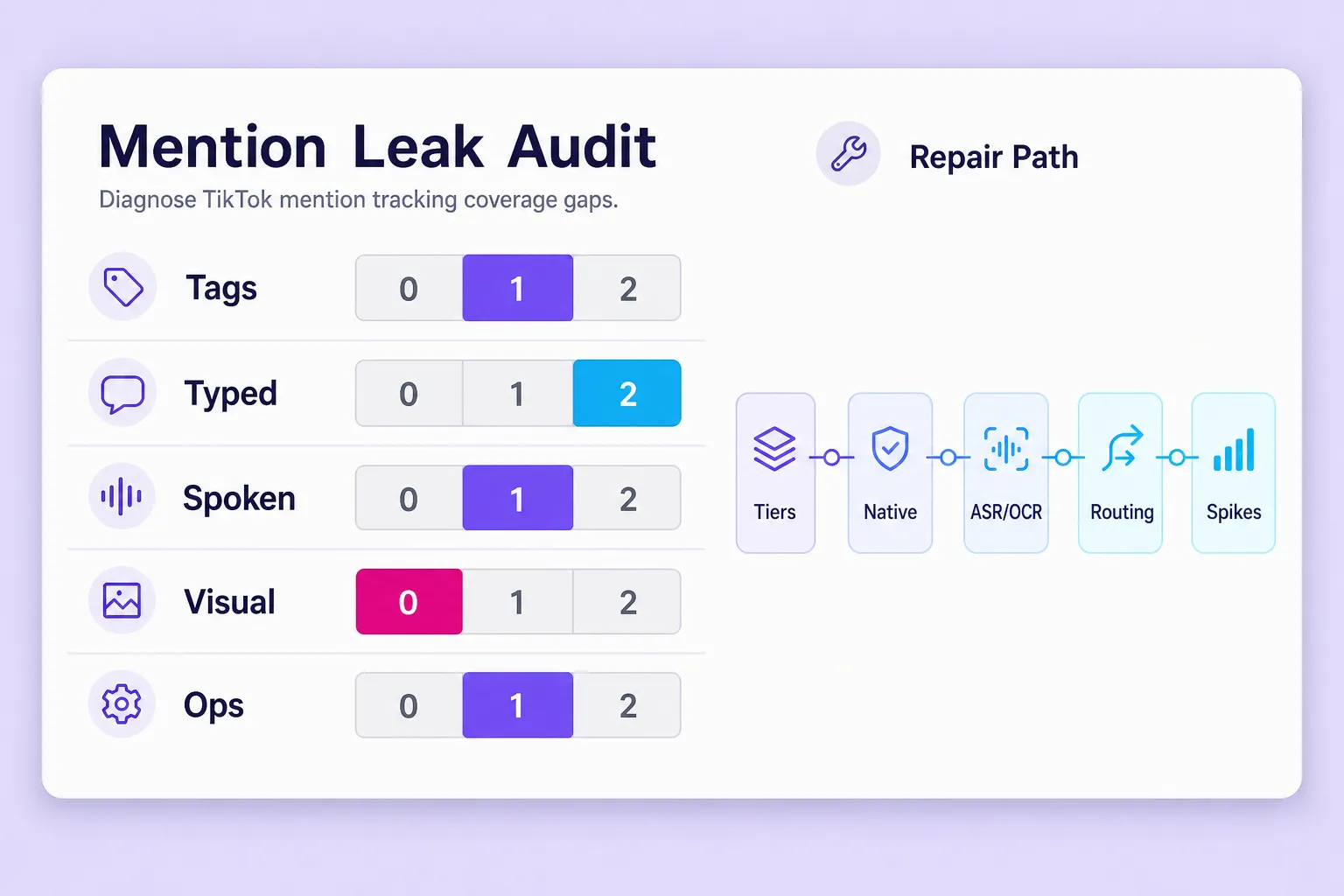
Here is the diagnostic I would run on any brand before spending a dollar. It is a practical audit, not a scientific benchmark. Score each layer honestly, then fix the biggest leak first. Most teams score high on Layer 1 and near zero on Layers 3 and 4, then wonder why their reported mentions do not match the buzz they can feel.
Step 1, score your capture per layer (0 to 2 each):
| Layer | 0 (blind) | 1 (partial) | 2 (covered) |
|---|---|---|---|
| L1 Tags | No one checks the filter | Filter checked weekly | Filter checked daily and routed |
| L2 Typed text (caption, comment, overlay) | No searches run | Manual search on a schedule | Automated keyword-tier tracking plus OCR |
| L3 Spoken audio | No ASR anywhere | Content Suite harvest only | ASR listening with alerts |
| L4 Visual mark (logo, packaging) | Not tracked | Manual review of top videos | Image-recognition coverage where the tool supports it |
| Ops (routing, QA, dedup) | None | Owners assigned informally | Named owners, SLAs, weekly ASR/OCR error sampling |
Step 2, read your score:
- 0 to 3, notification-dependent. You see the polite minority. Any confident claim about share of voice is guesswork. Stand up keyword tiers and a listening trial this month.
- 4 to 6, text-complete, video-blind. You catch written mentions and hear nothing. On a platform where much of the conversation is spoken or shown, you are missing the half that moves demand. Add ASR and OCR.
- 7 to 8, video-aware. You capture the main surfaces but may lack routing discipline. Tighten SLAs and dedup.
- 9 to 10, operational. Mentions become decisions, owners, responses, and trend intelligence. The remaining work is QA and speed.
Step 3, the maturity path. Move in this order, because each stage depends on the one before it: define keyword tiers, turn on native capture, add ASR and OCR listening, build routing and SLAs, then layer sentiment and spike analysis on top. Teams that jump straight to a listening tool without tiers and routing end up with a fast, expensive firehose and no one assigned to drink from it.
Step 4, run a weekly QA sample. Pull 20 videos where you know the brand is said aloud, ideally from your own creator collaborations, and measure how many your tool actually caught. That false-negative rate is your real coverage number. Add any missed pronunciation as a phonetic keyword, and repeat monthly. The single most common leak I see is not a missing tool. It is a capable platform that never got Tier 3 keywords, exclusions, or a QA loop, so the team stopped reading a feed that had quietly filled with noise.
Comparison of TikTok Mention-Tracking Methods
| Method | Layers covered | Cost | Real-time alerts | Best for | Main limit |
|---|---|---|---|---|---|
| Native Inbox filter | 1 | Free | Basic push | Direct tagged replies | Only shows tagged activity |
| Manual TikTok search | 1, partial 2 | Free | No | Low-volume spot checks | Personalized, manual, no scale |
| TikTok Content Suite | 1, 2, 3, partial 4 | Free, ad-account gated | No | Creator UGC and Spark Ads | Advertiser-skewed, not crisis-ready |
| Keyword-tier framework | Defines all | Free (your time) | N/A | Everyone, as the foundation | Requires upkeep |
| Paid social listening | 1, 2, 3, partial 4 | Paid | Yes | Untagged, spoken, on-screen at scale | Coverage and refresh vary by provider |
| Enterprise suite | 1, 2, 3, partial 4 | High | Yes | Large teams with governance | Cost and setup time |
Content Suite versus social listening, the core difference: Content Suite is a native, positive-skewed harvesting tool for advocacy and ads, gated behind an ad relationship. Social listening is a continuous, sentiment-scored radar built to catch the negative and neutral mentions too. Most serious teams run both, for opposite jobs.
Rule of thumb on when to upgrade: under a light weekly mention stream, native and manual search are enough. As volume rises into a steady daily flow, add keyword tiers and alerts. Once you are talked about constantly, or you operate in a high-risk category, add video-aware listening and routing. These are practical heuristics, not sourced thresholds, so calibrate them to your own audit.
Frequently Asked Questions
How do I see who mentioned my brand on TikTok?
You can see who mentioned your brand on TikTok by using the native Inbox filter for tags, manual search for typed text, and third-party tools with ASR and OCR for spoken and on-screen mentions. For tagged mentions, open the app, tap Inbox, then Activities, then All activity, then filter by "Mentions and tags." For untagged text, run scheduled manual searches of your brand name and hashtags in the search bar. For spoken and on-screen mentions, you need a tool with automatic speech recognition and optical character recognition, because neither native search nor the notification filter can read audio or video frames.
Can I track TikTok mentions for free?
You can track TikTok mentions for free only partially, because the native "Mentions and tags" filter plus manual search cover tagged mentions and a slice of untagged text, but not the spoken or visual layers reliably. TikTok's Content Suite adds native ASR and OCR discovery at no media spend if you have access. Free methods give you no reliable alerting, no sentiment, no history, and no cross-channel context, so once volume climbs or you need the audio and visual layers dependably, a paid tool becomes the realistic option.
Why don't I get notified about most TikTok mentions?
You don't get notified about most TikTok mentions because native notifications only fire when someone types your @handle, and most references are spoken, shown, or typed without the tag. Any reference that names your brand in plain text, says it aloud, or shows your logo generates no notification. Analysis from monitoring vendors suggests roughly half of TikTok mentions carry no tag, so a notification-only workflow structurally misses a large share of what people say about you.
Does TikTok have an API for tracking mentions?
TikTok does not have a general mention-tracking API for marketers; its Research API is restricted to qualified non-commercial researchers and its Business API mention endpoints are narrow. Third-party tools reach untagged, spoken, and on-screen mentions through other collection methods whose coverage can shift, so validate any tool's real TikTok coverage with your own two-week audit before committing.
Conclusion: Coverage Is a System, Not a Subscription
The instinct when you realize you are missing mentions is to buy a tool. That instinct is half right. A tool solves the audio and visual layers you physically cannot cover by hand. It does not solve the taxonomy, the routing, the deduplication, or the response clock, and those are where most brands actually fail. I have watched capable platforms sit unread because nobody defined what a mention was or who owned the reply.
So build the system in order. Define your four layers and your keyword tiers. Turn on the free native capture. Add ASR and OCR listening to reach what humans and hashtags miss. Wire routing and sub-24-hour SLAs, then interpret volume through sentiment and baseline-relative spikes. Each layer without the next is a false sense of coverage.
Here is the stance I will leave you with. TikTok conversation drifts further into speech and visuals every quarter, and answer engines increasingly assemble brand perception from what people say, not what they tag. The brands that win the next two years are the ones that can hear the untyped mention, route it to a human in under a day, and read whether it helped or hurt. Run the audit above. Fix your biggest leak this week. The conversation is already happening without your handle, and it is not waiting for your notification bell.
Filed under: Social Listening