Best Google Alerts Alternatives in 2026 (Free & Paid)
A transparently scored ranking of Google Alerts alternatives, using verified November 2026 pricing across free, SMB and enterprise tiers.

Quick answer: The best Google Alerts alternative depends on what you need to monitor. Talkwalker Alerts is a free option for news and web alerts. F5Bot specializes in Reddit, Hacker News and Lobsters, with a free tier for personal use. For brand monitoring with sentiment analysis and reporting, you can use BrandMentions. For enterprise consumer research or media intelligence, consider Brandwatch and Meltwater.
Google Alerts alternatives fall into three categories: free keyword alerts, community monitoring tools and full social listening platforms. The right choice depends on your sources, how quickly you need notifications, and whether you need to analyze and export mentions not just receive them.
This guide compares source coverage, alert speed, historical data, analysis features and pricing, including the plan restrictions that can change your actual cost.
Disclosure: Our team builds BrandMentions, one of the tools included in this guide. We compare its features and limitations alongside the alternatives; our assessment is not an independent endorsement.
Google Alerts Alternatives Compared by Use Case
Jump straight to the tool that matches your use case - each link below drops you into that tool's full profile.
- Best for free news and web alerts: Talkwalker Alerts (free). The closest like-for-like Google Alerts replacement, adding X and Boolean search in 22 languages at zero cost.
- Best for SMB and mid-market brand monitoring and reputation: BrandMentions (from $79/month billed annually). Cross-channel coverage, sentiment and historical data in one platform at published prices.
- Best for free Reddit and developer alerts: F5Bot (free / from $12.99/mo). Watches Reddit, Hacker News and Lobsters, including comments, and emails you when a keyword appears.
- Best for transparent self-serve listening: Brand24 (from $199/mo annual). One of the few platforms in its range that publishes every tier instead of routing you to a demo.
- Best for budget monitoring with Boolean power: Awario (from $29/mo annual). The lowest serious entry price in the category, with unlimited keywords per topic.
- Best for European and traditional-media PR: Determ (from €99/mo). Print, TV and radio alongside digital, with unlimited users on every plan.
- Best for Reddit and community precision on a budget: Syften (from $29.95/mo). Boolean filters, AI noise reduction and sub-minute Reddit delivery.
- Best for lightweight multi-platform keyword alerts: Kwatch (free / from $19/mo). Six platforms and per-second refresh with a genuine free tier. Advertised checking frequency is not a guarantee of publication-to-alert delivery.
- Best for B2B buying-intent discovery: Buska (from $49/mo). Intent scoring across the channels where B2B buyers actually compare tools.
- Best for forum and intent discovery: ForumScout (from $19/mo). 10M+ sources with unlimited mentions and AI filtering at a low entry price.
- Best for enterprise consumer research: Brandwatch (pricing on request). The deepest query building and consumer-opinion archive, sold by quote.
- Best for global enterprise media intelligence: Meltwater (pricing on request). Media, social, influencer and PR modules in one contract.
BrandMentions - Best for SMB-to-Mid-Market Brand Monitoring and Reputation
Verdict: Best for cross-channel SMB and PR teams · 9 source categories with up to 10 years of history on Enterprise · from $99/mo · Limitation: Boolean search arrives at Expert and API at Enterprise.
BrandMentions is the tool my team builds, so treat this as a disclosed, same-rubric entry.
| Plan | Price | Keywords | Mentions/mo | History |
|---|---|---|---|---|
| Starter | $99/mo (billed quarterly) | 5 | 5,000 | last 30 days |
| Pro | $299/mo | 20 | 30,000 | expanded |
| Expert | $499/mo | 50 | 75,000 | expanded, Boolean search |
| Enterprise | from $1,299/mo | custom | custom | up to 10 years, API |
Annual billing lowers the monthly price by roughly 15 to 20 percent.
Coverage & Latency
It monitors web, news, blogs, forums, videos, social media platforms in one feed. Latency ladders from daily on Starter to real-time on Expert and Enterprise, so Starter is a reporting plan, not a crisis plan.
Sentiment & Analysis
Sentiment runs on an LLM engine with emotion detection, spike context and AI digests. The strongest angle is not sentiment alone. It is explaining why a mention matters, which is the job of PR reporting.
Historical Data & API
New non-Enterprise projects start with the last 30 days. Up to 10 years of history and REST API access sit on Enterprise, which gives it more research depth than most self-serve tools.
Pricing, Decoded
All prices are public, which is rare in this range. The published starting point is $99/mo billed quarterly. BrandMentions Starter costs $99/month billed quarterly ($297 per quarter), or $79/month billed annually ($948 per year). Compare equivalent billing commitments across vendors.
Where It Falls Short
It is not free, and the cheap plans are genuinely entry-level. Boolean search is gated to Expert and API to Enterprise, so a Starter buyer who needs programmatic data is in the wrong tier. It is also not a publishing inbox, so you still need a separate tool to schedule posts.
Ideal Fit & Non-Obvious Insight
Best for agencies needing white-label reporting without an enterprise contract, and PR teams that care about history and fast cross-channel coverage. The non-obvious point: it makes sense when reputation, reporting and historical context live in one weekly workflow. If your only need is "email me when someone says our name," it is more platform than you require.
Brand24 - Best for Transparent Self-Serve Monitoring
Verdict: Best for SMBs wanting published pricing · 100,000 mentions/mo on Business · from $199/mo (annual) · Limitation: API is a $149/mo add-on and real-time arrives at Pro.
Brand24 is one of the few tools in its range that publishes every tier instead of routing you to a demo.
| Plan | Annual (per mo) | Monthly | Keywords / Mentions | Updates |
|---|---|---|---|---|
| Individual | $199 | $249 | 3 / 2,000 | every 12h |
| Team | $299 | $349 | 7 / 10,000 | hourly |
| Pro | $399 | $499 | 12 / 40,000 | real-time |
| Business | $599 | $699 | 25 / 100,000 | real-time |
| Enterprise | from $1,499 | quote | custom | real-time |
Coverage & Latency
It indexes Facebook, Instagram, X, TikTok, YouTube, Reddit, news, blogs, forums, podcasts and reviews on every tier. Latency is the paywall. The $199 Individual plan updates every 12 hours, so real-time does not arrive until Pro at $399.
Sentiment & Analysis
Brand24 turns feeds into clean dashboards. AI Events Detection flags volume spikes and suggests causes, and the AI Brand Assistant lets you query your own data in plain language. This is where it reads more modern than most mid-market rivals, and why it pairs well with dedicated sentiment analysis tools when you want to pressure-test accuracy.
Historical Data & API
API access is a separate $149/mo add-on on the Business plan and is included on Enterprise. If your reporting stack depends on programmatic access, do not compare the base plan alone.
Pricing, Decoded
Published and predictable. For the record, Brand24's own pricing page states it never charges more than your chosen plan, so plan for hard caps rather than surprise overage billing. The Team plan at $299 is the realistic team entry because it adds unlimited users and hourly updates.
Where It Falls Short
Costs climb once you need real-time data, higher mention volume, the API and the separate AI Visibility module ($99/mo add-on). A noisy brand can exhaust the 2,000-mention Individual cap during a single spike.
Ideal Fit & Non-Obvious Insight
Best for growing brands that live in dashboards. The non-obvious point: Reddit is indexed as one generic web source with no subreddit context or in-product reply, so Reddit-first teams will outgrow it on their primary channel fast.
Determ - Best for European and Traditional-Media PR
Verdict: Best for PR teams needing print, TV and radio · 100M+ news sources with unlimited users · from €99/mo · Limitation: Focus is capped at 1,000 mentions/mo.
Determ (formerly Mediatoolkit) is the media-monitoring specialist of the mid-market, priced in euros.
| Plan | Price (EUR/mo) | Topics | Mentions/mo | Users |
|---|---|---|---|---|
| Focus | €99 | 1 | 1,000 | unlimited |
| Expand | €299 | 5 | 5,000 | unlimited |
| Command | €499 | 10 | 10,000 | unlimited |
| Custom | quote | custom | custom | unlimited |
Focus is monthly with no commitment. Expand and Command require a yearly commitment. Annual prepay gives two months free.
Coverage & Latency
It covers news from 100M+ sites, plus X, Facebook, Instagram, YouTube, Reddit, Bluesky and Medium, and traditional media (print, TV, radio) where regionally available. Real-time updates are included on every plan.
Sentiment & Analysis
AI summaries and spike alerts on both volume and sentiment are included at the €99 entry, which is unusual. You can also manually correct sentiment to train the system for your niche.
Historical Data & API
Default history is three months, with an archive back to 2020 unlockable on request. API, MCP, BigQuery and Power BI exports sit on the Custom plan only.
Pricing, Decoded
Priced in euros, so US buyers absorb a conversion spread. The published entry is €99 Focus, €299 Expand and €499 Command. The quiet strength is unlimited users on every plan, which beats seat-based pricing once five or more people need access.
Where It Falls Short
Mention caps bind hard. Focus gives 1,000 mentions a month, roughly 33 a day, and a single news pickup can burn a week of allowance. Serious API work requires a custom quote.
Ideal Fit & Non-Obvious Insight
Best for European agencies and comms teams reporting earned media across legacy channels. The non-obvious point: it is one of very few platforms that still covers print, TV and radio in the same feed as digital, this matters when your reporting must include broadcast and print coverage alongside digital mentions.
Awario - Best for Budget Boolean Monitoring
Verdict: Best for budget-conscious SMBs · up to 1,000,000 mentions/mo on Enterprise · from $29/mo (annual) · Limitation: stored mentions are capped per topic, and older ones roll off.
Awario listed plans offer substantial monthly mention allowances, but stored-result limits and export restrictions affect their usefulness.
| Plan | Annual (per mo) | Monthly | Topics | Mentions/mo | Stored/topic |
|---|---|---|---|---|---|
| Starter | $29 | $49 | 3 | 30,000 | 5,000 |
| Pro | $89 | $149 | 15 | 300,000 | 15,000 |
| Enterprise | $249 | $399 | 100 | 1,000,000 | 50,000 |
Coverage & Latency
It covers web, news, blogs, forums, X, Facebook, Instagram, YouTube and Reddit on all plans, with near real-time checking. It does not monitor review sites, podcasts or newsletters.
Sentiment & Analysis
Built-in sentiment wires into share-of-voice analytics. It is practical for small teams, though it lacks the multilingual nuance of higher-end NLP engines.
Historical Data & API
Here is the catch. Each topic stores a fixed number of mentions (5,000 on Starter), and once you hit the cap, older mentions are replaced by new ones. API access is Enterprise only.
Pricing, Decoded
The cheapest serious entry in the category at $29/mo annual, but Starter has no data export and only one user. Pro at $89/mo annual is the real working plan.
The archive penalty. A 30,000-mention monthly limit means little if your topic only stores 5,000. You are buying a rolling feed, not a permanent archive.
Where It Falls Short
No exports, no reports and no API at Starter, plus a storage ceiling that quietly discards history. It is not the right fit for PR teams needing archive guarantees or governance.
Ideal Fit & Non-Obvious Insight
Best for solo marketers and small agencies comfortable writing queries. It sits naturally among tools for small business. The non-obvious point: its real value is cheap Boolean plus unlimited keywords per topic, so one "competitors" topic can track five rivals and their misspellings without spending extra topic slots.
Syften - Best for Reddit and Community Precision
Verdict: Best for fast, filtered community alerts · sub-1-minute Reddit target · from $29.95/mo · Limitation: X and YouTube are paid add-ons, and Entry has no Slack or AI filtering.
Syften is a precision instrument for teams where Reddit and developer forums are a sales, support or research channel.
| Plan | Price/mo | Community filters | Web filters | Archive |
|---|---|---|---|---|
| Entry | $29.95 | 3 | 1 | 7 days |
| Standard | $49.95 | 20 | 5 | 30 days |
| PRO | $119.95 | 100 | 20 | full available history |
Add-ons on Standard and PRO: X +$40/mo, YouTube +$20/mo. API is on every plan.
Coverage & Latency
It monitors Reddit, Hacker News, Stack Exchange, GitHub, Indie Hackers, forums, Bluesky, Mastodon, newsletters, podcasts and the public web, targeting under one minute on Reddit. Where F5Bot gives blunt keyword matching, Syften adds Boolean operators, phrase matching and exclusions.
Sentiment & Analysis
AI filtering, not classic sentiment, is the point. It suppresses spam, duplicates and auto-promos before an alert fires, which cuts the manual review burden sharply.
Historical Data & API
Archive scales by plan: 7 days on Entry, 30 on Standard, full available history on PRO. The API is on every plan, which is rare at this price, and PRO adds webhooks and MCP for AI-driven workflows.
Pricing, Decoded
Entry is affordable but thin on the web side (one filter). Most teams land on Standard at $49.95 once they need Slack and AI filtering. Budget for the X or YouTube add-ons if those channels matter.
Where It Falls Short
X and YouTube cost extra, and it provides no broad social sentiment or reputation reporting. It is a conversation radar, not a CMO dashboard.
Ideal Fit & Non-Obvious Insight
Best for B2B and developer-tool teams that live in Reddit and GitHub. The non-obvious point: the MCP server lets an AI agent query your matches directly, a quiet advantage over F5Bot's email-first design for anyone building agent workflows.
Talkwalker Alerts - Best Free News and Web Alerts
Verdict: Best for free news and X alerts · 4 source types, 22 languages · free · Limitation: no Reddit, no sentiment, no historical archive.
Talkwalker Alerts is the easiest free upgrade from Google Alerts, and the paid Talkwalker platform now operates inside Hootsuite.
| Product | Price | Delivery |
|---|---|---|
| Talkwalker Alerts | free | email, RSS, Slack |
Coverage & Latency
It covers News, X, Blogs and Discussion forums, with "as it happens," daily or weekly delivery. The Boolean operators (AND, OR, NOT, quotes, proximity, title and content filters) are documented, which most paid tools reserve for higher tiers.
Sentiment & Analysis
None. It is a keyword-match alert, not an analytics layer. For scoring, you move to the paid platform.
Historical Data & API
None. There is no searchable archive, no export and no API. Your inbox or RSS reader becomes the archive.
Pricing, Decoded
Genuinely free, no credit card, used by over 600,000 accounts per Talkwalker's page. The free alert tool has no paid upgrade path of its own. Its terms allow it to restrict or discontinue the free service at any time.
Where It Falls Short
No Reddit, no sentiment, no history. The "only the best results" filter is a black box with no published criteria.
Ideal Fit & Non-Obvious Insight
Best for anyone who wants a no-cost upgrade over Google Alerts for news and X. The non-obvious point: keep it running as a control channel beside a paid platform to catch coverage gaps. If you outgrow it, our list of Talkwalker alternatives maps the next step.
F5Bot - Best Free Reddit and Developer Alerts
Verdict: Best for free Reddit, Hacker News and Lobsters alerts · 3 sources, comments included · free / from $12.99/mo · Limitation: free tier has up to a 2-hour delay and 7 days of match history.
F5Bot is quietly critical infrastructure for founders, and it communicates its limits honestly.
| Plan | Price/mo | Keywords | Match history | Delivery |
|---|---|---|---|---|
| Free | $0 (personal use) | 5 | 7 days | email, up to 2h delay |
| Silver | $12.99 | 20 | 7 days | email, ~5 min |
| Gold | $49.99 | 200 | 90 days | +Slack, Discord, RSS/JSON, AI filters |
| Platinum | $214.99 | 300 | 90 days | +REST API, webhooks |
| Diamond | from $500 | custom | custom | API, webhooks, AI filtering |
Coverage & Latency
It watches Reddit posts and comments across all subreddits, plus Hacker News and Lobsters. Free runs up to a 2-hour delay, Silver about 5 minutes, Gold and above instant or scheduled.
Sentiment & Analysis
No sentiment. AI filtering, which lets you describe what you want in natural language instead of exact keywords, unlocks at Gold and helps when your brand name is also a common word.
Historical Data & API
Free and Silver keep 7 days of match history, Gold and above 90 days. REST API and webhooks start at Platinum. Keyword daily caps are hard cutoffs that disable an alert until you re-enable it.
Pricing, Decoded
The free tier is real but personal-use only. For commercial work, the product itself points you to Gold at $49.99/mo, not Silver, because Gold adds Slack, 200 keywords and AI filtering.
Where It Falls Short
It stops at three sources and email-first delivery. No dashboard, no sentiment, no broad web or social coverage.
Ideal Fit & Non-Obvious Insight
Best for solo founders and makers validating whether anyone talks about them. The non-obvious point: for one specific job, replying to an active Reddit or Hacker News thread before it cools, a focused alert often beats a full listening suite on speed and simplicity.
Do not compare monitoring tools on subscription price alone. A cheap tool that floods you with irrelevant alerts costs more in review time than a pricier tool that filters the noise for you.
Meltwater - Best Enterprise Media Intelligence
Verdict: Best for global enterprise PR and comms · unified media, social, influencer and PR modules · pricing on request · Limitation: no self-serve trial and a 12-month minimum.
Meltwater is built for large comms operations that need everything in one contract.
| Plan | Price | Model |
|---|---|---|
| Custom | pricing on request | modular, quote-based |
Coverage & Latency
It consolidates media monitoring (online, print, broadcast, podcasts), social listening, AI visibility tracking, influencer marketing and media relations, with real-time alerts and spike detection.
Sentiment & Analysis
Sentiment shift alerts and the Mira AI assistant support natural-language querying and summarization across modules. This is built for the boardroom, not just finding mentions.
Historical Data & API
Historical scope, API and MCP integrations are contract items scoped by package. Ask for retained history, source coverage and export limits before comparing quotes.
Pricing, Decoded
No published price card. Meltwater's own pricing page states quotes depend on modules, regions, data volume, users, integrations, onboarding, support and contract terms, with no self-serve trial. Treat any specific dollar floor you see elsewhere as third-party procurement data, not an official figure.
Where It Falls Short
Opacity and breadth. You cannot size it without a sales process, and a small team pays for modules it will not open.
Ideal Fit & Non-Obvious Insight
Best for global enterprises running multi-market PR, social and influencer programs together. The non-obvious point: its value is consolidation, not any single feature. If you only need a Google Alerts replacement, this is a media operating system you do not yet need.
Brandwatch - Best Enterprise Consumer Research
Verdict: Best for enterprise consumer research · Historical access, source coverage and export limits depend on the specific product and contract · pricing on request · Limitation: Quick Search defaults to a 30-day window.
Brandwatch runs separate product lines, and the distinction matters. Consumer Intelligence is the social-listening and research flagship, while Social Media Management (formerly Falcon.io) and the Listen module handle publishing and monitoring.
| Suite | Price | Model |
|---|---|---|
| Consumer Intelligence / Listen | pricing on request | query or volume based |
Coverage & Latency
It taps premium social data streams with real-time ingestion and configurable alerts. The query builder and consumer-research depth are the most advanced in the category.
Sentiment & Analysis
Sentiment, emotion, audience segmentation and image insights (as add-ons) are built for analysts who write complex Boolean rules. Without query discipline, it becomes an expensive dashboard rather than a decision engine.
Historical Data & API
Here are the current help-center limits for Listen social listening. Quick Searches default to a 30-day maximum, one year can be enabled with 5 percent sampling, Saved Searches load one year, and two years is a premium add-on. Do not conflate this with older consumer-opinion archive claims, which belong to different products.
Pricing, Decoded
Quote-only, scoped by query count, volume and add-ons. Budget for a procurement cycle, not a credit card, and get the historical window and API rate limits specified in the contract.
Where It Falls Short
Cost and complexity. There is no self-serve tier, and the price ladder climbs steeply once a team specs the queries, seats and historical access it actually needs.
Ideal Fit & Non-Obvious Insight
Best for consumer-insights teams and large-brand analysts. The non-obvious point: teams rarely leave Brandwatch over capability. They leave over budget and the quote-only motion, and a mid-market tool often covers most of the job for a fraction of the cost. Our list of Brandwatch alternatives lays out those trade-offs.
The Underdogs Worth Knowing
These are not category leaders, but each solves a specific job well enough to earn a shortlist spot. They follow the same structure so you can compare them cleanly.
KWatch.io - Best Lightweight Multi-Platform Alerts
Verdict: Best for cheap multi-platform keyword alerts · 6 platforms with per-second refresh · free / from $19/mo · Limitation: Slack, API and webhooks start at Business ($79/mo).
KWatch.io fills the gap between F5Bot and full suites.
| Plan | Price/mo | Notes |
|---|---|---|
| Free | $0 | 2 Reddit + 2 Hacker News alerts |
| Essential | $19 | 6 platforms, AI sentiment |
| Business | $79 | +Slack, API, webhooks, MCP |
| Enterprise | $199 | higher caps, team features |
Coverage & Latency
It monitors Reddit, Hacker News, X, YouTube, Facebook and LinkedIn with a per-second refresh. There is no Instagram or TikTok.
Sentiment & Analysis
AI sentiment is included on paid plans, but it is alert-first, not a deep analytics suite.
Historical Data & API
Saved results and filtering on paid plans. API, webhooks, Slack and MCP start at Business.
Pricing, Decoded
The $19 Essential covers all six platforms for a solo operator. $79 Business is the real team entry once alerts must flow into shared systems.
Where It Falls Short
LinkedIn and Facebook monitoring covers posts only, not comments. YouTube covers titles and descriptions only, not spoken content. So "real-time social" means real-time on Reddit, HN and X, and partial elsewhere.
Ideal Fit & Non-Obvious Insight
Best for lean teams that know exactly which platforms matter. The non-obvious point: a conversation-tracking mode follows specific Reddit and HN threads for new replies, a feature most alert tools lack.
Buska - Best for B2B Buying-Intent Discovery
Verdict: Best for B2B intent discovery · 33+ sources on Scale · from $49/mo · Limitation: intent-first, not a PR reporting tool.
Buska watches for buying signals rather than brand health.
| Plan | Price/mo | Sources | Updates |
|---|---|---|---|
| Starter | $49 | 16+ | daily |
| Growth | $99 | 28+ | every 3h |
| Scale | $249 | 33+ | hourly |
Coverage & Latency
It tracks Reddit, LinkedIn, X, Hacker News, Facebook, Instagram, TikTok, Quora, YouTube, Bluesky, GitHub, forums and the open web. Latency tightens from daily on Starter to hourly on Scale.
Sentiment & Analysis
The key metric is intent, not PR sentiment. It scores whether a poster is actively evaluating a solution, which is right for sales and less right for reputation reporting.
Historical Data & API
A rolling archive for active lead workflows. API arrives at Growth, with webhooks, MCP and CSV export.
Pricing, Decoded
Published and affordable. Starter $49, Growth $99, Scale $249, with unlimited team members on Scale.
Where It Falls Short
Buska itself says brand monitoring and e-reputation are not its core fit. For PR teams, it may not match the job.
Ideal Fit & Non-Obvious Insight
Best for B2B founders and growth teams. The non-obvious point: it is designed to find demand before it names you, watching the language of buying rather than waiting for a brand mention.
ForumScout - Best for Forum and Intent Discovery
Verdict: Best for forum and intent monitoring · 10M+ sources · from $19/mo · Limitation: entry plan scans only every 6 hours.
ForumScout monitors Reddit, LinkedIn, X, forums, news and more.
| Plan | Price/mo | Scouts | History | Update frequency |
|---|---|---|---|---|
| Starter | $19 | 10 | 3 months | every 6h |
| Pro | $49 | 20 | 6 months | faster |
| Ultra | $129 | 30 | 12 months | hourly |
Coverage & Latency
It watches 10M+ sources with unlimited mentions, and scan frequency rises from every 6 hours on Starter to hourly on Ultra.
Sentiment & Analysis
It combines AI filtering with sentiment and emotion analysis, which is stronger than many tools in this price band.
Historical Data & API
History is unusually clear for a low-cost tool: 3, 6 or 12 months by plan, with webhooks and Google Sheets sync.
Pricing, Decoded
Published and low. Starter $19, Pro $49, Ultra $129, with unlimited mentions on every tier.
Where It Falls Short
A 6-hour scan on Starter is fine for discovery, not for urgent crisis monitoring.
Ideal Fit & Non-Obvious Insight
Best for founders hunting for solution-seeking conversations. The non-obvious point: it answers "who is asking for a solution" far better than "what is every stakeholder saying about our reputation," and that distinction keeps expectations sane.
Original Research: What Google Alerts Misses, in Numbers
We measured where 168,184 mentions of ten well-known brands appeared over 90 days, then checked how much a news-and-web alert and the guide's free stack could reach. The data supports the guide's three-architecture split, and puts a number on the gap free tools leave.
- Over 60% of brand conversation happens outside news, blogs and web pages. Of the 168,184 mentions retrieved through BrandMentions for these ten brands, approximately 62% were classified outside news, blogs and web pages. The share ranges from 28% for Peloton to 76% for Duolingo.
- News, blogs and web pages accounted for 38.4% of this dataset. Adding the estimated Reddit and X shares brings those source categories to 47.2%. This is a source-category model, not measured coverage by Google Alerts, F5Bot or Talkwalker Alerts.
- Video is the largest single blind spot, at 27% of all mentions, followed by social networks at 19%.
- Most "Google Alerts" mentions are machine output. 65% of the 2,755 mentions came from 64 blogs that automatically repost Google Alert digests.
- People still recommend Google Alerts, but almost never on its own. 17 of the 20 discussion posts recommending it for brand or competitor monitoring paired it with another tool, a data source or an AI summariser.
- Three tools hold two-thirds of the conversation. Brand24, Meltwater and Brandwatch account for 68% of monitoring-related mentions of the reviewed tools, and for all but one tool, 87% or more of mentions come from comparison and review pages.
Method and dataset
All figures come from the BrandMentions API, queried on 10 November 2026 for 12 August to 9 November 2026 (90 days, UTC).
| Item | Detail |
|---|---|
| Brand panel | Canva, Figma, Shopify, Duolingo, HubSpot, Grammarly, Airtable, Peloton, Glossier, Allbirds. Each name is distinctive, so a plain exact-phrase match is reliable |
| Source types | News, blogs, web pages, social (Instagram, LinkedIn, Facebook), video (YouTube, TikTok), discussions (Reddit, Bluesky, Threads) |
| Discussion split | Discussion-platform percentages are estimates from samples taken on ten selected days per brand. Interpret them as exploratory estimates rather than exact platform totals. |
| Coverage model | Google Alerts: news, blogs and web. Talkwalker Alerts adds X. F5Bot adds Reddit. Everything else counts as outside the free stack |
| Google Alerts conversation | All 2,755 mentions of "Google Alerts" retrieved in full; all 49 discussion posts read and coded by hand |
| Tool share of voice | Each tool name plus the word "monitoring", to filter out unrelated uses of words such as Syften, Determ and Buska. Meltwater also excluded glacier and climate terms |
The coverage model is generous to Google Alerts. It assumes Google Alerts would catch every news, blog and web mention, which the guide itself notes it does not. Yet, collection limits, source classification, sampling and brand selection may affect these percentages.
Finding 1: Most brand conversation happens where Google Alerts doesn't look
Across the ten brands, only 38% of mentions appeared in news, blogs or web pages. n our BrandMentions dataset, 38.4% of collected mentions were classified as news, blogs or web pages. This describes the source mix in our sample; it does not measure Google Alerts’ coverage or the percentage of mentions it misses.
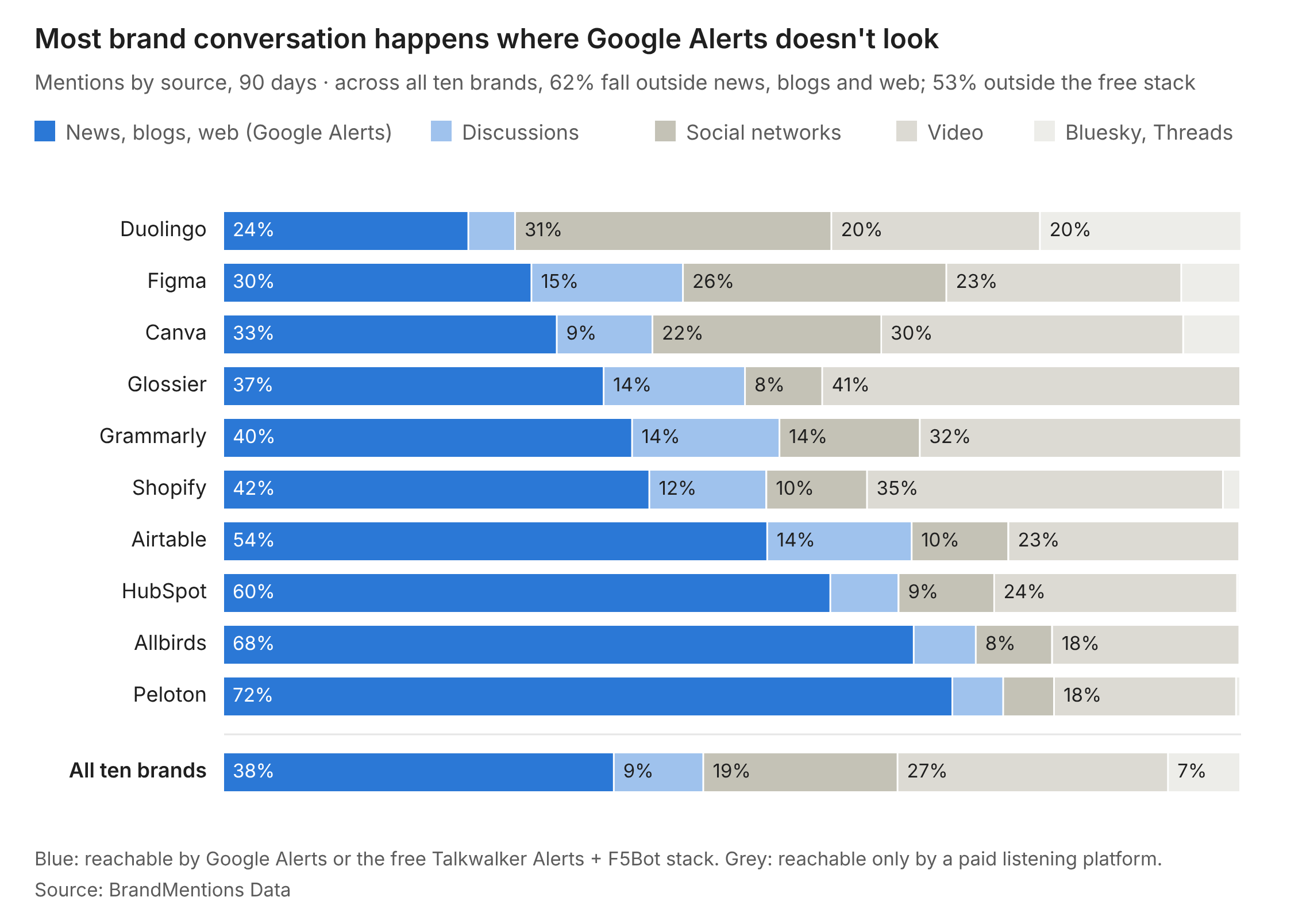
The gap follows the audience. Consumer and creator brands such as Duolingo, Figma and Canva are discussed mostly on social and video, so a news-and-web alert sees a quarter to a third of their conversation. B2B and news-driven brands such as HubSpot and Peloton sit closer to the guide's description of Google Alerts as good enough for news, at 60% to 72%.
Video is the largest single blind spot at 27% of all mentions. Every brand had at least 18% of its mentions on YouTube or TikTok.
Finding 2: The free stack adds 9 points of reach, almost all from Reddit
The guide's free stack works as described: each tool closes one of Google Alerts' gaps. But the gaps it closes are small next to the ones it leaves open.
| Layer | Sources | Share of all mentions | Cumulative reach |
|---|---|---|---|
| Google Alerts (best case) | News, blogs, web pages | 38.4% | 38.4% |
| + F5Bot | 7.7% | 46.1% | |
| + Talkwalker Alerts | X | 1.1% | 47.2% |
| Paid platform only | Video (YouTube, TikTok) | 26.6% | — |
| Paid platform only | Social (Instagram, Facebook, LinkedIn) | 19.1% | — |
| Paid platform only | Bluesky, Threads | 7.1% | — |
Reddit is the free stack's biggest win, which supports the guide's advice to add a Reddit monitor before anything else. Reddit made up over half of the sampled discussion posts for nine of the ten brands. Duolingo was the exception, at 18%.
X added little in this dataset, but read that with care. X collection in the index may be limited by access costs, so the true X share is probably higher. Bluesky was larger than X for five of the ten brands, led by Duolingo, where it was 20% of all mentions.
Finding 3: What people actually say about Google Alerts
Google Alerts drew 2,755 mentions in 90 days, but 65% of them (1,794) were Google Alert digests that 64 Blogspot blogs repost automatically, many of them Indonesian news aggregators. After excluding 1,794 identified automated digest reposts, 961 mentions remained. We manually reviewed the 49 discussion posts within that remainder.
Among the 49 discussion posts reviewed, 22 concerned personal tracking. Of the 20 posts recommending Google Alerts for business monitoring, 17 also mentioned another tool or data source.
| What the post was about | Posts | Share |
|---|---|---|
| Personal tracking: own name, people, fandoms, jobs, deals, obituaries | 22 | 45% |
| Recommended for brand, competitor or account monitoring | 20 | 41% |
| Complaint with no recommendation: noise, duplicates, misses, no history | 5 | 10% |
| Looking for a replacement, or calling it outdated | 2 | 4% |
Of the 20 business recommendations, 17 paired Google Alerts with something else: a paid tool, an SEO suite, LinkedIn Sales Navigator, a Reddit monitor, or an AI model that summarises the alerts. Four people described feeding their alerts into ChatGPT, Claude or another assistant for a daily or weekly digest, a workflow the guide does not yet cover.
What this means for buyers
The data supports the guide's advice to choose an architecture before a tool, and gives buyers a number to decide with.
- Check where your own brand is discussed before you choose a tier. If most of your mentions are in news and on the web, as with Peloton or HubSpot, the free stack covers most of the job. If you look like Duolingo or Canva, free tools will miss two-thirds of your conversation.
- Add Reddit first. It is the largest gap the free stack can close, and the channel where people talk about Google Alerts and its alternatives.
- Treat video and social as the paid-tier decision. Together they hold 46% of brand mentions in this panel, and no free tool in the guide reaches them.
- Expect to combine tools. Practitioners already do: 17 of 20 business users paired Google Alerts with something else, and a growing number route alerts through an AI assistant for a summary.
- Run the guide's 3-query proof on your own name. The spread between brands, from 24% to 72% news-and-web share, is too wide for anyone else's average to stand in for yours.
Limitations and disclosure
The dataset comes from BrandMentions, which publishes this guide and is one of the tools reviewed. These are simplified source assumptions, not measured tool coverage, so they cannot establish the actual gap between free and paid tools. Discussion-platform shares were estimated from 10 randomly selected days per brand, with small samples for brands such as Allbirds. The panel comprises ten deliberately selected, well-known brands with distinctive names; the findings may not generalize to other brands, particularly those with common-word names.
Requiring the word “monitoring” in tool-name searches reduces unrelated matches but also excludes relevant casual discussions. Historical analysis is also limited: a one-year Google Alerts query returned the same total as the 90-day window, suggesting the available index did not extend meaningfully beyond August 2026. Finally, the 49 Google Alerts discussion posts were coded by one reviewer without independent verification.
Data: BrandMentions, queried 10 November 2026 for 12 August to 9 November 2026.
How Is a Google Alerts Alternative Different From Social Listening?
A Google Alerts alternative is either a free alerting layer or a paid listening platform. The first sends a notification when a keyword appears. The second collects, filters, scores, stores and routes mentions so a team can make decisions.
The confusion starts because listicles drop Talkwalker Alerts, F5Bot, Brandwatch and Meltwater in one bucket. They are not the same buyer decision. A free alert tells you a word appeared. A platform tells you what changed, why it matters and who should act.
The practical test is simple. Do you need to know a mention happened, or analyze a pattern across thousands of them? The first is an alert. The second is a platform. If all you need is the first, start by setting up Google Alerts properly and add one Reddit monitor beside it.
If you only check your mentions once a day, you are paying for real-time latency you will never use. Buy speed only when minutes change the outcome, like a crisis or a live sales thread.
Can a Free Tool Really Replace Google Alerts in 2026?
Yes, for a narrow job. Free tools survive because they refuse to do too much. For personal monitoring, Talkwalker Alerts and F5Bot’s free tier provide complementary alerts. For business monitoring, F5Bot positions Gold at $49.99/month for professional use; Free and Silver are intended for personal use.”
The smart play is to stack them. Talkwalker Alerts covers news, web and X. F5Bot covers Reddit and Hacker News. Together they close Google's two biggest gaps. The moment you need sentiment, history or reporting, the free stack breaks and you move to a paid platform.
Labor is part of the price. The most expensive monitoring mistake is not the wrong subscription. It is assigning a junior person to check five free inboxes, then missing the one thread that mattered.
Which Alternative Covers Reddit Best?
Reddit is the channel most tools get wrong. Broad listening suites often index Reddit as one generic web source, with no subreddit context and no thread-level reply workflow. For Reddit-first buyers, specialists win.
F5Bot is the best free baseline. Syften adds Boolean precision with sub-minute delivery and AI filtering. KWatch.io adds a per-second refresh and a conversation-tracking mode that follows specific threads for new replies. If Reddit is where your buyers compare tools, start with a specialist and add a broad platform later, not the reverse. Our guide to free Reddit monitoring maps the current field.
How Should You Compare Latency, Coverage and History Before You Buy?
Do not trust the vendor screenshot. Run your own test instead.
The 3-query proof. In every tool you trial, run the same three searches: your exact brand name, a common misspelling or product nickname, and a competitor complaint phrase such as "alternative to [competitor]." Then check seven things.
| Test | What to inspect |
|---|---|
| Coverage | Did it catch news, blogs, forums, Reddit, YouTube, reviews and social? |
| Latency | How long did the same live mention take to appear? |
| Noise | How many results were irrelevant? |
| Sentiment | Were negative, sarcastic and mixed mentions classified correctly? |
| History | Can you see last week, last month, last quarter, last year? |
| Export | Can you pull data into a report or BI tool? |
| Routing | Can the right person get alerted without logging in? |
This matters because latency is not one number. Reddit may be near real-time in a specialist tool while LinkedIn depends on index visibility, account connection or plan level. Sentiment is the same story. Test sarcasm and product complaints yourself, because this is exactly where dashboards look better than they behave.
Free vs Paid Architecture: What You Actually Give Up
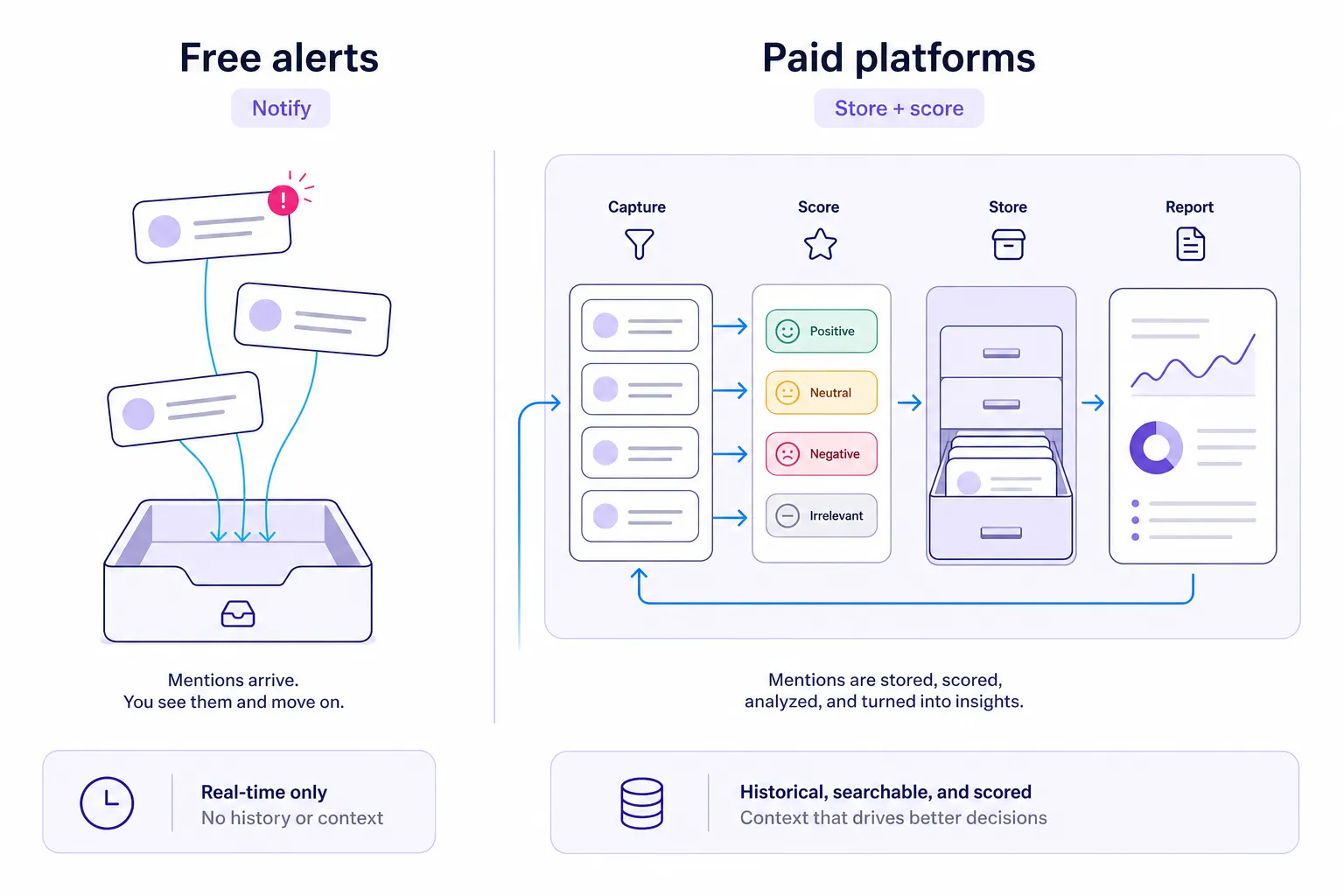
The difference is not features on a page. It is what the tool keeps and how fast. Free tools deliver a match and move on. Paid platforms store, score and let you query.
Three lines separate the two worlds. History: free tools keep days, paid tools keep months to years. Sentiment: free alerts do not score emotion, so if sentiment quality is your decision, the gap is the whole decision. Repeatability: a PR lead can defend a weekly report when the query and source set stay stable, which a pile of inbox alerts cannot do.
The seat-tax trap. A $49 single license looks cheap until support, sales and PR all need access. Always price the total cost for five seats, not the entry label, and compare that against unlimited-user models like Determ.
For lean teams, a hybrid still works. Run one free web alert, one Reddit alert and one paid platform only when volume or risk justifies it. If you want to compare the zero-cost picks first, review our free monitoring options before committing budget. When your volume is real and your clients want reports they will actually read, a BrandMentions trial is a low-friction way to test the mid-market tier against your own keywords.
The Total Cost Nobody Prices In
List price is the smallest line item for a serious buyer. Before you sign, add the seats, extra topics and mention caps, storage caps, the API add-on, the X and YouTube add-ons, AI module fees, onboarding, the annual commitment and the cancellation window (Mention's is 90 days). For euro-priced tools like Determ, add the currency conversion spread and any foreign transaction fee.
Enterprise buyers should also ask the questions no marketing page answers. Request SOC 2 or ISO status, a GDPR data processing agreement, data retention and deletion guarantees, SSO and SAML, role-based permissions, audit logs, SLA and support tiers, and data residency. If a vendor cannot answer these cleanly, that is your answer.
What No Tool Can Monitor
Be honest with yourself about the gaps, because no vendor has magic access. Coverage depends on permissions, integrations and licensed sources. Do not assume a tool can access private conversations, restricted accounts, stories or paywalled material. Ask separately about image recognition and audio transcription, and confirm what is included in your plan. Screenshots, text inside images and paywalled content largely escape every platform here. Strong vendors are upfront about this. Treat any tool that implies it monitors "everything" with suspicion.
Migrating Off Google Alerts Without Losing Signal
Do not just forward the old alerts into a new inbox. Clean the queries first. Convert vague keywords into Boolean strings with exclusions for your common false positives, especially if your brand name is also a dictionary word. Build a simple tagging schema (brand, competitor, industry, crisis) before the mentions start flowing, set a baseline period of two to four weeks so you know what normal looks like, and decide who gets routed what. Only then decommission Google Alerts, so you never go dark during the switch.
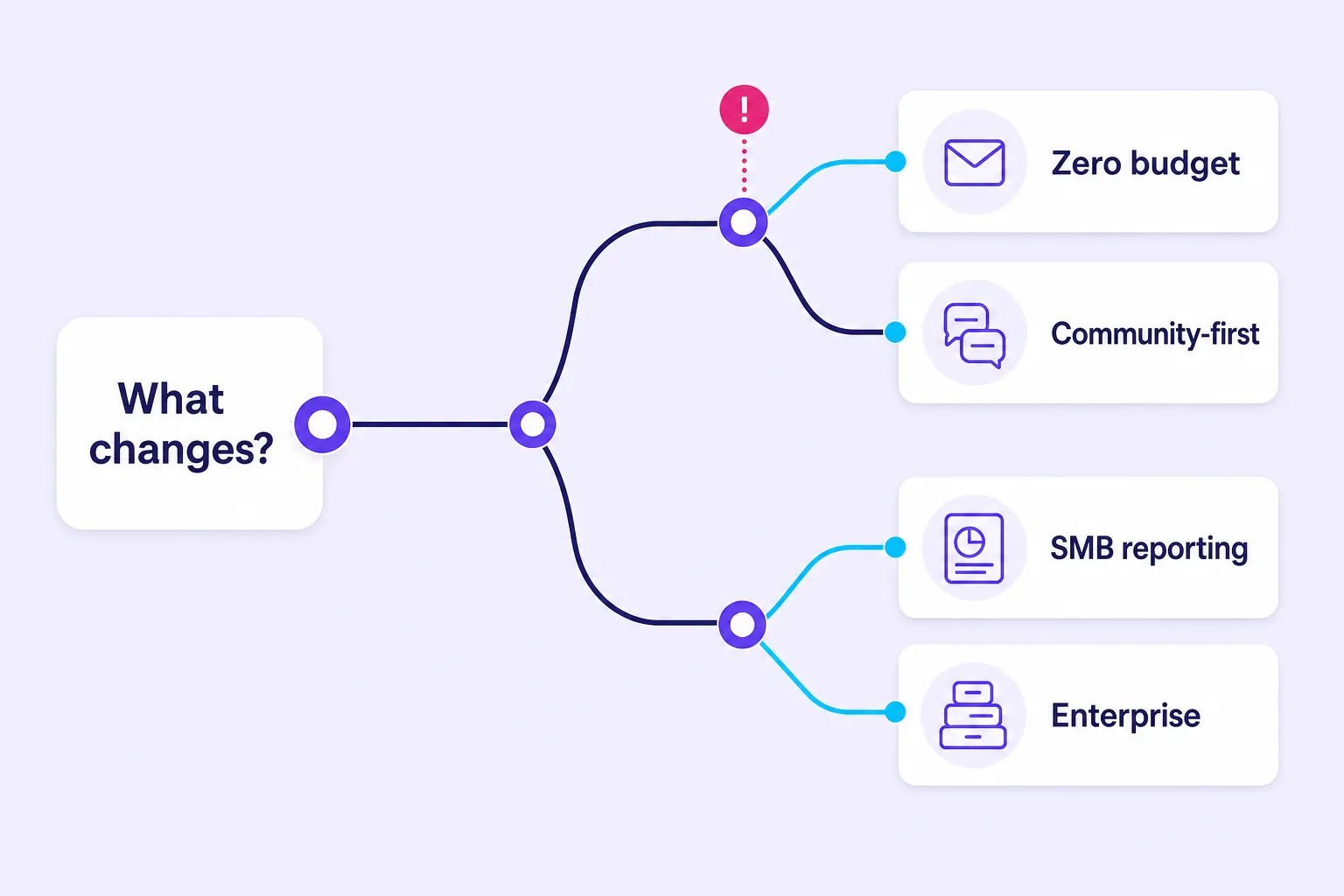
The Decision Tree: Match a Tool to Your Stakes and Budget
Use this in order. Stop at the first line that describes you.
- You only need to know when your name appears, budget zero. Talkwalker Alerts for news and X, F5Bot for Reddit and Hacker News. Run both.
- Reddit or developer communities are your main channel, small budget. Syften from $29.95/mo for Boolean precision, or F5Bot Gold if the job is purely Reddit and HN.
- You want cross-channel monitoring with sentiment and reports, SMB budget. BrandMentions from $99/mo or Brand24 from $199/mo. Choose BrandMentions for white-label and long history, Brand24 for the AI assistant and event detection.
- You want the lowest price with Boolean control. Awario from $29/mo annual, accepting the storage cap.
- Your coverage lives in print and European media, with many stakeholders. Determ from €99/mo for unlimited users and traditional media.
- You need multi-market media, deep research or broadcast, enterprise budget. Meltwater for unified media intelligence, Brandwatch for consumer research. Both quote-only.
Frequently Asked Questions
In short, what are the best Google Alerts alternatives in 2026?
For free, Talkwalker Alerts covers news and X while F5Bot covers Reddit and Hacker News. For paid, BrandMentions (from $79/month billed annually) and Brand24 (from $199/mo annual) lead the SMB tier, Determ (from €99/mo) and Awario (from $29/mo annual) are strong value picks, and Brandwatch and Meltwater serve enterprise on quote-only contracts.
Is there a genuinely free alternative to Google Alerts?
Yes. F5Bot is free for personal use and alerts you when your keywords appear on Reddit, Hacker News or Lobsters, including inside comments. Talkwalker Alerts is also free, adds X to news and blog coverage, and supports Boolean search in 22 languages, though historical backfill means retrieving mentions from before you created a search. Retention means keeping mentions already collected. These are different capabilities; F5Bot’s free tier retains seven days of match history.
Which Google Alerts alternative is best for Reddit monitoring?
For free alerts, F5Bot. For precise, filtered monitoring on a budget, Syften is an option for filtered community monitoring. Entry starts at $29.95/month; according to the plans listed above, AI filtering starts on Standard at $49.95/month. Sub-minute Reddit delivery is a vendor target, not a result measured in this comparison. Also, BrandMentions monitors Reddit with real time capacities on higher tier plans.
How much does a Google Alerts alternative cost in 2026?
Free tools (Talkwalker Alerts, F5Bot's personal tier, KWatch.io's free plan) cost $0. Paid monitoring starts at $19/mo (ForumScout, KWatch.io Essential), with the SMB-to-mid-market sweet spot running roughly $99 to $599/mo: BrandMentions from $99/mo, Brand24 from $199/mo annual, Determ from €99/mo and Awario from $29/mo annual. Enterprise platforms like Brandwatch and Meltwater are quote-only.
What is the difference between a Google Alerts alternative and a social listening platform?
A Google Alerts alternative is either a free alerting layer or a paid listening platform. A free alert simply tells you a keyword appeared. A listening platform collects, filters, scores, stores and routes mentions so a team can analyze patterns, track sentiment and make decisions. Choose a free alert if you only need to know a mention happened; choose a platform when you need to analyze a pattern across thousands of them.
How were the tools compared?
We compared the tools using their published pricing, documentation and stated capabilities. We did not run a controlled delivery-speed or coverage test across all 12 tools. Our separate research analyzes mentions collected through BrandMentions. Recommendations are organized by use case rather than an overall numerical ranking.
Which Google Alerts Alternative Should You Choose?
Scored on one rubric, there is no single winner here, only a right answer to a specific question. The market has split into three architectures: free alerting services, community-first paid monitors, and full listening platforms. Most buyers end up in the wrong one because they compare feature lists instead of asking what decision the data needs to drive.
So do this instead. Write down the one decision your monitoring data must change this quarter. A crisis you have to catch in minutes. A competitor move you need to see first. A sentiment trend your board wants proof of. If your workflow is "see a mention, reply to it," buy a community-first tool. If it is "track brand health, report to stakeholders, catch a crisis early," buy a listening platform. If the stakes are zero, stack Talkwalker Alerts and F5Bot and accept the gaps. Then run the 3-query proof on your shortlist, confirm the prices on each vendor's own page before you sign, and upgrade only when you hit a real wall. That is how you end up with signal, not another dashboard nobody opens.
Filed under: Social Listening