Best Social Listening Tools for Small Business (2026): 11 Tools Ranked and Priced
A transparently priced, objectively ranked guide to the best social listening tools for small business - 11 tools tested with real vendor pricing, update frequency, and hidden add-on costs exposed.

Quick Answer: The best social listening tool for most small businesses in 2026 is BrandMentions for keeping track of brands, competitors, and online conversations, Awario Starter for value, and Brand24 Pro for trend and event analysis. Real-time collection starts at $399/mo billed annually, on both BrandMentions Expert and Brand24 Pro. Lower-cost tools can still refresh continuously or hourly depending on their source coverage.
If you run a small business, you probably don’t need the biggest social listening platform, you need the one that catches the mentions that matter without making you pay for features you’ll never use. I founded BrandMentions, so I know this category from the inside. For this guide, I compared the tools on the things that actually affect a small team: price, coverage, mention limits, update speed, history, and how quickly you can get useful information out of them.
Top 5 Social Listening Tools for Small Business at a Glance
| Tool | Best for | Entry price | Update frequency |
|---|---|---|---|
| BrandMentions | Best overall value for tracking brands, competitors, and online conversations | $99/mo billed quarterly ($79 annually) | Daily on Starter; real time on Expert ($399 annually) |
| Awario | The affordable option for solo marketers | €29/mo billed annually (€49 monthly) | Continuous collection |
| Brand24 | Trend and event analysis | $249 monthly ($199 annually) | Every 12 hours on Individual; real time on Pro ($399 annually) |
| Mentionlytics | Cheapest plan that includes two users | $49/mo annually, advertised against a $69 list price | Every 12 hours on Basic |
| Octolens | B2B and developer-led growth, API-first workflows | $159/mo annually ($199 monthly) | Hourly |
Entry prices in this category have moved up, not down: Awario Starter is still €29 a month billed annually, but Brand24 Individual is now $249 monthly ($199 annually), Mentionlytics Basic lists at $69, BrandMentions Starter is $99 billed quarterly ($79 annually), so any roundup still quoting "from $19" is describing a price list that no longer exists.
Update frequency decides this purchase, not the headline price: Brand24 Individual and Mentionlytics Basic collect every 12 hours, BrandMentions Starter collects daily, Octolens Pro hourly, and real-time collection starts at $399 a month billed annually on both BrandMentions Expert and Brand24 Pro.
Sentiment percentages are the least trustworthy number on a small-business dashboard: no independent benchmark compares sentiment accuracy across these 11 tools at 100 or 300 mentions a month, and the only vendor metric with a published method we found during this research was measured at a volume no small brand produces, so track the count of negative mentions and read them.
How we verified the data: every price, quota, update frequency and plan limit was checked against the vendor's own pricing page, help center or product documentation in late September 2026. Where official vendor sources disagree, both readings are noted.
Disclosure: I’m the founder of BrandMentions, so of course I know the product inside out and have a point of view. I’ve still tried to make this comparison as useful and fair as possible by checking every tool against the same criteria. BrandMentions is a strong fit for some use cases, but it isn’t the best choice for everyone, and there are areas where other tools are a better fit. I’ve called those out clearly throughout the guide, including the limitations of our own plans.
At a Glance: Which Social Listening Tool Fits Which Use Case?
- BrandMentions - best for keeping track of brands, competitors, and online conversations. Cross-web and social coverage, automated sentiment sorting and share-of-voice benchmarking sit in the same dashboard, with a published pricing ladder from $99 a month billed quarterly to real-time collection at $399 billed annually.
- Awario - best overall value for a solo founder or one-person marketing team. €29 a month billed annually buys 3 topics with unlimited keywords each and a 30,000 mention monthly allowance, the largest collection ceiling in the sub-€50 bracket.
- Brand24 - best for trend and event analysis of mentions. Its Pro tier adds AI Events Detection, an AI Brand Assistant and AI Insights, and its help center publishes an actual sentiment evaluation metric rather than a vague accuracy claim.
- Mentionlytics - best for a two-person team on the cheapest possible plan. Its Basic plan includes 2 users and 10 social profiles, which most entry plans do not.
- Octolens - best for B2B and developer-led growth. Hourly refresh, unlimited seats, an API, webhooks and a hosted MCP server on its Pro plan, aimed at software and professional communities.
- Syften - best for community-led customer acquisition. Built around forums, Reddit and maker communities, with published pricing at the low end of the category.
- YouScan - best for visual and attribute-level research. Aspect sentiment analysis on the entry plan, with image-content and logo-based collection reserved for its Unlimited configurations.
- Hootsuite or Agorapulse - best if you already run publishing in a suite. Both bundle useful basics, and both leave the wider web to a dedicated tool.
- Determ - best for local and Central or Southeastern European media coverage. Regional press indexing that global tools frequently miss, on quote-based pricing.
Social Listening vs. Monitoring: What Small Businesses Actually Need
Social listening is the collection and analysis of public online conversations about a brand, competitor, product or topic, across social networks and the open web, in order to change a business decision. Social media management, by contrast, is the operation of your own accounts: publishing, replying and reporting.
Social Listening vs. Social Monitoring vs. Social Media Management: What Is the Difference?
| Practice | What it does | What you pay for | Who it is for |
|---|---|---|---|
| Social listening | Collects and analyses public conversations about your brand, competitors and category across social networks and the open web, then adds sentiment, history and comparison | Sources, mention volume, keywords, retained history | A business that needs the data to change a decision |
| Social monitoring | Catches new mentions of your own name and routes them somewhere a human will see them | Alert speed and keyword count | A business that mainly needs to reply fast |
| Social media management | Runs your own accounts: scheduling, publishing, inbox replies, channel analytics | Seats and connected profiles | A team that posts and answers daily |
That distinction is not academic, it is a pricing structure. Monitoring is comparatively cheap because it stores new mentions. Listening costs more because it holds history, computes sentiment over time and compares you to somebody else. Management is priced per person, which is why it behaves completely differently as you grow.
Before you add another tool to the stack, answer one question: what decision will its data change? If you cannot name the decision, you are buying a dashboard, not an insight. For most small businesses the decision is one of four: reply to a complaint before it spreads, catch a competitor's move, measure a campaign, or find someone actively asking for what you sell.
If you cannot name the decision the data will change, you are buying a dashboard, not an insight.
Every tool below was judged at small-business volume, which in practice means fewer than about 5,000 mentions a month and a team of one to three people. That assumption changes everything. It decides which plan limits bite first, which sentiment percentages become too volatile to interpret confidently, and whether a per-seat suite or a per-keyword product is cheaper for you. If you need the wider market view rather than the small-business cut, our general comparison of the best social listening tools covers the enterprise platforms in more depth.
How We Ranked These 11 Tools
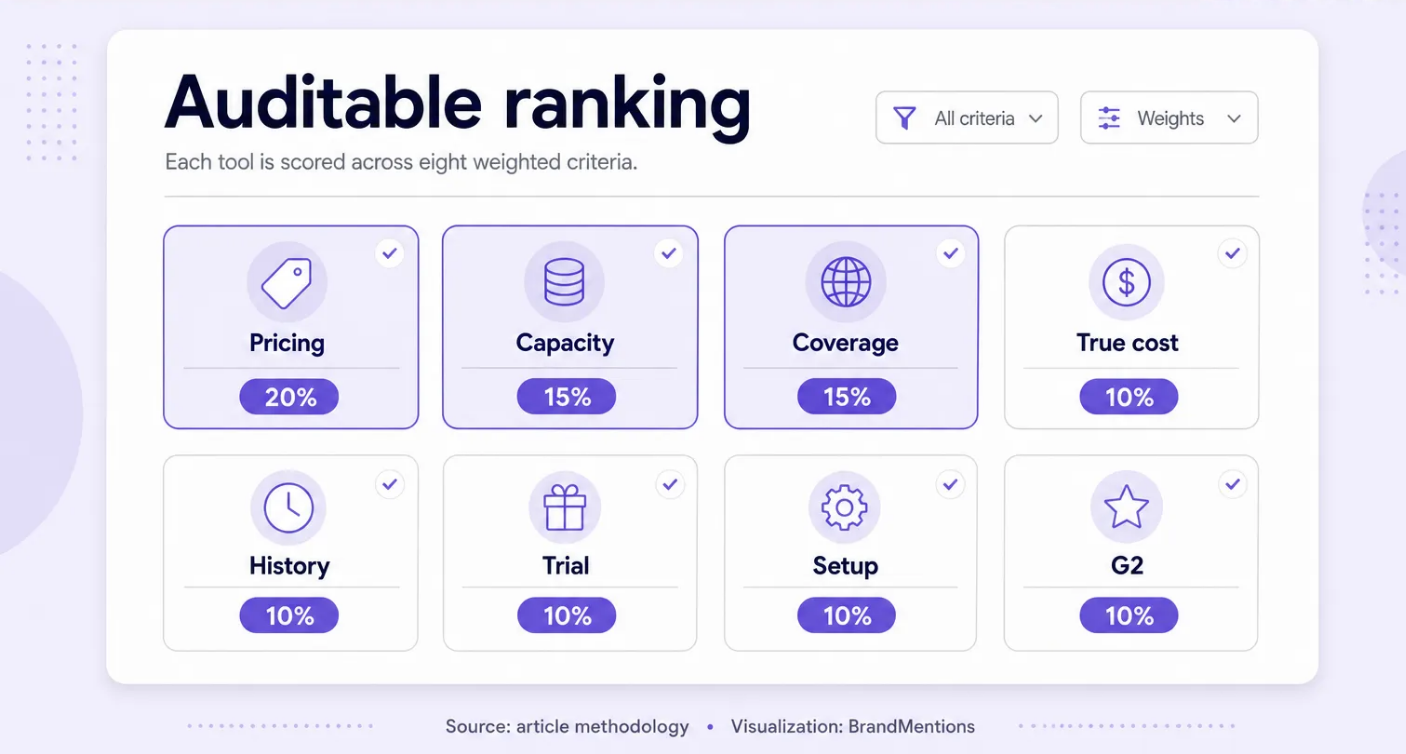
We scored each tool on eight weighted criteria, led by published pricing (20%) and entry-plan capacity (15%), and did not score sentiment accuracy because no independent small-business benchmark exists. Rankings that hide their weighting make it harder to understand what the final order actually rewards. Here is the full scoring frame, weighted for small-business reality rather than enterprise capability.
| Criterion | Weight | What was measured |
|---|---|---|
| Real published pricing | 20% | A price visible on the vendor's own page, with billing cadence stated. Quote-only products lose points by design. |
| Entry-plan capacity | 15% | Keywords or topics, monthly mention allowance, users and update frequency on the cheapest usable plan. |
| Source coverage breadth | 15% | Social networks plus news, blogs, forums, reviews, video and communities, checked against documentation. |
| True cost including add-ons | 10% | Seats, listening modules, API fees, overage rates, extra keyword charges, historical retrieval. |
| Historical access and retention | 10% | Backfill, storage caps and rotation rules, kept as separate figures. |
| Trial availability and scope | 10% | A self-serve trial, and whether it exposes the plan you intend to buy. |
| Setup effort | 10% | Documented query building, Boolean availability, alert routing, time to a first useful alert. |
| G2 rating and review count | 10% | Buyer context only, weighted by the reviews rating. |
What this ranking does not claim. There is no comparable, independent benchmark of sentiment accuracy, detection recall or alert latency across these 11 products at small-business volume, so no artificial scores were invented for those dimensions. Sentiment capabilities are discussed qualitatively in the individual reviews but do not contribute to the ranking score.
The Seeded-Control Test: How Do You Benchmark Two Tools in a Week?
Since nobody publishes that benchmark, run the short version yourself. It takes a week and it is fully auditable:
- Seed a control. Post one comment containing a unique string on a source the tool claims to cover. Record the timestamp.
- Measure real latency. Log the minute the alert arrives, not the refresh interval on the pricing page.
- Measure recall. Assemble ten mentions you already know exist, across three different sources, and count how many the tool finds.
- Measure noise. Take 100 collected results and count irrelevant ones, duplicates, reshares counted as new mentions and obvious bot posts. A high duplicate ratio inflates both volume and sentiment.
- Measure the exit. Export those 100 records and check which fields survive.
Do this with two tools on identical queries and you will have better evidence than any roundup can give you, including this one.
Full Comparison Table: 11 Social Listening Tools for Small Business
Prices are as published in September 2026. An annual figure is a monthly equivalent on a 12-month commitment, not always an available monthly payment. "Quote" means no fixed price is published for the relevant configuration.
| Rank | Tool | Published entry price | Entry capacity | Update frequency | Source emphasis | History on the entry plan | Trial |
|---|---|---|---|---|---|---|---|
| 1 | BrandMentions | $79/mo annually, $99/mo billed quarterly | 5 keywords, 5,000 mentions/mo, 1 user | Daily on Starter | Social, web, news, blogs, forums, reviews | About 30 days backfill; full history on Enterprise | 7 days |
| 2 | Awario | €29/mo annually, €49 monthly | 3 topics, unlimited keywords each, 30,000 mentions/mo, 1 user | Continuous collection | Social, news, blogs, forums, web | 5,000 stored mentions per alert, oldest rotate out | 7 days |
| 3 | Brand24 | $199/mo annually, $249 monthly | 3 keywords, 2,000 mentions/mo, 1 user | Every 12 hours | Social, news, blogs, forums, video, reviews, podcasts on Business | Initial sample from the preceding period, then forward | 14 days |
| 4 | Mentionlytics | $49/mo annually advertised against a $69 list price | 3 keyword rules, 5,000 mentions/mo, 2 users, 10 social profiles | Every 12 hours | Social, web, news, blogs, forums, reviews | Historical collection is a paid add-on | 14 days |
| 5 | Octolens | $159/mo annually, $199 monthly | 10 keywords, 15,000 mentions, unlimited seats | Hourly | Social plus software and professional communities | 2-year data retention, not a general backfill | Yes |
| 6 | Syften | $29.95/mo | Community and web filters with daily result caps | Continuous | Forums, Reddit, maker and developer communities | Archive access varies by plan | 14 days |
| 7 | Hootsuite | $99/user/mo | 10 social accounts plus basic listening | Real time on connected accounts | Own channels plus Quick Search | 7-day search window on Standard | 14 days |
| 8 | Agorapulse | $99/user/mo monthly, $79 annually | 10 social profiles shared across users | Real time on connected accounts | Connected social networks only | Social feed only | 15 days, extendable once |
| 9 | YouScan | $499/mo billed annually | 3 fixed text-based topics, 5,000 new mentions per topic per month | Continuous | Social, blogs, forums, reviews, news, plus visual on higher plans | Last 30 days | Request access |
| 10 | Sprout Social | $199/seat/mo annually, plus Listening | 5 social profiles on Standard | Real time on connected accounts | Own channels, plus paid Listening module | Backfill varies by source, longer costs extra | 30 days, core platform |
| 11 | Determ | Quote | Scoped by keywords, sources and users | Real time | Regional and global press, social, forums | Contract-defined | Demo |
How to read the Rank column. Rank is the descending order of each tool's total weighted score against the eight criteria in How We Ranked These 11 Tools, so it is the same order used for the 11 reviews below and for this page's ItemList structured data.
G2 Ratings: Always Read the Reviews
These were recorded during research in September 2026 and G2 pages do not all refresh together, so check the live page before you decide. They measure reviewer satisfaction, never listening accuracy.
| Tool | G2 rating |
|---|---|
| Octolens | 5.0/5 |
| Syften | 5.0/5 |
| BrandMentions | 4.9/5 |
| Mentionlytics | 4.9/5 |
| YouScan | 4.7/5 |
| Brand24 | 4.6/5 |
| Sprout Social | 4.4/5 |
| Hootsuite | 4.3/5 |
| Awario | 3.9/5 |
Some of the tools are not listed because no verified rating and count pair was reproduced for them, which is not a statement about their quality.
The 11 Tools Reviewed: Pricing, Limits and Verdicts for Small Business
Each review uses the same six sections in the same order, so you can compare like with like instead of reading marketing copy eleven times. Every review opens with a one-line verdict you can quote.
1. BrandMentions: Best for Tracking Brands, Competitors, and Online Conversations
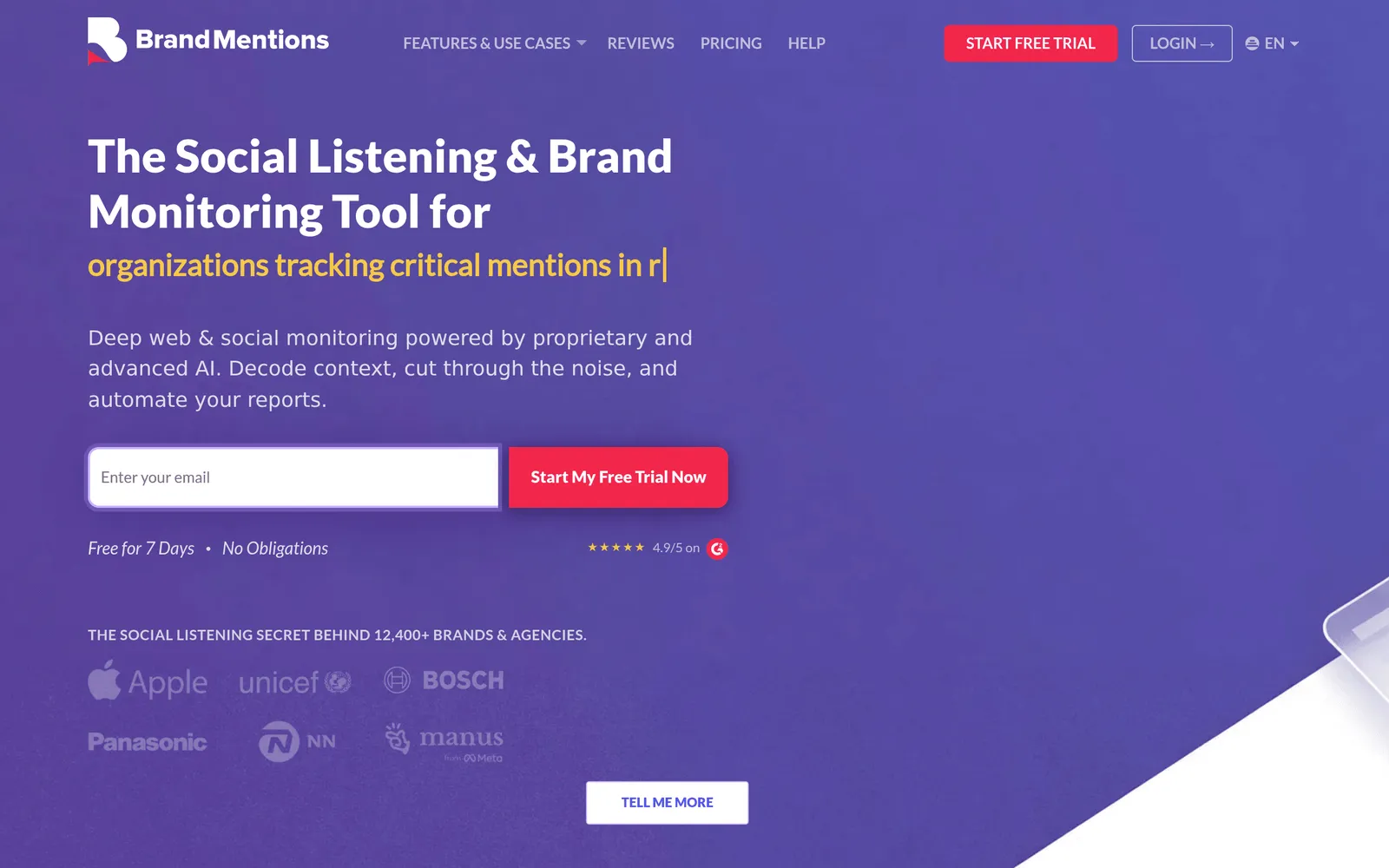
Verdict: the strongest fit when reputation and competitor tracking must share one dashboard, from $99/mo billed quarterly with no per-seat charges below Enterprise - but Starter updates daily, so Pro is the minimum for same-hour reply and Expert ($399 annually) is the real-time tier.
| Plan | Price | Keywords | Mentions/month | Users | Updates |
|---|---|---|---|---|---|
| Starter | $99/mo billed quarterly, $79 annually | 5 | 5,000 | 1 | Daily |
| Pro | $299 monthly, $249 annually | 20 | 30,000 | 2 | Hourly |
| Expert | $499 monthly, $399 annually | 50 | 75,000 | 10 | Real time |
| Enterprise | From $1,299 monthly, from $1,099 annually | Custom | Custom | Custom | Real time |
What You Actually Pay
Starter is $99 a month billed quarterly or $79 billed annually, which is $948 for a year. Pro adds multilingual AI sentiment, standard reports and an AI assistant. Expert is the published real-time tier at $399 annually, and it carries white-label reports, Strategic AI Insights and Boolean search. API access and full historical data sit on Enterprise. The trial is seven days.
Coverage and Data Limits
Social networks, news, blogs, forums and general web pages, plus named review sources rather than a generic "reviews" category. Historical access needs reading twice: the help center puts backfill at 30 days on Starter, Pro and Expert, while the pricing page reserves Full Historical Data for Enterprise. Read them together and plan for roughly a month backward, everything forward, on any self-serve plan.
Core Strengths
Reputation and competitive intelligence live in one dashboard, so a share-of-voice comparison against two or three named competitors does not require a separate analytics module or an export. Sentiment sorting is automatic and multilingual from Pro upward, and alerts route to email and Slack, which is what a one-person team actually needs. There are no per-seat charges below Enterprise.
Where It Falls Short
Starter is a daily-update monitoring plan and should not be sold as crisis cover. If a bad review needs a same-hour reply, Pro is the minimum and Expert is the honest answer. Two users on Pro is tight for an agency, and the review count on G2 is smaller than the oldest players in the category, which means fewer independent data points.
The Overlooked Buying Implication
The named review-source coverage is the part that rarely appears in comparison tables and matters most to local and service businesses. A clinic, restaurant or hotel can see review-platform activity in the same feed as its Instagram mentions instead of running a separate reputation software subscription alongside a listening tool. If your reputation lives on review platforms rather than on X, that consolidation is the reason to shortlist it.
Ideal Fit and Trial Test
A small business that weighs reputation and competitor intelligence equally and refuses to pay per seat. In the trial, track your brand plus a tightly defined competitor set and follow one consistent competitive analysis guide so differences in query construction do not distort the comparison.
2. Awario: Best Affordable Option for Solo Marketers
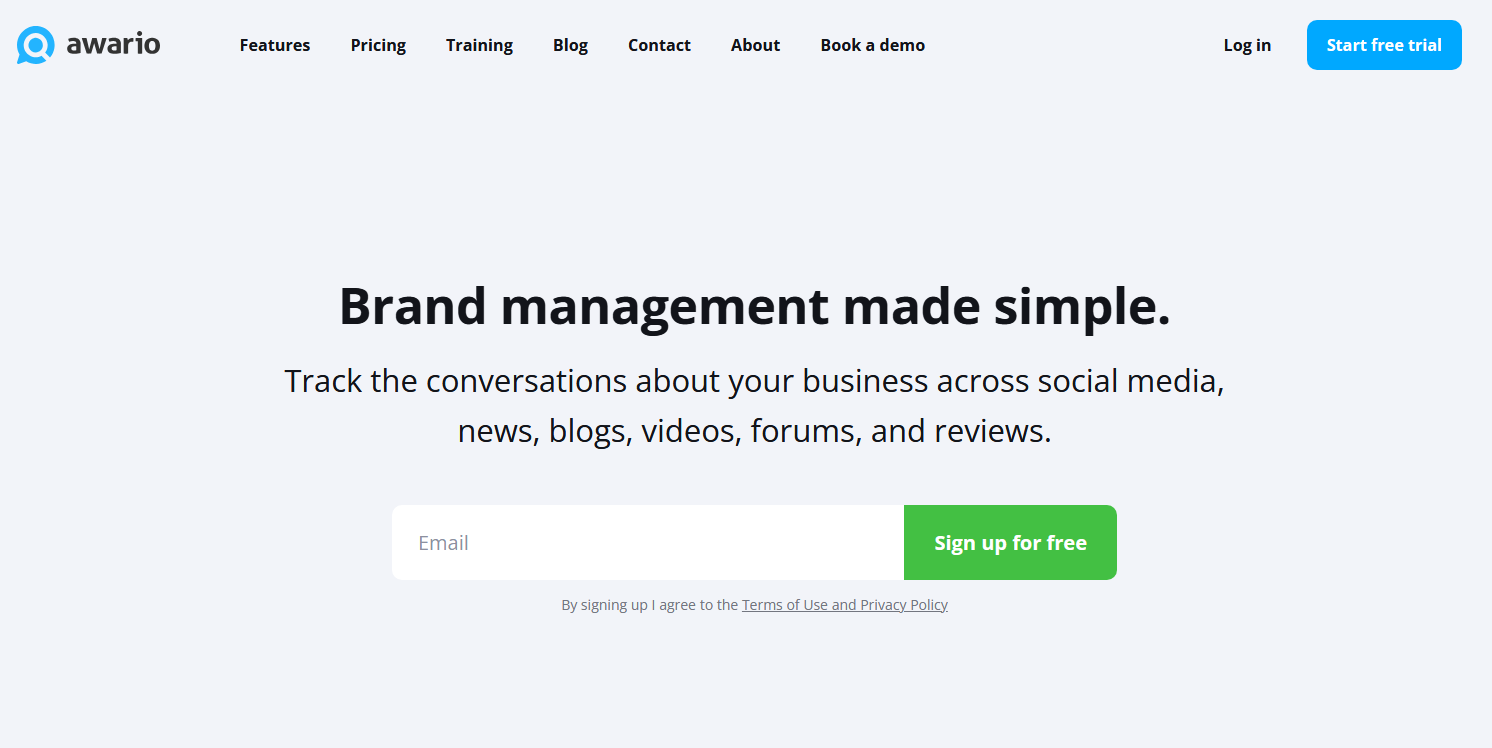
Verdict: best sub-€50 collection ceiling at €29/mo billed annually - 3 topics, unlimited keywords each and 30,000 mentions a month - but no export and no report sharing on Starter.
| Plan | Price | Topics | Mentions/month | Stored per alert | Users |
|---|---|---|---|---|---|
| Starter | €29/mo annually, €49 monthly | 3 | 30,000 | 5,000 | 1 |
| Pro | €149 monthly | 15 | 300,000 | 15,000 | 10 |
| Enterprise | Quote ladder above Pro | 100 | 1,000,000 | 50,000 | Custom |
What You Actually Pay
€29 a month on annual billing, or €49 month to month. Awario's help center states that an annual subscription saves two months against monthly billing and that you can cancel at any point. Pro is €149 monthly.
Coverage and Data Limits
Social networks, news, blogs, forums and the wider web, with Boolean search on every plan including Starter. The published quota table is stricter than the pricing card: Starter allows 1 project, 3 mention alerts, 5,000 mentions per alert and 30,000 new mentions a month, with export, report sharing, white-label reports and API all excluded.
Core Strengths
A topic accepts unlimited keywords, so every misspelling, handle and hashtag for your brand fits in one slot instead of burning three. The 30,000 mention monthly allowance is the most generous in the sub-€50 band by a wide margin, and Boolean on the cheapest tier is genuinely unusual.
Where It Falls Short
No export and no report sharing on Starter, which means a freelancer cannot hand a client a file without moving to Pro. Sentiment is a three-way classification without emotion granularity, and the jump from €29 to €149 is steep with nothing in between.
The Overlooked Buying Implication
Collection allowance and accessible storage are different limits, and Awario's FAQ says so plainly: once an alert hits its mention history cap, the oldest mentions are replaced by new ones. A busy competitor topic can therefore erase its own older records while your account still has unused monthly collection capacity. Point your highest-volume query at its own alert so it cannot cannibalise your brand history.
Ideal Fit and Trial Test
A founder or one-person marketing team who reads the dashboard themselves and does not need to send files out. During the seven-day trial, build one exclusion-heavy Boolean query and confirm that Starter's storage and export limits still let you keep the evidence your reporting needs.
3. Brand24: Best for Trend and Event Analysis
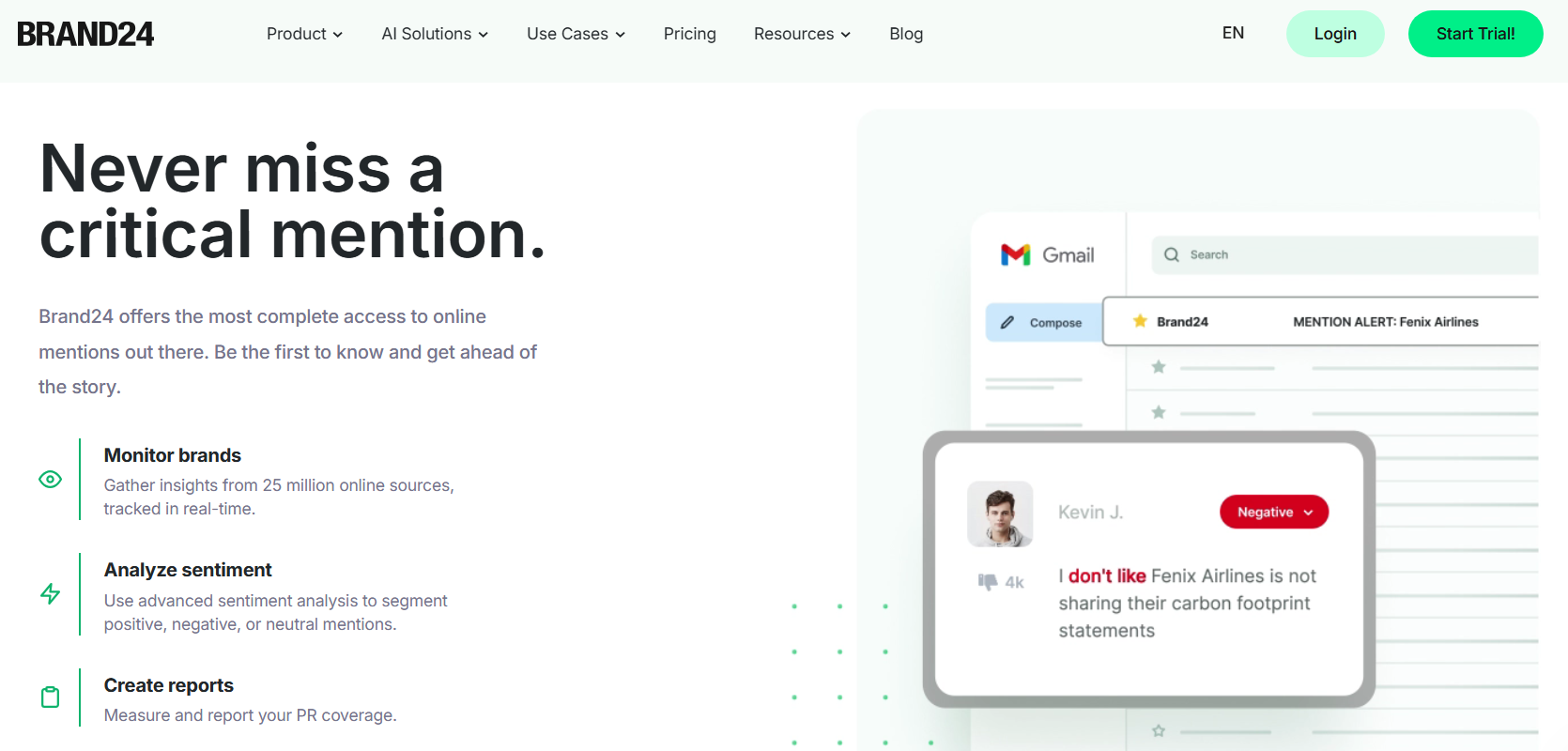
Verdict: one of the strongest trend and event analysis feature sets in this comparison, but Individual at $249 monthly collects every 12 hours with 3 keywords and 2,000 mentions, so Pro at $399 billed annually is the effective small-business entry.
| Plan | Price | Keywords | Mentions/month | Users | Updates |
|---|---|---|---|---|---|
| Individual | $249 monthly, $199 annually | 3 | 2,000 | 1 | Every 12 hours |
| Team | $349 monthly, $299 annually | 7 | 10,000 | Unlimited | Hourly |
| Pro | $499 monthly, $399 annually | 12 | 40,000 | Unlimited | Real time |
| Business | $699 monthly, $599 annually | 25 | 100,000 | Unlimited | Real time |
| Enterprise | From $1,499 annually, annual only | Custom | Custom | Unlimited | Real time |
What You Actually Pay
Individual is $249 monthly or $199 billed annually, which is $2,388 a year. Pro is the first real-time tier at $399 annually. API access is an extra $99 a month on Business and is included on Enterprise, which is also where the AI Visibility module lives.
Coverage and Data Limits
Source categories are tiered by plan and climb to 16 on Business, where podcasts are added. Individual's 2,000-mention monthly allowance is one of the tightest among the higher-ranked paid tools in this comparison. Projects start with an initial sample from the preceding period and then collect forward.
Core Strengths
Brand24's strongest differentiator here is its combination of trend detection, event analysis and AI-assisted interpretation, including AI Events Detection, AI Brand Assistant, AI Insights and AI Topics on higher tiers. Unlimited users from Team upward removes the seat curve entirely, which genuinely changes the maths for a five-person team.
Where It Falls Short
The published entry price is no longer a small-business price, and the plan that most roundups still call the cheap option collects twice a day with three keywords. AI Insights and AI Topics are capped to two projects on Pro, so a multi-brand agency is pushed to Business.
The Overlooked Buying Implication
An assistant that summarises your project cannot reconstruct conversations the project never collected, and Brand24's own documentation is the only place that spells out how its sentiment number was produced (95% macro-averaged F1 on 50,000 mentions). Treat that as a method disclosure worth crediting, not as a guarantee about your 300 mentions. Create the project before the campaign, not after it.
Ideal Fit and Trial Test
A growing business or small agency where analysis saves more time than raw alerts, with the budget for Pro rather than Individual. In the 14-day trial, judge whether the AI output explains a customer problem or merely restates the mention count.
BrandMentions vs. Brand24 for Small Business: Which Should You Choose?
Choose BrandMentions if you need to track many brands, competitors and review sources; choose Brand24 if unlimited users and deeper trend and event analysis matter more than keyword breadth. At $399 a month billed annually both reach real-time collection, and there the paths split.
| At $399/mo billed annually | BrandMentions Expert | Brand24 Pro |
|---|---|---|
| Keywords | 50 | 12 |
| Mentions per month | 75,000 | 40,000 |
| Users | 10 | Unlimited |
| Standout capability | White-label reporting, Strategic AI Insights, Boolean search | AI analysis layer (AI Events Detection, AI Insights) |
| Entry plan below it | Starter $99/mo billed quarterly ($79 annually), daily updates, 5 keywords, 5,000 mentions | Individual $249 monthly ($199 annually), every 12 hours, 3 keywords, 2,000 mentions |
On the cheapest plans the difference is just as sharp: BrandMentions Starter gives five keywords and 5,000 mentions a month on daily collection, while Brand24 Individual gives three keywords and 2,000 mentions on a 12-hour cycle at a higher price.
Awario vs. Brand24 for Small Business: Which Is Better Value?
For a solo operator, Awario Starter at €29/mo billed annually is the better value; Brand24 only becomes the better buy at Pro ($399 annually), where real-time collection and deeper trend, event and AI-assisted analysis arrive. The entry plans are not close on capacity.
| Entry plan | Awario Starter | Brand24 Individual |
|---|---|---|
| Price | €29/mo annually (€49 monthly) | $249 monthly ($199 annually) |
| Tracked terms | 3 topics, unlimited keywords each | 3 keywords |
| Mentions per month | 30,000 | 2,000 |
| Update frequency | Continuous collection | Every 12 hours |
| Users | 1 | 1 |
| Analysis depth | Three-way sentiment, no emotion granularity | AI sentiment on every plan, deeper AI modules above |
| Export and reporting | No export, no report sharing on Starter | Reporting included; API $99/mo on Business |
| Trial | 7 days | 14 days |
Read it as a trade of capacity against interpretation. Awario collects far more for far less and leaves the reading to you; Brand24 costs more per mention at the entry point and spends the difference on AI analysis and, from Team upward, unlimited users. If you need a file to send a client, note that export sits on Awario Pro (€149 monthly), which changes the comparison again.
4. Mentionlytics: Best Entry Plan for Two People
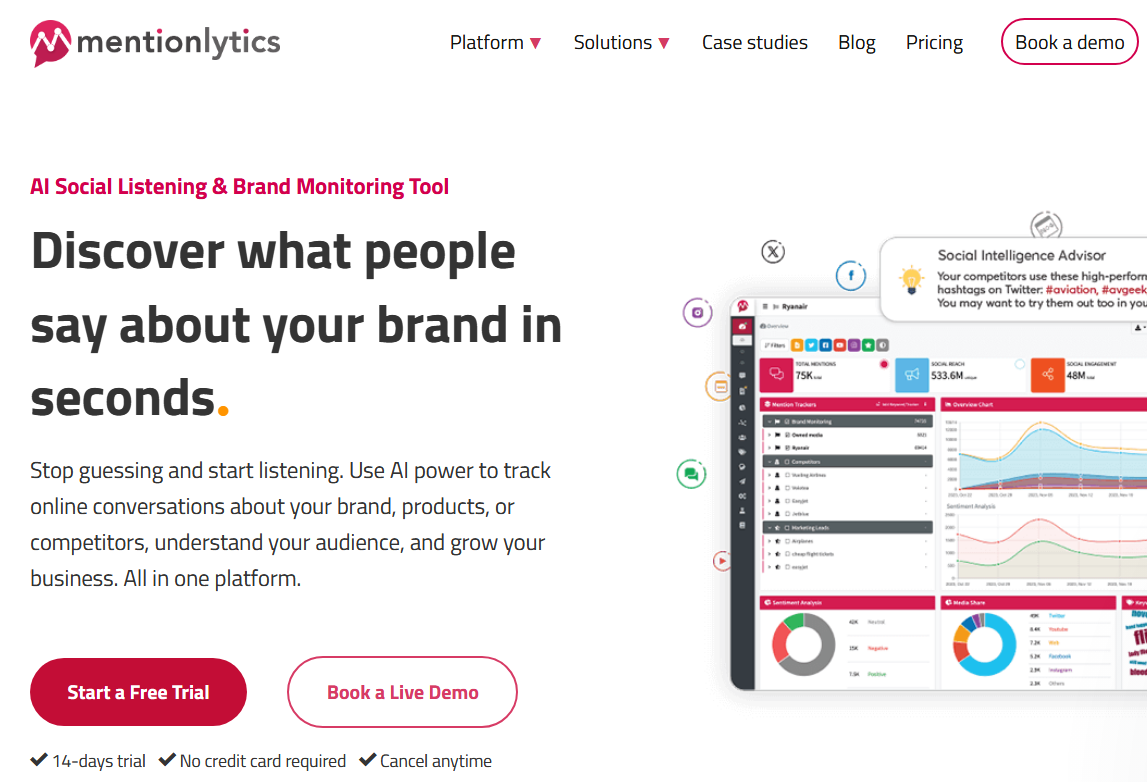
Verdict: the only entry plan here that includes 2 users and 10 social profiles, at $49 billed annually against a $69 list price - but 12-hour collection makes Basic a routine-monitoring plan and history is a paid add-on.
| Plan | Price billed yearly | Keyword rules | Mentions/month | Users | Updates |
|---|---|---|---|---|---|
| Basic | $49 advertised against a $69 list | 3 | 5,000 | 2 | Every 12 hours |
| Essential | $169 | 10 | 15,000 | 10 | Every 6 hours |
| Advanced | $299 | 15 | 50,000 | Unlimited | Continuous |
| Pro | $499 | 25 | 100,000 | Unlimited | Continuous |
What You Actually Pay
The Basic card shows $69 struck through and $49 as a limited-time annual rate, so budget on the list price in case the offer ends. Note that the ladder itself has moved during 2026, with mid-tier list prices reduced, which means any figure older than a quarter is suspect.
Coverage and Data Limits
Web sources (news, blogs, forums or any website) plus X, TikTok, LinkedIn, Facebook, Instagram, YouTube and Reddit, with Boolean search and reviews from Basic. Updates run every 12 hours on Basic, every 6 on Essential, continuously from Advanced. Historical collection is a separate paid job, not an included backfill.
Core Strengths
Two users and 10 social profiles on the cheapest plan is rare, and it removes the most common upgrade trigger at the bottom of this market. The Social Intelligence Advisor on higher tiers attempts recommendations rather than charts, which suits an owner who opens the tool once a week.
Where It Falls Short
A 12-hour collection cycle makes Basic a routine-monitoring plan, not an incident plan. The step from Basic to Essential is large in both price and capability, and the advisor occasionally presents a trivial correlation as an insight, so check its output rather than forwarding it.
The Overlooked Buying Implication
Historical retrieval is documented as priced per 1,000 mentions, for one keyword, on one channel. That structure multiplies fast: three competitors across four networks is not one backfill job at one price. If you need last year's data, price the retrieval before you price the subscription.
Ideal Fit and Trial Test
A two-person team that wants broad source coverage at the lowest credible price. During the 14-day trial, ask support to confirm you are testing Basic behaviour, because trials in this category routinely expose higher-tier features.
5. Octolens: Best for B2B and Developer-Led Growth
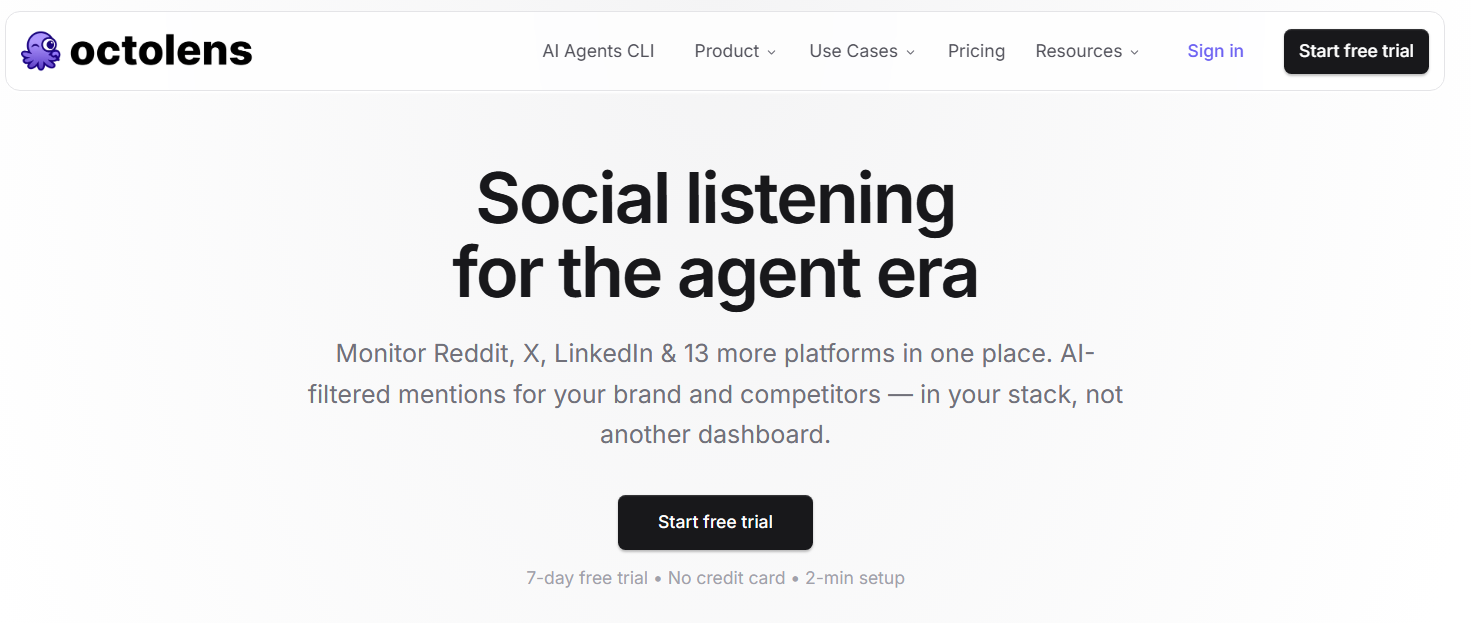
Verdict: one of the most automation-friendly tools in its price band - hourly refresh, unlimited seats, full API, webhooks and a hosted MCP server from $159/mo billed annually - but no consumer review coverage and thin news.
| Plan | Price | Keywords | Mentions/month | Seats | Refresh |
|---|---|---|---|---|---|
| Pro | $159/mo annually, $199 monthly | 10, $10 per extra | 15,000, $0.013 per extra | Unlimited | Hourly |
| Scale | Higher published tier | 40, $5 per extra | 50,000, $0.01 per extra | Unlimited | Faster, wider sources |
| Workspace | Custom | Custom | Custom | Unlimited | Custom |
What You Actually Pay
Pro is $159 a month billed annually, which is $1,908 a year. Extra keywords are $10 a month each and extra mentions are $0.013 each, with flex usage on by default and a spend cap available in settings.
Coverage and Data Limits
Social platforms plus community and software venues, with two years of retention on Pro. Broader web, news, podcast and newsletter coverage starts on the tier above. Retention is not the same thing as a general historical archive, and the documentation says so.
Core Strengths
Full API access, webhooks (Discord compatible) and a hosted MCP server on every plan, which makes it the most automation-friendly product in this price band. AI filtering scores relevance and intent, so "someone is asking for a tool like ours" surfaces separately from "someone typed our name".
Where It Falls Short
Narrow by design: no consumer review coverage, thin news, and share-of-voice reporting that trails the dedicated reputation tools. Pro is also priced above the entry point of several broader products, so it competes on workflow rather than on cost per mention.
The Overlooked Buying Implication
Search and monitoring draw from the same mention allowance, and one on-demand search returns about ten mentions. That means an agent or a curious teammate can consume your quota by asking questions, and a successful launch increases both your useful feedback and your invoice. Set the spend cap before you add a broad industry keyword, not after.
Ideal Fit and Trial Test
A B2B software or services team that wants mentions routed into Slack, a CRM or an agent workflow rather than read in a dashboard. Test your company context and relevance rules first, because those settings, not the keyword list, decide what reaches you.
6. Syften: Best for Community-Led Customer Acquisition
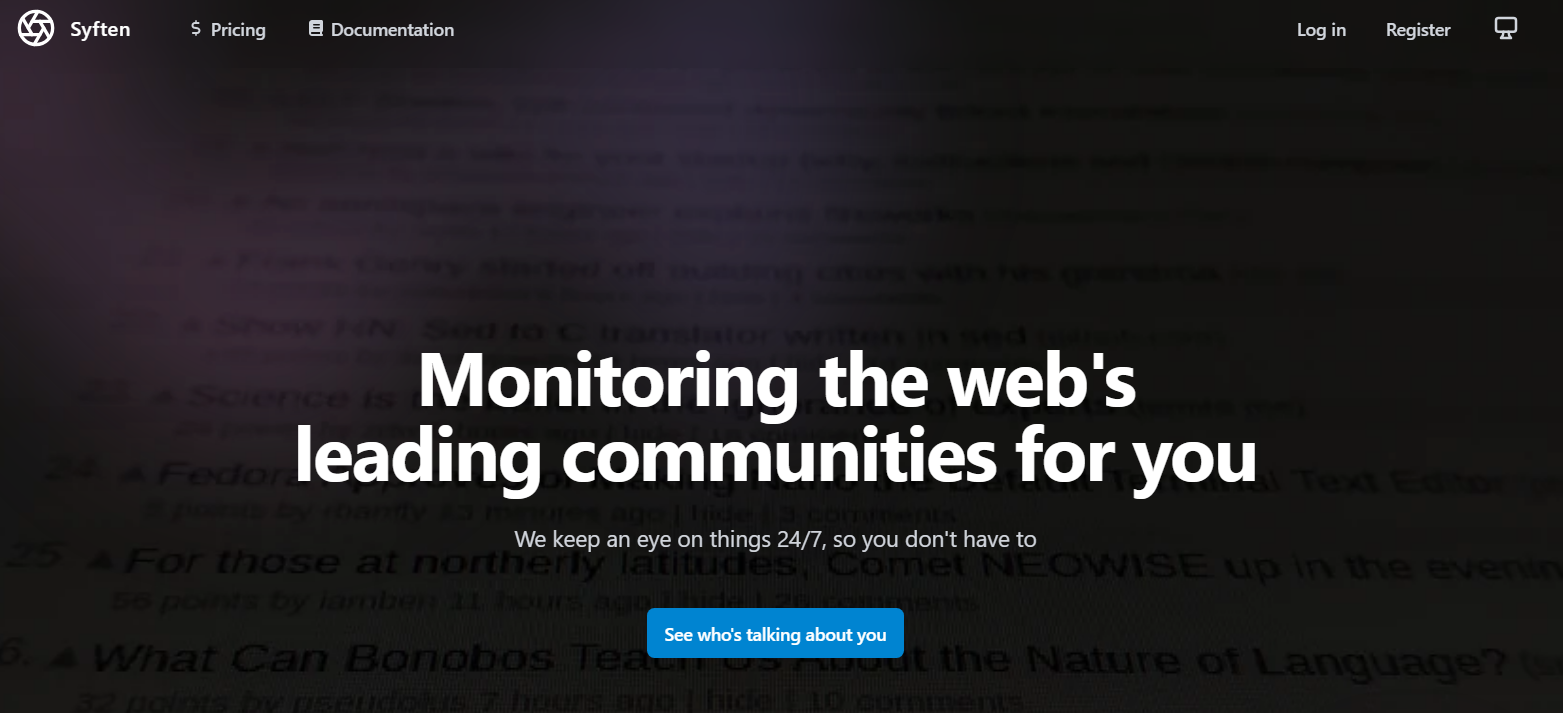
Verdict: a low-cost option for precise forum, Reddit and maker-community acquisition at $29.95/mo - but X and YouTube monitoring are sold separately and there is no conventional sentiment dashboard.
| Plan | Published price | Community filters | Web filters | Notable add-ons |
|---|---|---|---|---|
| Entry | $29.95/mo | Small filter set with daily result caps | Limited web filters | X and YouTube monitoring |
| Higher tiers | Published ladder above Entry | More filters, higher caps | More web filters | Archive access, integrations |
What You Actually Pay
$29.95 a month at the entry point, which keeps it in the same bracket as Awario. Check the price of the source add-ons you need before comparing, because X and YouTube monitoring are sold separately rather than bundled.
Coverage and Data Limits
Forums, Reddit, maker and developer communities, plus public web filters. Daily result caps apply per filter, and archive depth varies by plan.
Core Strengths
Precision. The filtering syntax is built for people who want three relevant threads a day rather than three hundred mentions a week, and its web filters can watch pages that are not conversations at all.
Where It Falls Short
It is not a reputation reporting suite. Its documented analysis returns relevance rather than a conventional sentiment dashboard, so if a stakeholder wants a sentiment trend chart, this is the wrong tool. Mainstream consumer and visual platforms are largely outside its remit.
The Overlooked Buying Implication
The web filters double as competitor intelligence. Pointed at a rival's pricing page or changelog, they tell you when something changes, which is a different and often more useful signal than a mention. Note that web filters use a different query syntax from community filters, so budget setup time for both.
Ideal Fit and Trial Test
A founder whose customers are in forums and who intends to reply personally. Test it with real posts from your target communities, and compare against dedicated Reddit listening tools on the same threads before deciding.
7. Hootsuite: Best If You Already Publish in the Suite
Verdict: worth it only if you already publish in Hootsuite - $99 per user per month includes Quick Search with a 7-day window on Standard, and full listening (Lumen with Topic Insights) is Enterprise with no published price.
| Plan | Price per user/month | Basic listening history | Search comparisons | Full listening |
|---|---|---|---|---|
| Standard | $99 | 7 days | 2 | No |
| Professional | $199 | 7 days per help center, 30 days per plan page | 2 or 5 depending on the source you read | No |
| Advanced | $399 | 30 days | 5 | No |
| Enterprise | Custom | 30 days Quick Search, 13 months Topic Insights | 5 to 10 | Lumen |
What You Actually Pay
$99, $199 and $399 per user per month for the three published tiers, with a 14-day trial. One Standard seat is $1,188 a year and three are $3,564 before anything else. Full listening (Lumen with Topic Insights) is Enterprise, with custom pricing and topic bundles sold in increments.
Coverage and Data Limits
Basic social listening is available to all customers through Quick Search. Its help center table gives 7 days of historical data and 2 search comparisons on Standard, Professional, Team and Business, moving to 30 days and 5 comparisons on Advanced and Enterprise. Lumen Topic Insights on Enterprise reaches 13 months of history with 5 saved topics and add-on bundles.
Core Strengths
One login for scheduling, inbox and a quick competitive check, which removes tool switching for a team that already needs the publishing side. Trend forecasting and AI summaries at the upper tiers are genuinely useful planning inputs.
Where It Falls Short
Per-user pricing makes Hootsuite increasingly expensive as a small team grows, and the listening a small business actually wants (saved topics, long history, wider web) is on the tier with no published price. Read "includes listening" as "includes search" and price accordingly.
The Overlooked Buying Implication
Hootsuite's own pages disagree about the Professional search window: the listening overview article shows 7 days for Professional, while the Professional plan page advertises 30 days of social search. Get the number you are buying confirmed in writing before you commit, because a seven-day window changes what the plan can do for campaign reporting.
Ideal Fit and Trial Test
A team already committed to Hootsuite for publishing that wants light monitoring in the same tab. In the trial, ask it to reproduce a search window, a comparison and an alert you actually need before any Enterprise conversation starts.
8. Agorapulse: Best Suite Economics for a One-Person Social Team
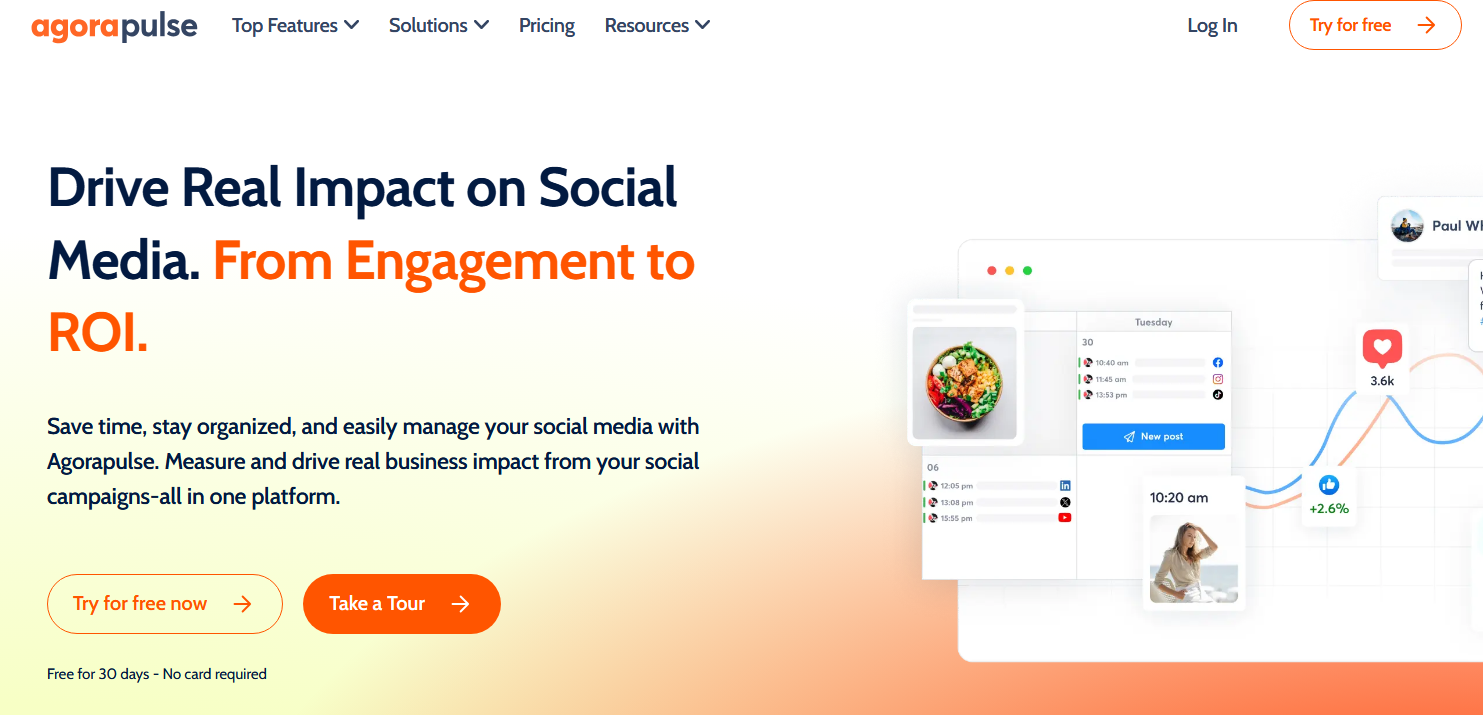
Verdict: the best suite economics for a single social manager at $79 per user per month billed annually with 10 shared profiles - but there is no open-web, news, forum or review coverage at all.
| Plan | Price per user/month (monthly / annual) | Users | Social profiles included |
|---|---|---|---|
| Standard | $99 / $79 | 1 per seat | 10, shared |
| Professional | $149 / $119 | 1 per seat | 10, shared |
| Advanced | $199 / $149 | 1 per seat | 10, shared |
| Custom | Contact vendor | Custom | Custom |
What You Actually Pay
$99 monthly or $79 annually per user on Standard, rising to $199 or $149 on Advanced. Annual billing is a 12-month commitment paid upfront with up to 20% off the base plan. Additional social profiles are $10 a month on annual billing and $15 on monthly.
Coverage and Data Limits
Listening covers the networks you connect and public keyword searches where the platform allows them. It does not crawl news sites, forums or review platforms, so confirm the listening search allowance on your specific plan before assuming parity with a dedicated tool.
Core Strengths
Everything reaches you in one inbox, so a mention becomes a reply in a click, and the reporting is clean enough to send to a client without reformatting. For a single social manager handling publishing, engagement and light monitoring, the economics are hard to beat inside a suite.
Where It Falls Short
No open-web coverage. A Google review, a Reddit thread or a news article about your business will not appear. The per-user model also means a three-person team costs more than most standalone listening products.
The Overlooked Buying Implication
Two details in the help center contradict the marketing. The 10 social profile slots are shared across all users rather than granted per seat, so adding a person does not add channels. And the "30 days free" trial is actually 15 days of Advanced access with one 15-day extension you must activate yourself, which also means the trial shows you a plan above the one you are likely to buy.
Ideal Fit and Trial Test
A single social manager or a small brick-and-mortar brand whose conversations happen on their own channels. Pair it with a €29 to $99 web-listening tool and you have a complete stack for under $200 a month.
Hootsuite vs. Agorapulse for Small Business: Which Suite Listens Better?
Choose Hootsuite if you want Quick Search and trend forecasting beyond your own social inbox; choose Agorapulse if the job is making sure no comment or message on your own channels goes unanswered. Both bill per user and both keep listening inside connected channels at small-business tiers.
| Hootsuite | Agorapulse | |
|---|---|---|
| Entry price | $99 per user per month | $99 per user per month monthly, $79 annually |
| Listening scope | Own channels plus Quick Search | Connected social networks only |
| Basic listening history | 7 days on Standard | Social feed only |
| Open web, news, forums, reviews | Not on published tiers; full listening (Lumen with Topic Insights) is Enterprise | Not covered at all |
| Profiles | 10 social accounts | 10 social profiles, shared across users |
| Trial | 14 days | 15 days, extendable once |
Neither replaces a dedicated listening tool. Pair either with a €29 to $99 web-listening subscription if a Google review, a Reddit thread or a news article about your business needs to reach you.
9. YouScan: Best for Visual and Attribute-Level Research
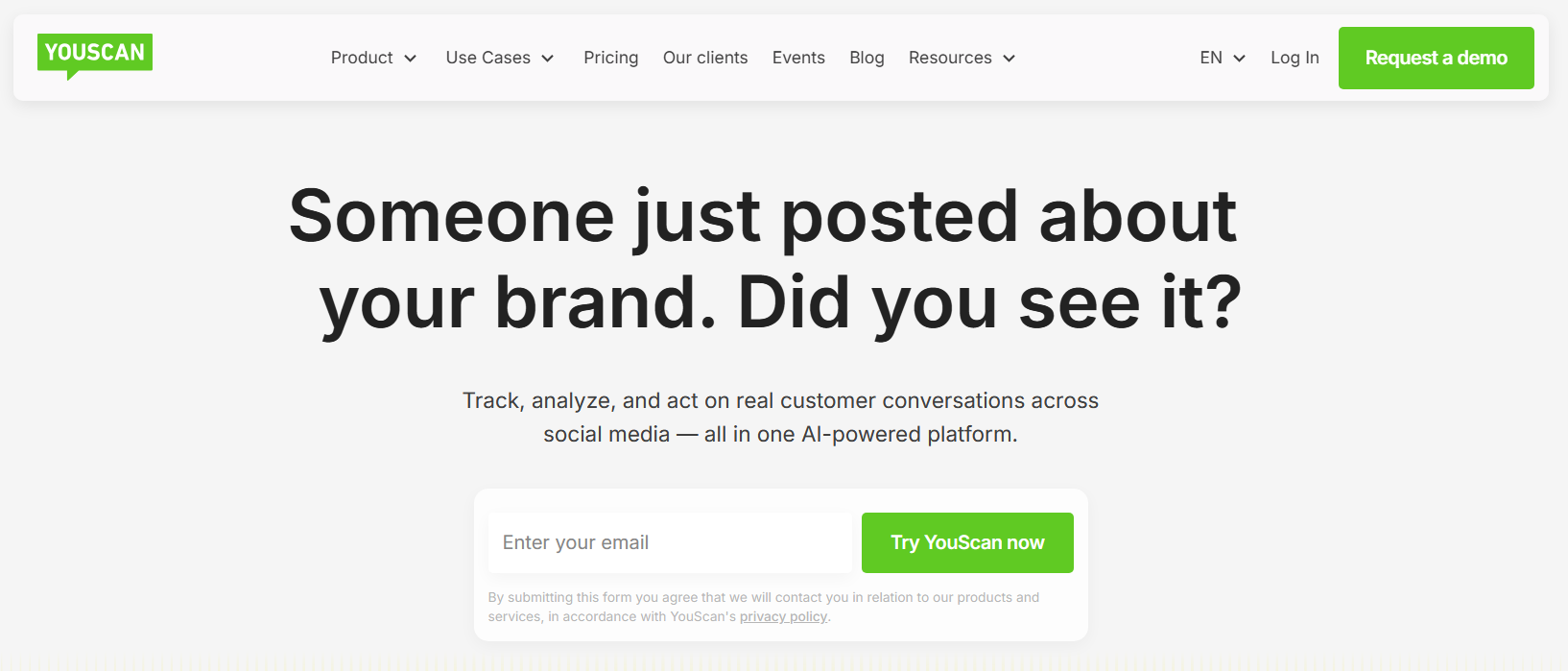
Verdict: aspect-level sentiment from $499/mo billed annually, but Starter is three fixed text-based topics capped at 5,000 new mentions each, and the visual collection everyone associates with YouScan sits on the Unlimited configurations.
| Plan | Price | Topics | Mentions | Users | Notable |
|---|---|---|---|---|---|
| Starter 3 | $499/mo billed annually | 3 fixed, text-based | Up to 15,000/month, capped at 5,000 per topic | Unlimited | Insights Copilot, 10 questions/month |
| Unlimited | Quote | Unlimited | Unlimited sampled | Unlimited | Image content and audience attribute collection |
What You Actually Pay
$499 a month billed annually, which is $5,988 a year, making it the most expensive self-serve entry point here. All plans include unlimited users, unlimited social searches and unlimited rules and alerts.
Coverage and Data Limits
Full coverage of supported social media, blogs, forums, reviews and online news on Starter, with aspect sentiment analysis, trend detection and one integration with Slack, Teams or WhatsApp. Historical data on Starter covers the last 30 days.
Core Strengths
Aspect-level sentiment is the real differentiator for product teams: instead of "38% negative", you see which attribute people dislike. On the Unlimited plans, collection can be driven by image contents such as brand logos and by social audience attributes, which finds user-generated content no keyword can reach.
Where It Falls Short
The price puts it beyond most small businesses, there is no self-serve trial, and for a text-only B2B brand the visual capability is an expense with no return.
The Overlooked Buying Implication
Two details in the help center reshape the Starter plan. Topics are fixed at three and cannot be scaled, and each topic is capped at 5,000 new mentions a month, so the headline 15,000 is not a shared pool you can point at one busy brand. Starter also collects on text-based search queries, which means the visual collection everyone associates with YouScan belongs to the Unlimited configurations, not the entry plan.
Ideal Fit and Trial Test
A consumer, hospitality or apparel brand that appears in customer photos daily, or a product team that needs opinions split by attribute. Count your last 50 social tags: if more than ten show the product without naming the brand, the visual configuration pays for itself.
10. Sprout Social: Best for Established Social Operations
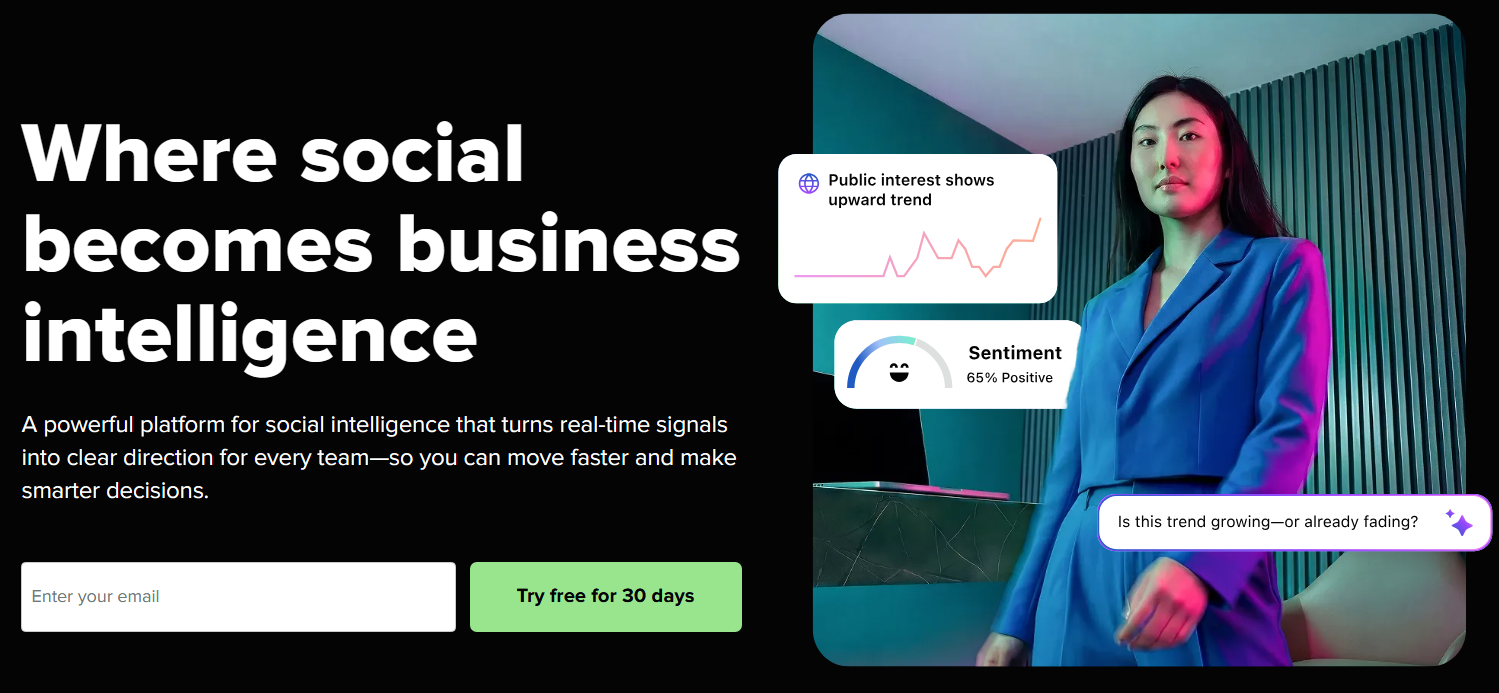
Verdict: the most polished listening workflow here once you have it, but the base plan is $199 per seat per month billed annually with Listening as a separately quoted add-on, and the 30-day trial does not test the module you are buying.
| Item | Detail |
|---|---|
| Relevant base plan | Standard at $199 per seat per month, billed annually |
| Included base capacity | 5 social profiles on Standard |
| Listening | Separately priced add-on on eligible plans |
| History | Default backfill varies by source, longer costs extra |
| Trial | 30 days, core platform |
What You Actually Pay
Three Standard seats are $7,164 a year before Listening, and the Listening module is quoted rather than published. Any comparison that uses the base seat price as a listening price is comparing the wrong products.
Coverage and Data Limits
Connected channels for publishing, engagement and care, with the Listening module adding topic analysis, sentiment and spike alerts. Historical backfill depends on the source, and deeper backfill is a separate purchase.
Core Strengths
Once Listening is in place, query building, topic grouping and reporting are among the most polished available, and a listening insight becomes a reply or a board-ready report without leaving the platform. Onboarding and support are strong, which matters when several departments share the tool.
Where It Falls Short
Total cost is the highest here outside the quote-only media platforms, and most small businesses will not use enough of the suite to justify the seat count. The listening price is not public.
The Overlooked Buying Implication
The 30-day trial validates the management platform, not the module you are buying. Sprout publishes a help article specifically so customers can check whether Listening is included in their plan, which tells you how often that confusion happens. Ask for explicit trial access to Listening and the sources you intend to buy, then compare the listening line alone against a dedicated tool.
Ideal Fit and Trial Test
A team of five or more that lives in the inbox and publishing tools daily and can treat listening as a fraction of a larger spend. Require one combined quote covering seats, Listening and any historical backfill.
11. Determ: Best for Regional Press Plus Social in One Tool
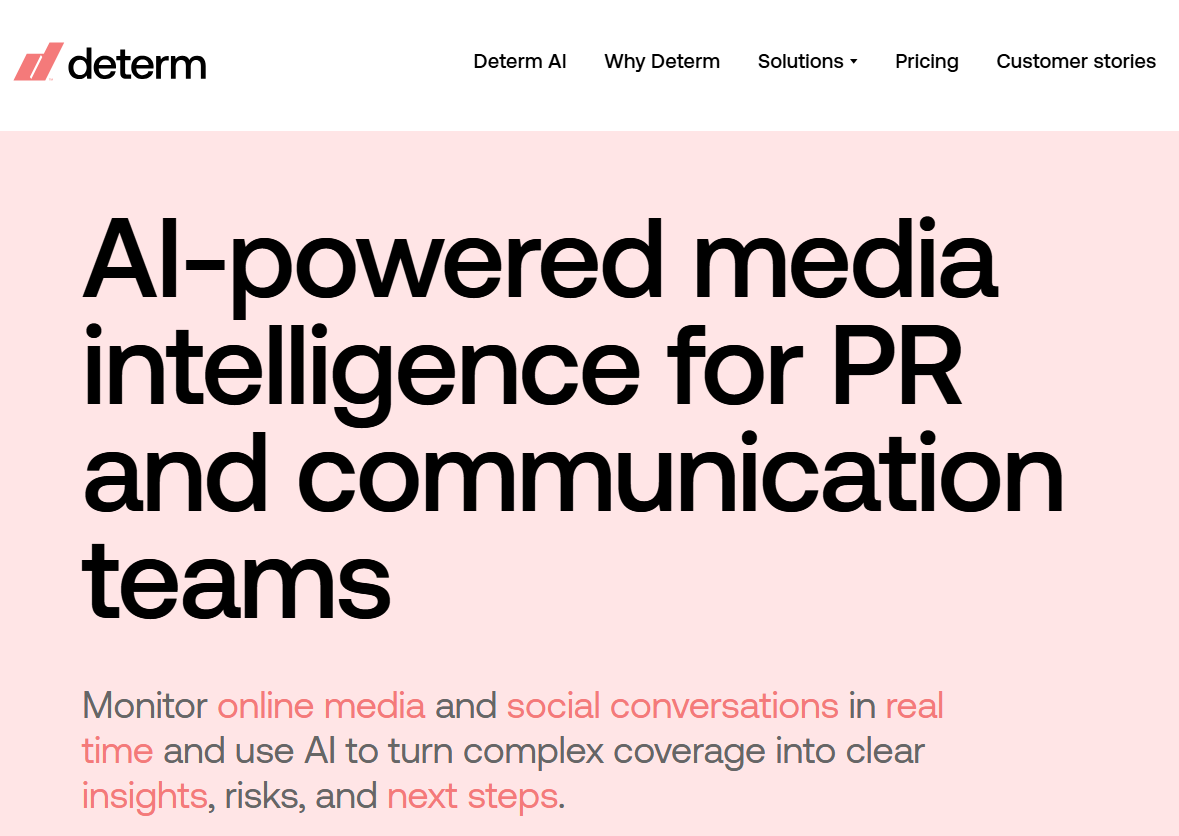
Verdict: the strongest regional press indexing here for Central and Southeastern Europe, with real-time alerting - but it is quote-only with no self-serve signup, which costs it points under this methodology.
| Item | Detail |
|---|---|
| Price | Quote, no published self-serve ladder |
| Scoping | Keywords, sources and users defined in a sales conversation |
| Coverage | Regional and global press, social, forums, blogs |
| History | Contract-defined |
| Access | Demo |
What You Actually Pay
Whatever your scope negotiates, which costs it points under this methodology by design. A founder should not have to book a call to learn a number.
Coverage and Data Limits
Its strength is media indexing, including local outlets in Central and Southeastern Europe that global platforms cover thinly or not at all. Sentiment and AI summaries are included, with depth set per contract.
Core Strengths
Speed of alerting and quality of regional press coverage. Reports export cleanly for stakeholders who care about press hits rather than social volume.
Where It Falls Short
No published price and no self-serve signup. For a US or UK small business with no regional press requirement, the main differentiator does not apply.
The Overlooked Buying Implication
Its media-monitoring heritage shows in how it treats sources: a regional newspaper's site is a first-class source rather than a generic web page. If earned coverage in one specific country matters more than social volume, that heritage is an asset rather than legacy baggage, and it is worth the call it takes to get a price.
Ideal Fit and Trial Test
A small business or agency in Central or Southeastern Europe that needs local press and social in one place. In the demo, hand them five local outlets you care about and ask them to show live results from each.
How Much Should a Small Business Actually Pay for Social Listening?
Plans that meet a realistic small-business brief run from €29 a month (Awario Starter, billed annually) to about $99 a month (BrandMentions Starter, billed quarterly), and real-time collection starts at $399 a month billed annually on BrandMentions Expert and Brand24 Pro. Work out the total, not the headline. Your real cost is the required plan, plus the seats you need, plus any listening module, plus historical retrieval, plus usage overages, plus the hours your team spends reading results that were never relevant.
Three current examples show why the advertised starting price tells you almost nothing:
| Tool | Entry-plan constraint that changes the purchase | Cost of the tier that removes it |
|---|---|---|
| Brand24 Individual | Collects every 12 hours, 3 keywords, 2,000 mentions a month | Pro at $399/month billed annually adds real-time collection, 12 keywords, 40,000 mentions |
| BrandMentions Starter | Daily updates, 5 keywords, 5,000 mentions a month | Expert at $399/month billed annually adds real-time updates, 50 keywords, 75,000 mentions |
| Sprout Social Standard | $199 per seat per month billed annually, listening not included | Listening is a separately priced add-on on eligible plans |
Vendors that publish a full ladder make this arithmetic possible in the first place; the BrandMentions pricing page is the reference used for its four tiers throughout this guide.
The Deadline-Adjusted Price: compare the cheapest plan that meets your response deadline, not the cheapest plan the vendor sells.
Buy the cheapest plan that meets your response deadline, not the cheapest plan the vendor sells.
If you review customer feedback every Friday, a 12-hour collection cycle is fine and you should stop paying for speed. If you have promised a public reply inside an hour, every plan in the 12-hour or daily band is the wrong purchase at any price.
There is a second curve nobody prices for you. Suites bill per user, standalone listening tools bill per keyword or topic.
The Seat-Versus-Keyword Test: forecast which one grows faster in your business before you choose the product type.
Three Hootsuite Standard seats cost $3,564 a year before you buy anything else. Three keywords added to a standalone tool cost far less. If you will add people before you add brands, competitors and campaign terms, a suite gets expensive quickly. If you will add tracked terms before you add staff, the keyword-priced tools win on the long curve.
Buy collection speed only when a named person is on the hook to act on it. Real-time alerts delivered to an inbox nobody owns are the most common wasted line item in a small marketing budget.
Can You Trust Sentiment Analysis When You Only Get 200 Mentions a Month?
Sentiment analysis classifies the attitude expressed in a piece of content, usually as positive, negative or neutral. A vendor's score on its own test set says nothing about performance on your customers, your language or your product category.
Brand24 is unusually specific here, and it deserves credit for it: its help center reports a 95% result using macro-averaged F1 evaluation on 50,000 mentions. Read that properly. It is a vendor-reported benchmark at enterprise volume, not a head-to-head result against the other 10 products here, and not a promise about your 200 mentions.
Here is the arithmetic that matters more than any vendor figure.
At low mention volumes, the raw count matters as much as the percentage.
The Count-Not-Percent Rule: at low mention volumes, report the raw count alongside the percentage so a small number of reclassified mentions cannot make a minor change look dramatic.
In a 20-mention week, reclassifying a single mention moves a sentiment category's share by five percentage points. Your dashboard shows a red spike. Reality shows one sarcastic comment that the classifier read literally. At 300 mentions a month, one mislabelled batch of 30 moves your split by ten points.
The Five-Step Sentiment Audit to Run During Any Trial
Run these five steps during any trial, in every language you sell in:
- Label the relevant mentions manually. Do it yourself, on real mentions from your own brand, not on the vendor's demo project.
- Separate four buckets, not three. Negative, neutral, positive and genuinely ambiguous - the ambiguous pile is the one that tells you how much you can trust the chart.
- Count missed complaints separately from wrongly labelled praise. The first one costs you money and the second one only annoys you, so they are not the same error.
- Stress-test the hard cases. Check sarcasm, mixed feedback and posts naming two brands at once, which is where most classifiers fail.
- Reuse the identical protocol on every tool you compare. Use it whenever you compare sentiment analysis tools, because the question is never whether the chart looks sophisticated.
Do These Tools Really Cover Every Platform, Post and Comment?
No. A platform logo on a pricing page is not evidence of coverage. It is evidence that some data from that platform reaches the product, under conditions the marketing page rarely states.
Ask four source-level questions before you compare prices. Does it capture posts only, or posts and comments? Public pages and profiles you specify, or open keyword search across the network? Hashtag results only, or full captions? And can it retrieve anything from before your query existed?
Then separate three concepts that vendors happily blend into one "history" column:
| Term | What it actually means | What it does not prove |
|---|---|---|
| Historical backfill | Retrieval of mentions published before you created the query | That coverage of every source is complete |
| Data retention | How long the product keeps what it already collected | That you can see conversations from before signup |
| Export access | Your ability to pull records out as CSV, API or report | That every field visible in the interface is exportable |
The gap between interface and export is real and documented. The Brandwatch API data restrictions documentation states that licensing removes full text for certain sources, including X and LinkedIn, and truncates online news text to a 256-character snippet. If you plan to feed listening data into your own reporting, an AI workflow or a warehouse, test an actual export before you design anything around it.
Platform access also shifts under everyone's feet. X, LinkedIn, TikTok and Instagram each restrict what third parties may retrieve, private groups are off limits everywhere, and deleted or edited posts vanish from feeds while sometimes remaining in your stored records. TikTok is the most uneven of all, which is why TikTok listening tools need checking post by post rather than logo by logo.
The Underdogs the Big Roundups Skip
Every list repeats the same ten names. These three narrow the job instead of widening the dashboard, which is exactly what a small team usually needs.
| Tool | Why it deserves a trial | When to walk away |
|---|---|---|
| Syften | Precise filtering in forums and maker communities, published price under $30 | You need a conventional sentiment and reputation report |
| Octolens | Hourly refresh with API, webhooks and MCP on the entry paid plan | Your budget or source needs do not match its Pro tier |
| Determ | Regional press indexing global tools miss | You cannot justify a quote-only vendor |
Two more are worth naming without a full review because their positioning is narrow: GummySearch for subreddit audience research, and Social Searcher for zero-signup spot checks. Neither replaces a monitoring programme, and both are honest about it.
If your customers argue about your category in one specific community, a $30 specialist that sees that community beats a $300 generalist that samples it.
The Five Rules in This Guide, Defined
These are the five buying rules this guide uses, each stated once in a single sentence so you can apply them to any vendor, not just the eleven here.
| Rule | One-sentence definition |
|---|---|
| The Deadline-Adjusted Price | Compare the cheapest plan that meets your response deadline, not the cheapest plan the vendor sells. |
| The Seat-Versus-Keyword Test | Before choosing a product type, forecast whether you will add people or tracked terms faster, because suites bill per user and standalone tools bill per keyword. |
| The Count-Not-Percent Rule | Below roughly 1,000 mentions a month, report the number of negative mentions, never the percentage. |
| The Project-Before-Campaign Rule | Create the listening project the week you plan the campaign, not the week you need the report, because small-business backfill is roughly a month at best. |
| The Denominator Lock | A share-of-voice number is only comparable while the sources, queries, date range and duplicate rules stay fixed. |
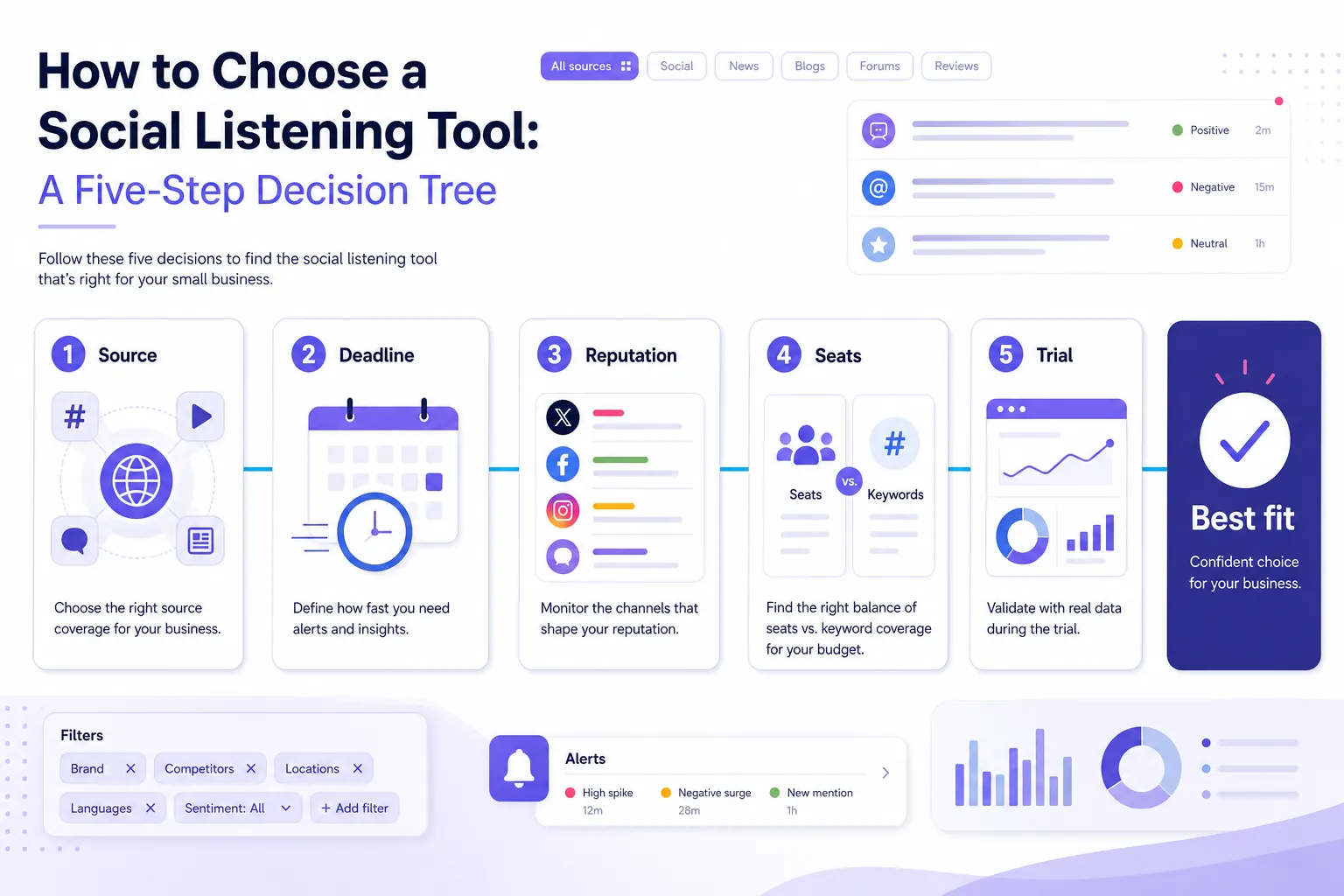
How to Choose a Social Listening Tool: A Five-Step Decision Tree
Work through these in order and stop at the first clear answer.
Step 1. Start with the source, not the price. Run the same query in two trials. If the conversation you need never appears, investigate the collection restriction before you discuss cost, because a higher tier does not always fix a source gap. Ask the vendor to show you one Reddit comment, one review, one Instagram result and one older competitor thread.
Step 2. Set the deadline, then pick the band.
| Budget and constraint | Sensible starting point |
|---|---|
| Under $40 a month | Awario Starter, Syften for community-only needs |
| $40 to $100 a month | Mentionlytics Basic (two users) or BrandMentions Starter (review-source breadth) |
| $150 to $400 a month | Octolens Pro for B2B workflows, BrandMentions Pro or Expert, or Brand24 Pro for real-time monitoring plus trend and event analysis |
| $500 and above | YouScan for visual and attribute research, or scoped proposals from Determ |
| Existing suite subscription | Price the incremental listening upgrade against a standalone tool before adding seats |
Step 3. Match the plan to where your reputation lives. Review platforms and local search point to BrandMentions. Reddit and Hacker News point to Syften or GummySearch. Photos and video point to YouScan. Your own social inbox points to Agorapulse or Hootsuite, with a web tool alongside. Regional press points to Determ.
Step 4. Decide by seats or keywords. One or two people tracking many terms means a standalone tool. Five people tracking few terms means unlimited-user plans (Brand24 from Team, Octolens, YouScan) or a suite you already pay for.
Step 5. Test the decision, not the dashboard. Run your brand query, one competitor query and one customer-problem query for seven days in two tools. Record which findings produced a reply, a content decision or a competitor observation. Do not reward the tool that produced more records.
As a founder, I care less about how impressive a dashboard looks and more about whether it surfaces something my team would otherwise have missed.
The Project-Before-Campaign Rule: create the listening project the week you plan the campaign, not the week you need the report.
Backfill on small-business plans is roughly a month at best (about 30 days on BrandMentions self-serve plans, last 30 days on YouScan Starter, a starting sample then forward on Brand24, and a paid job on Mentionlytics). Deep historical reconstruction is usually unavailable on lower-cost self-serve plans and may require a paid historical-data add-on or enterprise tier.
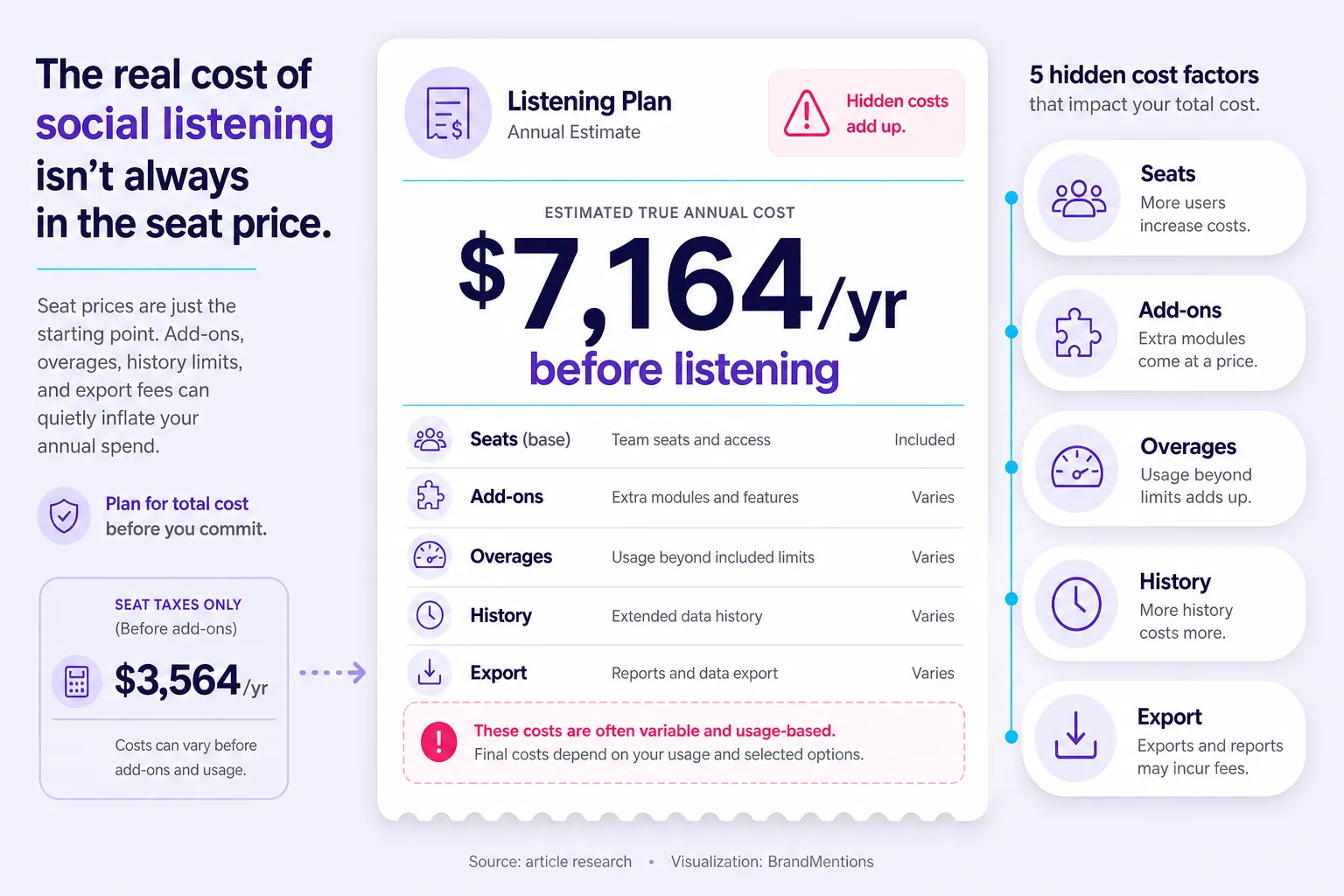
Hidden Costs, Contract Terms and the Questions Vendors Hope You Skip
Six cost lines sit outside the pricing card, and every one of them has bitten a small team I have worked with.
- Seat tax. Three Hootsuite Standard seats are $3,564 a year and three Sprout Standard seats are $7,164 before Listening. Unlimited-user plans flip this maths entirely.
- Module gating. Sprout's Listening is a separate purchase, Hootsuite's full Lumen listening is Enterprise, and neither price is published.
- Overages and flex usage. Octolens bills $0.013 per extra mention with flex on by default, and Brand24 sells API access on Business for $99 a month. Set caps at setup.
- Historical retrieval. Priced per 1,000 mentions per keyword per channel at Mentionlytics, limited to roughly 30 days on BrandMentions self-serve plans, and a separate purchase for deeper Sprout backfill.
- Export rights. Awario Starter excludes export and report sharing. If your deliverable is a file, that exclusion sets your real entry price at the Pro tier.
- Currency, tax and region. Awario lists in euros on the page checked here, YouScan shows the same numeral in dollars, euros and pounds, and annual plans are commitments billed upfront. Convert before you compare.
A published ladder is the only way to audit these lines yourself before a sales call: what each tier includes on keywords, mentions, users, update frequency and history is set out on the BrandMentions pricing page, and the wider market context sits in our comparison of the best social listening tools.
The Eleven Questions to Send Any Quote-Only Vendor
Send these eleven questions in writing before the demo, not after it:
- Contract length and auto-renewal terms.
- Renewal uplift cap.
- Notice period for cancellation.
- Onboarding or implementation fees.
- Overage rates.
- Exact sources and geographies included.
- Historical entitlement by access method.
- Export and API rights.
- Seat and add-on prices.
- Data retention after cancellation.
- The support response commitment.
A vendor who answers all eleven in one email is telling you something useful about the next twelve months.
Two compliance points deserve a place in the decision, not a footnote. First, these tools process personal data from public posts, so confirm where it is stored, how long it survives after you cancel, and whether your content can be used to train the vendor's models. Second, ask whether deletion on request is a self-serve action or a support ticket. If you operate under GDPR, that answer belongs in your records before the first invoice, not after the first complaint.
Free vs. Paid: An Honest Reality Check
Free works in exactly two situations. You get fewer than about 20 mentions a month and simply need to know when someone says your name, or you are testing the category before committing budget.
Google Alerts gives you notifications for newly indexed results with no history and no social coverage. F5Bot's free tier gives you five keywords, 20 daily alerts and up to a two-hour delay, specified for personal use. Both are useful, neither is auditable, and that is the real ceiling of a free stack.
Here is what paid actually buys, in the order it earns its money at small-business volume:
| The problem you keep hitting | What you are buying to fix it |
|---|---|
| You find out too late | Faster collection and reliable alert delivery |
| You miss a source entirely | Demonstrated coverage of that specific source |
| You waste hours filtering noise | Boolean, exclusions and relevance scoring |
| You cannot compare periods or competitors | Consistent queries, retention and reporting |
| You cannot show anyone the evidence | Export rights and shareable reports |
You pay for filtering in software dollars or in payroll hours, and payroll is usually the more expensive currency. If a free stack costs your marketing lead five hours a month, a $49 subscription that halves that is already profitable.
The honest sequence for a bootstrapped founder: run the free stack for 60 days, log every mention you wish you had seen sooner, and let that log pick your paid tier. That is also the fastest way to work out whether you need multilingual coverage, since a log full of non-English mentions points to multilingual listening tools rather than the cheapest English-first option. Founders who do this rarely buy the wrong plan. Those who start with a comparison table often buy twice. If you want the configuration details, our walkthrough of free listening options sets up that 60-day stack step by step.
The Denominator Lock: a share-of-voice number is only comparable while the sources, queries, date range and duplicate rules stay fixed.
Share of voice measures mentions inside a monitored set you defined. Add a source or widen a query and the percentage moves without anything changing in the market. Lock the denominator, note it on the report, and change one variable at a time.
Frequently Asked Questions
What is the best social listening tool for a small business?
For most small businesses, Awario Starter at €29 a month billed annually is the best value, BrandMentions is the best fit when reputation and competitor tracking share one dashboard, and Brand24 Pro is the strongest fit for trend and event analysis. Real-time collection starts at $399 a month billed annually on BrandMentions Expert and Brand24 Pro.
What is the difference between social listening and social monitoring?
Social monitoring catches new mentions of your own name and routes them somewhere a human will see them, so you pay for alert speed and keyword count. Social listening collects and analyses public conversations about your brand, competitors and category across social networks and the open web, then adds sentiment, history and comparison, so you pay for sources, mention volume, keywords and retained history. Monitoring is cheaper because it only stores new mentions; listening costs more because it holds history, computes sentiment over time and compares you with someone else. Buy monitoring if your job is to reply fast, and listening if the data has to change a decision.
Which social listening tools offer real-time updates for small business?
Real-time collection on a published small-business price starts at $399 a month billed annually, on BrandMentions Expert (50 keywords, 75,000 mentions, 10 users) and Brand24 Pro (12 keywords, 40,000 mentions, unlimited users). Below that band, the fastest published options are Awario, which collects continuously from €29 a month billed annually, and Octolens Pro at $159 a month billed annually with an hourly refresh. Among the mainstream self-serve plans compared here, BrandMentions Starter updates daily, while Brand24 Individual and Mentionlytics Basic collect every 12 hours. Other tools use different models: Awario and Syften describe continuous collection, Octolens refreshes hourly, and social-management suites can update connected accounts in real time..
What is the cheapest social listening tool that actually covers social and the web?
Awario Starter at €29 a month billed annually (€49 monthly) covers social networks, news, blogs, forums and the wider web with 3 topics, unlimited keywords per topic and a 30,000 mention monthly allowance. Syften at $29.95 a month is the cheapest credible option if your conversations are in forums and communities. Below that, you are buying notifications rather than listening.
Is there a free social listening tool for small business?
Yes, but only two free options are worth running, and both are notification services rather than listening platforms. Google Alerts is free and emails you newly indexed Google Search results, with controls for frequency, sources, language, region and result volume, but no history, no sentiment and no social coverage. F5Bot's free tier gives you 5 keywords, 20 daily alerts and delivery within two hours across Reddit, Hacker News and Lobsters, and it is specified for personal use, which makes F5Bot Silver at $9.99 a month the honest business baseline. A free stack makes sense if you get fewer than about 20 mentions a month or you are testing the category, and its real ceiling is that neither tool is auditable: you see what arrived, never what did not.
Does Hootsuite include social listening, or does it cost extra?
Basic social listening through Quick Search is available to all Hootsuite customers regardless of plan. Its help center gives that basic version a 7-day historical window and 2 search comparisons on Standard, Professional, Team and Business, rising to 30 days and 5 comparisons on Advanced and Enterprise. Full listening (Lumen with saved Topic Insights and 13 months of history) is an Enterprise feature with custom pricing, so a $99 Standard seat does not include the listening depth a dedicated tool provides.
How much does Brand24 cost in 2026, and is the entry plan enough?
Brand24 lists Individual at $249 a month or $199 billed annually (3 keywords, 2,000 mentions, 1 user, collection every 12 hours), Team at $349 or $299 (7 keywords, 10,000 mentions, unlimited users, hourly), Pro at $499 or $399 (12 keywords, 40,000 mentions, real time) and Business at $699 or $599 (25 keywords, 100,000 mentions). Enterprise starts from $1,499 a month on annual billing only. For anything resembling crisis monitoring, Pro is the effective floor, because a 12-hour cycle and a 2,000 mention cap do not support same-hour response.
How far back can a small-business plan pull historical mentions?
Historical access varies by product and should not be confused with retention. BrandMentions and YouScan provide roughly 30 days of backward access on the plans reviewed here, Brand24 starts with an initial sample and then collects forward, Awario limits stored mention history per alert, and Mentionlytics sells historical retrieval separately. On higher-tier configurations, historical access can extend much further. For example, BrandMentions offers access to up to 10 years of historical data on eligible higher-tier plans.
Conclusion: Buy the Smallest Configuration That Changes a Decision
The category has drifted upmarket while the roundups stayed still. Brand24's entry plan now costs more than double what most older lists quote, while suites still reserve real listening for tiers with no public price, and the products that genuinely serve a one-person team are often the ones designed around smaller budgets and narrower workflows. That is the honest shape of this market in 2026, and it is why the price you find in a comparison table is worth less than the price you find on a vendor's own pricing page this week.
What has not changed is the job. See the mention that matters, see it inside your response window, and see it wherever it appears, including the review platforms and forums where small-business reputations are actually made. On that job, Awario is the best value entry point, BrandMentions is the strongest fit when reputation and competitor tracking have to share one dashboard, Brand24 Pro is the choice when trend and event analysis saves more time than raw alerts, and the specialists beat every generalist inside their single channel.
The right listening tool is not the one that collects the most data. It is the one that helps you act on the right data.
Your next step takes a week, not a quarter. Write down the one decision listening should change for you this quarter, open two trials in the band your budget allows, configure identical queries in both, and run the seeded-control test from the methodology section. Keep the tool that surfaced something you would otherwise have missed. If neither does, keep your money and sharpen the brief, because the most expensive mistake in this category is not buying the wrong tool. It is buying the right one and never building the habit of acting on it.
Filed under: Social Listening


1 comment