How to Find Trending Hashtags on All Important Social Media Platforms (2026 Guide)
Lots of marketers have received benefits from real-time marketing campaigns. Spotting the right moment to attract attention to your brand/website/products can bring you lots of traffic and sales. I…


Lots of marketers have received benefits from real-time marketing campaigns. Spotting the right moment to attract attention to your brand/website/products can bring you lots of traffic and sales. In this situation, a winning solution would be to use popular hashtags while delivering relevant content.
Summary
Direct answer: To find trending hashtags, start with each platform's own native trend surface - X Trends, TikTok Creative Center, YouTube Studio Trends, Pinterest Trends, and Instagram or LinkedIn search - then verify every candidate inside that platform's search before you post. In 2026, hashtags no longer force reach; they signal context, community, and search intent, so choose a small, relevant set (one to two on X, three to five on Instagram, TikTok, and YouTube, three on LinkedIn, one topic tag on Threads) instead of a long block. The reliable workflow is the same everywhere: open the native tool, confirm the tag is still rising, score it for fit, and publish only when your content genuinely belongs in that conversation.
- Instagram capped hashtags at five per post and Reel in December 2025 (down from thirty), and Head of Instagram Adam Mosseri has said plainly that hashtags do not improve visibility. Their job now is to signal what a post is about.
- Instagram removed the ability to follow hashtags on December 13, 2024, moving discovery to keyword search and recommendations, so any workflow built on "follow a tag" is outdated.
- YouTube ignores every hashtag on a video or playlist if you use more than 60, and shows at most the first three from the description above the title.
- X remains the closest platform to the classic real-time trending hashtag, with Trends that are algorithmically selected, tailored by interests and location, and built around what is popular now rather than what has been popular for a while.
- For U.S. marketers, audience reach should set platform priority: Pew Research Center's 2025 survey found 84% of U.S. adults use YouTube, 71% Facebook, 50% Instagram, 37% TikTok, 26% Reddit, and 21% X.
- 41% of Gen Z start information searches on social platforms rather than a traditional search engine, per Sprout Social, which is why hashtags increasingly work as search and categorization signals.
Table of Contents
Jump straight to the platform you need:
- How to Find Trending Hashtags on X (Twitter)
- How to Find Trending Hashtags on Instagram
- How to Find Trending Hashtags on TikTok
- How to Find Trending Hashtags on YouTube and Shorts
- How to Find Trending Hashtags on LinkedIn
- How to Find Trending Hashtags on Threads
- How to Find Trending Hashtags on Pinterest
- How to Find Trending Hashtags on Facebook
- How to Find Trending Hashtags on Reddit
- How to Find Trending Hashtags on Bluesky
- Frequently Asked Questions
Prefer the strategy first? Start with the At a Glance tactics by goal, the Platform Hashtag Cheat Sheet, and the 100-Point Hashtag Fit Score.
At a Glance: Core Tactics by Goal
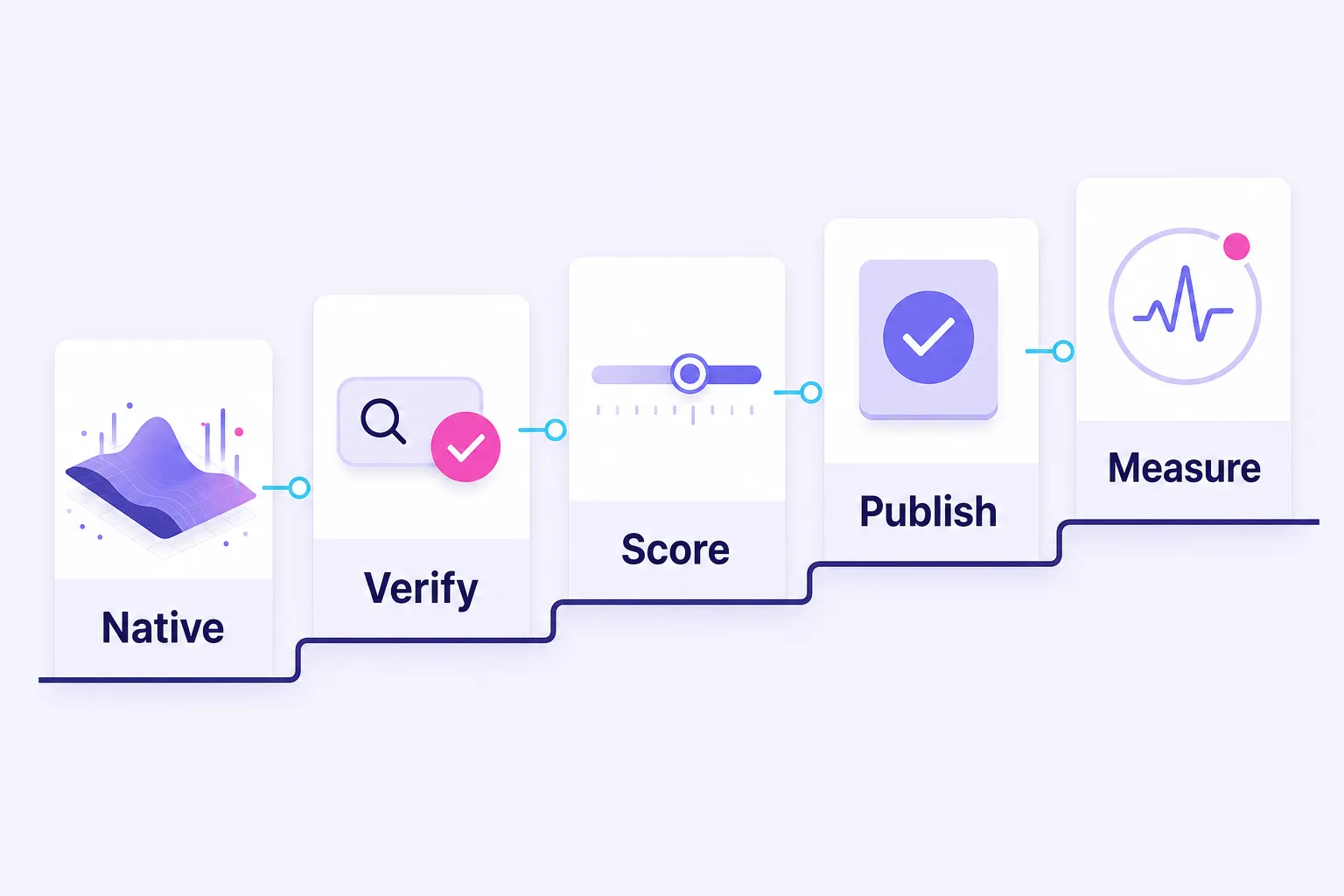
- Best for real-time, event-driven reach: X Trends. Nothing surfaces a live moment faster, and one or two well-chosen tags still tie you to the conversation.
- Best for zero-budget trend research: TikTok Creative Center. Free, official data on which hashtags are gaining momentum by region and time window, with trendlines and related videos.
- Best for search-led video ideas: YouTube Studio Trends. It connects trend research to what your audience actually searched over the last 28 days, plus content gaps.
- Best for B2B precision: LinkedIn Search. Hashtags behave like professional topic labels, so a tight set of three puts you in front of the right roles, not a broad crowd.
- Best for evergreen and seasonal planning: Pinterest Trends. It reflects search, save, and shopping behavior across up to two years, not today's viral spike.
- Best for enterprise, multi-market teams: cross-platform hashtag monitoring, so you compare adoption and sentiment across networks instead of counting visible posts in one app.
- Best for campaign aftercare: branded and campaign hashtag tracking, so you learn whether a tag attracted the right people, not just whether it got used.
What Counts as a Trending Hashtag in 2026?
A trending hashtag is a keyword or phrase preceded by the # symbol that is gaining unusual attention on a platform within a specific topic, location, community, or time window. It is a label that tells a machine and a user what a post is about. It is no longer a lever that force-feeds your content to strangers.
That single reframe explains almost every platform change of the last two years. The platforms did not kill hashtags. They killed the shortcut. Distribution is now decided by watch time, saves, shares, completion rate, and how well your caption matches what someone actually typed into a search bar.
Before you go further, get the vocabulary straight, because these entities are not interchangeable and AI answer engines treat them differently:
| Entity | What it is | Where it dominates |
|---|---|---|
| Hashtag | A clickable # label for topic and conversation routing | X, Instagram, TikTok, LinkedIn |
| Keyword | Plain search text the platform reads in captions, titles, on-screen text, and audio | YouTube, TikTok, Instagram search |
| Topic tag | A single structured subject attached to a post | Threads (one per post) |
| Sound | A trending audio clip that carries a format and audience expectation | TikTok, Reels, Shorts |
| Entity | A recognized person, brand, place, or product the platform maps semantically | All platforms, increasingly |
Stop researching hashtags for reach. Research them for context, community, and search. That is where the return moved, and pretending otherwise just burns your team's Monday.
Do Trending Hashtags Still Increase Reach in 2026?
Sometimes, but not the way marketers used to believe, and on Instagram, barely at all. This is the first question every client asks, so let me be precise.
On Instagram, the position is now official. As reported by Social Media Today, Mosseri said hashtags "don't improve visibility" but are a way to let people know what a post is about, which is why Instagram moved to five or fewer tags. A hashtag places your content into a searchable, active cluster. It does not rescue a weak hook.
On X, hashtags remain the main way people jump into a live topic, so they still earn their slot when the moment fits. On TikTok, YouTube, and LinkedIn, they help categorization and search but sit behind content quality. The honest framing is identical across every network: a strong post with a few relevant tags wins, and a weak post with perfect tags still loses.
How Is Finding Hashtags Different From the Old Twitter and Instagram Playbook?
The biggest change is that hashtag discovery moved from public lists to personalized systems. In 2019 you opened Twitter Trends, copied a tag, and did list-based research on Instagram. That still gives you ideas. It no longer gives you a strategy.
Three shifts rewrote the work. Trend surfaces became personalized, so what you see is filtered by your follows, interests, and location. Short-form video changed what "trend" even means, tying the tag to a sound, format, and comment culture. And on-platform search replaced raw hashtag browsing, because the systems now read your caption, on-screen text, and spoken audio directly.
The practical result is that 41% of Gen Z reach for social platforms first when looking something up, per Sprout Social's Q2 2025 Pulse Survey. If you follow social media trends at all, treat social search as the one that reorganizes everything else.
The caption is the new hashtag. When someone searches "best running shoes for flat feet" inside TikTok or Instagram, the platform matches that against your caption, your spoken words, and your on-screen text. A block of tags does not win that match. A clearly worded caption does.
How Do You Catch a Trend Early Enough to Ride It?
By the time a hashtag shows billions of views or sits at the top of a trending list, you are late. The saturation point is already too high for a new post to gain meaningful traction, and the system is already testing the next breakout. The window that matters is the sharp early climb, not the peak.
That is the lag most content calendars ignore. There is a gap between when a topic spikes among early adopters and when a platform officially labels it a trend. Your job is to spot the climb during that gap, which means watching niche creators and category communities, not the global top-ten list.
You cannot reverse-engineer a trend by copying tags from a viral post. Those tags reflect the outcome of the algorithm, not the trigger that caused it.
The discipline is boring but reliable. Check your trend sources on a fixed cadence, decide fast whether a trend fits, and skip the ones that do not. If you use a trending hashtag, know exactly why it is trending before you touch it.
Can One Hashtag Set Work Across Every Platform?
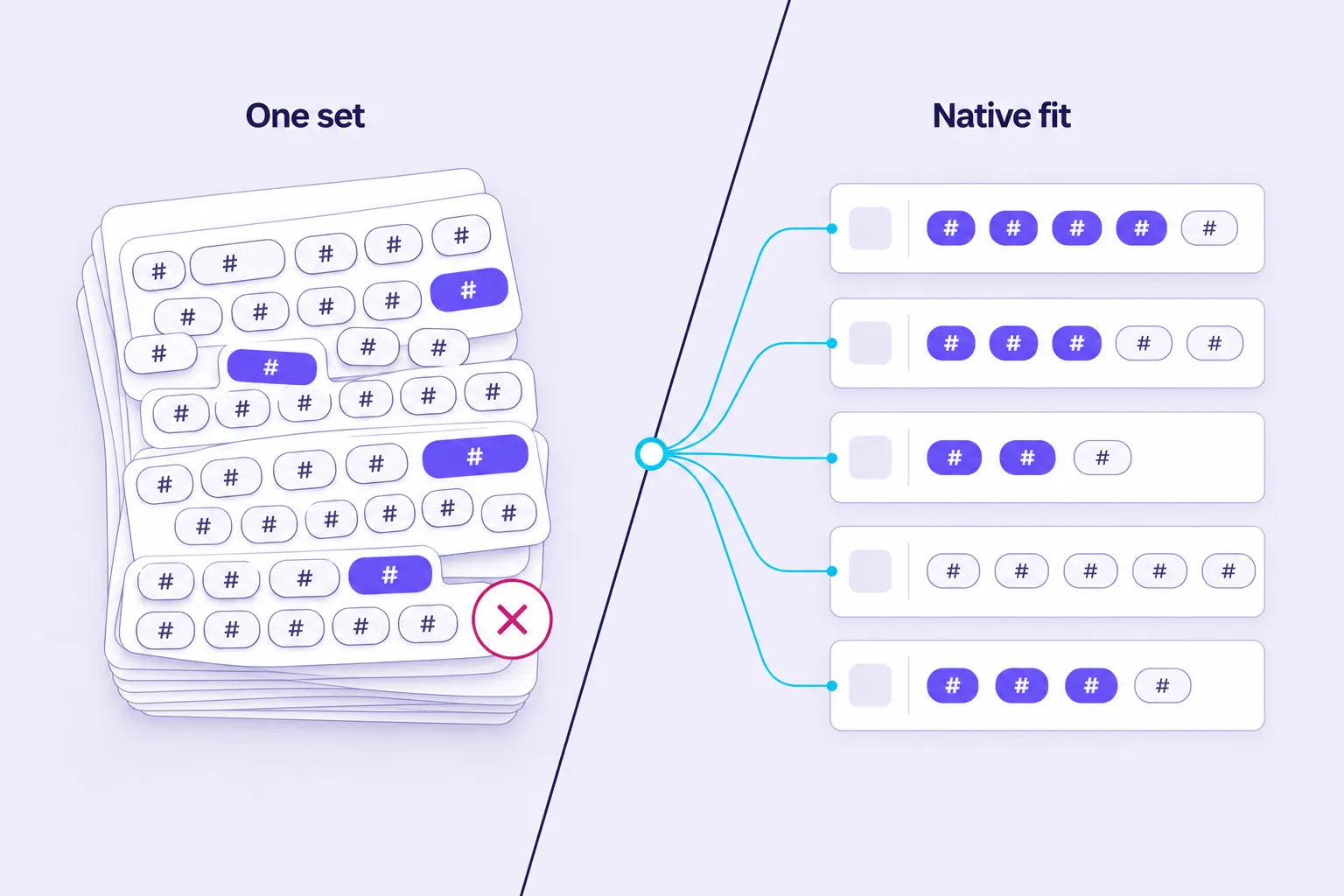
No, and the reason is structural, not just cultural. Every network processes metadata differently and expects a different volume, tone, and format. A block that performs on TikTok reads as engagement bait on LinkedIn.
#BookTok belongs to TikTok culture. It might make sense on Instagram if the post genuinely references that culture. It does not automatically belong on LinkedIn, where the same string looks out of place. Copy-pasting one set across platforms tells each algorithm you did not tailor the content for that environment, and TikTok and LinkedIn in particular reward context-specific signals.
Build a platform-specific shortlist per campaign. Confirm each tag is active, relevant, and not hijacked, using native search on that network. Then monitor performance separately.
The 100-Point Hashtag Fit Score
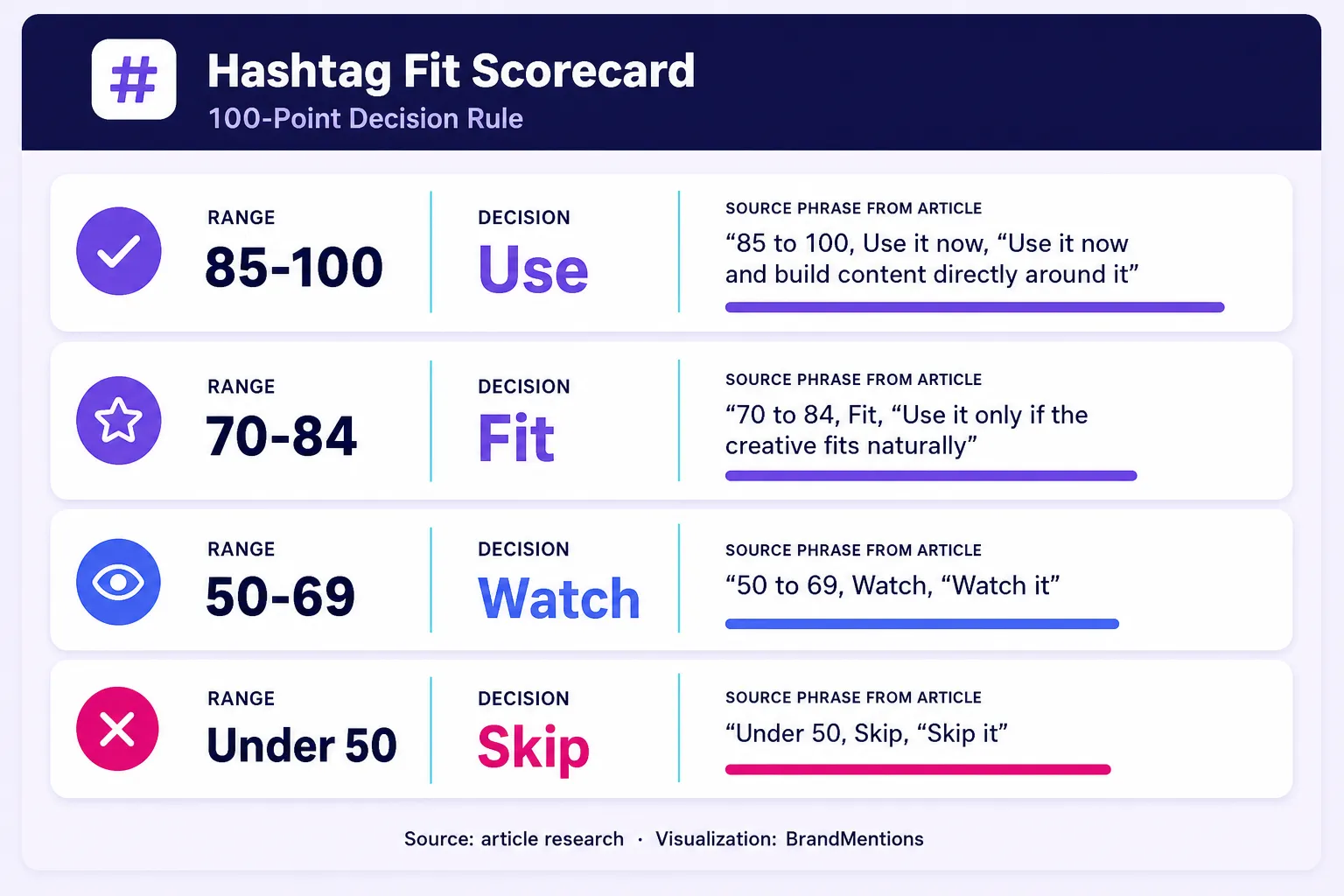
Before you use any trending hashtag, score it. This gives your team a shared decision instead of an argument about taste, and it is the fastest way to kill the copy-paste block.
| Scoring factor | Points | What to check | Pass threshold |
|---|---|---|---|
| Topic match | 25 | Does the tag describe this specific post, product, or customer question? | 18 |
| Audience match | 20 | Are the people posting and engaging the people you want to reach? | 14 |
| Momentum | 20 | Are recent posts, searches, or videos still active, or is the tag stale? | 12 |
| Platform fit | 15 | Does this platform actually use hashtags for discovery in this context? | 10 |
| Brand safety | 10 | Is the tag free of risky meanings, spam, or sensitive events? | 8 |
| Measurement value | 10 | Can you track adoption, mentions, or performance after posting? | 6 |
Then apply the decision rule:
| Score | Decision |
|---|---|
| 85 to 100 | Use it now and build content directly around it. |
| 70 to 84 | Use it only if the creative fits naturally. Do not force the post. |
| 50 to 69 | Watch it. Do not publish unless you can sharpen the angle. |
| Under 50 | Skip it. Popularity will not compensate for poor fit. |
The Hashtag Fit Rule: if a tag cannot name the audience, the intent, and the platform surface, it is too broad. #marketing describes your industry. It does not describe the reader's problem. #b2bdemandgen or #chicagocoffee does.
The Trend Receipt Rule: do not use a trend until you can point to three current posts that prove what it means on that platform. A tag can look innocent in isolation and carry a completely different meaning inside the community using it. This one rule prevents the most expensive hashtag mistake there is.
Platform Hashtag Cheat Sheet for 2026
| Platform | Optimal count | Hard limit | Primary function now | Native Trend Tool / Surface |
|---|---|---|---|---|
| X | 1 to 2 | none, but more cuts reach | Real-time reach and conversation | Trends panel |
| 3 to 5 | 5 per post or Reel | Context and search labeling | Explore, Search | |
| TikTok | 3 to 5 | none enforced, spam risk | Search and format context | Creative Center |
| YouTube | 3 to 5 | 60 (all ignored if exceeded) | Topic labeling and hashtag pages | Studio Trends, Search |
| 3 | 5 before spam risk | Professional topic indexing | LinkedIn Search | |
| Threads | 1 topic tag | 1 per post | Conversation routing | Trending topics, communities |
| optional | none meaningful | Keyword and planning signal | Pinterest Trends | |
| 1 to 2 | none meaningful | Campaign grouping only | Public search (limited) |
X vs Instagram, the core difference: On X, a hashtag is a ticket into a live public conversation, so you chase velocity and stay minimal. On Instagram, it is a private label the system reads for context, so you chase relevance and accept that reach comes from the content. Same symbol, opposite jobs.
TikTok vs YouTube, the core difference: On TikTok, hashtags feed a search index that rewards keyword and format alignment, and a free official tool researches them. On YouTube, hashtags are minor labels with a punishing 60-tag cutoff, and the real work happens in the title, thumbnail, and watch time.
How to Find Trending Hashtags on X (Twitter)
Direct answer: Open Explore, check your default Trends, then set the location to your target market and click into a trend to confirm it is still rising before using one or two tags.
Start with the X Trends FAQ, because X is still where "trending hashtag" most closely matches the classic meaning. X says Trends are algorithmically determined, tailored by default to your follows, interests, and location, and built around what is popular now rather than what has been popular for a while.
Here is the practical workflow. Open Explore and check your default Trends, then change the location, because a national or local campaign should not rely on personalized "For you" trends. A retailer in Dallas, a fintech in London, and a fashion account in Seoul can see entirely different trend sets on the same day.
Then click into the trend before using it. X groups related wordings under one topic, so #MondayMotivation and #MotivationMonday can appear together. That is useful for research and risky for posting if one variant carries a different tone. Check the latest and top posts to confirm the trend is still rising and not dominated by spam or conflict.
Decision threshold: one or two hashtags, worked into the sentence rather than stacked at the end. The 280-character norm makes minimalism mandatory, and posts that pile on more tags reliably see engagement fall.
Non-obvious insight: X Trends are spike detectors, not audience validators. A hashtag trends because many people reacted to the same event. That does not mean those people want a brand in the conversation, and velocity is neutral about tone. A trend can spike from outrage as easily as celebration.
If a hashtag does not change who understands your post, it does not belong in your post.
How to Find Trending Hashtags on Instagram
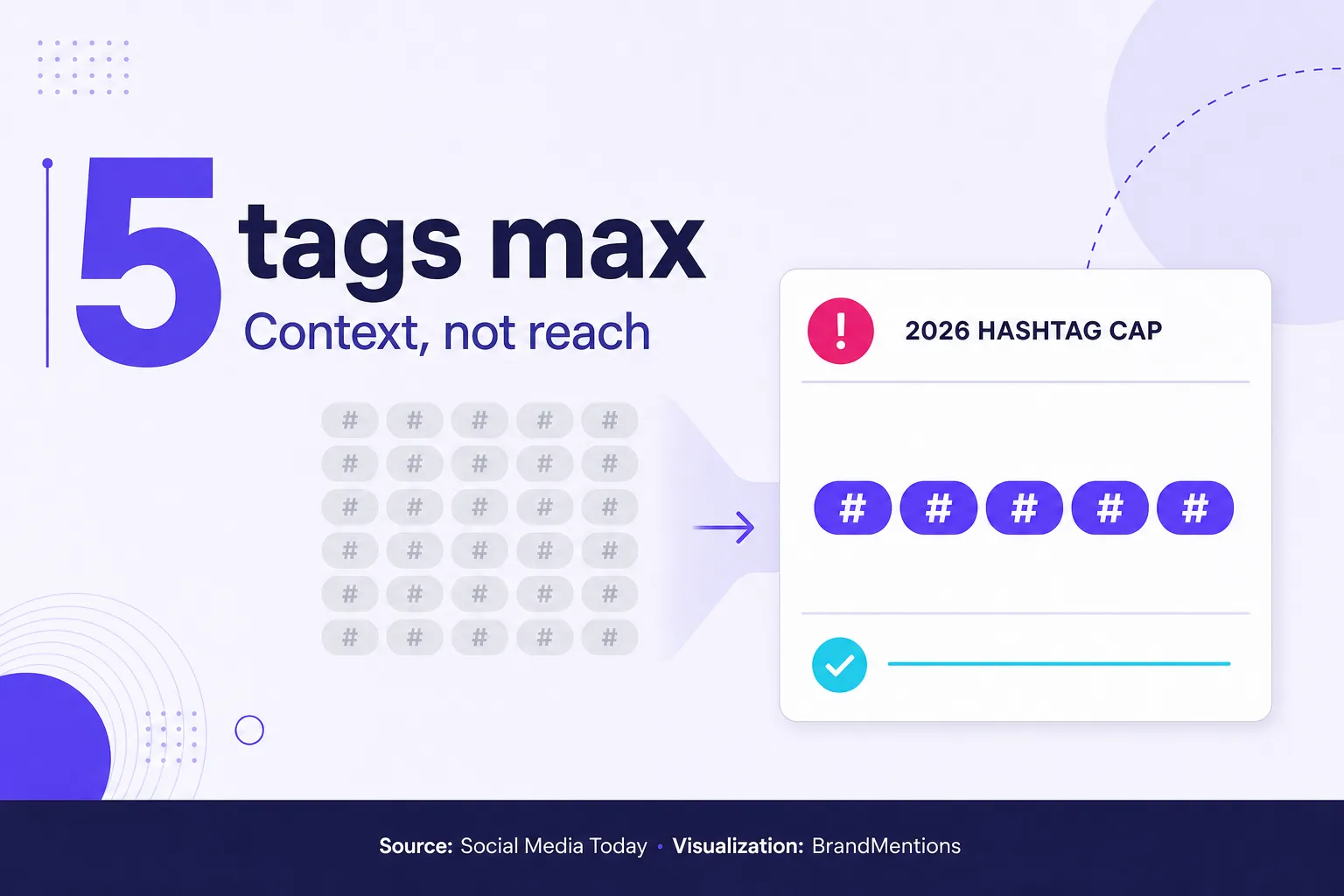
Direct answer: Search the topic the way a person would, open hashtag pages from real posts already reaching your audience, and pick five or fewer tags that each describe a different angle of one content route.
The most important update is the cap. As Social Media Today reported, Instagram moved from the long-standing thirty-hashtag habit to a five-tag limit for posts and Reels on December 18, 2025. Instagram also removed the ability to follow hashtags on December 13, 2024, so any tactic built on following a tag no longer exists.
So where do you find relevant tags now? Search the topic the way a person would, not just the hashtag. Open hashtag pages from real posts already reaching your audience, not from a listicle. Study the top content itself, the format, hook, caption, audio, and creator size, then pick five tags that each do a different job.
One Route, Five Labels: your five tags should describe one clear content route from several angles, not five unrelated audiences. A specialty coffee Reel might use #coldbrew, #specialtycoffee, #chicagocoffee, #coffeetasting, and one branded campaign tag. Compare that with #coffee, #love, #instagood, #summer, #smallbusiness, which point in five vague directions.
Because reach no longer flows from tags, the higher-leverage variables are timing and format. If you are optimizing anything, optimize the best time to post and your caption keywords before you touch the hashtag line. There are plenty of free Instagram tools that generate tag ideas from a seed keyword, but always validate them inside Instagram search before use.
Failure mode: reaching for a "big" tag that turns out to be restricted or banned. Instagram will not autocomplete a banned tag and will not turn it into a working link, so your post simply becomes undiscoverable through it. The damage is silent.
Non-obvious insight: study the small accounts, not the celebrities. When you inspect a hashtag page, look at the posts from accounts with modest followings that still broke onto Explore. Those tags did the actual work. The celebrity post reached Explore because of the celebrity, not the tag.
How to Find Trending Hashtags on TikTok
Direct answer: Use the free TikTok Creative Center, filter by region and industry, open each hashtag's trendline and related videos, then confirm the repeated creative pattern before choosing three to five tags.
Start with the TikTok Creative Center Trends guide. It requires no ad account and displays trending hashtags by industry, and each hashtag opens a trendline, related videos, audience insights, regional popularity, and related hashtags. That is the best native trend workflow any platform gives marketers.
Use it in order: select your region, choose the closest industry, compare time frames, open the hashtag analytics, then watch the related videos before choosing anything. Write down the repeated creative pattern, not just the tag. On TikTok the pattern is the trend, and the hashtag is only a pointer to it.
Then layer in TikTok Creator Search Insights, which surfaces topics people search often, lets you sort by category or "For You," and flags content gap topics that are searched often but covered by few videos. Trending hashtags show what people are watching. Search Insights show what people are asking for, which is usually the better brief.
Decision threshold: three to five relevant hashtags, tied to the video's format, caption, and sound. Skip #fyp, which adds almost nothing, and never treat the tag as the discovery engine.
Non-obvious insight: on TikTok a hashtag is often a format contract. #BookTok, #CleanTok, or #TikTokMadeMeBuyIt come with an expected rhythm, proof style, and comment culture. If you export the tags but ignore the format, you miss the thing that made the tag move. This is exactly why a real hashtag marketing strategy has to include creative analysis, not just a tag list.
How to Find Trending Hashtags on YouTube and Shorts
Direct answer: Open YouTube Studio > Analytics > Trends, search a seed topic, save the terms your audience searched in the last 28 days, then translate them into a title, thumbnail, and three to five description hashtags.
Start with the YouTube Studio Trends tab, not a random generator. YouTube says the Trends tab shows what your audience and viewers across YouTube are searching for, with a top-searches view based on your audience and saved topics over the last 28 days. In July 2025, YouTube also moved away from one broad Trending list toward category-specific charts, because viewers now discover trends through recommendations, search, Shorts, and comments.
So the workflow is: open Studio, go to Analytics, open Trends, search a seed topic, save relevant terms, look for content gaps, then translate the topic into a title, thumbnail angle, Short hook, and a small tag set. For Shorts, pause the Shorts feed and use the Trends entry point to find personalized trending audio.
Use hashtags carefully, because this is the platform where the wrong instinct backfires. Per YouTube's hashtag help, if a video or playlist has more than 60 hashtags, YouTube ignores every hashtag on that content, not just the extras. At most, the first three from the description appear above your title.
Decision threshold: three to five hashtags in the description, with the single most important one first so it displays above the title. Never approach the ceiling.
Non-obvious insight: the #Shorts tag is optional. YouTube classifies Shorts by format and duration, so it does not need the tag to know. Spend that slot on a precise topic tag instead, and pour your real effort into a title that matches a genuine search.
How to Find Trending Hashtags on LinkedIn
Direct answer: Type the topic into LinkedIn Search with and without the hashtag, filter to posts, and save only the tags used by credible practitioners, companies, and analysts - then keep the set to three.
Start with LinkedIn Search Help. LinkedIn says suggested searches will not suggest hashtags, but you can search them by typing them into the search bar. That one detail should shape your whole approach: LinkedIn is a professional search and relationship platform, not a hashtag-first discovery feed.
Search the core topic without the hashtag, then with it, filter to posts, and compare who appears in each result set. Save the tags used by credible practitioners, companies, analysts, and event organizers. Skip the tags that only attract creators talking to other creators.
For company pages running employee advocacy, know that LinkedIn Trending Employee Content is populated by activating hashtags on a Life or What We Do page, and admins must return after about six hours to confirm changes are live.
Decision threshold: three tags. Make one a broad industry category, one a specific sub-topic, and one branded or unique to your campaign. Beyond five, the marginal benefit is effectively zero and the block reads as spam.
Non-obvious insight: a relevant @mention often beats a fourth hashtag. If your buyer would not search or recognize a tag, it is doing nothing. Spend that spare effort tagging a relevant person or company, where the professional graph actually rewards you.
How to Find Trending Hashtags on Threads
Direct answer: Open Search, check trending topics, join relevant communities, and choose the single topic tag (Threads allows one per post) that enters the conversation you can genuinely add to.
Start with the Threads Communities announcement. Meta began testing communities across more than 100 topics in October 2025 and expanded to over 200 topics by December 2025, moving Threads from simple topic tags toward organized public conversation spaces.
Threads does not behave like old Twitter. Open Search, check trending topics, review the topic tags on strong posts, enter relevant communities, and watch the conversation style before you post. Threads limits you to one topic tag per post, which forces clarity: choose the single conversation you want to enter, then make the post useful enough to earn replies.
Non-obvious insight: Threads rewards conversation adjacency. You win by choosing the right nearby discussion and adding something to it, not by chasing the biggest visible topic. Reply before you post if the conversation is already moving.
How to Find Trending Hashtags on Pinterest
Direct answer: Use Pinterest Trends to study up to two years of search, save, and shopping behavior, then plan content weeks ahead of the peak using keywords in Pin titles, descriptions, and boards.
Start with Pinterest Trends. Pinterest shows what is trending based on search, save, and shopping behavior across regions and countries, with up to two years of trend history. That makes it a planning tool, not a real-time hashtag platform.
Search your root keyword, compare related terms, look for seasonality, then open the actual search results and study Pin titles, text overlays, and boards. Use keywords in the Pin title, description, board title, and destination page. Treat hashtags as optional labels and search terms as the strategy.
Non-obvious insight: Pinterest trends mature earlier than social trends. If you wait until a holiday hashtag is visible everywhere else, Pinterest users have already planned, saved, and bought. Plan Pinterest content weeks or months ahead of the peak, not during it.
How to Find Trending Hashtags on Facebook
Direct answer: Public Facebook hashtag results are a privacy-filtered slice, so use one campaign tag for consistency and measure through Page insights rather than investing heavy research time here.
Start with Facebook's original public conversations announcement, which set the model that still applies: hashtags are clickable and searchable, but post audience settings control visibility. That last part is why Facebook hashtag research misleads you.
Most Facebook activity happens in private profiles, private groups, and algorithmically distributed feeds. Public hashtag results are a filtered slice, not a clean read of demand. Search a tag to check it is active, use one campaign tag for cross-platform consistency, and measure through Page insights, but do not invest serious research time here unless you are running a paid campaign with a branded hashtag as a creative element.
Non-obvious insight: Facebook hashtag data is privacy-filtered data. You are seeing what is public and searchable, not everything people are discussing. Read your own comments and local event language for the real signal, then build a wider Facebook content strategy around that, not around a tag.
How to Find Trending Hashtags on Reddit
Direct answer: Reddit runs on subreddits and search rather than hashtags, so use it to validate whether a trend is real and to hear how a community actually talks before you commit a brand to it.
Reddit organizes around subreddits and search, and it is one of the best places to validate whether a trend is real and how a community actually talks about it before you commit a brand to it. Rather than hunting for a tag, find the subreddits where your audience already gathers, sort by rising and top posts, and read the language and framing the community uses. That native vocabulary is often the best raw material for the keywords and captions you will use on the hashtag-driven platforms.
How to Find Trending Hashtags on Bluesky
Direct answer: Bluesky supports hashtags in public text posts and can matter for niche tech and news conversations, but keep expectations modest - Pew puts Bluesky adoption among U.S. adults at 4%.
Bluesky supports hashtags in public text posts and can matter for niche tech and news conversations, but reach there is still small, with Pew putting Bluesky adoption among U.S. adults at 4%. Treat it as a place to seed and monitor early, community-specific conversations rather than a mass-reach channel, and use its search to confirm a tag is genuinely active before you lean on it.
A Note on Legacy Hashtag Tools
The old generation of hashtag generators still exists, and most of it is now the weakest part of any workflow. Tools that dump a hundred "high reach" tags were built for the thirty-tag Instagram era that ended in December 2025. They cannot know that Instagram now caps you at five or that a suggested tag is banned.
Trend list sites and geo-map tools can still spark ideas, and hourly trend aggregators remain useful for a quick read on X. But treat all of them as brainstorming only. Anything a third-party tool labels "trending" or "high reach" has to be verified inside the platform's own search before it goes near a post, because the native surface reflects the current discovery system and the third-party list often does not.
What You Can and Cannot Safely Automate
If you scale hashtag research, do it inside the platform terms, not against them. X exposes trend data by location through its official API, and larger teams can automate location snapshots instead of refreshing Explore by hand. TikTok Creative Center, YouTube Studio, and Pinterest Trends are all built to be checked programmatically or manually without scraping.
The line to respect is the walled garden. Bulk scraping of private posts, mass-following automation, and pulling data through unofficial endpoints all risk rate limits, account restriction, and privacy exposure. If a workflow depends on data a platform does not publish through an official surface or API, treat that as a compliance flag, not a growth hack.
Measuring Whether a Hashtag Actually Worked
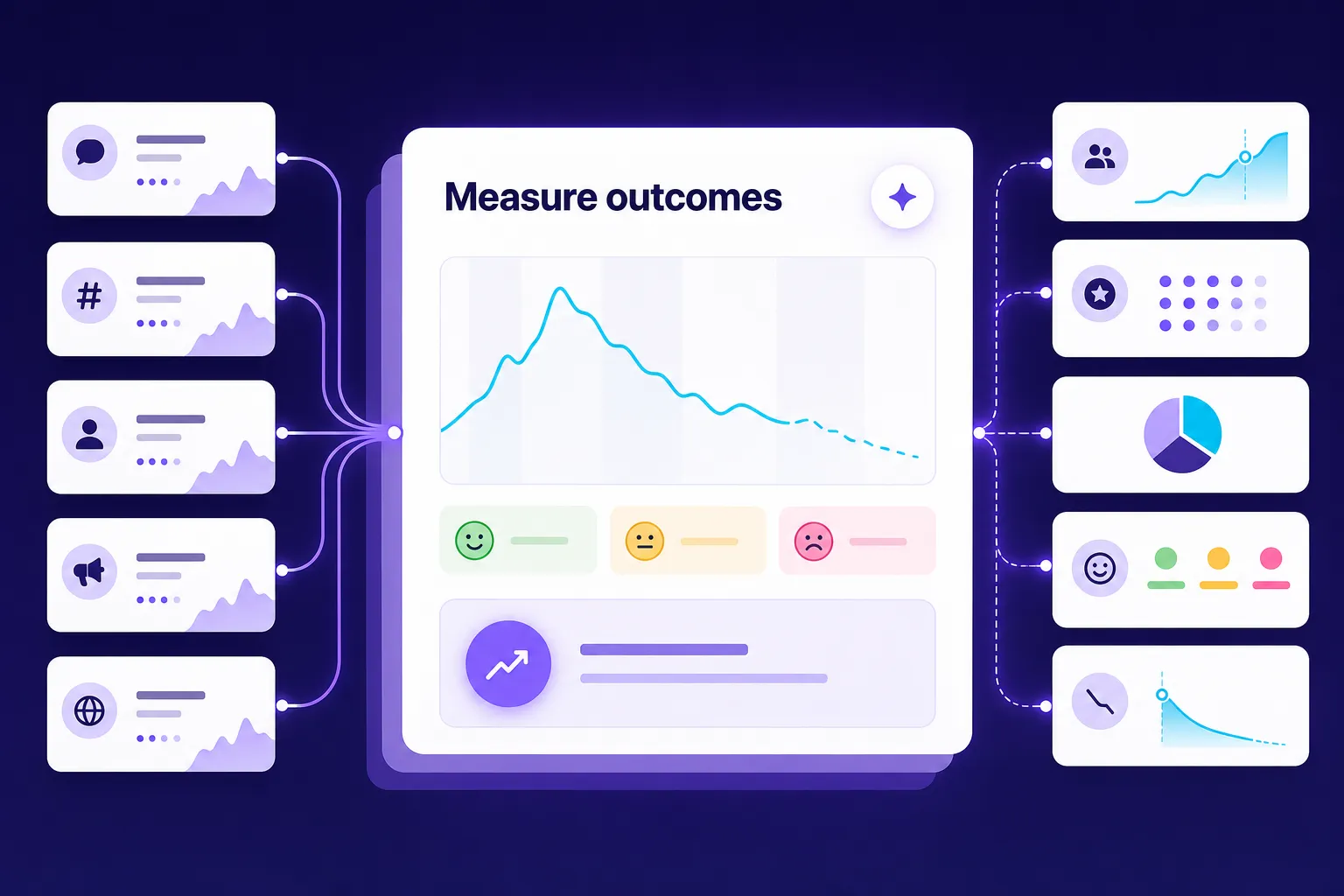
The reason so many teams cling to dead hashtag habits is simple: they never measured them. A tag with a billion views feels productive. Whether it brought a single relevant visitor is a different question, and it is the only one that matters.
Start with native analytics. Instagram's professional dashboard shows impressions from hashtags per post, TikTok breaks out hashtag-search traffic, YouTube Studio shows search terms, and LinkedIn shows which tags performed. Then connect the tag to a business outcome, not a vanity count. Tag the destination links with UTM parameters so you can trace qualified visits, sign-ups, and assisted revenue, and track creator pickup and share of voice for branded tags.
For a consolidated cross-platform read, layer a monitoring approach over native dashboards. A rundown of social media analytics tools will save you from stitching six exports together by hand, and effective hashtag monitoring tells you when a tag is gaining organic traction, when it starts to decay, and when it gets co-opted by unrelated content.
This is where a dedicated monitoring tool earns a specific slot. BrandMentions fits a defined niche here: tracking a single branded or campaign hashtag as it travels across X, Instagram, TikTok, YouTube, Reddit, and the wider web, with sentiment attached and historical mention volume you can compare week over week. That time-series, cross-platform view is the thing native analytics cannot give you, because each app only shows its own garden.
The modern reason to track this goes beyond counting posts. As AI answer engines increasingly summarize brands and conversations, watching how a hashtag or brand term gets characterized tells you whether your campaign is entering the discussions machines now read and repeat. BrandMentions leans into that answer-engine visibility question, tracking not just where a brand is mentioned but how it is described. Brandwatch and Meltwater cover similar social listening ground with strong enterprise reporting and workflow features; the right pick depends on whether you need focused cross-platform hashtag and mention tracking or heavier enterprise governance.
Judge a hashtag by what it delivered, not by how big it looked. A campaign tag with 50 posts from customers, creators, and journalists beats one with 500 posts from giveaway accounts.
The Trendjacking Approval Matrix
Before a brand joins a sensitive or fast-moving trend, someone has to own the call. Use a simple publish-or-escalate rule so nobody freelances a risky post at 11pm.
| Situation | Action |
|---|---|
| Fits Hashtag Fit Score 85+, no sensitive context, on-brand | Publish. A named owner posts within the window. |
| Trend touches news, tragedy, politics, or a polarized debate | Escalate to a senior approver before anything goes live. |
| Meaning is unclear or you cannot pass the Trend Receipt Rule | Hold. Do not post until three current posts confirm intent. |
| Branded tag being hijacked or criticized | Escalate to comms. Do not add fuel with a scheduled post. |
The point is speed with a brake. Real-time reach is worthless if it attaches your brand to something you spend a week apologizing for.
A Maturity Model for Hashtag Programs
Not every team should run the same process, so match the workload to your stage.
- Solo creator: one platform, native search only, five tags or fewer per post, a manual retirement check each month.
- Small brand: two or three platforms, a shared shortlist sheet, the 100-Point Fit Score, and weekly trend check-ins.
- Multi-market brand: location-specific trend research per region, local-language variants, and a monitoring tool to compare adoption across markets.
- Enterprise social team: automated trend snapshots by location, an approval matrix, share-of-voice and sentiment tracking, and a formal retirement calendar.
- Regulated industry: everything above, plus a compliance approver in the loop before any trendjacking and a documented audit trail.
As you move up this model, the goal is not more hashtags. It is more discipline, so consistent execution is what helps you grow social presence, not any single lucky tag.
When to Retire a Hashtag
The Retirement Trigger: stop using a tag the moment two of these appear together: declining daily velocity, sentiment drift, spam contamination, or audience mismatch. Marketers over-reuse tags that worked once. A tag that drove reach last month can now be saturated, flagged, or abandoned by the audience you want.
For campaign tags, retire on a schedule and check the tag page before every reuse. For trend tags, assume the useful window is short and closing, especially on X and TikTok, where a real-time moment can fade within hours. Keeping a dead tag on your posts is not neutral. It dilutes the signal your good tags are sending.
One reminder that costs nothing: write multi-word tags in CamelCase, like #GlutenFreeSourdough, not #glutenfreesourdough. Screen readers announce CamelCase word by word, and clean casing also protects you from the accidental merged-word readings that turn an innocent campaign into a screenshot.
Frequently Asked Questions
How many hashtags should I use on each platform in 2026?
Use one to two on X, three to five on Instagram, TikTok, and YouTube, and three on LinkedIn. Instagram now caps posts and Reels at five, and YouTube ignores every hashtag if you exceed 60. Threads allows one topic tag per post. Across every platform, a tight, relevant set outperforms a long list.
Where can I find trending hashtags for free?
Use native tools first. X Trends for real-time, location-based topics; TikTok Creative Center for trendlines and related videos; YouTube Studio Trends for the last 28 days of audience searches; Pinterest Trends for seasonal planning; and Instagram or LinkedIn Search to see which tags credible accounts in your niche actually pair with strong posts. Native surfaces reflect the current discovery system far better than recycled hashtag lists.
How do I find trending hashtags for Instagram Reels specifically?
Search the topic the way a viewer would, then open the hashtag pages attached to Reels already reaching your audience rather than pulling from a generator. Study the format, hook, caption, audio, and creator size on the top Reels, then choose five or fewer tags that each describe a different angle of one content route, such as #coldbrew, #specialtycoffee, #chicagocoffee, #coffeetasting, and one branded tag. Remember that Instagram caps posts and Reels at five tags as of December 2025 and that Mosseri says hashtags do not improve visibility, so timing, caption keywords, and audio matter more than the tag line. Validate every tag inside Instagram search first, because a banned tag will not autocomplete or become a working link.
How do I find local trending hashtags?
Set the location before you research. On X, open Explore and change the location so a national or local campaign relies on that market's Trends instead of your personalized "For you" feed - a retailer in Dallas, a fintech in London, and a fashion account in Seoul can see entirely different trend sets on the same day. On TikTok Creative Center, select your region and closest industry to see hashtags gaining momentum in that market, and use local-language variants for multi-market work. Then confirm each local tag inside native search and check its current posts against the Trend Receipt Rule before you publish.
Do banned or broken hashtags hurt my account?
They usually do not trigger a penalty, but they render the tag useless. On Instagram, a banned tag will not autocomplete or turn into a working link, so the post becomes undiscoverable through it. On YouTube, using hashtags unrelated to your content breaks the spam and misleading-metadata policy, so always check what appears on a tag's page before you use it.
How do I find trending hashtags on Reddit and Bluesky?
Reddit does not use hashtags; it organizes around subreddits and search, so use it to validate whether a trend is real and to learn how a community actually talks before you commit a brand to it. Bluesky does support hashtags in public text posts and can matter for niche tech and news conversations, but reach there is still small, with Pew putting Bluesky adoption among U.S. adults at 4%. On both, confirm a topic is genuinely active in native search before you build content around it.
Are hashtags dead?
No, but their job changed. They no longer force reach, especially on Instagram, where the platform head confirmed as much. They still work as labels for context, as entry points into communities, and as signals for on-platform search, which is now a primary discovery surface for younger users.
Conclusion: Curate for Function, Not for Volume
The honest through-line across every platform in 2026 is that the hashtag stopped being a growth hack and became an editorial choice. The systems can read your captions, your audio, and the pixels on the screen, so they no longer need a tag to know what you made. What they still reward is a clear signal about context, community, and conversation, delivered in a handful of precise tags rather than a wall of them.
So change the workflow, not just the tag list. Spend the time you used to spend hunting thirty hashtags on two things instead: writing captions the way your audience actually searches, and measuring which few tags bring relevant people rather than raw impressions. Score every candidate, verify the conversation, publish only when your content belongs there, and retire tags the moment they fade. Do that, and you stop chasing hashtags altogether. You start using them the way the platforms now quietly reward, as the last five percent of a post that was already worth watching.