Can AI Search Engines Cite Brand Mentions in Podcasts and YouTube Videos?
AI search engines can cite brand mentions from podcasts and YouTube videos, but only through accessible transcripts, episode pages and third-party coverage. Here's how spoken mentions become citabl…

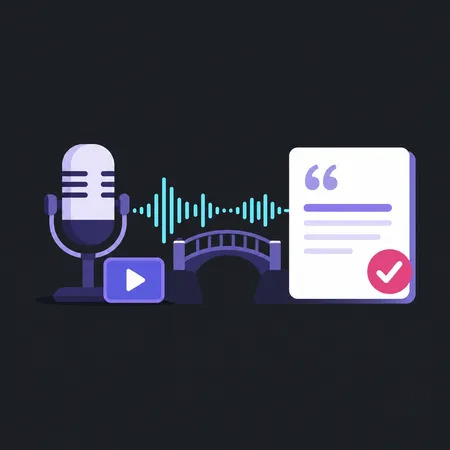
Quick answer: Yes, AI search engines can cite brand mentions that originate in podcasts and YouTube videos. What they cite is an accessible source: a watch page, an episode page, a published transcript, a show-notes page, or an article that discusses the recording. A spoken brand name, on its own, is not automatically discoverable, indexed, retrieved or cited. The route from a sentence someone said into an AI-generated answer runs through representation, access, selection and attribution, and it can fail quietly at any of those points. A video link inside an answer also does not prove that any system processed the audio.
Key takeaways
- A displayed citation usually links to a source URL, such as a watch page, episode page, or transcript. The link alone does not reveal whether the system processed text, audio, or video
- Transcript ≠ indexed ≠ retrieved ≠ cited. Each of those is a separate condition with a separate failure mode, and clearing one never guarantees the next.
- Google states that supporting pages must be indexed and eligible to appear in Search with a snippet. Ordinary Search technical requirements and policies still apply.
- Third-party recaps can be cited instead of the original recording, because they are already text at a crawlable address, while the episode itself may never be.
- Citation ≠ mention ≠ recommendation. An answer can cite a source, name a brand, or advise buying it, and those three outcomes have three separate causes.
- A practical first step is an accurate public HTML transcript, with speaker labels and useful timestamps.
Quick answer: can each AI platform cite a podcast or YouTube page?
| Platform | Can it cite a podcast/YouTube page? | Documented condition |
|---|---|---|
| ChatGPT (search) | Yes, with conditions - the page, not the audio. | Web-search answers can include citations, and a public episode page or transcript can serve as a web source; OpenAI notes citations can be inaccurate and that a Sources panel can include links not cited for any claim. |
| Perplexity | Yes, with conditions - discovery is documented, audio processing is not. | PerplexityBot supports finding and linking websites in search results, and a published use case locates a relevant video and, in contexts such as its browser, opens a specific segment. |
| Gemini | Yes, with conditions - in two different products. | Gemini Apps can find and answer questions about videos using publicly available YouTube information, subject to account and activity settings; the Gemini API separately analyzes supplied video, including public YouTube URLs. |
| Google AI Overviews & AI Mode | Yes, with conditions - eligibility is a precondition, not a placement. | A page must be indexed and eligible to appear in Google Search with a snippet, with no additional technical requirements. |
What is a spoken brand mention?
A spoken brand mention is an audible reference to a company, product or service inside recorded speech, whether or not the brand name appears in the title, description or any accompanying written text. In AI search, that reference becomes a potential citation source only when an accessible representation of the recording (a transcript, synchronized captions, written context, or a supported multimodal input) supplies relevant evidence that an answer system can retrieve and attribute.
Key terms: mention event, representation, retrieval and attribution
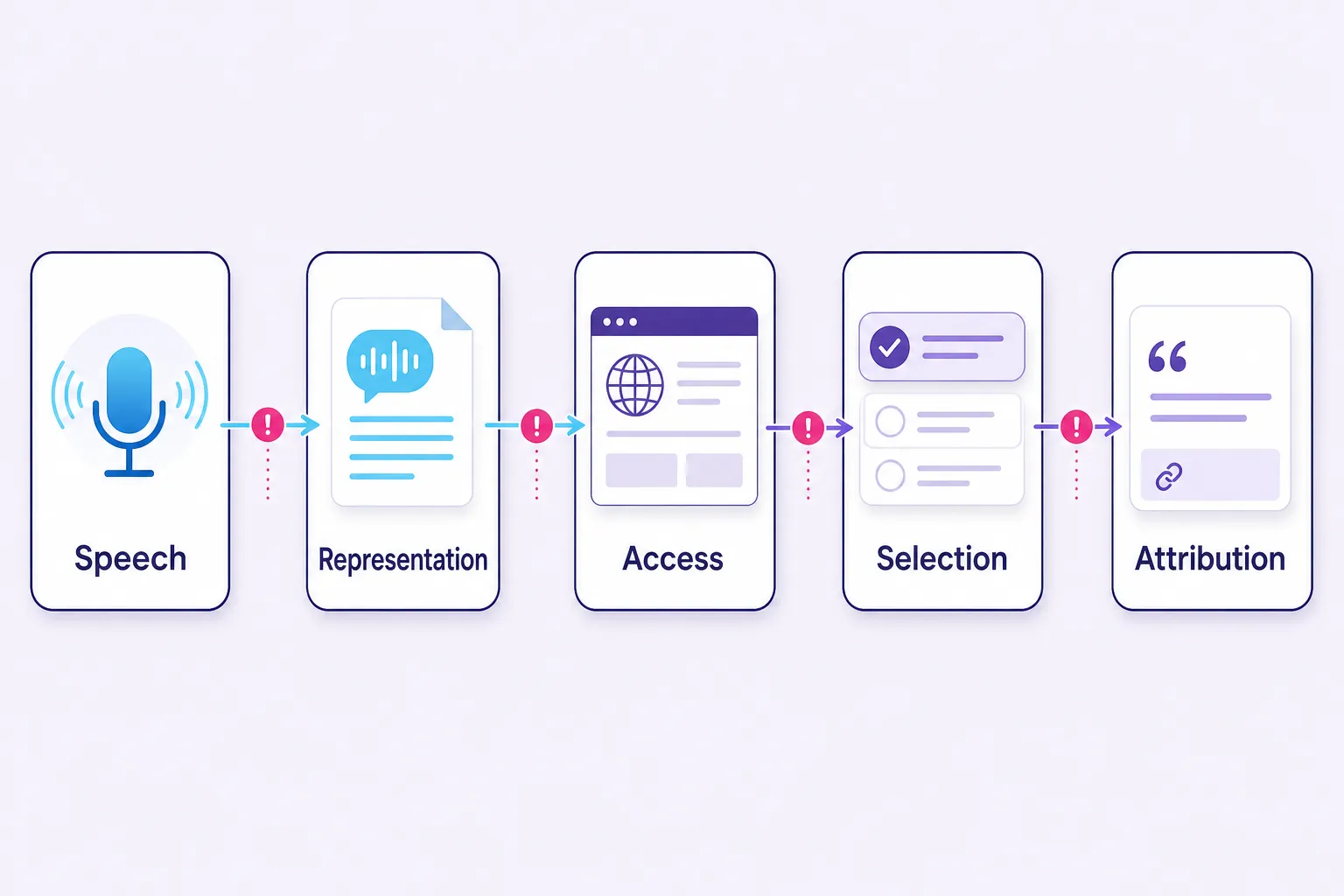
Four structural components sit between a sentence spoken on a microphone and a link under an AI-generated answer. They are parts of an ecosystem, not levers.
| Term | What it means | What it does not settle |
|---|---|---|
| Mention event | The original occurrence: a host names a product, a guest compares two vendors, a reviewer reads a sponsor script. | Whether any system ever detected it. The event has audience value independent of search. |
| Content representation | The form in which the event becomes available to another system: captions, transcripts, chapter titles, show notes, written recaps, supported video inputs. | How much evidence survived. A description summarizing an interview is not the same artifact as a transcript of it. |
| Discovery and retrieval layer | The mechanisms that locate and select information. Indexing organizes content for later search; retrieval selects information for one particular request. | That the normal discovery route was used. A user-supplied source, or one fetched at request time by a user-triggered agent, can enter an answer without it. |
| Answer attribution | The relationship between a generated statement and the source displayed beside it. | Whether the answer names the brand, or presents it as a suitable choice. Those are separate outcomes. |
These four entities give the working vocabulary for answer engine optimization, also called generative engine optimization (GEO) or AI search optimization, but their value is wider than marketing: they separate what happened in a recording from what a search system can establish about it.
One terminology trap deserves removing early, because it quietly corrupts a lot of analysis. A social post's "caption" is descriptive text written alongside the post. Closed captions are synchronized text representations of speech and other audio. A brand can be entirely absent from the first while being present in the second, which is exactly the situation most monitoring blind spots are made of.
Transcription vs. indexing vs. retrieval vs. citation
| Stage | What it establishes | What it does not establish |
|---|---|---|
| Transcription | Speech has been converted into text. | That a public search system will ever encounter, store or use that text. |
| Indexing | Content is available inside a searchable collection. | That the indexed page represents the conversation. An indexed episode page may hold only a title, a player and two paragraphs of description. |
| Retrieval | Information was selected for a specific question. | That it will be selected for any other question. A transcript can sit in a collection for months without being retrieved, including for queries about the brand named inside it. |
| Citation | A source reference was attached to a generated statement. | That the cited source supports the claim, was interpreted accurately, or was the original source of the information. |
The foundational retrieval-augmented generation research by Lewis and colleagues, published in 2020, combined knowledge stored in model parameters with passages fetched from an external collection. That distinction, learned knowledge versus retrieved evidence, is the reason "the AI knows my brand" and "the AI cited my brand's coverage" are different claims with different fixes. It does not follow that every commercial assistant implements that exact architecture.
Spoken mention vs. text mention
A public web text mention may already have a URL and surrounding context that support discovery and retrieval. Its accessibility and interpretation still depend on the system. It can be matched by string, by entity or by embedding.
A spoken mention has none of those properties at the moment it occurs. Everything downstream depends on a representation being created, published somewhere reachable, and preserved accurately enough to match the way a user phrases a question.
For teams that have only ever measured written coverage, this reframes what brand mentions are in operational terms. A spoken mention is real, has audience impact, and can still be invisible to every text-based system in the chain. The two facts are not in conflict.
Why does a podcast mention fail to become an AI citation?
The Spoken Mention Evidence Map sets out the dependencies between a recorded statement and an AI citation that can actually be defended. It is a diagnostic model for working out which boundary a mention failed to cross, not a checklist of optimization tasks.
SPOKEN BRAND REFERENCE
        |
        v
AVAILABLE REPRESENTATION
transcript, captions, written context,
or supported multimodal analysis
        |
        v
SOURCE ACCESS
discovery and indexing, or supported
request-time access by a specific system
        |
        v
QUESTION-SPECIFIC SELECTION
relevant evidence retrieved and interpreted
        |
        v
ANSWER ATTRIBUTION
a generated statement may receive a source link
Four boundaries, each with its own failure mode.
| Boundary | Diagnostic question | Typical failure |
|---|---|---|
| Representation | Were the words preserved in text anywhere? | Only a vague description exists; the product named at minute 24 survives nowhere. |
| Access | Can this particular system reach that representation? | The transcript exists inside a listening app, not on a crawlable public page. |
| Selection | Does the passage answer the question being asked? | A founder's origin story cannot answer a migration-effort question. |
| Attribution | What does the answer actually credit, and to whom? | The caveat is dropped, the wrong speaker is credited, or a different page is cited. |
Representation: were the words preserved?
A recording and its description are not interchangeable evidence. If a host names a product at minute 24, a description reading "a conversation about scaling customer support" has preserved nothing about that product. A transcript might. A written recap might too, in another publisher's wording and under that publisher's editorial responsibility.
The analytical unit here is the statement plus its context, not the episode URL. An episode URL tells you where the conversation lives; it tells you nothing about which sentences survived into text.
Access: can this particular system reach it?
A transcript visible inside a listening app is not automatically available through a public web page, and a public web page is not automatically reachable by every crawler or user-triggered fetcher.
Access is also source-specific and system-specific. An assistant may reach an article quoting an interview while never reaching the recording. That produces an indirect evidence route, which is a legitimate outcome, but it is not evidence of audio processing.
Selection: does the passage answer this question?
An accessible brand reference does not become useful for every question about the brand. A founder's origin story supports a company-history question and may say nothing relevant to a buyer asking about migration effort or support limitations.
Relevance here means the statement helps answer the actual question asked. It does not mean the brand name appears often. Google's published guide to its ranking systems describes passage ranking, which identifies individual sections of a page to assess relevance, so the common claim that a short mention inside a long transcript is always diluted beyond use overstates the case. What remains true is that a brief aside competes against documents written specifically to answer the question.
Attribution: what does the answer actually credit?
A system may cite an episode transcript while naming the guest's company. It may cite the episode without naming that company at all. It may name the company while citing an entirely different page. Keeping those outcomes separate is what makes analysis of brand mentions and AI usable rather than anecdotal.
The map's central point is easy to state and easy to forget: evidence can fail to cross a boundary even after crossing the previous one successfully. Detection does not establish access. Access does not establish selection. Selection does not establish accurate attribution.
Where the evidence lives: a format-by-format comparison
Discoverability depends on which representation holds the mention and whether that representation is reachable. The comparison below describes evidence availability and plausible routes. It is not a measured citation probability or a ranking order.
| Content format | Evidence it can contain | Possible route into an AI answer | What its existence does not establish |
|---|---|---|---|
| Raw audio or video file | The original speech, tone, and full surrounding conversation | Supported media analysis, or a separate transcription process | That any search product automatically processes the recording |
| Native platform captions or auto-transcript | Spoken words, often with timing information, subject to recognition errors | Platform integration, or retrieval where the text is exposed | That every caption track is indexed, or available to every assistant |
| Public HTML transcript on an episode page | Searchable dialogue, speaker labels, contextual notes | Ordinary web page discovery, indexing and retrieval | That the page is indexed, selected for a query, or cited |
| Episode description, show notes or feed text | Summaries, named guests, named products, links | Retrieval of the page or of available feed information | That an unlisted spoken reference is represented anywhere |
| In-app podcast transcript | Episode text inside one listening experience | Access provided by that product or its integrations | That external crawlers receive the same text |
| Third-party article, recap or newsletter | Another publisher's account of the conversation | Retrieval and citation of that publisher's page | That the recording was accessed, or accurately represented |
| Community thread discussing the episode | Listener interpretation, quotes, corrections, disagreement | Retrieval of the platform page, subject to platform rules | That the quoted passage is accurate or complete |
This structure is consistent with the W3C Web Accessibility Initiative's guidance on transcripts, which treats transcripts as textual alternatives to audio, distinguishes basic from descriptive transcripts, and notes that web transcripts commonly use HTML with identified speakers. Accessibility practice and discoverability practice point in the same direction here for different reasons, which is one of the few genuinely safe alignments in this field.
The bottom rows also explain a pattern worth internalizing: third-party coverage of an episode often becomes the citable artifact while the episode itself does not. The article is already text, already topical, already at a crawlable address. This is part of the broader explanation for why AI cites sources like community forums so readily, and it means the origin of a piece of information and the destination of the visible citation frequently differ.
How do ChatGPT, Perplexity, Gemini and Google AI Overviews handle video and podcast sources?
Each platform can surface video-related or podcast-related sources, but their published documentation describes different mechanisms, and none of them documents a universal pipeline that listens to arbitrary public recordings in response to a search query. The comparison only works if consumer applications, search features and developer APIs are kept apart.
| Platform | Documented mechanism | What it does NOT establish | Official source |
|---|---|---|---|
| ChatGPT (search) | Web-search responses may include citations; a Sources panel can contain both cited sources and other relevant links; citations can be inaccurate. A public transcript or episode page can serve as a web source. OAI-SearchBot and GPTBot have separate robots.txt controls for search and potential training use. ChatGPT-User handles certain user-initiated visits, for which robots.txt may not apply. | Native access to YouTube caption tracks, or automatic processing of podcast audio. A link in a Sources panel also does not establish claim-level attribution. | ChatGPT Search help · OpenAI crawler docs |
| Perplexity | A published video-discovery use case in which the product locates a relevant video and, in contexts such as its browser, opens a specific segment. PerplexityBot supports finding and linking websites in search results; Perplexity-User visits a page in response to a user request; both are distinguished from foundation-model training. | That every spoken reference across YouTube is continuously indexed, or that transcripts are weighted equally with editorial web pages. | Perplexity crawler docs |
| Gemini Apps vs. Gemini API | Gemini Apps can find videos and answer questions about them using publicly available YouTube information, subject to account and activity settings, and the feature is not present in every Gemini surface. The API is a separate path: a developer submits a supported video input (including public YouTube URLs) for analysis across audio and visual information with timestamp references, and agentic video understanding lets the model choose which segments and which signals to inspect. | That an unprompted buyer question will retrieve one particular brand mention. A good Gemini video answer does not predict a Google AI Overviews citation. | Gemini Apps YouTube help · Gemini API video understanding |
| Google AI Overviews & AI Mode | To appear as a supporting link, a page must be indexed and eligible to appear in Google Search with a snippet, with no additional technical requirements. Query fan-out issues related searches across subtopics, and AI Mode and AI Overviews can use different models and techniques, so responses and links can differ. Recommended foundations include making important content available in textual form; no special AI markup is prescribed. | Inclusion. Eligibility is a precondition, not a placement. Nor does it establish that any spoken sentence on a video platform is indexed. | Google Search Central: AI features |
Does Google AI Overviews cite YouTube videos? What Google actually documents
Yes, with conditions - and here the rule is explicit rather than inferred. For AI Overviews and AI Mode, the documented condition is that the page is indexed and eligible to appear with a snippet. This is why a noindex episode page cannot be a supporting link, and why a nosnippet directive can constrain how a page is used while the page stays indexed. A YouTube watch page cited in an AI Overview tells you a URL was displayed; it does not tell you whether captions, the description, a platform integration or a third-party page supplied the evidence.
If a competitor's claim about an AI platform cannot be traced to that platform's own documentation or to a dated study with a stated method, treat it as a hypothesis and design a check, not as a rule to optimize against.
Which AI search engines cite YouTube most? What citation-share studies show
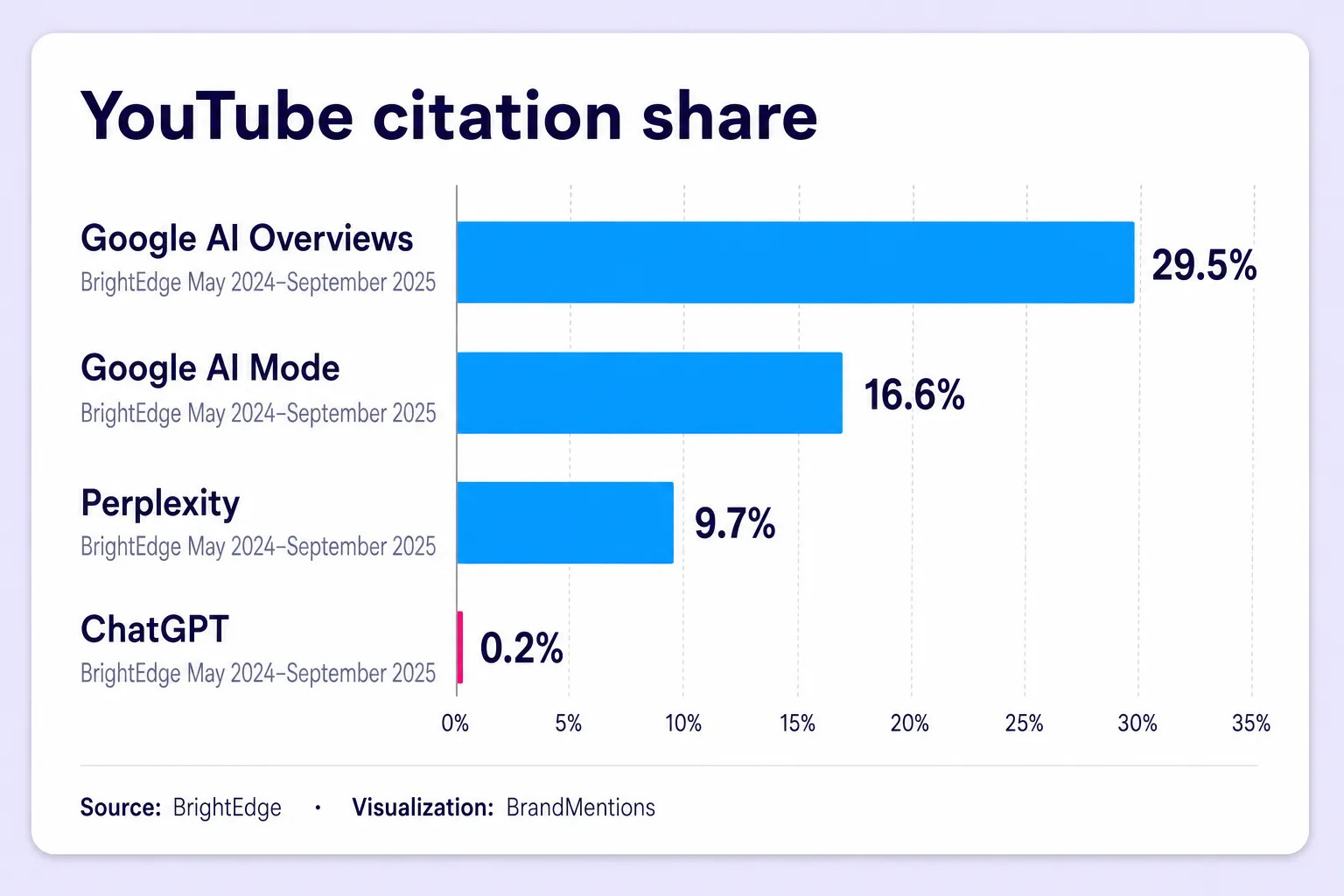
BrightEdge reported higher YouTube citation figures for Google’s AI surfaces than for Perplexity and ChatGPT. Other datasets report different patterns, so this ordering should not be treated as universal. Independent datasets showing how often various domains appear as citations are genuinely useful for orientation. The studies report different platform patterns and magnitudes. Their results should be interpreted within each study’s query set, collection period, and definition of citation share.
| Platform | Reported YouTube citation metric | Study and window |
|---|---|---|
| Google AI Overviews | 29.5% citation share, #1 domain | BrightEdge, May 2024 - September 2025 |
| Google AI Mode | 16.6% share, #1 domain | BrightEdge, May 2024 - September 2025 |
| Perplexity | 9.7% share, #5 domain | BrightEdge, May 2024 - September 2025 |
| ChatGPT | 0.2% share | BrightEdge, May 2024 - September 2025 |
BrightEdge describes these figures as "citation share" and also describes the AI Overviews figure as the percentage of overviews citing YouTube. Its public summary does not clearly establish a consistent denominator for every figure.
The collection windows and query sets matter as much as the figures. BrightEdge analyzed YouTube citation patterns across Google AI Overviews, Google AI Mode, ChatGPT and Perplexity from May 2024 to September 2025 using its AI Catalyst platform, tracking citation rates, platform competition, query types and week-over-week changes, and reported that YouTube is cited 200 times more than any other video platform in AI search results, with Vimeo, its nearest rival, at 0.1%. Profound's platform comparison, measured on its own prompt set, separates total citations from top-source share and reports YouTube at 1.9% of total Google AI Overviews citations but 18.8% of its top-10 source share, against 2.0% of total Perplexity citations and 13.9% of its top-10 share. Peec AI's broader study, covering 30 million sources across ChatGPT, Google AI Mode, Gemini, Perplexity and AI Overviews and measuring domains directly cited in answers, ranks Reddit first overall across the five engines. Its platform breakdown ranks YouTube first in AI Mode and AI Overviews, Reddit first in Gemini and Perplexity, and Wikipedia first in ChatGPT. Agenzy's 2026 source study reports lower absolute shares in the same direction: YouTube earned 4.7% of Google AI Overviews citations and 0.03% of ChatGPT citations across 2,283,923 AI citations (137 business projects for the Google AI Overviews figure and 138 for the ChatGPT figure).
Those four datasets use different panels, prompt sets, windows and definitions of "share," so their numbers are not interchangeable. Neither the percentages nor the platform ordering should be generalized beyond the datasets that produced them.
What citation-share research can and cannot prove
A citation to a video domain establishes a destination. It does not reveal whether the system used captions, descriptions, a platform integration, a third-party page or another representation. Domain counts cannot reverse-engineer a processing mechanism. Published shares are also snapshots tied to a collection window, a query set and a product version, and vendor datasets occasionally disagree with their own charts.
The most relevant correlational evidence comes from the Ahrefs study of AI brand visibility correlations, published in December 2025 across roughly 75,000 brands, which found YouTube mentions to be among the strongest correlates of AI brand visibility in the systems it examined. Two caveats carry as much weight as the finding. The study defined a YouTube mention as a brand name appearing in a video's title, transcript or description, so it is a composite measure that does not isolate spoken references. And correlation does not establish causation: brands that are discussed on video are often brands that are discussed everywhere.
A small original study: what adding a podcast transcript changed
In a single-episode before-and-after test, the episode page received no citations across 24 baseline answers to product and category questions and five citations across 24 answers after an HTML transcript was published. Transcript publication was associated with a change in observed citations. The test does not establish causation or predict how often other episodes will be cited.
What I tested
I tested one existing podcast episode page before and after adding a speaker-labeled, timestamped HTML transcript. The URL remained the same.
The episode featured a guest discussing a customer support product. Neither the brand name nor the approval-time statement examined in this study appeared in the page’s original title, description, or show notes. Before editing, the page contained a player and approximately 180 words introducing the guest and topic.
In the recording, the guest reported reducing approval time from two days to four hours after switching to the product. Adding the transcript made that statement available as HTML text on the episode page.
The page was already indexed before the test. Follow-up testing took place one day after Google Search Console showed the updated page had been recrawled. This did not establish whether Google had processed the transcript, or whether ChatGPT or Perplexity could retrieve it.
Five fixed prompts tested citations to the episode page: four concerned the product and its category, and one concerned information already available in the show notes.
| ID | Prompt |
|---|---|
| T1 | “What size support team is Brand Name suited for?” |
| T2 | “How fast is Brand Name approval workflow?” |
| T3 | “What help-desk routing tools work for a three-person team?” |
| T4 | “How does Brand Name compare to other customer support tools?” |
| T5 | "Who was the guest on The Podcast Show episode about scaling?" |
"Brand Name" replaces the actual product name, and "The Podcast Show" replaces the actual podcast title. The original tests used both real names. T5 asked for information already available in the show notes.
The four product and category questions were not equally dependent on the transcript. T2 directly concerned the guest’s reported approval time. T1 and T4 required broader evidence about suitability and comparisons. T3 did not name the brand and tested whether the episode would surface for a category-level question. Other web sources could potentially answer these questions.
Each of the five prompts ran three times in ChatGPT with search enabled and three times in Perplexity, during both rounds: 30 answers per round and 60 overall. Testing details: baseline 2026-10-02; transcript publication 2026-10-06; follow-up 2026-10-10. Tests used English (US locale), ChatGPT search mode and Perplexity (model versions as displayed at run time, where available), and fresh conversations for every run.
Anonymization and verification. The episode URL and brand identity are withheld for privacy. The five prompts above preserve their original wording apart from anonymizing the product name and podcast title. Withholding the source limits independent verification of the page, transcript, and citation-support judgments. These findings are an anonymized exploratory observation, not an independently reproducible benchmark.
What the answers cited
Across T1–T4, citations to the episode page changed as follows:
| Platform | Before transcript publication | After transcript publication |
|---|---|---|
| ChatGPT with search | 0 of 12 answers | 4 of 12 answers |
| Perplexity | 0 of 12 answers | 1 of 12 answers |
| Total | 0 of 24 answers | 5 of 24 answers |
The follow-up citations were unevenly distributed:
| Prompt | ChatGPT | Perplexity |
|---|---|---|
| T1: Team suitability | 1 of 3 answers | 0 of 3 answers |
| T2: Approval time | 2 of 3 answers | 1 of 3 answers |
| T3: Category and use case | 0 of 3 answers | 0 of 3 answers |
| T4: Product comparison | 1 of 3 answers | 0 of 3 answers |
The approval-time question produced three of the five citations. It was also the question most directly connected to the guest’s reported result.
For the fifth prompt, which asked for the guest’s identity, citations increased from five of six baseline answers to six of six follow-up answers. The page was therefore already appearing as a source for information available in its show notes before the transcript was added. This reference question provides context, but it cannot rule out changes in platform behavior between rounds.
Neither platform cited the episode for T3. That absence does not establish whether the page was inaccessible, never retrieved, or considered less useful than other sources. It shows only that the page did not receive a citation in those six follow-up answers.
Did the citations support the answers?
I reviewed the five follow-up citations to assess whether the episode supported their associated claims.
Two were assessed as clearly supported in the initial review. One accurately reproduced the reported change from two days to four hours. Another supported a comparison statement, although its link pointed to the episode page rather than a specific passage.
The remaining three raised different issues:
- One paraphrased the result as “reduced approval time to hours,” omitting the original two-day baseline.
- One inferred team suitability that the transcript did not explicitly establish.
- One cited the episode without making the supporting passage clear.
These issues should not be treated as three equivalent factual errors. Omitting the baseline can reduce completeness without making a statement false. An episode-level citation can also support a claim without linking to a timestamp. By contrast, using an individual experience to infer general team suitability can extend beyond the available evidence.
The audit therefore does not justify a simple “two correct, three incorrect” score. It illustrates why citation presence, claim support, and ease of verification require separate assessment.
What this study supports and what it does not
The narrow finding is that adding an HTML transcript was followed by five citations to the episode page across 24 product and category answers, compared with none across 24 baseline answers. ChatGPT produced four of those follow-up citations and Perplexity produced one.
These are observed frequencies within this test. Three repetitions per prompt and platform are insufficient to establish stable citation probabilities or a general platform ranking. The 24 answers in each round also represent repeated observations across four questions about one episode, rather than 24 independent source examples.
The design does not isolate the transcript’s causal effect. Time elapsed between rounds, indexing status could have changed, and platform behavior could have changed. The guest-identification question offers a reference point, but it is not an untreated comparison page.
Anonymization further limits what readers can independently check. A stronger follow-up would include multiple episodes, comparable pages left unchanged, repeated testing across several dates, and a second reviewer applying predefined criteria for citation support.
For this article’s evidence map, the study illustrates a limited but useful distinction: publishing a transcript changes the evidence available on a page; observing a citation shows displayed attribution. Neither observation alone reveals the complete retrieval process or establishes that every cited claim is supported.
How to make a spoken brand mention citable by AI search
There is no way to guarantee a citation, and anyone promising one is selling a hope. What you can do is remove every documented obstacle between a spoken sentence and an answer engine, in the order the evidence map implies. Each step below is an obstacle-removal task, not a ranking trick, and each ends with the result it should produce.
- Publish an accurate HTML transcript on the episode page. Put the full dialogue in HTML on the same page as the player, with speaker labels and timestamps. An HTML transcript can support accessibility while making the dialogue available as web text. A transcript sitting only in a creator dashboard, a feed file or a listening app is a different access situation holding identical words.
Result: the spoken mention now exists as crawlable text at the same address as the recording. - Name the brand, product and category in the written layer. Show notes, chapter titles and episode descriptions establish subject matter that a bare transcript may bury. Write the category and the use case, not just the brand name - "help-desk routing for a three-agent support team" supplies far more retrievable evidence than a product name in isolation. Never write a claim into show notes that the recording does not actually contain.
Result: the page states the subject and the use case a buyer would actually search for. - Confirm the page is indexed and snippet-eligible. Google's documented condition for appearing as a supporting link in AI Overviews or AI Mode is that the page is indexed and eligible to appear in Google Search with a snippet. Check indexing status before you debate anything more exotic; eligibility is a precondition, not a placement.
Result: the episode page meets Google’s stated supporting-link eligibility condition, subject to ordinary Search requirements. - Audit each access control separately, not as one on/off switch. Crawl blocking, index exclusion, snippet limits, Google-Extended and OpenAI's three separate user agents do different things in different places; the per-control effects are tabulated in Blocked, excluded, restricted and withheld. Record the current state of each directive, per property, rather than assuming one setting governs all AI surfaces.
Result: you know exactly which systems may fetch, index and quote the page, directive by directive. - Verify the transcript against the recording before you rely on it. Check brand names carefully: automatic captions can misrecognize proper names, unfamiliar terms, and homophones. Check that your name is spelled correctly throughout, that speakers are attributed correctly, that qualifications survived, and - for podcasts - that dynamically inserted audio has not left the displayed transcript diverging from what listeners heard.
Result: the text an engine can retrieve matches what listeners actually heard. - For third-party appearances, ask the publisher to publish or improve their own transcript. Technical accessibility is not authorization. A publisher's transcript is their content: link to it, quote within the limits the publisher and the law allow, and do not republish or edit it on your own domain without agreement - converting someone else's audio into your own written asset without permission is a legal question wearing a technical costume. Asking for a transcript, better show notes or a timestamped chapter is the legitimate route and usually the faster one.
Result: a citable transcript exists on the publisher's domain, with permission intact. - Treat derivative coverage as distribution, not corroboration - and route corrections to the most-cited derivative. One interview can exist as an episode, three clips, a transcript, a newsletter excerpt and five recaps, all sharing a single origin, so counting each derivative as separate validation overstates what the appearance established. When a spoken claim needs correcting, prioritize the page most likely to be cited rather than only the original recording; the propagation problem is detailed in what happens when a spoken claim is corrected.
Result: corrections land on the artifact an engine is most likely to retrieve, and the appearance is counted once. - Record citation observations longitudinally, with a full observation record. For every check, log the prompt, the platform and mode, the model version if exposed, the date and time, the locale, whether search ran, the full list of displayed sources, a screenshot or saved transcript, and the number of repetitions behind the conclusion. One screenshot is an impression; a dated series across a fixed query set is evidence.
Steps 1 - 4 change what is possible. Steps 5 - 8 change what you can defend. Most teams do the first half and report as if they had done the second.
Why might AI search miss a brand mention inside a video?
AI search misses spoken references because the words are unavailable, inaccurately represented, inaccessible to that particular system, insufficiently clear, or irrelevant to the question being asked. These are five distinct problems, and collapsing them into "the algorithm ignores us" makes them undiagnosable.
| Failure mode | Symptom | What actually fixes it |
|---|---|---|
| Missing text | No transcript, no captions, no written context | Create a representation (step 1 above) |
| Inaccessible text | Transcript exists, but not where the system can reach it | Publish it on an indexable public page; audit access controls (steps 3 - 4) |
| Unselected text | Accessible transcript never chosen for the query | Add the context that makes the passage answer a real question (step 2) |
| Unclear reference | Brand named, nothing attributable said | Nothing technical; the words themselves were thin |
| Irrelevant to the query | Source is fine; the question is different | Different coverage, not better formatting |
Absence of a transcript also does not prove that every multimodal route is impossible; it establishes the narrower fact that one specific textual representation is absent.
Blocked, excluded, restricted and withheld are four different states
This is the distinction most articles on the subject flatten, and it matters because the controls sit in different places and have different effects.
| Control | What it does | Effect on AI-feature use |
|---|---|---|
| robots.txt disallow | Instructs compliant crawlers not to fetch the specified URLs | Restricts compliant crawling; user-initiated fetchers may follow different rules |
noindex | Directs supported search engines not to index the page | Removes supporting-link eligibility in Google's AI features |
nosnippet / max-snippet / data-nosnippet | Limits what text can be shown | Can constrain how a page is used in AI features while leaving it indexed |
| Google-Extended | Governs certain Gemini Apps and grounded-response uses | Separate from ordinary Google Search eligibility |
| OAI-SearchBot / GPTBot / ChatGPT-User | Separate search and training crawl controls; ChatGPT-User handles certain user-initiated visits, for which robots.txt may not apply | A site absent from search surfacing can still appear as a navigational link |
A podcast network that blocks one of these without understanding the others frequently produces an outcome nobody intended. If a publisher wants episode pages usable as sources, the audit is per-control, not a single on/off switch.
Transcription error vs. ambiguous entity vs. foreign-language alias
Automatic captions can misrecognize brand names, unfamiliar terms, and homophones. Check important product references against the recording. If an automated transcript renders the fictional brand "LumaDesk" as "lunar desk," an exact-match search for the correct name will not find it.
It does not follow that the citation becomes impossible. Modern retrieval includes semantic matching, and a system may resolve a reference from surrounding context. That recovery should be treated as possible rather than assumed, and never relied on as a strategy.
Ambiguity is a separate problem that survives perfect transcription. "Notion," "Monday" and "Apple" can denote brands or ordinary words, and a bare token supplies less evidence than a passage naming the product, the category and the action.
Multilingual conditions add a third layer that almost no published guidance addresses. A brand spoken in one language may be transcribed with local orthography, transliterated inconsistently, or rendered differently again in machine-translated captions. Code-switching inside a single sentence is routine in many markets. Whether a query in one language retrieves a mention represented in another depends on the retrieval system's cross-lingual handling, which no major platform documents at the level of brand-entity resolution. For any brand with a non-Latin-script name or multiple accepted transliterations, this is not an edge case.
A reference without an attributable claim
Compare three hypothetical sentences. "We considered several products, including LumaDesk" establishes consideration. "We chose LumaDesk because it supported our approval workflow" establishes a stated selection and a reason. "Everyone says LumaDesk is good" reports an unspecified opinion.
All three contain the brand name. Each supports a different, narrowly framed answer: consideration, a stated selection reason, or an unspecified reported opinion. None alone establishes general product suitability. Speaker identity compounds this: a guest's experience, a host's endorsement, a quoted customer complaint and a sponsor read should never be treated as the same category of evidence.
Version mismatch between what was heard and what was written
Apple documents that dynamically inserted audio which changes after the original transcription may not appear in the displayed transcript. For a brand named inside an inserted segment, the listener's experience and the retrievable text genuinely diverge.
An episode URL is therefore not always a complete evidence identifier. Recording version, transcript version and observation date can all matter when a claim is disputed.
Adversarial and inaccurate representations
Because retrieval operates on representations rather than on the recording, the representation itself is an integrity surface. Uploaded caption files can differ from what was actually said. Transcripts can be edited after publication. Auto-generated summaries can attribute a guest's statement to a host. Synthetic audio can fabricate an endorsement that never happened, and text retrieved from a page can contain instructions aimed at the system reading it rather than information for the reader.
None of this is a reason for alarm, and none of it is documented as a common attack on brand mentions specifically. It is a reason to verify a transcript against the recording before treating it as evidence, particularly when the quoted passage is favorable, unexpected, or damaging enough to act on.
When a transcript and recording disagree, check the original recording and its provenance to establish what was said. Separately verify whether the statement itself is true.
For teams running a broader diagnosis of a brand missing from AI search, spoken mentions deserve a separate line item precisely because they fail in ways written coverage never does.
Do podcast and YouTube mentions influence AI brand visibility?
Podcast and YouTube mentions can make information about a brand available to answer systems, but publishing or detecting a mention does not establish that it caused a recommendation.
The defensible mechanism is informational. A source makes a claim about a brand available for possible retrieval. A creator's account of using a product supplies use-case context. An interview can explain an unfamiliar company's category to a system that had little else to go on. A critical review supplies evidence against a recommendation. None of that requires inventing a universal "spoken mention" ranking factor, and no platform documents one.
Source mention vs. answer mention vs. recommendation
| Outcome | What it means | What it proves about the others |
|---|---|---|
| Source mention | The brand appears in retrievable source text | Nothing. The source text and the answer text are different documents |
| Answer mention | The generated answer names the brand | Nothing about endorsement. A brand can be named to describe a limitation, report a controversy or explain a historical event |
| Citation | A source link sits beside a generated statement | Nothing about purchase guidance. A source can be cited for a factual claim without supporting any decision |
| Recommendation | The answer presents the brand as suitable for a stated need | Nothing about sourcing. A recommendation can appear with no adjacent citation at all |
This is the distinction at the center of how AI recommends brands, and it is the one most campaign reports quietly erase by counting all four as "AI visibility."
Retrieved evidence vs. learned familiarity
A newly published transcript can supply fresh evidence through retrieval. That is a different mechanism from a model having absorbed broad associations about a brand during training, and the two produce different symptoms. Answer text alone cannot reliably distinguish training-derived familiarity from retrieved information. Citations identify displayed attribution; they do not expose the system’s complete information path.
Keeping those apart changes what a team does next. If answers misdescribe the brand, identify the incorrect claims and inspect the displayed sources. If answers omit the brand, test relevant queries and source accessibility before deciding which content is missing.
Attention vs. discoverable evidence
A major podcast appearance can have substantial communication value whatever its citation footprint. Listeners remember it. Prospects raise it on calls. Journalists use it as background. Those outcomes are real and should be reported as such.
The reverse deserves attention too. A modestly viewed episode containing an unusually clear explanation of a narrow technical question is a plausible source for that question. That is not evidence that view count is irrelevant, nor that small videos get preferential treatment. It is evidence that relevance and reach measure different things.
The analytical mistake is substitution. Audience reach measures exposure. Mention monitoring measures detected references. Citation observation measures displayed attribution. Recommendation analysis evaluates what the answer actually advises. Four measurements, four denominators, no interchangeability. And because one interview can fan out into clips, transcripts, excerpts and recaps, none of those denominators should be inflated by derivative URLs.
Is an AI citation proof the podcast was used?
No - and that is the core of citation reliability: a citation is only as useful as the support the linked material actually provides for the sentence it sits beside.
The ALCE research on enabling language models to generate text with citations, published at EMNLP 2023, evaluates factual correctness and citation quality as separate dimensions. That separation matters enormously for long recordings. A link to a ninety-minute interview can be entirely genuine while the attributed claim is unsupported, incomplete, or assigned to the wrong speaker.
Episode-level citation vs. passage-level support. An episode-level citation identifies the recording. Passage-level support identifies the sentence that justifies the claim. A timestamp improves verifiability but does not establish accuracy by itself; the words at that timestamp still have to support the claim, including its qualifications. "A guest reported using the product with three agents" is narrower than "the product is ideal for three-person teams," and only the first is in the source.
Original recording vs. derivative account. A recap can be a legitimate source and can also change wording, drop a caveat or reinterpret an anecdote. If an assistant cites the recap, the attribution is to the recap. The podcast is part of the information's history, not part of the demonstrated access path. That history is worth naming explicitly as evidence lineage: the chain linking an original statement, its later representations, and the source displayed in the answer. Lineage is also why five derivative URLs from one interview are distribution rather than corroboration - they multiply discoverable representations without adding a single independent experience behind the claim. Evidence lineage is an analytical tool, not a ranking factor.
Repeatability vs. correctness. Generated answers are not deterministic. The same question asked twice can produce different sources, so a single observed citation is not proof of stable visibility and a single absence is not proof of exclusion. Repeatability and correctness are also separate properties: an answer can cite the same source every time and misrepresent it every time.
What happens when a spoken claim is corrected. This is the most neglected part of the chain. If a guest misstates a fact and the publisher corrects it, the correction has to propagate through the audio file, the transcript, any in-app transcript, derivative recaps, cached representations and whatever the engines retrieved earlier. Those systems update on different schedules and some do not update at all. A brand chasing a correction should expect the original version to remain retrievable somewhere for a while, and should prioritize getting the correction into the most-cited derivative page rather than only into the original recording.
Count citations if you must, but audit three of them properly: does the cited passage support the exact claim, is the right speaker credited, and did the answer keep the qualification the source attached.
What does a defensible measurement actually require?
A defensible observation of AI citation behavior requires controlling the variables that silently change the result. Published findings are easier to interpret when those variables are disclosed.
The variables that move outcomes include the exact prompt wording, the locale and language, account personalization and memory, the product mode (search-enabled, deep research, standard chat), the model version, whether web search actually triggered, the number of repeated runs, and the observation date. Two people can run "the same test" and reach opposite conclusions with none of those recorded.
The denominator matters just as much as the count. A citation rate means nothing without a defined query set, a stated number of runs per query and a rule for what counts as a citation: claim-level attribution, a related link in a sources panel, and a navigational link are three different things, and OpenAI's own documentation notes that a sources panel can contain cited sources alongside other relevant links.
Minimum credible observation record
| Field | Why it matters |
|---|---|
| Prompt, verbatim | Wording changes retrieval |
| Platform and mode | Search-enabled, deep research and standard chat behave differently |
| Model version, if exposed | Versions change behavior without notice |
| Date and time | Results are snapshots |
| Locale and language | Query language and location can affect available sources and results |
| Whether web search ran | Records whether a web-retrieval step was observed; it does not establish the origin of every claim |
| Full list of displayed sources | Separates claim-level citations from related links |
| Screenshot or saved transcript | Makes the observation auditable later |
| Number of repetitions | Answers are non-deterministic; one run is an anecdote |
If a claim about AI visibility does not carry that record, it is an impression. Treat isolated observations as preliminary evidence and state their limitations when making budget decisions.
This is also why tracking AI citations should be designed as a longitudinal series rather than a one-off screenshot hunt. The question is not "did we appear today," it is "how often, for which questions, with what described, over what period."
How to monitor spoken brand mentions in podcasts and videos
Spoken-mention monitoring and AI-answer monitoring observe two different parts of the evidence map, and conflating them produces both false optimism and false despair.
A system that searches only titles, descriptions, posts and comments cannot identify a brand reference that exists solely in speech. A brand can be the central topic of a forty-five minute discussion, named a dozen times, and register zero hits in a text-only dashboard because the episode is called "Industry Trends Q3." Transcript-aware monitoring widens the searchable material to include represented speech.
That is the specific role BrandMentions occupies here: transcript-based spoken-mention detection sitting inside broader public-web and social monitoring. Its documented YouTube coverage includes video titles, descriptions and comments, and its Spoken Mentions capability searches video and podcast transcripts for brand names said aloud, including references that never appear in the surrounding descriptive text when an accessible transcript contains them. Those findings can be read alongside media monitoring across social media, news, blogs, forums, review platforms and websites, which is what makes a spoken reference interpretable rather than isolated.
Two boundaries need stating plainly, because overclaiming here is endemic to the category. The official product facts describe transcript-based detection and the sources covered. They do not establish independent transcription of every audio source in existence, nor complete coverage of every public recording, nor any comparative claim about precision, recall or detection latency. The cited product documentation does not provide an independently reproducible benchmark for precision, recall, or detection latency. And detection is a monitoring capability, not a submission mechanism: finding a spoken mention does not make that mention visible to, retrieved by, or cited by any AI search engine.
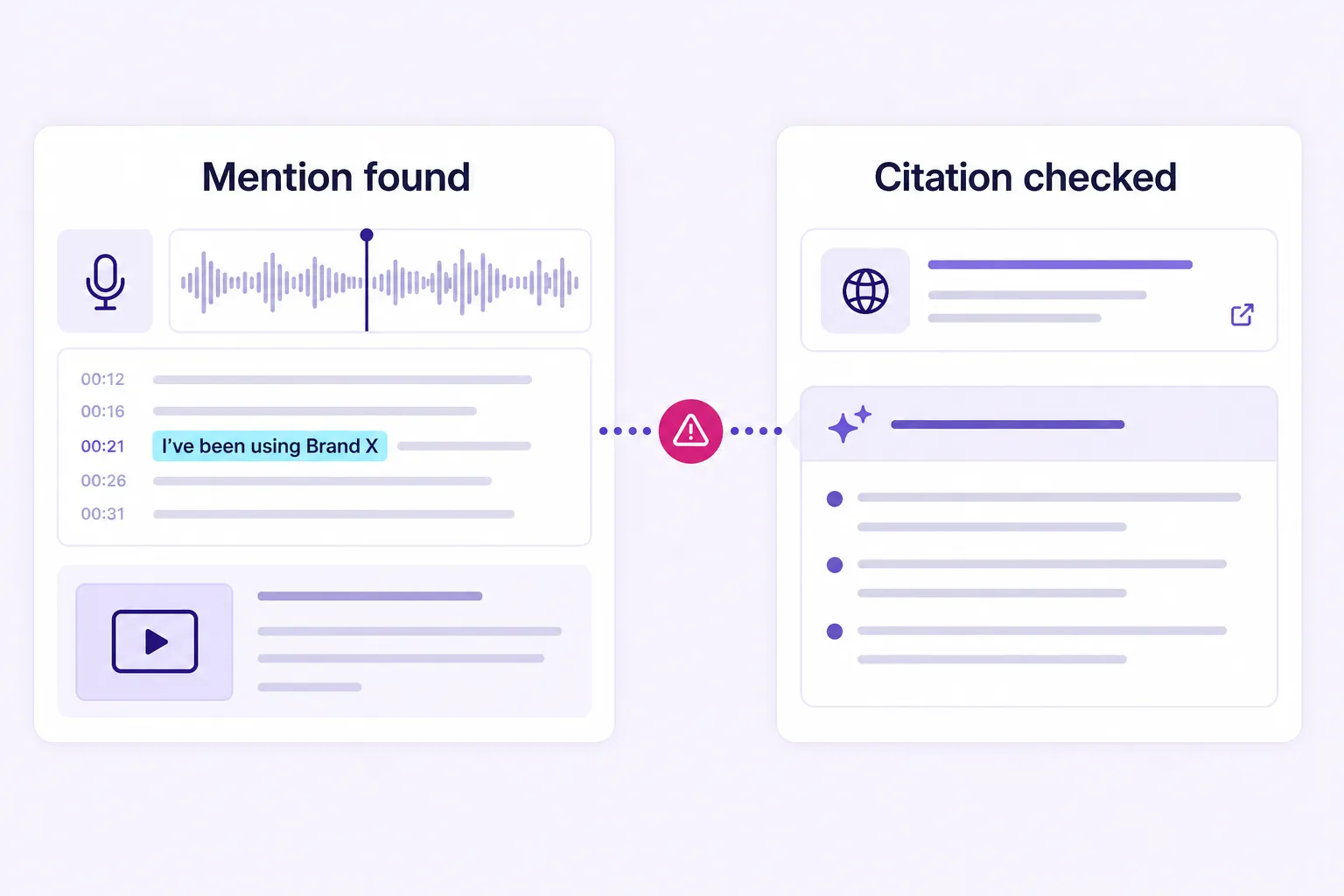
Mention detection vs. citation observation
A detected spoken mention establishes that a monitoring system found a reference in its available material. It does not establish that ChatGPT, Perplexity, Gemini or Google ever retrieved that material.
The reverse holds too. An AI answer might cite an episode page that contains only show notes, which demonstrates a source citation without demonstrating that any spoken reference was processed.
Two evidence sets, kept separate:
Conversation evidence: where the brand was discussed, what was said, who said it, and in what context.
Answer evidence: which assistant response named the brand, what claim it made, and which source it displayed.
The link between them has to be observed, not assumed.
Judge a monitoring programe by how few mentions you have to read, not by how many it collects. The useful output is the handful that change a decision: a complaint forming, a competitor claiming your category, a transcript that misquotes your product.
Why the distinction matters for PR, reputation and brand intelligence
For PR, a transcript-only mention surfaces earned coverage that a title-and-description report structurally cannot see. For reputation teams, it exposes a complaint, a comparison or an inaccurate claim that deserves a response whether or not any assistant ever repeats it. For brand intelligence, it shows the unscripted language people use about the product, which is usually better input for messaging than any survey. For AI visibility work, it identifies candidate sources worth examining, and "candidate" is the operative word: the source has become visible to the analyst, not necessarily to any answer engine.
The decision rule is short. If a detected spoken mention has an accessible textual representation, record its URL and put it into the citation checks you already run. If it has none, you have found earned attention that text-based retrieval cannot currently see, and the choice is whether to ask the publisher for a transcript or better show notes, pursue coverage you can legitimately earn, or simply value it as an audience-side outcome and report it as one.
Frequently Asked Questions
Can ChatGPT cite YouTube videos?
Yes, with conditions: a YouTube link can appear as a reference in a ChatGPT answer, but what is cited is the page, not the audio. OpenAI's search documentation does not establish universal access to video transcripts or direct audio analysis, and it notes that citations can be inaccurate and that a sources panel may include links that were not cited for any specific claim. A citation of a web page about a video is also a different thing from a claim supported by the video's spoken content, so the underlying evidence has to be checked rather than inferred from the link.
Do Google AI Overviews cite YouTube videos?
Yes, with conditions: a YouTube watch page can appear as a supporting link when it is indexed and eligible to appear in Google Search with a snippet, which is Google's documented condition for AI Overviews and AI Mode, with no additional technical requirements. That eligibility is a precondition, not a guarantee of inclusion. And a displayed YouTube link does not reveal whether captions, the description, a platform integration or a third-party page supplied the evidence behind the sentence it sits beside.
Does Perplexity use YouTube transcripts?
The documentation cited here does not establish whether, or how comprehensively, Perplexity retrieves YouTube transcripts. It publishes a video-discovery use case in which the product locates a relevant video and, in contexts such as its browser, opens a specific segment, and its crawler documentation separates PerplexityBot (finding and linking websites in search results) from Perplexity-User (visiting a page in response to a user request). Those are capabilities with conditions, not a documented commitment to index every spoken reference on YouTube or to weight transcripts equally with editorial web pages.
Are YouTube transcripts indexed by AI search engines?
Not as a rule: no platform documents a cross-platform guarantee that every YouTube transcript is indexed by every AI search engine. Transcript existence, system-specific access and query-specific retrieval are three separate conditions. Google's published requirement for supporting links in AI Overviews and AI Mode concerns pages that are indexed and eligible to appear with a snippet, which is not a commitment to index every spoken sentence on the platform.
Which AI search engine cites YouTube most?
It depends on the study. In BrightEdge’s analysis, Google’s AI surfaces cited YouTube most and ChatGPT least, with Perplexity in between.
In BrightEdge's analysis, YouTube held a 29.5% citation share in Google AI Overviews (#1 domain, average rank 6.3), 16.6% in Google AI Mode (#1 domain, average position 9.7), 9.7% in Perplexity (#5 domain) and 0.2% in ChatGPT (average position 5.2), measured across those four products from May 2024 to September 2025 using its AI Catalyst platform. Other datasets - Profound, Peec AI's 30-million-source study and Agenzy's 2026 source study - report different magnitudes on different prompt sets.
How do I get my podcast cited by ChatGPT or Google AI Mode?
Make the episode page citable first, then measure. Work through steps 1 - 4 of the citability checklist: publish an accurate HTML transcript on the episode page, name the product, category and use case in the written layer, confirm the page is indexed and snippet-eligible, and audit each crawler, index and snippet directive separately, because OAI-SearchBot and GPTBot have separate robots.txt controls for search and potential training use. ChatGPT-User handles certain user-initiated visits, for which robots.txt rules may not apply.
Do podcast transcripts help AI visibility?
Yes, with conditions: a published HTML transcript on an episode page is the representation most likely to be reachable by ordinary web discovery, because it turns speech into text at a crawlable address with speakers identified - which is also what W3C accessibility guidance describes. It supplies a textual representation and can reduce access obstacles, provided the page is reachable by the relevant system. Transcripts inside a creator dashboard, a feed file or a listening app hold the same words in a different access situation, so "the episode has a transcript" is not by itself a visibility claim.
Can AI search engines cite podcasts without a full transcript?
Yes. An episode page, detailed show notes or a third-party account can supply retrievable evidence with no transcript present. The limitation is what that source actually contains: a description that never names the brand cannot substantiate a spoken reference simply because it links to the episode.
How do I check whether an AI engine cited my podcast?
Run a fixed set of buyer-style questions repeatedly across each platform and mode, and log the prompt, platform, mode, model version if exposed, date and time, locale, whether web search ran, the full list of displayed sources, a screenshot, and the number of repetitions. Then audit the citations rather than counting them: confirm that the cited passage supports the exact claim, that the right speaker is credited, and that the answer kept the qualification the source attached. Because answers are non-deterministic, one observed citation is not proof of stable visibility and one absence is not proof of exclusion, which is why this has to be a dated series rather than a single screenshot.
Does a spoken brand mention count as an AI recommendation?
No. A spoken mention is an event in source material. An AI recommendation is a property of a generated answer that presents a brand as suitable for a stated need. An answer can cite a source that names a brand, name the brand itself for a neutral or critical reason, and recommend something else entirely, all in the same response.
Conclusion: the structure outlasts the features
A brand can sit at the center of an important conversation without ever appearing in a single written description of it. That conversation deserves attention before it becomes an AI citation, and whether or not it ever does. Knowing it happened is the measurable asset available today. Being cited for it remains a possibility, never a promise, and anyone selling it as the latter is describing a hope rather than a mechanism.
Filed under: AI Visibility & SEO