10 Best Talkwalker Alternatives & Competitors in 2026 (Scored)
The 10 best Talkwalker alternatives and competitors, scored on one published rubric with verified prices, trials and honest trade-offs. BrandMentions ranks first at 90/100.

Quick Answer: The best Talkwalker alternative for most growing brands and agencies is BrandMentions (90/100): web, social, news, video and podcast coverage in 100+ languages at $299/month (Pro) or $499/month (Expert), with a 7-day trial and free migration. Choose Brandwatch (80/100) instead if a multi-year archive and trainable custom classifiers drive your decisions and you have an analyst to run them. Choose YouScan (79/100) if visual and logo recognition is a weekly part of your workflow, because that is the one Talkwalker capability most mid-market tools do not replace.
Talkwalker is now sold as Lumen by Talkwalker, part of Hootsuite. This guide covers both names and what the product costs today.
Prices, plan limits and feature gates were read in October 2026 from each vendor's own documentation - full methodology, scoring rubric and bias disclosure in About this ranking.
Key takeaways:
- Talkwalker still exists, but it is now Lumen by Talkwalker inside Hootsuite, sold as Core, Analyze and Business on custom quotes, with an AI Agent and LLM Insights included from Core. Anyone telling you Talkwalker lacks AI is working from a 2023 page.
- Every tool is scored on one published rubric (coverage, AI analysis, reporting, ease of use, pricing transparency, value, switching support), so you can check the order and re-weight it yourself.
- The thing most buyers get wrong is comparing entry prices instead of comparable packages. YouScan's published $499/month plan is text-based. Sprout Social prices Listening separately. Brand24's cheapest plan collects every 12 hours. Price the first plan that preserves your workflow.
What is a Talkwalker alternative? A platform that takes over the listening, analysis, alerting and reporting workflows your team runs inside Talkwalker, not just a cheaper mention feed.
Talkwalker Alternatives and Competitors Compared (Scores, Prices, Trials, Trade-Offs)
The main comparison table: the ranked score, who each platform is for, the lowest price the vendor publishes, how you can evaluate it, and the trade-off that decides most shortlists. "Custom quote" means the vendor publishes no comparable subscription price, and we have not substituted a guess. Prices separate monthly billing from annual commitments.
| # | Platform | Score /100 | Best for | Published entry price | Trial | Main trade-off |
|---|---|---|---|---|---|---|
| 1 | BrandMentions | 90 | Growing brands and agencies | Pro $299/mo; Expert $499/mo; Starter $99/mo billed quarterly | 7 days, self-serve | No visual logo recognition; 2 seats on Pro |
| 2 | Brandwatch | 80 | Enterprise consumer research | Custom quote | Demo | No published price; analyst-dependent |
| 3 | YouScan | 79 | Visual intelligence | $499/mo (Starter 3, billed annually) | Demo | Published plan is text-based |
| 4 | Meltwater | 78 | PR and media intelligence | Custom quote | Guided demo | Package scope defines the price |
| 5 | Sprinklr | 77 | Enterprise unified CX | Custom quote | Demo | Self-serve products discontinued |
| 6 | Synthesio by Ipsos | 74 | Research and innovation | Custom quote (UK public-sector framework rate: £25,000 per licence per year) | Demo | Needs a scoped proposal, not a plan |
| 7 | Brand24 | 72 | Small-team monitoring | $249/mo; $199/mo annually | 14 days, no card | Entry plan collects every 12 hours |
| 8 | Determ | 69 | Focused European PR | €99/mo (Focus) | 5 days, no card | 1,000 mentions/mo on Focus |
| 9 | Mentionlytics | 66 | Budget monitoring | $49/mo promotional, billed yearly | 14 days | Basic collects every 12 hours |
| 10 | Sprout Social | 64 | Publishing plus listening | $199/seat/mo annually, plus a Listening quote | 30 days (platform only) | Listening is a separate quote |
Jump to
- The 10 best Talkwalker alternatives, ranked
- Also considered (and why they are not in the top 10)
- About this ranking (methodology and bias disclosure)
- How we scored every tool (rubric and weights)
- What is Talkwalker called now, and what does it cost in 2026?
- How to evaluate Talkwalker competitors and alternatives
- BrandMentions vs Talkwalker: head-to-head
- Talkwalker vs competitors
- What does a like-for-like year actually cost?
- What security and governance questions should you ask?
- Which Talkwalker alternative fits your use case?
- How to choose your Talkwalker replacement
- How to switch from Talkwalker without losing your history
- Frequently asked questions
The 10 Best Talkwalker Alternatives, Ranked
- BrandMentions - best for growing brands and agencies (90/100)
- Brandwatch - best for enterprise consumer research (80/100)
- YouScan - best for visual and logo recognition (79/100)
- Meltwater - best for PR and media intelligence (78/100)
- Sprinklr - best for enterprise unified CX (77/100)
- Synthesio by Ipsos - best for research-grade insights (74/100)
- Brand24 - best for small teams with a clear keyword brief (72/100)
- Determ - best for focused European PR monitoring (69/100)
- Mentionlytics - best for the lowest published entry cost (66/100)
- Sprout Social - best for publishing plus listening (64/100)
Every review below follows the same structure, in the same order: a one-line verdict, an identically formatted pricing table, then best fit, standouts, shortfalls, pricing reality, the details buyers miss, and a direct comparison with Talkwalker. Links to competing commercial pages carry nofollow; links to documentation and research do not.
1. BrandMentions, Best for Growing Brands and Agencies (90/100)
BrandMentions is an AI-powered social listening and brand monitoring platform founded in 2015, used by 12,400+ brands and agencies, with 32 billion+ mentions delivered from 125 million+ sources across 100+ languages. It holds 4.9 out of 5 on G2 from 242 reviews and 5.0 out of 5 on Capterra from 64 reviews.
Verdict: choose BrandMentions if you want Talkwalker-style breadth across web, social, news, video and podcasts at a published $299/month (Pro) or $499/month (Expert), with a 7-day self-serve trial and free migration; skip it if you need visual logo recognition or more than 10 seats.
| Plan | Price | Billing | Evaluation | Key limits and inclusions |
|---|---|---|---|---|
| Pro | $299/month | Monthly or annual | 7-day trial | 2 users, hourly collection, multilingual AI sentiment, AI Assistant, 6-month retention |
| Expert (most popular) | $499/month | Monthly or annual | 7-day trial | 10 users, real-time collection, Boolean search, white-label reports, 12-month retention |
| Enterprise | from $1,299/month | Monthly or annual | Scoped configuration | Custom limits, REST API, up to 10 years of history, dedicated success manager |
| Starter | $99/month | Billed quarterly | 7-day trial | Entry allowances, 3-month retention |
Best fit
Marketing, PR and insights teams at growing brands and agencies that use Talkwalker for breadth, alerting and client reporting, and want a published price, a self-serve trial and a migration they do not have to run themselves.
What stands out
Coverage spans web, social, news, forums, reviews and transcript-based Spoken Mentions inside video and podcasts, which is the source category most mid-market tools skip entirely. The sentiment layer is LLM-based with 12+ emotions including sarcasm, plus custom sentiment rules that let you encode your own domain language instead of fighting a default model. AI Digests, Flash Alerts and AI Reports replace the standing alert workflows most Talkwalker teams depend on, and reports export as editable PPTX rather than static PDF. The G2 Learning Hub positions it for real-time web and social mention tracking, and The CMO ranks it third overall and best for sentiment analysis.
Where it falls short
No visual logo recognition. If image-based detection is in your weekly workflow, this is not your replacement, and we would rather say that in the first paragraph than the last. There is also no print or broadcast monitoring, no publishing, and no care inbox. Seats are tight on lower tiers at 2 users on Pro and 10 on Expert, Boolean search starts on Expert rather than Pro, and the REST API arrives on Enterprise, which matters if you intend to pipe mentions into a warehouse on a $499 plan.
Pricing reality
Pro is $299/month and Expert is $499/month, Enterprise starts at $1,299/month, and Starter is $99/month billed quarterly. There are no overage fees, so a viral spike does not produce a surprise invoice. Read that correctly though: no overage fee is a billing promise, not a collection promise. Our help center states that when a project reaches its mention allowance, monitoring can pause until the next billing cycle or require an upgrade, which is exactly the wrong outcome mid-crisis. Size the allowance for your worst month, not your average one.
What most buyers miss
Three details that do not appear in any marketing comparison. First, retention is tiered: three months on Starter, six on Pro, twelve on Expert, with up to ten years of history on Enterprise, and a new project initially retrieves roughly the last thirty days before the free historical import fills in behind it. Second, free migration begins after the first payment, so it is not something you can exercise mid-trial. Third, white-label reports and white-label email delivery are different things: sending from your own domain requires a SendGrid account plus sender or domain authentication, documented in the BrandMentions help center, so loop in whoever owns your email infrastructure before you promise a client fully branded delivery.
Compared with Talkwalker
Overlapping coverage across web, social, news, video and podcasts, at a published price with a trial, free migration and editable reporting. Talkwalker keeps visual detection, 187 languages, no listed seat cap, and LLM Insights for tracking brand presence inside AI assistants. If those four matter weekly, stay or look at YouScan.
2. Brandwatch, Best for Enterprise Consumer Research (80/100)
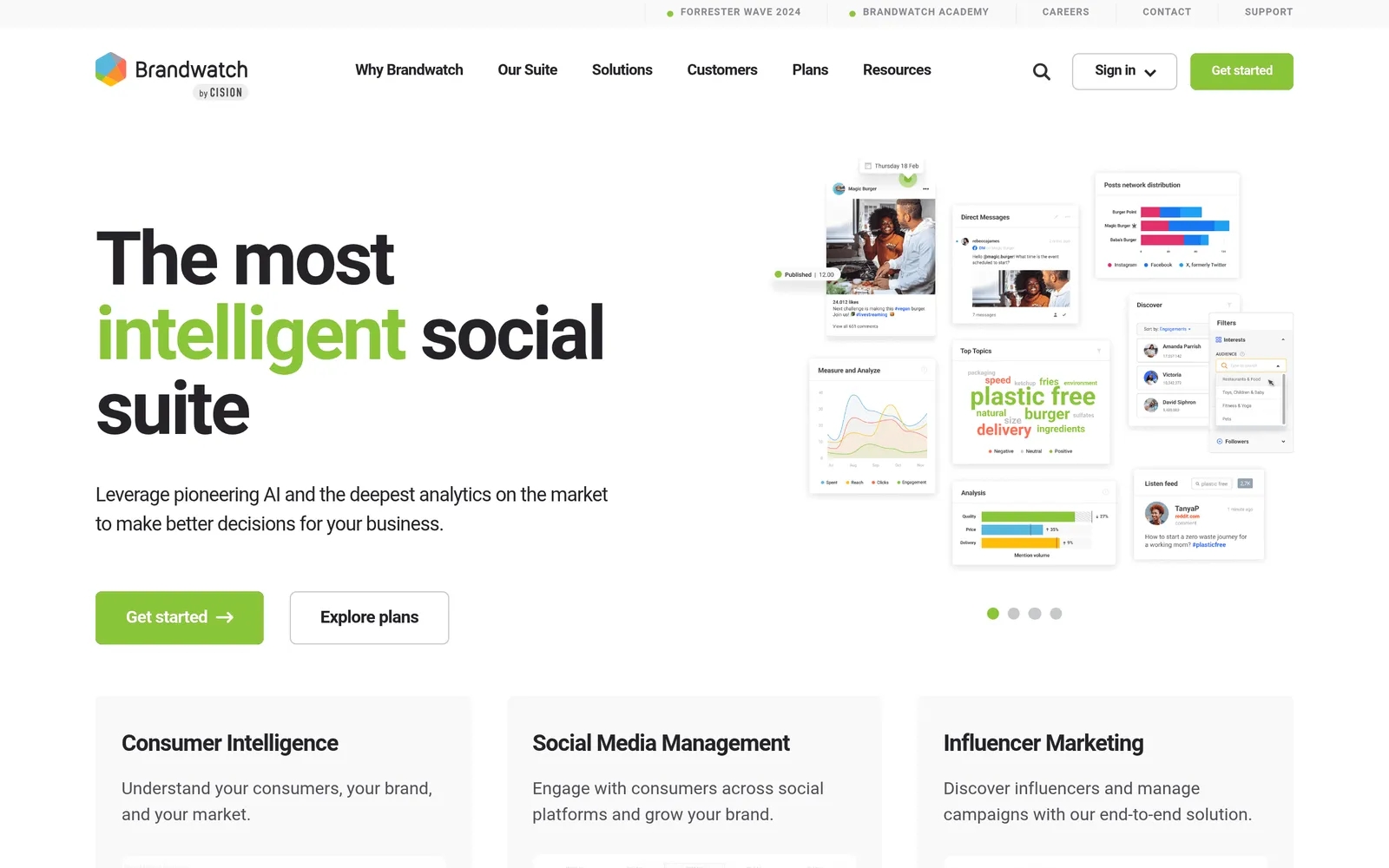
Brandwatch, part of Cision since 2021, is the closest like-for-like replacement at the enterprise end of the market: research-grade listening with a deep archive and trainable classification.
Verdict: choose Brandwatch if you need a multi-year archive and trainable custom classifiers and have an analyst to run them; skip it if you need a published price or a self-serve trial.
| Plan | Price | Billing | Evaluation | Key limits and inclusions |
|---|---|---|---|---|
| Consumer Research | Custom quote | Contract-specific | Demo | Archive access, custom classifiers, image analysis, first-party data upload |
| Consumer Intelligence suite | Custom quote | Contract-specific | Demo | Research workflow, segmentation, dashboards |
| Social Media Management | Custom quote | Contract-specific | Demo | Publishing and engagement, sold separately from research |
Best fit
Consumer insights and market research teams running long-horizon studies with a dedicated analyst, especially inside organizations already buying Cision for media intelligence.
What stands out
Archive depth and the query-and-segment workflow built around it. Brandwatch advertises 1.4+ trillion posts reaching back to 2008 on its Consumer Research page. Iris AI, trainable custom classifiers, image analysis and first-party data upload let a research team encode its own taxonomy rather than accept a vendor's. Brandwatch also states plainly that it combines large language models with proprietary technology, which is why the lazy "legacy enterprise versus modern LLM" framing you see on comparison pages does not survive contact with its documentation.
Where it falls short
Total price opacity, no self-serve trial, and a learning curve that punishes generalist teams. Procurement data from Vendr shows a median annual contract of $50,000 across 40 recorded purchases, with observed deals from roughly $19,500 to $81,200. Read that as a median of what buyers paid for varying scopes, not as a minimum or a like-for-like listening price.
Pricing reality
Request a proposal scoped to your archive requirement, classifier work, seat count and integrations, and be explicit about which product line you are buying. "Brandwatch" now spans research, social management and influencer products sold under separate lines.
What most buyers miss
Two things. The archive number is not consistent across Brandwatch's own properties: Consumer Research advertises 1.4+ trillion posts back to 2008, while Consumer Intelligence material cites 1.7 trillion conversations back to 2010. Get the archive window and the content definition written into your order form rather than inferring it from a web page. Second, and more operationally, the Brandwatch developer documentation sets a default Consumer Research API limit of 30 requests per ten minutes per client. If three internal systems poll independently, they share that budget, so plan one coordinated integration rather than three hopeful ones.
Compared with Talkwalker
Brandwatch is the research-depth alternative, not the cost-reduction one. Talkwalker counters with no listed seat cap and its own visual detection. Test your single most demanding historical question in both before you decide.
3. YouScan, Best for Visual and Logo Recognition (79/100)
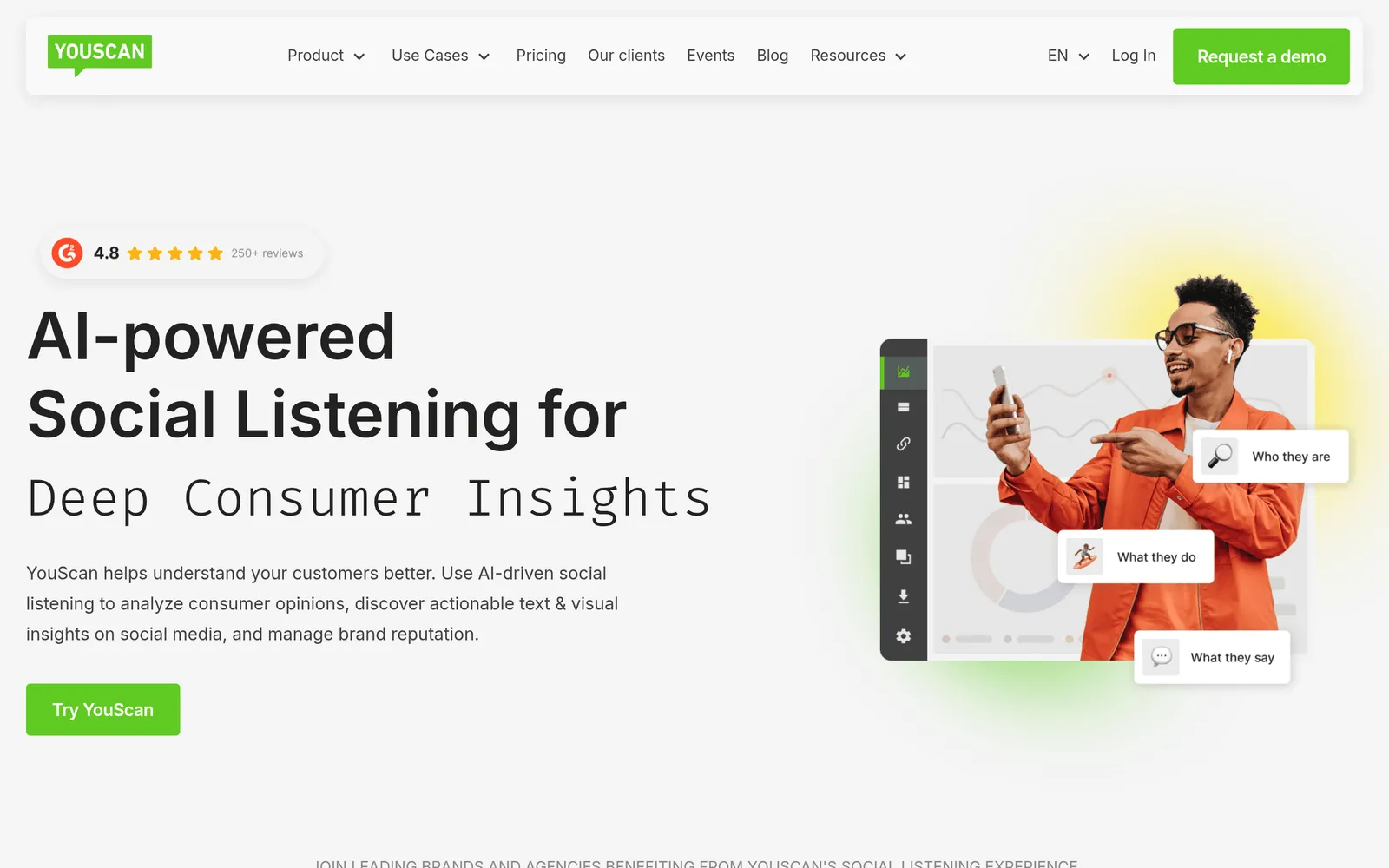
YouScan is the specialist that genuinely competes with Blue Silk AI: logo, product and scene detection in social images, plus conversational exploration of the results.
Verdict: choose YouScan if logo, product and scene detection in social images is a weekly job; skip it if you expect the published $499/month Starter 3 plan to include that capability, because Starter 3 is text-based and Visual Insights sits on the quote-only Unlimited configuration.
| Plan | Price | Billing | Evaluation | Key limits and inclusions |
|---|---|---|---|---|
| Starter 3 | $499/month | Annual | Demo, self-serve purchase | 3 text-based topics, 15,000 mentions/month, 1 custom dashboard, 10 Copilot questions/month, no listed seat cap |
| Unlimited (visual configuration) | Custom quote | Contract-specific | Demo | Visual Insights, Audience Insights, API access, mentions described as sampled |
Best fit
Consumer brands whose products appear in user photos without a caption: beverages, fashion, beauty, automotive, consumer electronics, sports sponsorship. Also visual trend work inside insights teams.
What stands out
Visual Insights finds your brand in photos where nobody typed your name, which is the one Talkwalker capability the rest of this list does not replace. Insights Copilot supports natural-language questions over mention data, comparable in intent to Lumen's AI Agent. There is no listed per-seat cap on either plan, which makes it unusually friendly to wide internal distribution.
Where it falls short
The published $499 price does not buy the capability YouScan is famous for. Starter 3 is a text-based package with three topics and 15,000 monthly mentions, which is restrictive next to similarly priced plans elsewhere. Text coverage of news, blogs and the long-tail web is narrower than the all-source suites.
Pricing reality
Starter 3 costs $499/month on annual billing. Budget separately for the Unlimited configuration if visual recognition is the reason YouScan is on your list, and get "Visual Insights" named explicitly on the quote.
What most buyers miss
YouScan's own pricing page describes mentions on the Unlimited plan as sampled. An uncapped contractual allowance is not the same as collection of every matching item, so ask what proportion of matching conversation your configuration captures and how that proportion is calculated. Also test uncaptioned exposure during evaluation, not images that happen to sit next to matching text, or you will end up validating ordinary keyword collection.
Compared with Talkwalker
A focused visual challenger with a published entry point and a faster evaluation route. Talkwalker remains broader across text, news and languages. For teams prioritizing visual listening, YouScan is the more specialized option in this comparison.
4. Meltwater, Best for PR and Media Intelligence (78/100)
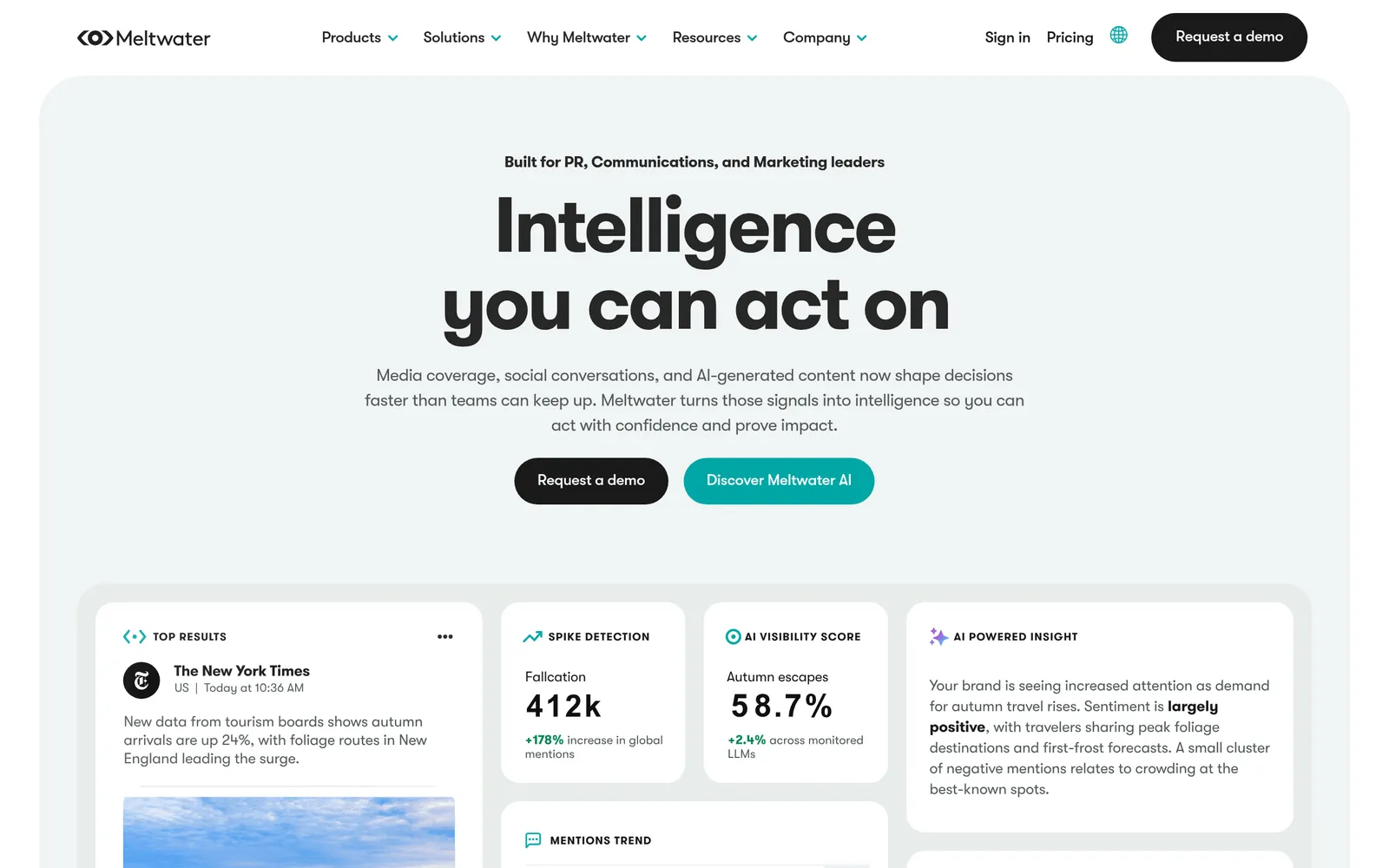
Meltwater, founded in Norway in 2001, is the suite to look at when communications owns the budget: media monitoring, social listening, a journalist database and distribution under one contract.
Verdict: choose Meltwater if print, broadcast and journalist outreach have to sit in the same contract as social listening; skip it if you only need listening, or if you require a published price and a self-serve trial.
| Plan | Price | Billing | Evaluation | Key limits and inclusions |
|---|---|---|---|---|
| Starter | Custom quote | Typically annual | Guided demo | Core monitoring scope, defined by package |
| Pro | Custom quote | Typically annual | Guided demo | Added analytics, Mira AI, benchmarking |
| Enterprise | Custom quote | Typically annual | Guided demo | Global scope, integrations, services |
| Agency | Custom quote | Typically annual | Guided demo | Multi-client portfolios and reporting |
Best fit
Corporate communications and PR leads who measure earned media as seriously as social conversation, and who want journalist identification and outreach in the same place as monitoring.
What stands out
Editorial depth across online news, print and broadcast, plus the media relations workflow that connects coverage to the journalists producing it. Mira AI supports summarization, trend detection and natural-language reporting. If the document your board reads is an earned media report, Meltwater is built for exactly that document, and our media monitoring guide explains why editorial sources behave differently from social ones in measurement.
Where it falls short
No self-serve trial, no published price, and annual agreements are the norm. Social listening is one module inside a wide suite, so a team that needs only listening pays for a database it may not open. Complex implementations can carry an onboarding charge.
Pricing reality
Meltwater publishes package names (Starter, Pro, Enterprise, Agency) but not subscription prices. Sources, regions, seats, modules, integrations and support level all move the quote, so compare a defined bundle rather than an annual figure quoted secondhand on another vendor's blog.
What most buyers miss
Meltwater grew substantially by acquisition, so module boundaries and source continuity vary by what you buy. Ask for a per-module source list in writing, including which content is licensed and which is crawled, before you sign. And apply the consolidation test: a suite only saves money if you actually retire a contract. Teams that keep the old listening tool "just for alerts" have bought a suite and a subscription.
Compared with Talkwalker
Meltwater is more oriented toward print, broadcast and journalist-outreach workflows, while Talkwalker emphasizes broad social listening and visual detection. Both are quote-only, so the decision turns on which workflow you are consolidating rather than on price transparency.
5. Sprinklr, Best for Enterprise Unified CX (77/100)
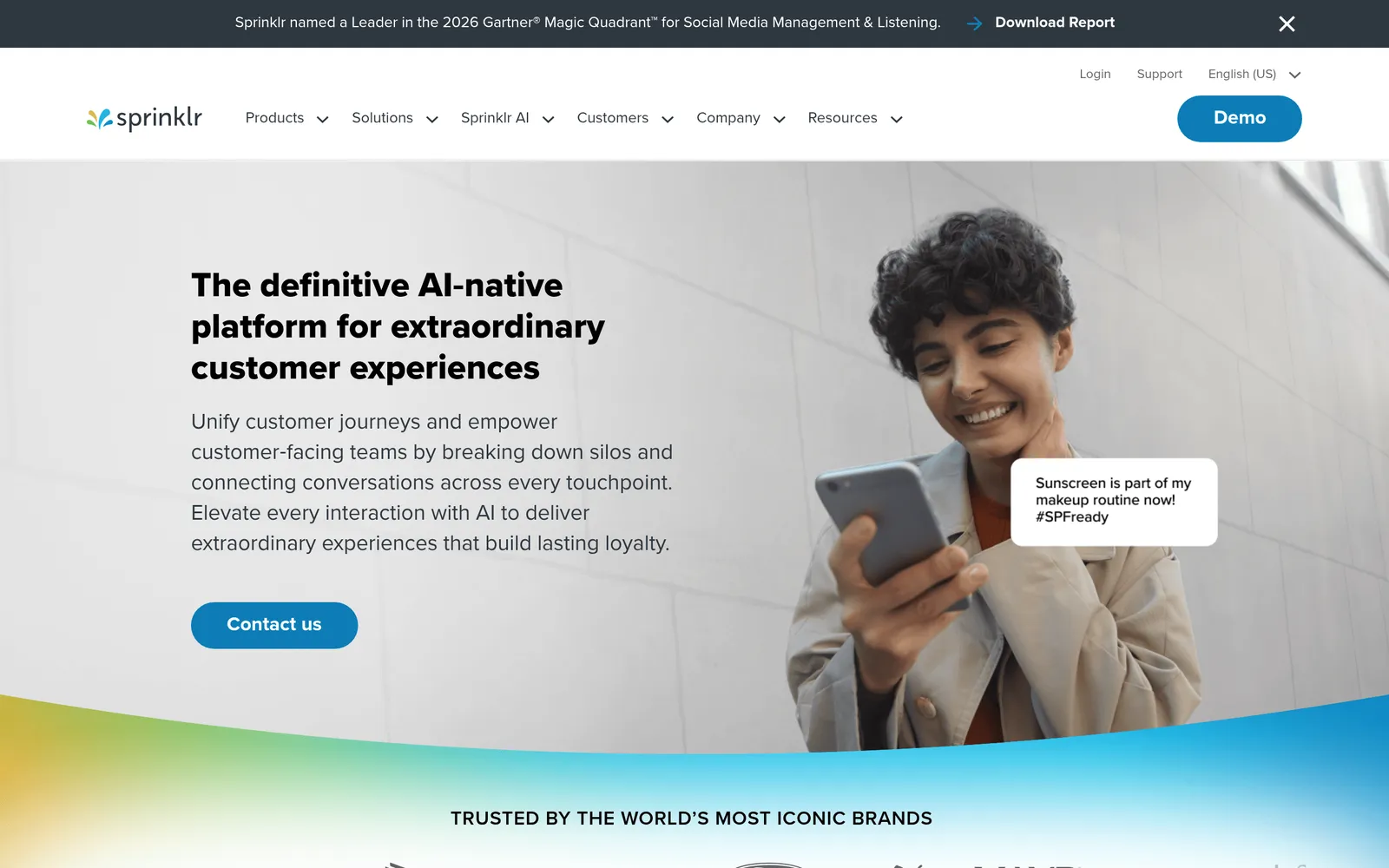
Sprinklr sells listening as one module of a unified customer experience platform that also runs care, social management, marketing and insights. As of October 2026 it is an enterprise purchase only.
Verdict: choose Sprinklr if a mention has to become a care ticket, a published reply and a campaign action inside one system; skip it if you want a short buying cycle or a published price, because Self-Serve service ended April 30, 2026 and every plan is custom-quoted.
| Plan | Price | Billing | Evaluation | Key limits and inclusions |
|---|---|---|---|---|
| Sprinklr Insights (incl. social listening) | Custom quote | Contract-specific | Personalized demo | Listening, competitive, visual, location and LLM insights modules |
| Full unified platform | Custom quote | Contract-specific | Personalized demo | Service, social, marketing and insights suites |
| Self-Serve | Discontinued | Not available | Not available | Existing Self-Serve service ended April 30, 2026 |
Best fit
Large enterprises where a mention has to become a care ticket, a published reply and a paid media exclusion inside one system, with the procurement and IT capacity to support it.
What stands out
Operational integration that has been designed in for over a decade rather than bolted on. The Insights suite spans social listening, competitive and product insights, location analytics, visual insights and LLM insights, which is the broadest module set here.
Where it falls short
Access. Sprinklr's own page states that Self-Serve products have been discontinued and that service for existing Self-Serve customers ended on April 30, 2026. Any $199 to $359 per seat figure you find online refers to that retired program and is irrelevant to 2026 budgeting. Implementation is a project measured in months, not days.
Pricing reality
Everything is custom-quoted, with no published pricing page of any kind. Scope your proposal around the products and workflows you intend to replace, and expect module breadth, not brand name, to drive the number.
What most buyers miss
Retention is volume-based, not purely time-based. The Sprinklr Active Data Retention policy documents storage caps where live ingestion can remove the oldest mentions once capacity fills, and bulk backfills face capacity checks. The practical implication: a single collection spike can shorten the history you retain, even though you never changed a reporting date range. Ask how your cap is sized and what happens at 100%.
Compared with Talkwalker
Sprinklr is the choice when you want broader operational integration and have the governance requirements to match. It is not the choice for reducing implementation scope or shortening a buying cycle.
6. Synthesio by Ipsos, Best for Research-Grade Insights (74/100)
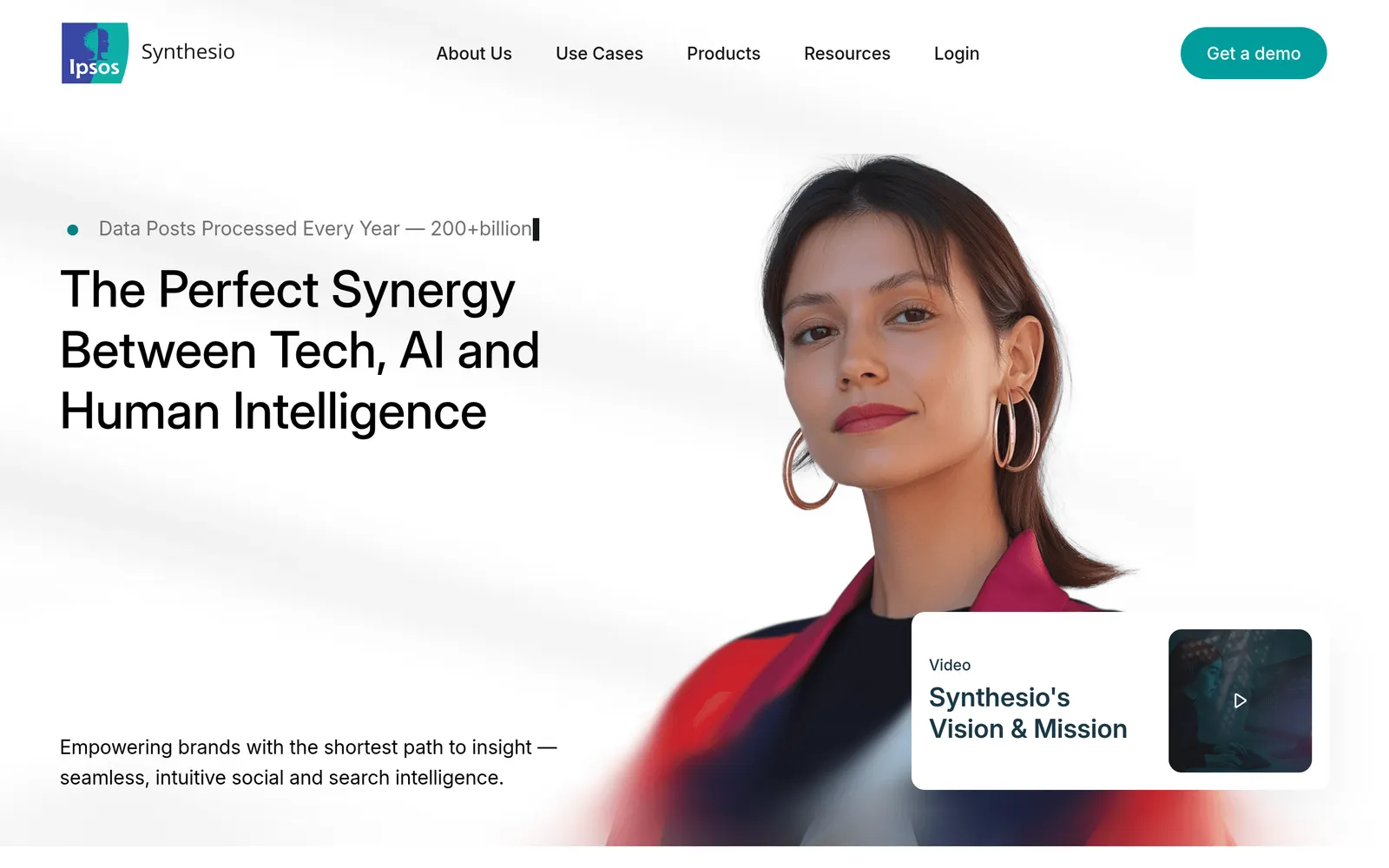
Synthesio has been part of Ipsos since the acquisition announced on October 30, 2018, which changes what you are buying: data plus a research organization that interprets it.
Verdict: choose Synthesio if you are buying a research capability with Ipsos method behind it, not a dashboard subscription; skip it if you need a published commercial price or an interface a social manager can run daily.
| Plan | Price | Billing | Evaluation | Key limits and inclusions |
|---|---|---|---|---|
| Platform licence | Custom quote (£25,000 per licence per year on the UK public-sector framework according to data.) | Annual | Demo | Social, search, review and visual content; topic modeling; Signals GenAI |
| Platform plus Ipsos services | Custom quote | Annual | Demo | Analyst-led insight reporting, workshops, custom research |
Best fit
Insights and innovation teams that need research outputs rather than mention notifications, and organizations that already buy Ipsos research and want continuity of method.
What stands out
Research method built into the software. Topic modeling includes maturity and velocity metrics, semantic and visual AI support analysis across social, search, review and image content, and Signals GenAI applies generative prompts to consumer data for faster insight generation. For teams that treat social data as a primary research input requiring defensible method, this makes Synthesio one of the most research-oriented options in the comparison, alongside Brandwatch.
Where it falls short
No self-serve trial, no published commercial pricing, and an interface designed for trained researchers rather than a social manager checking yesterday's mentions. Day-to-day monitoring workflows exist but are not the design center.
Pricing reality
The only public, traceable price point is a UK government framework listing. The UK Digital Marketplace listing shows £25,000 per licence per year. Treat that as a public-sector framework rate in one country, not as a universal commercial price, and ask whether your proposal covers platform access, insight services, or both.
What most buyers miss
The same framework paperwork prices things buyers assume are included. API access is listed from £15,000 per year as a separate line, and support is priced hourly (around £150 per hour for client success time and £210 per hour for consultancy). Also, do not confuse Signals GenAI with AI-answer visibility: it applies generative analysis to consumer and social data, which is a different product from monitoring how assistants describe your brand.
Compared with Talkwalker
Synthesio is the research-led alternative. Talkwalker is more practical for mixed monitoring and research teams, and its LLM Insights module addresses AI-answer visibility specifically, which Synthesio's generative analysis does not.
7. Brand24, Best for Small Teams With a Clear Keyword Brief (72/100)
Brand24 is the most approachable product here: every limit published, a 14-day trial with no card, and a project you can configure in minutes.
Verdict: choose Brand24 if a small team wants every plan limit published and a 14-day no-card trial; skip the $249/month Individual plan if crisis speed matters, because it collects every 12 hours and holds 3 keywords, 2,000 mentions and 1 user.
| Plan | Price (monthly / annual per month) | Billing | Evaluation | Key limits and inclusions |
|---|---|---|---|---|
| Individual | $249 / $199 | Monthly or annual | 14-day trial | 3 keywords, 2,000 mentions, 1 user, collection every 12 hours |
| Team | $349 / $299 | Monthly or annual | 14-day trial | 7 keywords, 10,000 mentions, hourly collection, no listed seat cap |
| Pro | $499 / $399 | Monthly or annual | 14-day trial | 12 keywords, 40,000 mentions, real-time collection, AI Insights and AI Topics |
| Business | $699 / $599 | Monthly or annual | 14-day trial | 25 keywords, 100,000 mentions, adds podcasts as a source category |
| Enterprise | from $1,499 | Annual | Sales conversation | Custom limits and consulting |
Best fit
Solo marketers and small teams monitoring one brand plus a couple of competitors, who value speed of setup over depth and do not need deep history or an API.
What stands out
Clarity. Keywords, mentions, seats, collection frequency and source categories are all on one page, which is more than most vendors on this list manage. AI event detection explains mention spikes without manual digging, the AI Brand Assistant summarizes conversation, and white-label reporting arrives from Pro. For very small operations, compare it against the wider set of tools for small teams before defaulting to the cheapest tier.
Where it falls short
Source access is tiered aggressively, so the plan you pick determines which platforms you can see, not just how many mentions you receive. Podcasts only arrive on Business. The entry plan is thin for the money at three keywords, 2,000 mentions, one seat and collection every 12 hours, which makes it a reporting tool rather than a crisis tool.
Pricing reality
Use $249/month for a monthly Individual subscription and $199/month only for the annual commitment, because those two numbers get conflated constantly in comparison tables. Add-ons stack on top: extra keywords and mention blocks are priced individually, and API access is an additional fee listed at $149/month, not an inclusion.
What most buyers miss
Two current facts. AI Visibility, the module for tracking brand presence in LLM answers, appears as an add-on across the plan columns rather than as an Enterprise-only feature, so ask for it to be priced on the tier you actually want. And the ownership chain now runs further than most pages report: Brand24 sits under Semrush, and Adobe completed its acquisition of Semrush on April 28, 2026. If product roadmap stability matters to your three-year plan, that is a reasonable question to raise in the sales call.
Compared with Talkwalker
Brand24 is simpler, cheaper and faster to evaluate, with narrower coverage of news, broadcast and international media and no visual detection. Treat it as a scoped monitoring replacement, not a full enterprise workflow transfer.
8. Determ, Best for Focused European PR Monitoring (69/100)
Determ, based in Zagreb, is the EU-hosted specialist: published euro pricing, multilingual sentiment and strong regional media coverage.
Verdict: choose Determ if you want EU-hosted, euro-priced monitoring with Boolean search already on the €99/month Focus plan; skip it if you need more than 1,000 mentions a month at that tier or consumer-scale social volume.
| Plan | Price | Billing | Evaluation | Key limits and inclusions |
|---|---|---|---|---|
| Focus | €99/month | Monthly | 5-day trial, no card | 1 topic, 1,000 mentions, real-time updates, AI features, no listed seat cap |
| Expand | €299/month | Monthly payment with a yearly commitment | 5-day trial, no card | 5 topics, 5,000 mentions |
| Command | €499/month | Monthly payment with a yearly commitment | 5-day trial, no card | 10 topics, 10,000 mentions |
| Custom | Custom quote | Contract-specific | Demo | Higher volumes, custom sources |
Best fit
European PR and comms teams, EU-based brands with data-handling requirements, and B2B organizations with modest mention volume that need precise filtering rather than high-volume collection. Worth comparing against other multilingual monitoring options if local-language press is your primary filter.
What stands out
Boolean search and source-level filtering (by site, outlet, location, language) are available on the €99 entry plan, where most vendors reserve advanced query building for mid tiers. AI features are available across tiers, there is no listed per-seat cap, and sentiment is built for multilingual European markets rather than translating everything to English first.
Where it falls short
Mention allowances are the tightest here. 1,000 per month on Focus suits a niche B2B brand and nothing consumer-facing. Default historical access reaches about three months, with older archive access on request. Source breadth and AI analysis trail the enterprise suites, and the platform leans media-first rather than social-first.
Pricing reality
Prices are published in euros. The detail that costs people money: on Expand and Command, paying monthly still carries a yearly commitment, so payment frequency and cancellation flexibility are two different questions. Ask both.
What most buyers miss
The "four platforms only" claim that circulates about Determ is wrong. Its own pricing matrix lists Reddit, Bluesky and Medium alongside Facebook, Instagram, X and YouTube, plus comments, forums and regionally available traditional media. That still does not make it a Talkwalker-scale social net, but build your shortlist from the current matrix rather than a two-year-old blog post. Also note that adding keyword variations inside a topic does not create extra mention capacity.
Compared with Talkwalker
Determ is a clearly priced route for a narrower, regional PR brief with a fast evaluation. Talkwalker is broader on social platforms, languages, history and visual detection. Size the topic and volume allowances honestly before calling it a replacement.
9. Mentionlytics, Best for the Lowest Published Entry Cost (66/100)
Mentionlytics publishes every plan limit down to the collection interval, which makes it the realistic option when the listening budget has largely disappeared.
Verdict: choose Mentionlytics if the lowest published entry price decides the shortlist; skip Basic at $49/month promotional if you need continuous collection, because that starts at Advanced ($299/month).
| Plan | Price (billed yearly) | Billing | Evaluation | Key limits and inclusions |
|---|---|---|---|---|
| Basic | $49/month promotional | Annual | 14-day trial | 3 keyword rules, 5,000 mentions, 10 social profiles, 2 users, collection every 12 hours |
| Essential | $169/month | Annual | 14-day trial | 10 keyword rules, 15,000 mentions, collection every 6 hours |
| Advanced | $299/month | Annual | 14-day trial | 15 keyword rules, 50,000 mentions, continuous collection, AI emotion analysis |
| Pro | $499/month | Annual | 14-day trial | 25 keyword rules, 100,000 mentions, custom reports, mention clustering |
| Business | $749/month | Annual | 14-day trial | Higher allowances, white-label reports, separate client accounts |
| Enterprise | from $1,299/month | Annual | Sales conversation | Custom allowances and reporting |
Best fit
Startups, small brands and agencies that need broad social coverage at the lowest published price and can accept slower collection at the bottom of the range.
What stands out
Transparency at the low end, including the specification most vendors bury: the collection interval per tier. AI emotion analysis and mention clustering arrive at Advanced, white-label reporting and separate client accounts at Business, which makes it workable for agencies running many small accounts.
Where it falls short
Source breadth, historical depth and reporting polish trail everything above it. Collection at 12-hour and 6-hour intervals on the two cheapest tiers makes them reporting tools rather than monitoring tools. Continuous collection, which is what most buyers assume "social listening" means, begins at Advanced.
Pricing reality
The $49 Basic rate is a current promotion on annual billing, not a permanent monthly-contract price, so confirm the renewal rate in writing. Treat $299 (Advanced) as the real entry point if you need continuous collection, which reframes Mentionlytics from "cheapest tool here" to "mid-priced tool with a cheap shelf below it."
What most buyers miss
Review monitoring for sites like Trustpilot, TripAdvisor and Booking.com is a paid add-on across the plan tiers, including at the top, which is unusual and matters a great deal for hospitality and multi-location buyers. An AI Visibility add-on is also offered from Essential upward, so the claim that Mentionlytics has no LLM-visibility capability is out of date. One more practical detail: the trial permits more users than the Basic plan retains, so evaluate the package you intend to keep.
Compared with Talkwalker
This is a budget comparison, not a functional one. Mentionlytics covers a fraction of Talkwalker's breadth, and its AI Image Recognition and AI Video & Audio Analysis are newly launched rather than proven at Blue Silk scale, but it publishes its prices and lets you start today. If your Talkwalker quote has simply become unaffordable, Advanced is the tier worth testing.
10. Sprout Social, Best for Publishing Plus Listening (64/100)
Sprout Social is a social management platform first. Listening is a separately priced add-on, which is why it ranks last on a list ordered by how well a product replaces Talkwalker, not by overall quality.
Verdict: choose Sprout Social if publishing, inbox and owned-channel reporting are the main job and listening is the supporting one; skip it if listening is the reason you are buying, because it is a separate quote on top of $199 to $399 per seat per month.
| Plan | Price | Billing | Evaluation | Key limits and inclusions |
|---|---|---|---|---|
| Standard | $199/seat/month | Annual | 30-day platform trial | 5 profiles, publishing, engagement, analytics; Listening not included |
| Professional | $299/seat/month | Annual | 30-day platform trial | Competitive reports, custom workflows; Listening not included |
| Advanced | $399/seat/month | Annual | 30-day platform trial | Asset library, chatbots, automation; Listening not included |
| Enterprise | Custom quote | Contract-specific | Demo | Custom scope |
| Listening add-on | Custom quote | Contract-specific | Demo | Available from Standard upward, separate contract line |
Best fit
Teams whose primary job is scheduling, community management and owned-channel reporting, who want topic listening in the same interface rather than a second vendor and a second login.
What stands out
Sprout Social is the most publishing- and community-management-focused platform in this comparison. When listening surfaces a trend, you can act on it in the same tool, which is a real workflow advantage rather than a feature checkbox. For the owned-channel side of the decision, our roundup of social analytics tools is the better reference than any listening comparison.
Where it falls short
Listening is not in any published seat price, so three Advanced seats still leaves you with no listening until a second negotiation. Per-seat pricing also inverts Talkwalker's no-seat-cap model entirely, which changes the economics for wide internal distribution.
Pricing reality
Base plans are published at $199, $299 and $399 per seat per month on annual billing, with Enterprise custom. The Listening add-on is quote-only. Ask for a combined seat plus Listening figure, and confirm which parts of Listening your evaluation covers, because the 30-day trial covers the platform rather than the add-on.
What most buyers miss
The Sprout Social Help Center documents constraints that decide migrations: a 2,037-character limit on listening queries, sampled X data, and no historical backfill for public Instagram hashtag listening. If you are porting long Boolean queries out of Talkwalker, audit their length and their source-specific history expectations before you commit, because a query that will not fit is not a query you can migrate.
Compared with Talkwalker
Sprout Social wins on publishing, inbox and owned-channel workflow. Talkwalker is far deeper as a listening platform, with visual detection, 187 languages and no listed seat cap. Choose Sprout when listening supports a social management job, not when it replaces a Talkwalker research and monitoring program.
Also Considered (and Why They Are Not in the Top 10)
These five come up in most Talkwalker comparisons. Each was reviewed against the same brief and left out of the ranking for a specific fit reason, not because it is a weak product.
- Hootsuite Listening (now Lumen). Hootsuite renamed its listening product Lumen, and it is powered by Talkwalker. Moving to it keeps you on the Talkwalker engine, so it is a packaging choice, not an alternative.
- Pulsar. An audience intelligence platform built for cultural and audience research rather than day-to-day brand monitoring. It is quote-only and overlaps with the research profile Brandwatch and Synthesio already cover in the ranking.
- Digimind. An enterprise listening and market intelligence suite sold on custom quotes. It overlaps with Brandwatch and Meltwater without adding a capability those two do not represent.
- Awario. An affordable keyword monitoring tool for small teams. It is lighter than Talkwalker on source coverage, analysis and reporting, and Mentionlytics already represents the budget slot with more published detail.
- Mention. A long-standing monitoring tool, but lighter on coverage, AI analysis and client reporting than the tools ranked here, so it does not replace a full Talkwalker workflow for the teams this list serves.
About This Ranking
Methodology. Prices, plan limits and feature gates were read on October 5, 2026 from each vendor's own pricing page, help center or developer documentation. Where a vendor publishes no price, we say so and give the public procurement reference instead of an estimate. Scores are editorial buying-fit judgments, not a laboratory benchmark.
How we built this list: BrandMentions publishes this comparison, and BrandMentions is one of the tools in it, ranked first. We applied the same rubric to every product, our own included, measured against one question: how well does it replace the work you currently do in Talkwalker. Facts come from vendor pricing pages, help centers, developer docs, government procurement records and verified G2 and Capterra reviews, checked in October 2026. Where another tool is stronger, we say so, and we show how the ranking changes if you weight the rubric differently. This is a document-based comparison, not an independent lab test. Spot something out of date? Write to us anytime and we will correct it.
Author's note on bias and experience. I am Cornelia Cozmiuc, Content & Digital Marketing Strategist at BrandMentions, and I have spent years sitting next to marketing and PR teams while they rebuilt monitoring programs after a renewal quote landed badly. The pattern is always the same. Someone opens a tab, types "talkwalker alternative," and finds a page where the vendor publishing it happens to have won. This page is published by a vendor too. The difference is that the rubric, the weights, the component scores and the places we lose are all on the page, and you can re-weight them yourself in the sensitivity table further down.
How We Scored Every Tool (Rubric and Weights)
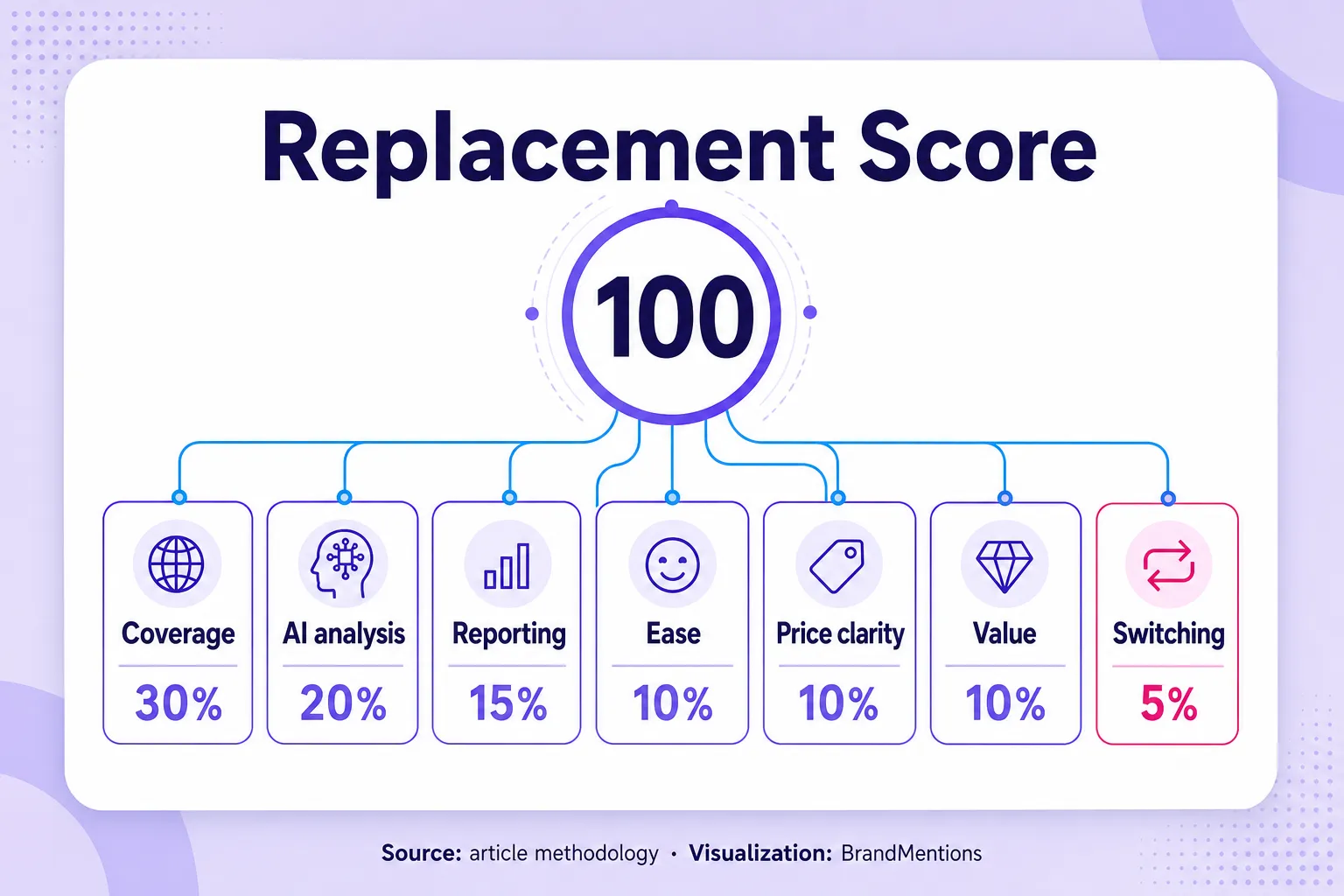
What is a Talkwalker replacement score? It is a weighted rating out of 100 that measures how fully a platform can take over the jobs a team currently does in Talkwalker, not how good the platform is in the abstract.
| Criterion | Weight | What a 5 looks like |
|---|---|---|
| Coverage | 30% | Web, news, social, video, podcasts, forums, reviews; 100+ languages; multi-year research depth |
| AI analysis | 20% | LLM sentiment with emotions, topic clustering, anomaly explanation, natural-language querying |
| Reporting | 15% | Scheduled, customizable, white-label, stakeholder-ready editable exports |
| Ease of use | 10% | A marketer configures a project unaided, with a documented evaluation route |
| Pricing transparency | 10% | Plans, limits and feature gates published; self-serve purchase possible |
| Value fit | 10% | Relevant capability per dollar at the plan a growing team would actually buy |
| Switching support | 5% | Documented migration, query rebuild, historical import |
Total = the sum of (each 1-to-5 rating ÷ 5) × its weight. A 5 means a strong fit under this brief. A 3 means a useful fit with material qualifications. Value fit never claims an undisclosed enterprise quote is expensive; it scores relevance of scope to a growing team.
| Platform | Coverage | AI | Reporting | Ease | Transparency | Value | Switching | Total |
|---|---|---|---|---|---|---|---|---|
| BrandMentions | 4 | 4 | 5 | 5 | 5 | 5 | 5 | 90 |
| Brandwatch | 5 | 5 | 5 | 2 | 1 | 3 | 3 | 80 |
| YouScan | 4 | 5 | 4 | 4 | 3 | 3 | 3 | 79 |
| Meltwater | 5 | 4 | 5 | 3 | 1 | 3 | 3 | 78 |
| Sprinklr | 5 | 5 | 5 | 2 | 1 | 2 | 2 | 77 |
| Synthesio | 4 | 5 | 5 | 2 | 1 | 3 | 3 | 74 |
| Brand24 | 3 | 4 | 3 | 5 | 5 | 3 | 3 | 72 |
| Determ | 3 | 3 | 4 | 4 | 5 | 3 | 3 | 69 |
| Mentionlytics | 3 | 3 | 3 | 4 | 4 | 4 | 3 | 66 |
| Sprout Social | 3 | 4 | 4 | 4 | 2 | 2 | 2 | 64 |
Scores were last re-checked October 5, 2026; tools are re-scored when a vendor changes plan limits or feature gates.
Two honest limits on these numbers. First, they are document-based editorial judgments, not measured precision and recall by source and language. Second, we publish this list and we rank first on it, so the weighting deserves scrutiny. Which is why the next table exists.
How does the ranking change if you re-weight it?
| Weighting profile | What changes | Winner | Runner-up |
|---|---|---|---|
| Enterprise research first (coverage 40%, AI 25%, reporting 15%, ease 10%, value 5%, switching 5%, transparency 0%) | Transparency stops mattering; archive depth dominates | Brandwatch (90) | Sprinklr (88); Meltwater and BrandMentions tie at 87 |
| Visual recognition mandatory (pass/fail gate applied before weighting) | BrandMentions, Brand24 and Determ fail the gate outright; Mentionlytics' image recognition is newly launched and needs testing | YouScan | Talkwalker retained |
| Budget first, hard ceiling of $200/month | BrandMentions Pro and Expert fall out of scope; BrandMentions Starter ($99/month, billed quarterly) stays in | Mentionlytics Essential ($169/month) | BrandMentions Starter ($99/month) |
| Agency client reporting first (reporting 30%, value 20%, transparency 15%, AI 15%, coverage 10%, ease 5%, switching 5%) | White-label rights and editable exports dominate | BrandMentions (95) | Brandwatch and YouScan tie at 75 |
Reject any finalist that fails a mandatory workflow, even if its weighted score looks attractive.
A weighted average is a tie-breaker between acceptable options, not a licence to drop a capability you must keep.
What Is Talkwalker Called Now, and What Does It Actually Cost in 2026?
Talkwalker's enterprise product is now sold as Lumen by Talkwalker, and every current plan requires a custom quote. Hootsuite announced the agreement to acquire Talkwalker on April 8, 2024, per the Hootsuite newsroom announcement. Talkwalker itself was founded in Luxembourg in 2009.
The current packages are Core, Analyze and Business. Core already includes social listening and media monitoring, custom dashboards, an AI Agent for natural-language questions, AI summaries and forecasting, and LLM Insights for tracking how AI assistants describe your brand. Talkwalker lists no per-seat cap across these plans, alongside coverage claims of 150 million sources, 30+ social platforms and 187 languages. Blue Silk AI handles image, video and audio detection, which remains the capability most mid-market tools do not replace.
Here is the part almost no comparison page reports. The step up between Lumen tiers is described primarily in non-sampled result volume, not in named features: Analyze advertises 2x Core's non-sampled volume plus additional topics, filters and channels, and Business advertises 6x plus more topics, more historical data, more AI Agent questions and more LLM Insights channels.
The Non-Sampled Question: before you compare two listening tools on price, ask each vendor in writing whether any part of your result set is sampled at your expected volume.
That question matters for every vendor on this list, not only Talkwalker.
A cheaper plan that samples is not a cheaper plan. It is a smaller one.
And to be precise about what the published page does and does not say: the multipliers are an advertised entitlement, not documented evidence that exceeding an allowance triggers sampling. Get the behaviour described in the contract.
On cost, be careful with the number that circulates most. Capterra still lists a Basic plan at $9,600 per year, which is a pre-Lumen figure for a package that no longer appears on Talkwalker's pricing page. Treat it as history, not as a 2026 floor. Capterra also shows Talkwalker at 4.4 out of 5 from 24 reviews.
Why do teams leave Talkwalker anyway?
Four reasons come up repeatedly, and only one of them is price.
- Cost opacity more than cost. No published price means no way to benchmark a renewal without calling peers.
- Depth you do not use. Dense, powerful platforms reward a dedicated analyst. Teams without one use a fraction of what they signed for.
- Sentiment corrections eating analyst hours. This is the hardest problem in the category and no vendor has solved it. At enterprise rates, the expectation is higher.
- No self-serve trial. You cannot test your own queries before you sign.
If you are leaving Talkwalker, write down the three reports your leadership actually opens each month. Any alternative that cannot rebuild those three inside a trial is not an alternative, whatever it costs.
How to Evaluate Talkwalker Competitors and Alternatives
Three questions decide most shortlists: what you lose by moving down market, how to compare coverage and AI claims that are not expressed in comparable units, and whether a mid-market platform can carry an enterprise workload at all.
What do you actually lose when you move to a cheaper tool?
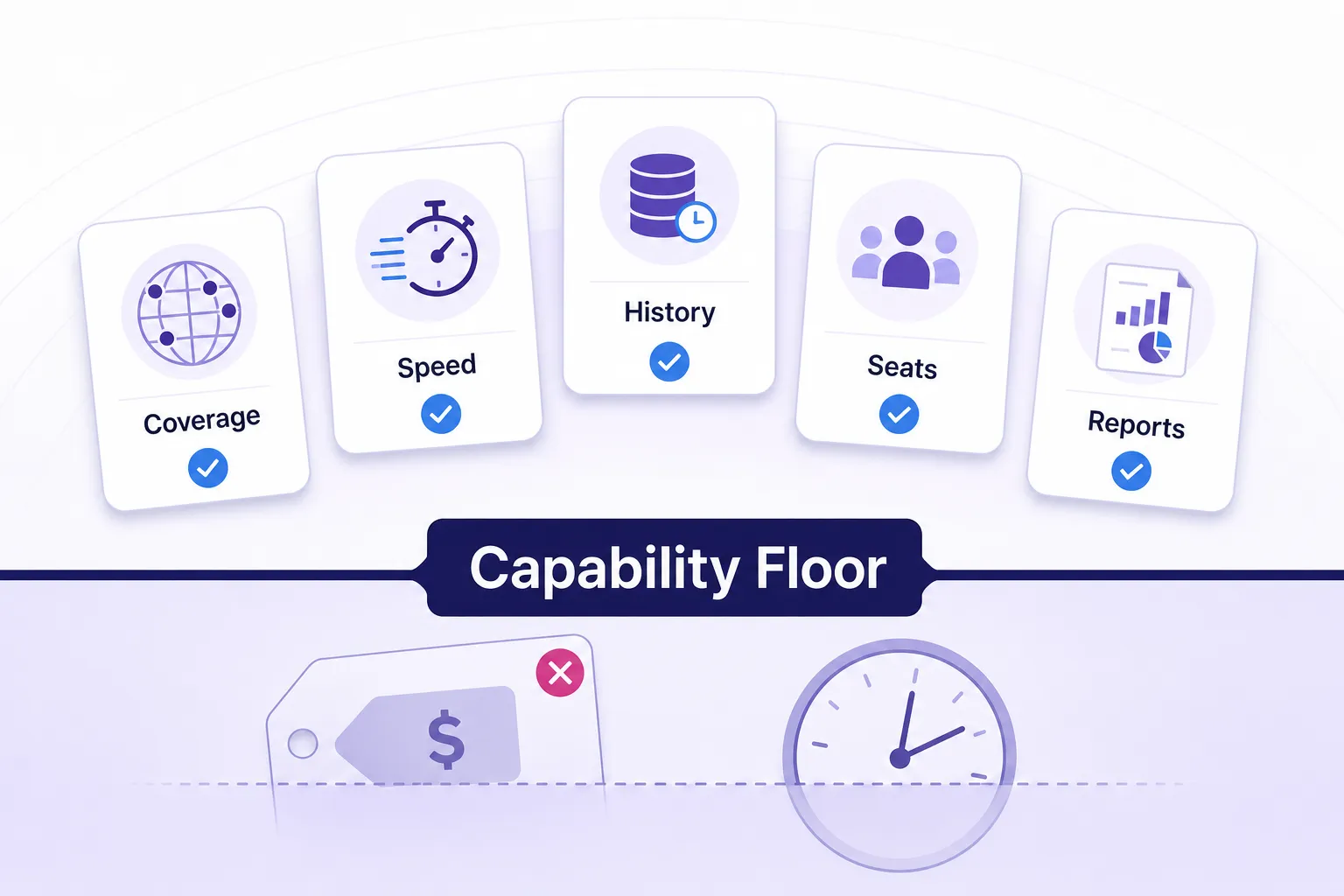
The real losses hide in plan entitlements, not in feature lists. Collection speed, visual recognition, historical access, seat counts, export fields and white-label rights are all gated by tier, and the gates rarely sit where you expect.
Three concrete examples from the vendors above. BrandMentions Pro collects hourly while Expert collects in real time. YouScan's published Starter 3 package uses text-based topics, and image-based collection sits on the quote-only Unlimited plan. Sprout Social requires a Standard seat before Listening can be added at all.
The Capability Floor: compare the first plan that preserves your workflow, not the cheapest plan on the page.
That single reframe eliminates most shortlist mistakes. If your crisis process depends on knowing within minutes, a $49 plan collecting every 12 hours is not in the running, no matter how prominently it advertises alerts.
An alert cannot warn you about a mention the platform has not collected yet. Settle collection frequency before you compare notification features.
Which Talkwalker alternatives have visual recognition, a self-serve trial or Boolean search?
| Platform | Visual recognition | Published price | Self-serve trial | Boolean on entry plan | API | Collection on entry plan | Seat cap |
|---|---|---|---|---|---|---|---|
| Talkwalker | Yes (Blue Silk AI) | No | No (demo) | Not published | Plan-dependent | Real time | No listed cap |
| BrandMentions | No | Yes | Yes, 7 days | No (from Expert) | Enterprise | Daily (Starter) | 1 Starter, 2 Pro, 10 Expert |
| Brandwatch | Yes (image analysis) | No | No (demo) | Not published | Yes, 30 requests per 10 min default | Not published | Not published |
| YouScan | Yes, on Unlimited (quote) | Yes (Starter 3) | No (demo) | Not published | Unlimited | Not published | No listed cap |
| Meltwater | Not published | No | No (demo) | Not published | Not published | Not published | Not published |
| Sprinklr | Yes (visual insights module) | No | No (demo) | Not published | Not published | Not published | Not published |
| Synthesio by Ipsos | Yes (visual content) | No | No (demo) | Not published | Separate line, from £15,000/yr (UK framework) | Not published | Not published |
| Brand24 | No | Yes | Yes, 14 days | Not published | $149/month add-on | Every 12 hours | 1 on Individual; no listed cap from Team |
| Determ | No | Yes | Yes, 5 days | Yes | Not published | Real time | No listed cap |
| Mentionlytics | Newly launched | Yes | Yes, 14 days | Not published | Not published | Every 12 hours | 2 on Basic |
| Sprout Social | Not published | Seats yes; Listening no | Platform only, 30 days | Not published | Not published | Not published | Per-seat pricing |
"Not published" means the vendor's public pages do not state it; ask for it in writing.
How should you compare coverage, "real time" and AI sentiment?
Compare correction workflows and normalized workloads, not competing accuracy claims. We did not run a shared sentiment or coverage benchmark for this comparison, so nothing here establishes which engine classifies your audience most accurately. Any page claiming otherwise without a published corpus is guessing.
The units these vendors publish are not comparable. One counts sources, another counts topics, another counts keyword rules that can each contain multiple terms, another counts conversations. Brandwatch's own properties illustrate the problem: its Consumer Research product page advertises 1.4+ trillion posts back to 2008, while its Consumer Intelligence suite material cites 1.7 trillion conversations back to 2010. Both are first-party. They are not the same measurement.
So normalize before you compare. Define one workload (your brand, your three competitors, your five markets, your exclusions, your seat count) and ask each vendor which specific plan holds it. Then compare those plans, and only those.
For sentiment, build a test set from your own mentions: mixed opinions, sarcasm, product-specific slang, and every language you actually serve. Have each vendor classify the same examples, then watch how an analyst corrects an error and whether that correction persists into reporting. Our explainer on how sentiment works covers why context beats a positive-negative label, and why no vendor on this list is immune.
The Three-Clock Test: measure publication time, collection time and alert-delivery time as three separate numbers.
Timestamp a handful of mentions during each trial. That separates a slow crawler from a slow notification layer, and it replaces "real time" as a marketing word with a figure you can put in a procurement document.
Can a mid-market platform replace an enterprise listening suite?
It can replace the work. It does not replace the contract, and the difference is worth naming.
An enterprise suite bundles listening with governance, analyst services and operational integrations into care, publishing and paid media. A mid-market platform replaces the listening, alerting, analysis and reporting layer, usually faster to adopt and at a fraction of the cost. The capability gap that existed five years ago, where only enterprise tools had Boolean search, real-time collection, API access or white-label reporting, has largely closed at the $300 to $500 per month tier.
What has not closed: visual logo recognition, very deep archives, per-seat generosity at scale, and formal services. In my experience the teams that switch successfully almost never missed the governance layer, because they never had the headcount to use it. They missed two things, historical reach and seat count, and both are predictable before you sign.
Count the humans who need a login before you count the keywords you need to track.
Seat limits, not mention limits, are what usually force the tier upgrade on mid-market plans.
BrandMentions vs Talkwalker: Head-to-Head
Is BrandMentions a good alternative to Talkwalker? Yes, BrandMentions is a strong Talkwalker alternative for most mid-market teams: it matches Talkwalker's text, video and podcast breadth, publishes its prices at $299 and $499 per month, includes a 7-day self-serve trial and free migration, and scores 90/100 on our rubric. It is not the right swap if you need visual logo recognition or more than ten seats.
BrandMentions vs Talkwalker, the core difference. BrandMentions sells comparable text, audio and video breadth plus stronger client reporting at a published price with limited seats and no image recognition. Talkwalker sells reach plus visual detection plus enterprise governance on a custom quote with no listed seat cap.
| Requirement | BrandMentions | Talkwalker |
|---|---|---|
| Buying route | Published plans, self-serve 7-day trial | Custom demo and quote |
| Practical comparison point | Pro $299/month; Expert $499/month | Core, Analyze or Business proposal |
| Sources | 125M+; web, social, news, forums, reviews, video, podcasts | 150M claimed; 30+ social platforms |
| Languages | 100+ | 187 |
| Collection cadence | Pro hourly; Expert real time | Real-time listening, plan-dependent volume |
| Visual logo recognition | Not available | Blue Silk AI image, video and audio detection |
| Sentiment | LLM-based, 12+ emotions including sarcasm, custom rules | AI sentiment; reviewers report manual correction |
| Spoken mentions in audio | Yes, transcript-based | Audio detection documented for enterprise Lumen |
| AI querying | AI Assistant, AI Digests, AI Reports | AI Agent, AI summaries, forecasting |
| AI-answer visibility | Not a native module | LLM Insights from Core |
| Historical access | 3 to 12 months retention by plan; up to 10 years on Enterprise | Plan-dependent; 2+ years documented for enterprise Lumen |
| Users | Pro 2, Expert 10, Enterprise custom | No per-seat cap listed |
| API | REST API on Enterprise | Available, plan-dependent |
| Reports | Editable PPTX; white-label from Expert; application branding on custom Enterprise | Custom dashboards and reports |
| Pricing | Published: $299 / $499 / from $1,299 per month | Custom quote after demo |
| Migration | Free custom migration, begins after first payment, usually a couple of business days | Standard onboarding |
| Ratings | G2 4.9/5 (242 reviews); Capterra 5.0/5 (64) | Capterra 4.4/5 (24 reviews) |
Where Talkwalker wins: visual detection, 187 languages, no seat cap, and a native module for tracking how AI assistants describe your brand. Where BrandMentions wins: published price, self-serve trial, no overage fees, editable PPTX reporting, emotion-level sentiment with custom rules, spoken mentions, and a migration service that moves your history rather than describing it. If sentiment is the specific reason you are leaving, compare approaches across sentiment analysis tools before the trial, because rule-based and LLM-based systems diverge fastest on sarcasm.
Do not switch to save money and then rebuild Talkwalker feature by feature. Switch to the platform that produces your three most-read reports with less manual correction, and treat the savings as the bonus.
Talkwalker vs Competitors
| Talkwalker vs | Where the competitor wins | Where Talkwalker wins | Choose the competitor when |
|---|---|---|---|
| BrandMentions | Published price, self-serve trial, editable PPTX reporting, free migration | Visual detection, 187 languages, no listed seat cap, LLM Insights | You want comparable breadth at a published mid-market price |
| Brandwatch | Archive depth, trainable custom classifiers | No listed seat cap, its own visual detection | Enterprise research with a dedicated analyst |
| YouScan | Specialist visual listening, published entry plan | Broader text, news and language coverage | Visual listening is the core job |
| Meltwater | Print, broadcast and journalist outreach | Social depth and visual detection | Communications owns the budget |
| Sprinklr | Operational integration across care, social and marketing | Focused listening and research, shorter implementation | A mention must become a ticket, a reply and a campaign action |
| Synthesio by Ipsos | Research method backed by Ipsos | Mixed monitoring and research teams, LLM Insights | You are buying a research capability |
| Brand24 | Simpler, cheaper, every limit published, 14-day trial | News, broadcast, international media, visual detection | A small team needs scoped monitoring |
| Determ | Clear euro pricing, fast evaluation for regional PR | Social platforms, languages, history, visual detection | A European PR brief with modest volume |
| Mentionlytics | Lowest published entry price, start today | Breadth and proven visual detection | The Talkwalker quote has become unaffordable |
| Sprout Social | Publishing, inbox and owned-channel workflow | Listening depth, visual detection, 187 languages, no listed seat cap | Social management is the main job |
What Does a Like-for-Like Year Actually Cost?
Entry prices mislead. Here is one defined workload priced at published monthly rates: one brand, three competitors, five markets, six people needing access, real-time collection, one white-label client report per month, no visual recognition requirement.
| Platform | Plan that holds the workload | Published 12-month cost at monthly billing | Binding constraint |
|---|---|---|---|
| BrandMentions | Expert | $5,988 | None for this workload; 10 seats included |
| Mentionlytics | Business | $8,988 (annual billing) | White-label reports start at Business; review monitoring is extra |
| Brand24 | Business | $8,388 | Add $1,788/year if you need API access |
| YouScan | Unlimited | Quote required | Starter 3 ($5,988, annual billing) holds only 3 topics, one short of this workload; visual also requires the quote |
| Determ | Command | €5,988 (yearly commitment) | 10,000 mentions/month |
| Sprout Social | 6 Standard seats plus Listening | $14,328 plus Listening quote | Listening is not purchasable alone |
| Brandwatch, Meltwater, Sprinklr, Synthesio, Talkwalker | Scoped proposal | Quote required | Public reference points only: Brandwatch $50,000 median across 40 recorded Vendr purchases; Synthesio £25,000 per licence per year on the UK framework |
Three costs this table deliberately excludes, because no vendor publishes them: onboarding and implementation fees, the overlap month when you run old and new in parallel, and the analyst hours spent rebuilding queries. Budget for all three. The overlap month alone is the single most common unplanned line item in a migration.
What Security and Governance Questions Should You Ask Every Vendor?
EU hosting is not a governance answer, and neither is a trust badge. Published documentation across these ten vendors is uneven, so send the same list to every finalist and compare the written replies rather than the website copy.
Ask for: SSO or SAML support and on which plan; role-based permissions and whether read-only client access exists; audit logs and their retention; a data processing agreement plus the current subprocessor list; data residency options; deletion handling and timescale after termination; export rights and permitted reuse of exported mentions after the contract ends; documented API rate limits; and the support SLA with its response targets per severity. If reputation incidents are the core job, pair that list with the evaluation criteria in our guide to reputation management software, because incident workflows live or die on permissions and alert routing, not on dashboard design.
Two answers to insist on in writing: what happens to collection when you reach your mention allowance, and what happens to retained history when storage or retention caps are hit. Both behaviours exist across this market, and both are invisible until the worst possible week.
Which Talkwalker Alternative Fits Your Use Case?
Match the brief on the left to the platform on the right, then apply the decision filters in the next section before you book anything.
| Use case | Best tool | Why it wins that brief |
|---|---|---|
| Growing brands and agencies | BrandMentions | Broad digital coverage, LLM sentiment with custom rules, editable client reporting and published mid-market pricing with a self-serve trial. |
| Enterprise consumer research | Brandwatch | Choose it when a multi-year archive and trainable custom classifiers drive your decisions, and you have an analyst to run them. |
| Visual and logo recognition | YouScan | Shortlist it when your brand appears in photos that never type your name. |
| PR and media consolidation | Meltwater | Right when listening has to sit next to media intelligence and journalist outreach in one contract. |
| Enterprise customer experience operations | Sprinklr | Right when a mention has to become a service ticket, a reply and a campaign action in the same system. |
| Research-led insight and innovation work | Synthesio by Ipsos | Right when you are buying a research capability, not a dashboard subscription. |
| Small teams with a clear keyword brief | Brand24 | Fast setup, fully published limits, 14-day trial with no card. |
| Focused, euro-priced PR monitoring | Determ | EU-hosted, published prices, Boolean search available on the entry plan. |
| Lowest published entry cost | Mentionlytics | The cheapest way onto a listening platform, with real constraints on collection speed at the bottom tier. |
| Publishing plus listening in one workflow | Sprout Social | Right when social management is the primary job and listening is the supporting one. |
How to Choose Your Talkwalker Replacement
Start with the decision the data is supposed to change, then apply these filters in order.
- Count your topics. Export your Talkwalker query list. More than 20 distinct topics rules out every entry tier here on day one.
- Count your logins. More than 10 people needing access means an Enterprise scope or a product with no listed seat cap.
- Decide on images. Count the saved dashboards or alerts that depend on image detection. Zero or one means you can optimize for breadth and price. Daily means YouScan, Talkwalker, Brandwatch or Sprinklr, or a careful test of Mentionlytics' newly launched image recognition.
- Decide on history. If leadership asks how this compares to three years ago, confirm the archive window in the order form and check retention separately from search.
- Match collection speed to risk. Real-time collection or 12-hour collection is a reputation decision, not a preference.
- Run the trial against a real incident. Load last month's actual spike, same date range, same query, and compare counts and sentiment to what Talkwalker showed you.
The Archive Continuity Test: treat historical search, retained data and portable export as three separate capabilities and verify each one independently.
Sprinklr's volume-based retention and Sprout Social's source-specific backfill limits are the clearest proof that an archive claim on a marketing page cannot settle any of the three. Ask which years are searchable, which records are retained, and which fields you can take with you when you leave.
Three short contrasts to speed up the shortlist. BrandMentions vs Brandwatch: published mid-market pricing and reporting speed against archive depth and trainable classifiers. BrandMentions vs Brand24: breadth, Boolean search and migration support against the simplest setup and the clearest small-team limits. YouScan vs Talkwalker: a focused visual specialist with a published entry plan against a broader text-and-visual suite on a quote.
How to Switch From Talkwalker Without Losing Your History
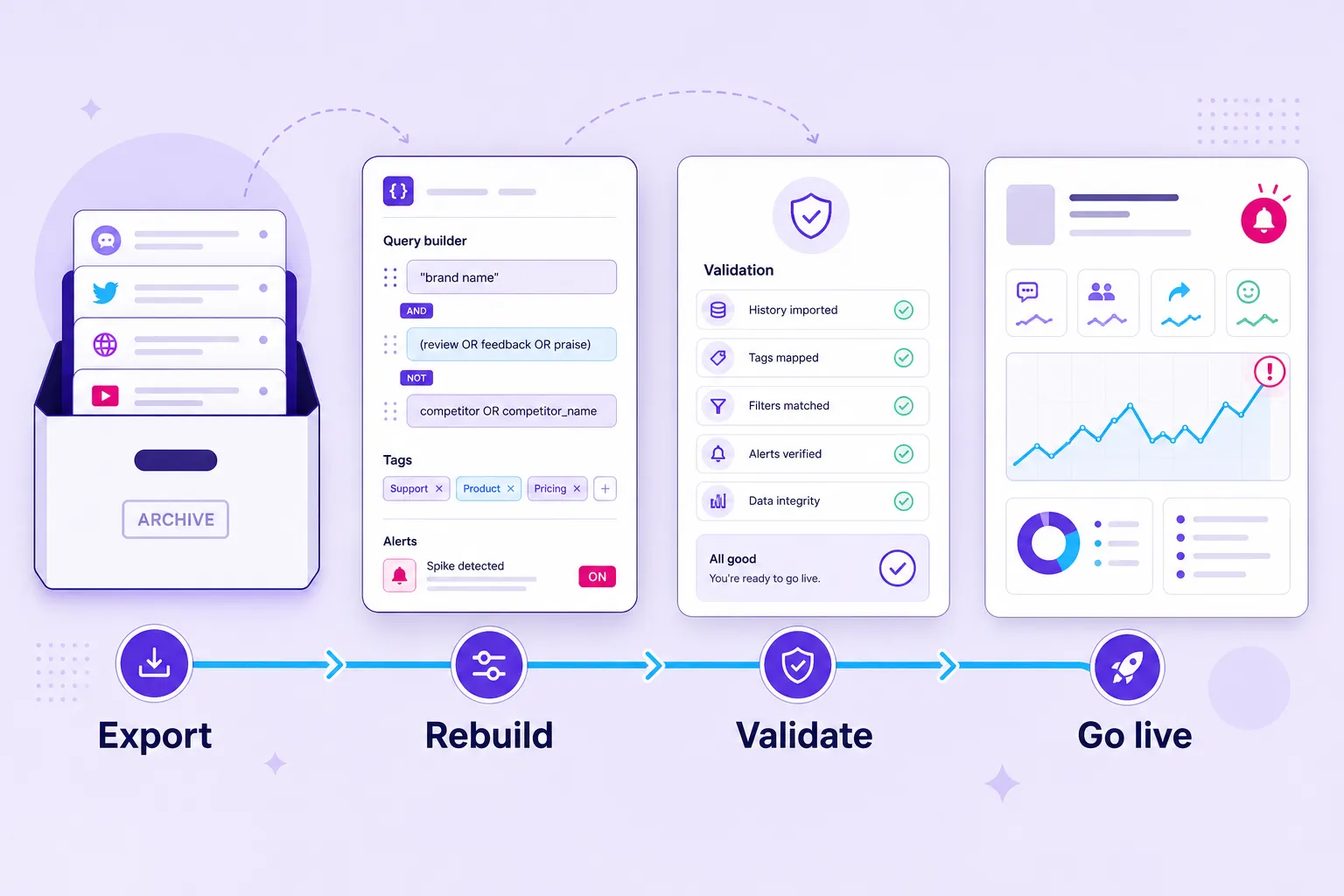
BrandMentions offers free custom migration from any tool on every plan, beginning after the first payment. The team imports your exported historical mentions, which are not billed and do not count against your monthly allowance, then rebuilds keywords, Boolean queries, tags, segments and alerts, usually within a couple of business days.
Work in this order.
- Inventory before you cancel. Queries, exclusions, tag taxonomies, alert recipients, report definitions and dashboard logic. The exclusions are the part teams forget and the part that took longest to build.
- Export while access is live. Check which fields your current agreement lets you export and reuse, because an import preserves only what you supply and cannot recreate content that was never exported.
- Rebuild queries, do not copy them. Every platform indexes, deduplicates and language-detects differently, so a query that was precise in Talkwalker will return noise elsewhere. Validate the rebuilt Boolean query building logic against examples whose correct answer you already know.
- Recreate your sentiment overrides deliberately. Every manual correction you made in Talkwalker encodes knowledge about your brand's language. Port those as custom sentiment rules rather than starting from a default model.
- Reconcile, do not expect identical totals. Inspect source mix, duplicates, sentiment labels and timestamps. Differences usually come from source scope or deduplication, and knowing which one is what earns the new numbers their credibility.
- Run parallel for one billing cycle, then cancel with notice. Check the notice period before the renewal date, not after it. This is an editorial recommendation rather than a vendor promise, and it is the cheapest insurance in the whole project.
The teams that regret a switch are almost never the ones that picked the wrong product. They are the ones that cancelled before they had rebuilt their alerts and approved a single replacement report.
Frequently Asked Questions
What is the best alternative to Talkwalker in 2026?
For most growing brands and agencies, BrandMentions. It covers web, social, news, forums, reviews, video and podcasts in 100+ languages at $299/month (Pro) or $499/month (Expert), offers a 7-day self-serve trial, charges no overage fees, and migrates your queries, tags, alerts and historical mentions for free once you are a paying customer. Enterprise research teams should evaluate Brandwatch instead, and anyone who depends on visual logo recognition should evaluate YouScan or keep Talkwalker on the shortlist.
Who are Talkwalker's main competitors?
Talkwalker's main competitors in 2026 are BrandMentions (90/100), Brandwatch (80), YouScan (79), Meltwater (78), Sprinklr (77), Synthesio by Ipsos (74), Brand24 (72), Determ (69), Mentionlytics (66) and Sprout Social (64), scored on this page for how fully each replaces the Talkwalker workflow. They split into three groups: quote-only enterprise suites (Brandwatch, Meltwater, Sprinklr, Synthesio), published-price mid-market platforms (BrandMentions, YouScan, Brand24, Determ) and budget or adjacent tools (Mentionlytics, Sprout Social, where listening is a separate add-on).
Is Talkwalker now part of Hootsuite, and is it still called Talkwalker?
Yes to both, with a naming change. Hootsuite announced the agreement to acquire Talkwalker on April 8, 2024, and the enterprise product is now sold as Lumen by Talkwalker in three plans: Core, Analyze and Business. All three require a custom quote, all list no per-seat cap, and Core already includes an AI Agent, AI summaries, forecasting and LLM Insights.
How much does Talkwalker cost in 2026?
Talkwalker publishes no price for Core, Analyze or Business; every figure comes from a demo-led custom quote. The $9,600 per year "Basic" price still listed on Capterra predates the Lumen repackaging and should not be used as a current rate or a floor. For reference, published alternatives in this comparison run from $49/month promotional (Mentionlytics Basic, annual billing) to $1,499/month (Brand24 Enterprise, annual billing), with BrandMentions Pro at $299/month and Expert at $499/month.
Is there a free Talkwalker alternative, or a trial you can start without talking to sales?
No platform in this comparison publishes a permanently free listening plan, so the free route is a trial rather than a free tier. The trials you can start without a sales call are BrandMentions (7 days, self-serve), Brand24 (14 days, no card), Mentionlytics (14 days) and Determ (5 days, no card). Sprout Social offers 30 days, but for its management platform only, not the Listening add-on. Brandwatch, Meltwater, Sprinklr, Synthesio, YouScan's visual configuration and Lumen by Talkwalker all require a demo. If "free" really means "lowest possible spend," the cheapest published plan here is Mentionlytics Basic at $49/month promotional on annual billing.
What is the cheapest Talkwalker alternative?
The cheapest published entry price is Mentionlytics Basic at $49/month promotional on annual billing, with 3 keyword rules, 5,000 mentions, 10 social profiles, 2 users and collection every 12 hours. Next cheapest are BrandMentions Starter at $99/month billed quarterly and Determ Focus at €99/month with 1 topic and 1,000 mentions. One caveat decides most budget shortlists: continuous collection on Mentionlytics begins at Advanced ($299/month), so if you need monitoring rather than periodic reporting, treat $299 as the real floor on that platform.
Which Talkwalker alternatives offer visual or logo recognition?
If image detection is a daily workflow, the proven options are YouScan, Talkwalker, Brandwatch or Sprinklr. YouScan is the specialist: Visual Insights detects logos, products and scenes in social images, but it sits on the quote-only Unlimited configuration, not the published $499/month Starter 3 plan, which is text-based. Brandwatch includes image analysis in Consumer Research, and Sprinklr includes a visual insights module inside Sprinklr Insights; both are custom-quoted. Talkwalker's own Blue Silk AI handles image, video and audio detection. Mentionlytics now lists AI Image Recognition and AI Video & Audio Analysis as new features on its pricing page; test them on uncaptioned images before relying on them. BrandMentions, Brand24 and Determ have no visual logo recognition.
Talkwalker vs Brandwatch: which is better?
They win on different jobs, and both are quote-only, so price transparency does not separate them. Brandwatch is the better choice for enterprise consumer research: it advertises 1.4+ trillion posts back to 2008 on its Consumer Research page, with Iris AI, trainable custom classifiers, image analysis and first-party data upload, and it scores 80/100 on our replacement rubric. Talkwalker (now Lumen) is the better choice for breadth and operational monitoring: 150 million sources, 30+ social platforms, 187 languages, no listed per-seat cap, Blue Silk AI image, video and audio detection, and LLM Insights for tracking how AI assistants describe your brand. Brandwatch needs an analyst to pay off; Talkwalker's AI Agent and summaries are included from Core. For a public cost reference point, Vendr data shows a $50,000 median annual Brandwatch contract across 40 recorded purchases.
Does Talkwalker have an API and Boolean search?
Talkwalker offers API access, and availability is plan-dependent across Core, Analyze and Business, so get it named in your proposal rather than assumed. Long Boolean queries are also a normal part of a Talkwalker setup, which is why query portability is the first thing to audit in a migration. Among the alternatives: Determ includes Boolean search and source-level filtering on its €99/month Focus plan; BrandMentions includes Boolean search from Expert ($499/month) and its REST API on Enterprise; Brand24 lists API access as a $149/month add-on; Brandwatch's developer documentation sets a default Consumer Research API limit of 30 requests per ten minutes per client; Synthesio lists API access from £15,000 per year on the UK public-sector framework; and Sprout Social's help center documents a 2,037-character limit on listening queries, which can be the deciding constraint if your Talkwalker queries are long.
How does the ranking change if you re-weight it?
Weighted for enterprise research, Brandwatch wins (90) ahead of Sprinklr (88). With visual recognition as a mandatory gate, YouScan wins. Under a hard ceiling of $200/month, Mentionlytics Essential wins ahead of BrandMentions Starter. Weighted for agency client reporting, BrandMentions wins (95). Reject any finalist that fails a mandatory workflow, even if its weighted score looks attractive.
Conclusion: Replace the Workflow, Not the Logo
The listening market split in two during 2026, and Sprinklr ending Self-Serve service on April 30, 2026 made the direction explicit. On one side, enterprise suites consolidated around custom quotes, governance and services. On the other, published-price platforms got good enough at coverage, LLM sentiment and client reporting that the question for a mid-market team stopped being "can we afford to leave" and became "what exactly would we miss."
For most growing brands and agencies, the honest answer is two things: visual logo recognition and a generous seat count. If you use image detection every week, go to YouScan or keep Talkwalker. If more than ten people need a login, scope an Enterprise plan or pick a product with no listed seat cap. Everyone else gets more from BrandMentions Expert at $499/month, with real-time collection, white-label reports and a migration handled for you, than from a renewal quote they have no way to benchmark.
Your next step is small and it is not a demo. Export your Talkwalker query list this week, count the topics and the logins, then start a 7-day trial and run it against last month's real incident. Bring a workflow to prove, not a dashboard to browse. The numbers will tell you what the sales calls will not.
Filed under: Social Listening